
In-Orbit Data Centers Market Size, Share & Forecast to 2035
Market at a glance
The In-Orbit Data Centers market was worth USD 208.8 million in 2025 and is forecast to reach USD 12.93 billion by 2035, growing at a 51.07% CAGR. North America accounts for 52.4% of the market.
 By Amit Jain, Senior Consultant, ICT & Emerging Technologies
 Reviewed by Deepti Agrawal
Last updated 10 Oct 2026
Base year 2025 PDF + Excel
Reviewed by Deepti Agrawal
Last updated 10 Oct 2026
Base year 2025 PDF + Excel
Source: DC Market Insights analysis
Key findings
Dedicated Compute Spacecraft Grow from USD 68.40 Million to USD 9.10 Billion
Compute Nodes Ride on Optical Relay Networks
Orbital Compute Costs About USD 95 Million per MW in 2027
AI and Machine Learning Workloads Reach USD 5.69 Billion by 2035
What is inside the report
- 01Introduction
- 02Research Methodology
- 03Executive Summary
- 04Market Dynamics
- 05Pricing
- 06Standards and Regulation
- 07Supply Chain
- 08Market Size and Forecast
- 09Market by Offering
- 10Market by Orbit Type
- 21chapters
- 2020-2024Historical period
- 2026-2035Forecast period
- 15Companies profiled
Regional insights
- North America52.4%
- Asia Pacific29.6%
- Europe12.8%
- Middle East and Africa3.4%
- Latin America1.8%
Segmentation
Companies profiled
- SpaceX
- Starcloud
- Axiom Space
- Kepler Communications
- Nvidia
- ADA Space
- Zhejiang Lab
- Lonestar Data Holdings
- Aetherflux
- Sophia Space
- Planet
- Thales Alenia Space
- Crusoe
- Apex Space
Recent developments
Kepler Communications launched the first tranche of 10 optical relay satellites carrying multi-GPU on-orbit compute modules with terabytes of storage (Source: Kepler press release).
SpaceX filed with the FCC for up to one million orbital data center satellites between 500 km and 2,000 km altitude (Source: Data Center Dynamics news report).
Nvidia launched its space computing platform, including the Space-1 Vera Rubin Module with up to 25 times the AI compute of the H100 for space-based inferencing (Source: Nvidia press release).
Starcloud raised USD 170 million in a Series A round at a USD 1.1 billion valuation and prepared to launch Starcloud-2 to run commercial edge and cloud workloads (Source: Via Satellite news report).
SpaceX filed its Form S-1, stating that it expects to begin deploying orbital AI compute satellites as early as 2028 (Source: SpaceX filing with the US Securities and Exchange Commission).
Sophia Space said it is finalizing a USD 7 million SAFE financing round and selected an Apex Space Nova bus for its 2027 orbital compute demonstration (Source: Via Satellite news report).
Full analysis
The In-Orbit Data Centers Market covers computing and storage hardware placed in Earth orbit or on the lunar surface to process and keep data in space, together with the in-orbit compute and storage services sold on that hardware. DC Market Insights values the global In-Orbit Data Centers Market at USD 208.83 million in 2025 and forecasts USD 12.93 billion by 2035, a CAGR of 51.07%. The 2025 value is built from units × price: about 244 edge compute payloads on newly launched satellites at roughly USD 0.42 million per payload give USD 102.43 million, about 18 dedicated orbital data center spacecraft at roughly USD 3.80 million per unit add USD 68.40 million, and in-orbit compute and storage services add USD 38.00 million. Dedicated orbital data center spacecraft are the fastest-growing segment at 63.08% a year because AI compute satellites move from single-GPU demonstrators to megawatt-scale deployments after 2027, and the Middle East and Africa is the fastest-growing region at 55.02% a year from a small base.
Executive Summary
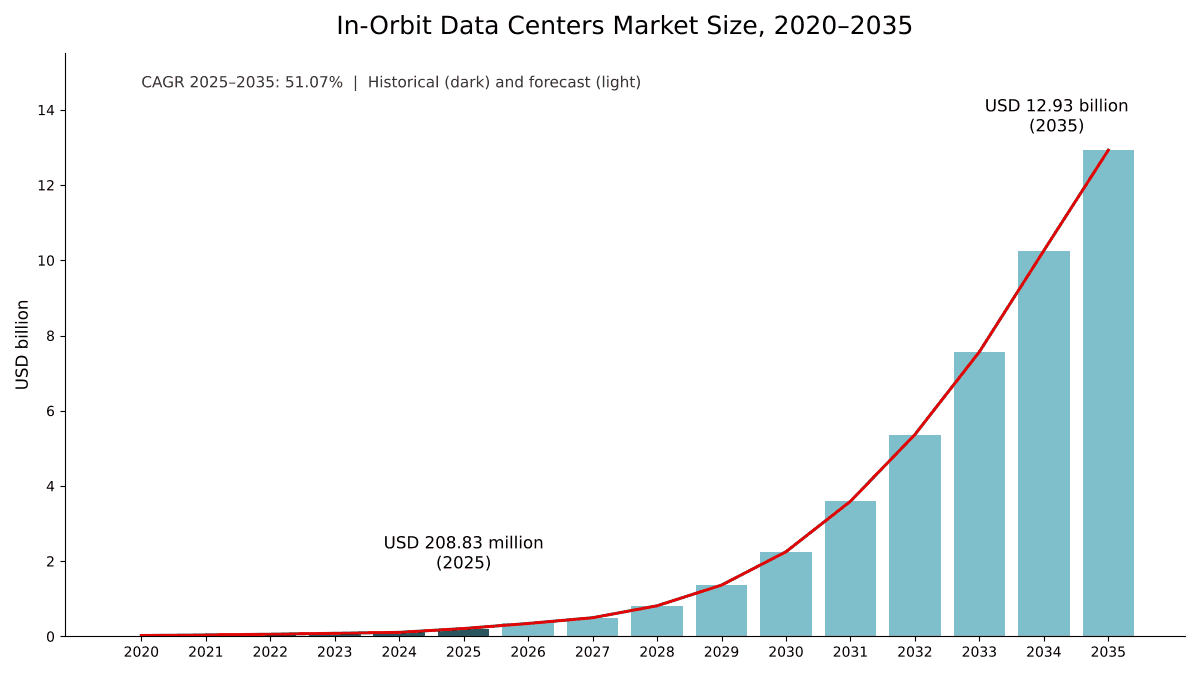
The Global In-Orbit Data Centers Market size was valued at USD 23.12 million in 2020, reached USD 208.83 million in 2025, and is anticipated to reach USD 12.93 billion by 2035, at a CAGR of 51.07% during the forecast period.
| Report attribute | Details |
|---|---|
| Historical Period | 2020-2024 |
| Base Year | 2025 |
| Forecast Period | 2026-2035 |
| In-Orbit Data Centers Market Size 2025 | USD 208.83 Million |
| In-Orbit Data Centers Market, CAGR | 51.07% |
| In-Orbit Data Centers Market Size 2035 | USD 12.93 Billion |
The market grew at 55.30% a year between 2020 and 2025, and 2025 alone added 94.8% over 2024 as satellites built to run data center workloads reached orbit: a 12-satellite computing constellation from China in May and the Starcloud-1 satellite with an Nvidia H100 graphics processing unit (GPU) in November.
The In-Orbit Data Centers Market passes USD 1 billion in 2029 in the DC Market Insights forecast, when the first commercial AI compute constellations begin to deploy, and reaches USD 2.25 billion in 2030.
Market Scope: What Are In-Orbit Data Centers and What Does the Market Cover?
In-orbit data centers are satellites, hosted payloads and lunar or station-based nodes that carry processors, memory and storage to run computing workloads in space instead of sending raw data to the ground first. DC Market Insights sizes the In-Orbit Data Centers Market at USD 208.83 million in 2025, valued at first sale in current US dollars, with 2025 as the base year and forecasts to 2035.
Included. Edge compute payloads (on-board AI and high-performance computers sold for integration into new satellites), dedicated orbital data center spacecraft and payloads (compute satellites, compute nodes hosted on relay constellations, lunar data storage payloads), the share of spacecraft bus, power, thermal and optical link hardware that serves the compute function, and in-orbit compute and storage services sold by capacity, by workload or by contract.
Excluded. Standard satellite flight computers that only run the spacecraft, broadband constellation routing hardware, ground stations and terrestrial data centers that process downlinked data, launch services bought for non-compute satellites, and research grants that buy no hardware or service.
How the segments fit together. The offering split (edge compute payloads, dedicated spacecraft, services) is the backbone of the model. The other splits re-cut the same USD 208.83 million; the component split keeps services as its own row.
Market Drivers: What Drives the In-Orbit Data Centers Market?
Three drivers explain most of the growth in the In-Orbit Data Centers Market: AI chips that now survive and run in orbit, the race to put AI compute next to unlimited solar power, and a growing satellite fleet that processes more of its data on board. Together they lift the market from USD 208.83 million in 2025 to USD 12.93 billion by 2035.
Dedicated Compute Spacecraft Grow from USD 68.40 Million to USD 9.10 Billion
Data center class AI chips have flown and worked in orbit. Starcloud-1, a 60 kg satellite carrying what Data Center Dynamics described as the first Nvidia H100 GPU in space, reached orbit on a SpaceX rocket in November 2025. In May 2025, China launched 12 computing satellites on a Long March 2D rocket from the Jiuquan Satellite Launch Center, as the first of a proposed 2,800-satellite fleet led by ADA Space and Zhejiang Lab. Dedicated orbital data center spending rises from USD 68.40 million in 2025 to USD 9.10 billion in 2035, when about 520 MW of orbital compute is deployed in a single year (DC Market Insights estimate). The chips behind this shift are covered in the AI Chip Market report.
Solar Power in Orbit Pulls Hyperscale AI Plans into Space
Google’s Project Suncatcher research found that a solar panel in orbit can be up to 8 times more productive than on Earth, and Google and Planet are slated to launch two prototype satellites by early 2027 (Source: Google Research blog). SpaceX filed with the US Federal Communications Commission (FCC) for up to one million orbital data center satellites at 500 km to 2,000 km altitude and estimated that 100 kW of compute per tonne launched could add 100 GW of AI compute capacity a year. Starcloud has pitched a 5 GW data center satellite powered by a four square kilometer solar array, while the DC Market Insights base case assumes 520 MW deployed in 2035.
Satellites Launched Reach 4,434 a Year and Push Processing On Board
The Satellite Industry Association counted 296 launches that deployed 4,434 satellites into Earth orbit in 2025, with 14,266 operational satellites at the end of the year (Source: Satellite Industry Association report release). DC Market Insights expects operators of imaging, radar and signals satellites to filter, compress and analyze a growing share of their data on board rather than wait for ground passes. About 5.5% of satellites launched in 2025 carried an edge compute payload, rising to 18.0% by 2035, which takes edge compute payload spending from USD 102.43 million to USD 1.17 billion (DC Market Insights estimate).
Market Trends: How Are Space-Based Data Centers Changing?
The In-Orbit Data Centers Market is moving from single demonstrators to networked compute nodes, from space-qualified niche chips to data center GPUs, and from science payloads to commercial cloud workloads. AI and machine learning workloads grow from USD 25.06 million in 2025 to USD 5.69 billion by 2035.
Compute Nodes Ride on Optical Relay Networks
Orbital computing is becoming a network service. Kepler Communications launched the first tranche of its optical relay network, 10 satellites of about 300 kg each, on a Falcon 9 from Vandenberg Space Force Base in January 2026, carrying multi-GPU on-orbit compute modules with terabytes of storage. Axiom Space announced its first two Orbital Data Center nodes as part of the Kepler constellation, with 2.5 Gbps optical links and a stated path from kilowatts to megawatts of processing power on orbit. In-orbit compute and storage services grow at 52.94% a year to USD 2.66 billion by 2035 (DC Market Insights estimate).
Space-Grade AI Platforms Arrive from Data Center Chipmakers
In March 2026 Nvidia launched its space computing platform: the Space-1 Vera Rubin Module, whose Rubin GPU delivers up to 25 times more AI compute for space-based inferencing than the H100, alongside IGX Thor and Jetson Orin for on-orbit edge computing. DC Market Insights forecasts compute processors to rise from 24.5% of market value in 2025 to 31.0% in 2035, the largest share gain of any component.
Commercial Cloud Workloads Join Government Missions
Crusoe plans to deploy on a Starcloud satellite scheduled for late 2026 and to offer limited GPU capacity from space by early 2027, and Aetherflux says its first orbital data center, called Galactic Brain, will be commercially operational by the first quarter of 2027. DC Market Insights expects cloud and AI compute providers to grow from 14.0% of demand in 2025 to 47.0% in 2035, overtaking government and defense agencies as the largest end-user by 2032.
Market Challenges: What Holds the In-Orbit Data Centers Market Back?
Cost per MW, an unproven business case and landing risk are the three constraints that keep the In-Orbit Data Centers Market below USD 1 billion through 2028 in the DC Market Insights forecast.
Orbital Compute Costs About USD 95 Million per MW in 2027
The all-in cost of a dedicated orbital data center, including compute, power, thermal, bus and launch, is about USD 95 million per MW in 2027, falling to USD 17.5 million per MW by 2035 (DC Market Insights estimate). Launch cost is the swing input: Google’s Suncatcher analysis notes that launch prices may fall to less than USD 200 per kg by the mid-2030s.
Builders Warn the Business Case Is Unproven
SpaceX’s own filing carries a warning. SpaceX told investors in its pre-IPO filing that its initiatives to develop orbital AI compute are in early stages and may not achieve commercial viability.
Lunar and Deep-Space Missions Carry Landing Risk
Lonestar Data Holdings integrated its Freedom lunar data center into Intuitive Machines’ Athena lander and reported that capacity on the mission was sold out. Athena came down sideways on March 6, 2025; Lonestar confirmed that the data center, which holds 8 terabytes of material, was intact.
Market Opportunities: Where Are the New Revenue Pools in Space Computing?
The two largest new revenue pools in the In-Orbit Data Centers Market are AI and machine learning workloads, growing at 72.03% a year, and defense processing of data from many satellites at once, which reaches USD 2.72 billion by 2035 in the DC Market Insights model.
AI and Machine Learning Workloads Reach USD 5.69 Billion by 2035
AI and machine learning workloads, mainly inference on sensor data and, later, batch training on solar-powered clusters, are worth USD 25.06 million in 2025 and USD 5.69 billion by 2035, reaching 44.0% of the market. Starcloud raised USD 170 million in a Series A round at a USD 1.1 billion valuation in March 2026, led by Benchmark with EQT Ventures, and is seeking to deploy up to 88,000 satellites as a distributed data center in space. Terrestrial demand for the same workloads is sized in our AI Data Center Market report.
Defense and Intelligence Processing Reaches USD 2.72 Billion
Axiom Space lists on-orbit, real-time processing, exploitation and dissemination of data from multiple national security and commercial satellites as a use case for its nodes. Defense and intelligence applications are worth USD 50.12 million in 2025 and USD 2.72 billion in 2035, a CAGR of 49.07% (DC Market Insights estimate).
Pricing: How Much Do In-Orbit Data Centers Cost per Payload and per MW?
An edge compute payload costs about USD 0.42 million per satellite in 2025, and a dedicated orbital data center costs about USD 95 million per MW in 2027, the first year the model counts orbital compute in MW. These are DC Market Insights estimates covering compute, storage, power and thermal hardware, spacecraft bus share and launch share, excluding ground stations.
| Price input (DC Market Insights estimate) | 2020 | 2025 | 2030 | 2035 |
|---|---|---|---|---|
| Edge compute payload (USD million per satellite) | 0.38 | 0.42 | 0.48 | 0.55 |
| Share of launched satellites with an edge compute payload | 2.0% | 5.5% | 11.0% | 18.0% |
| Dedicated compute spacecraft (USD million per unit) | 3.00 | 3.80 | n/a | n/a |
| Dedicated orbital data center (USD million per MW) | n/a | n/a | 40.0 | 17.5 |
Standards and Regulation: Which Rules Shape In-Orbit Data Centers?
Three sets of rules decide how orbital data centers are licensed and retired: FCC licensing of constellations, the FCC five-year deorbit rule for low Earth orbit (LEO), and European debris-neutral commitments.
FCC constellation licensing. The SpaceX application for up to one million orbital data center satellites at 500 km to 2,000 km altitude was filed with the FCC in January 2026, which makes US spectrum and licensing review the first gate for the SpaceX constellation.
FCC five-year deorbit rule (September 2022). The FCC voted 4-0 to require LEO satellites to deorbit as soon as practicable and no later than five years after mission completion, replacing the long-standing 25-year guideline, with a two-year transition period.
Zero Debris Charter. Twelve nations signed the European Space Agency’s Zero Debris Charter at the ESA/EU Space Council, aiming to become debris neutral in space by 2030.
Market Segmentation: Which Segment Leads the In-Orbit Data Centers Market?
Edge compute payloads lead the In-Orbit Data Centers Market with 49.0% of 2025 value, Low Earth Orbit leads orbit types with 86.0%, and government and defense agencies lead end-users with 46.0%. Dedicated orbital data center spacecraft are the fastest-growing segment at 63.08% a year, against 52.94% for services and 27.56% for edge payloads, because each AI compute satellite carries far more value than an edge computer on a sensor satellite.
By Offering: Edge Compute Payloads Lead with 49.0%
| Offering | 2025 (USD million) | Share 2025 | 2035 (USD billion) | CAGR 2025-2035 |
|---|---|---|---|---|
| Edge Compute Payloads | 102.43 | 49.0% | 1.17 | 27.56% |
| Dedicated Orbital Data Center Spacecraft | 68.40 | 32.8% | 9.10 | 63.08% |
| In-Orbit Compute and Storage Services | 38.00 | 18.2% | 2.66 | 52.94% |
Dedicated spacecraft overtake edge payloads in 2027 in the base case and reach 70.4% of value by 2035.
By Orbit Type: Low Earth Orbit Leads with 86.0%
| Orbit type | 2025 (USD million) | Share 2025 | 2035 (USD billion) | CAGR 2025-2035 |
|---|---|---|---|---|
| Low Earth Orbit (LEO) | 179.60 | 86.0% | 11.96 | 52.17% |
| Medium Earth Orbit (MEO) | 7.31 | 3.5% | 0.26 | 42.85% |
| Geostationary Orbit (GEO) | 18.79 | 9.0% | 0.45 | 37.46% |
| Lunar and Cislunar | 3.13 | 1.5% | 0.26 | 55.49% |
Low Earth Orbit data centers dominate because launch cost per kg, latency to the ground and optical relay coverage all favor altitudes below 2,000 km. Lunar and cislunar systems grow fastest from the smallest base, mainly as archival storage.
By Application: AI and Machine Learning Workloads Grow Fastest at 72.03%
| Application | 2025 (USD million) | Share 2025 | 2035 (USD billion) | CAGR 2025-2035 |
|---|---|---|---|---|
| Earth Observation and Remote Sensing | 71.00 | 34.0% | 2.33 | 41.76% |
| Defense and Intelligence | 50.12 | 24.0% | 2.72 | 49.07% |
| Satellite Communications | 45.94 | 22.0% | 1.42 | 40.95% |
| AI and Machine Learning Workloads | 25.06 | 12.0% | 5.69 | 72.03% |
| Scientific Research and Data Archiving | 16.71 | 8.0% | 0.78 | 46.78% |
By End-user: Government and Defense Agencies Lead with 46.0%
| End-user | 2025 (USD million) | Share 2025 | 2035 (USD billion) | CAGR 2025-2035 |
|---|---|---|---|---|
| Government and Defense Agencies | 96.06 | 46.0% | 3.88 | 44.75% |
| Commercial Satellite Operators | 62.65 | 30.0% | 2.33 | 43.55% |
| Cloud and AI Compute Providers | 29.24 | 14.0% | 6.08 | 70.52% |
| Research Institutions | 20.88 | 10.0% | 0.65 | 40.95% |
By Component: Compute Processors Lead with 24.5%
| Component | 2025 (USD million) | Share 2025 | 2035 (USD billion) | CAGR 2025-2035 |
|---|---|---|---|---|
| Compute Processors (GPU, CPU, FPGA) | 51.25 | 24.5% | 4.00 | 54.63% |
| Spacecraft Bus and Integration | 44.42 | 21.3% | 1.75 | 44.36% |
| Software and Services | 38.00 | 18.2% | 2.66 | 52.94% |
| Power and Thermal Systems | 35.87 | 17.2% | 2.67 | 53.88% |
| Networking and Optical Links | 22.21 | 10.6% | 1.03 | 46.72% |
| Storage Systems | 17.08 | 8.2% | 0.82 | 47.30% |
Power and thermal systems, the solar arrays and radiators that replace a grid connection and chillers, grow almost as fast as processors because every added kW of compute needs its own array and radiator area.
DC Exclusive: The Orbital Compute Build Model and Offering × Buyer Matrix
At USD 48.76 million in 2025, edge compute payloads bought by commercial satellite operators are the single largest cell of the matrix and 23.3% of all in-orbit data center spending. The matrix below cross-tabulates what is bought and who buys it. It is a DC Market Insights model, not a shipment count: it is built from 16 annual cohorts (2020 to 2035) of satellite launches, attach rates and payload prices, 7 years of dedicated spacecraft unit counts, 9 years of orbital compute MW and spend per MW, and a services ratio on installed hardware. In all, the model is built from 80 inputs: 16 launch cohorts, 16 attach rates, 16 payload prices, 7 unit counts with 7 unit prices, and 2 sets of 9 MW and cost-per-MW values, before the orbit, application, end-user, component and regional splits.
| 2025, USD million | Edge Compute Payloads | Dedicated Spacecraft | Services | Total |
|---|---|---|---|---|
| Government and Defense Agencies | 39.57 | 37.07 | 19.42 | 96.06 |
| Commercial Satellite Operators | 48.76 | 6.24 | 7.65 | 62.65 |
| Cloud and AI Compute Providers | 3.34 | 18.04 | 7.86 | 29.24 |
| Research Institutions | 10.76 | 7.05 | 3.07 | 20.88 |
| Total | 102.43 | 68.40 | 38.00 | 208.83 |
Government and defense agencies buy 54.2% of dedicated spacecraft value in 2025, while commercial satellite operators buy almost half of all edge payloads; a supplier of edge computers is selling into satellite manufacturers, while a builder of compute satellites is selling to governments and, increasingly, to cloud providers. Cloud and AI compute providers already spend 61.7% of their budget on dedicated spacecraft, the segment that grows fastest.
The orbital compute build model has inputs that any reader can check: satellites launched each year (4,434 in 2025, as counted by the Satellite Industry Association), the share carrying an edge compute payload (5.5% in 2025), the number of dedicated compute spacecraft (about 18 in 2025, including the 12 Chinese computing satellites and Starcloud-1) and, from 2027, orbital compute deployed in MW. Multiplying each by its price gives hardware spend; adding services gives the market. The model and its assumptions are explained on our research methodology page.
Regional Insights: Which Region Leads the In-Orbit Data Centers Market?
North America leads the In-Orbit Data Centers Market with 52.4% of 2025 value, and the Middle East and Africa is the fastest-growing region at 55.02% a year, as national satellite programs add on-board processing from a small base.
North America Leads with 52.4% Share
North America is worth USD 109.43 million in 2025 and is forecast to reach USD 6.54 billion in 2035, a CAGR of 50.54%. SpaceX anchors the regional forecast: its filing with the US Securities and Exchange Commission states that it expects to begin deploying orbital AI compute satellites as early as 2028 (Source: SpaceX Form S-1 filed with the US Securities and Exchange Commission).
Asia Pacific Holds 29.6% Share
Asia Pacific is worth USD 61.81 million in 2025 and USD 4.01 billion by 2035, a CAGR of 51.77%. China’s 12-satellite computing launch in May 2025 makes China the second-largest country market in the DC Market Insights allocation, and the plan for a 2,800-satellite fleet with a combined goal of 1,000 peta operations per second anchors the regional forecast. In the DC Market Insights allocation, Japan, India, South Korea and Australia add most of the remaining regional value through edge payloads.
Europe Holds 12.8% Share
Europe is worth USD 26.73 million in 2025 and USD 1.60 billion by 2035, a CAGR of 50.59%. The ASCEND study, funded by the European Commission under Horizon Europe and led by Thales Alenia Space, aims to deploy one gigawatt of orbital data center capacity before 2050. The United Kingdom, France, Germany and Italy lead European spending.
Middle East and Africa Holds 3.4% Share
The Middle East and Africa is worth USD 7.10 million in 2025 and USD 568.86 million by 2035, the fastest regional growth at 55.02% a year. The United Arab Emirates accounts for about 45% of regional spending in 2025 in the DC Market Insights allocation.
Latin America Holds 1.8% Share
Latin America is worth USD 3.76 million in 2025 and USD 206.86 million by 2035, a CAGR of 49.30%, with Brazil the largest country in the DC Market Insights allocation.
Country Analysis: Which Countries Lead In-Orbit Data Center Spending?
The United States is the largest country market for in-orbit data centers at USD 103.96 million in 2025, 49.8% of global value, followed by China at USD 44.50 million (21.3%) and the United Kingdom at USD 6.95 million (3.3%). The 12 largest countries account for 92.9% of 2025 spending.
| Rank | Country | Region | 2025 (USD million) | Share 2025 | 2035 (USD billion) | CAGR 2025-2035 |
|---|---|---|---|---|---|---|
| 1 | United States | North America | 103.96 | 49.8% | 6.16 | 50.41% |
| 2 | China | Asia Pacific | 44.50 | 21.3% | 2.75 | 51.02% |
| 3 | United Kingdom | Europe | 6.95 | 3.3% | 0.39 | 49.70% |
| 4 | Japan | Asia Pacific | 6.80 | 3.3% | 0.46 | 52.58% |
| 5 | France | Europe | 6.42 | 3.1% | 0.37 | 49.94% |
| 6 | Canada | North America | 5.47 | 2.6% | 0.38 | 52.80% |
| 7 | India | Asia Pacific | 4.94 | 2.4% | 0.42 | 55.82% |
| 8 | Germany | Europe | 4.28 | 2.0% | 0.28 | 51.67% |
| 9 | Italy | Europe | 3.21 | 1.5% | 0.18 | 49.81% |
| 10 | United Arab Emirates | Middle East and Africa | 3.20 | 1.5% | 0.27 | 55.99% |
| 11 | South Korea | Asia Pacific | 2.47 | 1.2% | 0.18 | 53.92% |
| 12 | Australia | Asia Pacific | 1.85 | 0.9% | 0.12 | 52.30% |
The United Arab Emirates is the fastest-growing country market at 55.99% a year, ahead of India at 55.82% in the DC Market Insights allocation. The country figures are a DC Market Insights allocation of the regional totals, weighted by each country’s estimated share of compute-equipped satellites launched and of dedicated orbital compute programs.
Forecast Scenarios: How Could the 2035 Forecast Change?
The In-Orbit Data Centers Market reaches USD 12.93 billion by 2035 in the base case, with a range of USD 6.25 billion to USD 23.39 billion across the low and high scenarios.
| Scenario | Assumption from 2026 | 2035 (USD billion) | CAGR 2025-2035 |
|---|---|---|---|
| Low | Orbital compute deployed 60% below base; cost per MW 10% higher; edge payload attach rate 15% lower | 6.25 | 40.49% |
| Base | 520 MW deployed in 2035 at USD 17.5 million per MW; attach rate reaches 18.0% | 12.93 | 51.07% |
| High | Orbital compute deployed 2.05 times base; cost per MW 8% lower; attach rate 15% higher | 23.39 | 60.29% |
Jeff Bezos said in October 2025 that gigawatt data centers in space are 10 or more years away and probably not more than 20, a timeline that sits between the base and high cases.
Competitive Insights: Who Leads the In-Orbit Data Centers Market?
- SpaceX
- Starcloud
- Axiom Space
- Kepler Communications
- Nvidia
- ADA Space
- Zhejiang Lab
- Lonestar Data Holdings
- Aetherflux
- Sophia Space
- Planet
- Thales Alenia Space
- Crusoe
- Apex Space
The ADA Space and Zhejiang Lab computing constellation is the largest single program in the In-Orbit Data Centers Market with about 21.8% of 2025 value (DC Market Insights estimate: 12 of about 18 dedicated compute spacecraft at about USD 3.80 million each, set against the USD 208.83 million market); edge payload spending of USD 102.43 million is spread across many satellite programs. Starcloud carries a USD 1.1 billion valuation after its USD 170 million Series A, and Aetherflux, which raised a USD 50 million Series A in 2025, targets commercial operation of its first orbital data center in the first quarter of 2027. SpaceX is the potential market maker: its AI segment generated USD 3.20 billion of revenue in 2025 with USD 12.73 billion of AI segment capital spending, and it acquired xAI in February 2026. Aetherflux, Axiom Space, Kepler Communications, Planet, Sophia Space and Starcloud use Nvidia accelerated computing platforms, while Google and Planet are building the Suncatcher prototypes.
Recent Developments
- In January 2026, Kepler Communications launched the first tranche of 10 optical relay satellites carrying multi-GPU on-orbit compute modules with terabytes of storage (Source: Kepler press release).
- In January 2026, SpaceX filed with the FCC for up to one million orbital data center satellites between 500 km and 2,000 km altitude (Source: Data Center Dynamics news report).
- In March 2026, Nvidia launched its space computing platform, including the Space-1 Vera Rubin Module with up to 25 times the AI compute of the H100 for space-based inferencing (Source: Nvidia press release).
- In March 2026, Starcloud raised USD 170 million in a Series A round at a USD 1.1 billion valuation and prepared to launch Starcloud-2 to run commercial edge and cloud workloads (Source: Via Satellite news report).
- In May 2026, SpaceX filed its Form S-1, stating that it expects to begin deploying orbital AI compute satellites as early as 2028 (Source: SpaceX filing with the US Securities and Exchange Commission).
- In June 2026, Sophia Space said it is finalizing a USD 7 million SAFE financing round and selected an Apex Space Nova bus for its 2027 orbital compute demonstration (Source: Via Satellite news report).
We follow these launches, filings and funding rounds as they happen in our data center industry updates.
Methodology: How We Built the In-Orbit Data Centers Market Model
DC Market Insights built this market bottom-up from three engines. Edge compute payloads multiply 16 annual satellite launch cohorts (2020 to 2035, anchored on the 4,434 satellites counted for 2025) by an attach rate rising from 2.0% to 18.0% and by a payload price rising from USD 0.38 million to USD 0.55 million. Dedicated orbital data center spacecraft are counted in units and priced per unit from 2020 to 2026 (18 units at USD 3.80 million in 2025), then in MW deployed per year from 2027 (2.2 MW in 2027, 38 MW in 2030 and 520 MW in 2035) priced at a cost per MW falling from USD 95 million to USD 17.5 million. Services start at USD 38.00 million in 2025, grow 15% a year on that base and add 12% of the dedicated hardware value deployed in the previous five years. The total was split by 3 offerings, 4 orbit types, 5 applications, 4 end-users, 6 components and 5 regions, and every split sums to the market total. The result was checked top-down: edge payload spending equals about 0.5% of the USD 20.4 billion of satellite manufacturing revenue reported for 2025, and 2035 dedicated spending of USD 9.10 billion stays below the USD 12.73 billion that SpaceX alone spent on its AI segment in 2025. The analyst named on this page built the model, and the reviewer checked the arithmetic, the sources and the dates before publication.
Table of contents
- 01Introduction
- 1.1Market Definition and Scope
- 1.2Included and Excluded Systems
- 1.3Currency, Base Year and Forecast Period
- 02Research Methodology
- 2.1Bottom-Up Build: Launch Cohorts, Attach Rates and Payload Prices
- 2.2Dedicated Spacecraft Units and Orbital Compute MW
- 2.3Top-Down Checks
- 2.4Sources and Fact Verification
- 03Executive Summary
- 3.1Market Size 2020, 2025 and 2035
- 3.2Key Findings
- 3.3Analyst View
- 04Market Dynamics
- 4.1Drivers
- 4.2Trends
- 4.3Challenges
- 4.4Opportunities
- 05Pricing
- 5.1Edge Compute Payload Value per Satellite
- 5.2Dedicated Spacecraft Price per Unit
- 5.3Orbital Compute Cost per MW, 2027-2035
- 5.4Launch Price Outlook
- 06Standards and Regulation
- 6.1FCC Constellation Licensing
- 6.2FCC Five-Year Deorbit Rule
- 6.3Zero Debris Charter
- 07Supply Chain
- 7.1Compute Processors and Space-Grade AI Modules
- 7.2Spacecraft Buses and Integrators
- 7.3Launch Providers
- 7.4Optical Relay Networks and Ground Segment
- 08Market Size and Forecast
- 8.1Market Size, 2020-2035
- 8.2Year-on-Year Growth
- 8.3Historical CAGR 2020-2025 and Forecast CAGR 2025-2035
- 09Market by Offering
- 9.1Edge Compute Payloads
- 9.2Dedicated Orbital Data Center Spacecraft
- 9.3In-Orbit Compute and Storage Services
- 10Market by Orbit Type
- 10.1Low Earth Orbit (LEO)
- 10.2Medium Earth Orbit (MEO)
- 10.3Geostationary Orbit (GEO)
- 10.4Lunar and Cislunar
- 11Market by Application
- 11.1Earth Observation and Remote Sensing
- 11.2Defense and Intelligence
- 11.3Satellite Communications
- 11.4AI and Machine Learning Workloads
- 11.5Scientific Research and Data Archiving
- 12Market by End-user
- 12.1Government and Defense Agencies
- 12.2Commercial Satellite Operators
- 12.3Cloud and AI Compute Providers
- 12.4Research Institutions
- 13Market by Component
- 13.1Compute Processors (GPU, CPU, FPGA)
- 13.2Power and Thermal Systems
- 13.3Spacecraft Bus and Integration
- 13.4Networking and Optical Links
- 13.5Storage Systems
- 13.6Software and Services
- 14DC Exclusive: Orbital Compute Build Model
- 14.1Offering × Buyer Matrix, 2025
- 14.2Model Inputs
- 15Market by Region
- 15.1North America: United States, Canada
- 15.2Asia Pacific: China, Japan, India, South Korea, Australia
- 15.3Europe: United Kingdom, France, Germany, Italy
- 15.4Middle East and Africa: United Arab Emirates
- 15.5Latin America: Brazil
- 16Country Analysis
- 16.1Top 12 Countries, 2025 and 2035
- 16.2Fastest-Growing Countries
- 17Regional Cross-Sections
- 17.1Regional Shares, 2025 and 2035
- 17.2Regional CAGR Comparison, 2025-2035
- 18Forecast Scenarios
- 18.1Low Scenario
- 18.2Base Scenario
- 18.3High Scenario
- 19Competitive Landscape
- 19.1Market Structure and Concentration
- 19.2Funding and Partnerships
- 19.3Recent Developments
- 20Company Profiles
- 20.1SpaceX
- 20.2Starcloud
- 20.3Axiom Space
- 20.4Kepler Communications
- 20.5Google
- 20.6Nvidia
- 20.7ADA Space
- 20.8Zhejiang Lab
- 20.9Lonestar Data Holdings
- 20.10Aetherflux
- 20.11Sophia Space
- 20.12Planet
- 20.13Thales Alenia Space
- 20.14Crusoe
- 20.15Apex Space
- 21Analyst Recommendations
- 21.1For Satellite Operators
- 21.2For Cloud and AI Compute Providers
- 21.3For Investors
- Fig. 1In-Orbit Data Centers Market Size, 2020-2035
- Fig. 2In-Orbit Data Centers Market by Region, 2025 and 2035
- Fig. 3Market Share by Offering, 2025 and 2035
- Fig. 4Market Share by Orbit Type, 2025 and 2035
- Fig. 5Market Share by Application, 2025 and 2035
- Fig. 6Market Share by End-user, 2025 and 2035
- Fig. 7Market Share by Component, 2025 and 2035
- Fig. 8Forecast Scenarios, 2035
- Table 1Report Attributes
- Table 2Price Inputs, 2020, 2025, 2030 and 2035
- Table 3Market by Offering, 2025 and 2035
- Table 4Market by Orbit Type, 2025 and 2035
- Table 5Market by Application, 2025 and 2035
- Table 6Market by End-user, 2025 and 2035
- Table 7Market by Component, 2025 and 2035
- Table 8Offering × Buyer Matrix, 2025
- Table 9Market by Region, 2025 and 2035
- Table 10Top 12 Countries, 2025 and 2035
- Table 11Forecast Scenarios, 2035
About this report
Written by Amit Jain and reviewed by Deepti Agrawal, Senior Editor, Research. Figures are built top-down and bottom-up and reconciled before publication, with 2025 as the base year.
Read our methodologyHow we built this
- Historical period2020-2024
- Base year2025
- Forecast period2026-2035
- Sizing approachTop-down + bottom-up
Need more than the report?
Advisory on this market
Due diligence, site selection and market entry work, by the analysts who wrote this report.
See consulting servicesFrequently asked questions
USD 208.83 million in 2025, rising to USD 12.93 billion by 2035. DC Market Insights estimates the market at USD 23.12 million in 2020.
51.07% a year from 2025 to 2035, after 55.30% a year between 2020 and 2025. DC Market Insights forecasts the market to pass USD 1 billion in 2029.
Low Earth Orbit (LEO) data centers are compute and storage satellites or nodes below 2,000 km. LEO holds 86.0% of the In-Orbit Data Centers Market in 2025, worth USD 179.60 million, and grows at 52.17% a year (DC Market Insights estimate).
USD 102.43 million in 2025 for edge compute payloads on new satellites, about 244 payloads at roughly USD 0.42 million each. DC Market Insights forecasts USD 1.17 billion by 2035.
Dedicated orbital data center spacecraft, growing at 63.08% a year from USD 68.40 million in 2025 to USD 9.10 billion by 2035. AI and machine learning workloads are the fastest-growing application at 72.03% a year.
About USD 95 million per MW in 2027, falling to USD 17.5 million per MW by 2035, according to DC Market Insights estimates including compute, power, thermal, bus and launch. An edge compute payload costs about USD 0.42 million per satellite in 2025.
North America, with USD 109.43 million or 52.4% of 2025 value. The Middle East and Africa grows fastest at 55.02% a year.
The ADA Space and Zhejiang Lab constellation is the largest single program with about 21.8% of 2025 value (DC Market Insights estimate). SpaceX, Starcloud, Axiom Space, Kepler Communications, Google, Nvidia, Lonestar Data Holdings, Aetherflux and Sophia Space also compete.
Licences, delivery and payment
Which licence should I choose?
Single User is a view-only PDF for one person. Multi User adds a printable PDF and the Excel data for unlimited users at one location. Enterprise covers your whole company and includes 100 free analyst hours.
How and when will I receive the report?
By email, within 24–48 business hours of payment, in the formats of your licence.
How can I pay?
Securely through PayPal: with a PayPal account, a debit or credit card, or PayPal Pay Later where available. Prices are in US dollars.
Can I see a sample first?
Yes. Request a free sample and we will email it to you.
Can the report be tailored to my needs?
Yes. We can add countries, segments or data cuts. Talk to an analyst about the scope you need.
Can I get an invoice or pay against a purchase order?
Write to sales@dcmarketinsights.com and our team will help.