
Data Centers On Site Photovoltaic Solar Power Market Size, Share & Forecast to 2035
Market at a glance
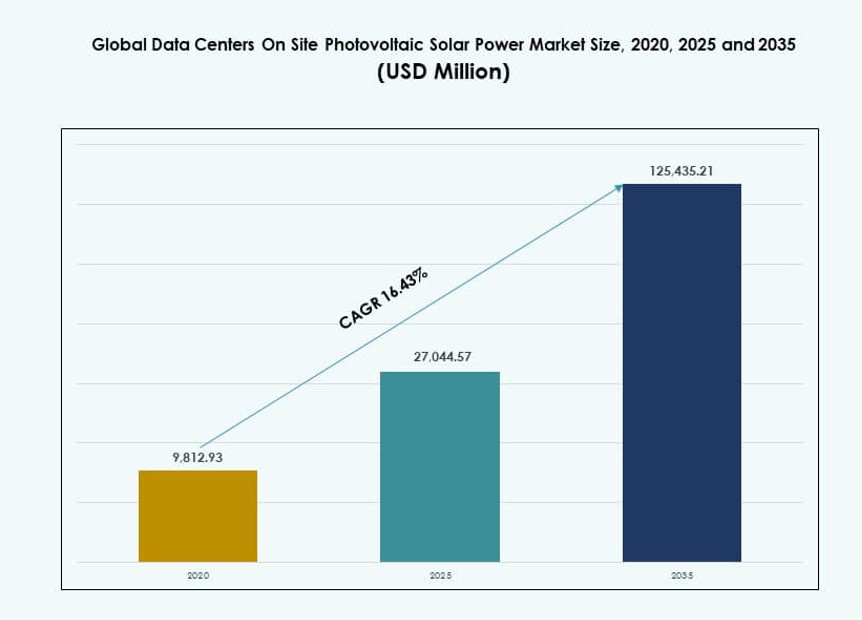
The Data Centers On Site Photovoltaic Solar Power market was worth USD 27.04 billion in 2025 and is forecast to reach USD 125.44 billion by 2035, growing at a 16.43% CAGR.
 By Satyabrat Rajawat, Senior Research Analyst, Strategic Advisory
 Reviewed by Deepti Agrawal
Last updated 11 Feb 2026
Base year 2024 PDF + Excel
Reviewed by Deepti Agrawal
Last updated 11 Feb 2026
Base year 2024 PDF + Excel
Key findings
Expansion of On‑Site Solar in Hyperscale and Colocation Facility Design
High Initial Capital Requirement and Long Payback Expectations
Rising Demand for Renewable‑Powered Digital Infrastructure from Enterprise Clients
Segmentation
Companies profiled
- Trina Solar
- JA Solar Co., Ltd
- SunPower Corporation
- First Solar, Inc
- JinkoSolar
- Canadian Solar
- Yingli Solar
- Hanwha Q CELLS
- SCHOTT North America, Inc
Recent developments
Dubai Electricity and Water Authority (DEWA) approved the second phase of its solar-powered green data center at Warsan, primarily powered by on-site renewable energy from the Mohammed bin Rashid Al Maktoum Solar Park. This expansion boosts capacity, resilience, and efficiency for digital services and smart grid operations.
CtrlS Datacenters completed its 125MW GreenVolt 1 on-site solar farm in Nagpur, Maharashtra, to power its Mumbai data center campus. The project, built in two phases with the first 65.2MW live in June 2024, uses efficient N-type solar panels and covers 60% of the campus's energy needs.
Full analysis
Executive summary
The Global Data Centers On Site Photovoltaic Solar Power Market size was valued at USD 9,812.93 million in 2020 to USD 27,044.57 million in 2025 and is anticipated to reach USD 125,435.21 million by 2035, at a CAGR of 16.43% during the forecast period.
| REPORT ATTRIBUTE | DETAILS |
|---|---|
| Historical Period | 2020-2023 |
| Base Year | 2024 |
| Forecast Period | 2025-2035 |
| Data Centers On Site Photovoltaic Solar Power Market Size 2025 | USD 27,044.57 Million |
| Data Centers On Site Photovoltaic Solar Power Market, CAGR | 16.43% |
| Data Centers On Site Photovoltaic Solar Power Market Size 2035 | USD 125,435.21 Million |
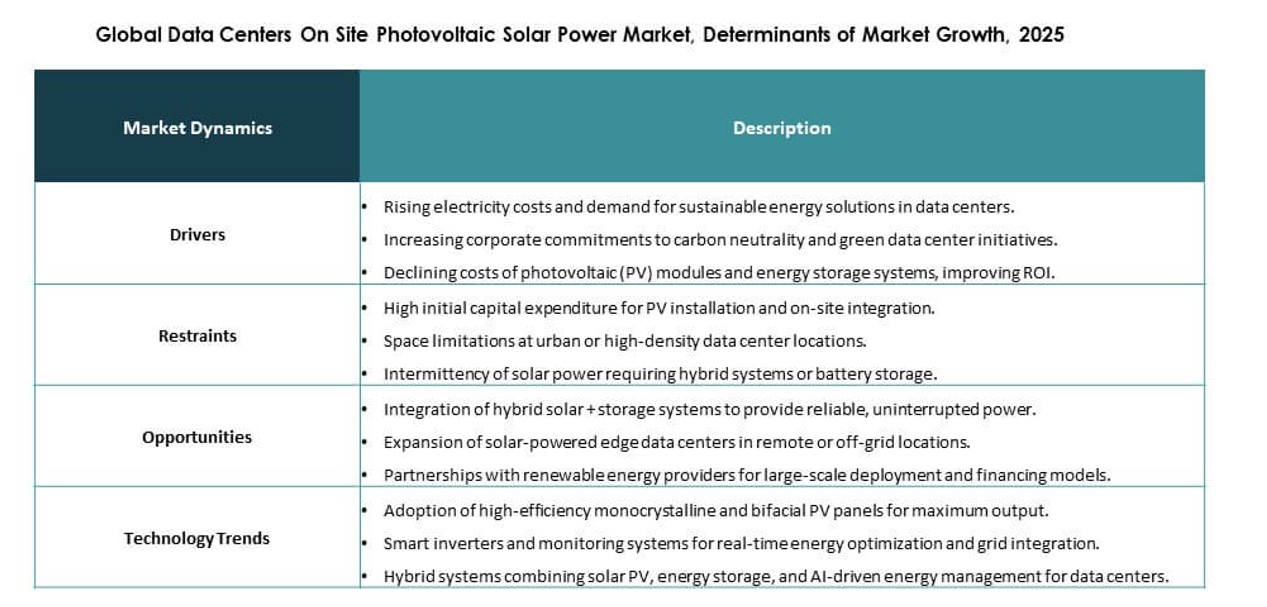
Rising energy demands, grid instability, and carbon neutrality goals are driving investments in on-site photovoltaic systems. Data center operators are rapidly adopting solar power to gain energy independence, improve uptime, and align with ESG commitments. Innovations in high-efficiency panels, digital monitoring systems, and hybrid solar-plus-storage models make integration more attractive. Businesses view solar-powered infrastructure as a long-term hedge against rising energy costs, while investors favor assets that improve sustainability, reliability, and lifetime returns.
North America leads deployment due to early adoption by hyperscale operators and supportive renewable policies. Europe follows, driven by high power costs and climate legislation. Asia Pacific is emerging fast, led by rising digital infrastructure needs in China, India, and Southeast Asia. The Middle East is gaining momentum with landmark solar-data center projects, while Latin America and Africa show long-term potential due to improving solar economics and digital growth.
Market Dynamics
Market Drivers
Rising Pressure to Reduce Energy Costs and Carbon Footprint Across Data Centers
Data center operators face sustained pressure to lower operating costs and meet climate targets. Energy expenses form a large share of total ownership cost. On‑site solar power supports predictable energy pricing over long periods. The Global Data Centers On Site Photovoltaic Solar Power Market gains importance due to this cost stability. Enterprises use solar to hedge against grid price swings. Sustainability reporting standards also shape procurement decisions. Corporate net‑zero goals push renewable integration at facility level. Investors value assets with lower long‑term energy risk. This driver strengthens long‑term deployment confidence.
- For instance, CtrlS Datacenters commissioned its 125 MW GreenVolt solar plant in Nagpur to supply its Mumbai campus, covering over 60% of total load using N-type modules.
Growing Adoption of Hybrid Energy Architectures for Power Resilience
Data centers require uninterrupted power under all conditions. Hybrid systems that combine solar, storage, and grid supply improve resilience. Solar power supports daytime load coverage and grid relief. Battery integration strengthens backup capability during outages. The Global Data Centers On Site Photovoltaic Solar Power Market benefits from this architectural shift. Operators prioritize uptime and power quality over single‑source dependence. Energy autonomy becomes a strategic operational metric. This shift supports capital allocation toward integrated energy systems. Long‑term reliability attracts institutional investment.
Advancements in Solar Technology and Digital Energy Management Platforms
Panel efficiency improvements enhance output within limited site space. Smart inverters support stable power conversion under variable loads. Digital energy platforms allow real‑time optimization of solar output. The Global Data Centers On Site Photovoltaic Solar Power Market aligns with this digital control trend. Predictive analytics improve asset utilization and maintenance planning. Automation reduces manual intervention and energy loss. Technology maturity lowers perceived execution risk. Vendors align offerings with data center performance standards. Innovation strengthens commercial scalability.
- For instance, JinkoSolar upgraded 40% of its lines in 2025 to produce 40–50 GW of TOPCon modules reaching up to 24.8% efficiency, ideal for dense PV installations in hyperscale campuses.
Strategic Role of Renewable Assets in Data Center Valuation and Financing
Renewable integration influences asset valuation in capital markets. Financial institutions favor infrastructure with sustainable power profiles. Solar assets support green financing and lower borrowing costs. The Global Data Centers On Site Photovoltaic Solar Power Market supports long‑term asset attractiveness. Power independence improves risk assessment models. Investors view renewable‑powered sites as future‑ready assets. Long asset lifecycles align with solar payback periods. This driver reshapes infrastructure investment strategies. Market confidence continues to rise.
Market Trends
Expansion of On‑Site Solar in Hyperscale and Colocation Facility Design
Hyperscale operators embed solar at design stage. Colocation providers use solar to attract sustainability‑focused clients. Site planning integrates rooftop and ground‑mounted arrays. The Global Data Centers On Site Photovoltaic Solar Power Market reflects this design‑first approach. Power planning shifts from retrofit to native integration. Operators seek modular solar capacity growth. Long‑term power planning improves cost predictability. Client demand influences provider investment decisions. This trend reshapes facility development models.
Shift Toward Energy‑Aware Workload and Power Load Management
Energy‑aware scheduling gains attention across large data centers. Operators align workloads with solar output windows. Power management software supports this coordination. The Global Data Centers On Site Photovoltaic Solar Power Market supports flexible energy use strategies. Solar availability influences operational planning. This approach improves renewable utilization rates. It reduces reliance on grid peak pricing. Digital coordination strengthens system efficiency. Operational intelligence becomes a key differentiator.
Increased Focus on Space‑Efficient and High‑Output Solar Installations
Data center land constraints influence solar selection. High‑efficiency panels gain preference. Compact mounting systems support dense layouts. The Global Data Centers On Site Photovoltaic Solar Power Market reflects this efficiency focus. Operators maximize output per square meter. Engineering innovation supports structural integration. Space optimization improves project feasibility. Urban and edge sites benefit strongly. This trend supports premium technology adoption.
Growing Collaboration Between Data Center Operators and Solar OEMs
Strategic partnerships increase across the value chain. OEMs customize systems for data center loads. Operators seek long‑term performance guarantees. The Global Data Centers On Site Photovoltaic Solar Power Market benefits from joint solution development. Collaboration improves deployment speed. Standardization reduces integration complexity. Shared roadmaps support scale expansion. Vendor relationships influence procurement strategy. Partnership‑driven execution gains momentum.
Market Challenges
High Initial Capital Requirement and Long Payback Expectations
On‑site solar projects require notable upfront investment. Capital approval remains complex for cost‑sensitive operators. Payback timelines depend on energy pricing assumptions. The Global Data Centers On Site Photovoltaic Solar Power Market faces financing scrutiny. Smaller operators face budget limitations. Project economics vary by geography. Financial uncertainty delays adoption decisions. Risk perception affects investment pacing. Capital intensity remains a key barrier.
Operational Complexity and Grid Integration Constraints
Solar integration adds technical complexity to data center operations. Grid interconnection rules vary by region. Power quality management requires advanced controls. The Global Data Centers On Site Photovoltaic Solar Power Market must address these constraints. Skilled workforce availability limits execution speed. Regulatory approval cycles extend timelines. Maintenance coordination adds operational burden. Integration risk concerns conservative operators. Complexity slows uniform adoption.
Market Opportunities
Rising Demand for Renewable‑Powered Digital Infrastructure from Enterprise Clients
Enterprise customers prefer sustainable data hosting partners. Renewable power improves brand alignment. Solar adoption strengthens service differentiation. The Global Data Centers On Site Photovoltaic Solar Power Market benefits from client‑driven demand. Green credentials influence contract decisions. Long‑term service agreements support investment recovery. Sustainability audits shape vendor selection. This opportunity supports premium pricing models.
Untapped Potential Across Emerging Markets and Edge Data Centers
Emerging economies expand digital infrastructure rapidly. Grid reliability challenges support on‑site solar use. Edge data centers require local power autonomy. The Global Data Centers On Site Photovoltaic Solar Power Market aligns with this need. Modular solar fits distributed deployments. Government renewable targets support adoption. Infrastructure gaps create deployment space. This opportunity expands addressable demand.
Market Segmentation
By Component
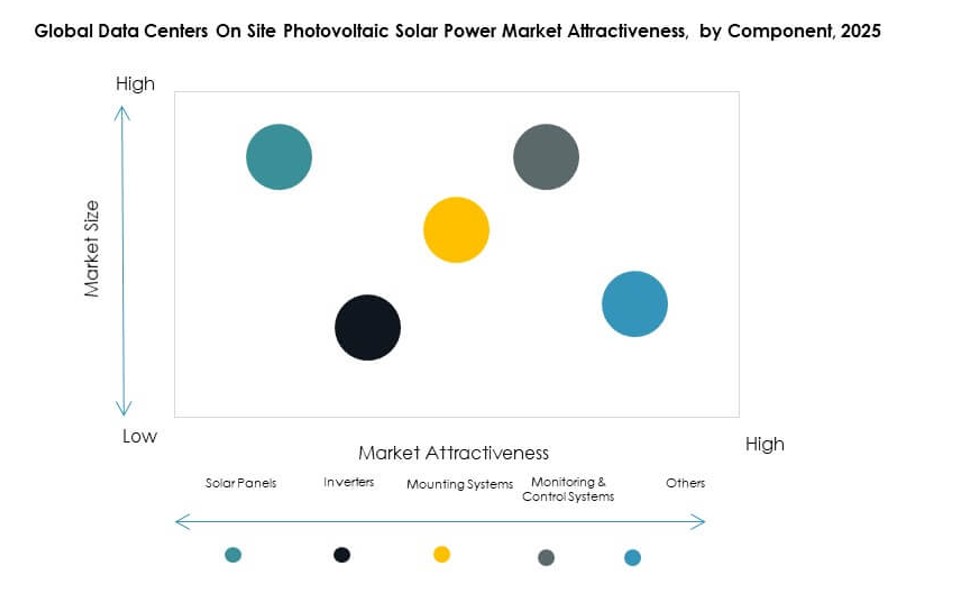
Solar panels dominate due to direct energy generation role and falling unit costs. High‑efficiency modules gain strong preference in data center environments. Inverters support stable power conversion under variable loads. Mounting systems enable space‑efficient deployment. Monitoring and control systems improve performance visibility and uptime. The Global Data Centers On Site Photovoltaic Solar Power Market benefits from integrated component solutions. Panels account for the largest share due to scale requirements. Innovation across balance‑of‑system components supports long‑term reliability.
By Application
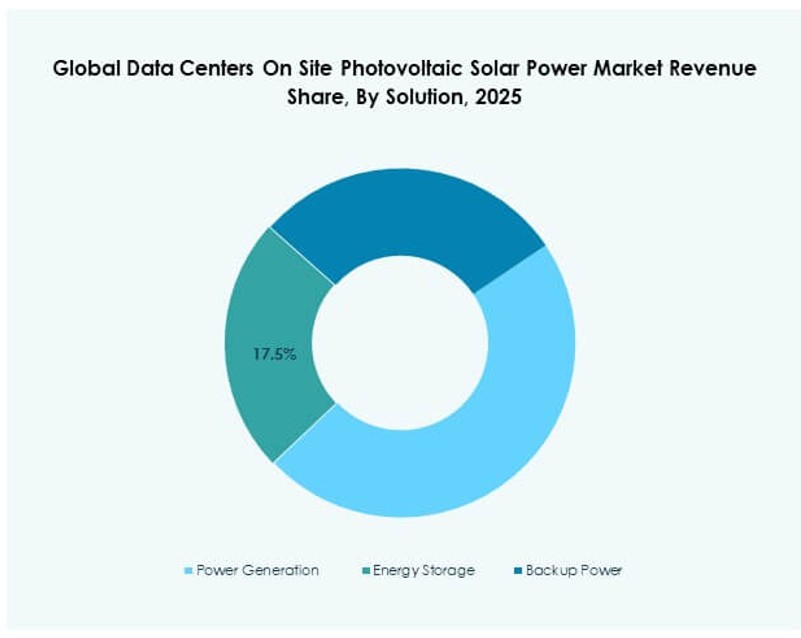
Power generation remains the leading application since operators aim to offset primary grid consumption. Energy storage gains traction where reliability and load balancing matter. Backup power applications support resilience strategies. The Global Data Centers On Site Photovoltaic Solar Power Market sees strongest adoption in primary power support. Storage integration improves solar utilization. Backup use remains secondary but strategic. Application choice depends on site size and grid quality. Power generation continues to dominate overall demand.
By System Type
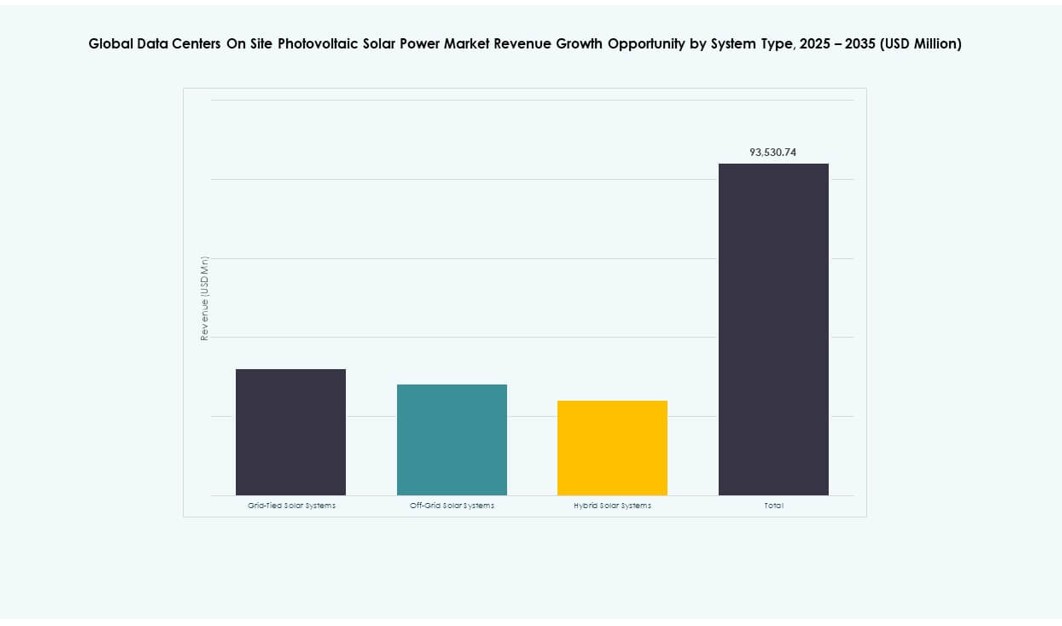
Grid‑tied systems hold the largest share due to cost efficiency and grid support. Hybrid systems show faster growth due to resilience benefits. Off‑grid systems remain niche for remote locations. The Global Data Centers On Site Photovoltaic Solar Power Market favors hybrid architectures in new builds. Grid‑tied systems reduce upfront costs. Hybrid models improve uptime assurance. System choice reflects reliability goals. Hybrid adoption accelerates steadily.
By Data Center Type
Hyperscale data centers dominate due to large energy demand and scale economics. Colocation facilities follow with strong client‑driven sustainability needs. Enterprise sites adopt selectively based on budget. Edge data centers show rising interest due to power autonomy needs. The Global Data Centers On Site Photovoltaic Solar Power Market aligns closely with hyperscale expansion. Scale supports solar feasibility. Colocation adoption grows steadily. Edge deployment creates new demand pockets.
By Technology
Monocrystalline panels lead due to high efficiency and space optimization. Polycrystalline panels serve cost‑sensitive installations. Thin‑film PV finds use in specific structural applications. The Global Data Centers On Site Photovoltaic Solar Power Market favors monocrystalline technology for performance reasons. Efficiency supports higher output density. Technology choice reflects land constraints. Durability influences lifecycle cost. Monocrystalline panels remain dominant.
Regional Insights
North America and Europe
North America leads with about 38% market share due to hyperscale concentration and renewable policies. The United States drives early adoption through corporate sustainability goals. Canada supports growth with clean energy incentives. Europe holds nearly 27% share due to strict climate regulations. Germany, France, and the UK lead regional deployment. Power price volatility supports solar adoption. The Global Data Centers On Site Photovoltaic Solar Power Market remains strong across these regions.
- For instance, Microsoft achieved 96% global renewable energy coverage in 2023, supported by large-scale solar PPAs in Virginia and Texas, where it operates high-density data center regions aligned with its 100/100/0 zero-carbon energy commitment.
Asia Pacific
Asia Pacific accounts for around 25% share with rapid data center expansion. China leads due to large‑scale digital infrastructure investment. India shows strong growth due to renewable targets. Japan and South Korea focus on energy security. The Global Data Centers On Site Photovoltaic Solar Power Market benefits from new build activity. Power demand growth supports solar integration. Government support accelerates adoption.
Middle East, Latin America, and Africa
These regions together hold about 10% share but show rising potential. The Middle East adopts solar to manage energy intensity. Latin America benefits from high solar irradiance. Africa explores solar for grid stability. The Global Data Centers On Site Photovoltaic Solar Power Market sees gradual uptake. Policy frameworks improve project feasibility. Early investments signal long‑term growth. Emerging regions expand future opportunities.
- For instance, DEWA launched the second phase of its green data center in Dubai in January 2026, powered by solar from the Mohammed bin Rashid Al Maktoum Solar Park, enhancing digital and grid services through on-site renewable energy.
Competitive Insights
- Trina Solar
- JA Solar Co., Ltd.
- SunPower Corporation
- First Solar, Inc.
- JinkoSolar
- Canadian Solar
- Yingli Solar
- Hanwha Q CELLS
- Vikram Solar Pvt. Ltd.
- SCHOTT North America, Inc.
The Global Data Centers On Site Photovoltaic Solar Power Market features a competitive landscape shaped by a mix of established solar manufacturers and regionally focused suppliers. It includes global players who dominate through high-efficiency panels, turnkey EPC services, and strong partnerships with data center operators. Companies like Trina Solar, JinkoSolar, and SunPower compete on technology performance, bankability, and large-scale deployment capabilities. Players also differentiate through integrated solutions, offering not just modules but also inverters, storage, and energy monitoring platforms. Market activity includes mergers, R&D investment, and regional expansion into high-growth areas. Competitive intensity is rising as operators demand customized systems that align with digital infrastructure standards. Strategic alignment with hyperscale and colocation clients remains central to maintaining leadership in this market.
Recent Developments
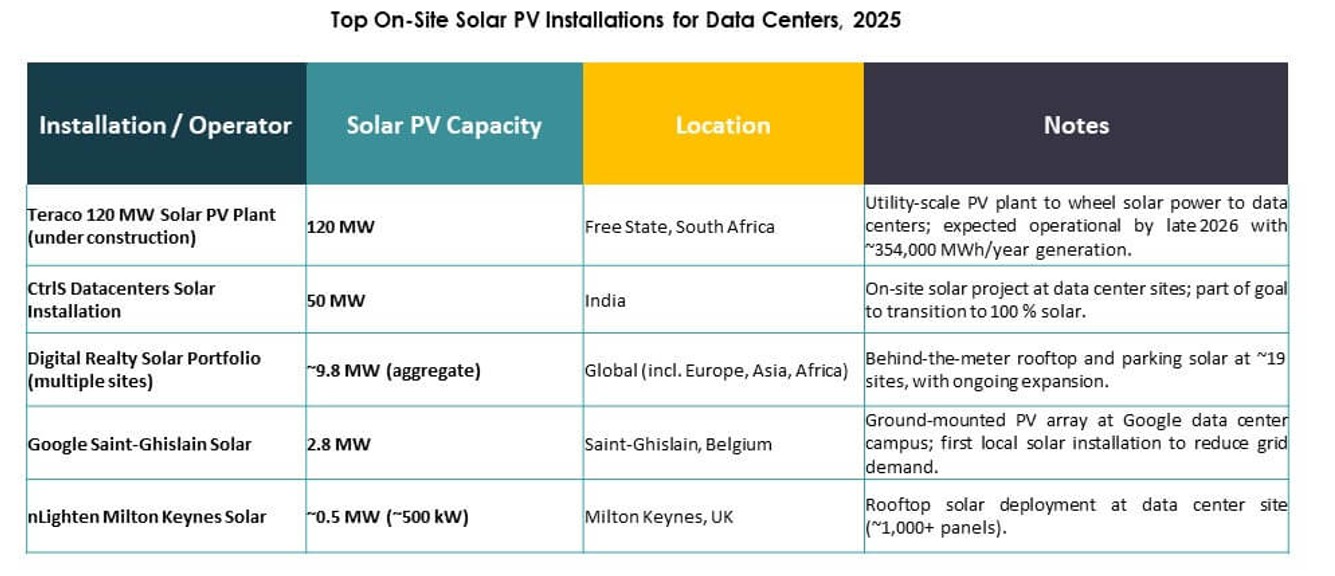
- In January 2026, Dubai Electricity and Water Authority (DEWA) approved the second phase of its solar-powered green data center at Warsan, primarily powered by on-site renewable energy from the Mohammed bin Rashid Al Maktoum Solar Park. This expansion boosts capacity, resilience, and efficiency for digital services and smart grid operations.
- In February 2025, CtrlS Datacenters completed its 125MW GreenVolt 1 on-site solar farm in Nagpur, Maharashtra, to power its Mumbai data center campus. The project, built in two phases with the first 65.2MW live in June 2024, uses efficient N-type solar panels and covers 60% of the campus’s energy needs.
Table of contents
Table of Content
- Introduction
- Market Definition & Scope
- Research Methodology
- Primary Research
- Secondary Research
- Data Validation & Assumptions
- Market Segmentation Framework
- Executive Summary
- Market Snapshot
- Key Findings
- Analyst Recommendations
- Market Outlook (2025–2035)
- Market Dynamics
- Market Drivers
- Market Restraints
- Market Opportunities
- Challenges & Risks
- Value Chain Analysis
- Porter’s Five Forces Analysis
- Market Attractiveness by Segment
- Component
- Application
- System Type
- Data Center Type
- Technology
- Region
- Global Data Centers On Site Photovoltaic Solar Power Market – Market Sizing & Forecast
- Historical Market Size (2020–2025)
- Forecast Market Size (2026–2035)
- Market Growth Rate Analysis
- Market Outlook by Region
- Global Data Centers On Site Photovoltaic Solar Power Market – By Component
- Solar Panels
- Inverters
- Mounting Systems
- Monitoring & Control Systems
- Others (e.g., trackers, junction boxes)
- Global Data Centers On Site Photovoltaic Solar Power Market – By Application
- Power Generation (primary energy supply)
- Energy Storage (coupled with batteries)
- Backup Power (supplement during outages)
- Global Data Centers On Site Photovoltaic Solar Power Market – By System Type
- Grid-Tied Solar Systems
- Off-Grid Solar Systems
- Hybrid Solar Systems (solar + storage + grid)
- Global Data Centers On Site Photovoltaic Solar Power Market – By Data Center Type
- Hyperscale Data Centers
- Colocation Data Centers
- Enterprise Data Centers
- Edge Data Centers
- Others
- Global Data Centers On Site Photovoltaic Solar Power Market – By Technology
- Monocrystalline Panels
- Polycrystalline Panels
- Thin-Film Solar PV
- Global Data Centers On Site Photovoltaic Solar Power Market – By Region
- North America
- U.S.
- Canada
- Mexico
- Europe
- UK
- France
- Germany
- Italy
- Spain
- Russia
- Rest of Europe
- Asia-Pacific
- China
- Japan
- South Korea
- India
- Australia
- Rest of Asia Pacific
- Latin America
- Brazil
- Rest of Latin America
- Middle East
- GCC
- Israel
- Turkey
- Rest of Middle East
- Africa
- South Africa
- Rest of Africa
- North America
- Competitive Landscape
- Market Share Analysis
- Key Player Strategies
- Mergers, Acquisitions & Partnerships
- Product & Service Launches
- Company Profiles
- Trina Solar
- JA Solar Co., Ltd.
- SunPower Corporation
- First Solar, Inc.
- JinkoSolar
- Canadian Solar
- Yingli Solar
- Hanwha Q CELLS
- Evergreen
- SCHOTT North America, Inc.
- Vikram Solar Pvt. Ltd.
- Others
About this report
Written by Satyabrat Rajawat and reviewed by Deepti Agrawal, Senior Editor, Research. Figures are built top-down and bottom-up and reconciled before publication, with 2024 as the base year.
Read our methodologyHow we built this
- Historical period2020-2023
- Base year2024
- Forecast period2025-2035
- Sizing approachTop-down + bottom-up
Need more than the report?
Advisory on this market
Due diligence, site selection and market entry work, by the analysts who wrote this report.
See consulting servicesFrequently asked questions
The Global Data Centers On Site Photovoltaic Solar Power Market was valued at USD 27044.57 million in 2025 and is projected to reach USD 125,435.21 million by 2035.
The Global Data Centers On Site Photovoltaic Solar Power Market is expected to grow at a CAGR of 16.43% during the forecast period from 2025 to 2035.
Solar Panels held the largest share in the Global Data Centers On Site Photovoltaic Solar Power Market in 2025, driven by their central role in primary energy generation.
Key growth drivers for the Global Data Centers On Site Photovoltaic Solar Power Market include demand for energy cost control, sustainability goals, hybrid power adoption, and technological improvements in PV systems.
Leading companies in the Global Data Centers On Site Photovoltaic Solar Power Market include Trina Solar, JA Solar, SunPower, First Solar, JinkoSolar, and Canadian Solar, among others.
North America led the Global Data Centers On Site Photovoltaic Solar Power Market in 2025, holding approximately 38% share due to strong hyperscale activity and policy support.
Licences, delivery and payment
Which licence should I choose?
Single User is a view-only PDF for one person. Multi User adds a printable PDF and the Excel data for unlimited users at one location. Enterprise covers your whole company and includes 100 free analyst hours.
How and when will I receive the report?
By email, within 24–48 business hours of payment, in the formats of your licence.
How can I pay?
Securely through PayPal: with a PayPal account, a debit or credit card, or PayPal Pay Later where available. Prices are in US dollars.
Can I see a sample first?
Yes. Request a free sample and we will email it to you.
Can the report be tailored to my needs?
Yes. We can add countries, segments or data cuts. Talk to an analyst about the scope you need.
Can I get an invoice or pay against a purchase order?
Write to sales@dcmarketinsights.com and our team will help.