Executive summary:
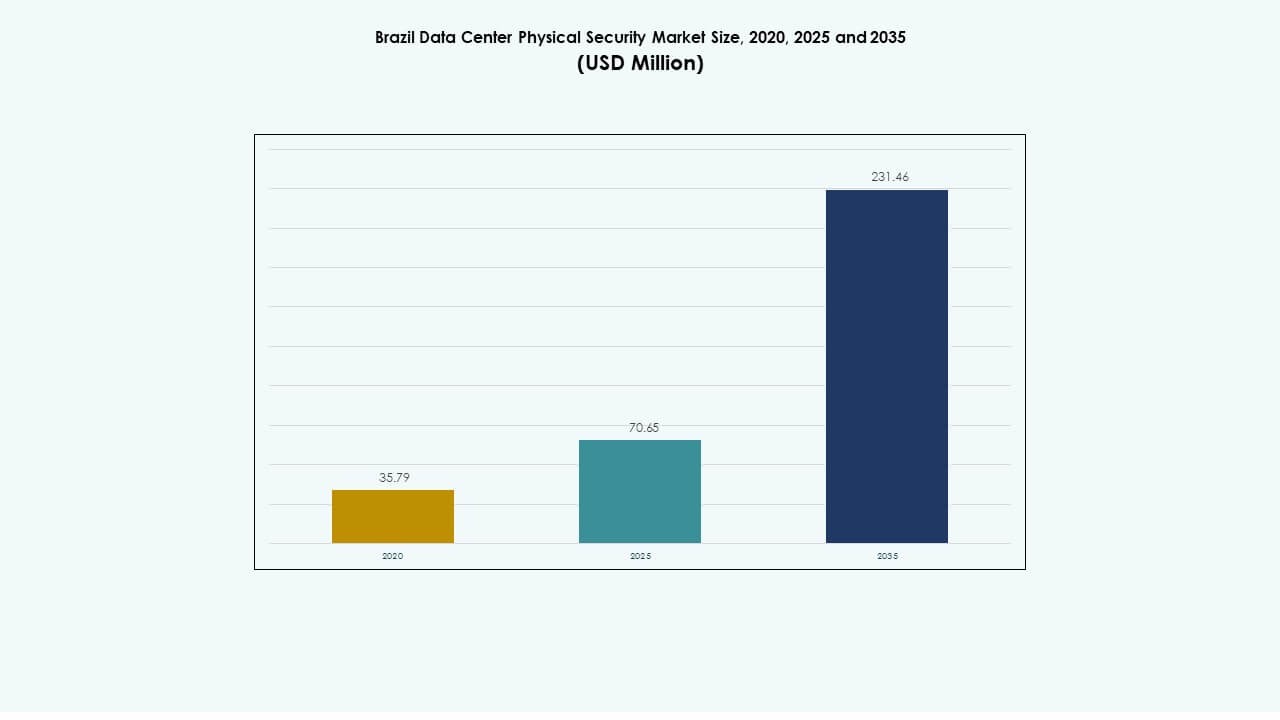
The Brazil Data Center Physical Security Market size was valued at USD 35.79 million in 2020 to USD 70.65 million in 2025 and is anticipated to reach USD 231.46 million by 2035, at a CAGR of 12.54% during the forecast period.
| REPORT ATTRIBUTE |
DETAILS |
| Historical Period |
2020-2023 |
| Base Year |
2024 |
| Forecast Period |
2025-2035 |
| Brazil Data Center Physical Security Market Size 2025 |
USD 70.65 Million |
| Brazil Data Center Physical Security Market, CAGR |
12.54% |
| Brazil Data Center Physical Security Market Size 2035 |
USD 231.46 Million |
Strong investment in hyperscale facilities, cloud infrastructure, and government-backed digital programs fuels this market’s growth. Adoption of AI-driven video surveillance, biometric access, and integrated monitoring platforms enhances reliability and operational control. The market holds strategic importance for businesses seeking compliance with data protection policies and investors targeting long-term infrastructure resilience across the region.
São Paulo dominates the landscape due to its robust connectivity, power reliability, and high data center concentration. Rio de Janeiro follows with expansions focused on sustainable, renewable-powered campuses. Secondary regions such as Brasília and Porto Alegre are emerging growth corridors driven by enterprise colocation demand and government digitalization efforts.
 Market Drivers
Rising Cloud Adoption and Data Localization Regulations
The Brazil Data Center Physical Security Market benefits from strong demand driven by rapid digital transformation and stricter data sovereignty policies. Enterprises are increasing local data storage, prompting greater investment in secured infrastructure. Government regulations promoting domestic data management encourage data center construction. This expansion heightens the need for advanced surveillance, biometric access, and intrusion detection. The trend strengthens the security ecosystem supporting national data resilience. It also attracts multinational companies ensuring compliance with regional laws.
- For example, Equinix operates eight active data centers across São Paulo and Rio de Janeiro, with a ninth facility under development as of 2025. The company continues to expand its Brazilian footprint in line with rising digital infrastructure demand and supportive national investment policies.
Integration of AI and IoT for Smart Security Infrastructure
Artificial intelligence and IoT integration redefine physical security efficiency and reliability. Smart sensors and predictive analytics improve real-time incident response. The combination of AI-based video analytics and automation strengthens security layers within hyperscale and colocation centers. These technologies enhance monitoring, reduce false alarms, and optimize operational costs. It pushes Brazil’s data centers toward automation-led security operations. Growing investment from global security providers supports continuous system evolution.
- For example, Johnson Controls provides AI-driven video surveillance and access control solutions for data centers worldwide. Its Metasys platform integrates IoT sensors and analytics to enhance real-time monitoring and operational security. The company continues to advance intelligent security technologies supporting regional deployments, including in Brazil.
Growth in Edge Computing and Distributed Infrastructure
Expansion of edge facilities across secondary cities drives new security deployment strategies. Edge sites demand compact yet intelligent access control and surveillance systems. The rise of distributed infrastructure increases demand for remotely managed physical protection. This diversification expands the market’s technology adoption base. It enhances resilience against network failures and localized threats. Businesses focus on unified platforms managing security across dispersed environments.
Increased Investor Confidence and Strategic Partnerships
International investors view Brazil as a key digital hub in Latin America. Partnerships between data center operators and global security vendors foster ecosystem modernization. Growing foreign investments stimulate innovation and integration of next-generation hardware. The market benefits from confidence in its regulatory stability and business potential. It strengthens local expertise in security deployment and maintenance. Rising mergers and alliances accelerate capacity building and service expansion.
 Market Trends
Shift Toward AI-Powered Surveillance Systems
The Brazil Data Center Physical Security Market witnesses a surge in AI-based surveillance adoption. Cameras now use machine learning for facial recognition and anomaly detection. This reduces dependence on manual supervision and enhances accuracy. Operators deploy AI analytics to interpret massive video data streams. The trend supports predictive maintenance and early risk identification. It also drives integration between cybersecurity and physical systems for unified monitoring.
Adoption of Cloud-Based Security Management Platforms
Security management is increasingly shifting toward cloud-based control centers. Operators prefer centralized dashboards for multi-site management. These platforms enable seamless coordination between access points and sensors. The transition improves scalability, visibility, and analytics efficiency. It supports business continuity across geographically dispersed data centers. Cloud-native security tools reduce maintenance burdens and promote agility.
Growing Focus on Environmental and Energy Efficiency
Sustainability is influencing physical security design choices. Energy-efficient surveillance and smart lighting systems are gaining prominence. The use of low-power sensors and AI-managed cooling optimization enhances sustainability. Operators link physical security to green certification initiatives. The integration aligns with corporate sustainability goals. It also creates opportunities for innovation in eco-friendly security technologies.
Hybrid Security Ecosystems and Predictive Intelligence
Hybrid ecosystems integrating physical and digital security gain traction. Predictive intelligence tools anticipate breaches based on historical data. Data centers implement layered defenses combining hardware and analytics. It enables proactive rather than reactive threat management. The approach ensures continuity for mission-critical operations. Vendors compete through advanced predictive analytics and interoperability features.
Market Challenges
High Cost of Implementation and Maintenance
The Brazil Data Center Physical Security Market faces challenges due to high deployment costs. Implementing biometric access, AI analytics, and advanced monitoring systems requires significant investment. Maintenance and hardware upgrades add recurring expenses. Smaller operators struggle to meet these requirements without external funding. The cost barrier slows adoption across mid-tier facilities. Currency fluctuations and import taxes raise equipment costs further. This financial strain limits uniform modernization across all operators.
Regulatory Complexity and Skills Shortage
Complex local compliance frameworks create challenges for new entrants. Data centers must adhere to overlapping regional and national policies. Lack of specialized professionals hampers proper implementation of modern systems. Training needs delay operational readiness. The industry also faces skill shortages in cybersecurity-physical integration. It affects response times and overall security efficiency. Addressing talent and regulation gaps remains critical for sustained market growth.
 Market Opportunities
Expansion of Hyperscale and Edge Data Centers
The Brazil Data Center Physical Security Market gains opportunity from large-scale infrastructure projects. Hyperscale developments from major cloud providers demand advanced protection. Edge deployments in smaller cities expand the customer base for compact systems. Local vendors can capture growth through regionally optimized solutions. It presents long-term potential for scalable, energy-efficient, and modular security innovations.
Rising Demand for Managed Security Services
Enterprises increasingly outsource physical security to managed service providers. This reduces capital expenditure and improves efficiency. Vendors offering integrated consulting, maintenance, and analytics gain an edge. It supports sustained revenue and faster technology refresh cycles. Continuous service-based models create predictable growth opportunities for operators and integrators.
Market Segmentation
By Data Center Size
Large data centers dominate the Brazil Data Center Physical Security Market, accounting for over half of total revenue. These facilities demand multi-layered access systems, extensive camera networks, and redundancy measures. Medium centers follow with steady adoption of AI-based surveillance. Small centers remain limited to basic access control, constrained by cost factors.
By Component
Solutions represent the leading share, driven by investments in access control and video analytics. Services follow due to the growing demand for integration and consulting. The trend reflects increased reliance on external expertise for system management. It underlines the importance of combining hardware with professional oversight.
By Solution
Video surveillance leads due to widespread deployment in hyperscale facilities. Access control follows closely, with biometrics and smart cards enhancing perimeter security. Monitoring and detection systems grow as automation gains ground. Other segments such as visitor management expand gradually through customization demand.
By Services
System integration dominates this category. Data centers prioritize seamless alignment between physical and IT security layers. Consulting services expand among enterprises implementing first-time security solutions. Maintenance and support sustain recurring revenue through continuous system updates.
By Security Layer
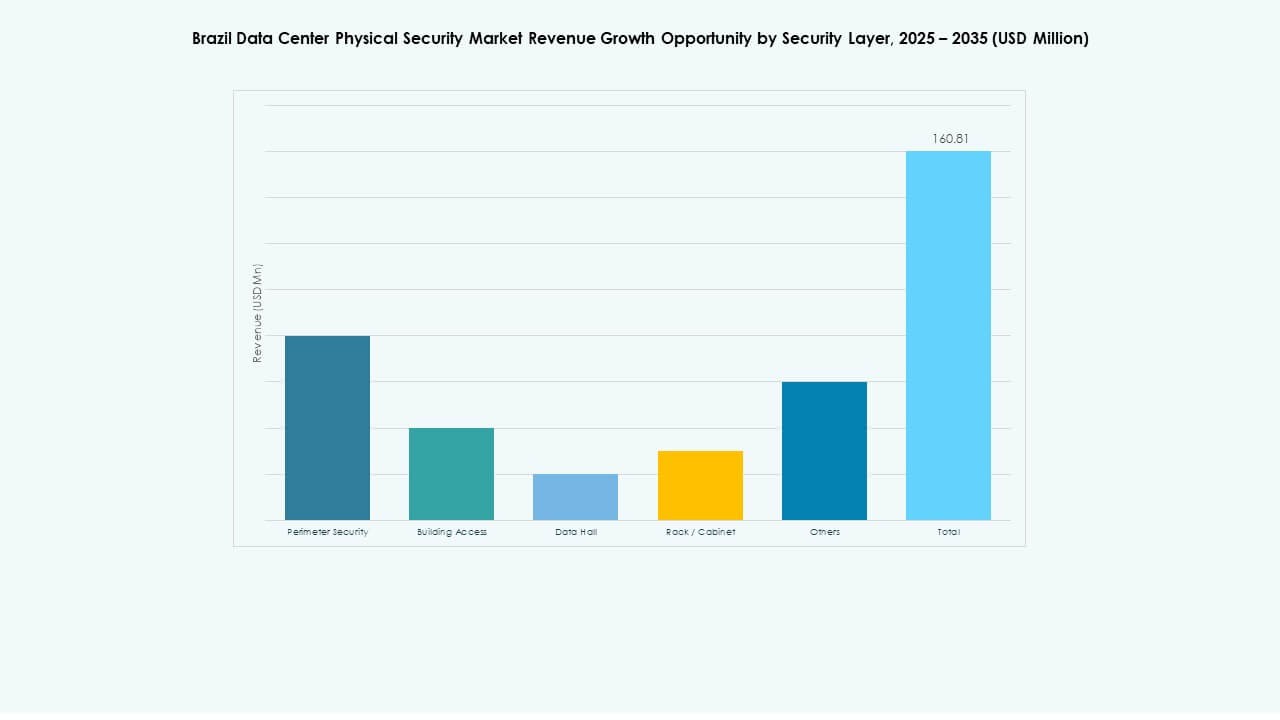
Perimeter security holds the largest share, emphasizing intrusion detection and barrier control. Data halls and rack-level protection grow due to critical asset protection needs. Building access management supports compliance and operational safety. It shows how multi-tier protection remains central to operational reliability.
By Data Center Type
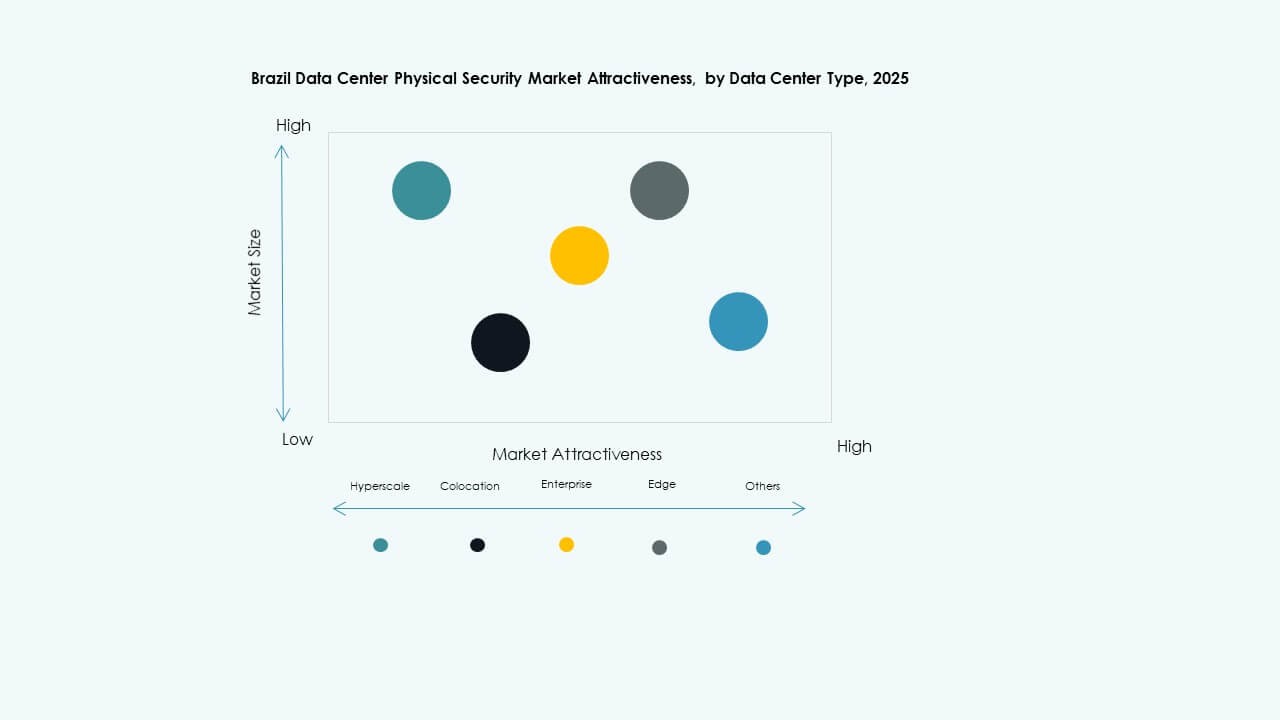
Hyperscale facilities dominate this segment, followed by colocation centers. Enterprise data centers modernize to match global standards. Edge centers represent the fastest-growing segment, fueled by regional expansion. This structure drives diverse deployment strategies across Brazil.
By End-user
IT and Telecom lead the market with extensive security budgets. BFSI follows, driven by compliance and privacy mandates. Government, healthcare, and retail sectors invest in access and monitoring systems. Manufacturing facilities increasingly adopt AI-based security for industrial data protection.
 Regional Insights
Southeast Region – Core Data Center Hub (63%)
The Southeast dominates the Brazil Data Center Physical Security Market due to strong infrastructure and urban concentration. São Paulo anchors most hyperscale and colocation facilities. Access control and advanced surveillance systems are heavily deployed. The region benefits from consistent power supply, skilled workforce, and favorable regulations.
- For example, Elea Digital is expanding its São Bernardo do Campo campus in Greater São Paulo toward a planned 100 MW capacity. The company currently operates over 10 MW across its São Bernardo do Campo and Tamboré sites, reinforcing São Paulo’s position as Brazil’s core data center hub.
South and Central-West Regions – Emerging Expansion Corridors (22%)
These regions experience rising investment in edge facilities. Curitiba and Brasília attract enterprises due to improved connectivity and lower real estate costs. Data centers in these zones focus on modular and scalable security systems. Growth reflects government-backed digital transformation initiatives and favorable logistics.
North and Northeast Regions – Growing Potential Markets (15%)
Northern and Northeastern Brazil show gradual adoption of data center security. Infrastructure constraints and lower IT penetration slow initial growth. However, expanding fiber networks and regional digitization programs are improving viability. These regions represent future frontiers for investors targeting high-growth potential areas.
- For example, Elea Digital announced the Rio AI City project in Rio de Janeiro, designed to operate on 100% renewable energy. The campus is planned to scale up to 3.2 GW to support cloud and AI workloads, marking one of Brazil’s largest sustainable data center initiatives.
Competitive Insights:
- Bosch Sicherheitssysteme GmbH
- Honeywell International Inc.
- Johnson Controls
- Schneider Electric SE
- Axis Communications AB
- ABB Ltd
- Siemens AG
- Securitas AB
- Dahua Technology Co. Ltd.
- Genetec
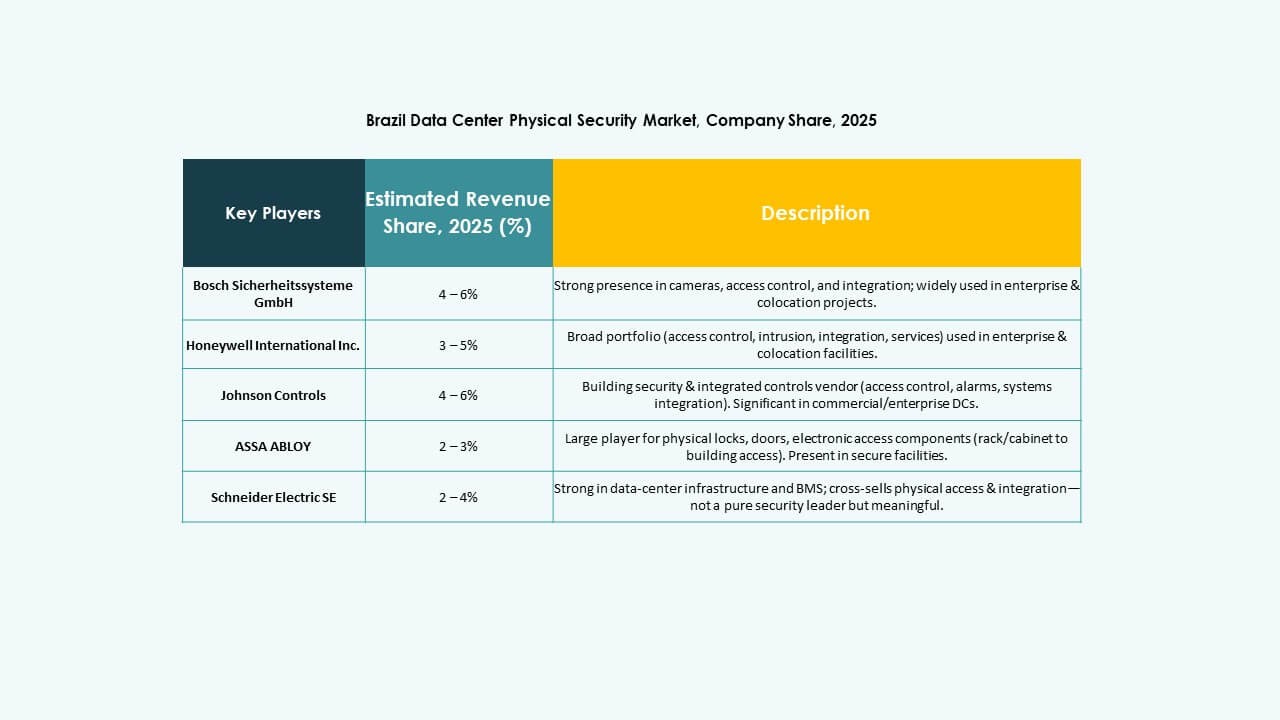
The Brazil Data Center Physical Security Market is highly competitive, driven by global and regional players offering integrated protection systems. Companies such as Bosch, Honeywell, and Schneider Electric lead with end-to-end surveillance, access control, and automation technologies. Axis Communications and Genetec strengthen their presence through AI-powered monitoring and cloud-based platforms. ABB and Siemens focus on industrial-grade safety and power management integration, enhancing resilience and compliance. Johnson Controls and Securitas expand through managed services and partnership models. It demonstrates a gradual consolidation trend where vendors invest in analytics-driven, interoperable solutions to meet evolving compliance and operational standards across hyperscale, colocation, and enterprise facilities.
Recent Developments:
- In October 2025, ASSA ABLOY acquired Kentix GmbH, a German company specializing in monitoring and access control products designed for data centers, enhancing their capabilities in physical security for this sector.
- In January 2025, ASSA ABLOY also acquired InVue, a Charlotte-based provider of asset protection and access control solutions, aligning with their strategy to expand globally in access control and asset protection.
- In June 2024, Honeywell International Inc. completed the acquisition of Carrier Global Corporation’s Global Access Solutions business for $4.95 billion, enhancing its building automation portfolio with advanced access control solutions like LenelS2, Onity, and Supra, which support security needs in data centers including those in Spain.
- In December 2024, Bosch Sicherheitssysteme GmbH sold its security and communications technology product business to the European investment firm Triton. The transaction included three business units Video, Access and Intrusion, and Communication as Bosch aims to focus more on systems integration business.