Home » Japan Hyperscale Data Center Market

Japan Hyperscale Data Center Market By Component (Solutions, Services); By Infrastructure Type (IT Infrastructure, Electrical Infrastructure, Mechanical Infrastructure, General Construction); By End-User (Cloud Providers, Colocation Providers, Enterprises); By Industry Vertical (BFSI, IT & Telecom, Government, Healthcare, Others) – Growth, Share, Opportunities & Competitive Analysis, 2025 – 2035

Report ID: 7351 | Report Format : Excel, PDF

Executive summary:

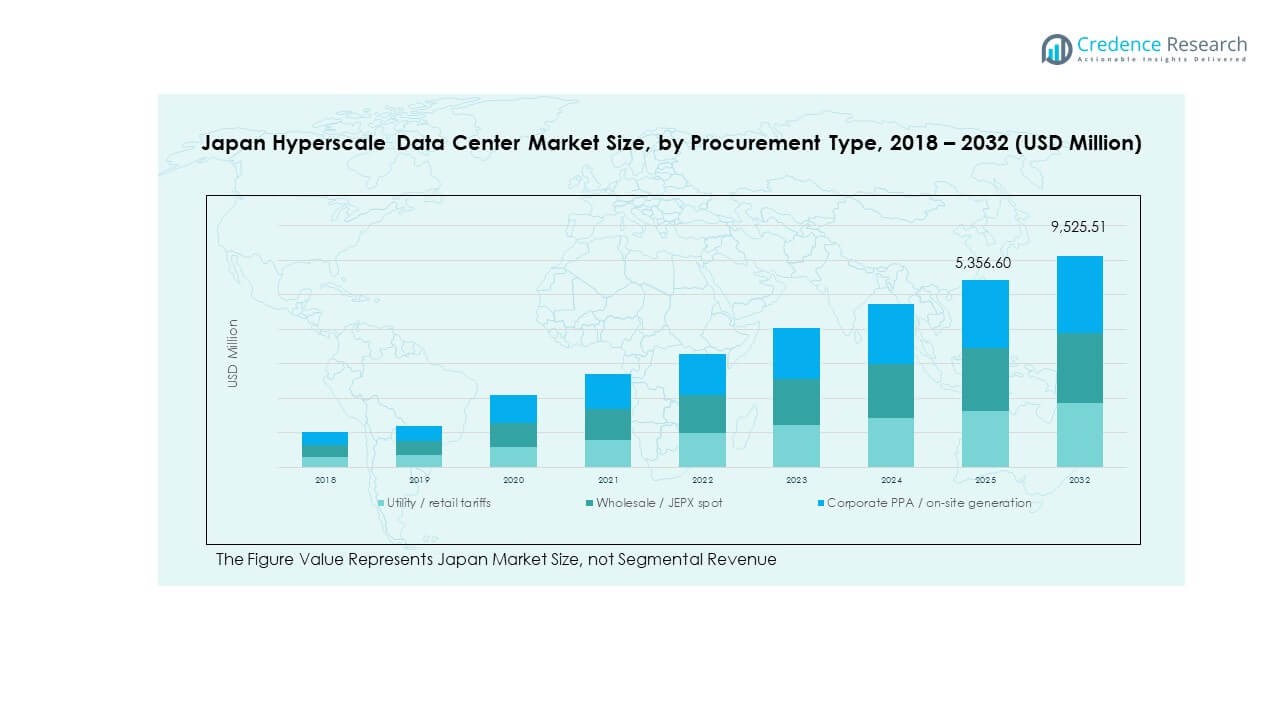
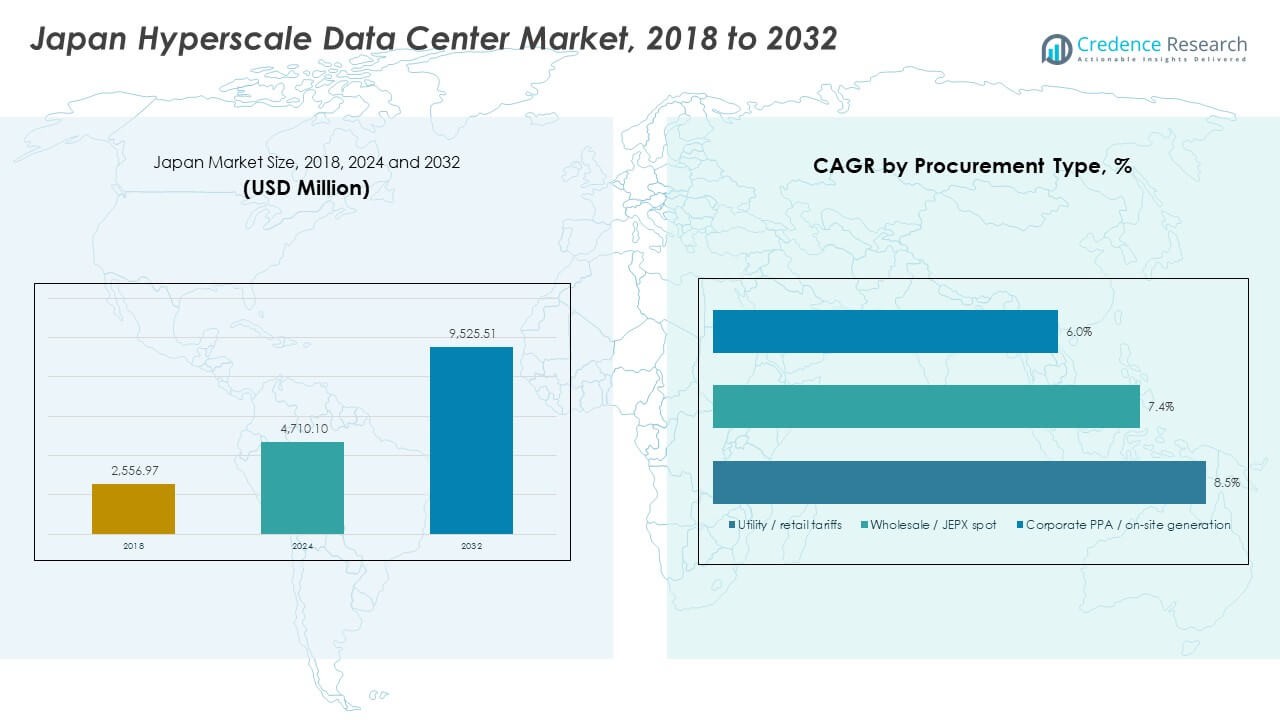
The Japan Hyperscale Data Center Market size was valued at USD 2,556.97 million in 2018, USD 4,710.10 million in 2024, and is anticipated to reach USD 9,525.51 million by 2032, at a CAGR of 8.57% during the forecast period.

REPORT ATTRIBUTE DETAILS
Historical Period 2020-2023
Base Year 2024
Forecast Period 2025-2035
Japan Hyperscale Data Center Market Size 2025 USD 4,710.10 Million
Japan Hyperscale Data Center Market, CAGR 8.57%
Japan Hyperscale Data Center Market Size 2035 USD 9,525.51 Million


Growing enterprise digitalization and widespread adoption of cloud computing drive infrastructure expansion. AI-driven workloads and high-performance computing accelerate demand for advanced power and cooling systems. The market gains strategic importance as Japan strengthens its role in Asia’s digital ecosystem, attracting investments from both domestic and global operators seeking scalable and energy-efficient facilities.

Greater Tokyo leads development, supported by strong connectivity, dense enterprise presence, and robust energy supply. Osaka follows as a cost-efficient alternative with growing hyperscale investments. Emerging regions such as Hokkaido and Kyushu show potential for renewable-powered data centers. Strategic geographic diversification helps Japan balance energy load and expand nationwide digital capacity.

Japan Hyperscale Data Center Market SizeMarket Drivers

Rising Cloud Computing Adoption and Digital Transformation Across Enterprises

Cloud adoption continues to expand rapidly across Japan, driven by digitalization across public and private sectors. Enterprises migrate workloads to hyperscale platforms for reliability and scalability. Government-backed initiatives promoting secure data localization enhance this shift. The Japan Hyperscale Data Center Market benefits from these transformations that push strong infrastructure investments. Enterprises seek redundancy and high availability to support critical workloads. Cloud-native firms such as AWS, Google, and Microsoft expand regional zones. AI-driven demand accelerates facility construction across major cities. This growth reinforces Japan’s position as a central digital hub in Asia.

Growing Demand for AI and High-Performance Computing Workloads

AI, machine learning, and big data analytics create strong infrastructure requirements across industries. Hyperscale facilities integrate GPU-based clusters and liquid cooling systems to meet these needs. Enterprises depend on such environments for faster data modeling and real-time analysis. It fosters growth in specialized power distribution and rack density solutions. Research and automation sectors also stimulate adoption of AI-ready data centers. The Japan Hyperscale Data Center Market aligns with national strategies encouraging innovation. High computing power supports robotics, fintech, and connected vehicle projects. Businesses view AI-driven capacity as a crucial competitive factor. Continuous expansion ensures sustainable digital growth nationwide.

  • For instance, NVIDIA and SoftBank Corp. announced a collaboration to develop AI data centers in Japan using NVIDIA Grace Hopper and Blackwell superchip platforms. The initiative aims to power next-generation generative AI and 5G/6G applications across SoftBank’s nationwide network infrastructure.

Innovation in Energy Efficiency and Sustainable Infrastructure Design

Japan emphasizes green technology integration within large-scale data facilities. Operators deploy renewable power sources and advanced heat recovery systems to cut emissions. Energy-efficient cooling and modular architecture improve power usage effectiveness (PUE). It reflects the industry’s push for low-carbon operations under government sustainability goals. Utility firms collaborate with data center providers to supply clean energy. Innovations like direct-to-chip cooling and microgrid integration lower energy intensity. The Japan Hyperscale Data Center Market experiences stronger investor confidence through ESG-focused models. Green certification drives competitive differentiation across facilities. Environmental compliance now defines strategic value for long-term operations.

Strategic Investments by Global and Domestic Players Strengthening Market Presence

Major corporations expand footprints through long-term partnerships and large-scale projects. Companies such as NTT, SoftBank, and Equinix enhance capacity in Tokyo and Osaka. These hubs attract global hyperscalers seeking stable infrastructure. The Japan Hyperscale Data Center Market gains attention from investors targeting Asia’s most advanced markets. Collaboration between foreign and local players accelerates innovation cycles. Investment momentum ensures stable connectivity and enhanced inter-regional data routing. It fosters ecosystem growth across colocation, edge computing, and cloud services. Strategic alliances shape Japan into a key digital interconnection zone. Market consolidation strengthens the foundation for sustainable hyperscale operations.

  • For instance, NTT Global Data Centers began construction of a 36 MW hyperscale campus in Osaka in October 2025, starting with an 18 MW first building. Equinix also operates its TY13x hyperscale data center in Tokyo, designed for up to 36 MW total capacity to support large-scale cloud and enterprise workloads.

Japan Hyperscale Data Center Market Share

Market Trends

Expansion of Hyperscale Ecosystems Through AI and Edge Infrastructure Integration

AI and edge computing accelerate modernization within large-scale facilities. Operators build hybrid environments combining central data hubs and edge nodes. This transition improves latency and supports real-time digital services. The Japan Hyperscale Data Center Market observes rapid adoption of AI-optimized servers. Urban regions deploy micro data centers near industrial zones for faster processing. Telecom operators collaborate to expand low-latency 5G backbones. It strengthens IoT, AR, and autonomous system deployments. The trend aligns with nationwide efforts to create an intelligent digital ecosystem. Japan’s leadership in edge readiness drives steady market expansion.

Emergence of Smart Data Center Management and Automation Platforms

Automation becomes central to optimizing hyperscale operations. AI-based management platforms monitor power, cooling, and security in real time. Data-driven automation reduces downtime and operational cost. The Japan Hyperscale Data Center Market integrates predictive analytics for resource allocation. Operators employ digital twins to simulate performance scenarios and enhance uptime. Automation tools improve service-level efficiency across distributed environments. Predictive maintenance prevents system failure in high-density clusters. It supports continuous improvement in operational reliability. These smart management systems define the next phase of infrastructure evolution.

Growing Role of Renewable Energy and Carbon-Neutral Data Operations

Japan’s energy landscape evolves toward cleaner power sourcing for data centers. Providers sign renewable energy purchase agreements to meet sustainability goals. Solar, wind, and geothermal projects contribute to powering hyperscale sites. The Japan Hyperscale Data Center Market emphasizes achieving carbon neutrality through energy innovation. Battery storage and hydrogen systems reduce dependence on grid-based electricity. Companies pursue energy reuse strategies through advanced cooling loops. ESG compliance becomes a major factor in investment decisions. It reshapes how operators design long-term data infrastructure. Environmental alignment drives positive market perception and resilience.

Increasing Focus on Interconnectivity and Global Data Exchange Networks

Global connectivity remains a core strategic priority for hyperscale expansion. Japan strengthens subsea cable networks linking Asia-Pacific, the U.S., and Europe. The Japan Hyperscale Data Center Market benefits from proximity to high-traffic routes. Cloud providers build multi-region zones ensuring redundancy and seamless service delivery. Interconnection facilities offer faster cross-border data transfer. Enterprises depend on these hubs for disaster recovery and business continuity. It enhances the country’s attractiveness as a regional data exchange center. Strong connectivity reduces network latency for international operations. This focus defines Japan’s emerging role as a global digital gateway.

Market Challenges

High Energy Consumption and Limited Availability of Renewable Resources

The rapid expansion of large-scale facilities drives high energy demand. Power supply constraints create challenges in maintaining operational efficiency. Japan’s renewable energy capacity remains insufficient to meet full-scale hyperscale demand. It increases dependence on traditional sources that raise environmental concerns. The Japan Hyperscale Data Center Market faces pressure to adopt efficient power systems. Operators struggle to balance sustainability with performance optimization. Regional grid congestion limits flexible power distribution. It prompts greater investment in local generation and microgrid development. Meeting future energy targets remains a critical operational challenge.

Land Scarcity, Regulatory Complexities, and Rising Construction Costs

Urban areas with high population density restrict land availability for new builds. Stringent construction and zoning laws extend approval timelines. The Japan Hyperscale Data Center Market contends with regulatory delays impacting project schedules. Costs for advanced materials, labor, and safety compliance continue to rise. Operators must plan around seismic safety standards and environmental audits. It slows expansion near key metropolitan areas like Tokyo and Osaka. Supply chain disruptions also hinder equipment procurement. Firms mitigate risks through multi-region strategies and modular architecture. These hurdles test long-term scalability and profitability for operators.

Market Opportunities

Strategic Expansion into Secondary Cities and Edge Infrastructure Growth

Emerging cities like Fukuoka, Nagoya, and Sapporo attract new data center investments. It diversifies capacity beyond traditional hubs, improving regional data accessibility. The Japan Hyperscale Data Center Market benefits from government-backed regional digital initiatives. Proximity to industrial zones enables low-latency connectivity for IoT and smart manufacturing. New infrastructure zones promote balanced national growth. Firms investing early gain competitive advantages in untapped areas. Partnerships with local utilities simplify power sourcing and regulation. Edge expansion ensures broader digital inclusion across all prefectures.

Rising Foreign Investments and Technological Collaboration Opportunities

International players view Japan as a stable, advanced market for long-term investment. Cross-border partnerships encourage technology transfer and resource sharing. The Japan Hyperscale Data Center Market gains capital inflows supporting innovation. Investors focus on green technology and AI-driven design improvements. Domestic firms collaborate with global hyperscalers for joint development projects. It accelerates adoption of advanced cooling and network optimization systems. These alliances enhance competitiveness and operational maturity. Strengthened cooperation opens pathways for high-value technology exports.

Market Segmentation:

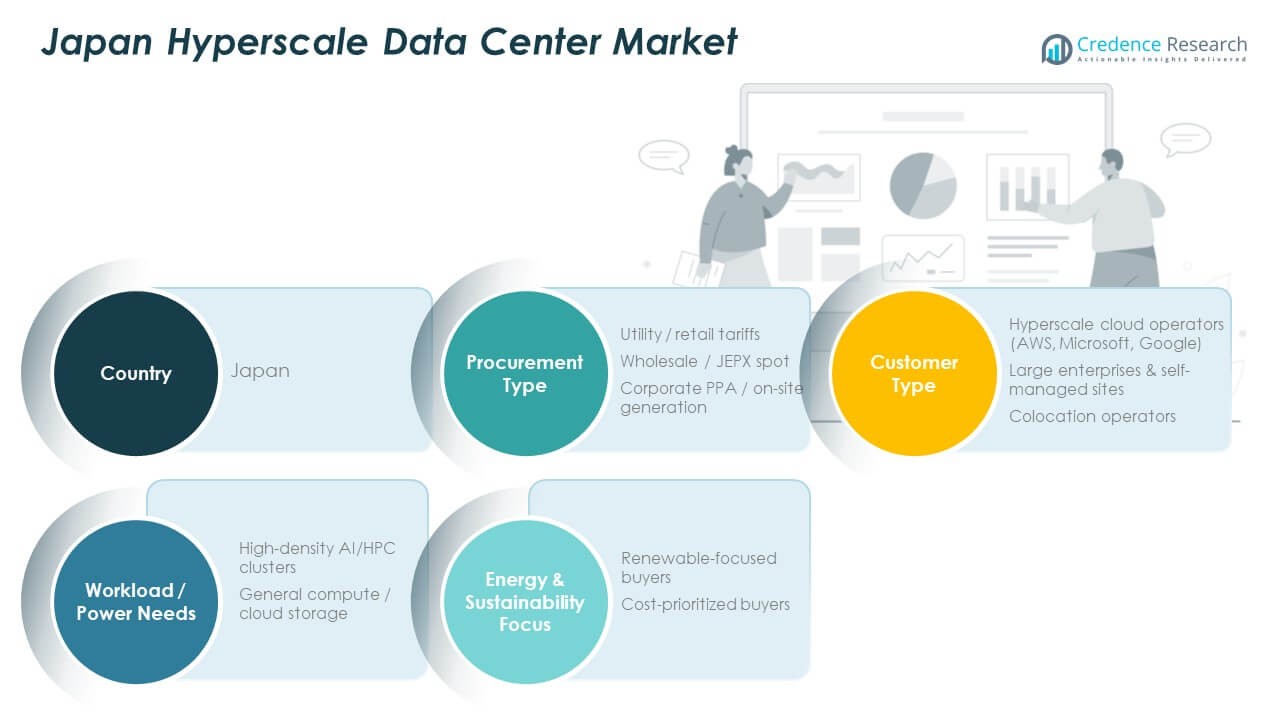
By Procurement Type Dynamics

The procurement landscape in the Japan Hyperscale Data Center Market divides into utility tariffs, wholesale/JEPX spot markets, and corporate PPAs with on-site generation. Corporate PPAs lead the market with an estimated 45% share, as operators secure long-term, stable, and renewable energy sources to meet sustainability goals. Wholesale and JEPX spot purchases follow with about 35%, offering cost flexibility for power-intensive workloads. Utility tariffs hold around 20%, serving smaller facilities or initial build phases. PPA-based sourcing strengthens investor confidence through predictable pricing and ESG alignment, positioning it as the dominant procurement approach for hyperscale operations.

By Customer Type  

Among customer categories, hyperscale cloud operators such as AWS, Microsoft, and Google dominate the Japan Hyperscale Data Center Market with nearly 55% market share. These global providers invest in large-scale campuses across Tokyo and Osaka to support AI workloads and high-availability cloud regions. Colocation operators contribute about 25% of market activity, serving enterprises and tech firms requiring scalable infrastructure without owning facilities. Large enterprises managing in-house centers hold the remaining 20%, focusing on data sovereignty and control. The dominance of hyperscalers reflects Japan’s growing role in Asia’s cloud backbone and enterprise digitization network.

By Workload and Power Needs

Workload segmentation shows high-density AI/HPC clusters leading with roughly 60% of demand. These facilities prioritize advanced cooling systems and high-capacity power delivery to support AI, analytics, and quantum computing applications. General compute and cloud storage workloads capture about 40%, ensuring steady baseline utilization across multi-tenant environments. The Japan Hyperscale Data Center Market continues to expand capacity for AI-driven computing as enterprise analytics and automation requirements rise. High-density workloads attract global investments in specialized infrastructure capable of supporting next-generation processing power and consistent operational efficiency.

By Energy and Sustainability Priorities

Energy and sustainability preferences in the Japan Hyperscale Data Center Market split between renewable-focused and cost-prioritized buyers. Renewable-focused operators command about 65% of the market, driven by corporate carbon-neutral commitments and national energy transition targets. These data centers integrate PPAs, on-site solar generation, and battery storage systems to reduce emissions. Cost-prioritized buyers represent around 35%, focusing on operational efficiency through tariff and wholesale-based sourcing. While both segments remain essential, the renewable-focused category drives future investment direction, aligning hyperscale expansion with Japan’s broader decarbonization and environmental goals.

Regional Insights:

Greater Tokyo Leads With Over Half Market Share

Greater Tokyo remains the dominant sub-region in the Japan Hyperscale Data Center Market. It commands approximately 50% of total capacity and revenue share, given Tokyo’s dense concentration of enterprises, financial institutions, and cloud providers. The region benefits from advanced connectivity, stable power infrastructure, and proximity to corporate headquarters. Many global hyperscalers choose Tokyo for their initial or primary Japan facilities. This concentration makes Greater Tokyo the clear national center for hyperscale data investment and operations.

  • For example, STACK Infrastructure launched a two-building, 36 MW campus in Inzai part of Greater Tokyo to serve hyperscalers and enterprises needing scalable capacity in a prime metropolitan hub.

Greater Osaka Commands Secondary Share with Roughly 20% Market Presence

Greater Osaka holds roughly 20% of the market share. Its appeal stems from lower land and construction costs compared with Tokyo, combined with strong industrial and commercial demand. The region draws operators seeking faster power-supply delivery and shorter site approval times. Renewable-energy availability and supportive infrastructure help attract colocation and hyperscale investments. Enterprises relocating or expanding their data operations often pick Osaka for balanced cost, performance, and reliability.

  • For instance, EdgeConneX announced in 2025 a plan to establish a 350 MW data center platform in the Greater Osaka region, underscoring the area’s growing role as a major infrastructure hub

Emerging Hubs: Hokkaido, Kyushu and Regional Zones Gaining Traction

Regions such as Hokkaido and Kyushu are emerging as growth zones beyond the traditional hubs. Government incentives and renewable energy potential drive interest there. These regions attract operators looking to diversify location risk and improve sustainability. Growing edge- and regional-data demand in smaller prefectures also strengthens their relevance. Over time, these emerging hubs could capture a growing slice of total national share as capacity expands outside core metro zones.

Competitive Insights:

  • NTT (NTT Global Data Centers / NTT Ltd.)
  • Equinix
  • Digital Realty
  • Brightlio
  • IDC Frontier / KDDI (SoftBank group ties)
  • AWS / Microsoft (Hyperscale Occupiers)

The competitive landscape of the Japan Hyperscale Data Center Market shows a clear dominance by global cloud providers and established data-center operators. AWS, Microsoft, and Google lead with large-scale self-built facilities. Equinix and Digital Realty command major presence through colocation and interconnection services. NTT Global Data Centers and SoftBank-backed IDC Frontier exert strong local influence, while KDDI’s Telehouse and Fujitsu cover hybrid and enterprise-grade demands. Colt Data Centre Services and other colocation operators fill niches for smaller firms or edge deployments. Competition hinges on capacity scale, energy sourcing, interconnect quality, and compliance with local regulations. Operators that provide sustainable power, high-density infrastructure, and flexible colocation options hold competitive edge.

Japan Hyperscale Data Center Market SegmentationRecent Developments:

  • In October 2025, NTT Global Data Centers commenced construction on a 36 MW hyperscale data center campus in Osaka, demonstrating their commitment to scaling up capacity in Japan’s key metropolitan regions for hyperscale facilities.
  • In July 2025, NTT Global Data Centers completed a significant buy-out of its subsidiary NTT Data in a $16.4 billion deal, integrating nearly 1 gigawatt of planned data center capacity, including a major 100 MW project in Tochigi, Japan. This move strengthens NTT’s position in the Japan hyperscale data center market and supports their expansion into AI-ready infrastructure.
  • In May 2025, NTT DATA announced accelerated global expansion of its Global Data Centers division with land acquisitions across strategic markets including 32 acres in Tochigi and 8 acres in Osaka, Japan. These developments aim to build multiple high-capacity data centers totaling over 136 MW across these sites.
  • In March 2025, Japanese conglomerate Mitsui acquired a 20MW hyperscale data center in Kanagawa prefecture for 18 billion Yen (approximately $121 million). This acquisition, done through Mitsui & Co., Realty Management (MBRM), is intended as a seed asset for a new digital infrastructure investment fund, marking a strategic expansion of Mitsui’s data center business in Japan.

CHAPTER NO. 1 : INTRODUCTION 21

1.1. Report Description 21

Purpose of the Report 21

USP & Key Offerings 21

1.2. Key Benefits for Stakeholders 22

1.3. Target Audience 22

CHAPTER NO. 2 : EXECUTIVE SUMMARY 23

CHAPTER NO. 3 : JAPAN HYPERSCALE DATA CENTER MARKET FORCES & INDUSTRY PULSE 25

3.1. Foundations of Change – Market Overview 25

3.2. Catalysts of Expansion – Key Market Drivers 27

3.2.1. Momentum Boosters – Growth Triggers 28

3.2.2. Innovation Fuel – Disruptive Technologies 28

3.3. Headwinds & Crosswinds – Market Restraints 29

3.3.1. Regulatory Tides – Compliance Challenges 30

3.3.2. Economic Frictions – Inflationary Pressures 30

3.4. Untapped Horizons – Growth Potential & Opportunities and Strategic Navigation – Industry Frameworks 31

3.5. Market Equilibrium – Porter’s Five Forces 32

3.6. Ecosystem Dynamics – Value Chain Analysis 34

3.7. Macro Forces – PESTEL Breakdown 36

3.8. Provided Facilities: For Greater Tokyo 37

3.9. Market Benchmark: For Greater Tokyo 38

3.10. Key Observations 39

3.11. Market References 40

3.12. Price Trend Analysis 41

3.13. Price Trend by Procurement Type 42

3.14. Buying Criteria 43

CHAPTER NO. 4 : COMPETITION ANALYSIS 44

4.1. Company Market Share Analysis 44

4.1.1. Japan Hyperscale Data Center Market Company Volume Market Share 44

4.1.2. Japan Hyperscale Data Center Market Company Revenue Market Share 46

4.2. Strategic Developments 48

4.2.1. Acquisitions & Mergers 48

4.2.2. New Product Launch 49

4.2.3. Agreements & Collaborations 50

4.3. Competitive Dashboard 51

4.4. Company Assessment Metrics, 2024 52

CHAPTER NO. 5 : JAPAN MARKET ANALYSIS, INSIGHTS & FORECAST, BY PROCUREMENT TYPE 53

CHAPTER NO. 6 : JAPAN MARKET ANALYSIS, INSIGHTS & FORECAST, BY CUSTOMER TYPE 58

CHAPTER NO. 7 : JAPAN MARKET ANALYSIS, INSIGHTS & FORECAST, BY WORKLOAD / POWER NEEDS 65

CHAPTER NO. 8 : JAPAN MARKET ANALYSIS, INSIGHTS & FORECAST, BY ENERGY & SUSTAINABILITY FOCUS 70

CHAPTER NO. 9 : JAPAN MARKET ANALYSIS, INSIGHTS & FORECAST, BY REGION 75

CHAPTER NO. 10 : COMPANY PROFILE 82

10.1. NTT (NTT Global Data Centers / NTT Ltd.) 82

10.2. Equinix 85

10.3. Digital Realty 85

10.4. Brightlio 85

10.5. IDC Frontier / KDDI (SoftBank group ties) 85

10.6. AWS / Microsoft (hyperscale occupiers) 85

10.7. Company 7 85

10.8. Company 8 85

10.9. Company 9 85

10.10. Company 10 85

List of Figures

FIG NO. 1. Japan Hyperscale Data Center Market Revenue Share, By Procurement Type, 2024 & 2032 53

FIG NO. 2. Market Attractiveness Analysis, By Procurement Type 54

FIG NO. 3. Incremental Revenue Growth Opportunity by Procurement Type, 2024 – 2032 55

FIG NO. 4. Japan Hyperscale Data Center Market Revenue Share, By Customer Type, 2024 & 2032 58

FIG NO. 5. Incremental Revenue Growth Opportunity by Customer Type, 2024 – 2032 59

FIG NO. 6. Incremental Revenue Growth Opportunity by Customer Type, 2024 – 2032 60

FIG NO. 7. Japan Hyperscale Data Center Market Revenue Share, By Workload / Power Needs, 2024 & 2032 65

FIG NO. 8. Market Attractiveness Analysis, By Workload / Power Needs 66

FIG NO. 9. Incremental Revenue Growth Opportunity by Workload / Power Needs, 2024 – 2032 67

FIG NO. 10. Japan Hyperscale Data Center Market Revenue Share, By Energy & Sustainability Focus, 2024 & 2032 70

FIG NO. 11. Market Attractiveness Analysis, By Energy & Sustainability Focus 71

FIG NO. 12. Incremental Revenue Growth Opportunity by Energy & Sustainability Focus, 2024 – 2032 72

FIG NO. 13. Japan Hyperscale Data Center Market Revenue Share, By Region, 2024 & 2032 75

FIG NO. 14. Market Attractiveness Analysis, By Region 76

FIG NO. 15. Incremental Revenue Growth Opportunity by Region, 2024 – 2032 77

List of Tables

TABLE NO. 1. : Japan Hyperscale Data Center Market Revenue, By Procurement Type, 2018 – 2024 (USD Million) 56

TABLE NO. 2. : Japan Hyperscale Data Center Market Revenue, By Procurement Type, 2025 – 2032 (USD Million) 56

TABLE NO. 3. : Japan Hyperscale Data Center Market Volume, By Procurement Type, 2018 – 2024 (Megawatts) 57

TABLE NO. 4. : Japan Hyperscale Data Center Market Volume, By Procurement Type, 2025 – 2032 (Megawatts) 57

TABLE NO. 5. : Japan Hyperscale Data Center Market Revenue, By Customer Type, 2018 – 2024 (USD Million) 61

TABLE NO. 6. : Japan Hyperscale Data Center Market Revenue, By Customer Type, 2025 – 2032 (USD Million) 62

TABLE NO. 7. : Japan Hyperscale Data Center Market Volume, By Customer Type, 2018 – 2024 (Megawatts) 63

TABLE NO. 8. : Japan Hyperscale Data Center Market Volume, By Customer Type, 2025 – 2032 (Megawatts) 64

TABLE NO. 9. : Japan Hyperscale Data Center Market Revenue, By Workload / Power Needs, 2018 – 2024 (USD Million) 68

TABLE NO. 10. : Japan Hyperscale Data Center Market Revenue, By Workload / Power Needs, 2025 – 2032 (USD Million) 68

TABLE NO. 11. : Japan Hyperscale Data Center Market Volume, By Workload / Power Needs, 2018 – 2024 (Megawatts) 69

TABLE NO. 12. : Japan Hyperscale Data Center Market Volume, By Workload / Power Needs, 2025 – 2032 (Megawatts) 69

TABLE NO. 13. : Japan Hyperscale Data Center Market Revenue, By Energy & Sustainability Focus, 2018 – 2024 (USD Million) 73

TABLE NO. 14. : Japan Hyperscale Data Center Market Revenue, By Energy & Sustainability Focus, 2025 – 2032 (USD Million) 73

TABLE NO. 15. : Japan Hyperscale Data Center Market Volume, By Energy & Sustainability Focus, 2018 – 2024 (Megawatts) 74

TABLE NO. 16. : Japan Hyperscale Data Center Market Volume, By Energy & Sustainability Focus, 2025 – 2032 (Megawatts) 74

TABLE NO. 17. : Japan Hyperscale Data Center Market Revenue, By Region, 2018 – 2024 (USD Million) 78

TABLE NO. 18. : Japan Hyperscale Data Center Market Revenue, By Region, 2025 – 2032 (USD Million) 78

TABLE NO. 19. : Japan Hyperscale Data Center Market Volume, By Region, 2018 – 2024 (Megawatts) 80

TABLE NO. 20. : Japan Hyperscale Data Center Market Volume, By Region, 2025 – 2032 (Megawatts) 80

Request Free Sample

We prioritize the confidentiality and security of your data. Our promise: your information remains private.

Ready to Transform Data into Decisions?

Request Your Sample Report and Start Your Journey of Informed Choices


Providing the strategic compass for industry titans.

Frequently Asked Questions:

What is the current market size for Japan Hyperscale Data Center Market, and what is its projected size in 2035?

The Japan Hyperscale Data Center Market size was USD 4,710.10 million in 2024. Forecasts project it will reach USD 9,525.51 million by 2032.

At what Compound Annual Growth Rate is the Japan Hyperscale Data Center Market projected to grow between 2025 and 2035?

The Japan Hyperscale Data Center Market is projected to grow at a CAGR of 8.57% between 2024 and 2032.

Which Japan Hyperscale Data Center Market segment held the largest share in 2024?

In 2024, the customer type segment dominated the Japan Hyperscale Data Center Market, with hyperscale cloud operators (e.g., major global cloud providers) holding the largest share of overall demand.

What are the primary factors fueling the growth of the Japan Hyperscale Data Center Market?

Growth in the Japan Hyperscale Data Center Market is driven by strong cloud adoption, rising AI/HPC workload demand, and growing emphasis on renewable energy plus sustainable infrastructure investments.

Who are the leading companies in the Japan Hyperscale Data Center Market?

Key players in the Japan Hyperscale Data Center Market include NTT (NTT Global Data Centers / NTT Ltd.), Equinix, Digital Realty, Brightlio, IDC Frontier / KDDI, and major hyperscale operators such as AWS and Microsoft.

Which region commanded the largest share of the Japan Hyperscale Data Center Market in 2024?

In 2024, the Greater Tokyo region commanded the largest share of the Japan Hyperscale Data Center Market, reflecting its concentration of enterprise demand, robust connectivity, and established infrastructure.

Licence Option

The report comes as a view-only PDF document, optimized for individual clients. This version is recommended for personal digital use and does not allow printing. Use restricted to one purchaser only.
To meet the needs of modern corporate teams, our report comes in two formats: a printable PDF and a data-rich Excel sheet. This package is optimized for internal analysis. Unlimited users allowed within one corporate location (e.g., regional office).
The report will be delivered in printable PDF format along with the report’s data Excel sheet. This license offers 100 Free Analyst hours where the client can utilize DC Market Insights’ research team. Permitted for unlimited global use by all users within the purchasing corporation.

Europe


North America

Smallform of Sample request

Request Sample