
Micro-mobile Data Center Market Size, Share & Forecast to 2035
Market at a glance
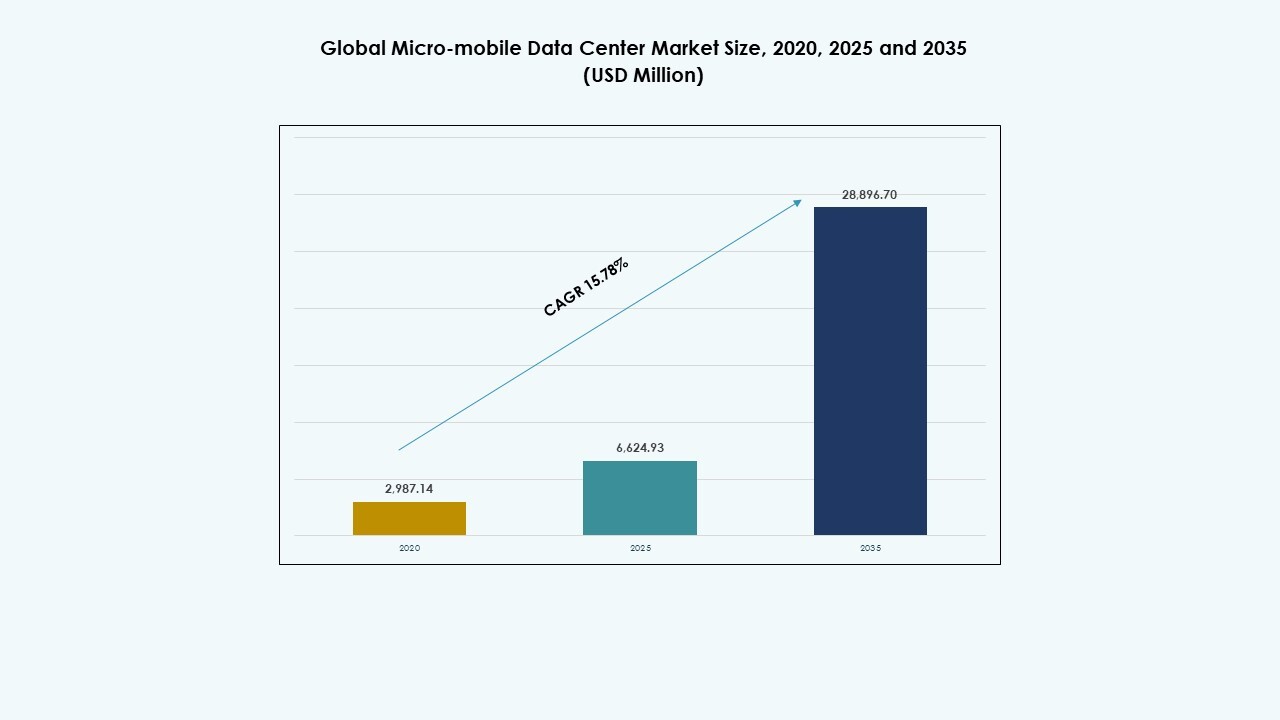
The Micro-mobile Data Center market was worth USD 6,624.9 million in 2025 and is forecast to reach USD 28.90 billion by 2035, growing at a 15.78% CAGR.
 By Priyanka Mor, Senior Consultant
 Reviewed by Deepti Agrawal
Last updated 26 Jul 2026
Base year 2024 PDF + Excel
Reviewed by Deepti Agrawal
Last updated 26 Jul 2026
Base year 2024 PDF + Excel
Key findings
High Initial Deployment And Infrastructure Costs
Growing Adoption Of Edge Data Centers And Distributed Computing
What is inside the report
- 01Introduction
- 02Executive Summary
- 03Market Dynamics
- 04Global Micro-mobile Data Center Market – Market Sizing & Forecast
- 05Global Micro-mobile Data Center Market – By Component
- 06Global Micro-mobile Data Center Market – By Rack Unit Size
- 07Global Micro-mobile Data Center Market – By Project Size
- 08Global Micro-mobile Data Center Market – By Organization Size
- 09Global Micro-mobile Data Center Market – By End-user
- 10Global Micro-mobile Data Center Market – By Region
- 12chapters
- 2020-2023Historical period
- 2025-2035Forecast period
- 15Companies profiled
Segmentation
Companies profiled
- Schneider Electric S
- Dell Technologies Inc
- Huawei Technologies Co., Ltd
- Hewlett Packard Enterprise (HPE)
- Eaton Corporation plc
- Vertiv Holdings Co
- IBM Corporation
- Panduit Corp
- Hitachi Ltd
- Cisco Systems Inc
- Zella DC (Zellabox)
- Cannon Technologies Ltd
- Canovate Group
- Instant Data Centers LLC
- Others
Recent developments
Vertiv announced the global launch of Vertiv SmartRun, a modular prefabricated overhead infrastructure system designed to integrate high-density power distribution busbar, liquid cooling piping network, hot-aisle containment and network infrastructure into a scalable solution for faster data center fit-out.
Dell Technologies announced software-driven disaggregated infrastructure innovations and stated that Dell NativeEdge advancements would be available in July 2025, supporting edge operations and distributed infrastructure management.
Vertiv announced global availability of Vertiv OneCore, a scalable prefabricated solution that integrates power, thermal and IT infrastructure technologies into a factory-assembled system for AI, HPC and high-density data centers.
Eaton announced it would acquire Boyd Thermal for USD 9.5 billion to expand its data center thermal capabilities. Reuters also noted that Eaton earlier acquired Fibrebond, a provider of pre-integrated modular power enclosures used at data centers, for USD 1.4 billion.
Full analysis
Micro-mobile Data Center Market summary
The Global Micro-mobile Data Center Market size was valued at USD 2,987.14 million in 2020 to USD 6,624.93 million in 2025 and is anticipated to reach USD 28,896.70 million by 2035, at a CAGR of 15.78% during the forecast period.
| REPORT ATTRIBUTE | DETAILS |
|---|---|
| Historical Period | 2020-2023 |
| Base Year | 2024 |
| Forecast Period | 2025-2035 |
| Micro-mobile Data Center Market Size 2025 | USD 6,624.93 Million |
| Micro-mobile Data Center Market , CAGR | 15.78% |
| Micro-mobile Data Center Market Size 2035 | USD 28,896.70 Million |
The market is driven by rising demand for edge computing, IoT data processing, rapid deployment and low-latency infrastructure across telecom, industrial, retail, health care, government and defense environments. Micro-mobile data centers combine IT racks, servers, cooling, power supply, monitoring, security and backup systems into compact, portable or prefabricated units. They help organizations deploy computing infrastructure near the point of data generation, reducing latency and supporting real-time applications. Demand is rising as enterprises require resilient infrastructure outside large centralized data centers.
IT and telecommunications remain the leading end-user group because 5G networks, edge computing nodes and distributed digital services require compact and secure infrastructure. BFSI, media and entertainment, health care, government, retail and manufacturing also support adoption through branch-level processing, surveillance, content delivery, smart operations and disaster recovery. Schneider Electric states that EcoStruxure Micro Data Centers enable Industry 4.0 and edge computing by bringing IT infrastructure wherever it is needed, supporting the market’s shift toward distributed computing.
Market Dynamics
Market Drivers
Rising Demand For Edge Computing And IoT Data Processing
Rising demand for edge computing and IoT data processing is a major driver for the Global Micro-mobile Data Center Market. Enterprises increasingly generate data through sensors, cameras, connected machines, mobile devices, retail systems and industrial automation platforms. Sending all data to centralized cloud environments can create latency, bandwidth cost and reliability challenges. Micro-mobile data centers address this need by placing compute, storage and networking closer to the data source. This supports faster analytics, local decision-making and improved application performance. For instance, Rittal states that its RiMatrix Micro Data Center is designed for edge applications requiring real-time, low-latency data processing close to where data is generated.
Need For Rapid And Portable Data Center Deployment
The need for rapid and portable deployment supports strong adoption of micro-mobile data centers. Many organizations require computing capacity in remote offices, industrial sites, disaster recovery locations, defense operations, temporary facilities and regions where traditional data center construction is not practical. Micro-mobile systems reduce deployment time because they arrive as integrated or prefabricated infrastructure with racks, power, cooling, security and monitoring. This makes them suitable for fast-growing digital operations and temporary capacity needs. Vertiv states that micro data centers are self-contained prefabricated units that integrate IT and supporting infrastructure and can be installed quickly and serviced easily.
Expansion Of 5G Networks Requiring Low-Latency Infrastructure
Expansion of 5G networks is increasing demand for micro-mobile data centers because telecom operators need distributed infrastructure to support low-latency services. 5G enables use cases such as industrial automation, autonomous systems, smart cities, connected health care, video analytics and immersive media. These applications require processing closer to users and devices. Micro-mobile data centers help telecom operators and enterprises place computing capacity at network edges, branch locations and local aggregation points. Eaton lists telecommunications, 5G, edge computing, government, health care, transport and retail among applications for its micro data center systems, reflecting broad deployment potential across distributed environments.
Market Restraints
High Initial Deployment And Infrastructure Costs
High initial deployment cost remains a key restraint for the Global Micro-mobile Data Center Market. Although these systems reduce construction complexity, buyers still need to invest in servers, racks, UPS systems, power distribution, cooling, physical security, software, monitoring and integration. Organizations also need site preparation, connectivity, skilled installation and maintenance support. Cost concerns are stronger among small and medium enterprises that may not have continuous edge workloads or dedicated IT teams. Buyers must justify investment through latency improvement, uptime protection, operational resilience or reduced dependence on distant facilities. Vendors need flexible configurations and managed service models to lower adoption barriers.
Limited Scalability Compared To Large Traditional Data Centers
Limited scalability creates another restraint because micro-mobile data centers are compact by design. They support edge and localized processing, but they cannot match the capacity of large hyperscale or colocation facilities. Organizations with fast-growing workloads may need multiple units, which can increase management complexity and cost. This restraint is important for cloud-heavy or AI-intensive users that require large compute clusters. The market must address this challenge through modular expansion, standardized designs and remote management platforms. Micro-mobile facilities will remain complementary to large data centers rather than direct replacements for high-scale centralized infrastructure.
Integration Challenges With Existing IT Infrastructure
Integration challenges can slow adoption, especially in enterprises with legacy networks, on-premises systems, cloud platforms and distributed security policies. Micro-mobile data centers must connect with existing IT service management, cybersecurity, data center infrastructure management and cloud environments. Operators also need standardized policies for backup, monitoring, user access, patching and compliance. Integration becomes more difficult when units are deployed across remote branches or industrial sites with limited IT staff. Vendors that provide pre-integrated systems, automation software and remote monitoring can reduce implementation risk and improve adoption across large distributed organizations.
Market Opportunities
Growing Adoption Of Edge Data Centers And Distributed Computing
Edge data centers and distributed computing create strong opportunities for the Global Micro-mobile Data Center Market. Enterprises are shifting toward architectures that combine centralized cloud infrastructure with local processing. This model supports low-latency applications, bandwidth optimization and business continuity. Micro-mobile data centers are well positioned because they offer compact, modular and deployable infrastructure for edge environments. They can serve retail stores, factories, hospitals, telecom towers, transportation hubs and remote offices. Eaton states that modular data center systems help deploy data center capacity quickly and with less risk, supporting AI, edge computing and cloud services.
Increasing Use In Remote, Defense, Mining And Disaster Recovery Sites
Remote, defense, mining and disaster recovery sites offer major growth opportunities because these environments require rugged, portable and secure computing infrastructure. Micro-mobile data centers can support field operations, command centers, exploration sites, emergency response, mobile health facilities and remote industrial operations. They improve resilience by enabling local processing when connectivity to central data centers is weak or disrupted. Government and defense users also value physical security, rapid deployment and controlled data handling. These requirements support demand for ruggedized enclosures, backup power, integrated cooling and remote monitoring. Vendors with secure, durable and configurable systems can gain strong traction in this opportunity area.
Digitalization And Cloud Adoption In Emerging Markets
Emerging markets create long-term opportunity as enterprises, governments and telecom operators invest in digital services, cloud adoption and localized computing infrastructure. Micro-mobile data centers can help organizations deploy IT capacity without building large traditional facilities. They support branch banking, public services, telecom nodes, smart city systems, retail chains and industrial operations. This opportunity is especially relevant in Asia Pacific, the Middle East, Latin America and Africa, where digital infrastructure expansion is accelerating. Compact and prefabricated designs can help customers overcome constraints related to land, power, skilled labor and construction time.
Technology Trends
Prefabricated And Modular Micro-data Center Solutions
Prefabricated and modular designs are a key technology trend in the Global Micro-mobile Data Center Market. These systems reduce deployment complexity by combining racks, cooling, power, security and monitoring into standardized units. Modular designs help customers add capacity in phases and deploy units across multiple sites with consistent configuration. This trend supports telecom edge nodes, retail branches, industrial plants and disaster recovery sites. It also improves quality because systems can be assembled and tested in controlled environments before shipment. Vertiv’s micro-modular data center portfolio includes SmartRow, SmartMod and SmartCabinet systems, reflecting strong vendor focus on integrated modular edge infrastructure.
Adoption Of Advanced And Energy-Efficient Cooling Technologies
Energy-efficient cooling is becoming more important as micro-mobile data centers support higher compute density in compact footprints. Operators require cooling systems that can maintain uptime in constrained environments while limiting power consumption. Demand is rising for intelligent airflow management, compact precision cooling, liquid cooling integration and rugged environmental control. This trend is especially important in industrial, remote, telecom and edge sites where ambient conditions can be difficult. The International Energy Agency projects global data center electricity consumption to reach around 945 TWh by 2030, which strengthens the need for more efficient power and cooling infrastructure across both centralized and edge data centers.
AI-Based Monitoring And Automated Data Center Management Systems
AI-based monitoring and automation are gaining adoption because micro-mobile data centers are often deployed in distributed sites with limited local IT staff. Automated management systems track power, temperature, humidity, access, alarms and equipment health. AI-based tools can support predictive maintenance, energy optimization and faster incident response. This trend improves reliability and reduces the need for frequent on-site visits. Software platforms such as DCIM, remote monitoring and automation tools are becoming critical because operators may manage hundreds or thousands of edge units across different locations. This trend supports growth in the software and services components of the market.
Market Segmentation
By Component
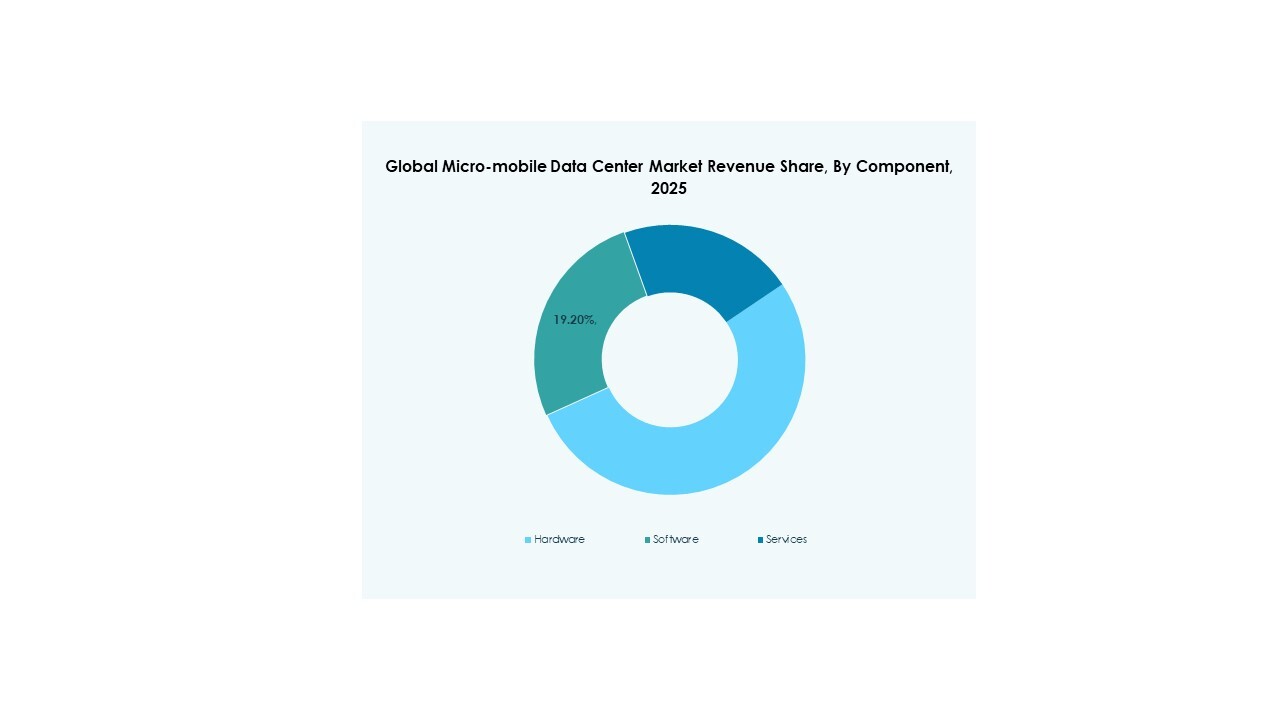
The Global Micro-mobile Data Center Market by component includes hardware, software and services. Hardware led the segment with 43.10% share in 2025 because micro-mobile systems require servers, racks, cooling systems, power supply, backup power, physical security and enclosures. Software accounted for 21.51% share due to rising adoption of DCIM, monitoring, automation and remote management platforms. Services represented 17.20% share, supported by installation, integration, maintenance and lifecycle support requirements. The supplied component-share estimates do not account for the full 100% of the market, but they clearly indicate hardware as the leading revenue contributor due to the physical infrastructure-heavy nature of micro-mobile deployments.
By Rack Unit Size
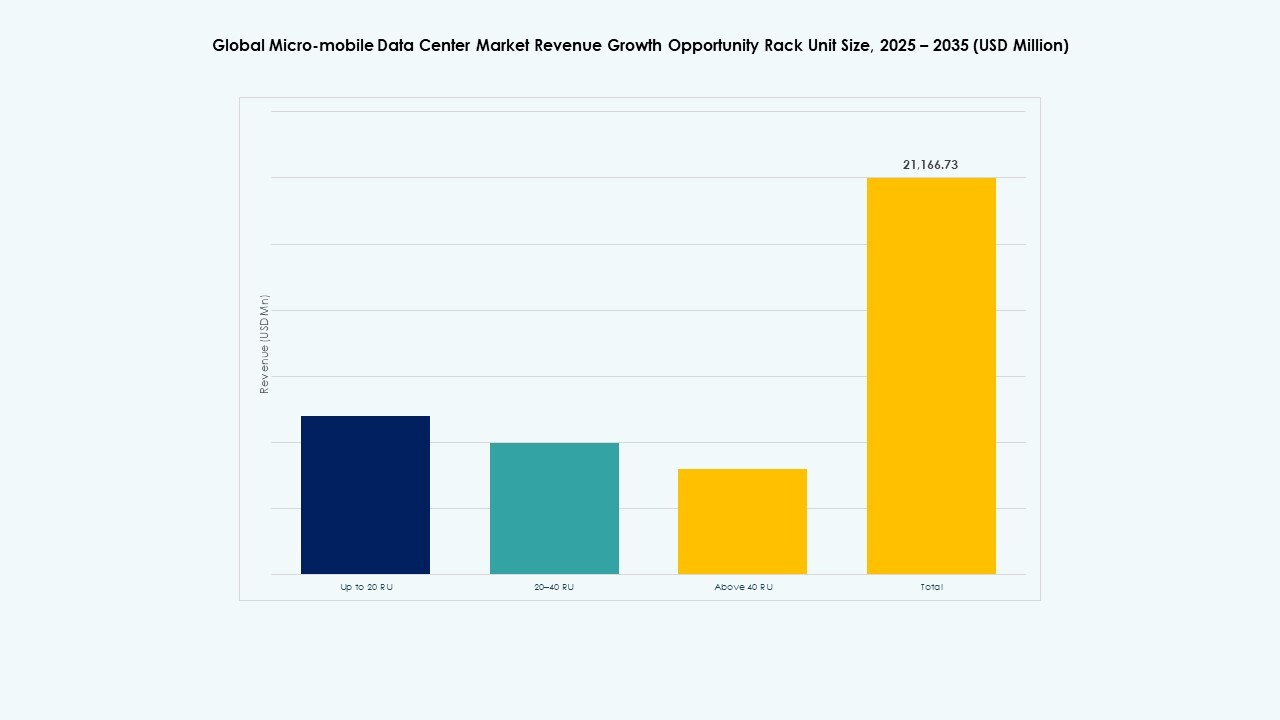
The market by rack unit size includes up to 20 RU, 20-40 RU and above 40 RU. The 20-40 RU segment held the largest share in 2025 because it offers a practical balance between compact deployment and sufficient IT capacity for branch, telecom, enterprise and industrial edge workloads. Up to 20 RU systems are preferred for smaller offices, retail outlets, remote monitoring stations and lightweight edge workloads. Above 40 RU systems serve larger edge environments, instant data centers and industrial facilities with higher compute or storage needs. Demand is shifting toward flexible rack configurations that can support phased expansion and easier serviceability.
By Project Size
The market by project size includes edge computing, instant data centers and remote office or branch office deployments. Edge computing led the segment in 2025 due to growing demand for localized data processing, low latency and distributed infrastructure. Instant data centers are gaining traction where organizations need rapid deployment for temporary capacity, disaster recovery, remote operations or fast-growing digital sites. Remote office and branch office deployments remain important for banking, retail, health care, education and public-sector applications. Micro-mobile systems support these project types by combining compact design, faster setup and integrated infrastructure in one deployable platform.
By Organization Size
The market by organization size includes large enterprises and small and medium enterprises. Large enterprises held the dominant share in 2025 because they operate multiple sites, branch networks, factories, telecom nodes, warehouses and mission-critical facilities. These organizations have stronger budgets for distributed IT infrastructure, remote monitoring and cybersecurity. SMEs represent a smaller but growing customer group because micro-mobile units allow them to deploy reliable IT capacity without building a full data center. SME adoption is strongest where businesses require local processing, secure backup, point-of-sale resilience or remote office support. Managed service models can accelerate adoption among smaller organizations.
By End-user
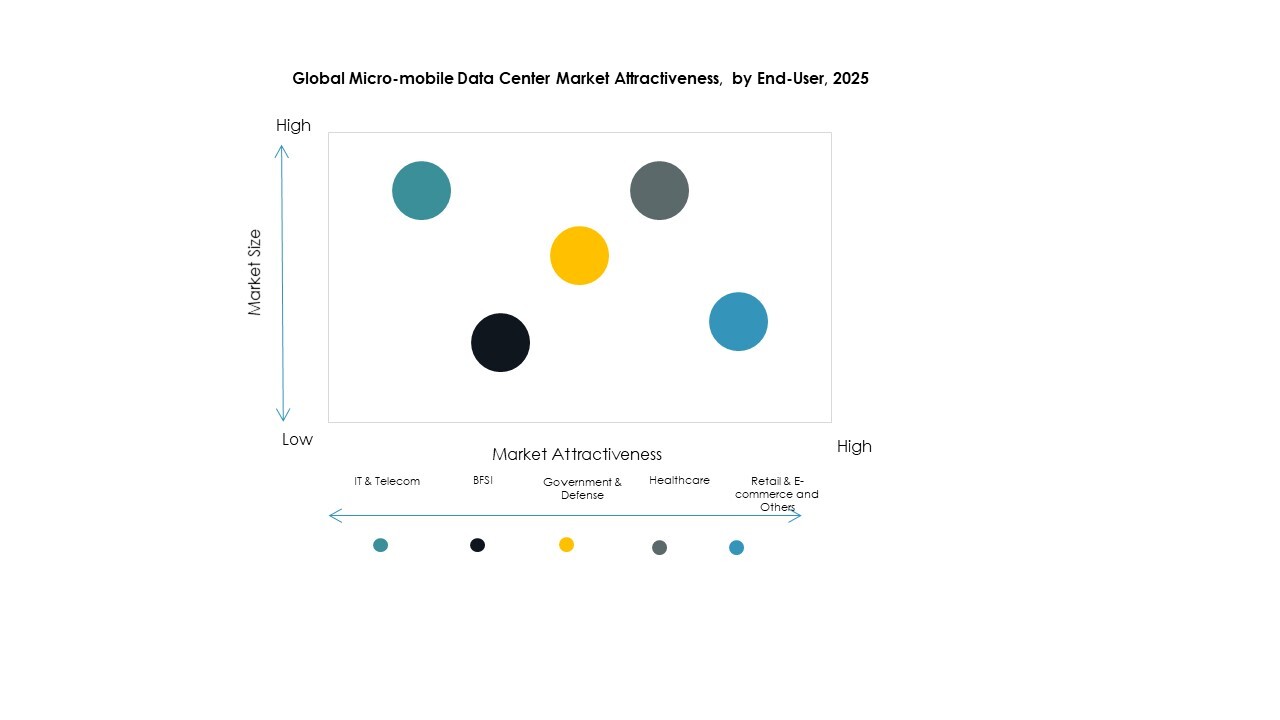
The Global Micro-mobile Data Center Market by end-user includes IT and telecommunications, BFSI, media and entertainment, health care, government and defense, retail, manufacturing and others. IT and telecommunications led the market in 2025 due to 5G rollout, edge computing, network modernization and distributed cloud requirements. BFSI uses micro-mobile systems for secure branch-level processing and backup. Media and entertainment demand is supported by content delivery and streaming. Health care requires local processing for patient data and imaging. Government and defense value secure portable infrastructure, while retail and manufacturing use it for store systems, automation and industrial IoT.
Regional Insights
North America Maintains Leadership Through Edge Computing, Cloud Adoption And Distributed Enterprise Infrastructure
North America led the Global Micro-mobile Data Center Market in 2025 due to strong cloud adoption, widespread edge computing deployment and mature enterprise IT infrastructure. The United States remains the largest regional contributor because telecom operators, retailers, manufacturers, health care providers and government agencies use distributed data center systems to support low-latency services and business continuity. Canada adds demand through public-sector digitalization, remote-site infrastructure and enterprise cloud adoption. The region also benefits from a strong vendor base that includes Schneider Electric, Dell Technologies, HPE, Eaton, Vertiv, IBM and Cisco Systems. Demand remains strong as AI, IoT and 5G applications push computing closer to users and assets.
Europe Advances Through Industry 4.0, Data Security And Energy-Efficient Edge Infrastructure
Europe represents a major market due to demand from Industry 4.0, telecom networks, regulated industries and energy-conscious enterprise users. Germany, the UK, France, the Nordics, Italy and Spain support strong adoption through manufacturing automation, retail digitization, health care IT and public-sector modernization. European users often prioritize secure, efficient and compliant infrastructure, which supports demand for micro-mobile data centers with integrated monitoring, physical protection and efficient cooling. Schneider Electric states that its EcoStruxure Micro Data Centers support industry 4.0, edge computing and EcoStruxure reference designs, which aligns with Europe’s industrial and edge infrastructure needs.
Asia Pacific Emerges As The Fastest-Growing Region With Telecom, Manufacturing And Cloud Expansion
Asia Pacific is expected to show the fastest growth in the Global Micro-mobile Data Center Market due to rapid digitalization, 5G rollout, industrial automation, smart city programs and cloud adoption. China, India, Japan, South Korea, Australia and Southeast Asia remain important demand centers. Manufacturing, telecom, retail, banking and government sectors are increasing deployment of localized compute infrastructure. Emerging economies in the region also benefit from micro-mobile data centers because they can deploy digital infrastructure faster than traditional facilities. Huawei, Hitachi, Schneider Electric, Vertiv and Dell Technologies support regional competition through edge, modular and enterprise infrastructure solutions.
Latin America, The Middle East And Africa Gain Ground Through Telecom Modernization And Remote-Site Demand
Latin America, the Middle East and Africa remain smaller but growing markets. Brazil, Mexico, the UAE, Saudi Arabia and South Africa are key demand centers due to telecom modernization, cloud expansion, smart city programs and distributed enterprise infrastructure. Mining, oil and gas, defense, retail and public-sector users also create demand for remote and portable data center systems. Micro-mobile data centers can support local compute needs in environments where connectivity, construction timelines and facility availability remain constraints. Long-term growth will depend on power availability, network coverage, digitalization pace and local service ecosystems.
Competitive Insights
- Schneider Electric S
- Dell Technologies Inc
- Huawei Technologies Co., Ltd
- Hewlett Packard Enterprise (HPE)
- Eaton Corporation plc
- Vertiv Holdings Co.
- IBM Corporation
- Panduit Corp.
- Rittal GmbH & Co. KG
- Hitachi Ltd.
- Cisco Systems Inc.
- Zella DC (Zellabox)
- Cannon Technologies Ltd.
- Canovate Group
- Instant Data Centers LLC
- Others
The Global Micro-mobile Data Center Market features competition among data center infrastructure providers, IT hardware companies, enclosure manufacturers, edge computing vendors and modular facility specialists. Schneider Electric, Vertiv, Eaton, Rittal, Canovate, Cannon Technologies and Instant Data Centers compete through prefabricated and modular data center systems, power infrastructure, cooling, racks and integrated physical protection. Dell Technologies, HPE, Cisco Systems, IBM, Huawei and Hitachi compete through servers, edge computing platforms, networking, software and enterprise IT ecosystems. Panduit and Zella DC support demand through enclosure, connectivity and edge infrastructure solutions. Competition is shaped by deployment speed, physical security, cooling efficiency, remote management, service coverage, rack flexibility and integration with enterprise IT environments.
Recent Developments
- In March 2025, Vertiv announced the global launch of Vertiv SmartRun, a modular prefabricated overhead infrastructure system designed to integrate high-density power distribution busbar, liquid cooling piping network, hot-aisle containment and network infrastructure into a scalable solution for faster data center fit-out.
- In May 2025, Dell Technologies announced software-driven disaggregated infrastructure innovations and stated that Dell NativeEdge advancements would be available in July 2025, supporting edge operations and distributed infrastructure management.
- In August 2025, Vertiv announced global availability of Vertiv OneCore, a scalable prefabricated solution that integrates power, thermal and IT infrastructure technologies into a factory-assembled system for AI, HPC and high-density data centers.
- In November 2025, Eaton announced it would acquire Boyd Thermal for USD 9.5 billion to expand its data center thermal capabilities. Reuters also noted that Eaton earlier acquired Fibrebond, a provider of pre-integrated modular power enclosures used at data centers, for USD 1.4 billion.
Table of contents
- 01Introduction
- 1.1Market Definition & Scope
- 1.2Research Methodology
- 1.2.1Primary Research
- 1.2.2Secondary Research
- 1.2.3Data Validation & Assumptions
- 1.3Market Segmentation Framework
- 02Executive Summary
- 2.1Market Snapshot
- 2.2Key Findings
- 2.3Analyst Recommendations
- 2.4Market Outlook (2025–2035)
- 03Market Dynamics
- 3.1Market Drivers
- 3.2Market Restraints
- 3.3Market Opportunities
- 3.4Challenges & Risks
- 3.5Value Chain Analysis
- 3.6Porter’s Five Forces Analysis
- 3.7Market Attractiveness by Segment
- 3.7.1Component
- 3.7.2Rack Unit Size
- 3.7.3Application
- 3.7.4Organization Size
- 3.7.5End-user
- 3.7.6Region
- 04Global Micro-mobile Data Center Market – Market Sizing & Forecast
- 4.1Historical Market Size (2020–2025)
- 4.2Forecast Market Size (2026–2035)
- 4.3Market Growth Rate Analysis
- 4.4Market Outlook by Region
- 05Global Micro-mobile Data Center Market – By Component
- 5.1Hardware (servers, racks, cooling systems, power supply, security)
- 5.2Software (DCIM, monitoring, automation)
- 5.3Services (installation, integration, maintenance)
- 06Global Micro-mobile Data Center Market – By Rack Unit Size
- 6.1Up to 20 RU
- 6.220–40 RU
- 6.3Above 40 RU
- 07Global Micro-mobile Data Center Market – By Project Size
- 7.1Edge Computing
- 7.2Instant Data Centers
- 7.3Remote Office / Branch Office (ROBO)
- 08Global Micro-mobile Data Center Market – By Organization Size
- 8.1Large Enterprises
- 8.2Small & Medium Enterprises (SMEs)
- 09Global Micro-mobile Data Center Market – By End-user
- 9.1IT & Telecommunications
- 9.2BFSI
- 9.3Media & Entertainment
- 9.4Healthcare
- 9.5Government & Defense
- 9.6Retail
- 9.7Manufacturing
- 9.8Others
- 10Global Micro-mobile Data Center Market – By Region
- 10.1North America
- 10.1.1U.S.
- 10.1.2Canada
- 10.1.3Mexico
- 10.2Europe
- 10.2.1UK
- 10.2.2France
- 10.2.3Germany
- 10.2.4Italy
- 10.2.5Spain
- 10.2.6Russia
- 10.2.7Rest of Europe
- 10.3Asia-Pacific
- 10.3.1China
- 10.3.2Japan
- 10.3.3South Korea
- 10.3.4India
- 10.3.5Australia
- 10.3.6Rest of Asia Pacific
- 10.4Latin America
- 10.4.1Brazil
- 10.4.2Rest of Latin America
- 10.5Middle East
- 10.5.1GCC
- 10.5.2Israel
- 10.5.3Turkey
- 10.5.4Rest of Middle East
- 10.6Africa
- 10.6.1South Africa
- 10.6.2Rest of Africa
- 11Competitive Landscape
- 11.1Market Share Analysis
- 11.2Key Player Strategies
- 11.3Mergers, Acquisitions & Partnerships
- 11.4Product & Service Launches
- 12Company Profiles
- 12.1Schneider Electric SE
- 12.2Dell Technologies Inc.
- 12.3Huawei Technologies Co., Ltd.
- 12.4Hewlett Packard Enterprise (HPE)
- 12.5Eaton Corporation plc
- 12.6Vertiv Holdings Co.
- 12.7IBM Corporation
- 12.8Panduit Corp.
- 12.9Rittal GmbH & Co. KG
- 12.10Hitachi Ltd.
- 12.11Cisco Systems Inc.
- 12.12Zella DC (Zellabox)
- 12.13Cannon Technologies Ltd.
- 12.14Canovate Group
- 12.15Instant Data Centers LLC
- 12.16Others
About this report
Written by Priyanka Mor and reviewed by Deepti Agrawal, Senior Editor, Research. Figures are built top-down and bottom-up and reconciled before publication, with 2024 as the base year.
Read our methodologyHow we built this
- Historical period2020-2023
- Base year2024
- Forecast period2025-2035
- Sizing approachTop-down + bottom-up
Need more than the report?
Advisory on this market
Due diligence, site selection and market entry work, by the analysts who wrote this report.
See consulting servicesFrequently asked questions
The Global Micro-mobile Data Center Market size was valued at USD 6,624.93 million in 2025 and is projected to reach USD 28,896.70 million by 2035.
The Global Micro-mobile Data Center Market is projected to grow at a CAGR of 15.78% between 2025 and 2035.
By component, hardware held the largest share in 2025 with 43.10% share. Hardware leads because micro-mobile data centers require servers, racks, cooling systems, power supply, security systems and integrated enclosures.
The market is primarily driven by rising demand for edge computing and IoT data processing, need for rapid and portable data center deployment and expansion of 5G networks requiring low-latency infrastructure. Growth is also supported by distributed computing, remote-site infrastructure and enterprise digitalization.
The leading companies in the Global Micro-mobile Data Center Market include Schneider Electric SE, Dell Technologies Inc., Huawei Technologies Co. Ltd., Hewlett Packard Enterprise, Eaton Corporation plc, Vertiv Holdings Co., IBM Corporation, Panduit Corp., Rittal GmbH & Co. KG, Hitachi Ltd., Cisco Systems Inc., Zella DC, Cannon Technologies Ltd., Canovate Group, Instant Data Centers LLC and others.
IT and telecommunications are expected to dominate the market due to 5G rollout, edge computing, network modernization and distributed cloud infrastructure requirements.
Licences, delivery and payment
Which licence should I choose?
Single User is a view-only PDF for one person. Multi User adds a printable PDF and the Excel data for unlimited users at one location. Enterprise covers your whole company and includes 100 free analyst hours.
How and when will I receive the report?
By email, within 24–48 business hours of payment, in the formats of your licence.
How can I pay?
Securely through PayPal: with a PayPal account, a debit or credit card, or PayPal Pay Later where available. Prices are in US dollars.
Can I see a sample first?
Yes. Request a free sample and we will email it to you.
Can the report be tailored to my needs?
Yes. We can add countries, segments or data cuts. Talk to an analyst about the scope you need.
Can I get an invoice or pay against a purchase order?
Write to sales@dcmarketinsights.com and our team will help.