Executive summary:
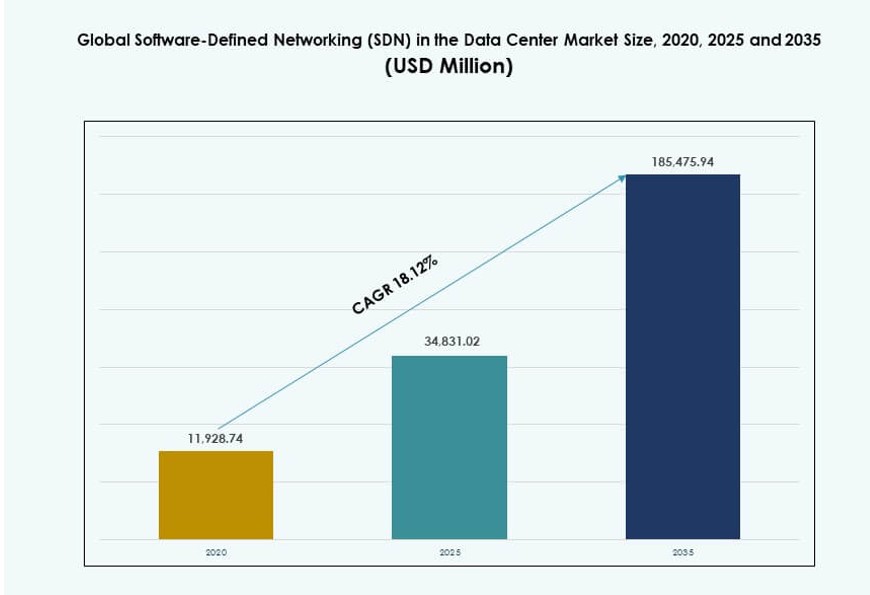
The Global Software-Defined Networking (SDN) in the Data Center Market size was valued at USD 11,928.74 million in 2020 to USD 34,831.02 million in 2025 and is anticipated to reach USD 185,475.94 million by 2035, at a CAGR of 18.12% during the forecast period.
| REPORT ATTRIBUTE |
DETAILS |
| Historical Period |
2020-2023 |
| Base Year |
2024 |
| Forecast Period |
2025-2035 |
| Software-Defined Networking (SDN) in the Data Center Market Size 2025 |
USD 34,831.02 Million |
| Software-Defined Networking (SDN) in the Data Center Market, CAGR |
18.12% |
| Software-Defined Networking (SDN) in the Data Center Market Size 2035 |
USD 185,475.94 Million |
The market advances due to rapid cloud adoption and rising demand for network automation. Enterprises prioritize programmable networks to manage complex traffic patterns. Innovation in controllers, analytics, and security strengthens adoption. Hyperscale and colocation expansion supports scalable SDN architectures. Businesses view this market as critical for agility and cost control. Investors value recurring software revenue and long-term infrastructure relevance.
North America leads the market due to early cloud maturity and hyperscale presence. Europe follows with strong enterprise digitization and compliance-driven upgrades. Asia Pacific emerges rapidly due to data center expansion in China, India, and Southeast Asia. Telecom-led digital growth supports adoption in the Middle East. Latin America and Africa show gradual uptake through cloud-first strategies and regional investments.
Market Dynamics:
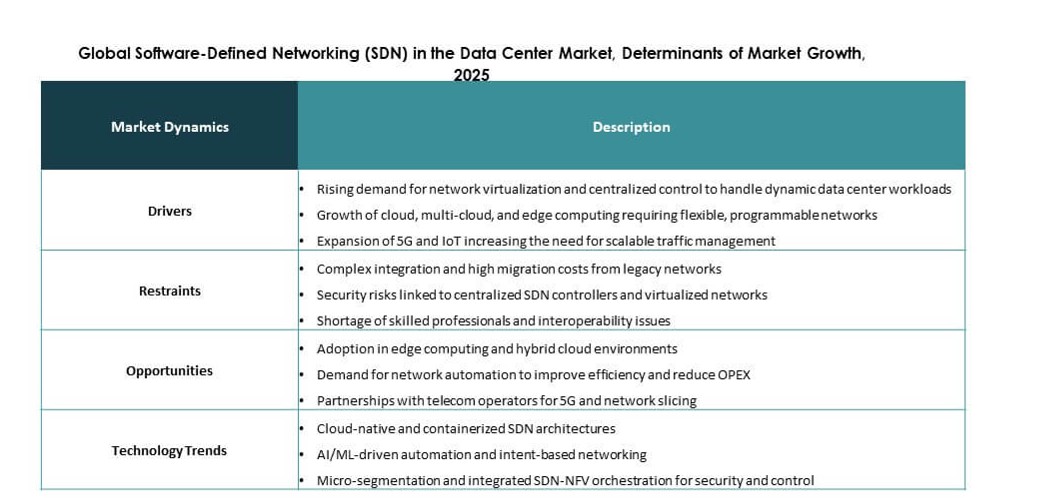
Market Drivers
Rising Demand for Programmable and Centralized Network Control Across Modern Data Centers
Enterprises require agile networks that adapt quickly to workload changes and traffic patterns. Traditional networking limits scalability and slows service delivery. Software-defined networking enables centralized control and faster configuration. Cloud-native applications increase east–west traffic inside data centers. Operators seek tools that simplify traffic management and reduce manual tasks. Automation improves uptime and service quality. The Global Software-Defined Networking (SDN) in the Data Center Market supports flexible network design. Investors view this shift as core to digital infrastructure growth.
- For instance, Cisco’s N9100 Series delivers up to 51.2 Tbps of switching capacity to support massive AI clusters and ultra‑dense fabrics in modern data centers.
Expansion of Cloud, Hyperscale, and Colocation Data Centers Worldwide
Public cloud adoption accelerates data center expansion across regions. Hyperscale operators deploy large and complex network fabrics. SDN supports consistent policy control across distributed facilities. Colocation providers use it to offer customizable services. Network abstraction improves multi-tenant isolation. Faster provisioning improves customer experience. The Global Software-Defined Networking (SDN) in the Data Center Market benefits from these deployment models. Businesses value predictable network performance and cost control.
- For instance, Arista’s R4 Series platforms support up to 576 ports of 800GbE in a single chassis to handle hyperscale traffic demands with high throughput.
Growing Need for Network Automation and Operational Cost Optimization
Data center operators face pressure to reduce operating expenses. Manual network configuration raises error rates and downtime risk. SDN platforms enable automated provisioning and policy enforcement. Centralized visibility improves troubleshooting speed. Reduced hardware dependency lowers capital spending. Software-driven upgrades extend infrastructure life. The Global Software-Defined Networking (SDN) in the Data Center Market aligns with efficiency goals. Financial stakeholders favor platforms that improve margins.
Rising Focus on Security, Compliance, and Traffic Visibility
Cyber risks continue to grow across enterprise networks. Data centers require fine-grained security controls. SDN enables microsegmentation and dynamic policy updates. Central controllers enforce uniform security rules. Visibility tools improve traffic monitoring and threat detection. Regulatory compliance requires auditable network policies. The Global Software-Defined Networking (SDN) in the Data Center Market addresses these priorities. Strategic investors consider security-driven demand a stable driver.
Market Trends
Integration of SDN With Cloud-Native and Container Networking Platforms
Enterprises deploy containerized workloads across hybrid environments. SDN integrates with Kubernetes and cloud orchestration layers. Unified control improves workload mobility. Policy consistency supports multi-cloud strategies. Network abstraction simplifies application deployment. Vendors align products with DevOps workflows. The Global Software-Defined Networking (SDN) in the Data Center Market reflects this convergence. Platform flexibility shapes purchasing decisions.
Shift Toward Vendor-Neutral and Open Networking Architectures
Buyers seek freedom from proprietary network stacks. Open APIs enable multi-vendor interoperability. White-box switches gain acceptance in large data centers. Software layers define network behavior. Cost transparency improves procurement planning. Operators gain stronger bargaining power. The Global Software-Defined Networking (SDN) in the Data Center Market supports open ecosystems. Technology investors favor scalable software-first models.
Rising Adoption of AI-Driven Network Analytics and Policy Optimization
Data center networks generate massive telemetry data. AI tools help predict congestion and failures. SDN controllers integrate analytics engines. Automated policy tuning improves traffic flow. Predictive insights reduce downtime risks. Network teams rely on data-driven decisions. The Global Software-Defined Networking (SDN) in the Data Center Market evolves toward intelligence-led control. Advanced analytics raise platform value.
Growing Use of SDN in Edge and Distributed Data Center Environments
Edge data centers support latency-sensitive applications. Distributed sites require centralized management. SDN enables remote configuration and monitoring. Lightweight controllers suit smaller facilities. Policy consistency improves service reliability. Telecom and enterprise edge use cases expand. The Global Software-Defined Networking (SDN) in the Data Center Market extends beyond core facilities. This trend broadens addressable demand.
Market Challenges
Complex Integration With Legacy Network Infrastructure and Skills Gaps
Many data centers rely on legacy hardware and protocols. Integration raises deployment complexity and costs. Interoperability issues slow adoption timelines. Network teams require new software skills. Training investments increase short-term expenses. Operational risk concerns delay upgrades. The Global Software-Defined Networking (SDN) in the Data Center Market faces cautious buyers. Vendors must simplify migration paths.
Concerns Around Controller Reliability, Security, and Performance Scalability
Centralized controllers create perceived single points of failure. High traffic loads test controller performance limits. Security breaches raise serious operational risks. Enterprises demand strong redundancy models. Performance validation takes time and resources. Trust builds slowly across regulated sectors. The Global Software-Defined Networking (SDN) in the Data Center Market must address resilience expectations. These concerns influence long buying cycles.
Market Opportunities
Growth Potential in Hybrid Cloud and Multi-Cloud Network Management
Enterprises adopt hybrid IT strategies across private and public clouds. SDN provides unified policy control. Seamless workload mobility supports business continuity. Network abstraction reduces operational friction. Service providers expand managed SDN offerings. The Global Software-Defined Networking (SDN) in the Data Center Market gains from hybrid demand. This area attracts strong enterprise spending.
Expansion Across Emerging Markets and Mid-Sized Enterprises
Digital transformation accelerates in emerging economies. SMEs seek cost-efficient network solutions. Cloud-based SDN reduces upfront investment. Simplified deployment suits limited IT teams. Regional data center growth supports adoption. The Global Software-Defined Networking (SDN) in the Data Center Market reaches new customer tiers. Vendors can scale through subscription models.
Market Segmentation
By Solution
The solution segment includes SDN controllers, switches, and gateways. SDN controllers dominate due to centralized network intelligence and policy control. Switches gain demand from white-box and open networking adoption. Gateways support interconnection across hybrid environments. The Global Software-Defined Networking (SDN) in the Data Center Market benefits from controller-led architectures. Growth drivers include automation needs and traffic visibility. Vendors focus on software differentiation. Controllers capture the largest revenue share.
By Services
Services cover integration, consulting, and support functions. Integration and deployment lead due to complex rollout requirements. Consulting supports network design and migration planning. Support services ensure uptime and policy compliance. The Global Software-Defined Networking (SDN) in the Data Center Market depends on service expertise. Enterprises value vendor-led implementation. Recurring support revenue improves vendor stability. Service demand rises with large deployments.
By Deployment Model
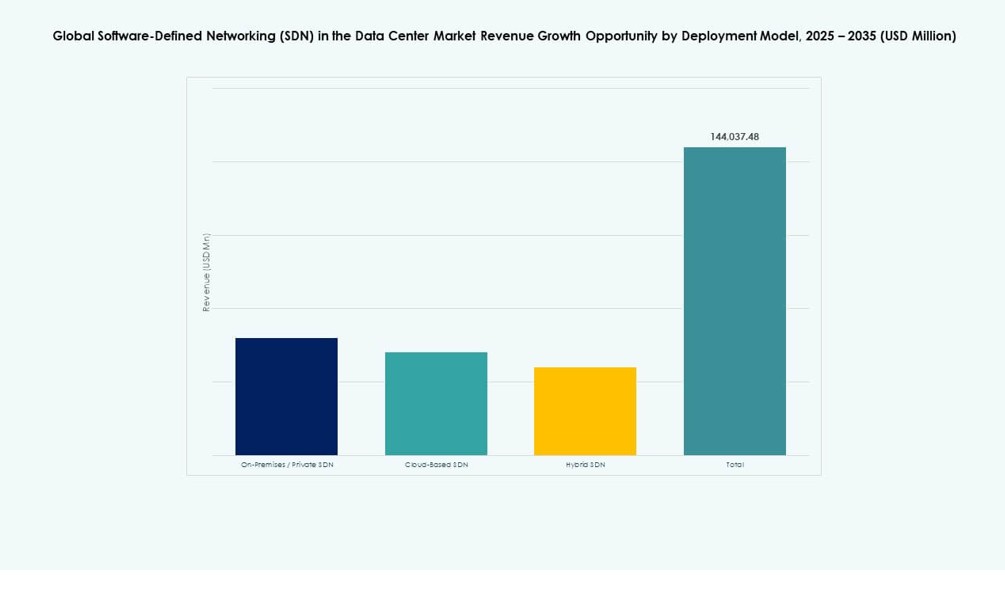
Deployment models include on-premises, cloud-based, and hybrid SDN. Hybrid SDN leads due to mixed IT environments. Cloud-based SDN grows fast among SMEs. On-premises remains relevant for regulated sectors. The Global Software-Defined Networking (SDN) in the Data Center Market reflects hybrid dominance. Flexibility drives adoption decisions. Security and control influence model choice.
By Architecture
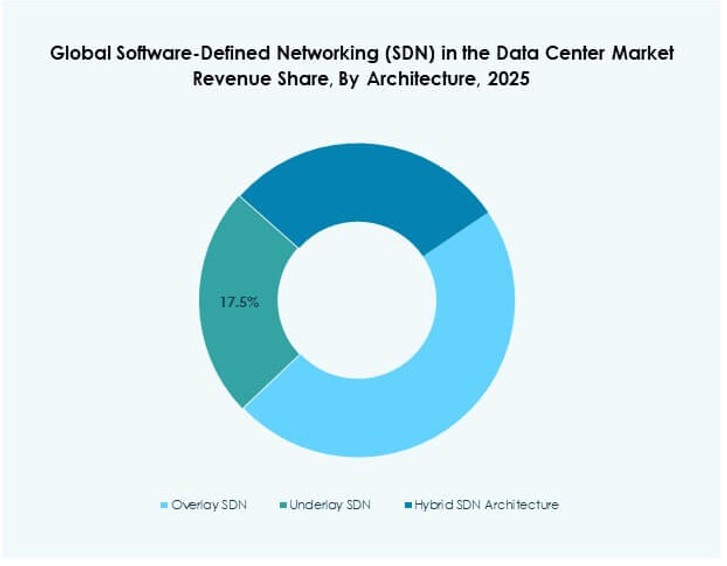
Architectures include overlay, underlay, and hybrid SDN. Overlay SDN holds the largest share due to ease of deployment. Underlay supports high-performance environments. Hybrid architecture combines flexibility and performance. The Global Software-Defined Networking (SDN) in the Data Center Market favors overlay solutions. Minimal hardware changes accelerate uptake. Enterprises prefer gradual transitions.
By Organization Size
Large enterprises account for the majority share due to complex networks. SMEs adopt cloud-based SDN for cost efficiency. Large firms invest in advanced automation. SMEs value simplified management tools. The Global Software-Defined Networking (SDN) in the Data Center Market serves both segments. Pricing flexibility supports SME growth. Enterprise demand remains stable.
By Application
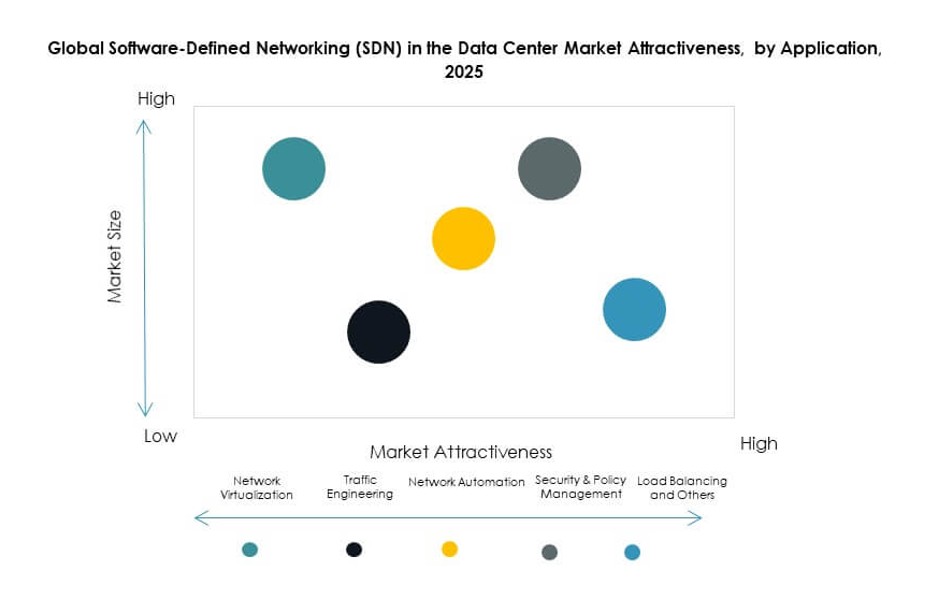
Network virtualization leads application adoption. Traffic engineering supports performance optimization. Automation improves operational efficiency. Security and policy management gain priority. Load balancing and interconnect support scale-out designs. Cloud networking expands multi-cloud use. The Global Software-Defined Networking (SDN) in the Data Center Market sees virtualization as core. Application diversity supports steady growth.
By End-User
IT and telecom dominate due to large-scale networks. BFSI adopts SDN for security and compliance. Healthcare values reliability and data protection. Government and defense require policy control. Retail and manufacturing support digital operations. Education adopts cloud-based models. The Global Software-Defined Networking (SDN) in the Data Center Market benefits from broad adoption. IT and telecom hold the largest share.
Regional Insights
North America
North America holds nearly 38% market share due to early technology adoption. The United States leads with hyperscale deployments. Cloud providers drive SDN investments. Colocation growth supports demand. Enterprise automation remains strong. The Global Software-Defined Networking (SDN) in the Data Center Market shows high maturity here. Canada and Mexico contribute steady growth.
Europe
Europe accounts for around 27% market share. Regulatory compliance shapes network design choices. Enterprises adopt SDN for efficiency and security. Western Europe leads adoption rates. Data sovereignty drives private SDN use. The Global Software-Defined Networking (SDN) in the Data Center Market gains from digital initiatives. Germany, UK, and France dominate demand.
- For instance, Nokia’s Nuage Networks provided SDN solutions for Orange Business Services across multiple European markets, enabling automated multi-tenant networks with secure virtual overlays.
Asia-Pacific
Asia-Pacific represents nearly 25% market share with rapid expansion. China and India lead data center builds. Cloud adoption accelerates across enterprises. Telecom operators invest in SDN. Cost-sensitive markets favor cloud-based models. The Global Software-Defined Networking (SDN) in the Data Center Market grows fastest here. Regional investments remain strong.
- For instance, Alibaba Cloud deployed its in-house SDN platform to manage dynamic workloads across its hyperscale data centers in China, optimizing traffic routing and tenant isolation for large-scale e-commerce and AI services.
Competitive Insights:
- Cisco Systems
- VMware
- Juniper Networks
- Arista Networks
- Hewlett Packard Enterprise (HPE)
- Huawei Technologies
- Nokia
- Dell Technologies
- IBM
- Ciena Corporation
The competitive landscape of the Global Software-Defined Networking (SDN) in the Data Center Market features a mix of traditional networking giants and specialized software vendors. Cisco and VMware lead with comprehensive SDN portfolios that integrate across hybrid environments. Juniper Networks and Arista Networks focus on high-performance networking for hyperscale and cloud-first operators. HPE and Dell Technologies provide integrated SDN infrastructure with data center hardware. Huawei and Nokia compete strongly in telecom-oriented deployments. IBM and Ciena enhance SDN offerings with analytics and orchestration capabilities. It remains a highly consolidated market where innovation, interoperability, and scalability drive vendor positioning. Strategic investments in AI-powered network intelligence and multi-cloud integration continue to define product differentiation. Partnerships, acquisitions, and SDN-specific R&D play key roles in strengthening market share.
Recent Developments
- In October 2025, Cisco launched the N9100 data center switch, the first NVIDIA partner-developed solution using Spectrum-X Ethernet silicon for SDN in AI workloads. It supports scalable, secure networking across neocloud and enterprise data centers.
- In October 2025, Arista Networks introduced its R4 Series platforms, including 7800R4 and 7280R4 routers with 800GbE and 3.2Tbps HyperPorts for SDN in AI data centers. These systems feature EOS software for EVPN/VXLAN overlays, deep buffering, and wire-speed encryption to optimize high-scale backbones and leaf-spine architectures.