Key takeaways
- Data center water consumption is now a local sustainability issue, not only a global technology issue. A facility’s impact depends on its cooling system, water source, climate, grid mix and workload density.
- AI is increasing the urgency because graphics processing units, or GPUs, create more heat per rack than many traditional enterprise servers. Higher heat density raises the need for better thermal design.
- Cooling efficiency can create trade-offs. Evaporative cooling can reduce electricity use but consume more water. Air cooling can save water but may raise power demand during hot weather.
- Water usage effectiveness, or WUE, helps measure water efficiency. It shows how many liters of water a data center uses for each kilowatt-hour of IT energy.
- The best cooling strategy is site-specific. Operators should balance water availability, power cost, carbon impact, local regulation and community acceptance.
The issue in one view
Data centers use water because computing equipment generates heat every second. Servers, storage systems, networking equipment and power systems must stay within safe temperature ranges. If cooling fails, equipment performance drops and downtime risk rises.
This issue is growing because data centers are scaling quickly. The International Energy Agency projects global data center electricity consumption will more than double to about 945 terawatt-hours by 2030. That would represent just under 3% of global electricity consumption in 2030.
Water demand is also rising. Lawrence Berkeley National Laboratory estimated that U.S. data centers consumed 66 billion liters of direct water in 2023, up from 21.2 billion liters in 2014. Hyperscale and colocation facilities accounted for 84% of the 2023 total.
The debate should not stop at “data centers use too much water.” The better question is: Which facility uses what type of water, in which watershed, during which season, and for what workload?
What data center water consumption means
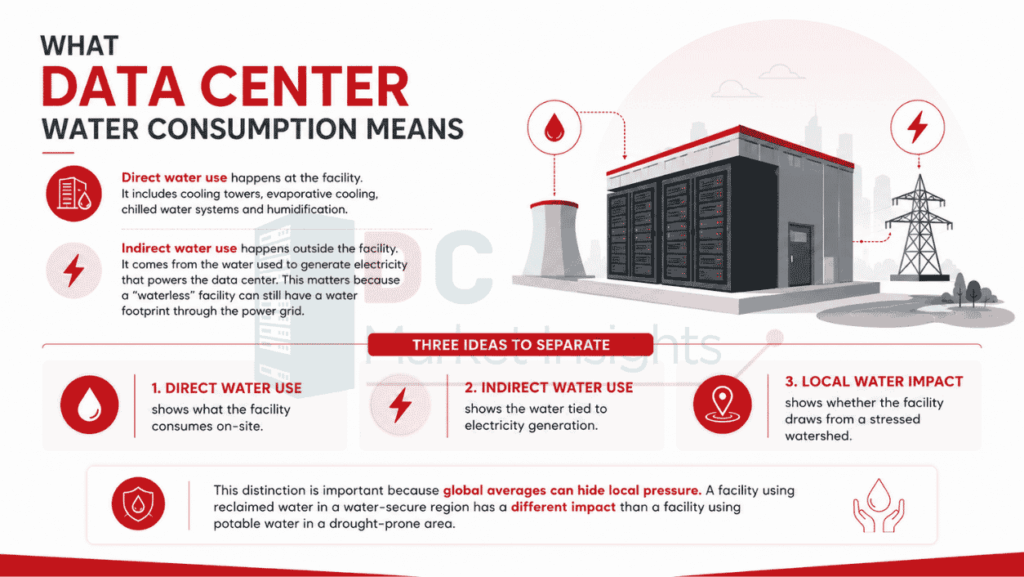
Data center water consumption means the water used to operate and cool digital infrastructure. Direct water use happens at the facility. It includes cooling towers, evaporative cooling, chilled water systems and humidification.
Indirect water use happens outside the facility. It comes from the water used to generate electricity that powers the data center. This matters because a “waterless” facility can still have a water footprint through the power grid.
You should separate three ideas when reading data center water claims:
- Direct water use shows what the facility consumes on-site.
- Indirect water use shows the water tied to electricity generation.
- Local water impact shows whether the facility draws from a stressed watershed.
This distinction is important because global averages can hide local pressure. A facility using reclaimed water in a water-secure region has a different impact than a facility using potable water in a drought-prone area.
Why cooling is becoming harder
Cooling is becoming harder because modern workloads pack more computing power into smaller spaces. AI training, AI inference, high-performance computing and dense cloud infrastructure push rack power higher.
Traditional air cooling worked well for many enterprise workloads. It becomes less effective when a rack contains dense GPU servers. More power per rack means more heat per square foot.
This change is forcing operators to rethink data center design. Cooling now affects land selection, power contracts, water planning, building layout and permitting.
You can see this shift in Microsoft’s new designs. The company said it launched a data center design in August 2024 that optimizes AI workloads and uses zero water for cooling. Microsoft said the design can avoid more than 125 million liters of water use per year per data center.
How data centers use water for cooling
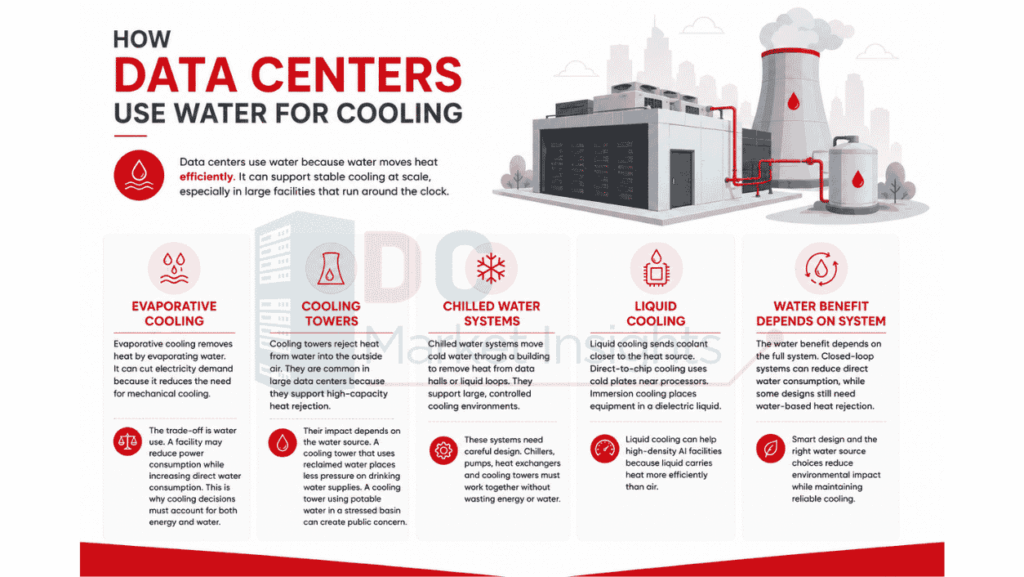
Data centers use water because water moves heat efficiently. It can support stable cooling at scale, especially in large facilities that run around the clock.
Evaporative cooling
Evaporative cooling removes heat by evaporating water. It can cut electricity demand because it reduces the need for mechanical cooling.
The trade-off is water use. A facility may reduce power consumption while increasing direct water consumption. This is why cooling decisions must account for both energy and water.
Cooling towers
Cooling towers reject heat from water into the outside air. They are common in large data centers because they support high-capacity heat rejection.
Their impact depends on the water source. A cooling tower that uses reclaimed water places less pressure on drinking water supplies. A cooling tower using potable water in a stressed basin can create public concern.
Chilled water systems
Chilled water systems move cold water through a building to remove heat from data halls or liquid loops. They support large, controlled cooling environments.
These systems need careful design. Chillers, pumps, heat exchangers and cooling towers must work together without wasting energy or water.
Liquid cooling
Liquid cooling sends coolant closer to the heat source. Direct-to-chip cooling uses cold plates near processors. Immersion cooling places equipment in a dielectric liquid.
Liquid cooling can help high-density AI facilities because liquid carries heat more efficiently than air. The water benefit depends on the full system. Closed-loop systems can reduce direct water consumption, while some designs still need water-based heat rejection.
Why this is a sustainability issue
Data center water consumption is a sustainability issue because water is local. Carbon dioxide mixes globally, but water shortages happen in specific basins, cities and seasons.
A data center can look efficient in a corporate sustainability report and still face local opposition. Residents want to know whether the project will affect drinking water, agriculture, energy prices or drought resilience.
This is why WUE alone is not enough. WUE can show efficiency, but it does not always show water source, seasonal stress or community impact.
Google’s approach shows how operators are now framing this issue. The company says it balances energy and water trade-offs when selecting cooling methods. Google also reported that 86% of freshwater withdrawals across its data center fleet came from sources at low or medium risk of depletion or scarcity.
That data point is useful, but facility-level context still matters. A global fleet figure does not answer every question for a town near one large project.
The AI factor
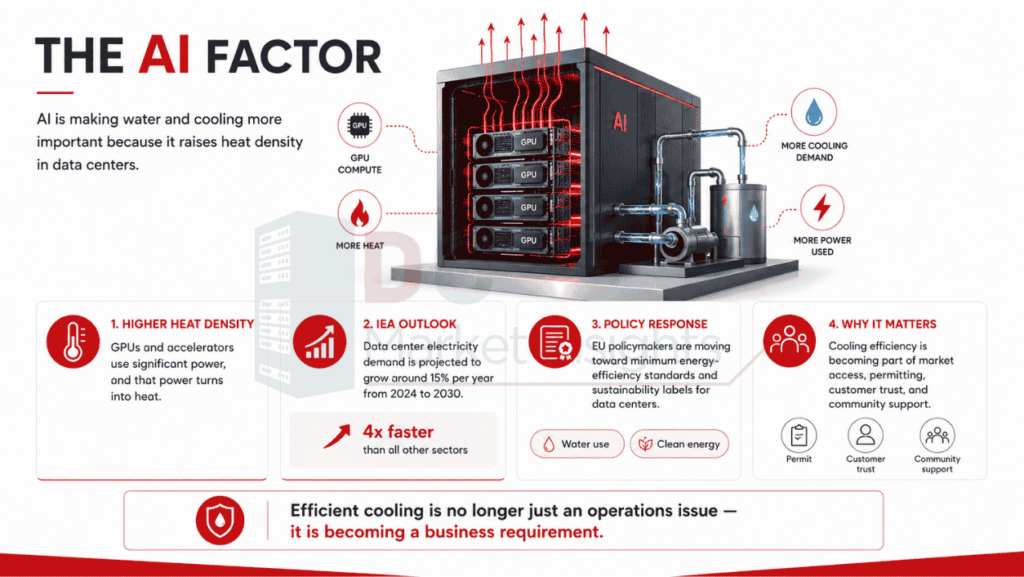
AI is making water and cooling more important because it increases heat density. GPUs and accelerators need significant power, and that power turns into heat.
The IEA projects data center electricity demand will grow around 15% per year from 2024 to 2030. That growth is more than four times faster than electricity demand growth from all other sectors.
Regulators are responding. Reuters reported in June 2026 that the European Union plans minimum energy-efficiency standards for data centers. The proposal also includes a sustainability label based on metrics such as water use and clean energy consumption.
This matters for operators because cooling efficiency is becoming part of market access. A project may need to prove resource efficiency before it secures permits, customers or community support.
Cooling efficiency and water efficiency are not the same
Cooling efficiency and water efficiency are connected, but they are not identical. This is the point many articles miss.
A system can save electricity by using evaporative cooling. That can lower energy costs and emissions, especially on a carbon-heavy grid. It can also increase water consumption.
A system can save water by using more air cooling or closed-loop liquid cooling. That can reduce local water demand. It may increase electricity use in hot climates if the design is not optimized.
The right choice depends on the site. A cool, humid region, a hot desert region and a water-rich industrial zone need different cooling strategies.
The strongest sustainability case answers three questions:
- Does the design reduce total resource impact?
- Does it protect the local watershed?
- Does it support reliable operations during heat waves and drought?
Key metrics you should understand
Power usage effectiveness
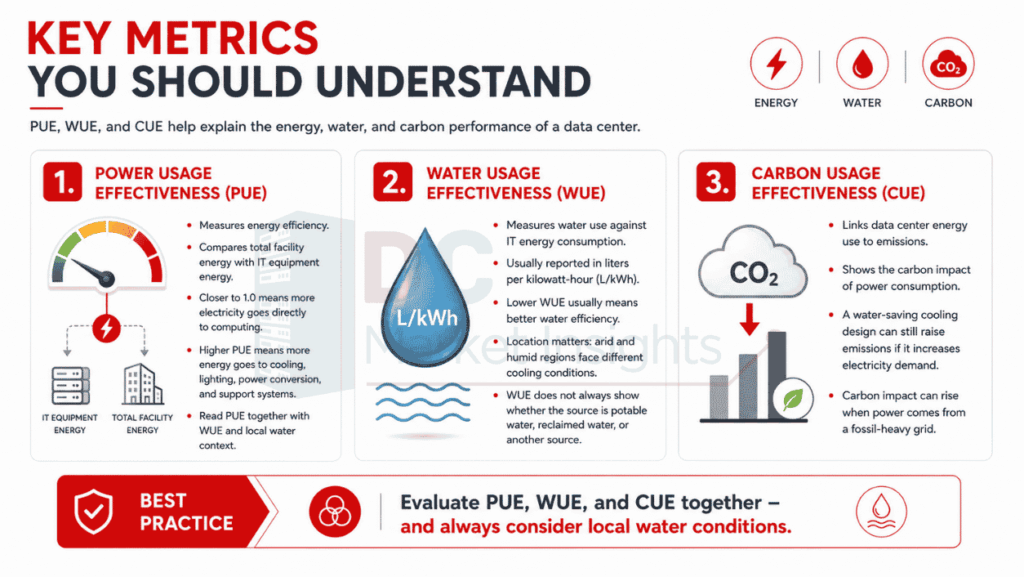
Power usage effectiveness, or PUE, measures energy efficiency. It compares total facility energy use with the energy used by IT equipment.
A PUE closer to one means more electricity goes directly to computing. A higher PUE means more electricity goes to cooling, lighting, power conversion and other support systems.
PUE is useful, but it can reward designs that save electricity while using more water. You should read it with WUE and local water data.
Water usage effectiveness
Water usage effectiveness, or WUE, measures water use against IT energy consumption. It is usually reported in liters per kilowatt-hour.
Microsoft defines WUE as a metric that tracks water use relative to electricity consumed. The company notes that location affects WUE because data centers in arid and humid regions face different cooling conditions.
A lower WUE usually signals better water efficiency. It does not always show whether the facility uses potable water, reclaimed water or another source.
Carbon usage effectiveness
Carbon usage effectiveness, or CUE, links data center energy use to emissions. It helps operators understand the carbon impact of power consumption.
CUE matters because a water-saving cooling system can increase electricity demand. If that electricity comes from a fossil-heavy grid, carbon impact can rise.
The real risk is local mismatch
The biggest risk is not water use alone. The biggest risk is a mismatch between facility design and local conditions.
A data center in a hot, dry region may need more cooling during the same months when water supplies face pressure. A project in a fast-growing city may compete with housing, industry and agriculture for the same infrastructure.
This creates a planning challenge. Operators need to assess water stress, seasonal availability, grid reliability and climate trends before choosing a site.
Uptime Institute has also emphasized that water is local. Its 2024 cooling system survey found that only 14% of respondents with water-cooled data centers used more than 16 million gallons, or 60,000 cubic meters, per year. The finding shows why facility-level data matters more than broad assumptions.
Business risks for data center operators
Regulatory pressure
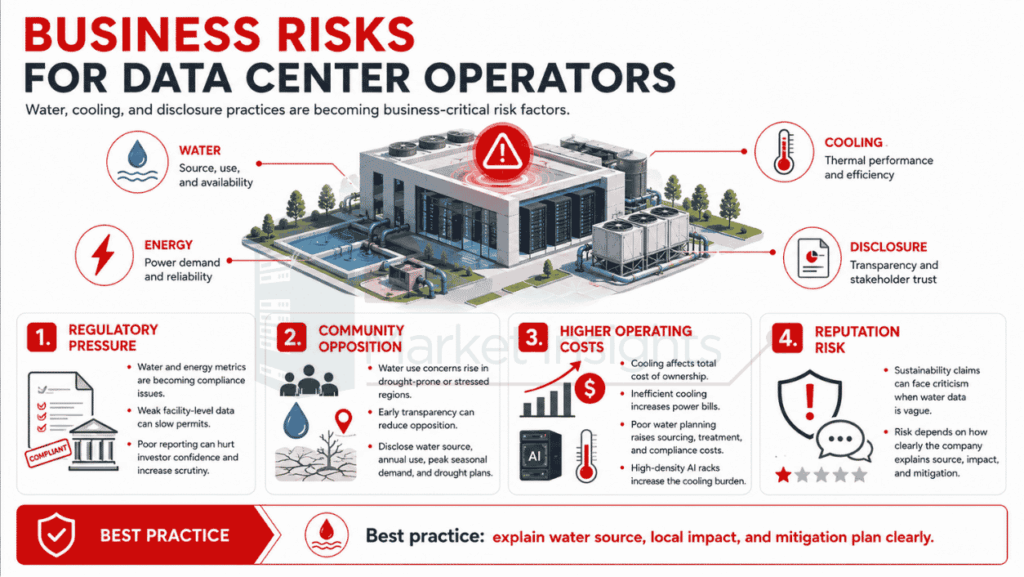
Governments are moving toward stricter reporting. The EU’s planned data center standards show that water and energy metrics are becoming compliance issues, not only sustainability disclosures.
This raises risk for operators that lack facility-level data. Poor reporting can slow permits, weaken investor confidence and increase public scrutiny.
Community opposition
Communities may oppose data centers when water use is unclear. Concern grows when facilities are planned in drought-prone regions or near stressed municipal systems.
Operators can reduce this risk with early transparency. They should disclose water source, expected annual use, peak seasonal demand and drought plans.
Higher operating costs
Cooling affects total cost of ownership. Inefficient cooling increases power bills. Poor water planning can raise sourcing, treatment and compliance costs.
AI workloads make this more serious. A high-density rack that draws more power also raises the cooling burden.
Reputation risk
Data center companies often make strong sustainability claims. Those claims can face criticism if water use data is vague or local impacts are not clear.
Reputation risk is not only about how much water a company uses. It is about whether the company explains the source, impact and mitigation plan.
Technologies reducing data center water demand
Closed-loop liquid cooling
Closed-loop liquid cooling can cut water use because coolant recirculates instead of evaporating. This approach is becoming more relevant for AI infrastructure.
Microsoft said its next-generation design avoids water evaporation for cooling and can save more than 125 million liters per year per data center.
Chip-level cooling
Chip-level cooling brings cooling closer to processors. It improves heat removal and supports higher rack densities.
This design can reduce reliance on air movement. It can also help operators fit more compute capacity into a smaller footprint.
Reclaimed water
Reclaimed water reduces pressure on potable supplies. It can support cooling towers or other systems where water quality requirements allow it.
This solution works best when municipalities, utilities and operators coordinate early. It may require new treatment and distribution infrastructure.
AI-based cooling control
AI-based cooling control can optimize temperatures, airflow and equipment performance in real time. It can reduce overcooling and identify hot spots before they create failures.
This is one of the most practical efficiency levers because it improves existing operations. Operators do not always need a new building to cut waste.
Heat reuse
Heat reuse captures waste heat and sends it to nearby buildings, district heating systems, greenhouses or industrial users.
Heat reuse does not always reduce direct water consumption. It improves total resource efficiency by turning waste heat into useful energy.
What operators should do now
Data center operators should treat water as a design constraint from the first site review. It should not be added later as a sustainability message.
First, map local water risk. The analysis should include watershed stress, seasonal drought risk, municipal capacity and competing demand.
Second, model cooling options by climate. Compare air cooling, evaporative cooling, chilled water, liquid cooling and hybrid systems under real weather conditions.
Third, disclose the water source. You should separate potable water, reclaimed water, surface water, groundwater and industrial water.
Fourth, track both WUE and PUE. A low PUE is not enough if it shifts pressure to local water. A low WUE is not enough if it increases emissions.
Fifth, plan for extreme heat. Cooling systems should work during heat waves, droughts and grid stress, not only average conditions.
Sixth, engage the community early. Operators should explain water use, job creation, infrastructure upgrades and mitigation plans before opposition builds.
What readers should look for in company claims
You should question broad sustainability claims that lack facility-level detail. A strong claim should include the location, water source, annual water use and WUE.
You should also check whether the company includes indirect water use. Electricity generation can add a large hidden water footprint.
You should look for clear language on “water positive” claims. A company may fund water replenishment projects, but the benefit may occur in a different basin from the facility.
The most credible operators will publish measurable data. They will explain trade-offs instead of presenting one cooling system as a universal solution.
Future outlook
Cooling efficiency will become a competitive advantage in the data center market. Customers, regulators and communities will ask for proof that facilities can scale without straining local resources.
AI will push more operators toward liquid cooling, closed-loop systems and hybrid thermal designs. Traditional air cooling will remain useful, but it will not solve every high-density workload.
Water disclosure will also improve. Regulators are already moving toward stronger efficiency and sustainability reporting. Investors will likely ask more questions about water risk in site selection and expansion planning.
The next generation of data centers will compete on compute capacity, uptime, power access and sustainability performance. Water strategy will be part of that competition.
Conclusion
Data center water consumption is becoming a critical sustainability issue because digital growth now depends on physical resources. Servers may power cloud services and AI tools, but they still need land, electricity and cooling.
Cooling efficiency is the center of the challenge. Operators must remove heat reliably while protecting local water supplies and controlling energy use.
The best data center strategy will not chase one metric. It will balance WUE, PUE, carbon impact, water source and local resilience.
For readers, the main lesson is simple. Do not judge data center water use by headline numbers alone. Look at the site, the cooling system, the source of water and the local context.