Home » China Data Center Cooling Market

China Data Center Cooling Market By Component (Solutions, Services); By Cooling Technique (Liquid Cooling, Air-Based Cooling); By Data Center Type (Enterprise, Colocation, Hyperscale); By Industry Vertical (BFSI, IT & Telecom, Healthcare, Government & Defense, Others); By End User (Cloud Providers, Colocation Providers, Enterprises); By Region – Growth, Share, Opportunities & Competitive Analysis, 2025 – 2035

Report ID: 7087 | Report Format : Excel, PDF

Executive summary:

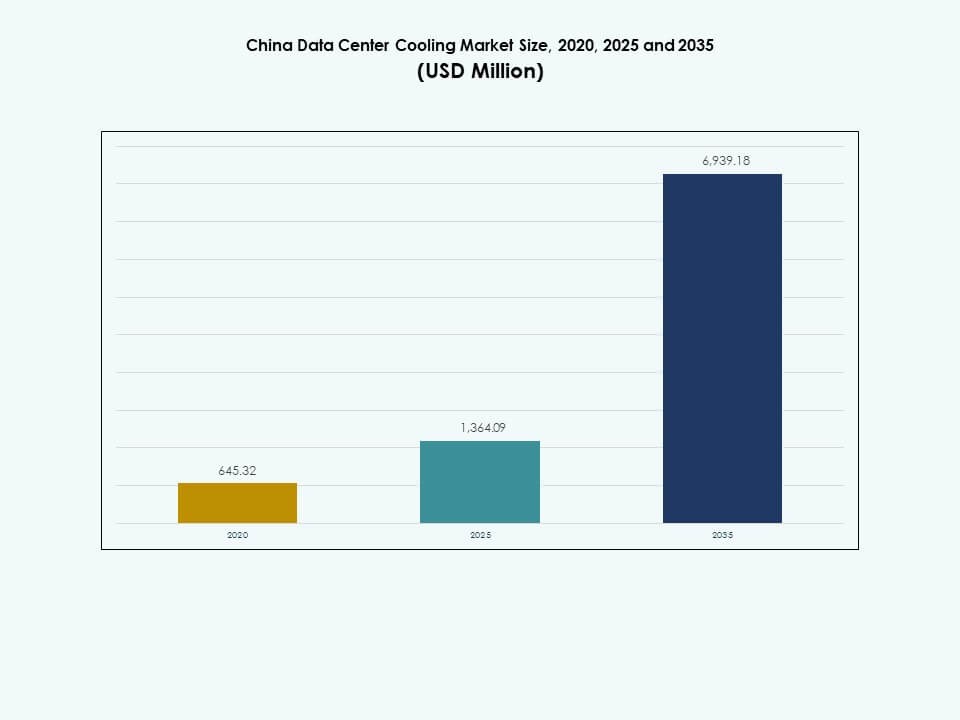
The China Data Center Cooling Market size was valued at USD 645.32 million in 2020, rising to USD 1,364.09 million in 2025, and is anticipated to reach USD 6,939.18 million by 2035, at a CAGR of 17.51% during the forecast period.

REPORT ATTRIBUTE DETAILS
Historical Period 2020-2023
Base Year 2024
Forecast Period 2025-2035
China Data Center Cooling Market Size 2025 USD 1,364.09 Million
China Data Center Cooling Market, CAGR 17.51%
China Data Center Cooling Market Size 2035 USD 6,939.18 Million


Rapid cloud growth, AI-driven computing loads, and rising rack densities continue to fuel the need for advanced cooling designs. Operators shift toward liquid cooling, smart automation, and energy-efficient architectures to stabilize thermal conditions across dense environments. Innovation in system design strengthens performance while supporting sustainability goals for data-driven industries. The market’s strategic importance rises as businesses and investors rely on efficient systems to safeguard uptime, improve energy use, and support high-volume processing demands.

Eastern China leads due to established hyperscale hubs and strong enterprise adoption across major coastal cities. Northern provinces gain traction through new campuses backed by favorable climate conditions and expanding cloud services. Southern regions show steady growth driven by digital transformation across emerging tech corridors. Western and inland provinces gain attention for future development supported by land availability and renewable power potential, strengthening regional diversity in cooling infrastructure growth.

China Data Center Cooling MarketMarket Drivers

Rapid Digitalization And Cloud Expansion Driving Cooling Investments

Cloud providers expand capacity across major Chinese cities. User data, video, and AI workloads grow at double-digit rates. Heat loads rise and strain legacy air-based systems. Operators deploy efficient cooling to keep racks within safe temperatures. The China Data Center Cooling Market supports this large expansion wave. Policy goals for digital infrastructure push more regional buildouts. New facilities specify high efficiency metrics from the initial design stage. Vendors that offer scalable, efficient solutions gain stronger bargaining power.

High-Density Computing Requirements Reshaping Thermal Architectures

AI training, analytics, and HPC clusters push power densities per rack to new levels. Traditional room-level air systems struggle to manage such intense heat. Operators adopt precision cooling, rear-door units, and direct liquid designs. The China Data Center Cooling Market responds with solutions tailored to dense zones. Vendors design products that fit modular rows and rack footprints. It helps data centers scale capacity without extra floor area. Better airflow control reduces hotspots and failure risks. Investors see stronger returns where efficient thermal design protects uptime.

  • For instance, Huawei Cloud highlights its Ulanqab facility for deploying indirect evaporative cooling and achieving PUE levels below 1.2, supporting high-density GPU workloads through advanced thermal engineering.

Sustainability Policies And Energy Efficiency Targets Accelerating Upgrades

National and local policies push data centers toward greener operations. Regulators set guidance for PUE thresholds and carbon intensity. Operators replace old chillers and inefficient units with high-efficiency equipment. The China Data Center Cooling Market benefits from retrofit and new build demand. Free cooling, economizers, and low-GWP refrigerants gain wider acceptance. Efficiency upgrades lower operating costs and strengthen sustainability branding. Enterprises favor colocation partners that show clear energy savings. This preference creates a stable demand pipeline for advanced cooling technologies.

Capital Inflows And Strategic Partnerships Strengthening Ecosystem Development

Domestic and global investors fund hyperscale campuses and regional hubs. Capital commitments include dedicated budgets for efficient cooling platforms. Operators partner with OEMs, integrators, and design firms on lifecycle solutions. The China Data Center Cooling Market gains depth through these structured alliances. Long-term service contracts support performance guarantees and continuous optimization. It improves reliability metrics and reduces unplanned downtime. Technology vendors secure reference projects that support future bids. Financial stakeholders see cooling performance as central to project valuation.

  • For instance, Schneider Electric confirms through industry releases that its EcoStruxure cooling deployments in Chinese data centers have delivered documented double-digit reductions in cooling-related energy use, strengthening long-term technology partnerships across major operators.

China Data Center Cooling Market ShareMarket Trends

Adoption Of AI-Enabled Controls And Real-Time Thermal Optimization

Operators use sensors and software to monitor temperatures and airflow. AI models adjust fan speeds, valve positions, and setpoints in real time. Energy use falls while thermal safety margins stay within targets. The China Data Center Cooling Market moves toward intelligent, closed-loop control stacks. Platforms integrate with DCIM and building systems for holistic views. It allows predictive maintenance before failures disrupt workloads. Data from live sites feeds constant algorithm improvement. Investors link valuation to the maturity of such digital control layers.

Shift Toward Liquid Cooling For AI And High-Performance Clusters

AI training clusters generate intense concentrated heat at chip level. Air alone cannot remove this load inside compact server designs. Direct-to-chip and immersion solutions gain wider early adoption. The China Data Center Cooling Market incorporates liquid systems into new campuses. Vendors design hybrid halls that support both air and liquid modes. It lets operators host mixed workloads on one site. Engineering teams adapt layouts, manifolds, and safety processes. Demand for compatible racks, pumps, and fluids grows in parallel.

Growth Of Prefabricated And Modular Cooling Blocks Near Edge Sites

Edge facilities appear near factories, towers, and urban hubs. These sites require quick deployment and predictable performance. Vendors supply prefabricated cooling blocks with integrated controls. The China Data Center Cooling Market expands into these distributed footprints. Modules arrive pretested, which shortens commissioning time. It reduces design risk for smaller operators and new entrants. Standardized units simplify maintenance and spare parts planning. Modular adoption supports faster scaling when demand in each location rises.

Integration Of Heat Reuse And Low-Carbon Energy Ecosystem Designs

Data centers search for ways to reuse waste heat from servers. Projects link cooling and heating networks in nearby districts. Designers evaluate temperature levels that suit various reuse options. The China Data Center Cooling Market includes more concepts with heat export. Partnerships with utilities, campuses, and industrial parks appear more often. It helps reduce net emissions and supports local policy goals. Operators present these projects in ESG disclosures and investor talks. Such integrated planning shapes new campus sites from early stages.

China Data Center Cooling Market SegmentationMarket Challenges

High Capital Intensity And Design Complexity For Advanced Solutions

Next-generation systems require large upfront capital commitments. Many operators hesitate to replace partially depreciated legacy units. Engineering high-density halls demands careful hydraulic and airflow modeling. The China Data Center Cooling Market faces adoption barriers among smaller players. Design errors can lock in inefficient performance for many years. It pushes some firms to favor incremental upgrades over full redesigns. Skilled consultants and integrators remain in short supply. Complex procurement decisions slow project timelines and strain budgets.

Regulatory Pressures, Resource Constraints, And Skills Gaps In Operations

Stricter rules on energy, water, and refrigerants shape technology choices. Certain regions face water stress, which limits evaporative solutions. Power grid constraints restrict where large campuses can locate. The China Data Center Cooling Market must align with varied local rules. Operators need teams that understand both IT and mechanical systems. It remains hard to hire and retain such cross-disciplinary staff. Limited skills increase the risk of suboptimal daily operation. Maintenance mistakes reduce efficiency gains promised by advanced designs.

Market Opportunities

Expansion Of Green Campuses, Retrofits, And Regional Edge Infrastructure

New greenfield campuses seek best-in-class cooling from day one. Legacy sites plan phased retrofits to meet policy and customer demands. The China Data Center Cooling Market can serve both project streams with tailored offers. Vendors that prove efficiency with clear metrics gain repeat orders. It opens cross-selling potential across chillers, controls, and services. Growth of edge and regional hubs adds many smaller deals. These sites need compact, robust, and easy-to-run systems. Successful suppliers build strong recurring revenue from service agreements.

Innovation In Materials, Fluids, And Integrated Service Models

Vendors research new heat exchangers, refrigerants, and coolants with better performance. System designs aim to reduce leaks, noise, and maintenance overhead. The China Data Center Cooling Market rewards suppliers that bundle products and services. It includes remote monitoring, optimization support, and predictive maintenance. Customers prefer fewer partners with strong technical depth. Successful players may export designs to other Asia-Pacific markets. Technology leadership inside China then becomes a platform for regional growth.

Market Segmentation

By Component

Solution offerings hold the largest share, since operators prioritize hardware and integrated systems. Services still play a crucial role across design, deployment, and lifecycle support. The China Data Center Cooling Market sees solutions tied closely with digital controls and monitoring. Vendors bundle equipment with software and connectivity features. Service contracts secure recurring revenue for performance tuning and repairs. It ensures stable operation under rising rack densities and changing workloads. Customers value providers that can deliver both products and expertise.

By Data Center Cooling Solution

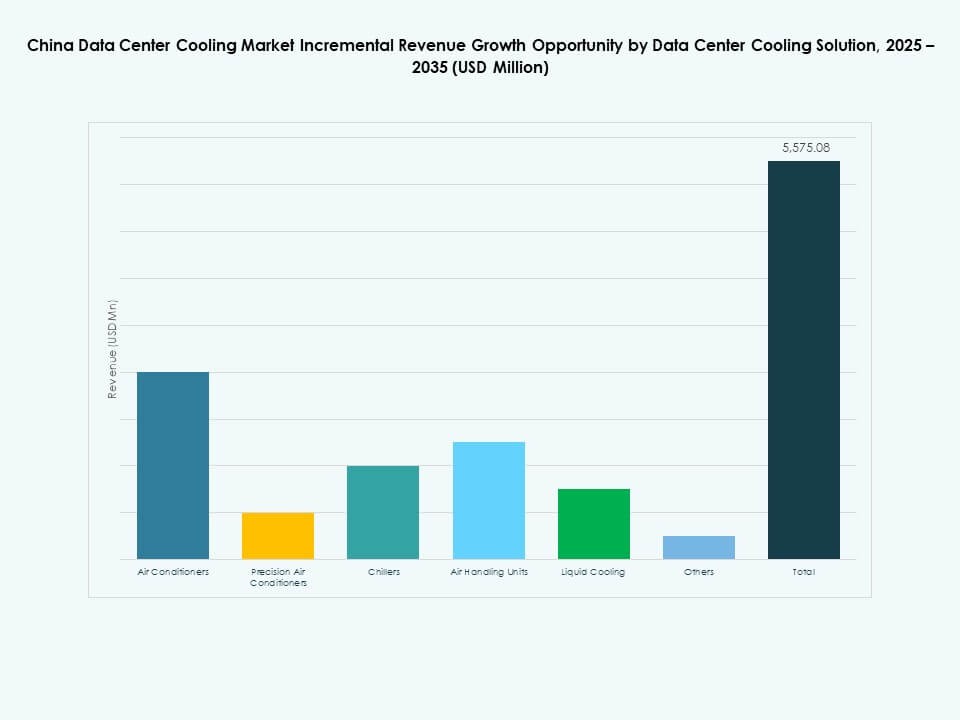
Precision air conditioners and chillers dominate deployments in large and colocation facilities. These systems provide tight temperature and humidity control for mission-critical halls. The China Data Center Cooling Market also sees growing adoption of liquid cooling units. Air handling units and free-cooling designs support sites in favorable climates. Smaller shares go to niche technologies grouped under others. Integration with economizers and variable-speed components improves efficiency. Operators select combinations that match climate, load profile, and redundancy needs.

By Service

Installation and deployment services lead due to frequent new builds and major retrofits. Complex layouts and phased projects require expert coordination and testing. The China Data Center Cooling Market then relies on support and consulting for optimization. Maintenance services secure long-term performance through routine checks and repairs. Many customers sign multi-year agreements tied to uptime metrics. It gives operators predictable service costs and access to specialists. Vendors gain stronger relationships and insight into evolving customer needs.

By Enterprise Size

Large enterprises and hyperscale operators account for the major share here. These organizations invest heavily in custom designs and high-capacity systems. The China Data Center Cooling Market also serves SMEs through colocation and modular sites. Smaller players often prefer standardized, ready-to-deploy solutions. Service providers tailor offerings to limited in-house engineering skills. Growth of digital-native SMEs supports demand for efficient shared infrastructure. Cooling vendors target them through channel partners and packaged solutions.

By Floor Type

Raised floors remain widely used in traditional and many colocation facilities. They support underfloor air distribution and cable management structures. The China Data Center Cooling Market still sees non-raised floors in new high-density designs. These layouts favor overhead or in-row air paths and flexible racks. Choice of floor type influences containment design and equipment selection. Vendors adapt product lines to both styles to retain addressable share. Operators evaluate costs, flexibility, and airflow control when deciding between layouts.

By Containment

Raised floor with hot aisle containment holds a strong share due to higher efficiency. It separates hot exhaust from cold supply air in a controlled way. The China Data Center Cooling Market also deploys cold aisle containment in many legacy halls. Some sites still operate raised floors without containment, often with lower efficiency. New projects favor clear containment strategies from initial design. Better separation reduces mixing and compressor workload. It improves thermal consistency and supports higher rack power densities.

By Structure

Room-based cooling still dominates older and multi-tenant facilities. Large air handlers and CRAC units manage full-hall conditions. The China Data Center Cooling Market shifts toward row-based and rack-based solutions in dense zones. These structures place cooling closer to heat sources for better control. Rack-based units suit AI and HPC clusters with extreme densities. Row-based systems balance flexibility and cost in many expansions. Operators often mix structures within a single site to match load patterns.

By Application

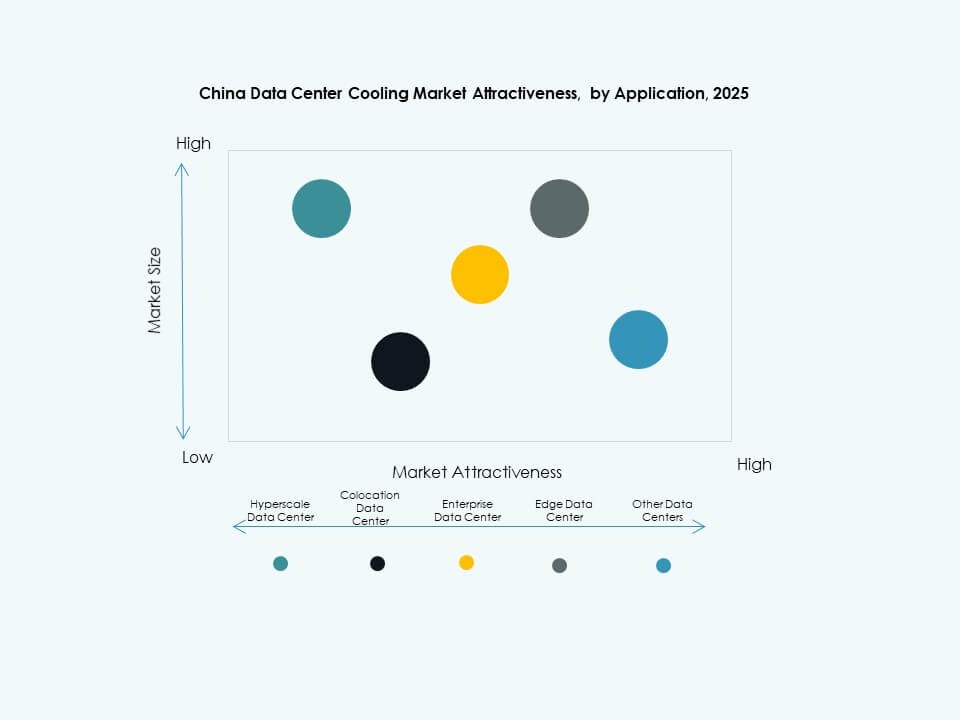
Hyperscale data centers account for the largest share of cooling demand. They require high capacity, redundancy, and advanced efficiency measures. The China Data Center Cooling Market also includes colocation and enterprise data centers. Edge data centers and other small sites add growing incremental demand. Each application type has different redundancy and service expectations. Vendors adapt solutions and contracts to each profile. Growth in cloud, content, and AI services sustains hyperscale-driven demand.

By End-User

IT and telecom end-users lead adoption due to large network and cloud footprints. BFSI, retail, and healthcare add strong demand for secure and compliant facilities. The China Data Center Cooling Market also serves energy and other vertical industries. Each sector values high uptime, data protection, and regulatory adherence. Cooling solutions must support continuous operation of sensitive applications. Vertical expertise helps vendors tailor reference designs and service models. This focus increases win rates in competitive bids.

Regional Insights

Strong Concentration In Eastern Coastal Hubs With Significant Northern Support

Eastern China holds an estimated 45% share of the market. Large clusters in Shanghai, Jiangsu, and Zhejiang host hyperscale and colocation sites. Northern China, including Beijing and Tianjin, contributes about 20% share. The China Data Center Cooling Market leans on these mature digital corridors. It benefits from strong fiber networks, skilled labor, and power access. Operators in these regions adopt high-efficiency and liquid-ready designs. Investors view these hubs as low-risk anchors for long-term infrastructure capital.

  • For example, Eastern China’s data center market, including major hubs in Shanghai, Jiangsu, and Zhejiang, benefits from Alibaba Cloud’s large self-built campuses that use indirect evaporative cooling and free-air cooling. The company reports that several of its facilities achieve low PUE levels supported by renewable energy integration and advanced airflow optimization. These efficiency gains strengthen the region’s leadership in China’s large-scale digital infrastructure development.

Rising Importance Of Southern Growth Corridors And Southwest Gateways

Southern provinces, including Guangdong and Guangxi, represent roughly 18% share. Strong cloud, telecom, and internet firms anchor demand near major cities. Southwest China, including Sichuan and Chongqing, holds around 10% share. The China Data Center Cooling Market in these areas leverages hydropower resources. It uses cooler climates in parts of the southwest to support free cooling. Regional governments promote digital parks and industrial internet zones. Cooling vendors gain opportunities in both greenfield campuses and regional edge sites.

  • For example, Tencent’s ESG disclosures confirm that its fourth-generation T-block data centers incorporate liquid cooling and other advanced thermal designs to support dense compute workloads. The company reports continued improvements in PUE performance across its new facilities through optimized cooling operations and energy-efficient engineering. These upgrades reflect Tencent’s broader strategy to enhance data center sustainability and operational efficiency.

Emerging Potential In Northwest, Northeast, And Inland Provinces

Northwest and Northeast regions together account for about 7% and 5% share. Lower land costs and access to renewables support new campus planning. Central inland provinces capture the remaining share through mixed enterprise and government sites. The China Data Center Cooling Market sees these regions as future capacity buffers. It can shift some workloads away from heavily loaded coastal grids. Policy support for western development encourages infrastructure investment. Cooling solutions here must balance long distances, climate diversity, and grid conditions.

Competitive Insights:

  • Hairf Network Power Beijing Co. Ltd.
  • Huawei Digital Power
  • Alibaba Cloud (liquid cooling technologies)
  • Schneider Electric
  • Johnson Controls International plc
  • Carrier
  • TICA
  • HICOOL Climate Equipment
  • Kendall Cold Chain System Co. Ltd.
  • Blueway Electric Appliances Co. Ltd.

The competitive landscape in the China Data Center Cooling Market blends strong domestic specialists with global infrastructure leaders. Local vendors focus on tailored designs for Chinese regulations, climate zones, and customer preferences. Global players provide mature portfolios in precision cooling, controls, and lifecycle services. It creates an environment where partnerships, joint projects, and OEM relationships become central to growth. Price pressure remains high, yet buyers prioritize reliability, service coverage, and efficiency credentials. Leading firms invest in liquid cooling, AI-driven controls, and low-GWP refrigerants to secure high-density and green projects. Smaller vendors compete through niche solutions, regional focus, and flexible engagement models. Market share tends to concentrate around players that can support nationwide rollouts and long-term service contracts.

Recent Developments:

  • In October 2025, Alibaba Cloud announced the commercial deployment of next-generation liquid cooling technologies across several data center campuses in Beijing and Hangzhou, targeting improved energy efficiency and environmental sustainability.
  • In May 2025, Chemours formed a partnership with Navin Fluorine to develop and localize Opteon™ two-phase immersion fluid, set for rollout in China in 2026. This collaboration will provide local data centers with state-of-the-art immersion cooling solutions, contributing to reduced power usage effectiveness (PUE) for high-density workloads.
  • In December 2024, Vertiv Group Corp acquired certain assets and technologies from BiXin Energy Technology Co., Ltd. to further expand their footprint and technical capabilities in the data center cooling market, particularly focusing on technological advancements for AI-optimized cooling

1. Introduction

1.1. Market Definition & Scope

1.2. Research Methodology

1.2.1. Primary Research

1.2.2. Secondary Research

1.2.3. Data Validation & Assumptions

1.3. Market Segmentation Framework

2. Executive Summary

2.1. Market Snapshot

2.2. Key Findings

2.3. Analyst Recommendations

2.4. Market Outlook (2025–2035)

3. Market Dynamics

3.1. Market Drivers

3.2. Market Restraints

3.3. Market Opportunities

3.4. Challenges & Risks

3.5. Value Chain Analysis

3.6. Porter’s Five Forces Analysis

4. China Data Center Cooling Market – Market Sizing & Forecast

4.1. Historical Market Size (2020–2025)

4.2. Forecast Market Size (2026–2035)

4.3. Market Growth Rate Analysis

4.4. Market Outlook by Country

5. Capital Expenditure (CapEx) Analysis

5.1. CapEx Trends by Cooling Solution

5.1.1. Investment patterns across air-based, liquid-based, hybrid, and immersion cooling

5.1.2. CapEx share by cooling equipment type (CRAC/CRAH, chillers, cooling towers, economizers, etc.)

5.1.3. Country-wise CapEx trends

5.1.4. OEM vs. retrofit investment analysis

5.2. Return on Investment (ROI) & Payback Period Analysis

5.2.1. ROI by cooling technology type

5.2.2. Cost-benefit comparison: air cooling vs. liquid cooling vs. immersion cooling

5.2.3. Payback period across Tier I–IV data centers

5.2.4. Case examples of cost savings through energy-efficient cooling adoption

6. Data Center Cooling Capacity & Utilization

6.1. Installed Capacity (MW & Sq. Ft.) by Cooling Solution

6.1.1. Installed cooling capacity by solution type and Country

6.1.2. Cooling system density (kW/rack and per sq. ft.)

6.1.3. Capacity expansion trends by hyperscale vs. colocation vs. enterprise

6.2. Utilization Rates & Efficiency Metrics

6.2.1. Cooling system utilization vs. design capacity

6.2.2. Average and peak load management practices

6.2.3. Equipment lifecycle and performance benchmarks

6.3. Power Usage Effectiveness (PUE) & Energy Efficiency

6.3.1. Average PUE by data center size and cooling technology

6.3.2. Comparison of traditional vs. green cooling systems

6.3.3. Cooling system contribution to total facility energy consumption

6.4. Rack Density & Cooling Efficiency

6.4.1. Average rack density (kW/rack) trends

6.4.2. Cooling adequacy vs. rack load

6.4.3. Relationship between high-density workloads (AI, HPC) and cooling requirements

7. Data Center Cooling Market, Energy & Resource Consumption Analysis

7.1. Energy Consumption Analysis

7.1.1. Total energy consumption by cooling solution type (air-based, liquid, hybrid, immersion)

7.1.2. Energy intensity per MW of IT load

7.1.3. Energy share of cooling in total facility power (cooling load ratio)

7.1.4. Annualized Energy Efficiency Ratio (EER / SEER) by cooling system type

7.1.5. Trend in energy consumption reduction through automation, AI, and free cooling technologies

7.2. Water Consumption Analysis

7.2.1. Water Usage Effectiveness (WUE) – liters per kWh of IT load

7.2.2. Water consumption by cooling technology (evaporative cooling, adiabatic cooling, etc.)

7.2.3. Water recycling and reuse systems in data centers

7.2.4. Impact of Country-wise water scarcity regulations on cooling system choice

7.2.5. Shift from water-intensive to air-based or hybrid systems

7.3. Combined Energy–Water Efficiency Metrics

7.3.1. Energy-Water Nexus in cooling optimization

7.3.2. Correlation between PUE, WUE, and total operational cost (OpEx)

7.3.3. Case studies of zero-water or waterless cooling deployments

7.4. Benchmarking & Comparative Analysis

7.4.1. Benchmarking against ASHRAE, Uptime Institute, and DOE standards

7.4.2. Comparison of China WUE/PUE averages by Country

7.4.3. Best practices adopted by hyperscalers (AWS, Google, Microsoft, Meta, etc.)

8. China Data Center Cooling Market – By Component

8.1. Solution

8.2. Services

9. China Data Center Cooling Market – By Data Center Cooling Solution

9.1. Air Conditioners

9.2. Precision Air Conditioners

9.3. Chillers

9.4. Air Handling Units

9.5. Liquid Cooling

9.6. Others

10. China Data Center Cooling Market – By Service

10.1. Installation & Deployment

10.2. Support & Consulting

10.3. Maintenance Services

11. China Data Center Cooling Market – By Enterprise Size

11.1. Large Enterprises

11.2. Small & Medium Enterprises (SMEs)

12. China Data Center Cooling Market – By Floor Type

12.1. Raised Floors

12.2. Non-Raised Floors

13. China Data Center Cooling Market – By Containment

13.1. Raised Floor with Hot Aisle Containment (HAC)

13.2. Raised Floor with Cold Aisle Containment (CAC)

13.3. Raised Floor without Containment

14. China Data Center Cooling Market – By Structure

14.1. Rack-Based Cooling

14.2. Row-Based Cooling

14.3. Room-Based Cooling

15. China Data Center Cooling Market – By Application

15.1. Hyperscale Data Center

15.2. Colocation Data Center

15.3. Enterprise Data Center

15.4. Edge Data Center

15.5. Other Data Centers

16. China Data Center Cooling Market – By End-user

16.1. Telecom

16.2. IT

16.3. Retail

16.4. Healthcare

16.5. BFSI

16.6. Energy

16.7. Others

17. Sustainability & Green Data Center Cooling

17.1. Energy Efficiency Initiatives

17.1.1. Deployment of free cooling, adiabatic cooling, and economizers

17.1.2. Smart control systems for temperature and airflow optimization

17.1.3. Case studies of efficiency improvement programs

17.2. Renewable Energy Integration

17.2.1. Integration of solar, wind, or geothermal sources in cooling operations

17.2.2. Hybrid systems combining renewable energy with mechanical cooling

17.3. Carbon Footprint & Emission Analysis

17.4. GHG reduction initiatives

17.5. LEED & Green Certifications

17.5.1. Share of cooling systems installed in LEED, BREEAM, or Energy Star certified facilities

17.5.2. Compliance with ASHRAE and ISO energy efficiency standards

18. Emerging Technologies & Innovations

18.1.1. Emerging Technologies & Innovations

18.1.2. Liquid Cooling & Immersion Cooling

18.1.3. Adoption rate and technology maturity

18.1.4. Key vendors and installations by Country

18.1.5. Comparative analysis: performance, cost, and energy savings

18.2. AI & HPC Infrastructure Integration

18.2.1. Cooling demand driven by AI training clusters and HPC systems

18.2.2. Adaptation of cooling design to high heat density workloads

18.3. Quantum Computing Readiness

18.3.1. Cooling requirements for quantum processors

18.3.2. Potential cooling technologies suitable for quantum environments

18.4. Modular & Edge Data Center Cooling

18.4.1. Cooling strategies for prefabricated and modular facilities

18.4.2. Compact and adaptive cooling for edge sites

18.5. Automation, Orchestration & AIOps

18.5.1. Integration of AI-driven thermal management

18.5.2. Predictive maintenance and automated cooling optimization

19. Competitive Landscape

19.1. Market Share Analysis

19.2. Key Player Strategies

19.3. Mergers, Acquisitions & Partnerships

19.4. Product & Service Launches

20. Company Profiles

20.1. Hairf Network Power Beijing Co Ltd

20.2. Blueway Electric Appliances Co. Ltd.

20.3. TICA

20.4. Hunan Yuanheng Technology Co. Ltd.

20.5. Chayora

20.6. Zero Technologies

20.7. Kendall Cold Chain System Co. Ltd.

20.8. HICOOL Climate Equipment

20.9. LANDKING Technology

20.10. Huawei Digital Power

20.11. Alibaba Cloud (liquid cooling tech)

20.12. Johnson Controls International plc

20.13. Schneider Electric

20.14. Carrier

Request Free Sample

We prioritize the confidentiality and security of your data. Our promise: your information remains private.

Ready to Transform Data into Decisions?

Request Your Sample Report and Start Your Journey of Informed Choices


Providing the strategic compass for industry titans.

Frequently Asked Questions:

What is the current market size for China Data Center Cooling Market, and what is its projected size in 2035?

The China Data Center Cooling Market reached USD 1,364.09 million in 2025 and is projected to hit USD 6,939.18 million by 2035. Strong digital expansion and dense compute loads push long-term growth across major hubs.

At what Compound Annual Growth Rate is the China Data Center Cooling Market projected to grow between 2025 and 2035?

The China Data Center Cooling Market is projected to grow at a CAGR of 17.51% between 2025 and 2035. Rising AI, cloud, and high-density workloads support this sustained expansion.

Which China Data Center Cooling Market segment held the largest share in 2025?

The Solution segment held the largest share of the China Data Center Cooling Market in 2025. Operators prioritized precision cooling, chillers, and integrated systems to support dense hyperscale and colocation buildouts.

What are the primary factors fueling the growth of the China Data Center Cooling Market?

Growth in the China Data Center Cooling Market is driven by cloud expansion, AI-driven heat loads, sustainability targets, and strong investment in high-density infrastructure. Improved efficiency goals and liquid-ready architectures also strengthen demand.

Who are the leading companies in the China Data Center Cooling Market?

Key players in the China Data Center Cooling Market include Hairf Network Power Beijing, Huawei Digital Power, Alibaba Cloud, Schneider Electric, Johnson Controls, Carrier, TICA, and HICOOL Climate Equipment. These firms lead with advanced cooling portfolios and strong service networks.

Which region commanded the largest share of the China Data Center Cooling Market in 2025?

Eastern China commanded the largest share of the China Data Center Cooling Market in 2025, holding roughly 45%. Strong hyperscale clusters and enterprise demand supported its dominant position.

Licence Option

The report comes as a view-only PDF document, optimized for individual clients. This version is recommended for personal digital use and does not allow printing. Use restricted to one purchaser only.
To meet the needs of modern corporate teams, our report comes in two formats: a printable PDF and a data-rich Excel sheet. This package is optimized for internal analysis. Unlimited users allowed within one corporate location (e.g., regional office).
The report will be delivered in printable PDF format along with the report’s data Excel sheet. This license offers 100 Free Analyst hours where the client can utilize DC Market Insights’ research team. Permitted for unlimited global use by all users within the purchasing corporation.

Europe


North America

Smallform of Sample request

Request Sample