Home » Netherland Data Center Cooling Market

Netherland Data Center Cooling Market By Component (Solution, Services); By Solution Type (Air Conditioning, Chilling Units, Cooling Towers, Economizer Systems, Liquid Cooling, Control Systems, Others); By Service Type (Consulting, Installation & Deployment, Maintenance & Support); By Data Center Type (Enterprise Data Centers, Colocation Data Centers, Cloud Data Centers); By Industry Vertical (BFSI, IT & Telecom, Healthcare, Government, Others) – Growth, Share, Opportunities & Competitive Analysis, 2025 – 2035

Report ID: 7423 | Report Format : Excel, PDF

Executive summary:

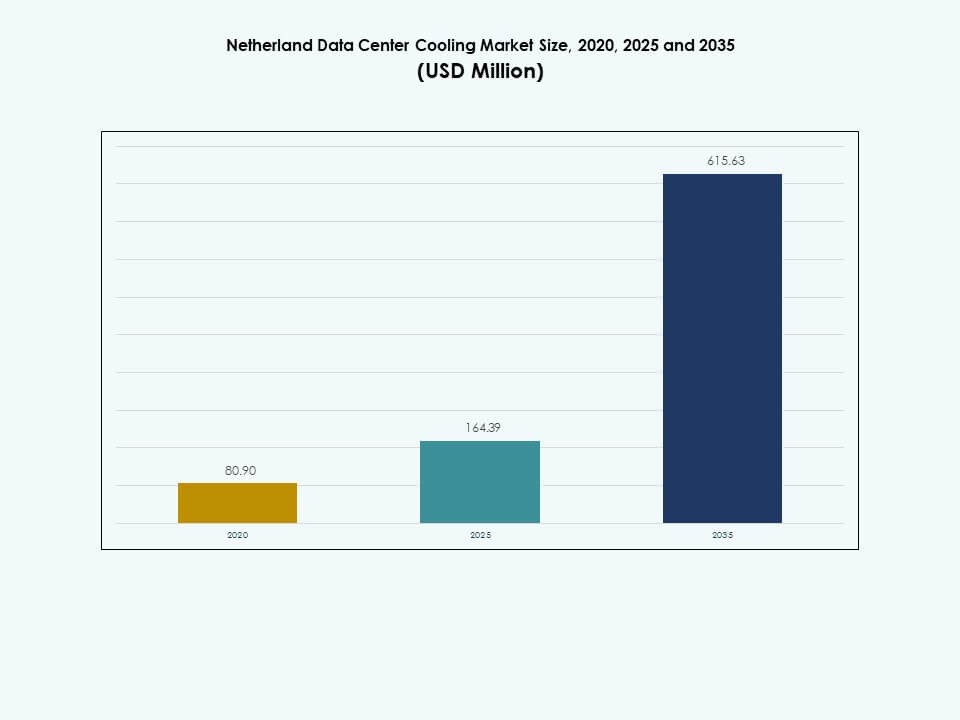
The Netherland Data Center Cooling Market size was valued at USD 80.90 million in 2020 to USD 164.39 million in 2025 and is anticipated to reach USD 615.63 million by 2035, at a CAGR of 14.08% during the forecast period.

REPORT ATTRIBUTE DETAILS
Historical Period 2020-2023
Base Year 2024
Forecast Period 2025-2035
Netherland Data Center Cooling Market Size 2025 USD 164.39 Million
Netherland Data Center Cooling Market, CAGR 14.08%
Netherland Data Center Cooling Market Size 2035 USD 615.63 Million


Strong drivers include rapid adoption of liquid cooling, advanced airflow management, and AI-based thermal optimization across Dutch facilities. Operators upgrade cooling to support high-density racks and improve energy efficiency in line with regulatory expectations. Innovation in predictive thermal control and hybrid cooling strengthens system reliability and reduces operational risk. The market gains strategic importance for investors and businesses due to strong digital growth, expanding cloud needs, and increasing sustainability commitments across key data center clusters.

The Dutch market remains heavily concentrated in the Amsterdam Metropolitan Region, supported by strong connectivity, hyperscale presence, and advanced digital infrastructure. Secondary areas such as Rotterdam–The Hague and North Netherlands are emerging due to expanding enterprise workloads and availability of suitable power and land. Regional hubs outside Amsterdam gain interest for edge deployments and sustainable site development. Cooling demand rises across distributed locations as new AI, HPC, and cloud workloads expand nationwide.

Netherland Data Center Cooling Market SizeMarket Drivers

Rising Demand for High-Density Compute and Sustainable Cooling Adoption

Growing compute intensity shapes stronger investment in advanced cooling across Dutch facilities. Operators deploy efficient systems to handle rising AI and cloud workloads. Firms rely on free cooling and liquid systems to manage thermal output with stable performance. The Netherland Data Center Cooling Market sees fast adoption due to strict uptime needs. Strong digital growth pushes companies to modernize old infrastructure. Investors view improved thermal control as a key enabler for long-term reliability. New workloads motivate design upgrades across large campuses. The momentum strengthens energy efficiency programs at national level. Stakeholders see value in consistent cooling upgrades. Data-driven sites require stronger capacity planning.

Increasing Regulatory Push for Energy-Efficient and Low-Emission Cooling Models

Tough energy rules encourage companies to update cooling to remain compliant. Operators respond with high-efficiency chillers, adaptive airflow tools, and smart monitoring. It motivates data centers to test hybrid and liquid systems that reduce power use. National regulators expect measurable gains across cooling operations. Firms commit to plans that reduce environmental impact through redesigned cooling cycles. Investors see strong value in compliance-driven upgrades. The Netherland Data Center Cooling Market benefits from sustainability commitments across hyperscale operators. Strong policy focus drives faster adoption of modern cooling layouts. New designs support greener site performance. Firms prepare long-term plans for stronger compliance.

  • For example, Microsoft’s Dutch data centers report the use of advanced low-water cooling methods that limit cooling-related water use to less than 5% of annual operating hours under normal conditions. Company sustainability documentation highlights that these facilities minimize reliance on traditional evaporative systems to meet Dutch environmental expectations. This approach reflects Microsoft’s efforts to improve water stewardship across its Netherlands footprint.

Growing Integration of AI, Automation, and Advanced Data Center Management Tools

Automation improves cooling output through real-time control and predictive airflow planning. Firms use AI models to detect thermal imbalance early and prevent load failures. It helps operators improve uptime with smarter power-cooling coordination. Dutch facilities integrate analytics to drive strong performance across peak hours. Automated workflows help reduce human error and optimize thermal use. The Netherland Data Center Cooling Market gains traction through digital intelligence. Operators use unified dashboards to improve operational visibility. Investors support these upgrades due to high return potential. Predictive systems improve airflow decisions faster. Data insights support stronger thermal management.

  • For example, Schneider Electric has reported deployments of its EcoStruxure Data Center and AI-enabled optimization tools across European sites, including Dutch facilities, to improve cooling efficiency through real-time analytics and automated controls. The company confirms that these systems help reduce energy use by optimizing airflow, temperature, and equipment operation. This reflects Schneider Electric’s broader strategy to support energy-efficient data center operations in the Netherlands.

Shift Toward Modular, Scalable, and High-Performance Cooling Infrastructure

Modular cooling supports fast deployment across new build sites and edge locations. It enables operators to scale capacity without long construction delays. The Netherland Data Center Cooling Market benefits from strong demand for flexible designs. Operators pick modular layouts to align with fast workload shifts. Firms choose scalable components to meet long-term growth plans. It improves agility across colocation and enterprise environments. Investors value the reduced risk created by modular structures. Growth in edge computing increases demand for scalable cooling formats. Deployment cycles shorten for new facilities. Modular choices enhance future-ready planning.

Netherland Data Center Cooling Market ShareMarket Trends

Expansion of Liquid Cooling and Direct-to-Chip Infrastructure Across High-Density Workloads

Liquid cooling adoption grows due to heavy AI and HPC deployments. Operators prefer direct-to-chip designs to reduce power stress. Firms integrate cold plates to support dense compute racks. The Netherland Data Center Cooling Market sees momentum from rising thermal loads. Liquid systems help deliver stable performance during peak computation. It reduces reliance on traditional air solutions. Dutch colocation hubs evaluate full-scale liquid variants for future facilities. Industry leaders explore immersion systems to secure higher rack densities. More pilots test deeper liquid use. Facilities plan long-term liquid strategies.

Growth of Heat Reuse Networks Across Data-Rich Dutch Urban Areas

Heat reuse gains traction in clusters with strong municipal support. Operators connect data center waste heat to district heating systems. It helps local governments reach climate targets through energy recovery. The Netherland Data Center Cooling Market sees new interest from urban planning teams. Heat-reuse design lowers operational cost for large operators. It provides a stable efficiency gain across winter seasons. Dutch cities incentivize integration of heat-exchange infrastructure. Firms use heat-reuse networks to enhance ESG performance. New agreements support shared heat programs. District teams plan larger recovery loops.

Shift Toward Smart Cooling With IoT Sensors and Predictive Control Models

IoT sensors support cooling optimization through continuous monitoring. Facilities use predictive analytics to improve airflow and fan output. It reduces energy waste and strengthens thermal stability. The Netherland Data Center Cooling Market sees wide use of sensor-driven systems. Smart tools help prevent hot spots with early alerts. Operators rely on digital models to plan rack placement. It improves control across multi-tenant colocation floors. Predictive cooling becomes a standard feature in modern facilities. More sites test full sensor networks. Predictive tools enhance operational confidence.

Rise of Edge Data Centers and Distributed Cooling Frameworks Supporting Local Compute

Edge demand grows due to low-latency workloads across Dutch enterprises. Operators deploy compact cooling units near telecom and 5G hubs. It improves thermal stability for near-user processing. The Netherland Data Center Cooling Market gains from strong adoption of edge computing. Firms need cooling models designed for small footprints. It allows regional players to run reliable micro-facilities. Edge nodes rely on adaptive cooling to maintain uptime. Growth in IoT services pushes further demand for edge-ready cooling. Smaller sites adopt flexible cooling units. Distributed nodes strengthen local compute.

Market Challenges

Rising Power Constraints and Limited Grid Capacity Affecting Cooling Infrastructure Deployment

High power demand challenges new cooling rollouts across dense regions. Operators face delays due to limited grid support for new facilities. It creates challenges for firms planning high-density cooling upgrades. The Netherland Data Center Cooling Market encounters constraints due to strong energy demand. Operators adapt by adopting hybrid and low-power cooling models. It pushes firms to reassess long-term capacity planning. Energy permits take longer, slowing deployment cycles. The issue raises concern for investors with large expansion plans. Power stress increases planning pressure. Firms seek alternative power strategies.

High Capital Requirements and Complex Integration Across Legacy Facility Designs

Cooling upgrades demand strong capital planning for older sites. Operators face integration challenges with outdated layouts. The Netherland Data Center Cooling Market must balance cost with performance. Firms need skilled teams to install high-efficiency systems. It raises operational complexity for operators working with tight budgets. Legacy infrastructure needs structural changes before new cooling works. Investors remain cautious due to long payback cycles. Modernization projects require careful planning to avoid service disruption. Upgrades demand longer engineering windows. Legacy sites require deeper redesign.

Market Opportunities

Strong Potential for Heat-Reuse Commercial Models and City-Integrated Energy Exchanges

Dutch cities aim to create heat-reuse networks linked to data centers. Firms can supply stable heat output to municipal grids. The Netherland Data Center Cooling Market holds strong potential for new revenue models. It boosts economic value for operators with high thermal output. It encourages partnerships with energy companies. Heat-reuse programs support national climate goals. District heating integration becomes an attractive investment pathway. Urban zones benefit from lower heating expenses. More cities plan recovery pipelines. Operators gain new community value.

Rising Demand for AI-Ready Liquid Cooling and High-Performance Compute Infrastructure

AI workloads drive strong demand for liquid cooling formats. Operators use high-density racks that need advanced thermal control. The Netherland Data Center Cooling Market gains opportunity from compute expansion. Firms can deploy immersion or direct-to-chip systems to lead the next upgrade cycle. It boosts competitiveness across hyperscale and colocation hubs. Investors see strong returns in liquid-based cooling adoption. High-performance compute clusters expand across major hubs. AI growth ensures long-term opportunity for cooling suppliers. Liquid solutions gain rising interest. Firms prepare liquid-driven designs.

Market Segmentation

By Component

The market shows strong traction across solution offerings, with cooling equipment leading demand due to high deployment across hyperscale and colocation sites. Services grow at a steady rate due to maintenance needs and integration work. Firms rely on solutions to manage rising thermal loads across dense racks. Service providers support long-term uptime through monitoring and consulting. Large campuses drive higher equipment consumption. The Netherland Data Center Cooling Market sees stronger adoption of advanced solutions that cut power use. Growth rises with modernization across old facilities. Dominance stays with solution components due to higher spending. Service growth complements solution demand. Vendors expand integrated packages.

By Data Center Cooling Solution

Air conditioners and precision systems hold leadership due to wide compatibility with Dutch facilities. Chillers gain share due to sustainability upgrades across large campuses. Liquid cooling grows fastest due to AI and HPC workloads. Air handling units support airflow control across raised floors. The Netherland Data Center Cooling Market benefits from strong hybrid solution use. Firms explore immersion cooling for high-density racks. Operators prefer systems that reduce power draw during peak hours. Precision units remain essential for consistent control. Liquid formats strengthen market direction. Air solutions maintain broad use.

By Service

Installation and deployment lead due to new data center expansions. Support and consulting grow as firms plan energy-efficient designs. Maintenance services keep strong share due to uptime needs. The Netherland Data Center Cooling Market relies on skilled service teams to manage complex systems. Operators use service contracts to secure long-term stability. Rising thermal loads encourage detailed facility assessments. Firms pick specialists to align systems with compliance needs. Growth continues across all service groups. Service models expand with automation needs. Facility teams request deeper advisory roles.

By Enterprise Size

Large enterprises hold dominant share due to extensive IT infrastructure. SMEs adopt cooling systems at steady pace driven by digital growth. The Netherland Data Center Cooling Market supports high-density setups across large firms. SMEs select compact cooling units for smaller server rooms. Strong cloud migration drives cooling investment. Large enterprises lead due to higher rack deployment. It encourages vendors to design scalable models. Demand stays steady across mid-sized firms. Enterprise upgrades increase cooling cycles. SMEs adopt modern units gradually.

By Floor Type

Raised floors dominate due to strong airflow advantages. Non-raised floors grow due to edge facility expansion. The Netherland Data Center Cooling Market benefits from airflow control in raised designs. Operators choose raised floors to avoid thermal pockets. Edge nodes use non-raised layouts for compact sites. Firms focus on stable airflow pathways. Rack layouts align with airflow design standards. Thermal efficiency shapes floor selection. Raised floors remain preferred for large sites. Compact sites support simpler layouts.

By Containment

Raised floor with HAC holds dominant share due to efficient airflow separation. CAC grows as operators target energy reduction. Raised floors without containment support simpler layouts across small sites. The Netherland Data Center Cooling Market sees strong demand for HAC in high-density zones. Containment improves cooling stability. Firms rely on sealed airflow pathways for peak operations. CAC reduces mixing of warm and cold air. Containment choices shape power use. HAC supports stronger rack cooling. CAC improves airflow direction.

By Structure

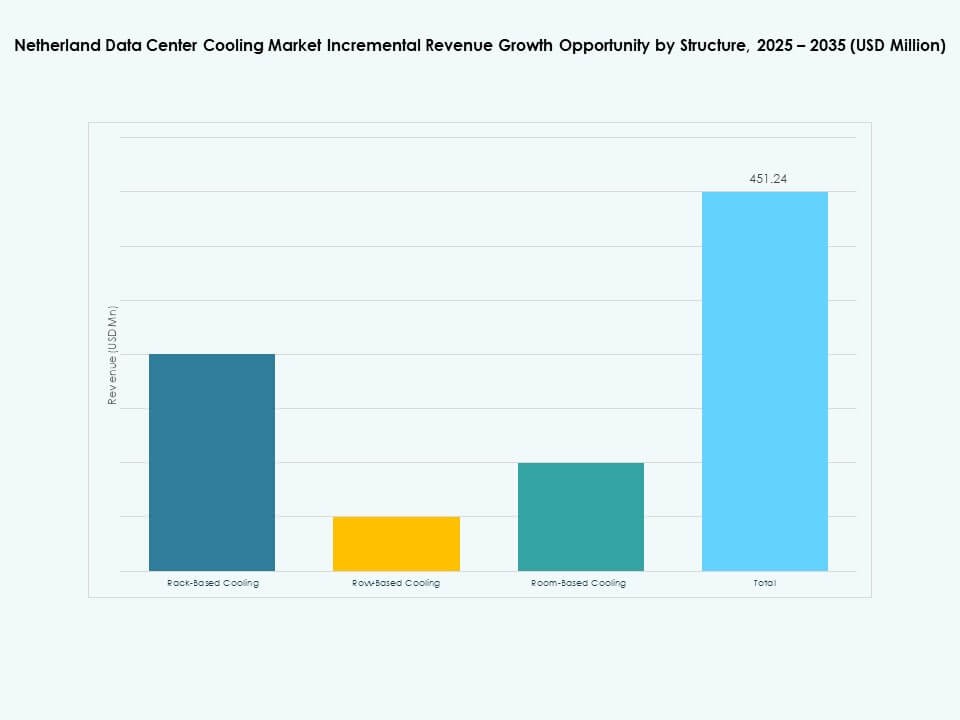
Room-based cooling holds strong presence across legacy facilities. Row-based cooling grows due to modular demand. Rack-based cooling gains interest from AI clusters. The Netherland Data Center Cooling Market sees rising adoption of distributed cooling models. Operators deploy rack systems for dense loads. Row-based designs support scalable growth. Room-based setups remain common due to old campuses. Modern designs shift toward flexible structures. Rack systems support future AI needs. Structure choice affects performance patterns.

By Application

Hyperscale data centers lead due to high compute density. Colocation centers hold strong share with multi-tenant workloads. Enterprise sites show steady upgrades to cooling systems. Edge sites grow due to low-latency needs. Other data centers adopt hybrid cooling tools. The Netherland Data Center Cooling Market supports diversified applications. Hyperscale growth drives major cooling investment. Edge nodes expand distributed demand. Colocation gains steady enterprise traffic. Enterprise sites evolve cooling strategy.

By End-User

IT and telecom dominate due to strong digital infrastructure. Retail and BFSI adopt cooling to support omni-channel platforms. Healthcare and energy sectors upgrade systems to secure uptime. The Netherland Data Center Cooling Market attracts interest from regulated industries. Operators deploy new systems to protect mission-critical data. Growth rises with cloud adoption. BFSI drives consistent demand. Retail expands cooling use through digital commerce. IT sites demand advanced cooling. Healthcare secures stronger thermal layouts.

Netherland Data Center Cooling Market SegmentationRegional Insights

Amsterdam Metropolitan Region – 72% Market Share

Amsterdam leads the Netherland Data Center Cooling Market due to dense hyperscale presence. It hosts major colocation clusters and global cloud operators. Strong network links through AMS-IX boost cooling demand. The region benefits from mature infrastructure and robust talent access. It maintains leadership through renewable-powered campuses. Investors prefer Amsterdam due to reduced operational risk. Cooling upgrades scale rapidly across large sites. New builds cluster near strong fiber zones. Urban policy supports digital development. Colocation hubs continue rapid expansion.

Rotterdam–The Hague Region – 16% Market Share

The region gains strong interest due to port-linked logistics and industrial digitalization. It supports secondary data center clusters with rising cooling needs. The Netherland Data Center Cooling Market expands here due to new enterprise workloads. Regional facilities use advanced airflow models to support reliability. Companies deploy scalable cooling for edge and mid-sized centers. Growth rises due to strong power access. Telecom nodes support fast deployment cycles. Industrial digital projects boost demand. Local firms adopt hybrid cooling. Regional hubs expand facility count.

  • For example, NorthC Data Centers operates a heat-reuse project in Rotterdam in partnership with the local district heating network, where residual data-center heat is upgraded and supplied to nearby homes. The initiative supports Rotterdam’s broader sustainability goals by reducing wasted thermal energy and lowering reliance on conventional heating sources. This approach highlights how Dutch facilities integrate heat-recovery systems into modern cooling design.

North Netherlands & Eindhoven–Brabant Region – 8% + 4% Market Share

Northern Netherlands grows due to Eemshaven’s strategic role in hyperscale expansion. Eindhoven–Brabant gains traction through tech-focused enterprises. The Netherland Data Center Cooling Market sees cooling adoption across both zones. Cooler climate helps improve free cooling output in northern clusters. Southern hubs rely on compact cooling setups for enterprise needs. Investors see long-term potential in distributed footprints. Growth stays stable due to regional digital projects. Emerging firms strengthen local cooling demand. Northern zones attract hyperscale interest. Southern tech clusters expand slower.

  • For example, Google’s Eemshaven data center in the Northern Netherlands shifted to using treated surface water supplied through a dedicated pipeline operated by North Water, replacing its previous cooling approach. The system reduces dependence on groundwater and lowers cooling-related electrical load while supporting Google’s broader carbon-free energy goals. This upgrade also aligns with Dutch sustainability expectations for large data center operations.

Competitive Insights:

  • Shell
  • Schneider Electric
  • Vertiv Group Corp.
  • Danfoss
  • Carrier
  • Mitsubishi Electric Corporation
  • STULZ GmbH
  • Rittal GmbH & Co. KG
  • CoolIT Systems
  • Johnson Controls International plc

The Netherland Data Center Cooling Market features strong competition between global OEMs and specialist vendors. Large multinational players supply core chillers, CRAH units, controls, and integrated cooling platforms. Niche vendors focus on liquid and high-density solutions for AI and HPC clusters. It pushes suppliers to differentiate through higher efficiency, modularity, and lifecycle service quality. Sustainability pressure steers portfolios toward low-GWP refrigerants and support for heat reuse schemes. Vendors compete for strategic deals with hyperscale, colocation, and telecom operators. Long-term service agreements strengthen customer stickiness and protect installed bases. Partnerships with EPC firms and local integrators help address complex retrofit projects. Product innovation, strong technical support, and proven reference sites increasingly influence tender outcomes.

Recent Developments:

  • In November 2025, Vertiv introduced its CoolCenter immersion cooling system to the European market, focusing on supporting AI data centers in the Netherlands. The system is designed to deliver high thermal efficiency, capable of cooling up to 240 kW per unit, and supports the shift toward liquid cooling technology among local operators.
  • In September 2025, Schneider Electric unveiled its complete liquid cooling technology portfolio following its acquisition of Motivair in February 2025. This portfolio includes CDUs, RDHx, HDUs, dynamic cold plates, and chillers, created to meet the thermal demands of the latest high-performance computing, AI, and accelerated computing applications.
  • In June 2025, Shell expanded its data center cooling offering with the launch of Shell DLC Fluid S3, a propylene glycol-based direct liquid cooling fluid designed to enhance heat transfer and sustainability for AI-driven and high-density workloads. This launch supports Shell’s strategy to deliver advanced thermal management solutions in Europe and beyond, especially as hyperscale and edge data centers proliferate across the region.
  • In March 2025, Vertiv Group Corp. announced a new global partnership with Tecogen, integrating Tecogen’s natural gas-powered chiller technology into Vertiv’s portfolio for data center applications. This collaboration aims to help facilities in the Netherlands and worldwide overcome electrical power constraints and improve sustainability by reducing grid strain, making room for larger AI and HPC deployments.

1. Introduction

1.1. Market Definition & Scope

1.2. Research Methodology

1.2.1. Primary Research

1.2.2. Secondary Research

1.2.3. Data Validation & Assumptions

1.3. Market Segmentation Framework

2. Executive Summary

2.1. Market Snapshot

2.2. Key Findings

2.3. Analyst Recommendations

2.4. Market Outlook (2025–2035)

3. Market Dynamics

3.1. Market Drivers

3.2. Market Restraints

3.3. Market Opportunities

3.4. Challenges & Risks

3.5. Value Chain Analysis

3.6. Porter’s Five Forces Analysis

4. Netherland Data Center Cooling Market – Market Sizing & Forecast

4.1. Historical Market Size (2020–2025)

4.2. Forecast Market Size (2026–2035)

4.3. Market Growth Rate Analysis

4.4. Market Outlook by Country

5. Capital Expenditure (CapEx) Analysis

5.1. CapEx Trends by Cooling Solution

5.1.1. Investment patterns across air-based, liquid-based, hybrid, and immersion cooling

5.1.2. CapEx share by cooling equipment type (CRAC/CRAH, chillers, cooling towers, economizers, etc.)

5.1.3. Country-wise CapEx trends

5.1.4. OEM vs. retrofit investment analysis

5.2. Return on Investment (ROI) & Payback Period Analysis

5.2.1. ROI by cooling technology type

5.2.2. Cost-benefit comparison: air cooling vs. liquid cooling vs. immersion cooling

5.2.3. Payback period across Tier I–IV data centers

5.2.4. Case examples of cost savings through energy-efficient cooling adoption

6. Data Center Cooling Capacity & Utilization

6.1. Installed Capacity (MW & Sq. Ft.) by Cooling Solution

6.1.1. Installed cooling capacity by solution type and Country

6.1.2. Cooling system density (kW/rack and per sq. ft.)

6.1.3. Capacity expansion trends by hyperscale vs. colocation vs. enterprise

6.2. Utilization Rates & Efficiency Metrics

6.2.1. Cooling system utilization vs. design capacity

6.2.2. Average and peak load management practices

6.2.3. Equipment lifecycle and performance benchmarks

6.3. Power Usage Effectiveness (PUE) & Energy Efficiency

6.3.1. Average PUE by data center size and cooling technology

6.3.2. Comparison of traditional vs. green cooling systems

6.3.3. Cooling system contribution to total facility energy consumption

6.4. Rack Density & Cooling Efficiency

6.4.1. Average rack density (kW/rack) trends

6.4.2. Cooling adequacy vs. rack load

6.4.3. Relationship between high-density workloads (AI, HPC) and cooling requirements

7. Data Center Cooling Market, Energy & Resource Consumption Analysis

7.1. Energy Consumption Analysis

7.1.1. Total energy consumption by cooling solution type (air-based, liquid, hybrid, immersion)

7.1.2. Energy intensity per MW of IT load

7.1.3. Energy share of cooling in total facility power (cooling load ratio)

7.1.4. Annualized Energy Efficiency Ratio (EER / SEER) by cooling system type

7.1.5. Trend in energy consumption reduction through automation, AI, and free cooling technologies

7.2. Water Consumption Analysis

7.2.1. Water Usage Effectiveness (WUE) – liters per kWh of IT load

7.2.2. Water consumption by cooling technology (evaporative cooling, adiabatic cooling, etc.)

7.2.3. Water recycling and reuse systems in data centers

7.2.4. Impact of Country-wise water scarcity regulations on cooling system choice

7.2.5. Shift from water-intensive to air-based or hybrid systems

7.3. Combined Energy–Water Efficiency Metrics

7.3.1. Energy-Water Nexus in cooling optimization

7.3.2. Correlation between PUE, WUE, and total operational cost (OpEx)

7.3.3. Case studies of zero-water or waterless cooling deployments

7.4. Benchmarking & Comparative Analysis

7.4.1. Benchmarking against ASHRAE, Uptime Institute, and DOE standards

7.4.2. Comparison of Netherland WUE/PUE averages by Country

7.4.3. Best practices adopted by hyperscalers (AWS, Google, Microsoft, Meta, etc.)

8. Netherland Data Center Cooling Market – By Component

8.1. Solution

8.2. Services

9. Netherland Data Center Cooling Market – By Data Center Cooling Solution

9.1. Air Conditioners

9.2. Precision Air Conditioners

9.3. Chillers

9.4. Air Handling Units

9.5. Liquid Cooling

9.6. Others

10. Netherland Data Center Cooling Market – By Service

10.1. Installation & Deployment

10.2. Support & Consulting

10.3. Maintenance Services

11. Netherland Data Center Cooling Market – By Enterprise Size

11.1. Large Enterprises

11.2. Small & Medium Enterprises (SMEs)

12. Netherland Data Center Cooling Market – By Floor Type

12.1. Raised Floors

12.2. Non-Raised Floors

13. Netherland Data Center Cooling Market – By Containment

13.1. Raised Floor with Hot Aisle Containment (HAC)

13.2. Raised Floor with Cold Aisle Containment (CAC)

13.3. Raised Floor without Containment

14. Netherland Data Center Cooling Market – By Structure

14.1. Rack-Based Cooling

14.2. Row-Based Cooling

14.3. Room-Based Cooling

15. Netherland Data Center Cooling Market – By Application

15.1. Hyperscale Data Center

15.2. Colocation Data Center

15.3. Enterprise Data Center

15.4. Edge Data Center

15.5. Other Data Centers

16. Netherland Data Center Cooling Market – By End-user

16.1. Telecom

16.2. IT

16.3. Retail

16.4. Healthcare

16.5. BFSI

16.6. Energy

16.7. Others

17. Sustainability & Green Data Center Cooling

17.1. Energy Efficiency Initiatives

17.1.1. Deployment of free cooling, adiabatic cooling, and economizers

17.1.2. Smart control systems for temperature and airflow optimization

17.1.3. Case studies of efficiency improvement programs

17.2. Renewable Energy Integration

17.2.1. Integration of solar, wind, or geothermal sources in cooling operations

17.2.2. Hybrid systems combining renewable energy with mechanical cooling

17.3. Carbon Footprint & Emission Analysis

17.4. GHG reduction initiatives

17.5. LEED & Green Certifications

17.5.1. Share of cooling systems installed in LEED, BREEAM, or Energy Star certified facilities

17.5.2. Compliance with ASHRAE and ISO energy efficiency standards

18. Emerging Technologies & Innovations

18.1.1. Emerging Technologies & Innovations

18.1.2. Liquid Cooling & Immersion Cooling

18.1.3. Adoption rate and technology maturity

18.1.4. Key vendors and installations by Country

18.1.5. Comparative analysis: performance, cost, and energy savings

18.2. AI & HPC Infrastructure Integration

18.2.1. Cooling demand driven by AI training clusters and HPC systems

18.2.2. Adaptation of cooling design to high heat density workloads

18.3. Quantum Computing Readiness

18.3.1. Cooling requirements for quantum processors

18.3.2. Potential cooling technologies suitable for quantum environments

18.4. Modular & Edge Data Center Cooling

18.4.1. Cooling strategies for prefabricated and modular facilities

18.4.2. Compact and adaptive cooling for edge sites

18.5. Automation, Orchestration & AIOps

18.5.1. Integration of AI-driven thermal management

18.5.2. Predictive maintenance and automated cooling optimization

19. Competitive Landscape

19.1. Market Share Analysis

19.2. Key Player Strategies

19.3. Mergers, Acquisitions & Partnerships

19.4. Product & Service Launches

20. Company Profiles

20.1. Shell

20.2. Schneider Electric

20.3. Vertiv Group Corp.

20.4. Danfoss

20.5. Carrier

20.6. Mitsubishi Electric Corporation

20.7. STULZ GmbH

20.8. Rittal GmbH & Co. KG

20.9. CoolIT Systems

20.10. Johnson Controls International plc

Request Free Sample

We prioritize the confidentiality and security of your data. Our promise: your information remains private.

Ready to Transform Data into Decisions?

Request Your Sample Report and Start Your Journey of Informed Choices


Providing the strategic compass for industry titans.

Frequently Asked Questions:

What is the current market size for the Netherland Data Center Cooling Market, and what is its projected size in 2035?

The Netherland Data Center Cooling Market was valued at USD 80.90 million in 2020 and reached USD 164.39 million in 2025. It is projected to grow to USD 615.63 million by 2035, driven by high-density compute and sustainability upgrades.

At what Compound Annual Growth Rate is the Netherland Data Center Cooling Market projected to grow between 2025 and 2035?

The Netherland Data Center Cooling Market is projected to expand at a CAGR of 14.08% from 2025 to 2035. Strong demand for energy-efficient and liquid-based cooling systems supports this long-term momentum.

Which Netherland Data Center Cooling Market segment held the largest share in 2025?

Cooling solutions held the largest share of the Netherland Data Center Cooling Market in 2025. Strong demand for air conditioners, precision systems, chillers, and hybrid cooling supported segment leadership.

What are the primary factors fueling the growth of the Netherland Data Center Cooling Market?

Key growth drivers for the Netherland Data Center Cooling Market include rising high-density compute loads, strict energy regulations, AI-driven automation, and expanding hyperscale and colocation footprints. Sustainability goals further accelerate upgrades.

Who are the leading companies in the Netherland Data Center Cooling Market?

Top companies in the Netherland Data Center Cooling Market include Shell, Schneider Electric, Vertiv, Danfoss, Carrier, Mitsubishi Electric, STULZ, Rittal, CoolIT Systems, and Johnson Controls International.

Which region commanded the largest share of the Netherland Data Center Cooling Market in 2025?

The Amsterdam Metropolitan Region held the largest share of the Netherland Data Center Cooling Market in 2025 with 72%, supported by major hyperscale activity and strong AMS-IX connectivity.

Licence Option

The report comes as a view-only PDF document, optimized for individual clients. This version is recommended for personal digital use and does not allow printing. Use restricted to one purchaser only.
To meet the needs of modern corporate teams, our report comes in two formats: a printable PDF and a data-rich Excel sheet. This package is optimized for internal analysis. Unlimited users allowed within one corporate location (e.g., regional office).
The report will be delivered in printable PDF format along with the report’s data Excel sheet. This license offers 100 Free Analyst hours where the client can utilize DC Market Insights’ research team. Permitted for unlimited global use by all users within the purchasing corporation.

Europe


North America

Smallform of Sample request

Request Sample