Home » France Data Center Cooling Market

France Data Center Cooling Market By Component (Solutions, Services); By Cooling Type (Room-Based Cooling, Row-Based Cooling, Rack-Based Cooling); By Technique (Air-Based Cooling, Liquid-Based Cooling); By End-User (Enterprise Data Centers, Colocation Data Centers, Cloud Data Centers) – Growth, Share, Opportunities & Competitive Analysis, 2025 – 2035

Report ID: 7157 | Report Format : Excel, PDF

Executive summary:

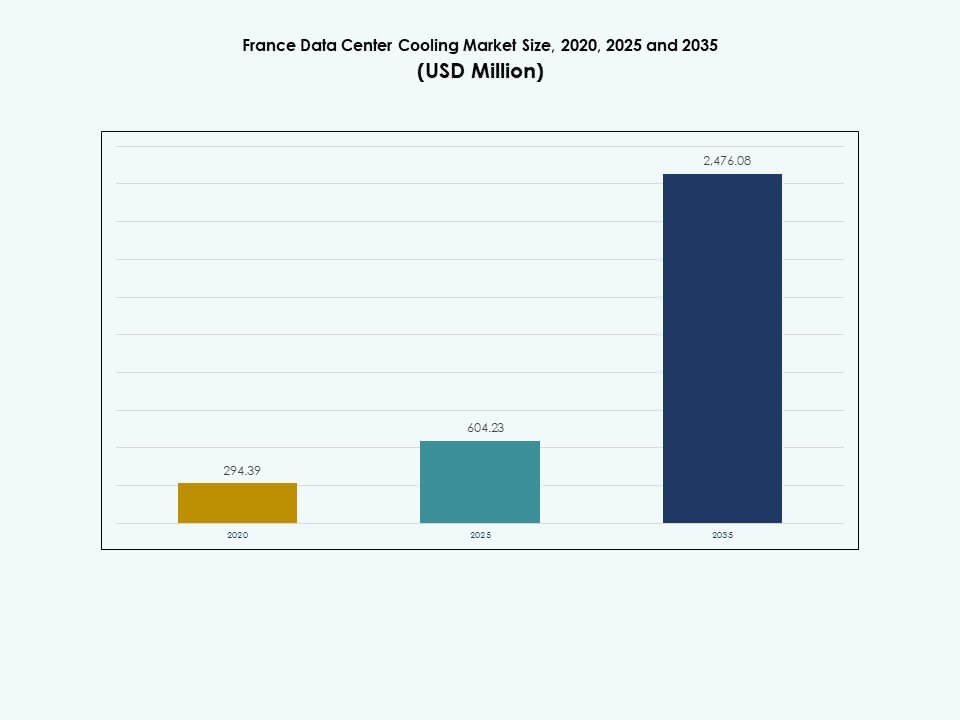
The France Data Center Cooling Market size was valued at USD 294.39 million in 2020 to USD 604.23 million in 2025 and is anticipated to reach USD 2,476.08 million by 2035, at a CAGR of 15.10% during the forecast period

REPORT ATTRIBUTE DETAILS
Historical Period 2020-2023
Base Year 2024
Forecast Period 2025-2035
France Data Center Cooling Market Size 2025 USD 604.23 Million
France Data Center Cooling Market, CAGR 15.10%
France Data Center Cooling Market Size 2035 USD 2,476.08 Million


High-density compute needs, rising AI adoption, and wider use of liquid and hybrid cooling systems push operators to upgrade infrastructure. New sustainability rules encourage energy-efficient designs that reduce operational strain and improve long-term resilience. This momentum strengthens the France Data Center Cooling Market, making it a strategic space for investors seeking growth opportunities aligned with digital transformation and advanced compute trends across the country.

Île-de-France remains the leading region due to its strong connectivity and concentration of hyperscale and colocation sites. Northern and western regions show rising development supported by cooler climates and expanding enterprise demand. Southern zones are emerging gradually as operators seek new capacity locations with suitable power access and growing edge requirements. This geographic mix supports balanced national expansion in the France Data Center Cooling Market.

France Data Center Cooling MarketMarket Drivers:

Rapid Digitalization And Cloud Growth Strengthening Demand For Advanced Thermal Management

Strong growth in hyperscale and colocation builds sustained demand for efficient cooling. The France Data Center Cooling Market benefits from nationwide cloud adoption and digital programs. Operators expand capacity in core hubs to support AI, IoT, and 5G workloads. High rack densities push traditional systems near practical limits in many urban facilities. Vendors promote next-generation solutions that manage higher heat loads with lower energy use. Operators seek technologies that stabilize PUE without harming performance or uptime. Investors view cooling efficiency as a direct proxy for asset quality. Strategic focus on sustainability aligns cooling investments with broader ESG objectives.

Shift Toward Energy Efficiency And Sustainability Aligning With National Climate Commitments

France pursues ambitious climate goals that influence cooling strategies across digital infrastructure. Public policies encourage low-carbon technologies and efficient building operations in major cities. The France Data Center Cooling Market increasingly focuses on renewable power integration and greener thermal designs. Operators adopt free cooling, adiabatic systems, and optimized airflow architectures. Vendors develop high-efficiency components that reduce fan and compressor energy demand. Investors favor assets with clear decarbonization paths and transparent performance metrics. ESG reporting pushes operators to monitor and disclose cooling impacts precisely. Sustainability positioning supports long-term competitiveness against other European data center hubs.

Rising High-Density Compute And AI Workloads Driving Liquid And Hybrid Cooling Adoption

AI clusters, GPU racks, and HPC nodes raise heat densities far beyond legacy norms. Many facilities need new cooling concepts to support these dense configurations safely. The France Data Center Cooling Market sees growing trials of direct-to-chip and immersion cooling. Hybrid layouts combine air and liquid systems to match varying rack densities. Vendors partner with chip makers and server OEMs on integrated thermal designs. Operators redesign white-space layouts to reduce hotspots and improve airflow paths. Investors back projects that show scalable support for AI-ready infrastructure. High-density capability becomes a key factor in colocation selection and pricing power.

  • For example, Atos announced in 2022 that the French CEA selected its BullSequana XH3000 supercomputer, which uses Atos’ patented Direct Liquid Cooling technology. The XH3000 platform is designed for high-density, GPU-accelerated workloads and is detailed in Atos’ official press releases and product literature as part of its exascale-class computing portfolio.

Regulatory Compliance And Risk Management Reinforcing Demand For Reliable Cooling Infrastructure

National and European regulations tighten expectations on uptime and operational resilience. Telecom, banking, and public sector users require strict continuity standards for data services. The France Data Center Cooling Market responds with redundant cooling architectures and robust monitoring. Operators deploy advanced controls to detect faults and avoid thermal incidents early. Vendors integrate smart sensors and analytics into cooling hardware portfolios. Insurance, audits, and certification frameworks reward facilities with stronger risk controls. Investors treat thermal reliability as central to asset protection and value preservation. Regulatory pressure keeps long-term spending on resilient cooling systems relatively stable.

  • For example, DATA4 Group announced a liquid-cooled deployment at its Marcoussis campus near Paris in 2025, integrating direct liquid cooling technology for high-density workloads. The project was confirmed through company statements and industry coverage, including reports from DataCenterDynamics.

Market Trends:

Growing Integration Of Smart Controls, AI Analytics, And Digital Twins In Cooling Operations

Operators deploy advanced control platforms to manage complex thermal environments in real time. Smart sensors track temperatures, humidity, and energy use across white space zones. The France Data Center Cooling Market sees rising adoption of AI tools in operations. Analytics engines fine-tune fan speeds, valve positions, and setpoints with minimal human input. Digital twins simulate layout changes and new workloads before physical deployment. Vendors bundle software suites with hardware to create integrated cooling ecosystems. Investors value data-driven efficiency improvements with clear, trackable savings. Smart control capability becomes a key differentiator in new facility designs.

Increased Preference For Modular, Scalable, And Prefabricated Cooling Architectures

Developers face strong time pressure to bring capacity online in major hubs. Modular cooling blocks allow faster deployment than fully bespoke plant designs. The France Data Center Cooling Market embraces prefabricated units for edge and regional sites. Standardized modules reduce engineering complexity for multi-site rollouts. Vendors offer factory-tested units that shorten commissioning periods and lower on-site risk. Operators scale capacity in line with tenant demand instead of overbuilding early. Investors support modular approaches that protect capital during uncertain demand cycles. Scalable cooling architectures align with rapid evolution in IT equipment lifecycles.

Rising Focus On Water Conservation And Alternative Heat Rejection Concepts

Water use faces greater scrutiny from regulators, communities, and sustainability frameworks. Operators reevaluate evaporative systems in water-stressed or sensitive regions. The France Data Center Cooling Market explores dry coolers, refrigerant-based solutions, and heat reuse. Vendors highlight water-free or water-light designs in new proposals. District heating links and heat export schemes gain attention in urban areas. Policymakers encourage projects that supply low-carbon heat to surrounding buildings. Investors favor facilities that manage both energy and water footprints effectively. Water stewardship becomes another core metric in cooling technology selection.

Expansion Of Edge, Regional, And Colocation Sites Reshaping Cooling Design Requirements

Demand spreads beyond core metropolitan hubs to secondary and regional locations. Edge sites support latency-sensitive applications near users and devices. The France Data Center Cooling Market adapts cooling designs to smaller, distributed facilities. Compact, integrated systems replace large central plants in many edge deployments. Vendors create turnkey solutions suited to constrained sites and mixed environments. Operators need flexible systems that handle varied climates and utility conditions. Investors see opportunity in portfolios of standardized regional assets. Cooling strategies balance reliability with simplicity to keep operations manageable at scale.

France Data Center Cooling Market Share

Market Challenges:

High Capital Costs, Retrofit Complexity, And Uncertain Payback Periods For Advanced Solutions

Cutting-edge cooling systems require significant upfront investment from operators. Many existing facilities face structural limitations that complicate retrofits. The France Data Center Cooling Market must balance ambition with realistic budgets. Decision makers struggle to model savings across long asset lifecycles. Vendors need to prove performance in real projects, not only in lab tests. Regulatory changes and energy price swings add uncertainty to payback forecasts. Smaller operators often delay upgrades despite clear efficiency benefits. Complex business cases slow adoption of innovative cooling technologies in mature sites.

Skilled Workforce Constraints, Regulatory Pressure, And Grid Limitations Impact Deployment Speed

Cooling plants demand specialized engineering and operational expertise. Many regions report shortages of experienced mechanical and controls professionals. The France Data Center Cooling Market operates under tightening environmental and planning rules. Permitting processes can extend project timelines in urban or sensitive zones. Grid capacity limits constrain where new high-density sites can locate. Vendors must design systems that work within local infrastructure constraints. Operators juggle compliance demands with rapid capacity expansion needs. These combined pressures raise execution risk for large cooling investments.

Market Opportunities:

Emerging Potential For Heat Reuse, District Energy Integration, And Industrial Symbiosis

Recovered heat from data centers can support nearby buildings and networks. Urban zones in France show interest in low-carbon heating sources. The France Data Center Cooling Market can benefit from partnerships with district energy operators. Vendors design heat exchangers and control logic for stable export flows. Operators gain new revenue streams while improving sustainability profiles. Municipalities view data centers as anchors for efficient local energy ecosystems. Investors appreciate assets that create multiple value pools from one infrastructure base. Policy support for circular energy models could accelerate these opportunities.

Growth Prospects In AI-Ready Infrastructure, Edge Sites, And Sustainable Financing Instruments

AI infrastructure requires dense racks and reliable advanced cooling strategies. Edge networks expand to support industrial, retail, and telecom applications. The France Data Center Cooling Market can capture demand through specialized designs and services. Vendors that master liquid and hybrid cooling gain strong strategic positions. Green loans and sustainability-linked financing favor efficient and low-carbon projects. Operators that align cooling strategies with these instruments reduce funding costs. Investors seek platforms with credible pathways to long-term climate alignment. This environment creates room for innovation across hardware, software, and service models.

Market Segmentation:

By Component, Solutions account for the largest share of spending, with many estimates near 65%. The France Data Center Cooling Market favors complete systems that bundle hardware and software. Services, including design, integration, and optimization, hold the remaining share. Growing complexity in thermal design drives demand for specialist support providers. Operators rely on services to maintain efficiency over the asset life. Vendors build recurring revenue through long-term service agreements and upgrades. Both components remain important, yet solutions still anchor most procurement decisions. Services gain influence as facilities pursue continuous optimization.

By Data Center Cooling Solution, Precision air conditioners and chillers dominate solution revenues, together near 55% share. The France Data Center Cooling Market depends on these systems for mission-critical environments. Air conditioners and air handling units serve standard and moderate-density rooms. Liquid cooling gains share within high-density and AI-focused deployments. Other solutions cover niche layouts, legacy spaces, and hybrid configurations. Vendors compete on efficiency, footprint, and ease of integration with BMS platforms. Operators often deploy mixed portfolios to match varied rack and room needs. Flexibility across solutions ensures support for future technology waves.

By Service Categories, Installation and deployment services lead with an estimated share near 45%. New builds and major expansions rely on expert project teams. The France Data Center Cooling Market also values support and consulting services. These services help align cooling strategies with regulatory and ESG requirements. Maintenance services retain steady demand to secure uptime and performance. Vendors bundle remote monitoring and predictive maintenance into service packages. Operators use service partners to manage skill gaps within internal teams. The balance of services supports long-term reliability and efficiency.

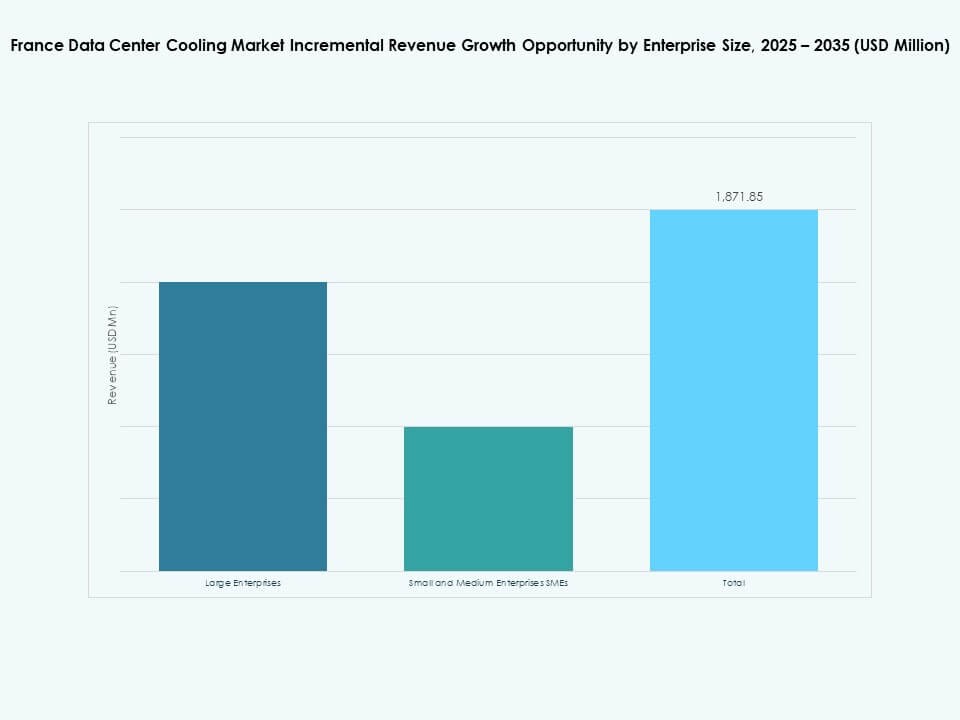
By Enterprise Size, Large enterprises hold the bulk of direct cooling investment, near 70% share. They operate owned or dedicated facilities with tailored thermal designs. The France Data Center Cooling Market also serves SMEs through colocation and managed services. Smaller firms rarely invest directly in large cooling plants. They instead select providers that offer efficient and sustainable infrastructure. Vendors address large enterprises with bespoke engineering and complex systems. Standardized offerings support SME needs through colocation partners. This split shapes product design and commercial strategies across the value chain.

By Floor Type, raised floors still dominate many existing enterprise and colocation sites. Their share remains near 60% in several estimates. The France Data Center Cooling Market also sees increasing non-raised floor adoption. New builds often favor slab designs for flexibility and cost reasons. Vendors adapt cooling hardware to either layout type without performance compromise. Containment and airflow management remain central in both configurations. Operators weigh structural constraints, cost, and density targets when selecting floor types. This mix supports diverse cooling architectures across the national footprint.

By Containment Strategies, raised floors with cold aisle containment remain widely used, near 40% share. Hot aisle containment grows quickly where higher densities prevail. The France Data Center Cooling Market still includes many raised floors without containment. Operators retrofit containment to reduce mixing and improve PUE. Vendors provide modular panels, doors, and baffles for various layouts. Containment choice depends on existing infrastructure, density plans, and budget. Better airflow control supports both energy savings and rack reliability. Containment strategies now form a core pillar of thermal design.

By Cooling Structure, room-based cooling remains common, especially in legacy and mixed-use rooms. Its share stays near 50% across many portfolios. The France Data Center Cooling Market sees faster growth in row-based and rack-based designs. Higher density and AI workloads push cooling closer to the heat source. Vendors supply in-row units and rear-door heat exchangers for targeted removal. Operators mix structures within one site to match varied zones. Structural choices reflect trade-offs between capex, density, and control sophistication. This diversity supports tailored solutions for many workload types.

By Application, hyperscale data centers hold the largest share, near 45%, driven by cloud demand. Colocation data centers follow closely, serving diverse enterprise and SME tenants. The France Data Center Cooling Market also includes enterprise and edge data centers. Edge and other facilities grow quickly to support low-latency needs. Vendors tailor offerings to each application’s density and uptime profile. Hyperscale favors highly optimized, large-scale plants with advanced controls. Colocation emphasizes flexibility across tenants and rack designs. Application mix shapes cooling strategies across regions and investment cycles.

By End-User, IT and telecom segments lead demand, together near 55% share. They operate critical digital infrastructure that requires strong uptime guarantees. The France Data Center Cooling Market also serves BFSI, retail, healthcare, and energy users. BFSI values secure and reliable environments for financial data processing. Healthcare data growth strengthens demand for compliant, resilient facilities. Retail and energy sectors expand digital operations that need regional capacity. Vendors design vertical-specific reference architectures for these industries. Diverse end-user demand stabilizes growth across economic cycles.

Regional Insights:

Île-De-France Dominance Supported By Hyperscale Hubs And Strong Connectivity

Île-de-France leads the France Data Center Cooling Market with around 45% share. The region hosts major cloud, telecom, and colocation facilities. Strong fiber networks and power access support large campuses. Cooling investments focus on efficiency, reliability, and compliance with urban regulations. Northern France follows with about 15% share, supported by industrial clusters. Operators deploy sites that balance land cost and grid stability. Regional authorities view data centers as strategic digital infrastructure anchors.

  • For instance, Equinix’s PA10 data center in Saint-Denis operates on 96% renewable energy and achieved ISO 50001 Energy Management certification. The company publicly reports a 23% reduction in operational emissions (Scope 1 and 2) from their 2019 baseline and a global 5.5% improvement in Power Usage Effectiveness (PUE) by 2022; PA10 itself reports an annual average PUE of 1.46, backed by Equinix investor and sustainability reports.

Western And Southern France Emerging Through Edge, Colocation, And Renewable Integration

Western France, including Atlantic corridors, holds near 20% market share. Developers use cooler climates and renewable resources for efficient operations. The France Data Center Cooling Market in this zone favors free cooling approaches. Southern France reaches roughly 10% share with selective hub development. Operators address latency needs for regional industries and cross-border links. Cooling strategies handle warmer conditions with efficient plant designs. Tourism and service economies stimulate demand for local digital services.

Eastern And Central Regions Building Niche Capacity With Growth Headroom

Eastern and central France together account for around 10% market share. These regions host smaller data centers that support regional enterprises. The France Data Center Cooling Market here focuses on reliable, compact systems. Operators prioritize simplicity, serviceability, and cost-effective performance. Some sites position near cross-border routes for wider European reach. Remaining share comes from emerging locations and specialized facilities. These areas provide future expansion options as national digital demand grows.

  • For instance, OVHcloud’s Roubaix campus in Northern France deployed new AI-powered cooling technology in late 2025, reducing water use by 30% and cooling-related electricity consumption by 50% at the site. OVHcloud confirms more than 60 racks and 2,000 servers using the new systems at Roubaix, with these sustainability metrics highlighted in official corporate news releases.

Competitive Insights:

  • Schneider Electric
  • Vertiv Group Corp.
  • STULZ GmbH
  • Rittal GmbH & Co. KG
  • Carrier
  • Johnson Controls International plc
  • Danfoss
  • Airedale International Air Conditioning
  • CoolIT Systems
  • Mitsubishi Electric Corporation

The France Data Center Cooling Market features a concentrated yet diverse competitive field. Global leaders and regional specialists compete on efficiency, reliability, and sustainability credentials. Schneider and Vertiv anchor large projects with broad portfolios and strong integration capability. STULZ, Rittal, and Airedale focus on precision cooling and tailored room solutions. Carrier, Johnson Controls, and Danfoss use HVAC expertise and controls to win projects. Mitsubishi Electric advances high-efficiency chillers and integrated systems for dense urban sites. CoolIT and similar vendors push liquid and direct-to-chip cooling for AI and HPC loads. Pricing power depends on lifecycle cost, PUE impact, and service quality. Vendors pairing hardware, analytics, and strong local support gain clear advantage. Partnerships with cloud, telecom, and colocation operators shape long term share positions.

Recent Developments:

  • In September 2025, Schneider Electric unveiled a complete new portfolio of liquid cooling solutions for high-density data centers, following its acquisition of a controlling stake in Motivair earlier in the year. This strategic move enhances Schneider’s capabilities in direct-to-chip liquid cooling and comprehensive thermal management tailored for AI and accelerated compute workloads in French and global data centers.
  • In September 2025, Johnson Controls launched its new Silent-Aire Coolant Distribution Unit (CDU) platform, supporting scalable liquid cooling for high-density French data centers and AI computing. The units, manufactured across several regions including Europe, offer modular designs with cooling capacities from 500kW to over 10MW, and can reduce non-IT energy consumption by over 50% in many centers.
  • In February 2025, Carrier Global Corporation reinforced its commitment to high-tech, integrated data center cooling solutions with an investment and technology partnership with ZutaCore, an innovator in direct-to-chip liquid cooling. The goal is to deliver scalable waterless cooling technologies and energy-efficient systems tailored to AI-driven French data centers, as part of Carrier’s QuantumLeap™ suite for thermal management.

1. Introduction

1.1. Market Definition & Scope

1.2. Research Methodology

1.2.1. Primary Research

1.2.2. Secondary Research

1.2.3. Data Validation & Assumptions

1.3. Market Segmentation Framework

2. Executive Summary

2.1. Market Snapshot

2.2. Key Findings

2.3. Analyst Recommendations

2.4. Market Outlook (2025–2035)

3. Market Dynamics

3.1. Market Drivers

3.2. Market Restraints

3.3. Market Opportunities

3.4. Challenges & Risks

3.5. Value Chain Analysis

3.6. Porter’s Five Forces Analysis

4. France Data Center Cooling Market – Market Sizing & Forecast

4.1. Historical Market Size (2020–2025)

4.2. Forecast Market Size (2026–2035)

4.3. Market Growth Rate Analysis

4.4. Market Outlook by Country

5. Capital Expenditure (CapEx) Analysis

5.1. CapEx Trends by Cooling Solution

5.1.1. Investment patterns across air-based, liquid-based, hybrid, and immersion cooling

5.1.2. CapEx share by cooling equipment type (CRAC/CRAH, chillers, cooling towers, economizers, etc.)

5.1.3. Country-wise CapEx trends

5.1.4. OEM vs. retrofit investment analysis

5.2. Return on Investment (ROI) & Payback Period Analysis

5.2.1. ROI by cooling technology type

5.2.2. Cost-benefit comparison: air cooling vs. liquid cooling vs. immersion cooling

5.2.3. Payback period across Tier I–IV data centers

5.2.4. Case examples of cost savings through energy-efficient cooling adoption

6. Data Center Cooling Capacity & Utilization

6.1. Installed Capacity (MW & Sq. Ft.) by Cooling Solution

6.1.1. Installed cooling capacity by solution type and Country

6.1.2. Cooling system density (kW/rack and per sq. ft.)

6.1.3. Capacity expansion trends by hyperscale vs. colocation vs. enterprise

6.2. Utilization Rates & Efficiency Metrics

6.2.1. Cooling system utilization vs. design capacity

6.2.2. Average and peak load management practices

6.2.3. Equipment lifecycle and performance benchmarks

6.3. Power Usage Effectiveness (PUE) & Energy Efficiency

6.3.1. Average PUE by data center size and cooling technology

6.3.2. Comparison of traditional vs. green cooling systems

6.3.3. Cooling system contribution to total facility energy consumption

6.4. Rack Density & Cooling Efficiency

6.4.1. Average rack density (kW/rack) trends

6.4.2. Cooling adequacy vs. rack load

6.4.3. Relationship between high-density workloads (AI, HPC) and cooling requirements

7. Data Center Cooling Market, Energy & Resource Consumption Analysis

7.1. Energy Consumption Analysis

7.1.1. Total energy consumption by cooling solution type (air-based, liquid, hybrid, immersion)

7.1.2. Energy intensity per MW of IT load

7.1.3. Energy share of cooling in total facility power (cooling load ratio)

7.1.4. Annualized Energy Efficiency Ratio (EER / SEER) by cooling system type

7.1.5. Trend in energy consumption reduction through automation, AI, and free cooling technologies

7.2. Water Consumption Analysis

7.2.1. Water Usage Effectiveness (WUE) – liters per kWh of IT load

7.2.2. Water consumption by cooling technology (evaporative cooling, adiabatic cooling, etc.)

7.2.3. Water recycling and reuse systems in data centers

7.2.4. Impact of Country-wise water scarcity regulations on cooling system choice

7.2.5. Shift from water-intensive to air-based or hybrid systems

7.3. Combined Energy–Water Efficiency Metrics

7.3.1. Energy-Water Nexus in cooling optimization

7.3.2. Correlation between PUE, WUE, and total operational cost (OpEx)

7.3.3. Case studies of zero-water or waterless cooling deployments

7.4. Benchmarking & Comparative Analysis

7.4.1. Benchmarking against ASHRAE, Uptime Institute, and DOE standards

7.4.2. Comparison of France WUE/PUE averages by Country

7.4.3. Best practices adopted by hyperscalers (AWS, Google, Microsoft, Meta, etc.)

8. France Data Center Cooling Market – By Component

8.1. Solution

8.2. Services

9. France Data Center Cooling Market – By Data Center Cooling Solution

9.1. Air Conditioners

9.2. Precision Air Conditioners

9.3. Chillers

9.4. Air Handling Units

9.5. Liquid Cooling

9.6. Others

10. France Data Center Cooling Market – By Service

10.1. Installation & Deployment

10.2. Support & Consulting

10.3. Maintenance Services

11. France Data Center Cooling Market – By Enterprise Size

11.1. Large Enterprises

11.2. Small & Medium Enterprises (SMEs)

12. France Data Center Cooling Market – By Floor Type

12.1. Raised Floors

12.2. Non-Raised Floors

13. France Data Center Cooling Market – By Containment

13.1. Raised Floor with Hot Aisle Containment (HAC)

13.2. Raised Floor with Cold Aisle Containment (CAC)

13.3. Raised Floor without Containment

14. France Data Center Cooling Market – By Structure

14.1. Rack-Based Cooling

14.2. Row-Based Cooling

14.3. Room-Based Cooling

15. France Data Center Cooling Market – By Application

15.1. Hyperscale Data Center

15.2. Colocation Data Center

15.3. Enterprise Data Center

15.4. Edge Data Center

15.5. Other Data Centers

16. France Data Center Cooling Market – By End-user

16.1. Telecom

16.2. IT

16.3. Retail

16.4. Healthcare

16.5. BFSI

16.6. Energy

16.7. Others

17. Sustainability & Green Data Center Cooling

17.1. Energy Efficiency Initiatives

17.1.1. Deployment of free cooling, adiabatic cooling, and economizers

17.1.2. Smart control systems for temperature and airflow optimization

17.1.3. Case studies of efficiency improvement programs

17.2. Renewable Energy Integration

17.2.1. Integration of solar, wind, or geothermal sources in cooling operations

17.2.2. Hybrid systems combining renewable energy with mechanical cooling

17.3. Carbon Footprint & Emission Analysis

17.4. GHG reduction initiatives

17.5. LEED & Green Certifications

17.5.1. Share of cooling systems installed in LEED, BREEAM, or Energy Star certified facilities

17.5.2. Compliance with ASHRAE and ISO energy efficiency standards

18. Emerging Technologies & Innovations

18.1.1. Emerging Technologies & Innovations

18.1.2. Liquid Cooling & Immersion Cooling

18.1.3. Adoption rate and technology maturity

18.1.4. Key vendors and installations by Country

18.1.5. Comparative analysis: performance, cost, and energy savings

18.2. AI & HPC Infrastructure Integration

18.2.1. Cooling demand driven by AI training clusters and HPC systems

18.2.2. Adaptation of cooling design to high heat density workloads

18.3. Quantum Computing Readiness

18.3.1. Cooling requirements for quantum processors

18.3.2. Potential cooling technologies suitable for quantum environments

18.4. Modular & Edge Data Center Cooling

18.4.1. Cooling strategies for prefabricated and modular facilities

18.4.2. Compact and adaptive cooling for edge sites

18.5. Automation, Orchestration & AIOps

18.5.1. Integration of AI-driven thermal management

18.5.2. Predictive maintenance and automated cooling optimization

19. Competitive Landscape

19.1. Market Share Analysis

19.2. Key Player Strategies

19.3. Mergers, Acquisitions & Partnerships

19.4. Product & Service Launches

20. Company Profiles

20.1. Schneider Electric

20.2. Carrier

20.3. Johnson Controls International plc

20.4. Danfoss

20.5. Vertiv Group Corp.

20.6. STULZ GmbH

20.7. Rittal GmbH & Co. KG

20.8. Airedale International Air Conditioning

20.9. CoolIT Systems

20.10. Mitsubishi Electric Corporation

20.11. Modine Manufacturing Company

20.12. Green Revolution Cooling (GRC)

Request Free Sample

We prioritize the confidentiality and security of your data. Our promise: your information remains private.

Ready to Transform Data into Decisions?

Request Your Sample Report and Start Your Journey of Informed Choices


Providing the strategic compass for industry titans.

Frequently Asked Questions:

What is the current market size for France Data Center Cooling Market, and what is its projected size in 2035?

The France Data Center Cooling Market was valued at USD 604.23 million in 2025 and is projected to reach USD 2,476.08 million by 2035. Strong expansion in hyperscale and colocation sites continues to drive market growth across key regions.

At what Compound Annual Growth Rate is the France Data Center Cooling Market projected to grow between 2025 and 2035?

The France Data Center Cooling Market is expected to grow at a CAGR of 15.10% through 2035. Rising cloud demand and AI-driven density requirements support this sustained growth rate.

Which France Data Center Cooling Market segment held the largest share in 2025?

In 2025, solutions held the largest share of the France Data Center Cooling Market. Precision air conditioners and chillers dominated spending due to high reliability needs in hyperscale and colocation facilities.

What are the primary factors fueling the growth of the France Data Center Cooling Market?

Key growth drivers in the France Data Center Cooling Market include high-density compute demand, wider liquid and hybrid cooling adoption, and strong sustainability policies. AI workloads and regulatory pressure also push operators toward advanced thermal systems.

Who are the leading companies in the France Data Center Cooling Market?

Top players in the France Data Center Cooling Market include Schneider Electric, Vertiv, STULZ, Rittal, Carrier, Johnson Controls, Danfoss, CoolIT Systems, and Mitsubishi Electric. These vendors compete through technology depth, energy efficiency, and integrated service portfolios.

Which region commanded the largest share of the France Data Center Cooling Market in 2025?

Île-de-France held the largest share of the France Data Center Cooling Market in 2025, with about 45% share. Its dominance stems from strong hyperscale presence, dense connectivity hubs, and major colocation expansions.

Licence Option

The report comes as a view-only PDF document, optimized for individual clients. This version is recommended for personal digital use and does not allow printing. Use restricted to one purchaser only.
To meet the needs of modern corporate teams, our report comes in two formats: a printable PDF and a data-rich Excel sheet. This package is optimized for internal analysis. Unlimited users allowed within one corporate location (e.g., regional office).
The report will be delivered in printable PDF format along with the report’s data Excel sheet. This license offers 100 Free Analyst hours where the client can utilize DC Market Insights’ research team. Permitted for unlimited global use by all users within the purchasing corporation.

Europe


North America

Smallform of Sample request

Request Sample