Home » Russia Data Center Cooling Market

Russia Data Center Cooling Market By Component (Solution, Services); By Solution Type (Air Conditioning, Chilling Units, Cooling Towers, Economizer Systems, Liquid Cooling, Control Systems, Others); By Service Type (Consulting, Installation & Deployment, Maintenance & Support); By Data Center Type (Enterprise Data Centers, Colocation Data Centers, Cloud Data Centers); By Industry Vertical (BFSI, IT & Telecom, Healthcare, Government, Others) – Growth, Share, Opportunities & Competitive Analysis, 2025 – 2035

Report ID: 7533 | Report Format : Excel, PDF

Executive summary:

The Russia Data Center Cooling Market size was valued at USD 155.98 million in 2020 to USD 313.45 million in 2025 and is anticipated to reach USD 1,049.53 million by 2035, at a CAGR of 12.81% during the forecast period.

REPORT ATTRIBUTE DETAILS
Historical Period 2020-2023
Base Year 2024
Forecast Period 2025-2035
Russia Data Center Cooling Market Size 2025 USD 313.45 Million
Russia Data Center Cooling Market, CAGR 12.81%
Russia Data Center Cooling Market Size 2035 USD 1,049.53 Million


Growing demand for efficient cooling comes from rising cloud use, AI workloads, and high-density compute adoption. Operators invest in liquid cooling, free cooling, and precision air systems to reduce energy use and improve reliability. Modernization of older data centers also drives upgrades across major hubs. Businesses value these improvements for better uptime, while investors see long-term stability through sustained digital expansion.

Moscow leads the market due to dense enterprise activity and strong network infrastructure. St. Petersburg follows with expanding colocation and cloud growth supported by improving telecom connectivity. Regions in the Volga, Ural, and Siberian corridors show rising interest due to industrial expansion and the suitability of colder climates for free cooling. These areas gain traction as operators diversify capacity beyond traditional hubs.

Russia Data Center Cooling Market Size

Market Drivers:

Rapid Digitalization, Sovereign Cloud Push, and Rising IT Workloads Across Industries

The Russia Data Center Cooling Market benefits from strong national digitalization policies and rising cloud demand. Government programs encourage domestic cloud, AI, and cybersecurity platforms across sectors. Telecom and banking groups expand regional facilities to keep data within Russian borders. This shift raises rack density and thermal loads in new and existing sites. Operators require efficient cooling to protect uptime and service quality. High internet penetration supports growth in video, gaming, and e-commerce traffic. These workloads increase heat output in server rooms. Investors see growing utilization and long asset lives, which strengthens project economics.

Energy Efficiency, Cost Control, and Focus on Total Lifecycle Performance

Rising electricity tariffs push operators to prioritize efficient infrastructure in the Russia Data Center Cooling Market. Facility owners track power usage closely to protect margins in colocation contracts. Efficient chillers, precision air conditioners, and optimized airflow reduce wasted power. Operators compare lifecycle costs rather than only upfront capital costs. Vendors respond with high-efficiency compressors, better refrigerants, and variable-speed fans. Control systems tune cooling output against real-time loads. Lower energy use frees capacity for extra IT equipment. This focus on long-term savings strengthens demand for modern cooling upgrades and replacements.

  • For instance, DataLine’s Ostankino-3 data center publicly highlights its focus on high-efficiency cooling, using modern chiller systems and optimized airflow management to reduce energy use in large server halls. The company reports that the facility incorporates advanced engineering designs to support reliable thermal performance under growing compute loads.

Technology Adoption from Free Cooling to Advanced Liquid Cooling Architectures

Cold climate conditions support widespread free cooling in the Russia Data Center Cooling Market. Operators extend economizer hours, often relying on outside air or water to remove heat. Many facilities pair free cooling with efficient mechanical backup systems. High-density zones for AI and HPC workloads encourage direct liquid cooling pilots. Some sites test rear-door heat exchangers and immersion solutions around GPU clusters. These projects help operators understand performance, safety, and maintenance requirements. Vendors design solutions tailored for local climatic and regulatory conditions. Successful pilots often scale into full-hall deployments over time.

  • For instance, Yandex’s Vladimir data center uses an advanced free-cooling design that relies on outdoor air during much of the year, helping the facility maintain a reported PUE of around 1.1. Public disclosures highlight the site’s focus on energy-efficient engineering and large-scale sustainable cooling practices suitable for Russia’s cold climate.

Strategic Importance for Colocation, Telecom, and Cloud Investors

Investors view the Russia Data Center Cooling Market as crucial for long-term digital infrastructure returns. Colocation providers must prove reliable, efficient thermal management to win enterprise contracts. Telecom and cloud operators depend on stable cooling to protect network cores and cloud platforms. Cooling system resilience supports strict uptime service level agreements. Well-designed plants reduce outage risk from extreme weather or equipment failures. Efficient cooling also helps operators meet internal ESG and carbon targets. These strengths improve access to finance from banks and infrastructure funds. Strategic investors link cooling investments directly to competitive advantage and customer trust.

Russia Data Center Cooling Market ShareMarket Trends:

Shift Toward High-Density Cooling Architectures for AI, HPC, and Analytics Loads

A clear trend in the Russia Data Center Cooling Market is the move toward high-density racks. AI training clusters, financial modeling, and advanced analytics create intense heat loads. Operators redesign white space layouts to support 20 kW racks and beyond. Cold aisle and hot aisle containment systems become standard in new builds. Engineers test direct-to-chip liquid loops around GPU servers. Some providers deploy hybrid halls mixing traditional and high-density zones. Cooling designs now allow flexible power and density per rack. This flexibility supports future upgrades without heavy reconstruction.

Growing Use of Automation, Sensing, and AI-Driven Cooling Optimization

Automation spreads across facilities in the Russia Data Center Cooling Market. Operators deploy smart sensors for temperature, pressure, and humidity across aisles. Building management systems integrate with DCIM platforms and energy dashboards. AI tools adjust fan speeds, valve positions, and chiller loads in near real time. These systems maintain safe conditions while avoiding overcooling. Remote operation centers supervise multiple sites through unified control views. Predictive analytics highlight failing components early, reducing unplanned downtime. This intelligence supports lean staffing models and more consistent facility performance.

Rising Preference for Modular, Scalable, and Prefabricated Cooling Blocks

Developers favor modular concepts in the Russia Data Center Cooling Market. Prefabricated chiller plants and rooftop units shorten deployment timelines. Containerized cooling blocks arrive tested and pre-integrated from factories. Operators scale capacity in phases instead of large one-time builds. This approach limits stranded capital and aligns spend with demand growth. Modular air handling and liquid cooling units also simplify future technology refresh cycles. Design teams reuse proven module templates across multiple cities. The trend supports faster go-to-market for both colocation and enterprise facilities.

Integration of Sustainability, Green Power, and Heat Re-Use Concepts

Sustainability shapes many investments in the Russia Data Center Cooling Market. Operators evaluate low-GWP refrigerants and more efficient compressor technologies. District heating links and local heat reuse projects enter long-term planning. Some sites consider routing waste heat to nearby offices or industrial customers. Renewable power contracts align with efficient cooling plants to lower operational emissions. Sustainability metrics appear in public ESG reports and customer tenders. Design teams treat cooling efficiency as a visible compliance and brand factor. This trend encourages continuous improvement of plant design and operation strategies.

Market Challenges:

Supply Chain Constraints, Regulatory Risk, and Technology Access Limitations

Developers in the Russia Data Center Cooling Market face supply and regulatory headwinds. Sanctions restrict access to certain Western cooling components and controls. Longer lead times and higher import costs complicate project budgets. Local certification rules can delay adoption of new refrigerants or technologies. Engineers must validate alternative vendors and redesign systems for local availability. Currency volatility affects long-term maintenance contracts and spare parts planning. Policy changes around data sovereignty and security create extra compliance work. These challenges demand careful risk management and diversified supplier relationships across projects.

Harsh Climate Extremes, Aging Facilities, and Skills Gaps in Advanced Cooling Design

Climate conditions challenge operators in the Russia Data Center Cooling Market. Winter temperatures enable efficient free cooling but increase risk of freezing in external loops. Summer heatwaves and humidity spikes stress chiller and air-handling capacity. Many legacy facilities lack modern containment and airflow management. Upgrades inside live environments require careful staging and risk control. There is limited local experience with immersion and advanced liquid cooling across some regions. Training for operations teams on new architectures takes time and resources. These factors slow modernization programs and must be managed through structured planning.

Market Opportunities:

Expansion Beyond Moscow, Edge Deployments, and New Regional Hubs

Geographic expansion creates strong upside for the Russia Data Center Cooling Market. Capacity remains concentrated in Moscow and a few major cities. Enterprises now seek local hosting in more regions to cut latency. Edge data centers near industrial zones require compact, efficient cooling systems. Telecom operators extend 5G and fiber networks, which supports regional compute nodes. Vendors can supply modular cooling tailored to harsh local climates. Investors see first-mover advantages in emerging regional hubs and corridors.

Localization, Innovation Partnerships, and Green Transformation Potential

Localization strategies open further opportunities in the Russia Data Center Cooling Market. Partnerships with domestic manufacturers reduce supply risk and delivery times. Joint ventures can localize assembly of chillers, CRAH units, and control panels. Universities and innovation centers support research into new coolants and designs. Green financing programs may reward efficient plants and heat reuse projects. Service providers can build strong maintenance networks across regions. This ecosystem supports long-term customer relationships and recurring revenue. 

Russia Data Center Cooling Market SegmentationMarket Segmentation:

By Component: Growing Preference for Integrated Cooling Solutions with Strong Service Wrap

Component demand in the Russia Data Center Cooling Market tilts firmly toward solution packages. Cooling solutions such as chillers, precision air conditioners, and liquid systems hold the largest share. These integrated offerings address performance, redundancy, and monitoring requirements in one design. Service revenue grows as operators outsource maintenance and optimization. Support contracts and remote monitoring strengthen vendor ties with large colocation and telecom clients. Enterprises often seek turnkey packages instead of managing multiple suppliers. This structure favors vendors with strong engineering, project delivery, and long service histories.

By Data Center Cooling Solution: Chillers and Precision Air Conditioners Remain Core Backbone

Across cooling technologies, the Russia Data Center Cooling Market still relies heavily on chillers and precision air conditioners. Chillers support large central plants in multi-hall campuses. Precision air conditioners deliver close control over temperature and humidity near racks. Air handling units and free cooling coils extend efficiency during cold seasons. Liquid cooling segments grow faster but from a smaller installed base. Operators test immersion and direct liquid approaches around AI and HPC clusters. Other specialized solutions serve niche layouts and brownfield constraints. The mix continues moving gradually toward higher efficiency platforms.

By Service: Strong Role for Installation, Consulting, and Long-Term Maintenance Support

Service activity in the Russia Data Center Cooling Market spans deployment, support, and maintenance. Installation and deployment services dominate project kickoff phases. Engineers handle design validation, integration, and commissioning of complex plants. Support and consulting services guide technology selection, redundancy planning, and regulatory alignment. Maintenance contracts secure uptime through scheduled inspections, spare parts, and upgrades. Remote diagnostics and performance tuning provide extra value for high-tier sites. Service vendors with strong regional presence win repeat work. Their expertise lowers operational risk for both colocation and enterprise operators.

By Enterprise Size: Large Enterprises Lead, SMEs Grow Through Colocation Partnerships

Customer size structure in the Russia Data Center Cooling Market favors large enterprises. Telecom groups, major banks, and hyperscale players control most direct build projects. These organizations invest in advanced containment, free cooling, and redundancy schemes. Small and medium enterprises rely more on colocation providers and cloud platforms. Their cooling needs are indirect but still drive overall capacity growth. Colocation operators aggregate SME workloads inside large, efficient facilities. This model brings enterprise-grade cooling benefits to smaller customers. Vendors target both customer tiers with differentiated service packages and designs.

By Floor Type: Raised Floors Maintain Dominance but Non-Raised Designs Gain Attention

Floor configuration influences cooling strategies in the Russia Data Center Cooling Market. Raised floor environments hold a larger share in legacy and many modern facilities. They support under-floor air distribution and structured cabling paths. Non-raised floor designs appear more often in new hyperscale and modular builds. These layouts rely on overhead cabling and carefully directed airflow. Operators weigh structural costs, construction speed, and cooling performance when choosing floor types. High-density zones often combine overhead distribution with containment solutions. The mix supports flexibility in future cooling upgrades and layout changes.

By Containment: Hot and Cold Aisle Containment Accelerate Efficiency Gains

Containment strategies shape airflow in the Russia Data Center Cooling Market. Raised floors with hot aisle containment now represent a leading configuration in many new rooms. These designs isolate hot exhaust air and send it directly back to cooling coils. Raised floors with cold aisle containment also see wide adoption. Both approaches reduce bypass air and improve equipment inlet temperatures. Some legacy halls still operate without full containment, which limits efficiency. Operators gradually retrofit containment structures during refresh cycles. Vendors supply modular containment kits that fit diverse rack and floor layouts.

By Structure: Shift from Room-Based to Rack- and Row-Based Cooling Architectures

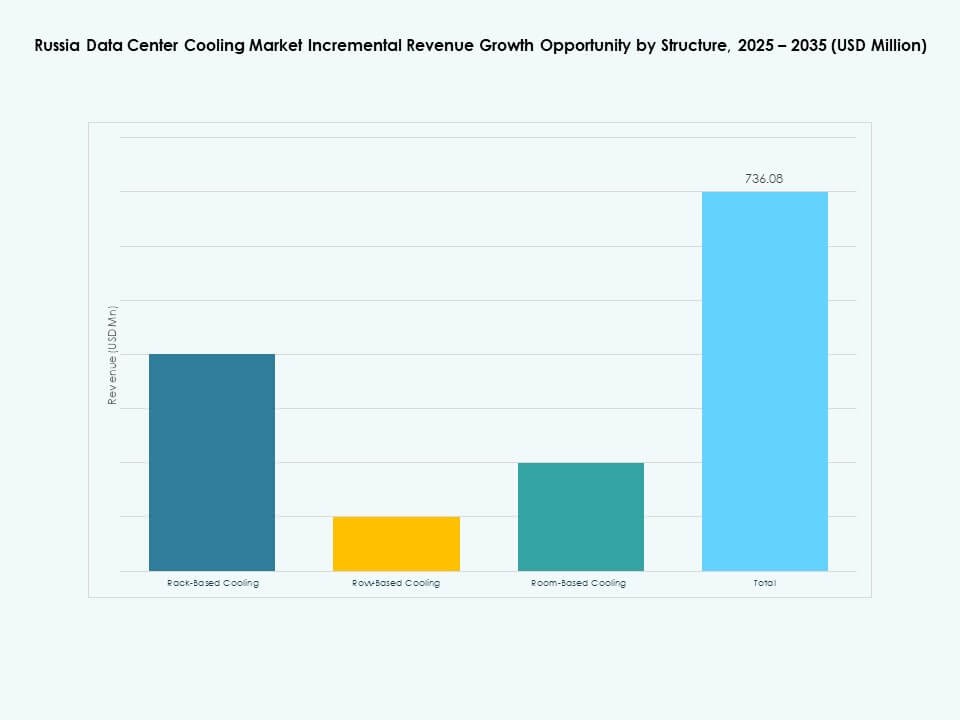
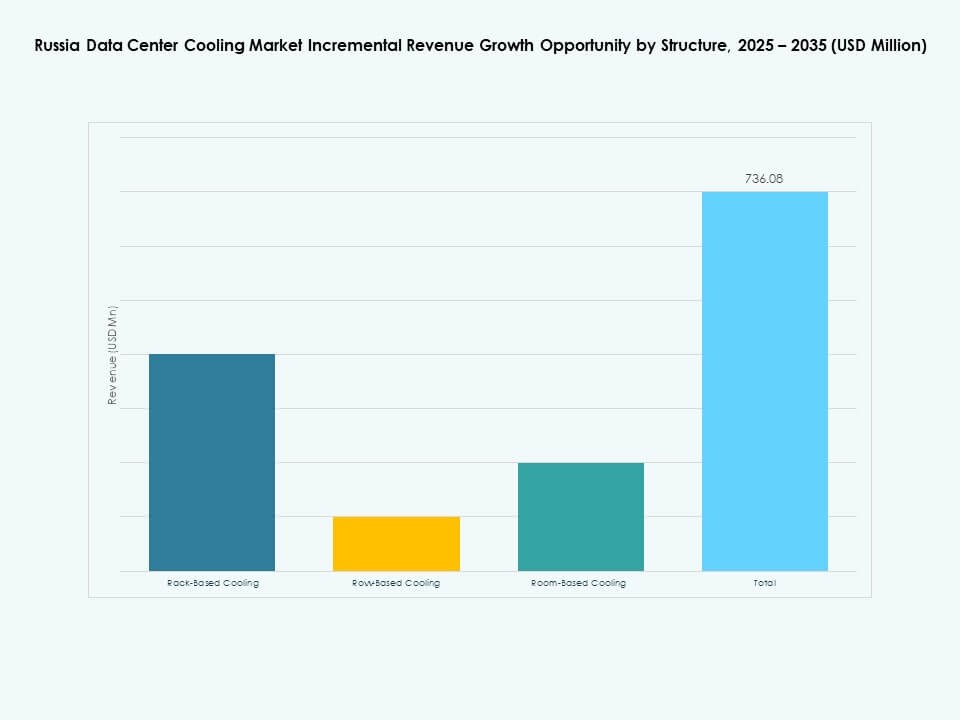
Cooling structure choices evolve in the Russia Data Center Cooling Market. Room-based cooling remains common in older sites and smaller facilities. These systems use large CRAC or CRAH units to condition whole rooms. Row-based cooling gains ground where density varies across aisles. Rack-based cooling sees adoption in very high-density zones or retrofit constraints. Structured approaches allow closer matching of cooling output to specific heat sources. They also support phased densification without full room redesigns. Operators blend structures within the same site, matching architecture to application needs and budgets.

By Application: Hyperscale and Colocation Data Centers Anchor Demand Growth

Application segmentation in the Russia Data Center Cooling Market shows strong weight toward hyperscale and colocation facilities. Hyperscale data centers require highly efficient, modular cooling for massive IT loads. Colocation sites attract enterprises seeking reliable, cost-effective hosting. Enterprise data centers remain important but often modernize more slowly. Edge data centers appear near industrial and telecom nodes, requiring compact systems. Other specialized sites include government, research, and content delivery facilities. Each application segment favors tailored cooling designs, control schemes, and redundancy levels.

By End-User: Telecom, IT, and BFSI Users Remain Core Demand Engines

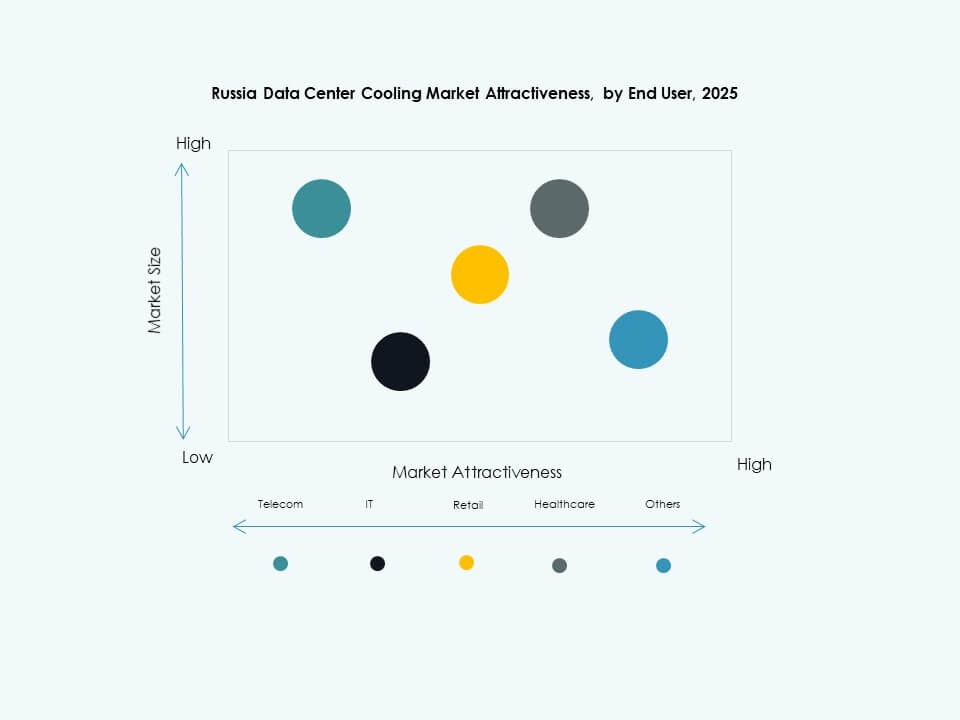
End-user demand in the Russia Data Center Cooling Market concentrates around telecom, IT, and BFSI groups. Telecom operators drive network core and edge facility expansion. IT service providers and cloud platforms need scalable cooling to support digital services. Banks and insurers demand high reliability and regulatory compliance. Retail, healthcare, energy, and other verticals contribute through sector-specific workloads. Their applications often involve strong security requirements and continuous availability. Vendors position reference designs tailored for each vertical’s risk profile and uptime needs. 

Regional Insights:

Central Federal District and Moscow Cluster as Primary Capacity Center

The Central Federal District anchors the Russia Data Center Cooling Market with a dominant share. Industry research indicates Moscow and its region host roughly 65–76% of national rack capacity, reflecting strong concentration of enterprises and government demand. High traffic through major internet exchanges and telecom cores reinforces this lead. Cooling plants in this subregion adopt advanced free cooling and efficient chillers. Developers prioritize Tier III and higher designs with strong redundancy. Investors focus initial capital here due to proven demand and high utilization rates.

Northwestern Hubs and Emerging Volga and Ural Corridors

The Northwestern subregion, led by St. Petersburg, holds the second-largest share in the Russia Data Center Cooling Market. Studies suggest St. Petersburg alone carries about 15–18% of rack capacity and over one third of recent construction capacity in some analyses. This reflects strong telecom, media, and cloud presence. Volga and Ural districts form an emerging corridor linking industrial centers and logistics hubs. New facilities there favor modular plants and free cooling, supported by suitable climate. These subregions create diversification away from Moscow, improving national resilience.

  • For instance, Rostelecom’s St. Petersburg Data Center, launched in 2021 in the Kalininsky District, provides a Tier III-standard environment with a total IT capacity of 7.4 MW and can host up to 800 racks. The facility integrates both conventional and advanced cooling, offering robust disaster recovery and redundancy features for high-availability operations necessary for public and enterprise use.

Siberian and Far Eastern Regions with Long-Term Edge and Greenfield Potential

Siberian and Far Eastern districts hold a smaller combined share of the Russia Data Center Cooling Market today. These areas together account for the remaining fraction of national capacity after central and northwestern hubs. Cold climates offer excellent conditions for extensive free cooling and potential renewable integration. Telecom expansion and resource industries drive localized digital demand. Edge data centers supporting remote operations, logistics, and border trade emerge gradually. Long-term growth may accelerate as infrastructure corridors and cross-border connectivity improve toward Asian markets.

  • For instance, MTS launched a modular data center in Novosibirsk in 2022, featuring two halls with a combined capacity of 250 racks and 1.8 MW of IT power. Public reports confirm the project was completed in about eight months at a cost of roughly 2 billion rubles, supporting rapid regional cloud expansion. The facility was built to Tier III standards and designed to leverage Siberia’s cold climate for efficient operation.

Competitive Insights:

  • Vertiv Group Corp.
  • Schneider Electric
  • Danfoss
  • Carrier
  • Mitsubishi Electric Corporation
  • STULZ GmbH
  • Rittal GmbH & Co. KG
  • CoolIT Systems
  • Modine Manufacturing Company
  • Johnson Controls International plc

The Russia Data Center Cooling Market features intense competition between global OEMs and specialized niche vendors. Large multinational players offer broad portfolios that cover air, liquid, and hybrid solutions, which helps them address complex Tier III and Tier IV projects. Local partners and system integrators strengthen their reach through design, installation, and lifecycle support. Vendors compete on energy efficiency, free cooling enablement, and integration with smart controls. High-density workloads push demand for precision air and advanced liquid solutions, giving innovators a clear edge. Service quality, remote monitoring, and fast maintenance response influence win rates. Sustainability benchmarks and ESG reporting shape procurement criteria for hyperscale and colocation customers.

Recent Developments:

  • In November 2025, Vertiv announced the acquisition of PurgeRite for about $1 billion, significantly expanding its liquid cooling portfolio for data centers globally, which enables more advanced and scalable cooling solutions to meet surging demand from AI-driven rack densities and compute-intensive workloads.
  • In November 2025, Rittal LLC presented its centralized, modular portfolio of AI-ready racks and liquid cooling solutions designed to support effective high-density thermal management at the SC25 exhibition. These innovations are specifically engineered to minimize operational complexity while supporting rapid deployments in AI and hyperscale data centers.
  • In January 2024, Danfoss entered a major strategic partnership with Google to develop and implement sustainable cooling and heat reuse systems for data centers. Danfoss Turbocor® compressors are being installed as part of these efficiency and decarbonization efforts.

1. Introduction

1.1. Market Definition & Scope

1.2. Research Methodology

1.2.1. Primary Research

1.2.2. Secondary Research

1.2.3. Data Validation & Assumptions

1.3. Market Segmentation Framework

2. Executive Summary

2.1. Market Snapshot

2.2. Key Findings

2.3. Analyst Recommendations

2.4. Market Outlook (2025–2035)

3. Market Dynamics

3.1. Market Drivers

3.2. Market Restraints

3.3. Market Opportunities

3.4. Challenges & Risks

3.5. Value Chain Analysis

3.6. Porter’s Five Forces Analysis

4. Russia Data Center Cooling Market – Market Sizing & Forecast

4.1. Historical Market Size (2020–2025)

4.2. Forecast Market Size (2026–2035)

4.3. Market Growth Rate Analysis

4.4. Market Outlook by Country

5. Capital Expenditure (CapEx) Analysis

5.1. CapEx Trends by Cooling Solution

5.1.1. Investment patterns across air-based, liquid-based, hybrid, and immersion cooling

5.1.2. CapEx share by cooling equipment type (CRAC/CRAH, chillers, cooling towers, economizers, etc.)

5.1.3. Country-wise CapEx trends

5.1.4. OEM vs. retrofit investment analysis

5.2. Return on Investment (ROI) & Payback Period Analysis

5.2.1. ROI by cooling technology type

5.2.2. Cost-benefit comparison: air cooling vs. liquid cooling vs. immersion cooling

5.2.3. Payback period across Tier I–IV data centers

5.2.4. Case examples of cost savings through energy-efficient cooling adoption

6. Data Center Cooling Capacity & Utilization

6.1. Installed Capacity (MW & Sq. Ft.) by Cooling Solution

6.1.1. Installed cooling capacity by solution type and Country

6.1.2. Cooling system density (kW/rack and per sq. ft.)

6.1.3. Capacity expansion trends by hyperscale vs. colocation vs. enterprise

6.2. Utilization Rates & Efficiency Metrics

6.2.1. Cooling system utilization vs. design capacity

6.2.2. Average and peak load management practices

6.2.3. Equipment lifecycle and performance benchmarks

6.3. Power Usage Effectiveness (PUE) & Energy Efficiency

6.3.1. Average PUE by data center size and cooling technology

6.3.2. Comparison of traditional vs. green cooling systems

6.3.3. Cooling system contribution to total facility energy consumption

6.4. Rack Density & Cooling Efficiency

6.4.1. Average rack density (kW/rack) trends

6.4.2. Cooling adequacy vs. rack load

6.4.3. Relationship between high-density workloads (AI, HPC) and cooling requirements

7. Data Center Cooling Market, Energy & Resource Consumption Analysis

7.1. Energy Consumption Analysis

7.1.1. Total energy consumption by cooling solution type (air-based, liquid, hybrid, immersion)

7.1.2. Energy intensity per MW of IT load

7.1.3. Energy share of cooling in total facility power (cooling load ratio)

7.1.4. Annualized Energy Efficiency Ratio (EER / SEER) by cooling system type

7.1.5. Trend in energy consumption reduction through automation, AI, and free cooling technologies

7.2. Water Consumption Analysis

7.2.1. Water Usage Effectiveness (WUE) – liters per kWh of IT load

7.2.2. Water consumption by cooling technology (evaporative cooling, adiabatic cooling, etc.)

7.2.3. Water recycling and reuse systems in data centers

7.2.4. Impact of Country-wise water scarcity regulations on cooling system choice

7.2.5. Shift from water-intensive to air-based or hybrid systems

7.3. Combined Energy–Water Efficiency Metrics

7.3.1. Energy-Water Nexus in cooling optimization

7.3.2. Correlation between PUE, WUE, and total operational cost (OpEx)

7.3.3. Case studies of zero-water or waterless cooling deployments

7.4. Benchmarking & Comparative Analysis

7.4.1. Benchmarking against ASHRAE, Uptime Institute, and DOE standards

7.4.2. Comparison of Russia WUE/PUE averages by Country

7.4.3. Best practices adopted by hyperscalers (AWS, Google, Microsoft, Meta, etc.)

8. Russia Data Center Cooling Market – By Component

8.1. Solution

8.2. Services

9. Russia Data Center Cooling Market – By Data Center Cooling Solution

9.1. Air Conditioners

9.2. Precision Air Conditioners

9.3. Chillers

9.4. Air Handling Units

9.5. Liquid Cooling

9.6. Others

10. Russia Data Center Cooling Market – By Service

10.1. Installation & Deployment

10.2. Support & Consulting

10.3. Maintenance Services

11. Russia Data Center Cooling Market – By Enterprise Size

11.1. Large Enterprises

11.2. Small & Medium Enterprises (SMEs)

12. Russia Data Center Cooling Market – By Floor Type

12.1. Raised Floors

12.2. Non-Raised Floors

13. Russia Data Center Cooling Market – By Containment

13.1. Raised Floor with Hot Aisle Containment (HAC)

13.2. Raised Floor with Cold Aisle Containment (CAC)

13.3. Raised Floor without Containment

14. Russia Data Center Cooling Market – By Structure

14.1. Rack-Based Cooling

14.2. Row-Based Cooling

14.3. Room-Based Cooling

15. Russia Data Center Cooling Market – By Application

15.1. Hyperscale Data Center

15.2. Colocation Data Center

15.3. Enterprise Data Center

15.4. Edge Data Center

15.5. Other Data Centers

16. Russia Data Center Cooling Market – By End-user

16.1. Telecom

16.2. IT

16.3. Retail

16.4. Healthcare

16.5. BFSI

16.6. Energy

16.7. Others

17. Sustainability & Green Data Center Cooling

17.1. Energy Efficiency Initiatives

17.1.1. Deployment of free cooling, adiabatic cooling, and economizers

17.1.2. Smart control systems for temperature and airflow optimization

17.1.3. Case studies of efficiency improvement programs

17.2. Renewable Energy Integration

17.2.1. Integration of solar, wind, or geothermal sources in cooling operations

17.2.2. Hybrid systems combining renewable energy with mechanical cooling

17.3. Carbon Footprint & Emission Analysis

17.4. GHG reduction initiatives

17.5. LEED & Green Certifications

17.5.1. Share of cooling systems installed in LEED, BREEAM, or Energy Star certified facilities

17.5.2. Compliance with ASHRAE and ISO energy efficiency standards

18. Emerging Technologies & Innovations

18.1.1. Emerging Technologies & Innovations

18.1.2. Liquid Cooling & Immersion Cooling

18.1.3. Adoption rate and technology maturity

18.1.4. Key vendors and installations by Country

18.1.5. Comparative analysis: performance, cost, and energy savings

18.2. AI & HPC Infrastructure Integration

18.2.1. Cooling demand driven by AI training clusters and HPC systems

18.2.2. Adaptation of cooling design to high heat density workloads

18.3. Quantum Computing Readiness

18.3.1. Cooling requirements for quantum processors

18.3.2. Potential cooling technologies suitable for quantum environments

18.4. Modular & Edge Data Center Cooling

18.4.1. Cooling strategies for prefabricated and modular facilities

18.4.2. Compact and adaptive cooling for edge sites

18.5. Automation, Orchestration & AIOps

18.5.1. Integration of AI-driven thermal management

18.5.2. Predictive maintenance and automated cooling optimization

19. Competitive Landscape

19.1. Market Share Analysis

19.2. Key Player Strategies

19.3. Mergers, Acquisitions & Partnerships

19.4. Product & Service Launches

20. Company Profiles

20.1. Vertiv Group Corp.

20.2. Schneider Electric

20.3. Danfoss

20.4. Carrier

20.5. Mitsubishi Electric Corporation

20.6. STULZ GmbH

20.7. Rittal GmbH & Co. KG

20.8. CoolIT Systems

20.9. Modine Manufacturing Company

20.10. Johnson Controls International plc

20.11. Green Revolution Cooling

Request Free Sample

We prioritize the confidentiality and security of your data. Our promise: your information remains private.

Ready to Transform Data into Decisions?

Request Your Sample Report and Start Your Journey of Informed Choices


Providing the strategic compass for industry titans.

Frequently Asked Questions:

What is the current market size for the Russia Data Center Cooling Market, and what is its projected size in 2035?

The Russia Data Center Cooling Market reached USD 313.45 million in 2025. It is projected to grow to USD 1,049.53 million by 2035, reflecting strong demand for advanced thermal systems.

At what Compound Annual Growth Rate is the Russia Data Center Cooling Market projected to grow between 2025 and 2035?

The Russia Data Center Cooling Market is expected to expand at a CAGR of 12.81% during the forecast period, driven by rising densities and efficiency-focused cooling investments.

Which Russia Data Center Cooling Market segment held the largest share in 2025?

Cooling solutions such as chillers and precision air conditioners held the largest share of the Russia Data Center Cooling Market in 2025, supported by strong deployment across hyperscale and colocation sites.

What are the primary factors fueling the growth of the Russia Data Center Cooling Market?

The Russia Data Center Cooling Market grows due to rising cloud adoption, higher rack densities, stronger focus on efficiency, and wider use of free cooling and advanced liquid-based systems.

Who are the leading companies in the Russia Data Center Cooling Market?

Key players in the Russia Data Center Cooling Market include Vertiv, Schneider Electric, Danfoss, Carrier, Mitsubishi Electric, STULZ, Rittal, CoolIT Systems, Modine, and Johnson Controls.

Which region commanded the largest share of the Russia Data Center Cooling Market in 2025?

The Central Federal District, led by Moscow, accounted for the largest share of the Russia Data Center Cooling Market in 2025, supported by dense enterprise activity and major digital infrastructure hubs.

Licence Option

The report comes as a view-only PDF document, optimized for individual clients. This version is recommended for personal digital use and does not allow printing. Use restricted to one purchaser only.
To meet the needs of modern corporate teams, our report comes in two formats: a printable PDF and a data-rich Excel sheet. This package is optimized for internal analysis. Unlimited users allowed within one corporate location (e.g., regional office).
The report will be delivered in printable PDF format along with the report’s data Excel sheet. This license offers 100 Free Analyst hours where the client can utilize DC Market Insights’ research team. Permitted for unlimited global use by all users within the purchasing corporation.

Europe


North America

Smallform of Sample request

Request Sample