
Austria AI Data Center Market Size, Share & Forecast to 2035
Market at a glance
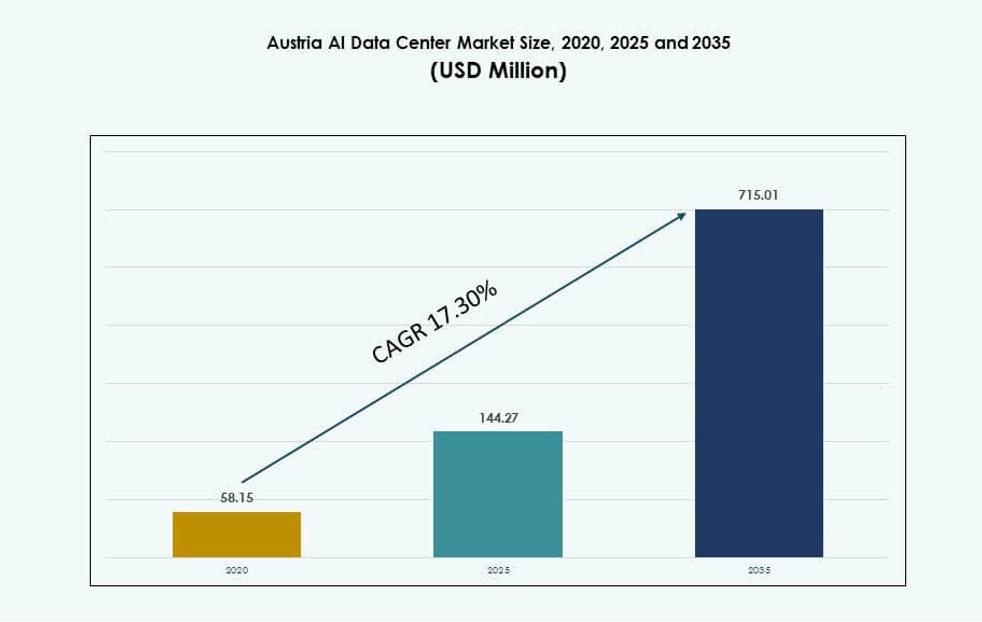
The Austria AI Data Center market was worth USD 144.3 million in 2025 and is forecast to reach USD 715.0 million by 2035, growing at a 17.3% CAGR. Vienna Metropolitan Region accounts for over 60% of the market.
 By Amit Jain, Senior Consultant, ICT & Emerging Technologies
 Reviewed by Deepti Agrawal
Last updated 16 Feb 2026
Base year 2024 PDF + Excel
Reviewed by Deepti Agrawal
Last updated 16 Feb 2026
Base year 2024 PDF + Excel
Source: DC Market Insights analysis
Key findings
AI-Specific Data Center Design Featuring GPU-Optimized and Liquid-Cooled Racks
High Initial Capital Costs and Infrastructure Readiness Delays Across Edge Locations
AI Innovation Hubs, Academic Partnerships, and Startup Ecosystem Expansion
Regional insights
- Vienna Metropolitan Region60%+
- Linz and Salzburg20%
- Graz, Innsbruck, and Other Provinces20%
Segmentation
Companies profiled
- ANEXIA
- Next Layer
- A1 Digital
- Digital Realty Trust
- Equinix
- Microsoft (Azure)
- Amazon Web Services (AWS)
- Google Cloud / Alphabet
- Dell Technologies
- NVIDIA
Recent developments
fragmentiX announced the construction of the LEND AI DataCentre near Salzburg. Developed in partnership with DELL Technologies, this high-security facility emphasizes data sovereignty, sustainability via local hydropower, and AI applications unique to Europe.
Microsoft expanded its Austria East datacenter region to support Microsoft 365 data residency locally, offering full local storage and processing for Power Platform, Dynamics 365, and collaboration tools with integration into the EU Data Boundary framework.
Microsoft launched a new Austrian Azure cloud region in Vienna that enables local cloud and AI services for enterprises and public sector clients, enhancing data sovereignty and compliance within Austria.
Anexia purchased a small hydropower plant in Styria, Austria, to generate sustainable electricity for its data centers, including support for AI workloads amid growing energy demands in the region.
AtlasEdge acquired a Vienna data center site. The purchase establishes the company's presence in Austria's key connectivity hub, with plans to expand it to a 10MW facility by Q3 2026
Full analysis
Executive summary
The Austria AI Data Center Market size was valued at USD 58.15 million in 2020 to USD 144.27 million in 2025 and is anticipated to reach USD 715.01 million by 2035, at a CAGR of 17.30% during the forecast period.
| REPORT ATTRIBUTE | DETAILS |
|---|---|
| Historical Period | 2020-2023 |
| Base Year | 2024 |
| Forecast Period | 2025-2035 |
| Austria Pacific AI Data Center Market Size 2025 | USD 144.27 Million |
| Austria Pacific AI Data Center Market, CAGR | 17.30% |
| Austria Pacific AI Data Center Market Size 2035 | USD 715.01 Million |
Growing demand for AI workloads, sovereign cloud platforms, and sustainable data center designs is reshaping Austria’s digital infrastructure landscape. Enterprises seek high-density compute environments to support machine learning, NLP, and generative AI. National policies on digital innovation and strict data residency rules are accelerating local infrastructure investments. Businesses prioritize low-latency, AI-ready deployments for critical applications. Operators integrate GPU clusters and AI orchestration layers across new facilities. Innovation from cloud providers and domestic firms fuels competition and service upgrades. Austria’s AI data centers enable faster insights and operational efficiency. It serves as a strategic backbone for enterprise transformation and public-sector AI deployment.
Vienna leads the market with strong interconnection, hyperscale activity, and policy alignment. It hosts the bulk of the country’s AI-ready infrastructure. Salzburg and Linz are emerging as secondary hubs due to rising regional AI demand and lower deployment costs. These cities attract mid-size operators and industry-focused AI deployments. Graz and Innsbruck show early-stage potential driven by university research and smart city programs. Austria benefits from central access to Germany, Switzerland, and Eastern Europe. It strengthens the country’s position as a regional AI compute and data exchange hub.
Market Dynamics
Market Drivers
Surging Demand for High-Density Compute Supporting AI and Next-Gen Workloads
The Austria AI Data Center Market benefits from rising AI adoption in enterprise workflows, including analytics, automation, and inference. Demand for high-density GPU clusters and accelerated compute nodes is increasing. Organizations across BFSI, telecom, and manufacturing seek dedicated infrastructure for model training and real-time decisioning. Businesses are investing in AI-native platforms requiring specialized cooling and power delivery. This demand accelerates new facility development tailored to AI workloads. Operators are integrating rack-level liquid cooling and low-latency interconnects. AI is reshaping data center design from the core to the edge. Investment activity is rising from both domestic and international players. It positions Austria as a central AI compute hub in the region.
- For instance, Electric Power Systems (EPS) launched timber pre‑fabricated data center pods capable of 10–40 kW capacity in October 2025, offering sustainable, modular high‑density compute infrastructure suitable for AI workloads.
Expansion of Digital Transformation Strategies Across Public and Private Sectors
Austria’s national digital strategies encourage AI integration across healthcare, education, and transportation. Public-private partnerships fund research centers and advanced infrastructure zones. Enterprise demand for automation and personalized services increases AI model training requirements. High compute availability is now central to operational performance. Businesses prioritize data residency and regulatory compliance, boosting domestic capacity. The Austria AI Data Center Market gains importance in supporting sovereign AI development. Strategic initiatives align with EU-level digital and green transformation goals. AI-readiness has become a core factor in IT procurement. This ecosystem drives growth across colocation and cloud deployments.
- For instance, AI Factory Austria (AI:AT) launched in March 2025 with EU EuroHPC funding to build state‑of‑the‑art computing infrastructure, enabling companies to train larger AI models efficiently.
Integration of Energy-Efficient Systems and Sustainability-Driven Infrastructure
Sustainability remains a top priority in data center planning and operations. Austria’s abundant renewable energy, especially hydroelectric power, supports green AI infrastructure. Operators deploy energy-efficient cooling systems and optimize PUE through advanced monitoring tools. Liquid-cooled GPU racks reduce heat output and boost performance. Certifications such as ISO 50001 and green building standards guide facility design. The market attracts hyperscale investments due to low-carbon energy access. AI workloads align with sustainability objectives by optimizing resource use. Intelligent power management systems ensure operational efficiency. It enables enterprises to scale AI while meeting ESG targets.
Strengthening Cross-Border Connectivity and Edge Compute Networks
Austria’s central European location enables strong cross-border data exchange across Germany, Switzerland, and Eastern Europe. Edge networks expand in secondary cities to reduce latency and support real-time AI applications. Businesses leverage hybrid and multi-cloud environments to distribute AI processing. Data center operators enhance peering capacity and direct cloud connectivity. Vienna remains the national hub with Tier III and IV-certified facilities. Interconnection density allows seamless workload distribution across AI clusters. Emerging cities offer cost advantages and growing enterprise footprints. It supports AI-driven service delivery in finance, logistics, and e-government. The Austria AI Data Center Market plays a critical role in regional AI compute alignment.
Market Trends
AI-Specific Data Center Design Featuring GPU-Optimized and Liquid-Cooled Racks
The Austria AI Data Center Market is seeing rapid adoption of AI-centric infrastructure tailored to high-performance computing. Operators deploy racks supporting 30–50 kW densities, often with direct-to-chip or immersion cooling. Traditional airflow systems are being replaced by advanced liquid-based solutions. Modular designs help scale GPU clusters with minimal downtime. Facilities now integrate DCIM tools optimized for AI training telemetry. High-throughput networking infrastructure supports petabyte-scale data exchange. Vendors focus on ready-to-deploy AI stacks with validated hardware-software integrations. It encourages enterprises to shift from generic compute to AI-optimized hosting models. Design optimization enhances speed, efficiency, and sustainability.
Rise in Demand for Sovereign AI Infrastructure and Data Localization Compliance
Data localization regulations are shaping AI infrastructure development in Austria. Enterprises, especially in healthcare and finance, require localized training environments. Compliance with GDPR and national data residency laws drives investment in in-country AI hosting. Data centers respond with secure zones and compliance-ready architectures. Encryption at rest, access controls, and audit features become standard. Sovereign AI requires control over data flow, storage, and compute operations. Hyperscalers and colocation providers now offer sovereign cloud services for training and inference. The Austria AI Data Center Market aligns infrastructure with legal frameworks. It enables AI development without compromising regulatory obligations.
Growth in GPU-as-a-Service Models and Elastic AI Compute Platforms
AI-as-a-Service is reshaping capacity delivery models across Austria. GPU-as-a-Service platforms allow dynamic resource allocation for training and inferencing. Enterprises subscribe to shared clusters hosted within national borders. Elastic models offer flexibility, reducing capex for AI adoption. Operators integrate orchestration tools to manage multi-tenant AI workloads. Platform providers bundle compute with toolkits for data prep, model tuning, and monitoring. Pricing models support burst workloads and steady-state inference. The Austria AI Data Center Market supports this shift with infrastructure that enables real-time scaling. Businesses reduce time-to-AI while maintaining operational control.
AI-Driven Facility Operations Using Predictive Maintenance and Smart Optimization
AI is not only the workload but also the operational enabler in data centers. Operators adopt AI-driven tools to manage energy use, thermal flow, and workload distribution. Predictive maintenance reduces downtime by identifying hardware failures in advance. Smart controls optimize cooling, UPS load, and generator performance. AI-enhanced BMS and EMS systems deliver granular insights. Data centers achieve lower PUE and higher reliability using real-time optimization. Vendors offer AI-native management layers that improve response time. The Austria AI Data Center Market benefits from internal efficiency gains. It improves service quality and lowers lifecycle costs.
Market Challenges
High Initial Capital Costs and Infrastructure Readiness Delays Across Edge Locations
Building AI-ready data centers demands large upfront investment. High-density racks, liquid cooling systems, and specialized GPUs raise procurement costs. Infrastructure buildout timelines extend due to design complexity and regulatory clearances. Power availability and grid interconnection issues impact secondary and edge locations. Local permitting delays add uncertainty for greenfield projects. Skilled workforce shortages slow deployment of advanced systems. Rural and mid-tier cities lack the robust connectivity required for edge AI deployment. The Austria AI Data Center Market faces hurdles in balancing regional rollout with ROI. Operators need capital efficiency and long-term usage guarantees to de-risk expansion.
Regulatory Ambiguity in AI-Specific Compliance and Environmental Impact Norms
The AI ecosystem lacks standardized regulations on compute transparency and carbon accounting. Evolving EU-level policies around digital sovereignty, AI ethics, and energy use add complexity. Operators must adapt to changing emission thresholds and workload categorization. Environmental rules differ across federal and municipal jurisdictions, creating compliance ambiguity. Large-scale AI centers may face scrutiny for energy use even with green sourcing. Difficulty in quantifying AI workloads’ externalities limits policy clarity. Vendors face pressure to justify resource use in high-density deployments. The Austria AI Data Center Market must address these legal uncertainties. Long-term viability depends on clear, harmonized frameworks.
Market Opportunities
AI Innovation Hubs, Academic Partnerships, and Startup Ecosystem Expansion
Austria’s universities and AI research centers offer collaboration opportunities for data center operators. Vienna, Linz, and Graz host clusters focused on AI research, training, and simulation. Data center providers can partner with institutions to offer AI infrastructure on demand. The Austria AI Data Center Market supports academic experimentation and early-stage innovation. Access to scalable GPU compute fosters entrepreneurship and model iteration.
Rising Cross-Border AI Projects and Regional Integration With EU Compute Networks
Austria’s position enables integration into larger EU AI infrastructure networks. Operators can serve multi-country AI training requirements with low-latency performance. Government-backed initiatives promote shared compute, boosting regional demand. The Austria AI Data Center Market is positioned to become a key link in EU-wide AI workloads. Interoperable frameworks open doors for international collaboration and scaling.
Market Segmentation
By Type
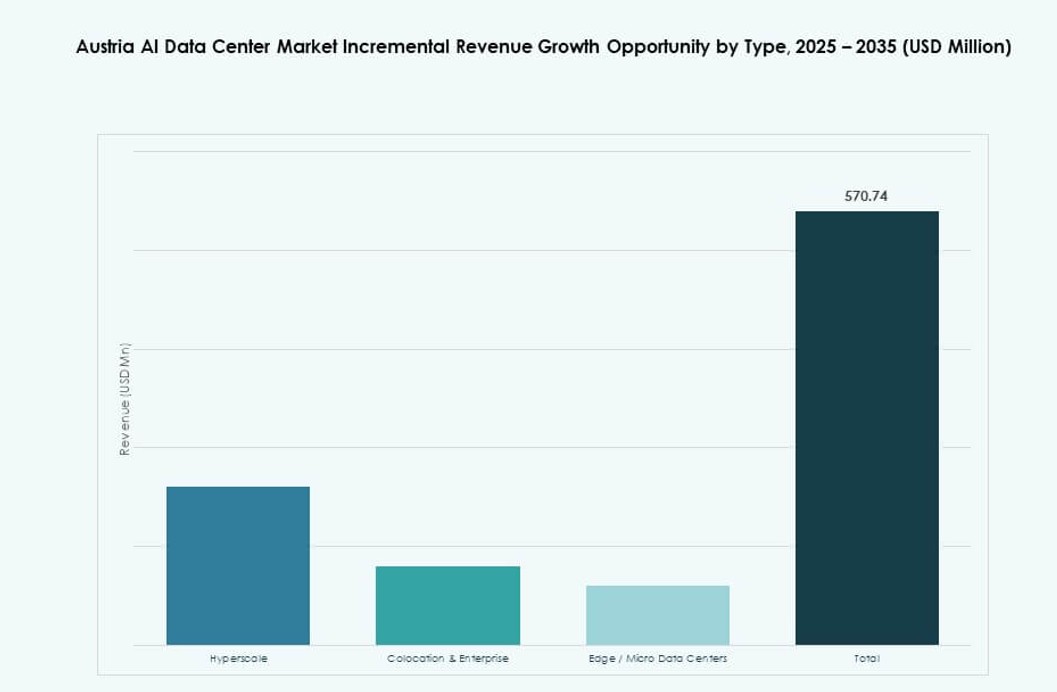
The hyperscale segment dominates the Austria AI Data Center Market, driven by demand for scalable AI training and high-volume inference capacity. Operators focus on building large, modular campuses optimized for GPU clustering. Colocation and enterprise deployments follow, supporting regulated sectors and private AI development. Edge/micro data centers are emerging for real-time analytics and localized model execution. Growth in edge AI applications strengthens the long-term potential of this segment.
By Component
Hardware holds the largest market share due to AI’s high demand for GPUs, accelerators, and cooling systems. Facilities are upgrading to support high-rack power densities and advanced chipsets. Software and orchestration platforms gain traction for AI workload scheduling, management, and observability. The services segment supports design, integration, and ongoing AI infrastructure operations. Each layer plays a key role in supporting AI deployment at scale.
By Deployment
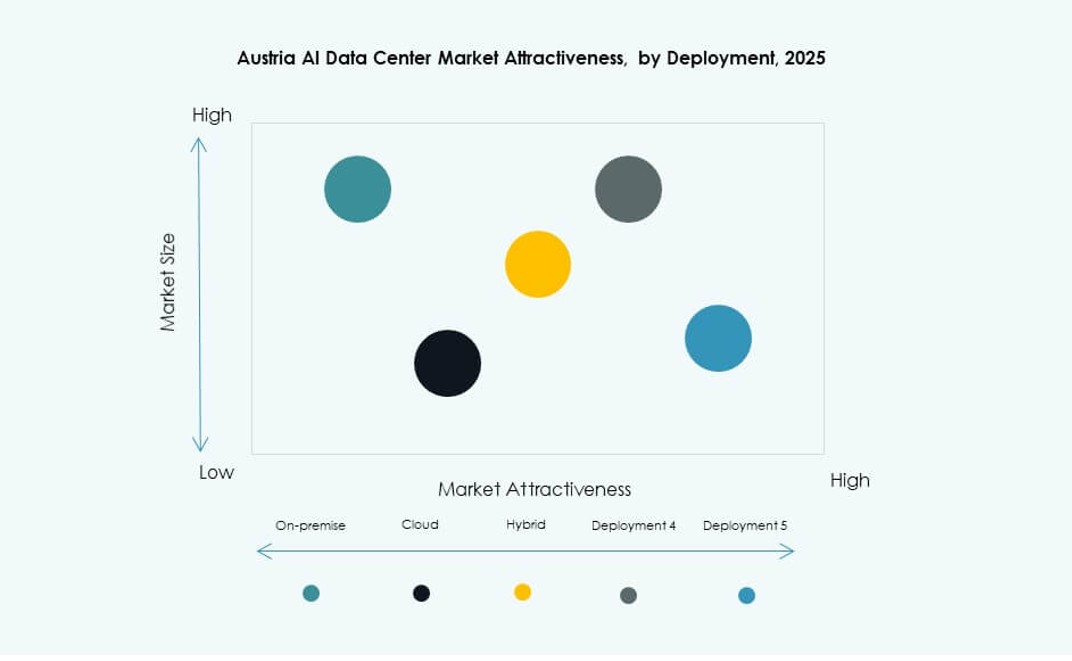
Hybrid deployment leads in the Austria AI Data Center Market, as enterprises seek to balance control, performance, and scalability. Cloud deployment is expanding due to on-demand GPU provisioning and lower upfront cost. On-premise remains relevant in regulated industries requiring complete data governance. Hybrid models provide flexibility to optimize cost and compliance. This deployment mix reflects Austria’s maturing enterprise AI strategies.
By Application
Machine learning (ML) leads application segments, supporting structured and unstructured data processing across industries. Generative AI (GenAI) grows rapidly, fueled by enterprise chatbot, image generation, and code synthesis use cases. NLP supports language translation, customer service, and sentiment analysis. Computer vision is applied in smart surveillance, quality control, and healthcare diagnostics. The “others” category includes robotics and forecasting models gaining adoption.
By Vertical
The IT and telecom vertical leads due to heavy investment in AI-driven automation and service optimization. BFSI follows with AI in fraud detection, risk modeling, and customer personalization. Healthcare is expanding due to imaging diagnostics and predictive analytics. Retail leverages AI for supply chain and personalization. Media & entertainment use cases in content generation are growing. Manufacturing and automotive use AI in quality control and autonomous systems. Other sectors adopt AI incrementally with targeted deployments.
Regional Insights
Vienna Metropolitan Region Dominates with Over 60% Market Share
Vienna leads the Austria AI Data Center Market, holding over 60% of the market share. The city offers strong power grid reliability, dense connectivity, and access to top-tier universities. High regulatory clarity and green energy availability make it ideal for AI-ready infrastructure. Major global and regional operators have established presence near Vienna. It serves as the core interconnection hub for domestic and cross-border traffic. Strategic location and data sovereignty needs reinforce Vienna’s lead.
- For instance, Digital Realty operates multiple Vienna facilities with over 118,000 ft² and 220,000 ft² of colocation space, supporting more than 185 customers and enhancing the city’s interconnection ecosystem
Linz and Salzburg Emerge with 20% Combined Share as Secondary Hubs
Linz and Salzburg account for about 20% of the market, serving regional enterprises and public sector projects. These cities benefit from lower land costs and supportive municipal policies. Emerging industrial AI use cases drive localized compute demand. Data centers in these areas support hybrid deployments and regional edge requirements. Linz’s industrial base and Salzburg’s smart city initiatives create early traction. It enables AI deployment closer to source systems.
- For instance, Google has advanced plans for a data center near Linz in Kronstorf, with groundwork underway and planning submissions made in 2025, signaling a strategic build‑out outside Vienna.
Graz, Innsbruck, and Other Provinces Hold 20% Market Share and Future Potential
Graz, Innsbruck, and other provinces collectively represent 20% of the Austria AI Data Center Market. These regions are in early development stages but show promise for edge and academic-linked infrastructure. AI innovation programs and university research clusters support future growth. Infrastructure gaps, such as power provisioning and connectivity, still limit scale. Incentives and public-private models could accelerate deployment. It creates opportunity for distributed AI compute networks.
Competitive Insights
- ANEXIA
- Next Layer
- A1 Digital
- Digital Realty Trust
- Equinix
- Microsoft (Azure)
- Amazon Web Services (AWS)
- Google Cloud / Alphabet
- Dell Technologies
- NVIDIA
The Austria AI Data Center Market features a mix of local, regional, and global players driving innovation, capacity expansion, and specialized AI infrastructure. Local firms like ANEXIA, A1 Digital, and Next Layer focus on colocation, enterprise-grade hosting, and national compliance support. Hyperscale leaders such as AWS, Google Cloud, and Microsoft Azure are investing in GPU-optimized infrastructure to meet growing enterprise demand. Equinix and Digital Realty offer scalable interconnection and hybrid platforms across Vienna and secondary cities. NVIDIA plays a critical role through hardware acceleration and ecosystem partnerships. It creates a competitive landscape marked by AI-native services, sustainability initiatives, and cross-border integration. Operators are differentiating through AI workload orchestration, renewable energy use, and sovereign hosting capabilities.
Recent Developments
- In October 2025, fragmentiX announced the construction of the LEND AI DataCentre near Salzburg. Developed in partnership with DELL Technologies, this high-security facility emphasizes data sovereignty, sustainability via local hydropower, and AI applications unique to Europe.
- In August 2025, Microsoft expanded its Austria East datacenter region to support Microsoft 365 data residency locally, offering full local storage and processing for Power Platform, Dynamics 365, and collaboration tools with integration into the EU Data Boundary framework.
- In July 2025, Microsoft launched a new Austrian Azure cloud region in Vienna that enables local cloud and AI services for enterprises and public sector clients, enhancing data sovereignty and compliance within Austria.
- In December 2024, Anexia purchased a small hydropower plant in Styria, Austria, to generate sustainable electricity for its data centers, including support for AI workloads amid growing energy demands in the region.
- In March 2024, AtlasEdge acquired a Vienna data center site. The purchase establishes the company’s presence in Austria’s key connectivity hub, with plans to expand it to a 10MW facility by Q3 2026
Table of contents
Table of Content
- Introduction
- Market Definition & Scope
- Research Methodology
- Primary Research
- Secondary Research
- Data Validation & Assumptions
- Market Segmentation Framework
- Executive Summary
- Market Snapshot
- Key Findings
- Analyst Recommendations
- Market Outlook (2025–2035)
- Market Dynamics
- Market Drivers
- Market Restraints
- Market Opportunities
- Challenges & Risks
- Value Chain Analysis
- Porter’s Five Forces Analysis
- Austria AI Data Center Market – Market Sizing & Forecast
- Historical Market Size (2020–2025)
- Forecast Market Size (2026–2035)
- Market Growth Rate Analysis
- Market Outlook by Region
- Market Trends & Insights
- Technology Adoption Trends
- Business & Investment Trends
- Regulatory & Policy Landscape
- Data sovereignty & localization requirements
- Energy efficiency and carbon regulations by region
- Tax incentives or subsidies for green AI data centers
- Compliance standards (ISO, ASHRAE, LEED, BREEAM, Energy Star)
- Risk & Resilience Analysis
- Supply chain risk for servers, accelerators, networking hardware
- Operational risks: power outages, cooling failures, cyberattacks
- Disaster recovery & business continuity strategies for AI data centers
- Cost Analysis & Pricing Trends
- Capex and Opex for AI data centers by type (hyperscale, colocation, edge)
- Cost breakdown: compute, cooling, networking, storage, software
- ROI, TCO analysis, and benchmarking vs traditional data centers
- Future Outlook & Strategic Recommendations
- Market forecasts by sub-segment and geography beyond 2035
- Emerging technologies (quantum computing, neuromorphic computing) impact on AI data centers
- Strategic investment recommendations by region, vertical, and application
- Austria AI Data Center Market – By Type
- Hyperscale
- Colocation & enterprise
- Edge/micro data centers
- Austria AI Data Center Market – By Component
- Hardware
- Software & orchestration
- Services
- Austria AI Data Center Market – By Deployment
- On-premise
- Cloud
- Hybrid
- Austria AI Data Center Market – By Application
- Generative AI (GenAI)
- Machine Learning (ML)
- Natural Language Processing (NLP)
- Computer Vision (CV)
- Others
- Austria AI Data Center Market – By Vertical
- Healthcare
- Retail
- IT and Telecom
- BFSI
- Automotive
- Media & Entertainment
- Manufacturing
- Others
- Sustainability & Green AI Data Centers
- Energy Efficiency Initiatives
- Deployment of free cooling, adiabatic cooling, and economizers
- Smart control systems for temperature and airflow optimization
- Case studies of efficiency improvement programs
- Renewable Energy Integration
- Integration of solar, wind, or geothermal sources in cooling operations
- Hybrid systems combining renewable energy with mechanical cooling
- Carbon Footprint & Emission Analysis
- GHG reduction initiatives
- LEED & Green Certifications
- Share of cooling systems installed in LEED, BREEAM, or Energy Star certified facilities
- Compliance with ASHRAE and ISO energy efficiency standards
- Energy Efficiency Initiatives
- Emerging Technologies & Innovations
- Emerging Technologies & Innovations
- Liquid Cooling & Immersion Cooling
- Adoption rate and technology maturity
- Key vendors and installations by region
- Comparative analysis: performance, cost, and energy savings
- AI & HPC Infrastructure Integration
- Cooling demand driven by AI training clusters and HPC systems
- Adaptation of cooling design to high heat density workloads
- Quantum Computing Readiness
- Cooling requirements for quantum processors
- Potential cooling technologies suitable for quantum environments
- Modular & Edge AI Data Center
- Cooling strategies for prefabricated and modular facilities
- Compact and adaptive cooling for edge sites
- Automation, Orchestration & AIOps
- Integration of AI-driven thermal management
- Predictive maintenance and automated cooling optimization
- Competitive Landscape
- Market Share Analysis
- Key Player Strategies
- Mergers, Acquisitions & Partnerships
- Product & Service Launches
- Company Profiles
- ANEXIA
- Next Layer
- A1 Digital
- Digital Realty Trust
- Microsoft (Azure)
- Equinix
- Amazon Web Services (AWS)
- Dell Technologies
- Hewlett Packard Enterprise (HPE)
- Lenovo
- Google Cloud / Alphabet
- Meta Platforms
- NVIDIA
- IBM
- Aligned Data Centers
- Arista Networks / Broadcom
- QTS Realty Trust
- Case Studies & Use Cases
About this report
Written by Amit Jain and reviewed by Deepti Agrawal, Senior Editor, Research. Figures are built top-down and bottom-up and reconciled before publication, with 2024 as the base year.
Read our methodologyHow we built this
- Historical period2020-2023
- Base year2024
- Forecast period2025-2035
- Sizing approachTop-down + bottom-up
Need more than the report?
Advisory on this market
Due diligence, site selection and market entry work, by the analysts who wrote this report.
See consulting servicesFrequently asked questions
The Austria AI Data Center Market was valued at USD 144.27 million in 2025 and is projected to reach USD 715.01 million by 2035.
The Austria AI Data Center Market is expected to grow at a CAGR of 17.30% from 2025 to 2035.
In 2025, the hyperscale segment held the largest share of the Austria AI Data Center Market due to strong demand for scalable GPU compute.
Key growth drivers for the Austria AI Data Center Market include AI infrastructure investments, digital transformation programs, and sovereign data compliance.
Leading players in the Austria AI Data Center Market include ANEXIA, A1 Digital, Equinix, AWS, Microsoft, and Google Cloud.
Vienna held over 60% of the Austria AI Data Center Market in 2025, supported by dense connectivity and regulatory clarity.
Licences, delivery and payment
Which licence should I choose?
Single User is a view-only PDF for one person. Multi User adds a printable PDF and the Excel data for unlimited users at one location. Enterprise covers your whole company and includes 100 free analyst hours.
How and when will I receive the report?
By email, within 24–48 business hours of payment, in the formats of your licence.
How can I pay?
Securely through PayPal: with a PayPal account, a debit or credit card, or PayPal Pay Later where available. Prices are in US dollars.
Can I see a sample first?
Yes. Request a free sample and we will email it to you.
Can the report be tailored to my needs?
Yes. We can add countries, segments or data cuts. Talk to an analyst about the scope you need.
Can I get an invoice or pay against a purchase order?
Write to sales@dcmarketinsights.com and our team will help.