Home » Thailand Data Center Cooling Market

Thailand Data Center Cooling Market By Component (Solution, Services); By Solution Type (Air Conditioning, Chilling Units, Cooling Towers, Economizer Systems, Liquid Cooling, Control Systems, Others); By Service Type (Consulting, Installation & Deployment, Maintenance & Support); By Data Center Type (Enterprise Data Centers, Colocation Data Centers, Cloud Data Centers); By Industry Vertical (BFSI, IT & Telecom, Healthcare, Government, Others) – Growth, Share, Opportunities & Competitive Analysis, 2025 – 2035

Report ID: 7632 | Report Format : Excel, PDF

Executive summary:

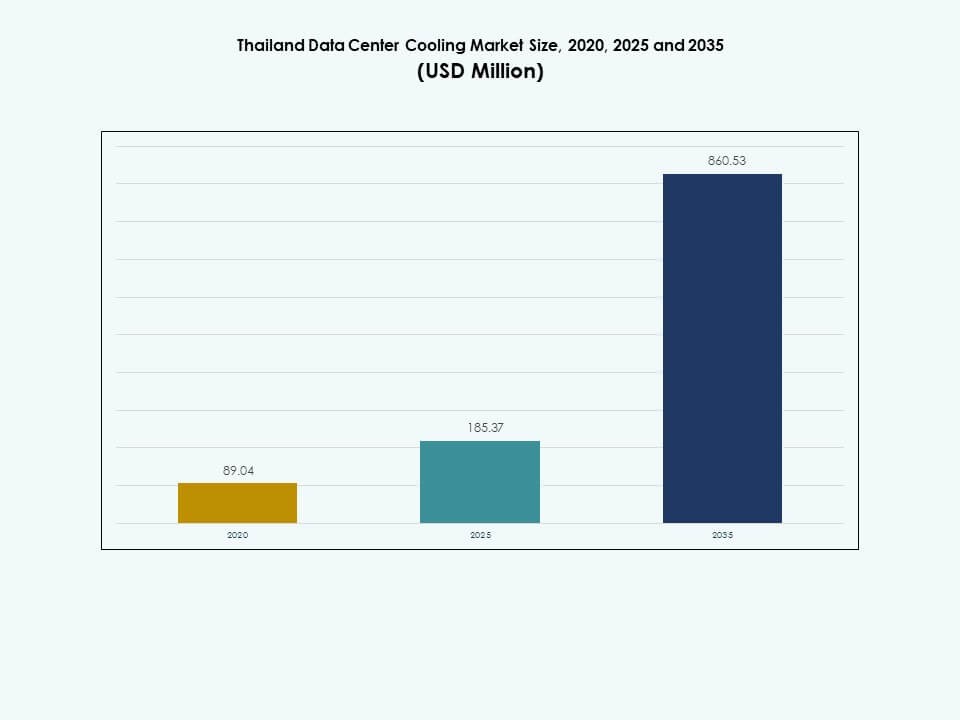
The Thailand Data Center Cooling Market size was valued at USD 89.04 million in 2020 to USD 185.37 million in 2025 and is anticipated to reach USD 860.53 million by 2035, at a CAGR of 16.52% during the forecast period.

REPORT ATTRIBUTE DETAILS
Historical Period 2020-2023
Base Year 2024
Forecast Period 2025-2035
Thailand Data Center Cooling Market Size 2025 USD 185.37 Million
Thailand Data Center Cooling Market, CAGR 16.52%
Thailand Data Center Cooling Market Size 2035 USD 860.53 Million


Strong demand for advanced cooling rises with Thailand’s shift toward high-density computing, AI workloads, and cloud-driven expansion. Operators adopt liquid cooling, modular systems, and intelligent airflow control to manage higher rack power demands. Innovation accelerates upgrades across hyperscale, colocation, and enterprise facilities. The market gains strategic importance as businesses seek stronger uptime, better operational efficiency, and long-term energy savings within rapidly growing digital ecosystems.

Geographically, Bangkok leads market activity due to its concentration of colocation hubs, cloud zones, and enterprise data centers. The Eastern Economic Corridor emerges as a high-potential cluster supported by industrial development and new edge deployments. Northern and secondary regions show rising interest from smaller operators seeking cost-efficient capacity expansion. These geographic shifts strengthen Thailand’s role as a competitive digital infrastructure hub in Southeast Asia.

Thailand Data Center Cooling Market SizeMarket Drivers:

Rapid Digitalization and Cloud Growth Driving High-Density Cooling Demand

Rapid digitalization across Thailand lifts demand for reliable data center hosting. Cloud service providers expand local zones to meet low latency needs. E-commerce, fintech, and content platforms push higher rack power densities. The Thailand Data Center Cooling Market responds with efficient, scalable cooling architectures. It supports stable operations for hyperscale and colocation operators in Bangkok. Stricter uptime targets drive investment in redundant cooling loops and automation. Investors view robust cooling as protection against costly service outages. Strong digital infrastructure policies reinforce confidence in long-term asset performance.

Energy Efficiency, Sustainability Targets, and Regulatory Influence on Cooling Choices

Energy efficiency standards shape procurement choices for new cooling systems. Operators target lower PUE values to manage rising electricity tariffs. Government sustainability goals encourage greener designs and refrigerants. The market pushes high-efficiency chillers and advanced airflow management. The Thailand Data Center Cooling Market links directly to national climate goals. It helps reduce indirect emissions from fast-growing digital workloads. Corporate ESG commitments steer capital toward efficient retrofits and upgrades. Green financing instruments reward projects with clear efficiency benchmarks.

  • For instance, NTT Global Data Centers’ Bangkok 3 facility is designed with a highly efficient water-cooled chiller system and a planned IT load of 14 MW, built to Tier III standards in a low-risk location. Public information indicates the site is scheduled to enter commercial service in the second half of 2025 and supports NTT Group’s net-zero data center targets and Thailand’s broader digital and sustainability goals.

Advanced Cooling Technologies Supporting AI, GPU, and High-Density Workloads

High-density computing drives adoption of liquid and hybrid cooling designs. AI workloads in GPUs create intense thermal loads per rack. Operators deploy containment and row-based systems for tighter temperature control. The Thailand Data Center Cooling Market benefits from modular technology platforms. It allows phased capacity growth with limited site disruption. Vendors offer prefabricated cooling modules for rapid deployment timelines. Controls software improves setpoint management and predictive maintenance planning. These innovations lower lifecycle costs while protecting critical hardware.

  • For example, ETIX Bangkok #1 is designed for ultra-high-density workloads and supports rack capacities up to 200 kW, according to the company’s published specifications. The facility incorporates liquid- and immersion-ready cooling infrastructure to serve AI and GPU-intensive tenants, and ETIX reports that it operates using renewable energy sourced through its sustainability commitments in Thailand.

Strategic Role of Cooling in Asset Valuation and Investor Confidence

Cooling performance directly influences data center valuation in Thailand. Institutional investors assess resilience of thermal designs before commitments. Long-term contracts favor operators with proven efficiency and reliability metrics. The Thailand Data Center Cooling Market underpins mission-critical digital services. It supports banking, telecom, and public sector platforms serving national users. Robust cooling capacity reduces risk premiums in project financing models. Global operators partner with local firms to align designs with climate conditions. This alignment strengthens competitiveness of Thai facilities within Southeast Asia.

Thailand Data Center Cooling Market ShareMarket Trends:

Integration of Smart Cooling, Sensors, and DCIM for Real-Time Control

Smart cooling platforms gain prominence in Thai data centers. Operators integrate sensors across racks, coils, and CRAC units. Real-time analytics support tighter temperature and humidity bands. The Thailand Data Center Cooling Market shows strong interest in DCIM integration. It links thermal data with power and IT load insights. Advanced control logic enables dynamic airflow and capacity adjustments. Remote dashboards support multi-site monitoring from central network operations centers. Vendors highlight software features as strongly as mechanical specifications.

Shift Toward Liquid and Hybrid Architectures for AI and GPU Clusters

High-density racks reshape cooling design across new Thai facilities. GPU clusters for AI and analytics strain legacy air-based systems. Designers trial rear-door heat exchangers and in-row liquid loops. The Thailand Data Center Cooling Market moves toward mixed cooling architectures. It balances capex constraints with future proofing for heavier loads. Pilot projects test immersion concepts in select high-density zones. Results inform future standards for hyperscale campus expansions. Vendors collaborate with chip makers to align cooling envelopes.

Rising Adoption of Modular and Prefabricated Cooling Systems Across Sites

Modular cooling blocks gain ground in greenfield and expansion projects. Prefabricated units shorten deployment timelines for regional colocation hubs. Smaller edge sites near 5G nodes adopt compact cooling packages. The Thailand Data Center Cooling Market tracks strong growth in prefabricated solutions. It supports flexible capacity planning for uncertain long-term demand. Operators reconfigure modules when client workloads shift between locations. Vendors bundle maintenance services with modular hardware offerings. This service focus creates sticky, recurring revenue relationships.

Growing Focus on Sustainability Metrics, Certifications, and Low-GWP Refrigerants

Sustainability reporting drives greater transparency around cooling performance. Operators disclose PUE and water usage metrics in ESG reports. International clients request alignment with global data center sustainability standards. The Thailand Data Center Cooling Market adopts low-GWP refrigerants and efficient fans. It supports compliance with emerging regional environmental regulations. Designers explore heat reuse opportunities for nearby commercial buildings. Certifications influence site selection for cloud and enterprise tenants. Cooling innovations become a visible differentiator in marketing materials.

Market Challenges:

Climate, Technical Complexity, and Reliability Constraints on Cooling Design

Thailand’s hot, humid climate stresses traditional air-based cooling designs. High wet-bulb temperatures limit efficiency of some free cooling options. Operators must oversize equipment to maintain safe operating envelopes. The Thailand Data Center Cooling Market balances equipment safety and energy efficiency. It requires careful selection of coils, compressors, and control schemes. Corrosion risk increases near coastal or industrial locations in the country. Stringent uptime targets leave little tolerance for trial-and-error approaches. Engineering complexity slows adoption of newer technologies at some sites.

Cost Pressures, Skills Gaps, and Supply Risks for Advanced Technologies

High capital costs for advanced cooling technologies challenge smaller operators. Budget constraints delay migration away from legacy perimeter units. Electricity tariffs remain a major concern for long-term operating budgets. The Thailand Data Center Cooling Market must justify upgrades with clear payback. It depends on reliable data to prove savings from efficiency gains. Skilled HVAC and data center engineers remain in short supply locally. Training needs slow rollout of sophisticated controls and automation platforms. Currency volatility can raise costs for imported equipment and parts.

Thailand Data Center Cooling Market SegmentationMarket Opportunities:

Hyperscale, Colocation, and Edge Expansion Creating Large-Scale Cooling Demand

Strong regional cloud expansion creates opportunities for large cooling projects. Hyperscale players evaluate Thai locations for new availability zones. Colocation providers position Bangkok as a regional interconnection gateway. The Thailand Data Center Cooling Market can supply turnkey solutions for campuses. It offers scope for vendors with hybrid and liquid expertise. Edge deployments near industrial parks open space for compact designs. Cross-border data traffic strengthens demand for resilient, low-latency sites. Service providers can differentiate through guarantees on efficiency and uptime.

Green Retrofits, Services, and Local Partnerships Unlocking New Revenue Pools

Sustainability commitments unlock demand for green cooling retrofits. Large enterprises seek pathways to meet internal carbon reduction targets. The Thailand Data Center Cooling Market rewards vendors with strong ESG propositions. It creates space for performance-based contracts around energy savings. Water-efficient systems appeal in regions facing seasonal shortages. Consulting and lifecycle services build recurring revenue beyond equipment sales. Local manufacturing partnerships can reduce lead times and import dependence. Innovative financing models help smaller operators access advanced systems.

Market Segmentation:

By Component: Growing Preference for Integrated Cooling Solutions with Expanding Service Layers

Solution components hold the larger share, driven by demand for complete cooling packages. Chillers, precision units, and in-row systems anchor core investments. The Thailand Data Center Cooling Market sees solutions as the primary value driver. It reflects buyers’ preference for integrated, tested system configurations. Services segments grow fast as operators seek design and optimization support. Installation, commissioning, and performance tuning require specialized expertise. Long-term service contracts enhance reliability for critical facilities. Vendors that combine hardware with strong service portfolios capture higher wallet share.

By Data Center Cooling Solution: Precision and Chiller Systems Leading, Liquid Cooling Rising

Precision air conditioners and chillers dominate due to their reliability in hot climates. These systems support strict environmental control in mission-critical rooms. The Thailand Data Center Cooling Market relies heavily on precision units for core halls. It complements them with air handling units and containment solutions. Liquid cooling grows from a smaller base, tied to AI workloads. Other niche solutions cover specialized rooms and supporting spaces. Operators adopt mixed architectures to match each zone’s thermal profile. Flexible designs reduce overprovisioning while securing uptime commitments.

By Service: Installation, Support, and Maintenance Building Recurring Revenue Streams

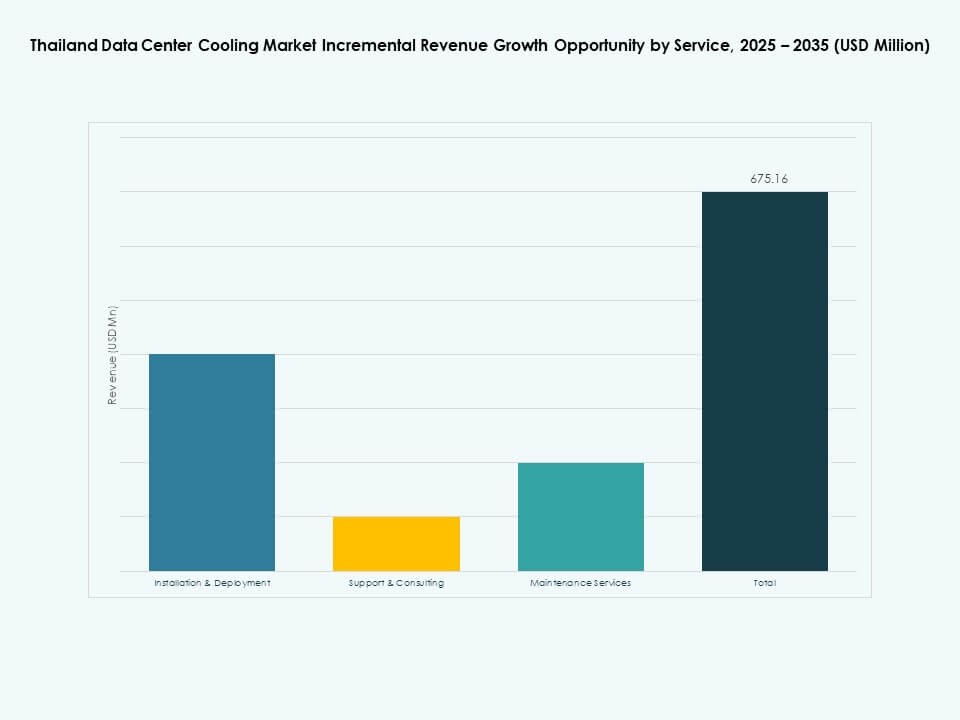
Installation and deployment services hold a strong share within service revenue. Complex projects need careful commissioning to avoid thermal risks. The Thailand Data Center Cooling Market values experienced integrators during build phases. It also depends on support and consulting services for design refinement. Maintenance services grow as operators prioritize uptime and efficiency. Predictive maintenance programs reduce unplanned downtime and repair costs. Service providers bundle spare parts, inspections, and performance reporting. Comprehensive contracts deepen relationships and improve long-term revenue visibility.

By Enterprise Size: Large Enterprises Dominating, SMEs Creating Niche Growth

Large enterprises and global cloud providers dominate cooling investments. Their projects involve high-density halls and multi-megawatt campuses. The Thailand Data Center Cooling Market reflects this bias toward large customers. It sees complex tender processes and strict performance requirements. SMEs contribute through smaller server rooms and edge deployments. These projects favor compact, standardized cooling systems. Vendors create scalable product lines tailored to both groups. Channel partners help reach SMEs that lack in-house engineering teams.

By Floor Type: Raised Floors Leading, Non-Raised Designs Evolving with New Builds

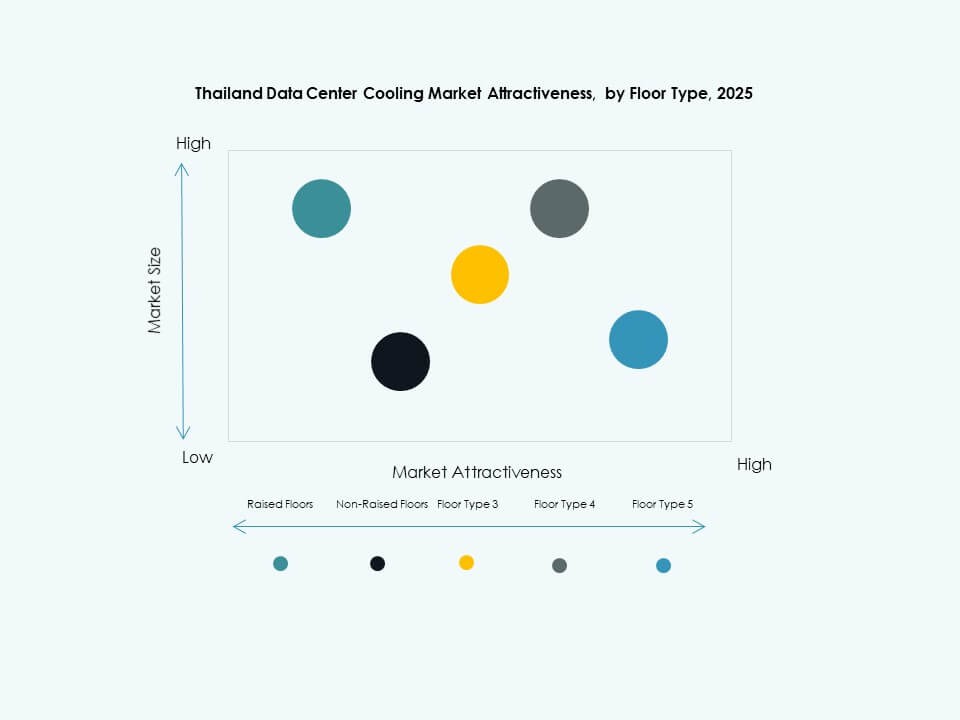
Raised floor environments retain a strong share across legacy and many modern sites. They support underfloor air distribution and flexible cabling layouts. The Thailand Data Center Cooling Market still sees raised floors as standard for many builds. It benefits airflow management in traditional air-based designs. Non-raised floors grow in newer, high-density facilities. These halls favor overhead cabling and row-based cooling structures. Designers choose layouts based on load, cost, and construction constraints. Hybrid campuses may combine both floor types across different phases.

By Containment: Hot and Cold Aisle Containment Enhancing Thermal Efficiency

Hot aisle containment holds a significant share among advanced sites. It captures hot exhaust air and improves return temperature control. The Thailand Data Center Cooling Market also uses cold aisle containment widely. It separates cold supply air and reduces bypass flows. Raised floors without containment still exist in older facilities. These environments show higher energy use and thermal variability. Operators retrofit containment to improve performance without full rebuilds. Choice of scheme depends on legacy layout, budgets, and risk appetite.

By Structure: Room, Row, and Rack-Based Cooling Matching Varied Load Profiles

Room-based cooling remains common across many Thai facilities. It uses central units to condition entire halls. The Thailand Data Center Cooling Market now shifts toward row-based systems for higher densities. It places cooling closer to heat sources and improves control. Rack-based systems serve the most demanding loads and AI clusters. Mixed deployments appear in campuses with diverse tenants and workloads. Structural choices align with scalability, redundancy goals, and site constraints. Vendors design product families that interoperate across these structures.

By Application: Hyperscale and Colocation Sites Anchoring Demand, Edge Hubs Emerging

Hyperscale data centers contribute a leading share of cooling demand. They deploy large chiller plants and advanced distribution networks. Colocation data centers follow closely, serving many enterprise tenants. The Thailand Data Center Cooling Market also supports enterprise and edge data centers. It tailors smaller systems for branch and latency-sensitive locations. Other data centers, including government and sector-specific sites, add base demand. Application mix shapes required redundancy levels and service models. Vendors adapt portfolios to cover each application tier effectively.

By End-user: Telecom and IT Leading Adoption, BFSI and Healthcare Gaining Importance

Telecom and IT sectors form the largest end-user base. Their networks and cloud platforms require continuous availability. The Thailand Data Center Cooling Market next sees strong demand from BFSI. It supports secure processing for payments and financial transactions. Healthcare and retail sectors grow cooling needs with digital records and omnichannel services. Energy and other industries use data centers for operational analytics. Sector diversity cushions market risk across economic cycles. Vendors customize solutions to each sector’s regulatory and reliability needs.

Regional Insights:

Central Thailand and Bangkok: Core Hub with Highest Market Share

Central Thailand, led by Bangkok, holds about 55% share of demand. Dense enterprise presence and major carrier hotels drive this dominance. Large colocation campuses cluster near key power and fiber routes. The Thailand Data Center Cooling Market sees most hyperscale interest in this subregion. It benefits from strong infrastructure, skilled labor, and connectivity. High land and energy costs push designs toward efficient, high-density cooling. Investors treat Bangkok as the anchor node for regional network traffic.

  • For example, SUPERNAP Thailand’s Bangkok facility holds Tier IV certifications for Design, Constructed Facility, and Gold Operations, confirming its high fault-tolerant standards. The site supports power densities up to 33 kW per cabinet and has maintained 100% uptime since its launch in 2017, according to publicly available operational records.

Eastern Economic Corridor: Fast-Growing Industrial and Cloud Expansion Zone

The Eastern Economic Corridor accounts for roughly 25% market share. Industrial estates and logistics hubs attract edge and regional facilities. Proximity to ports supports data needs for manufacturing and trade. The Thailand Data Center Cooling Market gains from new campuses near Rayong and Chonburi. It enables low latency links to factories and automation systems. Cooling designs here emphasize reliability under industrial environmental conditions. Policy support and infrastructure projects strengthen long-term attractiveness of the corridor.

  • For example, True IDC’s AI hyperscale facility in Chonburi delivers over 20 megawatts of capacity and uses a smart fan wall cooling system with liquid-cooling readiness, according to its 2025 launch announcement. Public sources confirm that the site targets best-in-class PUE and is built to support high-density GPU workloads.

Rest of Thailand: Emerging Regional Cities and Edge Deployments

The remaining regions share about 20% of market demand. Northern, Northeastern, and Southern provinces see gradual deployment of smaller sites. These locations support government services, education, and local enterprises. The Thailand Data Center Cooling Market finds opportunities in compact, modular solutions here. It helps extend digital services beyond Bangkok and the corridor. Lower land costs support future regional hub development. Improved fiber networks could lift the share of these subregions over time.

Competitive Insights:

  • Mitsubishi Electric Corporation
  • Daikin Industries Ltd.
  • Carrier
  • Johnson Controls International plc
  • Danfoss
  • Vertiv Group Corp.
  • Schneider Electric
  • STULZ GmbH
  • Rittal GmbH & Co. KG
  • CoolIT Systems

The Thailand Data Center Cooling Market features a concentrated mix of global and regional vendors. Mitsubishi Electric, Daikin, Carrier, and Johnson Controls compete on breadth of HVAC portfolios. Vertiv, Schneider Electric, STULZ, and Rittal focus on integrated white space solutions. CoolIT Systems targets liquid and high-density cooling niches in emerging AI workloads. Pricing pressure remains intense due to strong bid competition on large campus projects. Service capability and local partner networks shape win rates more than hardware differentiation alone. Sustainability credentials and low-GWP refrigerant roadmaps influence hyperscale procurement decisions. It pushes vendors to prove measurable efficiency gains with clear performance data. Players that bundle design, deployment, and lifecycle optimization retain stronger, long-term customer relationships. Data center clients value rapid response and spare parts availability. Regional reference projects help new entrants build credibility with investors.

Recent Developments:

  • In November 2025, Daikin Applied advanced its presence in the data center cooling segment by acquiring Chilldyne, a specialist in direct-to-chip liquid cooling, complementing Daikin’s earlier acquisition of DDC Solutions in August 2025. These moves significantly expand Daikin’s portfolio to deliver modular, high-density, and energy-efficient cooling technologies for hyperscale and AI-driven data centers, targeting increased market share in Thailand and across Asia.
  • In September 2025, Schneider Electric unveiled a comprehensive portfolio of end-to-end liquid cooling solutions following its acquisition of Motivair in early 2025. The extended range covers Coolant Distribution Units, Rear Door Heat Exchangers, and advanced cold plates, specifically designed for high-performance AI and hyperscale data centers in Thailand, thus reinforcing Schneider’s leadership in digital infrastructure and intelligent thermal management.
  • In May 2025, Ecolab made headlines by launching its new cooling management technology designed to optimize data center performance and energy efficiency. The technology is engineered to meet the stringent operational requirements of modern data centers, offering reliability and environmental compliance in the Thai market.
  • In April 2025, ST Telemedia Global Data Centres (STT GDC) unveiled a direct-to-chip liquid cooling solution designed for high-density data centers in Thailand. This product launch showcased the company’s commitment to empowering local data center operators with advanced cooling that achieves greater operational efficiency and drives sustainable expansion in the digital era.
  • In March 2025, Vertiv entered a global partnership with Tecogen to integrate natural gas-powered chiller solutions into its data center cooling portfolio. This collaboration responds to increasing power constraints and the scalability needs of AI-driven infrastructure in Thailand. Vertiv’s partnership underpins its commitment to resilient, alternative-energy-based cooling strategies for modern data centers.
  • In February 2025, Carrier announced a significant technology partnership and investment in ZutaCore, a leading provider of two-phase direct-to-chip liquid cooling technologies for data centers.

1. Introduction

1.1. Market Definition & Scope

1.2. Research Methodology

1.2.1. Primary Research

1.2.2. Secondary Research

1.2.3. Data Validation & Assumptions

1.3. Market Segmentation Framework

2. Executive Summary

2.1. Market Snapshot

2.2. Key Findings

2.3. Analyst Recommendations

2.4. Market Outlook (2025–2035)

3. Market Dynamics

3.1. Market Drivers

3.2. Market Restraints

3.3. Market Opportunities

3.4. Challenges & Risks

3.5. Value Chain Analysis

3.6. Porter’s Five Forces Analysis

4. Thailand Data Center Cooling Market – Market Sizing & Forecast

4.1. Historical Market Size (2020–2025)

4.2. Forecast Market Size (2026–2035)

4.3. Market Growth Rate Analysis

4.4. Market Outlook by Country

5. Capital Expenditure (CapEx) Analysis

5.1. CapEx Trends by Cooling Solution

5.1.1. Investment patterns across air-based, liquid-based, hybrid, and immersion cooling

5.1.2. CapEx share by cooling equipment type (CRAC/CRAH, chillers, cooling towers, economizers, etc.)

5.1.3. Country-wise CapEx trends

5.1.4. OEM vs. retrofit investment analysis

5.2. Return on Investment (ROI) & Payback Period Analysis

5.2.1. ROI by cooling technology type

5.2.2. Cost-benefit comparison: air cooling vs. liquid cooling vs. immersion cooling

5.2.3. Payback period across Tier I–IV data centers

5.2.4. Case examples of cost savings through energy-efficient cooling adoption

6. Data Center Cooling Capacity & Utilization

6.1. Installed Capacity (MW & Sq. Ft.) by Cooling Solution

6.1.1. Installed cooling capacity by solution type and Country

6.1.2. Cooling system density (kW/rack and per sq. ft.)

6.1.3. Capacity expansion trends by hyperscale vs. colocation vs. enterprise

6.2. Utilization Rates & Efficiency Metrics

6.2.1. Cooling system utilization vs. design capacity

6.2.2. Average and peak load management practices

6.2.3. Equipment lifecycle and performance benchmarks

6.3. Power Usage Effectiveness (PUE) & Energy Efficiency

6.3.1. Average PUE by data center size and cooling technology

6.3.2. Comparison of traditional vs. green cooling systems

6.3.3. Cooling system contribution to total facility energy consumption

6.4. Rack Density & Cooling Efficiency

6.4.1. Average rack density (kW/rack) trends

6.4.2. Cooling adequacy vs. rack load

6.4.3. Relationship between high-density workloads (AI, HPC) and cooling requirements

7. Data Center Cooling Market, Energy & Resource Consumption Analysis

7.1. Energy Consumption Analysis

7.1.1. Total energy consumption by cooling solution type (air-based, liquid, hybrid, immersion)

7.1.2. Energy intensity per MW of IT load

7.1.3. Energy share of cooling in total facility power (cooling load ratio)

7.1.4. Annualized Energy Efficiency Ratio (EER / SEER) by cooling system type

7.1.5. Trend in energy consumption reduction through automation, AI, and free cooling technologies

7.2. Water Consumption Analysis

7.2.1. Water Usage Effectiveness (WUE) – liters per kWh of IT load

7.2.2. Water consumption by cooling technology (evaporative cooling, adiabatic cooling, etc.)

7.2.3. Water recycling and reuse systems in data centers

7.2.4. Impact of Country-wise water scarcity regulations on cooling system choice

7.2.5. Shift from water-intensive to air-based or hybrid systems

7.3. Combined Energy–Water Efficiency Metrics

7.3.1. Energy-Water Nexus in cooling optimization

7.3.2. Correlation between PUE, WUE, and total operational cost (OpEx)

7.3.3. Case studies of zero-water or waterless cooling deployments

7.4. Benchmarking & Comparative Analysis

7.4.1. Benchmarking against ASHRAE, Uptime Institute, and DOE standards

7.4.2. Comparison of Thailand WUE/PUE averages by Country

7.4.3. Best practices adopted by hyperscalers (AWS, Google, Microsoft, Meta, etc.)

8. Thailand Data Center Cooling Market – By Component

8.1. Solution

8.2. Services

9. Thailand Data Center Cooling Market – By Data Center Cooling Solution

9.1. Air Conditioners

9.2. Precision Air Conditioners

9.3. Chillers

9.4. Air Handling Units

9.5. Liquid Cooling

9.6. Others

10. Thailand Data Center Cooling Market – By Service

10.1. Installation & Deployment

10.2. Support & Consulting

10.3. Maintenance Services

11. Thailand Data Center Cooling Market – By Enterprise Size

11.1. Large Enterprises

11.2. Small & Medium Enterprises (SMEs)

12. Thailand Data Center Cooling Market – By Floor Type

12.1. Raised Floors

12.2. Non-Raised Floors

13. Thailand Data Center Cooling Market – By Containment

13.1. Raised Floor with Hot Aisle Containment (HAC)

13.2. Raised Floor with Cold Aisle Containment (CAC)

13.3. Raised Floor without Containment

14. Thailand Data Center Cooling Market – By Structure

14.1. Rack-Based Cooling

14.2. Row-Based Cooling

14.3. Room-Based Cooling

15. Thailand Data Center Cooling Market – By Application

15.1. Hyperscale Data Center

15.2. Colocation Data Center

15.3. Enterprise Data Center

15.4. Edge Data Center

15.5. Other Data Centers

16. Thailand Data Center Cooling Market – By End-user

16.1. Telecom

16.2. IT

16.3. Retail

16.4. Healthcare

16.5. BFSI

16.6. Energy

16.7. Others

17. Sustainability & Green Data Center Cooling

17.1. Energy Efficiency Initiatives

17.1.1. Deployment of free cooling, adiabatic cooling, and economizers

17.1.2. Smart control systems for temperature and airflow optimization

17.1.3. Case studies of efficiency improvement programs

17.2. Renewable Energy Integration

17.2.1. Integration of solar, wind, or geothermal sources in cooling operations

17.2.2. Hybrid systems combining renewable energy with mechanical cooling

17.3. Carbon Footprint & Emission Analysis

17.4. GHG reduction initiatives

17.5. LEED & Green Certifications

17.5.1. Share of cooling systems installed in LEED, BREEAM, or Energy Star certified facilities

17.5.2. Compliance with ASHRAE and ISO energy efficiency standards

18. Emerging Technologies & Innovations

18.1.1. Emerging Technologies & Innovations

18.1.2. Liquid Cooling & Immersion Cooling

18.1.3. Adoption rate and technology maturity

18.1.4. Key vendors and installations by Country

18.1.5. Comparative analysis: performance, cost, and energy savings

18.2. AI & HPC Infrastructure Integration

18.2.1. Cooling demand driven by AI training clusters and HPC systems

18.2.2. Adaptation of cooling design to high heat density workloads

18.3. Quantum Computing Readiness

18.3.1. Cooling requirements for quantum processors

18.3.2. Potential cooling technologies suitable for quantum environments

18.4. Modular & Edge Data Center Cooling

18.4.1. Cooling strategies for prefabricated and modular facilities

18.4.2. Compact and adaptive cooling for edge sites

18.5. Automation, Orchestration & AIOps

18.5.1. Integration of AI-driven thermal management

18.5.2. Predictive maintenance and automated cooling optimization

19. Competitive Landscape

19.1. Market Share Analysis

19.2. Key Player Strategies

19.3. Mergers, Acquisitions & Partnerships

19.4. Product & Service Launches

20. Company Profiles

20.1. Mitsubishi Electric Corporation

20.2. Daikin Industries Ltd.

20.3. Carrier

20.4. Johnson Controls International plc

20.5. Danfoss

20.6. Vertiv Group Corp.

20.7. Schneider Electric

20.8. STULZ GmbH

20.9. Rittal GmbH & Co. KG

20.10. CoolIT Systems

Request Free Sample

We prioritize the confidentiality and security of your data. Our promise: your information remains private.

Ready to Transform Data into Decisions?

Request Your Sample Report and Start Your Journey of Informed Choices


Providing the strategic compass for industry titans.

Frequently Asked Questions:

What is the current market size for the Thailand Data Center Cooling Market, and what is its projected size in 2035?

The Thailand Data Center Cooling Market reached USD 185.37 million in 2025. It is projected to grow sharply and reach USD 860.53 million by 2035 based on the market outlook.

At what Compound Annual Growth Rate is the Thailand Data Center Cooling Market projected to grow between 2025 and 2035?

The Thailand Data Center Cooling Market is projected to expand at a CAGR of 16.52% from 2025 to 2035. Strong digital adoption and high-density workloads support this rapid growth pace.

Which Thailand Data Center Cooling Market segment held the largest share in 2025?

The solution segment held the largest share of the Thailand Data Center Cooling Market in 2025. Strong demand for chillers, precision cooling, and integrated systems drove its dominance.

What are the primary factors fueling the growth of the Thailand Data Center Cooling Market?

Growth in the Thailand Data Center Cooling Market is fueled by digital expansion, hyperscale investments, higher rack densities, and adoption of liquid and hybrid cooling. Sustainability targets and efficiency needs also accelerate technology upgrades.

Who are the leading companies in the Thailand Data Center Cooling Market?

Key leaders in the Thailand Data Center Cooling Market include Mitsubishi Electric, Daikin, Carrier, Johnson Controls, Danfoss, Vertiv, Schneider Electric, STULZ, Rittal, and CoolIT Systems.

Which region commanded the largest share of the Thailand Data Center Cooling Market in 2025?

Central Thailand, led by Bangkok, commanded the largest share of the Thailand Data Center Cooling Market in 2025. Strong colocation activity and hyperscale interest made it the core cooling demand hub.

Licence Option

The report comes as a view-only PDF document, optimized for individual clients. This version is recommended for personal digital use and does not allow printing. Use restricted to one purchaser only.
To meet the needs of modern corporate teams, our report comes in two formats: a printable PDF and a data-rich Excel sheet. This package is optimized for internal analysis. Unlimited users allowed within one corporate location (e.g., regional office).
The report will be delivered in printable PDF format along with the report’s data Excel sheet. This license offers 100 Free Analyst hours where the client can utilize DC Market Insights’ research team. Permitted for unlimited global use by all users within the purchasing corporation.

Europe


North America

Smallform of Sample request

Request Sample