Home » Poland Data Center Cooling Market

Poland Data Center Cooling Market By Component (Solution, Services); By Solution Type (Air Conditioning, Chilling Units, Cooling Towers, Economizer Systems, Liquid Cooling, Control Systems, Others); By Service Type (Consulting, Installation & Deployment, Maintenance & Support); By Data Center Type (Enterprise Data Centers, Colocation Data Centers, Cloud Data Centers); By Industry Vertical (BFSI, IT & Telecom, Healthcare, Government, Others) – Growth, Share, Opportunities & Competitive Analysis, 2025 – 2035

Report ID: 7501 | Report Format : Excel, PDF

Executive summary:

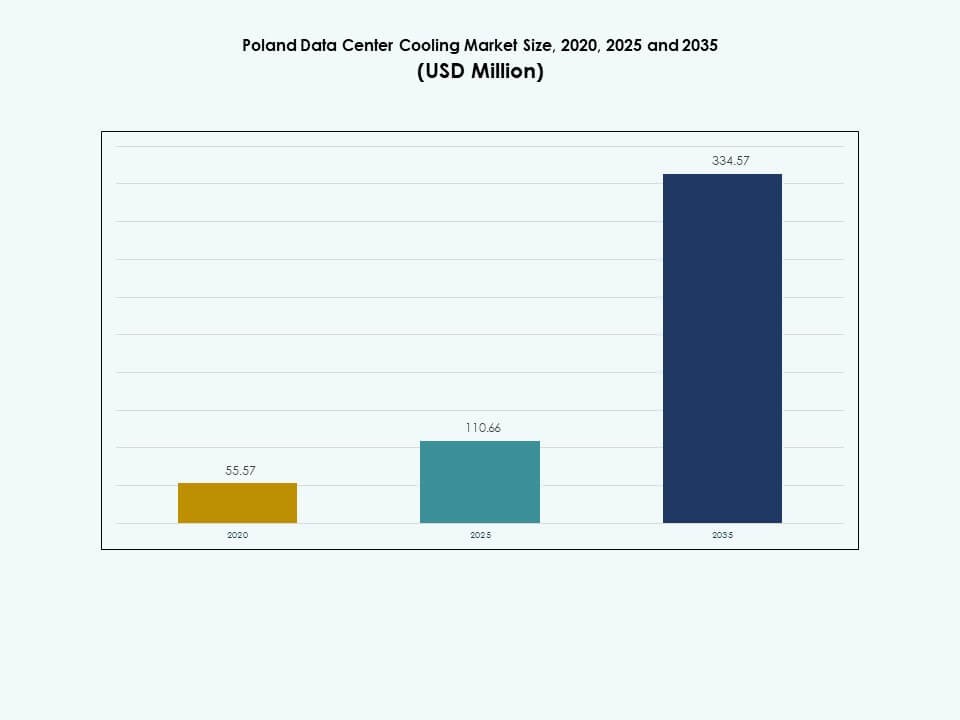
The Poland Data Center Cooling Market size was valued at USD 55.57 million in 2020 to USD 110.66 million in 2025 and is anticipated to reach USD 334.57 million by 2035, at a CAGR of 11.65% during the forecast period.

REPORT ATTRIBUTE DETAILS
Historical Period 2020-2023
Base Year 2024
Forecast Period 2025-2035
Poland Data Center Cooling Market Size 2025 USD 110.66 Million
Poland Data Center Cooling Market, CAGR 11.65%
Poland Data Center Cooling Market Size 2035 USD 334.57 Million


Market growth is driven by strong adoption of advanced cooling technologies that support AI, cloud, and edge workloads. Operators integrate hybrid air–liquid systems, precision units, and intelligent controls to handle higher thermal loads. Innovation in sustainability, automation, and energy-efficient systems enhances operational reliability. Businesses and investors view this shift as a strategic pathway to support long-term digital expansion while managing power constraints and performance demands.

Regional development is led by central Poland, driven by the Warsaw metropolitan area’s strong enterprise base and connectivity strength. Large cloud and colocation projects continue to cluster around this hub due to favorable infrastructure and skilled workforce availability. Emerging activity in southern and western regions reflects broader digitalization and industrial demand. These areas gain traction through new campuses that support edge, manufacturing, and logistics-linked data center growth.

Poland Data Center Cooling Market SizeMarket Drivers:

Rapid Expansion Of Cloud, Colocation, And Enterprise Digital Infrastructure Across Poland

The Poland Data Center Cooling Market grows with new cloud and colocation builds. Warsaw leads demand due to dense enterprise clusters and strong network links. Global cloud providers place new zones and edge sites near key metros. Local operator’s upgrade legacy rooms to Tier III standard environments. High rack densities push demand for efficient thermal designs. Enterprises shift workloads from on-premise rooms to professional facilities. That shift raises cooling capacity needs per square meter. Investors view large campuses near Warsaw and Poznań as core digital assets.

Rising Focus On Energy Efficiency, Sustainability Targets, And Regulatory Compliance In Facilities

The Poland Data Center Cooling Market benefits from strict energy and climate goals. Operators move from older direct expansion units toward high-efficiency chillers. Free cooling and indirect evaporative designs gain share in cooler regions. Facility owners seek lower PUE to meet corporate net-zero plans. Government and EU rules tighten expectations on power and carbon use. That pressure supports upgrades to variable speed fans and pumps. Efficient cooling protects margins when power tariffs rise. Investors back sites with clear efficiency roadmaps and transparent reporting.

Adoption Of High-Density Compute, AI, And Edge Workloads Driving Advanced Cooling Needs

The Poland Data Center Cooling Market sees demand from GPUs and AI clusters. High-density racks strain legacy perimeter air systems inside many rooms. Operators test rear door heat exchangers and liquid cooling loops. Telecom and cloud players deploy edge nodes near 5G hubs. Those compact sites require resilient and efficient cooling footprints. AI training and inference workloads raise average heat loads per rack. Cooling reliability becomes a core selection factor in customer contracts. Investors favor campuses ready for 30 kW and higher rack densities.

  • For instance, Beyond.pl’s Poznań campus offers high-density colocation, supporting direct-to-chip liquid cooling up to 130 kW per rack, with additional support for immersion and rear door cooling, and targets AI and HPC workloads at scale, as stated officially by Beyond.pl’s head of innovation.

Growing Role Of Poland As A Regional Connectivity And Disaster Recovery Hub

The Poland Data Center Cooling Market gains from its role in regional resilience. Many firms treat Warsaw and nearby metros as backup for Western hubs. Strong fiber routes link Poland to Germany, the Nordics, and CEE. That position attracts cross-border colocation demand from international clients. New campuses design scalable cooling blocks for phased expansion. Modular plants allow capacity to match long-term contract pipelines. Reliable cooling supports high uptime, which reduces business continuity risk. Investors view such resilient platforms as long-life infrastructure plays.

  • For instance, Equinix’s WA3 facility in Warsaw provides maximum power per rack of 9 kW and features 2N redundancy with N+1 chilled water cooling, serving regional enterprise clients who require scalable space, resilient disaster recovery, and consistent uptime across multi-site deployments.

Poland Data Center Cooling Market ShareMarket Trends:

Shift Toward Hybrid Air And Liquid Cooling Architectures For High-Density Environments

The Poland Data Center Cooling Market shows a clear tilt toward hybrid setups. Many new builds mix air-based cooling with liquid at the rack. Rear door units appear in halls with dense AI or HPC zones. Direct-to-chip loops gain interest for selected high-value workloads. Operators keep lower density rows on efficient airside designs. This mix reduces retrofit costs inside existing white space. Vendors promote flexible platforms that support stepwise density growth. Investors track which sites can shift fastest to liquid support.

Growing Use Of Smart Controls, Digital Twins, And AI For Thermal Optimization

The Poland Data Center Cooling Market adopts smarter control layers for plants. Operators integrate DCIM, BMS, and sensor networks across halls. AI tools study airflow, load patterns, and weather trends. Those tools propose setpoint changes that cut power yet protect safety. Digital twins help test new layouts and containment designs. That planning reduces risk before physical changes inside live rooms. Continuous monitoring supports predictive maintenance on chillers and pumps. Investors value facilities that use data to prove efficiency gains.

Rising Popularity Of Modular, Prefabricated Cooling Plants For Faster Deployment

The Poland Data Center Cooling Market sees stronger interest in modular gear. Many new campuses use prefabricated chiller and pump blocks outdoors. Those modules shorten construction schedules for each new hall phase. Standard designs simplify maintenance and spare parts logistics. Smaller edge sites also deploy containerized cooling units. Such units land near telecom nodes with tight plots. Modular layouts support repeatable quality and clear performance tests. Investors appreciate predictable capex profiles and repeatable design templates.

Emphasis On Green Power Integration, Heat Reuse, And Low-Water Technologies

The Poland Data Center Cooling Market aligns closely with green infrastructure themes. Operators link cooling plants to renewable power contracts and on-site solar. Low-water solutions gain attention where water stress risk appears. Indirect systems and adiabatic units limit full evaporative use. Some projects explore heat reuse for nearby offices or housing. That reuse strengthens local community support for large campuses. Cooling designs now factor district heating links from early stages. Investors prefer assets that fit long-term sustainability and community goals.

Market Challenges:

High Capital Intensity, Rising Power Costs, And Pressure On Project Economics

The Poland Data Center Cooling Market faces notable cost hurdles. Large-scale plants, chillers, and redundancy systems demand heavy upfront funding. Power prices in Europe strain operating budgets for many sites. Efficient technology lowers energy use yet often needs higher capex. Operators must balance resilience, density, and payback timelines. Smaller players struggle to match hyperscale levels of efficiency. Financing can slow when lenders question long-term grid or tariff stability. That dynamic favors well-capitalized platforms with strong balance sheets.

Grid Constraints, Policy Complexity, And Shortage Of Specialized Engineering Skills

The Poland Data Center Cooling Market must navigate local grid limits. Securing high-capacity connections near cities can take long periods. Policy frameworks mix national and municipal rules for permitting. That mix creates uncertainty for site selection and expansion timing. Skilled thermal and controls engineers remain in short supply. Competition for talent raises labor costs across projects. Global vendors help, yet language and regulatory gaps appear. Those factors slow adoption of advanced cooling methods in smaller deployments.

Market Opportunities:

Growth In Green Data Centers, Retrofits, And District Heating Partnerships In Poland

The Poland Data Center Cooling Market offers clear upside in green projects. Many owners plan retrofits of older halls with efficient equipment. New campuses can design for future heat reuse from day one. Partnerships with utilities unlock revenue from waste heat sales. Upgrades to low-GWP refrigerants open new service revenue lines. Engineering firms gain work from design and optimization projects. Investors can back platforms focused on green premium colocation.

Rising Edge Deployments, Regional Campuses, And Service-Led Cooling Offerings

The Poland Data Center Cooling Market also gains from edge growth. Telecom players roll out small compute sites near user clusters. Each node needs compact and reliable thermal solutions. Vendors can supply standardized edge cooling kits and services. Regional cities attract new campuses that support local industries. Service models for maintenance and optimization expand recurring income. Investors see value in networks of smaller, efficient sites.

Market Segmentation:

By Component: Solution And Services Mix Supporting Diverse Operator Needs

In the Poland Data Center Cooling Market, solution components hold the larger share. Operators prioritize chillers, air units, and liquid systems for core performance. Hardware decisions strongly influence PUE targets and uptime metrics. Services remain vital for design, integration, and lifecycle support. Many owners bundle maintenance contracts with initial equipment deals. Consulting grows where clients plan multi-site expansion programs. The balance between solutions and services shifts toward more managed offerings. That shift supports recurring revenue and deeper customer ties.

By Data Center Cooling Solution: Strong Role For Chillers And Precision Air Systems

Within the Poland Data Center Cooling Market, chillers and precision air units dominate. Large campuses rely on advanced chiller plants for base cooling duty. Precision systems manage temperature and humidity for critical halls. Liquid cooling rises from a small base within dense AI zones. Air handling units and indirect systems support free cooling in cooler months. Other niche solutions target specific retrofit constraints or edge sites. Operators select mixes based on density and climate profiles. Vendors that offer integrated solution families gain advantage.

By Service: Installation, Support, And Maintenance Building Long-Term Engagement

The Poland Data Center Cooling Market shows strong demand for installation and deployment services. Complex plants require careful commissioning to secure design performance. Support and consulting services guide capacity planning and technology choices. Maintenance services ensure reliability and protect warranties across long equipment lives. Many clients shift toward full lifecycle service agreements. That model reduces unplanned downtime and budget surprises. Service partners also provide training for operator teams. Strong service networks help vendors expand share with large operators.

By Enterprise Size: Large Enterprises Leading, SMEs Growing With Colocation Use

In the Poland Data Center Cooling Market, large enterprises influence most capacity decisions. Big firms contract sizeable spaces in colocation or build private sites. Their workloads push higher rack densities and advanced cooling choices. SMEs rely more on shared colocation environments with standard service tiers. Cooling vendors reach SMEs mainly through colocation partners. Demand from digital native SMEs rises with e-commerce and SaaS growth. That demand encourages operators to refresh cooling plants for flexibility. Both segments seek predictable operating costs and uptime.

By Floor Type: Raised Floors Retaining Role, Non-Raised Designs Expanding In New Builds

The Poland Data Center Cooling Market still sees wide use of raised floors. Many legacy halls use underfloor air distribution for cooling paths. New designs increasingly shift toward non-raised floors with overhead ducts. High-density zones often favor non-raised layouts for better airflow control. Both styles incorporate aisle containment for improved efficiency. Operators choose based on retrofit constraints and future density plans. Vendors design solutions compatible with both floor types. Flexible products support mixed environments inside larger campuses.

By Containment: Strong Preference For Hot And Cold Aisle Strategies In Modern Halls

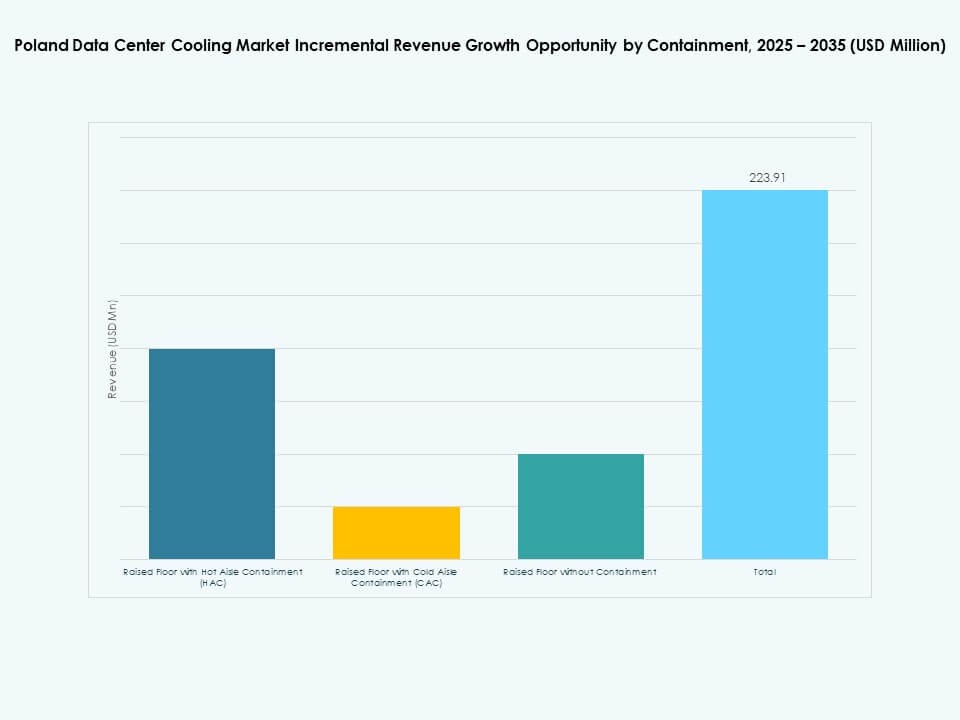
The Poland Data Center Cooling Market features broad deployment of containment systems. Raised floors with hot aisle containment help isolate return air paths. Cold aisle containment keeps supply air focused on server inlets. Sites without containment decline over time due to lower efficiency. New builds usually include containment from early design stages. Retrofits add doors and panels to improve existing airflow. Containment supports higher rack densities without major plant upgrades. Vendors provide modular kits suited to varied hall layouts.

By Structure: Rack, Row, And Room-Based Cooling Used For Different Density Levels

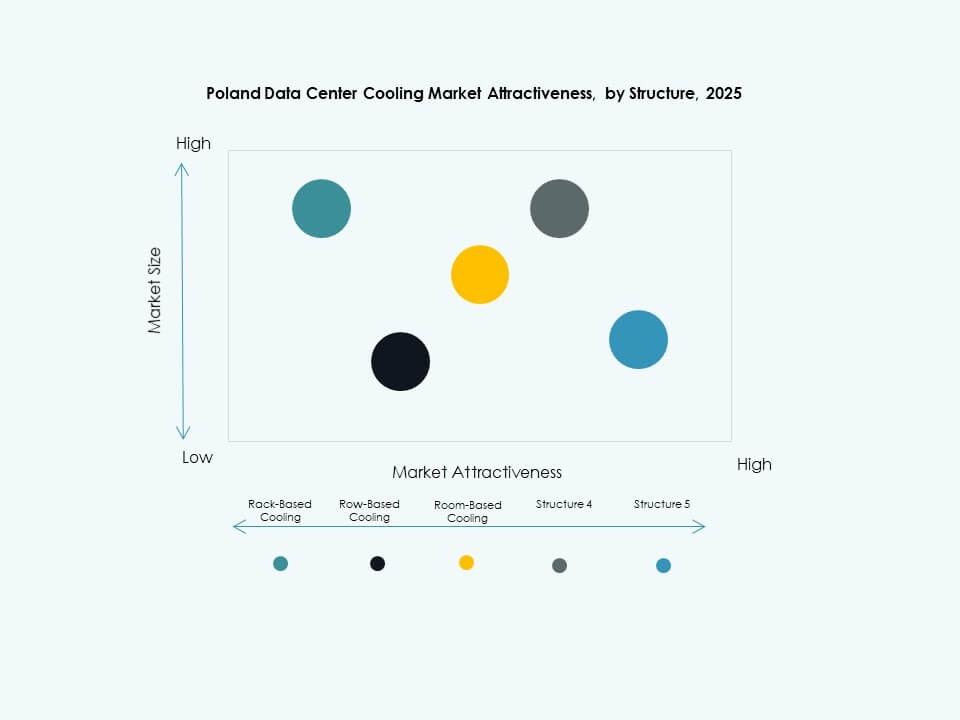
The Poland Data Center Cooling Market applies each structural style for specific cases. Room-based cooling remains common in older and lower density spaces. Row-based units appear in medium density and modular halls. Rack-based solutions serve the highest density and AI workloads. Operators often combine structures within the same site. This mix helps match capital spend to workload criticality. Vendors promote scalable paths from room to rack units. That path lets customers upgrade cooling structure with limited disruption.

By Application: Hyperscale, Colocation, And Edge Deployments Shaping Demand Profiles

The Poland Data Center Cooling Market sees strong pull from hyperscale and colocation sites. Hyperscale projects define large, efficient central campuses. Colocation providers host diverse customers with mixed density needs. Enterprise data centers shrink in number yet remain important in some sectors. Edge data centers spread near telecom and industrial locations. Other specialized sites support research, public sector, or content delivery. Each application favors different redundancy and control strategies. Cooling vendors tailor offers to these varied operating models.

By End-User: Telecom, IT, And BFSI Leading Adoption, With Growth In Other Verticals

The Poland Data Center Cooling Market serves telecom, IT, and BFSI as key users. Telecom players drive edge and regional node deployments. IT and cloud firms anchor hyperscale and large colocation footprints. BFSI customers demand high resilience and clear compliance support. Retail and e-commerce verticals expand digital platforms and logistics hubs. Healthcare and energy sectors add secure workloads and analytics. Other industries modernize legacy IT into centralized or colocation sites. Diverse end users support steady, multi-year cooling demand.

Poland Data Center Cooling Market SegmentationRegional Insights:

Central Poland And Warsaw Cluster Holding The Largest Share Of National Capacity

Within the Poland Data Center Cooling Market, central Poland leads activity. The Warsaw metro area hosts over half of installed capacity by broad estimates. Strong fiber networks and corporate headquarters concentrate demand in this zone. Many hyperscale and major colocation sites select plots near Warsaw. Cooling investments focus on large, efficient plants to support growth. That dominance gives the region the highest share of cooling spend. Investors see central Poland as the primary core for new campuses.

  • For instance, Orange Polska opened its state-of-the-art Data Hub facility in Warsaw, featuring four data halls of 400 square meters each and using N+1 redundant precision air-conditioning and chilled water lines to ensure strict uptime for critical operations.

Southern Industrial Regions Showing Solid Growth And A Rising Share Of New Projects

The Poland Data Center Cooling Market also grows across southern regions. Silesian and Lesser Poland areas together hold a meaningful minority of capacity. Industrial hubs seek low-latency access to digital services and cloud. New data centers near Katowice and Kraków raise regional share over time. Cooling designs there focus on reliable support for manufacturing and logistics. Good transport links help attract further digital infrastructure projects. Investors treat these regions as strong secondary clusters with clear upside.

  • For instance, Beyond.pl’s data center campus in Poznań is certified ANSI/TIA-942 Rated 4 (Uptime Institute Tier IV), a distinction achieved by only a handful of facilities in Europe, and operates at a Power Usage Effectiveness (PUE) of 1.2 while sourcing 100% renewable electricity.

Northern And Western Regions Emerging With Edge, Port, And Logistics-Linked Deployments

The Poland Data Center Cooling Market records emerging activity in northern and western zones. Pomeranian and West Pomeranian regions gain from ports and trade routes. Greater Poland and Lower Silesian areas expand with tech and logistics demand. Combined, these regions hold the remaining share of national cooling capacity. Many projects focus on edge, content delivery, and regional backup. Cooling systems often use modular plants sized for gradual expansion. Investors watch these corridors for steady, distributed growth in new facilities.

Competitive Insights:

  • DCX Liquid Cooling Systems
  • Schneider Electric
  • Vertiv Group Corp.
  • Danfoss
  • Carrier
  • Mitsubishi Electric Corporation
  • STULZ GmbH
  • Rittal GmbH & Co. KG
  • CoolIT Systems
  • Modine Manufacturing Company

The Poland Data Center Cooling Market features a mix of global and specialist vendors. Schneider Electric, Vertiv, Carrier, and Mitsubishi Electric compete on breadth of portfolios. Danfoss, STULZ, Rittal, and Modine focus on efficient components and tailored engineered systems. DCX Liquid Cooling Systems and CoolIT Systems strengthen the high-density and liquid segment. Price pressure stays high, yet buyers prioritize reliability, efficiency, and service capability. It drives vendors to highlight lifecycle support, local parts availability, and strong partner networks. Sustainability targets push suppliers to offer low-GWP refrigerants and low-water cooling options. Partnerships with data center developers, utilities, and integrators shape access to major projects. Vendors that prove performance with audited PUE or WUE gains gain share over time. Digitalization trends in Poland keep the project pipeline healthy for leading suppliers.

Recent Developments:

  • In November 2025, Valeo, a global thermal systems leader, and 2CRSi, a manufacturer of high-performance servers, announced a strategic partnership aimed at developing innovative liquid cooling solutions for edge data centers in Poland and across Europe.
  • In September 2025, Atman, a major Polish data center operator, opened its flagship WAW-3 data center in Warsaw. This facility is equipped with 14.4 MW of IT power and features advanced liquid cooling technologies, setting a new standard for scalable and high-performance infrastructure in Poland’s data center sector.
  • In February 2025, Schneider Electric unveiled a major strategic acquisition securing a controlling stake in Motivair to expand its global liquid cooling portfolio. This move strengthened Schneider Electric’s supply chain and thermal management capabilities for high-density Polish data centers, enabling advanced closed-loop chiller technologies and comprehensive infrastructure support for AI and high-performance computing.
  • In February 2025, Vertiv announced the global launch of its Liquid Cooling Services portfolio delivering installation, commissioning, and lifecycle management for advanced liquid cooling systems. This service offering supports Poland’s fast-growing AI and HPC-powered data centers, with a strong emphasis on maximizing operational reliability and system availability across new high-density facilities

1. Introduction

1.1. Market Definition & Scope

1.2. Research Methodology

1.2.1. Primary Research

1.2.2. Secondary Research

1.2.3. Data Validation & Assumptions

1.3. Market Segmentation Framework

2. Executive Summary

2.1. Market Snapshot

2.2. Key Findings

2.3. Analyst Recommendations

2.4. Market Outlook (2025–2035)

3. Market Dynamics

3.1. Market Drivers

3.2. Market Restraints

3.3. Market Opportunities

3.4. Challenges & Risks

3.5. Value Chain Analysis

3.6. Porter’s Five Forces Analysis

4. Poland Data Center Cooling Market – Market Sizing & Forecast

4.1. Historical Market Size (2020–2025)

4.2. Forecast Market Size (2026–2035)

4.3. Market Growth Rate Analysis

4.4. Market Outlook by Country

5. Capital Expenditure (CapEx) Analysis

5.1. CapEx Trends by Cooling Solution

5.1.1. Investment patterns across air-based, liquid-based, hybrid, and immersion cooling

5.1.2. CapEx share by cooling equipment type (CRAC/CRAH, chillers, cooling towers, economizers, etc.)

5.1.3. Country-wise CapEx trends

5.1.4. OEM vs. retrofit investment analysis

5.2. Return on Investment (ROI) & Payback Period Analysis

5.2.1. ROI by cooling technology type

5.2.2. Cost-benefit comparison: air cooling vs. liquid cooling vs. immersion cooling

5.2.3. Payback period across Tier I–IV data centers

5.2.4. Case examples of cost savings through energy-efficient cooling adoption

6. Data Center Cooling Capacity & Utilization

6.1. Installed Capacity (MW & Sq. Ft.) by Cooling Solution

6.1.1. Installed cooling capacity by solution type and Country

6.1.2. Cooling system density (kW/rack and per sq. ft.)

6.1.3. Capacity expansion trends by hyperscale vs. colocation vs. enterprise

6.2. Utilization Rates & Efficiency Metrics

6.2.1. Cooling system utilization vs. design capacity

6.2.2. Average and peak load management practices

6.2.3. Equipment lifecycle and performance benchmarks

6.3. Power Usage Effectiveness (PUE) & Energy Efficiency

6.3.1. Average PUE by data center size and cooling technology

6.3.2. Comparison of traditional vs. green cooling systems

6.3.3. Cooling system contribution to total facility energy consumption

6.4. Rack Density & Cooling Efficiency

6.4.1. Average rack density (kW/rack) trends

6.4.2. Cooling adequacy vs. rack load

6.4.3. Relationship between high-density workloads (AI, HPC) and cooling requirements

7. Data Center Cooling Market, Energy & Resource Consumption Analysis

7.1. Energy Consumption Analysis

7.1.1. Total energy consumption by cooling solution type (air-based, liquid, hybrid, immersion)

7.1.2. Energy intensity per MW of IT load

7.1.3. Energy share of cooling in total facility power (cooling load ratio)

7.1.4. Annualized Energy Efficiency Ratio (EER / SEER) by cooling system type

7.1.5. Trend in energy consumption reduction through automation, AI, and free cooling technologies

7.2. Water Consumption Analysis

7.2.1. Water Usage Effectiveness (WUE) – liters per kWh of IT load

7.2.2. Water consumption by cooling technology (evaporative cooling, adiabatic cooling, etc.)

7.2.3. Water recycling and reuse systems in data centers

7.2.4. Impact of Country-wise water scarcity regulations on cooling system choice

7.2.5. Shift from water-intensive to air-based or hybrid systems

7.3. Combined Energy–Water Efficiency Metrics

7.3.1. Energy-Water Nexus in cooling optimization

7.3.2. Correlation between PUE, WUE, and total operational cost (OpEx)

7.3.3. Case studies of zero-water or waterless cooling deployments

7.4. Benchmarking & Comparative Analysis

7.4.1. Benchmarking against ASHRAE, Uptime Institute, and DOE standards

7.4.2. Comparison of Poland WUE/PUE averages by Country

7.4.3. Best practices adopted by hyperscalers (AWS, Google, Microsoft, Meta, etc.)

8. Poland Data Center Cooling Market – By Component

8.1. Solution

8.2. Services

9. Poland Data Center Cooling Market – By Data Center Cooling Solution

9.1. Air Conditioners

9.2. Precision Air Conditioners

9.3. Chillers

9.4. Air Handling Units

9.5. Liquid Cooling

9.6. Others

10. Poland Data Center Cooling Market – By Service

10.1. Installation & Deployment

10.2. Support & Consulting

10.3. Maintenance Services

11. Poland Data Center Cooling Market – By Enterprise Size

11.1. Large Enterprises

11.2. Small & Medium Enterprises (SMEs)

12. Poland Data Center Cooling Market – By Floor Type

12.1. Raised Floors

12.2. Non-Raised Floors

13. Poland Data Center Cooling Market – By Containment

13.1. Raised Floor with Hot Aisle Containment (HAC)

13.2. Raised Floor with Cold Aisle Containment (CAC)

13.3. Raised Floor without Containment

14. Poland Data Center Cooling Market – By Structure

14.1. Rack-Based Cooling

14.2. Row-Based Cooling

14.3. Room-Based Cooling

15. Poland Data Center Cooling Market – By Application

15.1. Hyperscale Data Center

15.2. Colocation Data Center

15.3. Enterprise Data Center

15.4. Edge Data Center

15.5. Other Data Centers

16. Poland Data Center Cooling Market – By End-user

16.1. Telecom

16.2. IT

16.3. Retail

16.4. Healthcare

16.5. BFSI

16.6. Energy

16.7. Others

17. Sustainability & Green Data Center Cooling

17.1. Energy Efficiency Initiatives

17.1.1. Deployment of free cooling, adiabatic cooling, and economizers

17.1.2. Smart control systems for temperature and airflow optimization

17.1.3. Case studies of efficiency improvement programs

17.2. Renewable Energy Integration

17.2.1. Integration of solar, wind, or geothermal sources in cooling operations

17.2.2. Hybrid systems combining renewable energy with mechanical cooling

17.3. Carbon Footprint & Emission Analysis

17.4. GHG reduction initiatives

17.5. LEED & Green Certifications

17.5.1. Share of cooling systems installed in LEED, BREEAM, or Energy Star certified facilities

17.5.2. Compliance with ASHRAE and ISO energy efficiency standards

18. Emerging Technologies & Innovations

18.1.1. Emerging Technologies & Innovations

18.1.2. Liquid Cooling & Immersion Cooling

18.1.3. Adoption rate and technology maturity

18.1.4. Key vendors and installations by Country

18.1.5. Comparative analysis: performance, cost, and energy savings

18.2. AI & HPC Infrastructure Integration

18.2.1. Cooling demand driven by AI training clusters and HPC systems

18.2.2. Adaptation of cooling design to high heat density workloads

18.3. Quantum Computing Readiness

18.3.1. Cooling requirements for quantum processors

18.3.2. Potential cooling technologies suitable for quantum environments

18.4. Modular & Edge Data Center Cooling

18.4.1. Cooling strategies for prefabricated and modular facilities

18.4.2. Compact and adaptive cooling for edge sites

18.5. Automation, Orchestration & AIOps

18.5.1. Integration of AI-driven thermal management

18.5.2. Predictive maintenance and automated cooling optimization

19. Competitive Landscape

19.1. Market Share Analysis

19.2. Key Player Strategies

19.3. Mergers, Acquisitions & Partnerships

19.4. Product & Service Launches

20. Company Profiles

20.1. DCX Liquid Cooling Systems

20.2. Schneider Electric

20.3. Vertiv Group Corp.

20.4. Danfoss

20.5. Carrier

20.6. Mitsubishi Electric Corporation

20.7. STULZ GmbH

20.8. Rittal GmbH & Co. KG

20.9. CoolIT Systems

20.10. Modine Manufacturing Company

Request Free Sample

We prioritize the confidentiality and security of your data. Our promise: your information remains private.

Ready to Transform Data into Decisions?

Request Your Sample Report and Start Your Journey of Informed Choices


Providing the strategic compass for industry titans.

Frequently Asked Questions:

What is the current market size for Poland Data Center Cooling Market, and what is its projected size in 2035?

The Poland Data Center Cooling Market was valued at USD 110.66 million in 2025 and is projected to reach USD 334.57 million by 2035. The growth reflects expanding digital infrastructure and rising cooling intensity across new hyperscale and colocation sites.

At what Compound Annual Growth Rate is the Poland Data Center Cooling Market projected to grow between 2025 and 2035?

The Poland Data Center Cooling Market is expected to grow at a CAGR of 11.65% between 2025 and 2035. This rate aligns with strong demand for energy-efficient thermal systems across high-density environments.

Which Poland Data Center Cooling Market segment held the largest share in 2025?

The Poland Data Center Cooling Market saw the solution segment hold the largest share in 2025. Strong investments in chillers, precision systems, and liquid-ready platforms kept solutions ahead of service-based revenue streams.

What are the primary factors fueling the growth of the Poland Data Center Cooling Market?

The Poland Data Center Cooling Market grows due to rising cloud expansion, higher rack densities, and stronger sustainability targets. Innovation in hybrid air-liquid systems and wider adoption of smart controls supports this momentum.

Who are the leading companies in the Poland Data Center Cooling Market?

Key players in the Poland Data Center Cooling Market include Schneider Electric, Vertiv, Danfoss, Carrier, Mitsubishi Electric, STULZ, Rittal, Modine, CoolIT Systems, and DCX Liquid Cooling Systems. These firms compete on efficiency, reliability, and advanced thermal engineering.

Which region commanded the largest share of the Poland Data Center Cooling Market in 2025?

The central Poland and Warsaw region held the largest share of the Poland Data Center Cooling Market in 2025. Strong fiber networks, enterprise clusters, and major colocation campuses concentrated most cooling investments in this zone.

Licence Option

The report comes as a view-only PDF document, optimized for individual clients. This version is recommended for personal digital use and does not allow printing. Use restricted to one purchaser only.
To meet the needs of modern corporate teams, our report comes in two formats: a printable PDF and a data-rich Excel sheet. This package is optimized for internal analysis. Unlimited users allowed within one corporate location (e.g., regional office).
The report will be delivered in printable PDF format along with the report’s data Excel sheet. This license offers 100 Free Analyst hours where the client can utilize DC Market Insights’ research team. Permitted for unlimited global use by all users within the purchasing corporation.

Europe


North America

Smallform of Sample request

Request Sample