Home » Vietnam Data Center Cooling Market

Vietnam Data Center Cooling Market By Component (Solution, Services); By Solution Type (Air Conditioning, Chilling Units, Cooling Towers, Economizer Systems, Liquid Cooling, Control Systems, Others); By Service Type (Consulting, Installation & Deployment, Maintenance & Support); By Data Center Type (Enterprise Data Centers, Colocation Data Centers, Cloud Data Centers); By Industry Vertical (BFSI, IT & Telecom, Healthcare, Government, Others) – Growth, Share, Opportunities & Competitive Analysis, 2025 – 2035

Report ID: 7684 | Report Format : Excel, PDF

Executive summary:

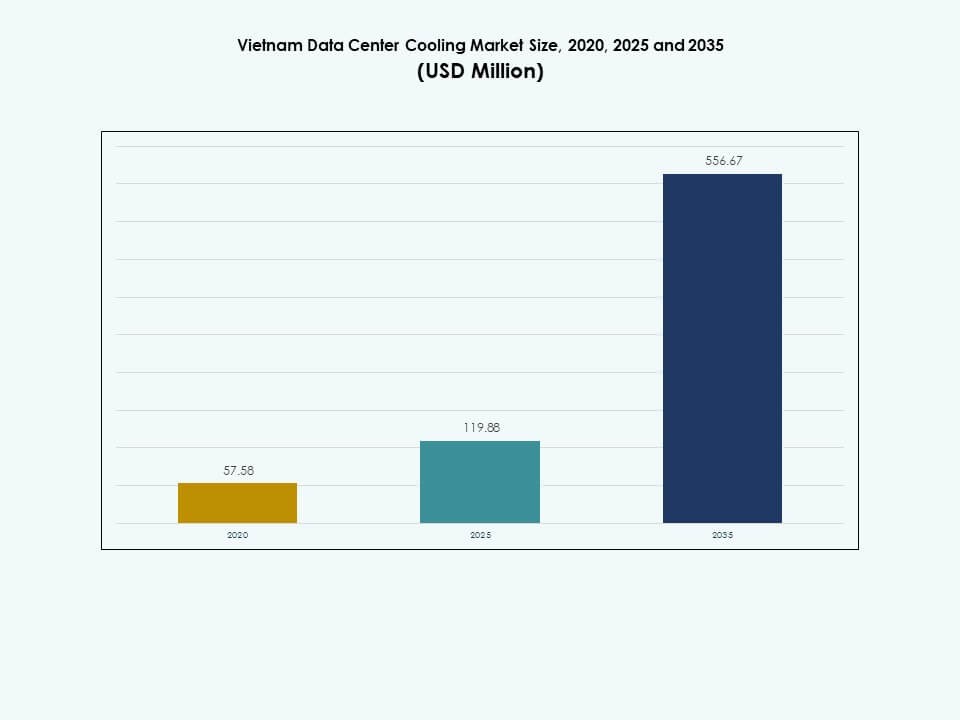
The Vietnam Data Center Cooling Market size was valued at USD 57.58 million in 2020 to USD 119.88 million in 2025 and is anticipated to reach USD 556.67 million by 2035, at a CAGR of 16.52% during the forecast period.

REPORT ATTRIBUTE DETAILS
Historical Period 2020-2023
Base Year 2024
Forecast Period 2025-2035
Vietnam Data Center Cooling Market Size 2025 USD 119.88 Million
Vietnam Data Center Cooling Market, CAGR 16.52%
Vietnam Data Center Cooling Market Size 2035 USD 556.67 Million


Strong market growth is driven by rising deployment of high-density workloads, advanced cooling adoption, and rapid expansion of hyperscale and colocation facilities. Operators shift to liquid cooling, precision systems, and AI-driven thermal control to manage heavier heat loads. Innovation in energy-efficient systems strengthens long-term value for investors. Businesses prioritize cooling upgrades to secure performance stability and support complex digital applications across sectors.

Northern Vietnam leads due to major hyperscale clusters and strong connectivity infrastructure. Southern provinces expand quickly as enterprise and retail sectors scale digital footprints. Central Vietnam emerges as a developing zone due to increasing land availability and supportive local policies. Each region diversifies growth by attracting new cooling investments aligned with rising cloud, telecom, and data-driven demands.

Vietnam Data Center Cooling Market Size

Market Drivers

Rising Demand for High-Density Workloads and Efficient Cooling Technologies

The Vietnam Data Center Cooling Market gains momentum from stronger AI and cloud needs. High-density racks push operators to adopt liquid and precision cooling. Many facilities replace legacy systems to reduce heat stress in new workloads. Investors treat Vietnam as a strategic point for regional computing growth. Businesses expand capacity to support fast digital adoption in major cities. It strengthens the role of efficient cooling across new builds. Operators deploy advanced systems to maintain stable rack performance. The trend shapes long-term infrastructure spending across the country. Cooling vendors target Vietnam due to predictable demand growth.

  • For example, Viettel’s Hoa Lac Data Center in Hanoi operates with a reported PUE of 1.4–1.45 and uses renewable energy for 30% of its power supply. The facility is Vietnam’s largest, supporting over 2,400 racks with a total capacity of 30 MW. HSBC confirmed the site’s eligibility for sustainable financing based on its green infrastructure commitments.

Growing Focus on Energy Efficiency and Green Cooling Innovation

Energy rules push data centers to adopt efficient cooling designs. Operators shift toward modular chillers and low-power cooling lines. Many projects now test AI-driven controls to cut energy use. Green goals increase interest in systems with strong power savings. The market supports new eco-friendly cooling models in hyperscale sites. It opens space for advanced innovation across the supply chain. Businesses view efficient cooling as a direct cost advantage. Investors show confidence in Vietnam due to stable energy planning. Operators treat green cooling as a core design requirement.

  • For example, FPT Telecom operates the Fornix HCM01 data center in Ho Chi Minh City, which is built to meet Tier III standards and serves large enterprise and cloud clients. The facility has been featured in national tech events such as FPT Techday, where the company highlighted its data-center expansion and digital infrastructure capabilities. These updates reflect ongoing improvements in reliability and operational performance.

Shift Toward Large-Scale Hyperscale and Colocation Expansion Across Key Cities

Hyperscale demand grows in Hanoi and Ho Chi Minh City. Colocation firms upgrade cooling to support dense compute zones. It strengthens the Vietnam Data Center Cooling Market as new builds scale. Many sites deploy liquid cooling lines for AI and GPU workloads. Enterprises trust facilities that manage heat with stable redundancy. Investors back large projects due to strong long-term returns. New digital rules encourage higher cooling standards. Vietnam attracts global players seeking safe expansion zones. Cooling adoption rises as more workloads shift to cloud.

Rapid Digitalization Across Telecom, BFSI, and Retail Sectors

Telecom networks expand edge locations that need stable cooling. BFSI sites deploy precision cooling to secure sensitive platforms. Retail platforms depend on reliable cooling to support online operations. Many firms upgrade IT rooms to avoid heat-related failures. It drives steady use of advanced cooling systems. Businesses view cooling as a core part of their digital plans. Investors monitor thermal stability as a sign of site quality. Sector growth supports new projects across major provinces. Cooling adoption stays strong across regulated industries.

Vietnam Data Center Cooling Market ShareMarket Trends

Growing Deployment of Liquid and Immersion Cooling for AI Workloads

AI demand pushes facilities to adopt liquid and immersion cooling. Operators redesign racks to support higher heat outputs. Many sites test immersion tanks for dense GPU clusters. The trend builds new interest in coolant-based designs. It supports stable load cycles in advanced compute zones. Businesses rely on these systems to avoid heat spikes. The Vietnam Data Center Cooling Market shifts toward high-density cooling lines. Investors track immersion trials as firms scale AI workloads. Adoption grows fastest in hyperscale environments.

Rising Use of Modular Cooling Units in New Data Center Builds

Developers adopt modular units to cut build time. Many sites install prefabricated cooling blocks for faster setup. Operators trust modular units for predictable performance control. The trend supports flexible expansion in crowded cities. It reduces energy waste with targeted airflow direction. Businesses prefer compact units in dense zones. Investors back modular growth due to low deployment risk. Modular cooling gains traction across mid-sized projects. It supports scalable growth models.

Integration of Smart Monitoring and AI-Based Cooling Control

Facilities deploy sensors to track airflow and heat trends. AI tools adjust cooling output to avoid energy waste. Operators use dashboards to monitor real-time thermal conditions. Many sites improve uptime through automated cooling cycles. The trend supports stronger reliability in digital services. Businesses treat smart cooling as a growth enabler. Investors view data-driven cooling as a safe choice. Smart upgrades reshape operational planning across sites. It aligns cooling with dynamic workloads.

Shift Toward Low-Water and Sustainable Cooling Systems

Facilities prioritize low-water systems to manage climate concerns. Many projects integrate air-cooled chillers to reduce water use. Operators favor sustainable units with stronger energy control. The trend supports new green certifications across sites. Businesses link cooling decisions to long-term climate plans. Investors monitor sustainable cooling lines for portfolio gains. Green models improve brand trust in key industries. It strengthens the push toward eco-friendly data center growth. Adoption accelerates in new urban projects.

Vietnam Data Center Cooling Market SegmentationMarket Challenges

High Infrastructure Costs and Limited Availability of Skilled Technical Talent

High capital needs limit adoption of advanced cooling lines. Many firms delay upgrades due to cost pressure. Operators struggle to hire skilled thermal engineers. The Vietnam Data Center Cooling Market needs more trained specialists. Frequent skill gaps slow complex cooling deployments. Businesses depend on foreign partners for advanced setup. Investors track these limits before funding large builds. It raises challenges for sites managing dense workloads. Growth needs stronger training efforts.

Power Supply Constraints and Regulatory Complexity Across Key Provinces

Power rules vary across major regions. Many sites face delays due to approval cycles. Operators manage heat stress during power constraints. The market faces hurdles due to grid reliability issues. Complex rules slow cooling expansion in crowded zones. Investors monitor policy changes to plan spending. High heat loads create further planning pain points. It limits the pace of cooling modernization. Many firms request simpler approval processes.

Market Opportunities

Expansion of Hyperscale and Edge Data Centers Across Vietnam
Hyperscale demand brings new cooling opportunities across major cities. Edge builds push need for compact cooling units. Many sites adopt liquid cooling to manage high heat loads. Operators invest in scalable cooling designs for long-term use. The Vietnam Data Center Cooling Market benefits from this shift. Businesses value reliable thermal control for digital platforms. Investors gain new entry points across provinces. It builds stronger interest in advanced cooling innovation. Growth expands with every new compute zone.

Rising Demand for Green Cooling and Low-Energy Designs

Green rules create demand for efficient systems. Many sites adopt eco-friendly cooling units to save energy. Operators use AI to control airflow with low power use. Businesses prefer green-certified facilities for corporate goals. The market supports new sustainable cooling solutions. Investors prioritize low-energy lines for stable returns. It strengthens focus on innovation in cooling methods. Demand rises fastest in new urban hubs. Growth aligns with national sustainability goals.

Market Segmentation

By Component

The Vietnam Data Center Cooling Market shows strong dominance of solution-based deployments. Cooling solutions hold the highest share due to wide use in hyperscale, edge, and enterprise sites. Services expand steadily as operators need support for integration and maintenance. Many firms rely on deployment services during capacity upgrades. Consulting grows due to rising demand for cooling optimization. Investors treat solution segments as safe assets due to steady growth. Adoption stays strong across regulated industries. Cooling services create value through long-term contracts. Demand rises as systems scale nationwide.

By Data Center Cooling Solution

Precision air conditioners lead due to strong use in controlled environments. Many hyperscale and enterprise sites depend on precise temperature control. Chillers maintain a solid share due to stable thermal output. Liquid cooling grows fastest in AI-heavy projects. Air handling units support large layouts across major cities. The Vietnam Data Center Cooling Market gains traction as systems modernize. Operators favor solutions that support dense workloads. Growth remains strong in multi-tenant facilities. Demand rises as complexity increases across builds.

By Service

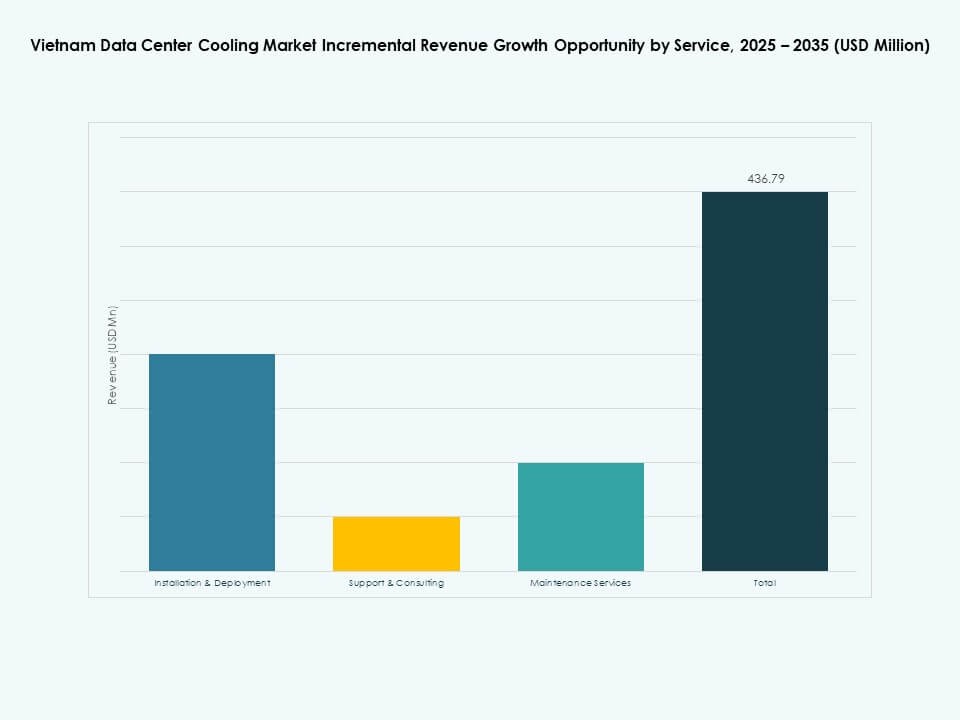
Installation and deployment services lead due to high project activity. Many new builds require full integration support. Maintenance holds strong share due to heavy use of chilled systems. Support and consulting grow as operators improve reliability. The Vietnam Data Center Cooling Market benefits from these service layers. Businesses rely on service partners for uptime. Investors trust service-led models for stable revenue. Many firms seek tailored service bundles. Growth expands in new hyperscale clusters.

By Enterprise Size

Large enterprises dominate due to major digital transformation efforts. Many prefer advanced cooling to manage dense workloads. SMEs increase adoption as cloud use grows. It supports stable growth across smaller server rooms. The Vietnam Data Center Cooling Market expands with both groups. Large firms deploy high-power units across multiple racks. SMEs choose modular cooling for cost control. Many projects scale with rising regional demand. Growth remains strong in digital-first sectors.

By Floor Type

Raised floors hold strong share due to structured cooling layouts. Many sites rely on raised floors to optimize airflow. Non-raised floors grow in modern builds with newer layouts. The Vietnam Data Center Cooling Market supports both formats. Operators choose raised floors in legacy and enterprise sites. Edge sites adopt non-raised floors for compact designs. Many developers blend both for flexible builds. Growth aligns with new project designs. Cooling integration depends on site structure.

By Containment

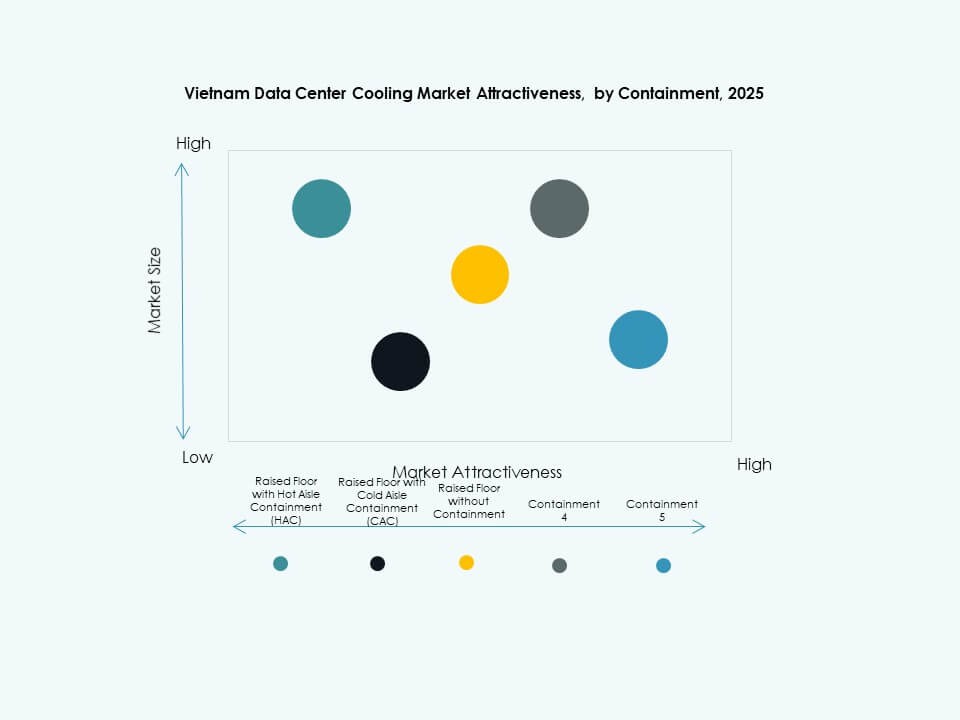
Hot aisle containment leads in advanced facilities due to strong efficiency. Cold aisle containment holds steady share across older builds. Raised floors without containment remain common in small setups. The Vietnam Data Center Cooling Market shifts toward strong containment planning. Many hyperscale sites deploy HAC to control heat leakage. CAC stays relevant across mid-sized rooms. Operators upgrade containment for better airflow. Many firms add containment during expansion cycles. Efficiency goals shape new deployments.

By Structure

Room-based cooling dominates due to wide adoption in older sites. Row-based cooling grows due to strong efficiency control. Rack-based cooling expands fastest in AI and GPU-heavy workloads. The Vietnam Data Center Cooling Market adapts to dense compute zones. Many developers test rack-based systems for heavy heat loads. Row-based units provide structured temperature control. Room cooling remains cost-effective for large halls. Growth spreads across all formats. Adoption aligns with project scale.

By Application

Hyperscale data centers lead due to massive compute demand. Colocation sites maintain strong share across major cities. Enterprise data centers adopt precision cooling for stable loads. Edge sites grow due to telecom expansion. The Vietnam Data Center Cooling Market supports all applications. Many firms upgrade cooling for long-term reliability. Hyperscale growth drives new liquid cooling lines. Enterprise upgrades remain steady across sectors. Edge builds attract new investment.

By End-user

Telecom leads due to strong 5G and edge growth. IT firms follow with heavy digital workloads. Retail and BFSI adopt stable cooling for critical platforms. Healthcare grows due to sensitive data needs. Energy sites depend on cooling for industrial systems. The Vietnam Data Center Cooling Market supports diverse industries. Many firms upgrade to meet heat demands. Growth spreads across all major verticals. Cooling remains core to digital continuity.

Regional Insights

Northern Vietnam – 55% Share

Northern Vietnam holds the largest share at 55%. Strong hyperscale and colocation growth drives cooling demand. The region hosts major cloud clusters and enterprise hubs. Many developers choose Hanoi due to stable connectivity. The Vietnam Data Center Cooling Market gains strength in this zone. It benefits from better power access and skilled labor. Many investors treat the region as a primary hub. Growth stays stable across large facilities.

  • For instance, Boyd Corporation announced in September 2025 the expansion of its Bac Ninh manufacturing facility in Northern Vietnam, doubling its capacity to 800,000 square feet for liquid cooling solutions tailored for AI data centers. This upgrade supports advanced direct-to-chip cooling, allowing hyperscale facilities in the region to handle increased power and thermal density for demanding cloud workloads.

Southern Vietnam – 35% Share

Southern Vietnam maintains a 35% share backed by strong enterprise activity. Ho Chi Minh City hosts many private data centers. Retail and BFSI clusters drive cooling needs. The zone attracts investors due to strong economic growth. The Vietnam Data Center Cooling Market expands with business demand. Many sites adopt modular cooling for dense layouts. Growth rises with digital service expansion. Cooling upgrades increase across mid-sized facilities.

  • For example, in July 2024, CMC Corporation invested USD 12.5 million to establish CMC AI Digital Infrastructure (CMC ADI) in the Tan Thuan Export Processing Zone. The new subsidiary focuses on developing and operating hyperscale data centers to support Vietnam’s growing digital economy. Public announcements highlight CMC’s plan to accelerate large-scale infrastructure growth through this dedicated data-center platform.

Central Vietnam – 10% Share

Central Vietnam holds a 10% share due to emerging activity. Da Nang hosts new edge and enterprise sites. Many operators select the zone for land availability. The Vietnam Data Center Cooling Market grows with government support. It gains attention from firms seeking low-cost expansion. Digital adoption rises across industries in the region. Growth remains steady in upcoming projects. Cooling adoption increases across new builds.

Competitive Insights:

  • Daikin Industries Ltd.
  • Mitsubishi Electric Corporation
  • Carrier
  • Johnson Controls International plc
  • Danfoss
  • Vertiv Group Corp.
  • Schneider Electric
  • STULZ GmbH
  • Rittal GmbH & Co. KG
  • CoolIT Systems

The Vietnam Data Center Cooling Market features strong competition among global HVAC leaders and advanced cooling specialists. Vertiv and Schneider Electric hold solid positions due to integrated cooling portfolios tailored for hyperscale and colocation needs. Daikin, Mitsubishi Electric, and Carrier strengthen their presence through energy-efficient chillers and high-performance CRAC systems. Danfoss expands influence through component innovation that supports liquid and hybrid cooling. STULZ and Rittal provide precision cooling systems that appeal to enterprise and telecom operators. CoolIT Systems gains traction with liquid cooling solutions for AI and GPU-dense racks. The market rewards firms that deliver low-energy performance, quick deployment, and stable thermal control. It encourages ongoing innovation as operators scale capacity and handle higher rack densities across major regions.

Recent Developments:

  • In November 2025, Daikin Applied announced the acquisition of Chilldyne, a leader in negative pressure liquid cooling for data centers, solidifying Daikin’s commitment to advanced cooling technologies for hyperscale and AI data centers.
  • In November 2025, Mitsubishi Electric Corporation entered into a memorandum of understanding with Hon Hai Precision Industry Co., Ltd. (Foxconn) to establish a global alliance for AI data center solutions, aiming to supply advanced cooling systems and intelligent infrastructure for hyperscale environments.
  • In September 2025, Boyd announced the expansion of its manufacturing facility in Bac Ninh, Vietnam, doubling its space to 800,000 square feet to boost production of liquid cooling solutions for data centers, especially those leveraging artificial intelligence. This development is aimed at addressing the growing demand for advanced cooling systems capable of handling high thermal density and compute loads.
  • In February 2025, Carrier Global Corporation formed an investment and technology partnership with ZutaCore, an innovator in two-phase direct-to-chip liquid cooling. The collaboration focuses on developing high-performance cooling solutions targeted at AI and high-density computing workloads, establishing a foundation for sustainable, waterless cooling in new-generation data centers.

1. Introduction

1.1. Market Definition & Scope

1.2. Research Methodology

1.2.1. Primary Research

1.2.2. Secondary Research

1.2.3. Data Validation & Assumptions

1.3. Market Segmentation Framework

2. Executive Summary

2.1. Market Snapshot

2.2. Key Findings

2.3. Analyst Recommendations

2.4. Market Outlook (2025–2035)

3. Market Dynamics

3.1. Market Drivers

3.2. Market Restraints

3.3. Market Opportunities

3.4. Challenges & Risks

3.5. Value Chain Analysis

3.6. Porter’s Five Forces Analysis

4. Vietnam Data Center Cooling Market – Market Sizing & Forecast

4.1. Historical Market Size (2020–2025)

4.2. Forecast Market Size (2026–2035)

4.3. Market Growth Rate Analysis

4.4. Market Outlook by Country

5. Capital Expenditure (CapEx) Analysis

5.1. CapEx Trends by Cooling Solution

5.1.1. Investment patterns across air-based, liquid-based, hybrid, and immersion cooling

5.1.2. CapEx share by cooling equipment type (CRAC/CRAH, chillers, cooling towers, economizers, etc.)

5.1.3. Country-wise CapEx trends

5.1.4. OEM vs. retrofit investment analysis

5.2. Return on Investment (ROI) & Payback Period Analysis

5.2.1. ROI by cooling technology type

5.2.2. Cost-benefit comparison: air cooling vs. liquid cooling vs. immersion cooling

5.2.3. Payback period across Tier I–IV data centers

5.2.4. Case examples of cost savings through energy-efficient cooling adoption

6. Data Center Cooling Capacity & Utilization

6.1. Installed Capacity (MW & Sq. Ft.) by Cooling Solution

6.1.1. Installed cooling capacity by solution type and Country

6.1.2. Cooling system density (kW/rack and per sq. ft.)

6.1.3. Capacity expansion trends by hyperscale vs. colocation vs. enterprise

6.2. Utilization Rates & Efficiency Metrics

6.2.1. Cooling system utilization vs. design capacity

6.2.2. Average and peak load management practices

6.2.3. Equipment lifecycle and performance benchmarks

6.3. Power Usage Effectiveness (PUE) & Energy Efficiency

6.3.1. Average PUE by data center size and cooling technology

6.3.2. Comparison of traditional vs. green cooling systems

6.3.3. Cooling system contribution to total facility energy consumption

6.4. Rack Density & Cooling Efficiency

6.4.1. Average rack density (kW/rack) trends

6.4.2. Cooling adequacy vs. rack load

6.4.3. Relationship between high-density workloads (AI, HPC) and cooling requirements

7. Data Center Cooling Market, Energy & Resource Consumption Analysis

7.1. Energy Consumption Analysis

7.1.1. Total energy consumption by cooling solution type (air-based, liquid, hybrid, immersion)

7.1.2. Energy intensity per MW of IT load

7.1.3. Energy share of cooling in total facility power (cooling load ratio)

7.1.4. Annualized Energy Efficiency Ratio (EER / SEER) by cooling system type

7.1.5. Trend in energy consumption reduction through automation, AI, and free cooling technologies

7.2. Water Consumption Analysis

7.2.1. Water Usage Effectiveness (WUE) – liters per kWh of IT load

7.2.2. Water consumption by cooling technology (evaporative cooling, adiabatic cooling, etc.)

7.2.3. Water recycling and reuse systems in data centers

7.2.4. Impact of Country-wise water scarcity regulations on cooling system choice

7.2.5. Shift from water-intensive to air-based or hybrid systems

7.3. Combined Energy–Water Efficiency Metrics

7.3.1. Energy-Water Nexus in cooling optimization

7.3.2. Correlation between PUE, WUE, and total operational cost (OpEx)

7.3.3. Case studies of zero-water or waterless cooling deployments

7.4. Benchmarking & Comparative Analysis

7.4.1. Benchmarking against ASHRAE, Uptime Institute, and DOE standards

7.4.2. Comparison of Vietnam WUE/PUE averages by Country

7.4.3. Best practices adopted by hyperscalers (AWS, Google, Microsoft, Meta, etc.)

8. Vietnam Data Center Cooling Market – By Component

8.1. Solution

8.2. Services

9. Vietnam Data Center Cooling Market – By Data Center Cooling Solution

9.1. Air Conditioners

9.2. Precision Air Conditioners

9.3. Chillers

9.4. Air Handling Units

9.5. Liquid Cooling

9.6. Others

10. Vietnam Data Center Cooling Market – By Service

10.1. Installation & Deployment

10.2. Support & Consulting

10.3. Maintenance Services

11. Vietnam Data Center Cooling Market – By Enterprise Size

11.1. Large Enterprises

11.2. Small & Medium Enterprises (SMEs)

12. Vietnam Data Center Cooling Market – By Floor Type

12.1. Raised Floors

12.2. Non-Raised Floors

13. Vietnam Data Center Cooling Market – By Containment

13.1. Raised Floor with Hot Aisle Containment (HAC)

13.2. Raised Floor with Cold Aisle Containment (CAC)

13.3. Raised Floor without Containment

14. Vietnam Data Center Cooling Market – By Structure

14.1. Rack-Based Cooling

14.2. Row-Based Cooling

14.3. Room-Based Cooling

15. Vietnam Data Center Cooling Market – By Application

15.1. Hyperscale Data Center

15.2. Colocation Data Center

15.3. Enterprise Data Center

15.4. Edge Data Center

15.5. Other Data Centers

16. Vietnam Data Center Cooling Market – By End-user

16.1. Telecom

16.2. IT

16.3. Retail

16.4. Healthcare

16.5. BFSI

16.6. Energy

16.7. Others

17. Sustainability & Green Data Center Cooling

17.1. Energy Efficiency Initiatives

17.1.1. Deployment of free cooling, adiabatic cooling, and economizers

17.1.2. Smart control systems for temperature and airflow optimization

17.1.3. Case studies of efficiency improvement programs

17.2. Renewable Energy Integration

17.2.1. Integration of solar, wind, or geothermal sources in cooling operations

17.2.2. Hybrid systems combining renewable energy with mechanical cooling

17.3. Carbon Footprint & Emission Analysis

17.4. GHG reduction initiatives

17.5. LEED & Green Certifications

17.5.1. Share of cooling systems installed in LEED, BREEAM, or Energy Star certified facilities

17.5.2. Compliance with ASHRAE and ISO energy efficiency standards

18. Emerging Technologies & Innovations

18.1.1. Emerging Technologies & Innovations

18.1.2. Liquid Cooling & Immersion Cooling

18.1.3. Adoption rate and technology maturity

18.1.4. Key vendors and installations by Country

18.1.5. Comparative analysis: performance, cost, and energy savings

18.2. AI & HPC Infrastructure Integration

18.2.1. Cooling demand driven by AI training clusters and HPC systems

18.2.2. Adaptation of cooling design to high heat density workloads

18.3. Quantum Computing Readiness

18.3.1. Cooling requirements for quantum processors

18.3.2. Potential cooling technologies suitable for quantum environments

18.4. Modular & Edge Data Center Cooling

18.4.1. Cooling strategies for prefabricated and modular facilities

18.4.2. Compact and adaptive cooling for edge sites

18.5. Automation, Orchestration & AIOps

18.5.1. Integration of AI-driven thermal management

18.5.2. Predictive maintenance and automated cooling optimization

19. Competitive Landscape

19.1. Market Share Analysis

19.2. Key Player Strategies

19.3. Mergers, Acquisitions & Partnerships

19.4. Product & Service Launches

20. Company Profiles

20.1. Daikin Industries Ltd.

20.2. Mitsubishi Electric Corporation

20.3. Carrier

20.4. Johnson Controls International plc

20.5. Danfoss

20.6. Vertiv Group Corp.

20.7. Schneider Electric

20.8. STULZ GmbH

20.9. Rittal GmbH & Co. KG

20.10. CoolIT Systems

Request Free Sample

We prioritize the confidentiality and security of your data. Our promise: your information remains private.

Ready to Transform Data into Decisions?

Request Your Sample Report and Start Your Journey of Informed Choices


Providing the strategic compass for industry titans.

Frequently Asked Questions:

What is the current market size for the Vietnam Data Center Cooling Market, and what is its projected size in 2035?

The Vietnam Data Center Cooling Market stood at USD 119.88 million in 2025. It is projected to reach USD 556.67 million by 2035, supported by strong demand for efficient cooling in expanding digital infrastructures.

At what Compound Annual Growth Rate is the Vietnam Data Center Cooling Market projected to grow between 2025 and 2035?

The Vietnam Data Center Cooling Market is expected to grow at a 16.52% CAGR from 2025 to 2035. This growth reflects rising AI workloads, hyperscale investment, and stronger adoption of advanced cooling designs.

Which Vietnam Data Center Cooling Market segment held the largest share in 2025?

In 2025, solution components, particularly precision air conditioners and chillers, held the largest share of the Vietnam Data Center Cooling Market. Strong deployment across hyperscale and colocation facilities drove this lead.

What are the primary factors fueling the growth of the Vietnam Data Center Cooling Market?

The Vietnam Data Center Cooling Market grows due to rising high-density workloads, green cooling innovation, hyperscale expansion, and stronger digital adoption across regulated sectors. Investors push demand for efficient and scalable cooling systems.

Who are the leading companies in the Vietnam Data Center Cooling Market?

Key players in the Vietnam Data Center Cooling Market include Daikin, Mitsubishi Electric, Carrier, Johnson Controls, Danfoss, Vertiv, Schneider Electric, STULZ, Rittal, and CoolIT Systems. These firms lead through advanced cooling portfolios.

Which region commanded the largest share of the Vietnam Data Center Cooling Market in 2025?

Northern Vietnam held the largest share of the Vietnam Data Center Cooling Market in 2025 at 55%. The region leads due to major hyperscale clusters, strong connectivity, and consistent investment in high-capacity cooling systems.

Licence Option

The report comes as a view-only PDF document, optimized for individual clients. This version is recommended for personal digital use and does not allow printing. Use restricted to one purchaser only.
To meet the needs of modern corporate teams, our report comes in two formats: a printable PDF and a data-rich Excel sheet. This package is optimized for internal analysis. Unlimited users allowed within one corporate location (e.g., regional office).
The report will be delivered in printable PDF format along with the report’s data Excel sheet. This license offers 100 Free Analyst hours where the client can utilize DC Market Insights’ research team. Permitted for unlimited global use by all users within the purchasing corporation.

Europe


North America

Smallform of Sample request

Request Sample