Executive summary:
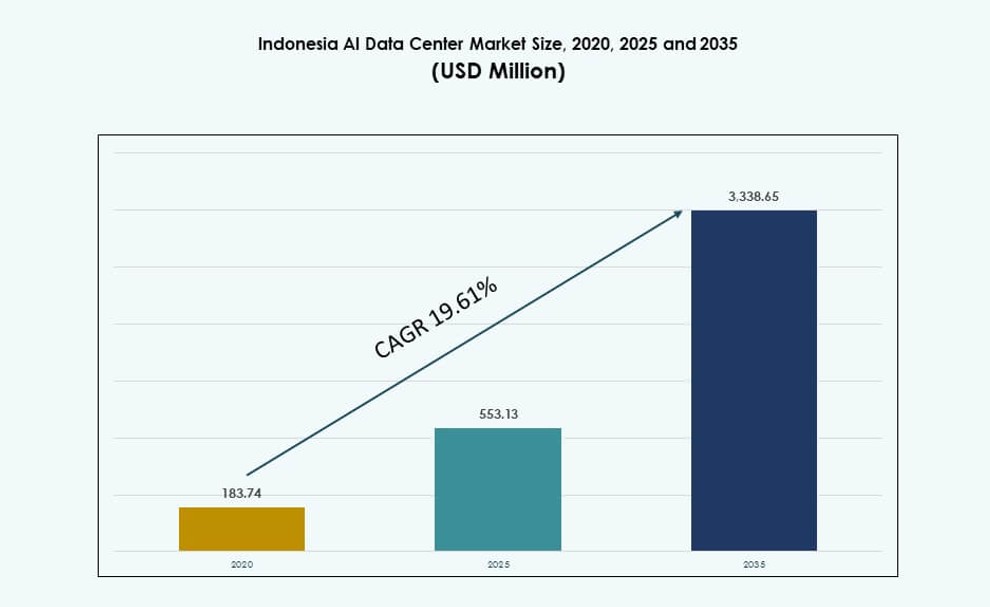
The Indonesia AI Data Center Market size was valued at USD 183.74 million in 2020 to USD 553.13 million in 2025 and is anticipated to reach USD 3,338.65 million by 2035, at a CAGR of 19.61% during the forecast period.
| REPORT ATTRIBUTE |
DETAILS |
| Historical Period |
2020-2023 |
| Base Year |
2024 |
| Forecast Period |
2025-2035 |
| Indonesia AI Data Center Market Size 2025 |
USD 553.13 Million |
| Indonesia AI Data Center Market, CAGR |
19.61% |
| Indonesia AI Data Center Market Size 2035 |
USD 3,338.65 Million |
The market is advancing rapidly due to rising AI adoption across sectors and aggressive cloud zone expansion by global hyperscalers. Enterprises and digital-native firms are investing in local AI infrastructure for training, inference, and data residency needs. Government-backed digital transformation and sovereignty policies are further pushing demand for localized compute. Operators are integrating high-density GPU clusters and liquid cooling to meet performance needs. These shifts make the Indonesia AI Data Center Market a strategic location for investors and technology providers.
Greater Jakarta leads with most of the country’s AI-ready capacity due to its infrastructure readiness and network density. Batam is emerging as a key secondary hub, offering proximity to Singapore and cost advantages. West Java, including Bekasi and Karawang, is gaining traction due to industrial demand and government incentives. The Indonesia AI Data Center Market is expanding beyond Tier-1 cities through edge deployments and regional investments aimed at broadening access to low-latency AI services.
Market Dynamics:
Market Drivers
Surging AI Compute Demand from Enterprises and Startups Across Indonesia
Enterprises in Indonesia are aggressively scaling AI deployments to enhance operational agility and decision-making. Startups are driving innovation in fintech, healthtech, and agritech, pushing demand for low-latency compute. This demand is fueling investment in AI-optimized data center infrastructure. Indonesia AI Data Center Market benefits from this dual momentum of traditional enterprise upgrades and new-age business requirements. The rise in digital-native services is also driving storage, processing, and connectivity needs. IT modernization strategies are accelerating cloud and AI adoption across verticals. Government-backed digitalization efforts add to infrastructure pressures. Together, these drivers make AI data centers a long-term infrastructure priority for the economy.
- For instance, Xendit offers adaptive fraud detection services that use machine learning to help businesses reduce fraud and maintain higher payment success rates.
AI-Centric National Digital Strategies Elevating Data Center Investment Priority
The Indonesian government’s push for digital transformation is placing AI infrastructure at the forefront. Public-sector modernization plans rely on scalable AI infrastructure for e-government, cybersecurity, and smart city platforms. AI data centers serve as foundational layers for these initiatives. Through programs like “Making Indonesia 4.0,” industrial AI is gaining policy-level support. Localized compute infrastructure reduces reliance on overseas clouds and boosts digital sovereignty. AI workload localization supports national data security goals. Indonesia AI Data Center Market is positioned to meet these needs through edge and core infrastructure development. Investors view this policy alignment as a strong stability signal.
Transition to High-Density, AI-Optimized Hardware Configurations in Key Facilities
Operators are redesigning facilities to handle AI workloads with dense GPU configurations and liquid cooling systems. NVIDIA H100 and similar hardware are becoming standard in new deployments. This shift is driving rack power densities beyond 30 kW, triggering redesign of traditional cooling and power backup. Hyperscale and colocation providers are racing to integrate modular power and high-efficiency cooling. Indonesia AI Data Center Market is witnessing a rise in demand for turnkey, AI-specific capacity. Equipment vendors and EPC players are adapting offerings for high-density builds. The hardware transformation is unlocking new service models and revenue streams for operators.
Private Sector Cloud Expansions Enhancing Distributed AI Infrastructure Footprint
Global and regional cloud providers are expanding their footprints across Indonesia to meet rising AI training and inference workloads. AWS, Microsoft, and Google have committed to Indonesian cloud zones, indirectly spurring data center builds. Local players like Telkom Indonesia and DCI Indonesia are upgrading AI-readiness in their facilities. This helps distribute AI compute infrastructure closer to users and applications. Indonesia AI Data Center Market benefits from this investment convergence between global hyperscalers and local players. Cross-regional interconnectivity also improves AI service delivery across Southeast Asia. It enhances Indonesia’s role as a regional AI hub.
- For instance, AWS opened its Jakarta region in 2022 with three availability zones, delivering over 100 services including AI tools like SageMaker for local workloads.
Market Trends
Widespread Integration of Liquid Cooling Solutions for High-Density AI Racks
AI training clusters require high-performance GPUs, which produce more heat than traditional servers. Operators are now deploying direct-to-chip and rear-door liquid cooling systems in high-density halls. This trend is reshaping facility designs and energy strategies. Indonesia AI Data Center Market is incorporating liquid cooling as a standard in new AI-centric builds. Liquid-cooled racks support 50–100 kW densities, reducing cooling footprint and improving energy efficiency. Suppliers of immersion and CDU systems are forming local partnerships. Demand for precision cooling analytics is also rising. This thermal shift helps reduce power usage effectiveness (PUE) metrics significantly.
Growing Emphasis on AI-Native Security and Data Compliance Frameworks
Data centers hosting AI models face increasing scrutiny over privacy, compliance, and secure processing. Operators are integrating AI-native cybersecurity protocols, zero-trust architectures, and encrypted data pipelines. Indonesia AI Data Center Market is adopting local and regional compliance frameworks for sovereignty and trust. Facilities are being audited for AI workload segregation, especially in BFSI and healthcare. ISO/IEC certifications tailored to AI processing are gaining traction. Sovereign cloud environments are also being designed for regulated industries. Compliance readiness is becoming a competitive differentiator in the market.
Edge AI Data Centers Emerging to Serve Remote and Industrial Workloads
AI data processing is shifting closer to end-users in manufacturing zones, smart ports, and logistics hubs. This is driving deployment of edge and micro data centers across Indonesia’s secondary cities. Indonesia AI Data Center Market is seeing new use cases such as predictive maintenance, smart surveillance, and autonomous systems. These use cases demand on-site AI inference with low latency and real-time processing. Edge infrastructure also reduces bandwidth stress on core networks. Vendors are offering containerized, ruggedized systems tailored for industrial conditions. Energy-efficient microgrids and battery systems are being added for off-grid resilience.
Rise in AI-Capable Modular and Prefabricated Data Center Deployments
Speed-to-market has become a key trend in meeting sudden AI workload surges. Modular, prefabricated AI data centers are being deployed across campuses and special economic zones. Indonesia AI Data Center Market benefits from these rapid deployment models that offer scalability and customization. These setups come pre-integrated with liquid cooling, dense racks, and AI accelerators. Vendors are offering containerized solutions with GPU-ready clusters and advanced airflow systems. Modular builds reduce time-to-value and capital risk for operators. This trend is supporting AI testing labs, regional AI hubs, and enterprise-specific inference workloads.
Market Challenges
Infrastructure Gaps in Power, Cooling, and Network Affecting AI Compute Readiness
Many existing facilities are not optimized for high-density AI workloads that demand resilient infrastructure. Reliable grid power, advanced cooling, and redundant fiber connectivity remain challenges across secondary regions. Indonesia AI Data Center Market must overcome these structural limitations to scale AI-ready capacity. Frequent outages, voltage instability, and high diesel reliance hurt energy efficiency and uptime. Upgrading electrical and thermal systems requires capital-intensive retrofits. Network latency in outer islands also limits AI service availability. These gaps delay adoption of high-performance compute applications beyond Tier 1 cities.
Shortage of Skilled Workforce and AI-Ready Operations Talent Base
Operating AI-specific data centers requires advanced talent in AI infrastructure, software-defined systems, and liquid cooling. Indonesia faces a shortage of professionals with these niche skillsets. This slows down both deployment and operations of AI environments. Indonesia AI Data Center Market is impacted by limited availability of engineers with AI integration and data compliance expertise. Training programs are still catching up to AI infrastructure demands. Operators are relying on foreign contractors or remote support. Talent gaps also increase operational risks, affect uptime, and inflate costs in high-performance clusters.
Market Opportunities
Sovereign AI and Local Cloud Zones Creating National Compute Advantage
The government’s focus on national AI sovereignty creates an opportunity for AI-native data centers tailored for public sector workloads. Sovereign cloud zones, enabled by local players, are in high demand. Indonesia AI Data Center Market can become a strategic pillar for digital independence. Enterprises working with regulated data seek local AI compute alternatives to foreign cloud regions. This is expanding the addressable market for localized, AI-specific data center services.
Integration of Renewable Energy and AI Efficiency Tools to Meet ESG Goals
Indonesia’s strong solar and geothermal potential supports green data center builds. AI workloads present a chance to align growth with environmental goals. Indonesia AI Data Center Market is embracing solar-powered campuses, AI-based cooling optimization, and dynamic workload scheduling. These steps help meet sustainability benchmarks. Operators investing in green AI infrastructure are gaining favor with both investors and global tenants.
Market Segmentation
By Type
Hyperscale data centers dominate the Indonesia AI Data Center Market due to rising demand from global cloud providers. These facilities are designed for high-density AI training clusters and support rapid scale-ups. Colocation and enterprise deployments are expanding as local firms seek flexible AI compute access. Edge and micro data centers are gaining traction in remote industrial zones, where they support AI inference tasks. Growth in all three segments reflects a move toward distributed and specialized compute infrastructure.
By Component
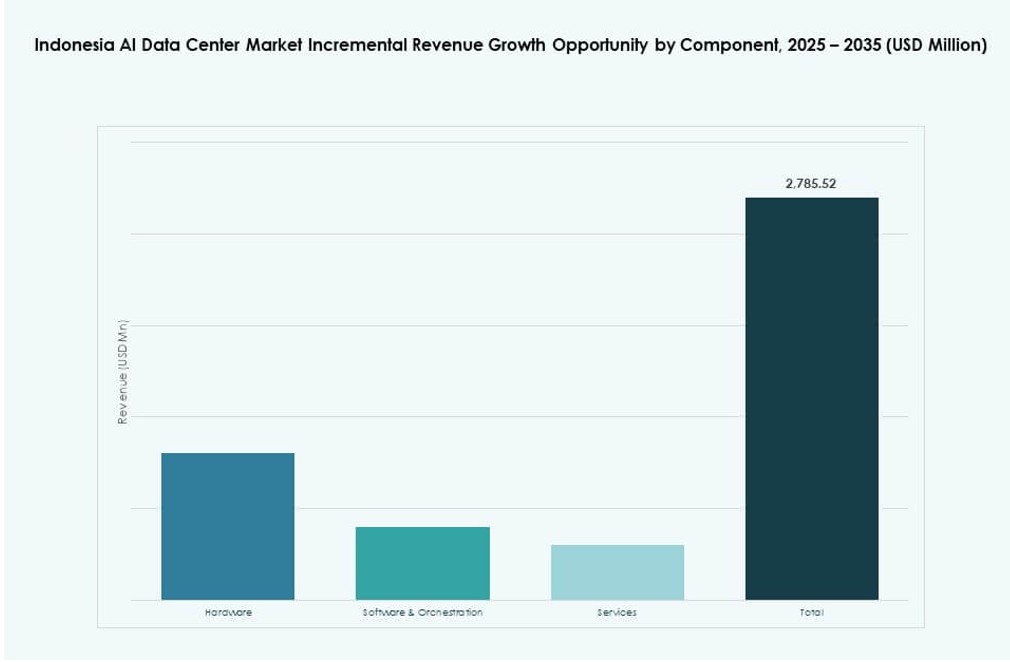
Hardware leads the component segment, driven by demand for high-performance GPUs, dense servers, and liquid cooling. Software & orchestration platforms are gaining ground as AI workload management, automation, and container orchestration become key. Services are growing due to rising demand for managed AI infrastructure, design consulting, and compliance audits. Indonesia AI Data Center Market sees vendors bundling components to offer turnkey, AI-specific environments.
By Deployment
Cloud deployments hold the largest share in Indonesia AI Data Center Market, supported by regional cloud zones from hyperscalers. Hybrid deployments are expanding rapidly across regulated sectors and large enterprises. On-premise deployment is relevant for firms with strict data control needs or latency-sensitive AI applications. Each model is evolving to align with AI workloads and compliance structures in the country.
By Application
Machine Learning (ML) remains the leading application segment, supported by enterprise AI automation and decision support. Generative AI (GenAI) is rising fast, driving demand for advanced GPU clusters. Natural Language Processing (NLP) is being deployed in customer service and compliance tech. Computer Vision (CV) supports industrial use cases like defect detection and surveillance. Indonesia AI Data Center Market is evolving to support application diversity across verticals.
By Vertical
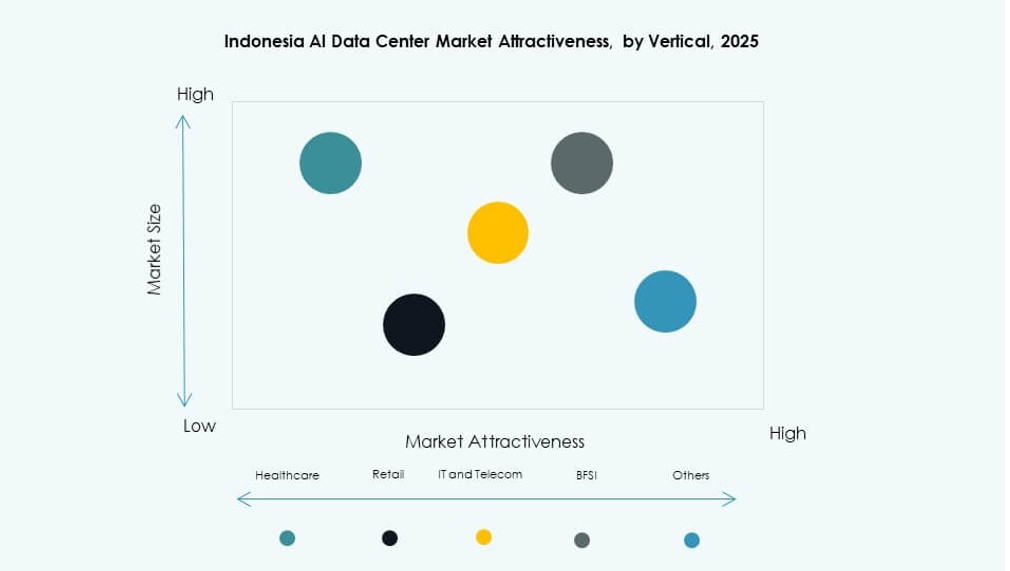
IT and Telecom lead the market in AI infrastructure investment, followed by BFSI and Manufacturing. Healthcare is growing due to AI-driven diagnostics and imaging. Retail and Media & Entertainment are exploring AI for personalization and content generation. Automotive is deploying AI for smart mobility use cases. Indonesia AI Data Center Market is witnessing sector-specific growth paths as AI adoption broadens across industries.
Regional Insights
Greater Jakarta Region – Core AI Data Center Hub with Over 65% Market Share
Jakarta dominates the Indonesia AI Data Center Market due to its superior infrastructure, enterprise base, and connectivity. Over 65% of national capacity is located here. The region hosts hyperscale zones, AI-ready colocation facilities, and sovereign cloud deployments. Key players like DCI Indonesia, Telkomsigma, and EDGE DC operate high-density campuses here. Proximity to enterprises, talent, and undersea cable landing points strengthens Jakarta’s leadership.
Batam and West Java – Emerging Growth Corridors with Strategic Connectivity
Batam holds around 15% market share and is emerging due to its proximity to Singapore. It attracts investment due to lower costs and regional connectivity. West Java, especially Bekasi and Karawang, is becoming a hotspot for industrial and edge deployments. Indonesia AI Data Center Market benefits from incentives in special economic zones and new greenfield projects in these regions. Infrastructure upgrades are improving reliability and capacity.
- For instance, Telkom Indonesia’s NeutraDC and Singtel’s Nxera broke ground on a hyperscale data center in Batam’s Kabil Industrial Estate in 2023. The 8-hectare site targets up to 54 MW capacity and integrates renewable power via Medco Power. A topping-off ceremony was held in late 2025.
Other Provinces – Nascent Markets with High Future Potential Beyond Core Regions
Regions such as Central Java, East Kalimantan, and Bali account for nearly 20% combined market share. These areas are witnessing early-stage deployments, mostly driven by industrial AI and government-backed smart city pilots. Indonesia AI Data Center Market can expand further here through targeted edge investments. Fiber rollout, smart grid upgrades, and policy support are critical to unlock full potential. These areas offer long-term growth for distributed AI compute.
- For instance, DCI Indonesia inaugurated its E1 data center in Jakarta in March 2024, featuring 30,000 sqm of space and supporting up to 4,000 racks. The facility is Tier IV certified and delivers 18 MW of IT capacity for high-availability workloads.
Competitive Insights:
- DCI Indonesia
- Telkomsigma
- BDx Indonesia
- Equinix
- Digital Realty Trust
- Microsoft (Azure)
- Amazon Web Services (AWS)
- Google Cloud / Alphabet
- CoreWeave
- NVIDIA
The Indonesia AI Data Center Market features a mix of domestic providers and global hyperscalers. DCI Indonesia and Telkomsigma lead local deployment, offering AI-ready colocation and cloud services. BDx Indonesia is expanding capacity for regional AI hosting. Global players like AWS, Microsoft, and Google Cloud have established local zones, intensifying competition and accelerating innovation. Equinix and Digital Realty are scaling operations to support high-density AI clusters with liquid cooling and modular builds. CoreWeave and NVIDIA are entering via infrastructure partnerships to target GPU-intensive workloads. The market is defined by aggressive expansions, strategic alliances, and rising demand for sovereign, low-latency AI compute. It is evolving into a regional hub for Southeast Asia.
Recent Developments:
- In June 2025, DCI Indonesia launched its eighth data center facility, JK6, an AI-ready site with 36 MW capacity equipped with liquid cooling technology for high-density workloads. This addition increased the company’s total installed capacity to 119 MW, positioning it as Indonesia’s largest data center provider.
- In May 2025, Equinix unveiled its first AI-ready data center, JK1, in Jakarta in partnership with PT Astra International, offering access to over 50 global and local networks.
- In May 2025, Microsoft Azure opened its first cloud region, Indonesia Central, providing AI-ready hyperscale infrastructure with three availability zones for low-latency services and data residency.
- In March 2025, Digital Realty Trust formed a 50-50 joint venture, Digital Realty Bersama, with Bersama Digital Infrastructure Asia to develop and operate data centers across Indonesia, supporting AI and digital growth.