
China AI Data Center Market Size, Share & Forecast to 2035
Market at a glance
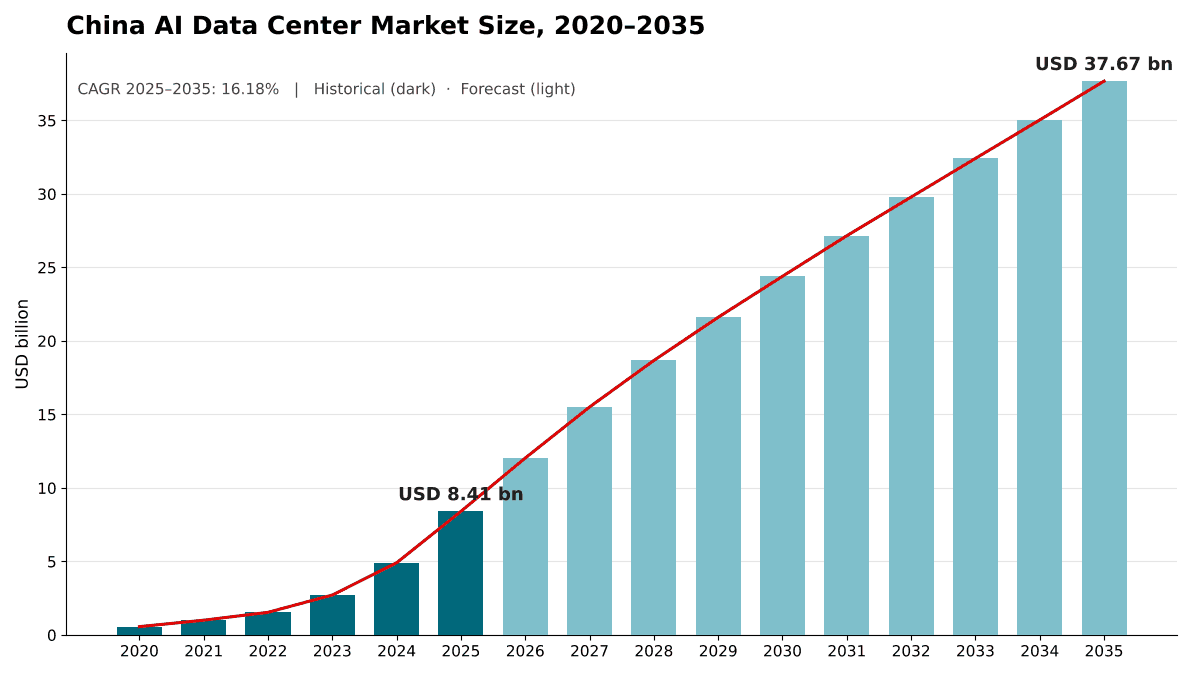
The China AI Data Center market was worth USD 8,410.0 million in 2025 and is forecast to reach USD 37.67 billion by 2035, growing at a 16.18% CAGR. Inner Mongolia and Gansu-Ningxia account for 26.3% of the market.
 By Amit Jain, Senior Consultant, ICT & Emerging Technologies
 Reviewed by Deepti Agrawal
Last updated 21 Oct 2026
Base year 2025 PDF + Excel
Source: DC Market Insights analysis
Key findings
Alibaba Commits at Least 380 Billion Yuan to Cloud and AI Infrastructure
Direct-to-Chip Liquid Cooling Reaches 59.1% of Spend by 2035
Export Controls Make GPU Supply the Pacing Item
Wholesale Colocation Grows to USD 12.32 Billion by 2035
What is inside the report
- 01Introduction
- 02Key Market Statistics
- 03Executive Summary
- 04Market Drivers
- 05Market Trends
- 06Market Challenges
- 07Market Opportunities
- 08Pricing Analysis
- 09Standards and Regulation
- 10China AI Data Center Market Segmentation
- 16chapters
- 2020-2024Historical period
- 2026-2035Forecast period
- 16Companies profiled
Regional insights
- Inner Mongolia and Gansu-Ningxia26.3%
- Beijing-Tianjin-Hebei21.3%
- Yangtze River Delta18.6%
- Chengdu-Chongqing and Guizhou14.3%
- Greater Bay Area (Guangdong)12.2%
- Rest of China7.3%
Segmentation
Companies profiled
- ByteDance (Volcano Engine)
- Alibaba Cloud
- Tencent Cloud
- Baidu AI Cloud
- Huawei
- China Telecom
- China Mobile
- China Unicom
- GDS Holdings
- VNET Group
- Chindata Group
- Envision
- Inspur
- Sugon
- Vertiv
- Schneider Electric
Recent developments
Alibaba said it will invest at least 380 billion yuan in cloud and AI infrastructure over the next three years (Source: Alibaba Group announcement).
the US government informed Nvidia that a license is required to export H20 products to China, and Nvidia later took a USD 4.5 billion charge for H20 inventory and purchase obligations (Source: Nvidia SEC filing).
Huawei announced the Atlas 950 SuperPoD with up to 8,192 Ascend 950DT chips, available in the fourth quarter of 2026 (Source: Huawei keynote speech).
the US president said Nvidia would be allowed to ship H200 products to approved customers in China (Source: statement by the US president).
VNET reported 889 MW of wholesale capacity in service and 452 MW under construction at the end of 2025 (Source: VNET 2025 results).
Envision's Galaxy Campus in Ulanqab, with a planned total capacity of 2 gigawatts, was described as China's biggest AI computing park (Source: Envision campus description).
ByteDance held preliminary talks with local data center vendors to add 5 to 6 gigawatts of compute in Ulanqab (Source: South China Morning Post, citing a source).
Full analysis
The China AI Data Center Market is valued at USD 12.04 billion in 2026 and is projected to reach USD 37.67 billion by 2035, up from USD 8.41 billion in 2025, a CAGR of 16.18% from 2025 to 2035 (DC Market Insights estimate). What moves the money here is the gap between chip supply and hall supply: Chinese hyperscalers committed hundreds of billions of yuan to AI infrastructure in 2025 and 2026, yet US licence rules on Nvidia accelerators decided how fast each hall could be filled, so operators put capital into power, liquid cooling and white space that can host either imported GPUs or Huawei Ascend pods. The 2025 value is built from the halls themselves: about 1,620 MW of new AI IT capacity at roughly USD 4.57 million of facility spend per MW gives USD 7.40 billion of new-build spend, and software and services on an average installed AI base of about 2,980 MW at USD 0.338 million per MW add USD 1.01 billion. The China AI Data Center Market covers that facility layer only (power and electrical systems, cooling, racks and white space, in-hall networking and cabling, data center infrastructure management (DCIM) and orchestration software, and design, build and operations services) and excludes the artificial intelligence (AI) servers and accelerators. Racks above 100 kW are the fastest-growing segment at 31.75% a year because liquid-cooled training pods concentrate far more power in each rack, and Inner Mongolia and Gansu-Ningxia form the fastest-growing region at 19.77% a year as training moves to the western computing hubs. All data center types in China, including non-AI halls, are sized in the China Data Center Market report; this market is the AI-dedicated slice of it.
Key Market Statistics: What Will China Spend on AI Data Center Halls in 2026?
DC Market Insights estimates that China will spend USD 12.04 billion on AI data center facility infrastructure, software and services in 2026, 43.13% more than the USD 8.41 billion of 2025.
- China AI Data Center Market size 2025: USD 8.41 billion.
- China AI Data Center Market size 2026: USD 12.04 billion.
- China AI Data Center Market size 2030: USD 24.40 billion.
- China AI Data Center Market size 2035: USD 37.67 billion (low case USD 29.58 billion, high case USD 44.94 billion).
- CAGR 2025 to 2035: 16.18% (low case 13.40%, high case 18.25%).
- Largest component: power and electrical infrastructure, USD 2.66 billion or 31.7% of 2025 value.
- Fastest-growing segment: racks above 100 kW, 31.75% a year, from USD 731.74 million in 2025 to USD 11.53 billion in 2035.
- Leading and fastest-growing region: Inner Mongolia and Gansu-Ningxia, 26.3% of 2025 value, 19.77% a year.
- Largest operator type: hyperscale self-build, 46.2% of 2025 value.
- Market leaders: ByteDance, Alibaba and Tencent together, about 37% of 2025 spending (DC Market Insights estimate).
Executive Summary: China AI Data Center Market Snapshot, 2025, 2026 and 2035
The China AI Data Center Market size was valued at USD 568.96 million in 2020, reached USD 8.41 billion in 2025, and is anticipated to reach USD 37.67 billion by 2035, at a CAGR of 16.18% during the forecast period.
| Report attribute | Details |
|---|---|
| Historical Period | 2020-2024 |
| Base Year | 2025 |
| Forecast Period | 2026-2035 |
| China AI Data Center Market Size 2025 | USD 8.41 Billion |
| China AI Data Center Market Size 2026 | USD 12.04 Billion |
| China AI Data Center Market, CAGR | 16.18% |
| China AI Data Center Market Size 2035 | USD 37.67 Billion |
The market grew at 71.38% a year between 2020 and 2025 as new AI capacity completed in mainland China rose from 140 MW to 1,620 MW and large language model training moved from pilot clusters to campus-scale halls. Growth slows to 16.18% a year from 2025 to 2035 as facility cost per MW starts to fall, even as annual completions rise to about 4,960 MW by 2035.
The market reaches USD 24.40 billion in 2030. By 2035, software and services on the installed base make up USD 16.65 billion, or 44.2% of the China AI Data Center Market, against 12.0% in 2025, so the market shifts from a construction market toward an operations market over the decade.
Market Scope: What Does the China AI Data Center Market Cover Besides the Chips?
The China AI Data Center Market covers spending on the buildings and systems that house AI compute in mainland China, in current US dollars, sized by DC Market Insights at USD 8.41 billion in 2025.
Included. Power distribution, uninterruptible power supplies and generators serving AI halls; air, direct-to-chip liquid and immersion cooling; racks and white-space fit-out; in-hall switches, such as Cisco Systems’ Nexus data center switches, and AI fabric cabling; DCIM software; and design, build and operations services.
Excluded. AI servers, graphics processing units (GPU) and other accelerators, storage arrays, land and shell construction, data center interconnect links between campuses, colocation rent and cloud service revenue, and data centers in Hong Kong, Macao and Taiwan.
How the segments fit together. The component, cooling technology, workload, operator type and rack density splits each re-cut the same USD 8.41 billion. The regional split groups the East Data West Computing hubs into six regions. Accelerator spending is sized in the Data Center GPUs Market report.
Market Drivers: Why Are Chinese Hyperscalers Building AI Halls So Fast?
Three drivers explain most of the growth: hyperscaler capital spending measured in hundreds of billions of yuan, national computing-power targets, and 13.73 million computing racks drawing 170 billion kWh.
Alibaba Commits at Least 380 Billion Yuan to Cloud and AI Infrastructure
Alibaba said in February 2025 that it will invest at least 380 billion yuan (USD 52.4 billion) in cloud and AI infrastructure over the next three years. Alibaba reported capital expenditures of RMB31,501 million in the September 2025 quarter and said it had deployed approximately RMB120 billion toward AI and cloud infrastructure over the prior four quarters (Source: Alibaba results filing with the US Securities and Exchange Commission). DC Market Insights estimates that facility infrastructure, software and services account for about a quarter of AI capital spending in China, with the rest going to servers and accelerators.
National Targets Push Intelligent Computing to 1.59 Million PFLOPS
China’s October 2023 computing-power infrastructure plan aimed for total computing power of 300 exaflops (EFLOPS) by 2025 and for AI computing power to reach 35 percent of the total. National Data Administration (NDA) data put intelligent computing at 32 percent of China’s total computing capacity of 280 EFLOPS in 2024, and the NDA’s Digital China Development Report 2025 says intelligent computing power reached 1.59 million petaflops (PFLOPS) by the end of 2025, with 42 large intelligent computing clusters built. DC Market Insights reads these targets as a floor under telecom and public computing centers, which take 17.4% of 2025 value.
Computing Racks Reach 13.73 Million and Use 170 Billion kWh of Electricity
The Ministry of Industry and Information Technology (MIIT) reported 10.85 million standard racks in operation at the end of June 2025, and the NDA counted more than 13.73 million standard racks of computing facilities at the end of 2025. A National Energy Administration (NEA) report says China’s computing centers consumed 170 billion kWh of electricity as of 2025, and electricity used by internet data services rose 44 percent year on year to 49.4 billion kWh in the first half of 2026. DC Market Insights calculates that its average 2025 installed AI base of about 2,980 MW, run at full load with a power usage effectiveness (PUE) of 1.34, would draw about 35 billion kWh a year, or about 20.6% of that 170 billion kWh. The wider compute stack is covered in the AI Infrastructure Market report.
Market Trends: How Are Liquid Cooling and Ascend Pods Reshaping China AI Data Center Halls?
The China AI Data Center Market is shifting toward liquid cooling, racks above 100 kW, domestic accelerators and gigawatt campuses in the western hubs.
Direct-to-Chip Liquid Cooling Reaches 59.1% of Spend by 2035
Direct-to-chip liquid cooling is worth USD 2.94 billion, or 34.9% of the China AI Data Center Market, in 2025 and grows at 22.46% a year to USD 22.26 billion by 2035, when it reaches 59.1%. Immersion cooling grows faster still, at 24.24% a year, from USD 571.93 million to USD 5.01 billion. Air cooling keeps growing at 7.81% a year for inference halls and lower-density racks but falls from 58.3% to 27.6% of value. These are DC Market Insights estimates; buyers comparing cooling suppliers can read the Data Center Liquid Cooling Market report.
Huawei’s 8,192-Chip Atlas 950 SuperPoD Sets Rack Designs
Huawei said in September 2025 that its Atlas 950 SuperPoD will have up to 8,192 Ascend 950DT chips, 20 times more neural processing units than its Atlas 900 A3 SuperPoD, and that it plans Ascend 950, 960 and 970 series chips over three years. DC Market Insights expects these pods to push spending on racks above 100 kW up fifteenfold by 2035.
Gigawatt Campuses Move Training to Inner Mongolia
Envision’s Galaxy Campus in Ulanqab, Inner Mongolia, described as China’s biggest AI computing park, has a planned total capacity of 2 gigawatts, with directly connected green electricity above 80 percent. The South China Morning Post reported in September 2026, citing a source, that ByteDance held preliminary talks with local data center vendors to add 5 to 6 gigawatts of compute in Ulanqab. DC Market Insights forecasts Inner Mongolia and Gansu-Ningxia to grow their combined share of the China AI Data Center Market from 26.3% in 2025 to 35.7% in 2035.
Market Challenges: How Do Export Controls and PUE Limits Slow China AI Data Center Builds?
Accelerator supply under US export controls and energy-efficiency rules are the two constraints that DC Market Insights expects to slow the China AI Data Center Market, cutting the 2035 value by up to USD 8.09 billion in the low scenario.
Export Controls Make GPU Supply the Pacing Item
On April 9, 2025, the US government informed Nvidia that a license is required to export its H20 products to China, and Nvidia took a USD 4.5 billion charge in the first quarter of fiscal 2026 for H20 excess inventory and purchase obligations (Source: Nvidia results filing with the US Securities and Exchange Commission). In December 2025 the US president said Nvidia would be allowed to ship H200 products to approved customers in China, with 25% paid to the United States. Tencent’s third-quarter 2025 capital expenditure fell 24 percent year on year to RMB13.0 billion, which Tencent attributed to the availability of AI chips. DC Market Insights models a slower 2026 ramp for operators that depend on imported accelerators.
Efficiency Rules Raise the Cost of Each MW
The July 2024 data center action plan targets an average PUE below 1.5 by 2025 and a 10 percent annual increase in the use of renewable energy in data centers. The NDA reports that the average PUE of ultra-large computing facilities fell to 1.34 by the end of 2025. Meeting these levels with dense AI racks requires liquid cooling, heat reuse and green power contracts, which DC Market Insights includes in its facility spend per MW of USD 4.57 million in 2025, up from USD 3.92 million in 2020.
Market Opportunities: Where Will AI Colocation and Operations Revenue Grow in China?
The two largest new revenue pools in the China AI Data Center Market are wholesale colocation built for AI tenants, growing at 18.04% a year, and the operations of an installed AI base that passes 40 GW by 2035.
Wholesale Colocation Grows to USD 12.32 Billion by 2035
VNET reported 889 MW of wholesale capacity in service and 452 MW under construction at the end of 2025, and media reports in March 2026 said that ByteDance signed a 500 MW data center agreement with VNET for data centers in China. DC Market Insights values wholesale colocation at USD 2.35 billion in 2025 and USD 12.32 billion in 2035, with its share rising from 27.9% to 32.7% as internet companies lease capacity instead of building every hall themselves.
Operations and Software Reach USD 16.65 Billion by 2035
DCIM and orchestration software, which includes software-defined data center tools that pool power, cooling and compute under software control, is the fastest-growing component at 20.53% a year, from USD 302.79 million to USD 1.96 billion, and design, build and operations services, the data center life cycle services that run from design to decommissioning, grow at 18.83% a year to USD 7.27 billion. Inference halls, which overtake training halls around 2032, add the most operations demand (DC Market Insights estimate).
Pricing: How Much Does an AI Data Center Cost per MW in China?
An AI data center hall in China costs about USD 4.57 million per MW of IT load in facility infrastructure in 2025, excluding servers, land and shell, and about USD 0.338 million per MW each year in software and services. These are DC Market Insights estimates.
| AI hall spend per MW (USD million) | 2020 | 2025 | 2030 | 2035 |
|---|---|---|---|---|
| Facility capex per MW of new AI capacity | 3.92 | 4.57 | 4.40 | 4.24 |
| Software and services per installed MW per year | 0.288 | 0.338 | 0.388 | 0.438 |
| New AI capacity completed (MW) | 140 | 1,620 | 4,020 | 4,960 |
Facility capex per MW rose about 3.1% a year from 2020 to 2025 as liquid cooling, higher-rated power trains and denser optical cabling entered AI halls. DC Market Insights expects it to fall about 0.75% a year from 2026 as domestic suppliers of coolant distribution units, power modules and prefabricated modular halls scale up.
Standards and Regulation: Which Rules Shape AI Data Centers in China?
Three sets of Chinese rules, with targets of 300 EFLOPS of computing power and an average PUE below 1.5 by 2025, decide where and how AI data centers are built in China; US export controls on accelerators, covered under Market Challenges, are the fourth.
Computing-power infrastructure plan (October 2023). Released by six departments including MIIT, the plan aims for 300 EFLOPS of total computing power by 2025 and a 35 percent share for AI computing power.
Data center action plan (July 2024). The plan issued by the National Development and Reform Commission (NDRC), MIIT and two central bureaus, as summarized in a government news report on the plan, sets an average PUE below 1.5 by 2025 and a 10 percent annual increase in renewable energy use in data centers. Dense AI halls meet the PUE limit mainly through liquid cooling. East Data West Computing. The NDRC and three other central departments approved eight national computing hubs and planned 10 national data center clusters in 2022. The NDA head said in August 2024 that investment driven by the hubs had passed 200 billion yuan.
Market Segmentation: Which Components, Cooling Types and Rack Bands Lead in China?
Power and electrical infrastructure leads the China AI Data Center Market by component with 31.7% of 2025 value, hyperscale self-build leads operator types with 46.2%, and AI training halls take 63.8%. Racks above 100 kW are the fastest-growing segment at 31.75% a year, because every new generation of training pods packs more accelerators, and more power, into each rack.
Which China AI Data Center Segment Grows Fastest? Racks Above 100 kW at 31.75% a Year
Racks above 100 kW are the fastest-growing China AI data center segment, rising 31.75% a year from USD 731.74 million (8.7% of 2025 value) to USD 11.53 billion (30.6% of 2035 value), DC Market Insights estimates. Each Huawei Atlas 950 SuperPoD, with up to 8,192 Ascend 950DT chips, and each liquid-cooled GPU pod needs racks far above 100 kW, so the power trains, coolant distribution and floor loading for these racks set the cost of every new training hall. Immersion cooling (24.24% a year) and DCIM software (20.53%) are the next fastest segments.
By Component: Power and Electrical Infrastructure Leads with 31.7%
| Component | 2025 (USD billion) | Share 2025 | 2035 (USD billion) | CAGR 2025-2035 |
|---|---|---|---|---|
| Power and Electrical Infrastructure | 2.66 | 31.7% | 10.99 | 15.23% |
| Cooling Systems | 1.80 | 21.4% | 8.63 | 16.95% |
| Racks and White Space | 1.06 | 12.6% | 3.88 | 13.86% |
| In-Hall Networking and Cabling | 1.29 | 15.3% | 4.94 | 14.39% |
| DCIM and Orchestration Software | 0.30 | 3.6% | 1.96 | 20.53% |
| Design, Build and Operations Services | 1.30 | 15.4% | 7.27 | 18.83% |
Power leads because an AI hall’s transformers, switchgear, uninterruptible power supplies and busways scale with every MW. Cooling gains 1.5 points of share by 2035 as liquid loops replace air handlers.
By Cooling Technology: Air Cooling Leads with 58.3%
Air cooling is worth USD 4.90 billion (58.3%) in 2025 and USD 10.40 billion in 2035, growing 7.81% a year. Direct-to-chip liquid cooling is worth USD 2.94 billion (34.9%) and becomes the largest cooling technology before 2030, reaching USD 22.26 billion. Immersion cooling grows fastest at 24.24% a year, from USD 571.93 million to USD 5.01 billion (13.3% of 2035 value).
By Workload: AI Training Leads with 63.8%
AI training halls account for USD 5.37 billion (63.8%) in 2025 and grow at 11.97% a year to USD 16.61 billion. AI inference halls grow at 21.34% a year, from USD 3.04 billion to USD 21.06 billion, and reach 55.9% of 2035 value. DC Market Insights splits AI workloads by hall purpose rather than by application, so natural language processing, computer vision and generative AI all sit inside the training and inference rows. The same applies to the China data analytics, autonomous data platform and sensor data analytics workloads that carmakers, factories and city operators run on AI clusters: DC Market Insights counts their halls in the inference row.
By Operator Type: Hyperscale Self-Build Leads with 46.2%
| Operator type | 2025 (USD billion) | Share 2025 | 2035 (USD billion) | CAGR 2025-2035 |
|---|---|---|---|---|
| Hyperscale Self-Build | 3.89 | 46.2% | 16.42 | 15.50% |
| Wholesale Colocation | 2.35 | 27.9% | 12.32 | 18.04% |
| Telecom Operators and Public Computing Centers | 1.46 | 17.4% | 4.97 | 13.01% |
| Enterprise and Edge | 0.71 | 8.5% | 3.96 | 18.66% |
Enterprise and edge AI sites grow at 18.66% a year from USD 714.91 million, the fastest of the four, as banking, financial services and insurance (BFSI) firms, carmakers and manufacturers place inference capacity close to their own data.
By Rack Density: Racks of 20 to 50 kW Lead with 41.2%
Racks of 20 to 50 kW are worth USD 3.47 billion (41.2%) in 2025 and grow at 10.42% a year. Racks of 50 to 100 kW hold 27.6% and grow at 20.09% a year to USD 14.50 billion, becoming the largest band by 2035. Racks below 20 kW stay almost flat at 1.99% a year.
DC Exclusive: China AI Hall Buyer-by-System Spend Teardown, USD 8.41 Billion in 2025
At USD 1.24 billion in 2025, hyperscale power and electrical infrastructure is the single largest cell of the teardown and 14.7% of all China AI data center spending.
| 2025, USD billion | Power | Cooling | Racks | Networking | Software | Services | Total |
|---|---|---|---|---|---|---|---|
| Hyperscale Self-Build | 1.24 | 0.92 | 0.45 | 0.65 | 0.12 | 0.51 | 3.89 |
| Wholesale Colocation | 0.79 | 0.49 | 0.32 | 0.31 | 0.08 | 0.36 | 2.35 |
| Telecom and Public Computing | 0.44 | 0.27 | 0.19 | 0.23 | 0.07 | 0.26 | 1.46 |
| Enterprise and Edge | 0.19 | 0.12 | 0.10 | 0.10 | 0.03 | 0.17 | 0.71 |
| Total | 2.66 | 1.80 | 1.06 | 1.29 | 0.30 | 1.30 | 8.41 |
Hyperscale builders spend 23.7% of their budget on cooling, the highest of any operator type, because their training halls carry the densest racks. Wholesale colocation spends the largest share on power at 33.7%, which DC Market Insights attributes to landlords delivering powered halls and leaving part of the cooling fit-out to tenants.
The China AI Hall Buyer-by-System Spend Teardown is a DC Market Insights model, not a shipment count. It is built from 99 inputs: 16 annual capacity cohorts (2020 to 2035), 16 facility capex-per-MW values, 32 software and services rates per installed MW, 1 retirement rate, 6 component weights, 4 operator weights and 24 cell weights, checked against the disclosed capital spending of 2 hyperscalers and the electricity use reported by the NEA. The model and its assumptions are explained on our research methodology page.
Regional Insights: Why Is China AI Training Moving to Inner Mongolia and Gansu-Ningxia?
Inner Mongolia and Gansu-Ningxia together lead the China AI Data Center Market with 26.3% of 2025 value and are also the fastest-growing region at 19.77% a year, because training clusters that do not need low latency move to the western computing hubs with more land and renewable power.
Inner Mongolia and Gansu-Ningxia Lead with 26.3% Share
The two northwestern hubs are worth USD 2.21 billion in 2025 and USD 13.44 billion by 2035, a CAGR of 19.77%, and reach 35.7% of the market by 2035. Ulanqab hosts the 2 GW Galaxy Campus and the ByteDance expansion talks reported in 2026.
Beijing-Tianjin-Hebei Holds 21.3% Share
Beijing-Tianjin-Hebei is worth USD 1.79 billion in 2025 and USD 6.59 billion by 2035, a CAGR of 13.94%. Inference for northern China users and AI developers keeps it large (DC Market Insights estimate). The region loses 3.8 points of share by 2035 as training moves west.
Yangtze River Delta Holds 18.6% Share
The Yangtze River Delta is worth USD 1.57 billion in 2025 and USD 5.95 billion by 2035, growing 14.27% a year. Financial, manufacturing and e-commerce inference keeps it busy (DC Market Insights estimate).
Chengdu-Chongqing and Guizhou Hold 14.3% Share
The two southwestern hubs are worth USD 1.20 billion in 2025 and USD 5.47 billion by 2035, growing 16.35% a year on inference and backup capacity (DC Market Insights estimate).
Greater Bay Area (Guangdong) Holds 12.2% Share
The Guangdong part of the Greater Bay Area hub is worth USD 1.03 billion in 2025 and USD 3.92 billion by 2035, growing 14.35% a year on internet, device and fintech inference (DC Market Insights estimate).
Rest of China Holds 7.3% Share
Data centers outside the national hubs are worth USD 613.98 million in 2025 and USD 2.30 billion by 2035, growing 14.13% a year, mostly provincial telecom and enterprise AI sites.
Forecast Scenarios: What If Accelerator Supply Stalls, or Ascend Ships at Scale, by 2035?
The China AI Data Center Market reaches USD 37.67 billion by 2035 in the base case, with a range of USD 29.58 billion to USD 44.94 billion across the low and high scenarios.
| Scenario | Assumption from 2026 | 2035 (USD billion) | CAGR 2025-2035 |
|---|---|---|---|
| Low | New AI capacity 20% below base; facility capex per MW 5% lower | 29.58 | 13.40% |
| Base | New AI capacity rises to 4,960 MW a year; capex per MW falls 0.75% a year | 37.67 | 16.18% |
| High | New AI capacity 18% above base; facility capex per MW 3% higher | 44.94 | 18.25% |
The low case is a long gap in accelerator supply, with halls slipping and more capacity staying air-cooled. The high case assumes domestic accelerators such as Huawei’s Ascend line ship at scale and gigawatt campuses like Ulanqab are built on their announced timelines.
Competitive Insights: Which Hyperscalers and Operators Spend Most on China AI Data Center Halls?
- ByteDance (Volcano Engine)
- Alibaba Cloud
- Tencent Cloud
- Baidu AI Cloud
- Huawei
- China Telecom
- China Mobile
- China Unicom
- GDS Holdings
- VNET Group
- Chindata Group
- Envision
- Inspur
- Sugon
- Vertiv
- Schneider Electric
The three largest buyers, ByteDance, Alibaba and Tencent, together account for about 37% of the China AI Data Center Market in 2025 (DC Market Insights estimate: about four-fifths of the 46.2% hyperscale self-build share, based on their disclosed and reported capital spending). Alibaba (at least 380 billion yuan over three years) and ByteDance (a reported 2026 plan above 200 billion yuan) are the two largest spenders; the 2026 China AI Data Center Market of USD 12.04 billion equals about 25.4% of the combined annual pace of those two plans (USD 17.47 billion a year for Alibaba and USD 30 billion for ByteDance). Among colocation operators, GDS Holdings reported 2025 net revenue of RMB11,432.3 million and VNET reported 2025 net revenues of RMB9.95 billion and 889 MW of wholesale capacity in service.
Recent Developments: Which 2025 and 2026 Deals and Chip Decisions Moved China AI Data Center Spending?
Seven dated events from February 2025 to September 2026 shaped the USD 12.04 billion that DC Market Insights expects China to spend on AI data center halls in 2026.
- In February 2025, Alibaba said it will invest at least 380 billion yuan in cloud and AI infrastructure over the next three years (Source: Alibaba Group announcement).
- In April 2025, the US government informed Nvidia that a license is required to export H20 products to China, and Nvidia later took a USD 4.5 billion charge for H20 inventory and purchase obligations (Source: Nvidia SEC filing).
- In September 2025, Huawei announced the Atlas 950 SuperPoD with up to 8,192 Ascend 950DT chips, available in the fourth quarter of 2026 (Source: Huawei keynote speech).
- In December 2025, the US president said Nvidia would be allowed to ship H200 products to approved customers in China (Source: statement by the US president).
- In March 2026, VNET reported 889 MW of wholesale capacity in service and 452 MW under construction at the end of 2025 (Source: VNET 2025 results).
- In August 2026, Envision’s Galaxy Campus in Ulanqab, with a planned total capacity of 2 gigawatts, was described as China’s biggest AI computing park (Source: Envision campus description).
- In September 2026, ByteDance held preliminary talks with local data center vendors to add 5 to 6 gigawatts of compute in Ulanqab (Source: South China Morning Post, citing a source).
Methodology: How We Built the China AI Data Center Market Model
DC Market Insights built the China AI Data Center Market bottom-up from 16 annual cohorts of new AI IT capacity (2020 to 2035), from 140 MW in 2020 to 1,620 MW in 2025 and 4,960 MW in 2035, each priced with a facility capex per MW of USD 3.92 million in 2020, USD 4.57 million in 2025 and USD 4.24 million in 2035. Software and services were added on the average installed AI base at USD 0.288 million per MW in 2020, rising to USD 0.438 million per MW in 2035, with 1.5% of the base retired or repurposed each year. The total was split by 6 components, 3 cooling technologies, 2 workloads, 4 operator types, 4 rack-density bands and 6 regions, and every split sums to the market total. The result was checked top-down against the capital spending disclosed or reported for Alibaba and ByteDance, against the 170 billion kWh of computing-center electricity reported by the NEA, and against the capacity disclosures of GDS Holdings and VNET.
Table of contents
- 01Introduction
- 1.1Market Definition and Scope
- 1.2Boundary with the China Data Center Market
- 1.3Currency, Units and Assumptions
- 02Key Market Statistics
- 2.1Market Size, 2025, 2026, 2030 and 2035
- 2.2Fastest-Growing Segment and Region
- 03Executive Summary
- 3.1Market Snapshot, 2025, 2026 and 2035
- 3.2Growth from 2020 to 2035
- 04Market Drivers
- 4.1Alibaba Commits at Least 380 Billion Yuan to Cloud and AI Infrastructure
- 4.2National Targets Push Intelligent Computing to 1.59 Million PFLOPS
- 4.3Computing Racks Reach 13.73 Million and Use 170 Billion kWh
- 05Market Trends
- 5.1Direct-to-Chip Liquid Cooling Reaches 59.1% of Spend by 2035
- 5.2Huawei's 8,192-Chip Atlas 950 SuperPoD Sets Rack Designs
- 5.3Gigawatt Campuses Move Training to Inner Mongolia
- 06Market Challenges
- 6.1Export Controls Make GPU Supply the Pacing Item
- 6.2Efficiency Rules Raise the Cost of Each MW
- 07Market Opportunities
- 7.1Wholesale Colocation Grows to USD 12.32 Billion by 2035
- 7.2Operations and Software Reach USD 16.65 Billion by 2035
- 08Pricing Analysis
- 8.1Facility Capex per MW of New AI Capacity, 2020-2035
- 8.2Software and Services Spend per Installed MW
- 09Standards and Regulation
- 9.1Computing-Power Infrastructure Plan (October 2023)
- 9.2Data Center Action Plan and PUE Targets (July 2024)
- 9.3East Data West Computing Hubs
- 10China AI Data Center Market Segmentation
- 10.1Fastest-Growing Segment: Racks Above 100 kW
- 10.2By Component: Power and Electrical Infrastructure
- 10.3By Component: Cooling Systems
- 10.4By Component: Racks and White Space
- 10.5By Component: In-Hall Networking and Cabling
- 10.6By Component: DCIM and Orchestration Software
- 10.7By Component: Design, Build and Operations Services
- 10.8By Cooling Technology: Air, Direct-to-Chip Liquid and Immersion Cooling
- 10.9By Workload: AI Training and AI Inference
- 10.10By Operator Type: Hyperscale Self-Build
- 10.11By Operator Type: Wholesale Colocation
- 10.12By Operator Type: Telecom Operators and Public Computing Centers
- 10.13By Operator Type: Enterprise and Edge
- 10.14By Rack Density: Below 20 kW, 20 to 50 kW, 50 to 100 kW and Above 100 kW
- 11DC Exclusive: China AI Hall Buyer-by-System Spend Teardown
- 11.1Operator Type by Component, 2025
- 11.2Model Inputs (99)
- 12China AI Data Center Market, By Region
- 12.1Inner Mongolia and Gansu-Ningxia
- 12.2Beijing-Tianjin-Hebei
- 12.3Yangtze River Delta
- 12.4Chengdu-Chongqing and Guizhou
- 12.5Greater Bay Area (Guangdong)
- 12.6Rest of China
- 13Forecast Scenarios
- 13.1Low, Base and High Cases to 2035
- 14Competitive Landscape
- 14.1Buyer Concentration: ByteDance, Alibaba and Tencent
- 14.2ByteDance (Volcano Engine)
- 14.3Alibaba Cloud
- 14.4Tencent Cloud
- 14.5Baidu AI Cloud
- 14.6Huawei
- 14.7China Telecom
- 14.8China Mobile
- 14.9China Unicom
- 14.10GDS Holdings
- 14.11VNET Group
- 14.12Chindata Group
- 14.13Envision
- 14.14Inspur
- 14.15Sugon
- 14.16Vertiv
- 14.17Schneider Electric
- 15Recent Developments
- 15.1Dated Events, February 2025 to September 2026
- 16Research Methodology
- 16.1Bottom-Up Capacity Cohort Model
- 16.2Top-Down Checks Against Capital Spending and Electricity Use
- Fig. 1China AI Data Center Market Size, 2020-2035
- Table 1China AI Data Center Market Attributes
- Table 2AI Hall Spend per MW, 2020-2035
- Table 3China AI Data Center Market by Component, 2025 and 2035
- Table 4China AI Data Center Market by Operator Type, 2025 and 2035
- Table 5China AI Hall Buyer-by-System Spend Teardown, 2025
- Table 6Forecast Scenarios, 2035
About this report
Written by Amit Jain and reviewed by Deepti Agrawal, Senior Editor, Research. Figures are built top-down and bottom-up and reconciled before publication, with 2025 as the base year.
Read our methodologyHow we built this
- Historical period2020-2024
- Base year2025
- Forecast period2026-2035
- Sizing approachTop-down + bottom-up
Need more than the report?
Advisory on this market
Due diligence, site selection and market entry work, by the analysts who wrote this report.
See consulting servicesFrequently asked questions
USD 12.04 billion in 2026, up 43.13% from USD 8.41 billion in 2025, according to DC Market Insights estimates. The market is projected to reach USD 37.67 billion by 2035, a CAGR of 16.18% from 2025.
16.18% a year from 2025 to 2035, after 71.38% a year from 2020 to 2025, when AI training moved from pilot clusters to campus-scale halls. Growth slows because the base is larger and facility cost per MW starts to fall.
Racks above 100 kW, growing 31.75% a year from USD 731.74 million in 2025 to USD 11.53 billion in 2035 (DC Market Insights estimate), because liquid-cooled GPU pods and Huawei Ascend SuperPoDs pack more power into each rack.
Power and electrical infrastructure, with USD 2.66 billion or 31.7% of 2025 value. DCIM and orchestration software grows fastest among components at 20.53% a year.
About USD 4.57 million per MW of IT load in facility infrastructure in 2025, excluding servers, land and shell, plus about USD 0.338 million per MW each year in software and services (DC Market Insights estimates).
Inner Mongolia and Gansu-Ningxia, with USD 2.21 billion or 26.3% of 2025 value, also the fastest-growing region at 19.77% a year as training clusters move to the western computing hubs. Beijing-Tianjin-Hebei follows with 21.3%.
22.46% a year for direct-to-chip liquid cooling, from USD 2.94 billion in 2025 to USD 22.26 billion by 2035, when it reaches 59.1% of value. Immersion cooling grows 24.24% a year.
About 37% of 2025 spending comes from ByteDance, Alibaba and Tencent together (DC Market Insights estimate). GDS Holdings, VNET Group, Chindata Group, Huawei, Baidu AI Cloud, Envision, China Telecom, China Mobile and China Unicom also compete.
USD 714.91 million in 2025, growing 18.66% a year to USD 3.96 billion by 2035, the fastest of the four operator types, as banks, carmakers and manufacturers place inference capacity near their own data.
USD 12.04 billion in 2026 covers only AI-dedicated halls: their power, cooling, racks, networking, software and services. Non-AI data centers, servers, accelerators, land and colocation rent sit outside it and are covered by the wider China Data Center Market report.
Get this report
How do I get the full report?
Request a quote; we reply by email within one business day.
How and when will I receive the report?
By email, within 24–48 business hours of payment.
How can I pay?
Once you accept the quote, we email you a secure payment link.
Can I see a sample first?
Yes. Request a free sample and we will email it to you.
Can the report be tailored to my needs?
Yes. We can add countries, segments or data cuts. Talk to an analyst about the scope you need.
Can I get an invoice or pay against a purchase order?
Write to sales@dcmarketinsights.com and our team will help.