
Germany Data Center Racks Market Size, Share & Forecast to 2035
Market at a glance
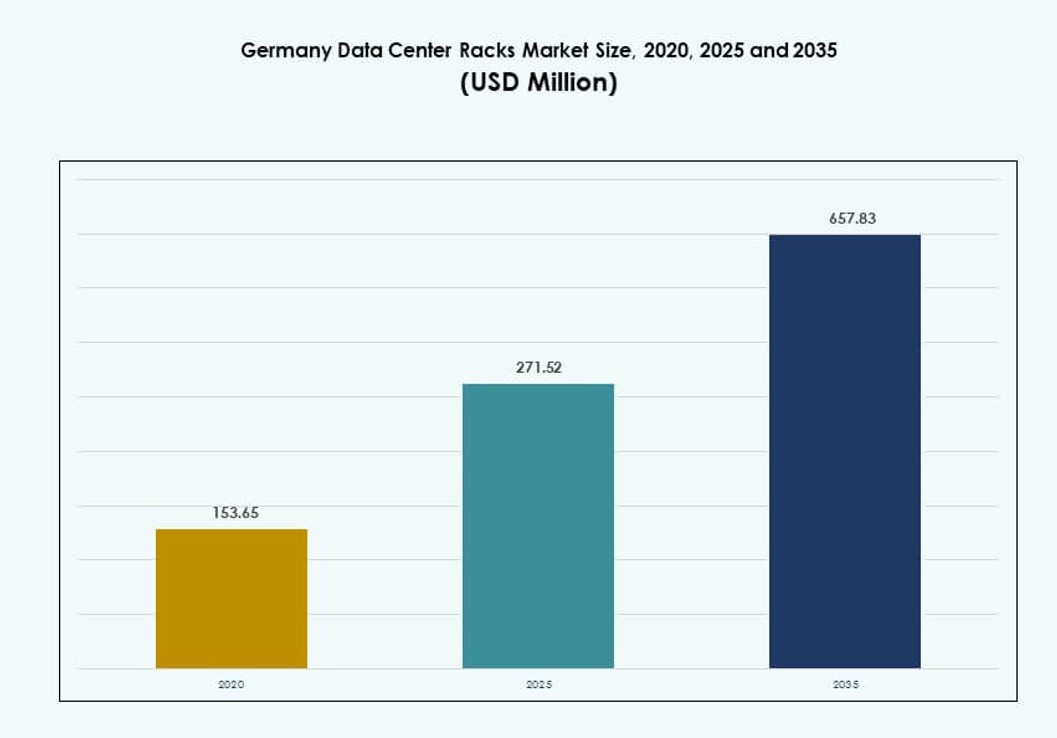
The Germany Data Center Racks market was worth USD 271.5 million in 2025 and is forecast to reach USD 657.8 million by 2035, growing at a 9.18% CAGR. Frankfurt accounts for over 38% of the market.
 By Satyabrat Rajawat, Senior Research Analyst, Strategic Advisory
 Reviewed by Deepti Agrawal
Last updated 3 Mar 2026
Base year 2024 PDF + Excel
Reviewed by Deepti Agrawal
Last updated 3 Mar 2026
Base year 2024 PDF + Excel
Source: DC Market Insights analysis
Key findings
Integration of Direct Liquid Cooling Rack Systems in AI-Centric Data Facilities
Rising Power Density and Cooling Requirements Strain Legacy Facility Rack Infrastructure
Surge In AI Data Centers And GPU Clusters Creates Opportunity For High-Density Rack Providers
Regional insights
- Frankfurt38%+
- Berlin and Munich26%
- Northern And Eastern Regions Emerging18%
Segmentation
Companies profiled
- Schneider Electric
- Rittal
- Vertiv Group
- Eaton
- Apra-Norm
- Schäfer IT-Systems
- Cisco Systems, Inc
- Hewlett Packard Enterprise (HPE)
- Dell Inc
- Chatsworth Products
Recent developments
Schneider Electric launched an upgraded version of its EcoStruxure™ rack systems in Germany. The new racks support higher power density and built-in rack-level monitoring. The launch targets hyperscale and colocation operators adopting AI and liquid-cooled workloads.
Rittal partnered with German colocation providers to deploy modular rack solutions optimized for fast expansion. The collaboration focuses on standardized 42U and above-42U cabinets with improved airflow control. These racks support rapid rollout in Frankfurt and Munich facilities.
Siemens, Cadolto, and Legrand from the list unveiled a modular edge data center featuring AI-ready compute zones and flexible finance packages at Data Center World Frankfurt, targeting Germany's demand for rapid edge deployments with prefabricated 42U racks that cut on-site fit-out time by 40%.
Hewlett Packard Enterprise (HPE) entered strategic agreements with major German research institutes to co-develop next-generation data center rack technologies, emphasizing enhanced performance, energy efficiency, and liquid-cooling adaptations for modern hyperscale needs.
Full analysis
Executive summary
The Germany Data Center Racks Market size was valued at USD 153.65 million in 2020 to USD 271.52 million in 2025 and is anticipated to reach USD 657.83 million by 2035, at a CAGR of 9.18% during the forecast period.
| REPORT ATTRIBUTE | DETAILS |
|---|---|
| Historical Period | 2020-2023 |
| Base Year | 2024 |
| Forecast Period | 2025-2035 |
| Germany Data Center Racks Market Size 2025 | USD 271.52 Million |
| Germany Data Center Racks Market, CAGR | 9.18% |
| Germany Data Center Racks Market Size 2035 | USD 657.83 Million |
Strong growth in high-density computing, AI workloads, and cloud-native deployments is reshaping demand for rack systems across German data centers. Businesses are shifting to modular, intelligent rack designs with integrated cooling and power monitoring capabilities. The rise in liquid-cooled systems and edge deployments is accelerating innovation in rack manufacturing. Operators require scalable solutions that support diverse applications, from colocation to government cloud. The market holds strategic value for investors targeting digital infrastructure and ESG-aligned technologies in Germany’s evolving IT landscape.
Frankfurt leads in deployment due to its dense concentration of hyperscale and colocation facilities with strong interconnectivity. Berlin and Munich follow as fast-growing zones backed by public digital projects and enterprise cloud adoption. Emerging cities like Hamburg and Leipzig are gaining traction with new data parks and edge computing needs. Regional expansion reflects the country’s decentralized data infrastructure push and industrial IoT integration.
Market Dynamics
Market Drivers
Surge in High-Density Computing Drives Demand for Advanced Rack Solutions
Germany Data Center Racks Market benefits from the fast expansion of high-density computing. Enterprises deploying AI and HPC workloads seek racks supporting over 30 kW per cabinet. Rack architecture now includes liquid-cooled designs and integrated power distribution units (PDUs). Equipment density pushes vendors to offer scalable and heat-tolerant enclosures. The need for quick deployment favors modular racks with pre-engineered configurations. Colocation providers prefer custom rack setups tailored to tenant workloads. Hyperscale operators in Frankfurt, Berlin, and Hamburg drive volume demand. The market enables data centers to maintain uptime and operational efficiency under demanding loads. It serves as a core component of next-gen facility planning.
Government-Led Digitization Programs Support Strategic Investment in Data Infrastructure
Public-sector digital transformation boosts rack demand across federal and local data facilities. Initiatives like Germany’s “Digital Strategy 2025” require expanded IT capacity. Ministries, universities, and public cloud zones rely on resilient rack systems for scaling compute infrastructure. Government IT consolidation fuels procurement of standardized cabinet configurations. The Germany Data Center Racks Market grows in tandem with public investments in secure cloud and AI labs. Racks with integrated cable management, remote monitoring, and fire protection see increased preference. It supports centralized management of public datasets and analytics. Investors align their funding strategies with these state-backed programs. The market remains a backbone of national digital resilience planning.
Cloud-Native Adoption Reshapes Rack Configurations in Enterprise Data Centers
Cloud-native infrastructure adoption by private businesses reshapes traditional rack requirements. Enterprises build hybrid architectures combining on-premise and cloud-hosted workloads. They opt for racks compatible with GPU servers, edge appliances, and software-defined storage arrays. The shift to high-availability and containerized environments influences rack topology. Custom airflow management and redundancy features grow in importance. The Germany Data Center Racks Market facilitates seamless migration for cloud-transitioning firms. It supports businesses in maintaining data sovereignty and latency control. Rack vendors tailor configurations to DevOps workflows and workload diversity. The segment sees traction among mid-sized firms enhancing their digital maturity.
- For instance, Deutsche Telekom’s T-Systems operates a high-security TwinCore data center in Magdeburg, paired with its Biere campus, supporting SAP HANA workloads under its Future Cloud Infrastructure. The facility uses Intel Xeon Scalable platforms and containerized deployments to manage enterprise cloud migrations, including RISE with SAP.
Rising Edge Deployment Across Industrial Zones Expands Rack Installations Beyond Metro Hubs
Edge computing is gaining traction across Germany’s logistics, automotive, and energy sectors. Industrial zones and smart manufacturing hubs deploy micro data centers with compact rack systems. These installations require racks supporting harsh environments, lower power loads, and modular growth. It expands rack penetration beyond metro cities into Tier-2 and Tier-3 regions. The Germany Data Center Racks Market plays a key role in enabling localized processing for Industry 4.0 use cases. Racks embedded in factory floors or near IoT sensor nodes need vibration-tolerant enclosures. This demand creates new revenue opportunities for vendors offering ruggedized and low-footprint rack designs. It aligns with decentralized infrastructure strategies in energy, transport, and utilities.
- For instance, Bosch operates edge rack systems in its Reutlingen factories as part of its Industry 4.0 strategy, supporting high-volume IoT workloads. These modular racks are designed for rugged environments and enable local processing for advanced manufacturing and sensor data analytics.
Market Trends
Integration of Direct Liquid Cooling Rack Systems in AI-Centric Data Facilities
Direct liquid cooling (DLC) integration is rising across AI-focused data center projects. Operators need to manage thermal loads from GPU clusters and dense blade servers. Racks now ship with built-in DLC support for CPUs and GPUs, replacing traditional airflow systems. DLC helps lower power usage effectiveness (PUE) and enhances equipment longevity. Vendors offer sealed racks with cold plates and rear-door heat exchangers. The Germany Data Center Racks Market sees strong uptake of such systems in AI labs and research campuses. It reflects the shift from generic to workload-optimized rack infrastructure. The market evolves with advanced thermal management built into rack form factors.
Demand for Customizable Modular Racks for Faster Deployment And Relocation
Modular rack systems gain traction among operators seeking faster deployment cycles. Prefabricated and tool-less designs reduce installation time and simplify site relocation. Businesses prioritize racks that adapt to space constraints, cable routing, and airflow control. Custom modules allow enterprises to scale without full room overhauls. Flexible dimensions and adjustable mounting rails improve server compatibility. The Germany Data Center Racks Market benefits from this modularity trend. It enables cost-efficient expansion in retrofitted buildings, basements, and rented server spaces. Modular racks also align with agile IT strategies adopted by startups and edge-focused enterprises.
Emergence of Rack-Level Monitoring Solutions for Energy Efficiency And Remote Visibility
Smart racks with integrated monitoring units are becoming standard across modern facilities. Operators monitor real-time parameters like temperature, humidity, and power draw. Embedded sensors and intelligent PDUs enable predictive maintenance and energy savings. Rack-level analytics help optimize workload distribution and reduce cooling overhead. Remote control interfaces support unmanned or low-staff data centers. The Germany Data Center Racks Market supports this trend through adoption of intelligent enclosures. It enhances operational transparency and aligns with ESG-compliant energy management. Rack telemetry is now integral to facility optimization in green data center projects.
Design Preferences Shift Toward Aisle Containment-Ready and Seismic-Resistant Rack Models
Rack design increasingly aligns with aisle containment and structural safety needs. Cold and hot aisle containment systems require standardized rack heights and airflow sealing features. Seismic-resistant racks see demand in regions implementing building safety codes. Pre-drilled bases and stabilizing frames allow for secure installations in multi-tenant facilities. The Germany Data Center Racks Market reflects this shift toward durable, containment-friendly product. Facilities under Tier III or Tier IV classifications require such specifications. Vendors differentiate on shock resistance, airflow direction, and structural strength under high load. This trend is shaping rack procurement criteria across the region.
Market Challenges
Rising Power Density and Cooling Requirements Strain Legacy Facility Rack Infrastructure
Legacy data centers in Germany face growing incompatibility with modern high-density racks. Older buildings struggle to support racks above 15–20 kW per cabinet. Insufficient floor load capacity and outdated airflow systems limit scalability. These issues require significant retrofit investments or rack replacement strategies. The Germany Data Center Racks Market contends with facility readiness gaps that slow adoption. Businesses delay upgrades due to high downtime risk and capital costs. Some operators remain hesitant to shift to liquid-cooled or containment-ready racks. The lack of standardized retrofitting protocols increases deployment complexity. These limitations create entry barriers for advanced rack systems.
Compliance Complexities in Rack Design And Sourcing Due To Regional Data Regulations
Germany enforces strict standards around equipment security, emissions, and fire safety. Rack vendors must comply with EN 50600, ISO 27001, and BSI cloud compliance mandates. Local sourcing preferences and TAA compliance further limit procurement flexibility. The Germany Data Center Racks Market must navigate these regulatory filters during design and deployment. Custom clearance delays and certification costs burden overseas manufacturers. Multi-national firms often need rack variants to meet facility-specific compliance. Even minor design changes require retesting and recertification. This increases time-to-market for new rack models and limits innovation cycles.
Market Opportunities
Surge In AI Data Centers And GPU Clusters Creates Opportunity For High-Density Rack Providers
Germany’s expanding AI ecosystem boosts demand for high-density racks supporting GPU clusters. Research centers and hyperscalers deploy 30–60 kW racks with integrated cooling. This shift allows vendors to offer specialized racks aligned with AI training workloads. The Germany Data Center Racks Market leverages this opportunity to expand into thermal-intensive deployments. Liquid-cooled racks, rear-door exchangers, and busway power rails see higher demand. Vendors offering rapid-ship, AI-ready racks can capture long-term contracts in this segment.
Edge Micro Data Centers Across Smart Manufacturing And Logistics Open New Rack Demand Zones
Edge infrastructure demand from automotive, pharma, and logistics zones opens growth pockets. These deployments need compact racks with rugged enclosures and localized cooling. The Germany Data Center Racks Market can serve decentralized compute zones through small-form factor cabinets. Vendors have opportunities to design edge-specific racks with remote visibility and faster rollout features. Demand aligns with industrial IoT growth and AI at the edge use cases.
Market Segmentation
By Rack Type
Cabinet racks dominate the Germany Data Center Racks Market due to their secure, enclosed design and enhanced airflow control. These are preferred in hyperscale and enterprise environments requiring equipment protection and cable management. Open frame racks cater to budget-conscious or test environments, but lack physical security. The “Others” segment includes wall-mount or specialty enclosures for limited spaces or edge use cases. Cabinet racks lead the market with the highest volume share across all data center tiers.
By Rack Height
42U racks remain the industry standard and hold the largest share in the Germany Data Center Racks Market. They provide optimal balance between space efficiency and cooling airflow, making them suitable for most deployments. Below 42U racks find use in edge facilities and branch offices. Above 42U racks cater to hyperscale deployments demanding higher server density per footprint. Rack height choice often depends on cooling infrastructure, room height, and weight load tolerance.
By Width
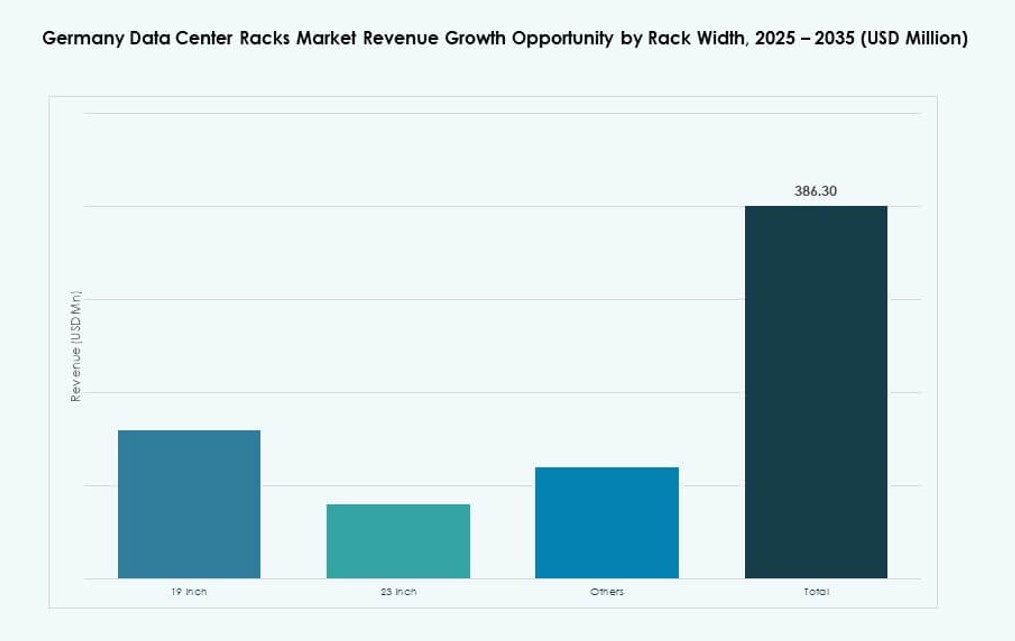
19-inch racks dominate the Germany Data Center Racks Market due to their widespread compatibility with most servers and network equipment. Standardization makes them easier to integrate into both new and existing facilities. 23-inch racks are used for telecom equipment or legacy systems but remain a niche segment. The “Others” category includes non-standard widths for customized or rugged use cases. The 19-inch segment holds the largest deployment base in enterprise and colocation setups.
By Application
Server racks account for the largest share of the Germany Data Center Racks Market, driven by core compute infrastructure demand. These racks host critical application servers, cloud nodes, and storage arrays. Network racks, while smaller in volume, support vital connectivity equipment such as routers, switches, and patch panels. Demand for network racks increases in distributed edge deployments and backup sites. Server racks maintain dominance across colocation, hyperscale, and private enterprise data centers.
By End-User
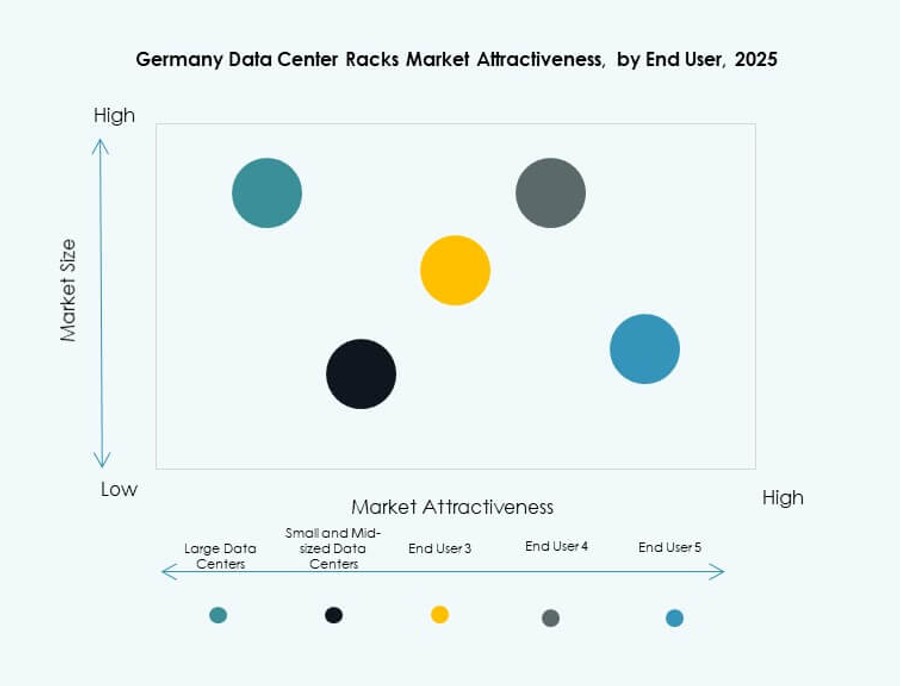
Large data centers are the leading consumers in the Germany Data Center Racks Market. They include colocation hubs, hyperscale campuses, and government IT parks. These facilities prioritize modular, scalable rack deployments for high-capacity workloads. Small and mid-sized data centers show increasing adoption with cloud-native transitions and SaaS expansion. SMBs invest in standard cabinets with integrated cooling and PDUs to streamline their infrastructure. Both segments reflect a maturing digital ecosystem.
By Vertical
IT & Telecom remains the top vertical in the Germany Data Center Racks Market, driven by cloud adoption and 5G deployments. BFSI follows with demand for secure and compliant storage infrastructure. Government & Defense invests in high-redundancy racks for mission-critical applications. Healthcare and Energy sectors deploy racks for edge diagnostics, EHR systems, and real-time monitoring. Retail and “Others” segments show growth with omnichannel transformation and IoT retail systems.
Regional Insights
Frankfurt Leads with Over 38% Share Due to Hyperscale Presence and Subsea Connectivity
Frankfurt dominates the Germany Data Center Racks Market with over 38% share. The region hosts a dense concentration of hyperscale, colocation, and cloud service providers. Its strategic location connects to major European and global networks via DE-CIX. Rack demand is driven by AI lab expansions and interconnection-heavy workloads. Frankfurt also benefits from proximity to finance, telecom, and enterprise clients. Its ecosystem supports rack vendors offering scalable, high-density enclosures.
- For instance, Equinix FR5 campus supports a total power capacity of 25.2 MW across its facility, enabling high-density rack deployments connected to over 220 networks via DE-CIX.
Berlin and Munich Capture 26% Share Combined Through Enterprise and Public Sector Demand
Berlin and Munich together hold around 26% share of the Germany Data Center Racks Market. Berlin’s public institutions and digital government initiatives fuel rack deployments. Munich sees demand from tech startups, automotive OEMs, and AI research firms. Both cities support mid-sized data centers with modular rack needs. Regional investments in smart city infrastructure also boost rack demand. Growth is steady, supported by urban digitization programs.
- For instance, Digital Realty’s Munich campus provides high-density colocation with racks rated up to 20 kW each, integrated for automotive data processing and AI simulations.
Northern And Eastern Regions Emerging With 18% Share From Edge Deployments And Industrial Zones
Northern and Eastern Germany regions account for nearly 18% market share. Cities like Hamburg, Leipzig, and Dresden see rack demand for industrial edge computing. Logistics parks and energy grids host micro data centers requiring rugged, compact racks. These regions reflect growth in decentralized, purpose-built facilities. The Germany Data Center Racks Market expands here through vendor partnerships and regional system integrators. Future rack demand will track industrial AI and smart manufacturing trends.
Competitive Insights
- Schneider Electric
- Rittal
- Vertiv Group
- Eaton
- Apra-Norm
- Schäfer IT-Systems
- Cisco Systems, Inc.
- Hewlett Packard Enterprise (HPE)
- Dell Inc.
- Chatsworth Products
The Germany Data Center Racks Market features a mix of global giants and domestic specialists, creating a competitive yet fragmented landscape. Global leaders like Schneider Electric, Vertiv, and Rittal dominate the high-density, liquid-cooled rack segment, supported by strong distribution networks and integration capabilities. Local manufacturers such as Apra-Norm and Schäfer IT-Systems focus on custom rack enclosures tailored to regional compliance and modularity needs. IT infrastructure vendors including HPE, Dell, and Cisco provide rack solutions bundled with server and network equipment. Competition centers on innovation, product modularity, and integration of intelligent power and cooling features. It continues to evolve with growing demand for smart racks, AI-ready architectures, and edge-specific designs that meet industry-specific workloads.
Recent Developments
- In September 2025, Schneider Electric launched an upgraded version of its EcoStruxure™ rack systems in Germany. The new racks support higher power density and built-in rack-level monitoring. The launch targets hyperscale and colocation operators adopting AI and liquid-cooled workloads.
- In June 2025, Rittal partnered with German colocation providers to deploy modular rack solutions optimized for fast expansion. The collaboration focuses on standardized 42U and above-42U cabinets with improved airflow control. These racks support rapid rollout in Frankfurt and Munich facilities.
- In June 2025, Siemens, Cadolto, and Legrand from the list unveiled a modular edge data center featuring AI-ready compute zones and flexible finance packages at Data Center World Frankfurt, targeting Germany’s demand for rapid edge deployments with prefabricated 42U racks that cut on-site fit-out time by 40%.
- In December 2024, Hewlett Packard Enterprise (HPE) entered strategic agreements with major German research institutes to co-develop next-generation data center rack technologies, emphasizing enhanced performance, energy efficiency, and liquid-cooling adaptations for modern hyperscale needs.
Table of contents
Table of Content
- Introduction
- Market Definition & Scope
- Research Methodology
- Primary Research
- Secondary Research
- Data Validation & Assumptions
- Market Segmentation Framework
- Executive Summary
- Market Snapshot
- Key Findings
- Analyst Recommendations
- Market Outlook (2025–2035)
- Market Dynamics
- Market Drivers
- Market Restraints
- Market Opportunities
- Challenges & Risks
- Value Chain Analysis
- Porter’s Five Forces Analysis
- PESTEL Analysis
- Market Attractiveness Analysis
- Racks Type
- Racks Deployment
- Component
- Medium
- Deployment Model
- Application
- Racks Layer / Capacity & Placement Analysis
- External Infrastructure & Facility-Level Integration
- Room-Level Rack Distribution & Containment Integrity
- Rack-Level & Server-Node Management (U-Space Allocation & Asset Loading)
- Multi-Layer Rack Stack Evaluation (Facility → Row → Rack → Node)
- Rack Risk & Resilience Modeling
- Technology Adoption & Trends
- High-Density & Liquid-Cooled Racks Adoption Trends
- Software-Defined Rack Management & Disaggregation
- Telemetry, Sensors & Analytics Integration
- Orchestration & Workload-Aware Rack Operations
- Kubernetes & Platform-Layer Integration
- Convergence of Compute, Network & Rack Infrastructure
- Benchmarking / KPIs
- Performance & Incident Metrics
- Hot-Spot Mitigation KPIs
- Cost & Efficiency KPIs
- Rack Effectiveness & Utilization Indices
- Data Protection & Security Metrics
- Cost Analysis & TCO
- Hardware vs Software vs Services Cost Breakdown
- CapEx vs OpEx Optimization Models
- Predictive Maintenance & Lifecycle Cost Savings
- Rack Lifecycle Cost Modeling
- Competitive Benchmarking
- Vendor share by region / vertical
- Vendor vs technology mapping
- Partnerships & M&A
- Service provider plays
- Future Outlook & Innovation
- Liquid-Cooled & 50–100 kW Racks as Mainstream
- Computational & Smart Racks
- Autonomous Rack Operations
- Sustainability & Density Innovations
- Next-Gen Materials & Mechanical Innovation
- Rack-Level Data Sovereignty & Compliance
- Heat / Energy Link Back to Facilities
- Germany Data Center Racks Market – Market Sizing & Forecast
- Historical Market Size (2020–2025)
- Forecast Market Size (2026–2035)
- Market Growth Rate Analysis
- Market Outlook by Region
- Germany Data Center Racks Market – By Rack Type
- Open Frame Rack
- Cabinet
- Others
- Germany Data Center Racks Market – By Rack Height
- Below 42 U
- 42 U
- Above 42 U
- Germany Data Center Racks Market – By Width
- 19 Inch
- 23 Inch
- Others
- Germany Data Center Racks Market – By Application
- Server Racks
- Network Racks
- Germany Data Center Racks Market – By End-user
- Large Data Centers
- Small and Mid-sized Data Centers
- Germany Data Center Racks Market – By Vertical
- BFSI
- Government & Defense
- Healthcare
- IT & Telecom
- Energy
- Retail
- Others
- Competitive Landscape
- Market Share Analysis
- Key Player Strategies
- Mergers, Acquisitions & Partnerships
- Product & Service Launches
- Company Profiles
- Apra-Norm
- Schäfer IT-Systems
- ELDON
- Schneider Electric
- Vertiv Group
- Rittal
- Eaton
- AMCO Enclosures
- Belden Inc.
- Chatsworth Products
- Cisco Systems, Inc.
- Dell Inc.
- Fujitsu
- Hewlett Packard Enterprise Development LP
- International Business Machines Corporation
- Legrand
- nVent
- Panduit Corp.
- Others
About this report
Written by Satyabrat Rajawat and reviewed by Deepti Agrawal, Senior Editor, Research. Figures are built top-down and bottom-up and reconciled before publication, with 2024 as the base year.
Read our methodologyHow we built this
- Historical period2020-2023
- Base year2024
- Forecast period2025-2035
- Sizing approachTop-down + bottom-up
Need more than the report?
Advisory on this market
Due diligence, site selection and market entry work, by the analysts who wrote this report.
See consulting servicesFrequently asked questions
The Germany Data Center Racks Market was valued at USD 271.52 million in 2025 and is projected to reach USD 657.83 million by 2035.
The Germany Data Center Racks Market is expected to grow at a CAGR of 9.18% during the 2025–2035 forecast period.
In 2025, cabinet racks held the largest share in the Germany Data Center Racks Market due to strong adoption in colocation and hyperscale facilities.
The Germany Data Center Racks Market is driven by AI adoption, modular deployments, public digitalization programs, and demand for high-density racks.
Key players in the Germany Data Center Racks Market include Schneider Electric, Rittal, Vertiv, Eaton, and Apra-Norm, among others.
Frankfurt commanded the largest share of the Germany Data Center Racks Market in 2025, contributing over 38% due to its hyperscale and interconnection ecosystem.
Licences, delivery and payment
Which licence should I choose?
Single User is a view-only PDF for one person. Multi User adds a printable PDF and the Excel data for unlimited users at one location. Enterprise covers your whole company and includes 100 free analyst hours.
How and when will I receive the report?
By email, within 24–48 business hours of payment, in the formats of your licence.
How can I pay?
Securely through PayPal: with a PayPal account, a debit or credit card, or PayPal Pay Later where available. Prices are in US dollars.
Can I see a sample first?
Yes. Request a free sample and we will email it to you.
Can the report be tailored to my needs?
Yes. We can add countries, segments or data cuts. Talk to an analyst about the scope you need.
Can I get an invoice or pay against a purchase order?
Write to sales@dcmarketinsights.com and our team will help.