
OCP Rack Market Size, Share & Forecast to 2032
Market at a glance
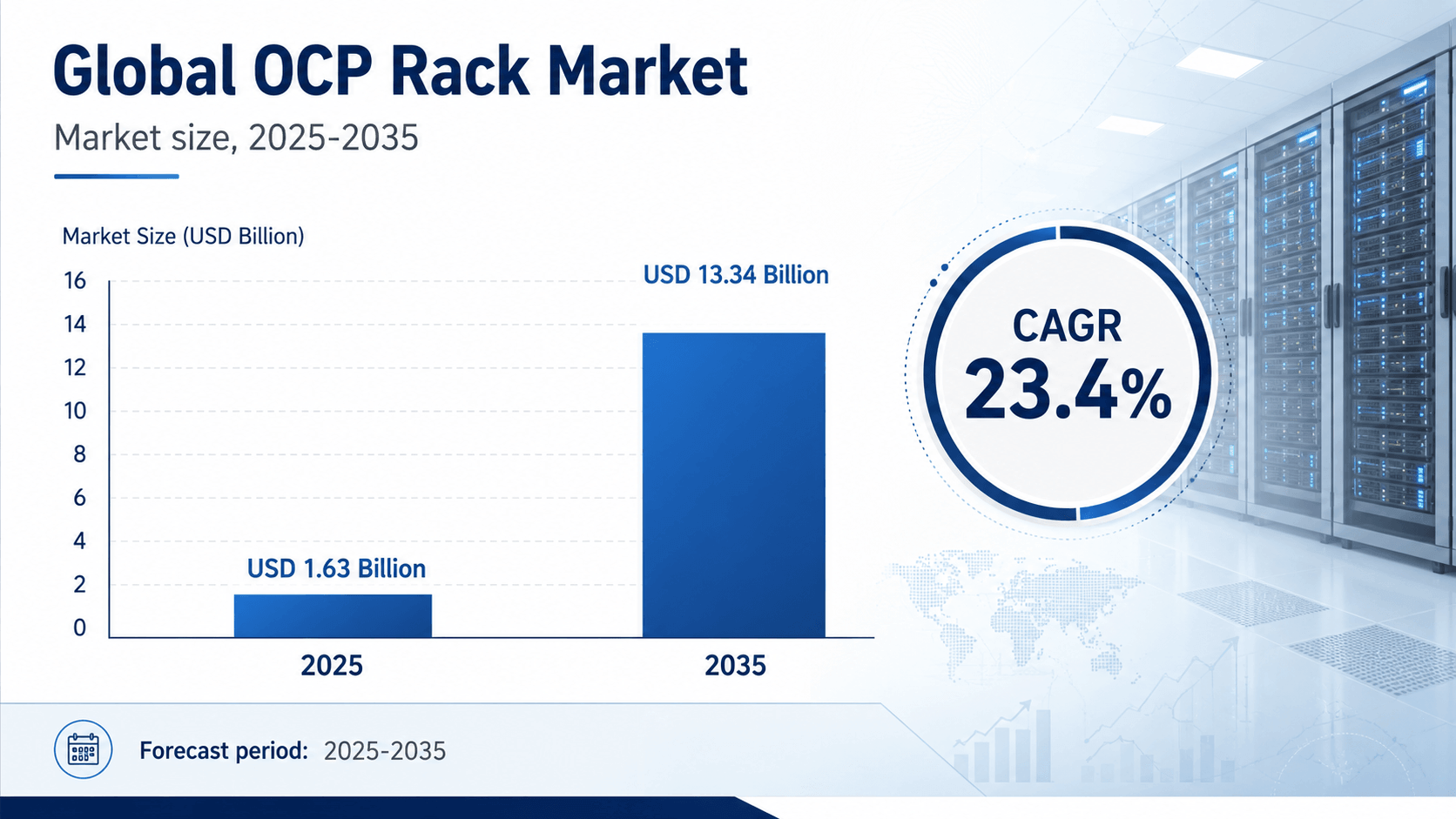
The OCP Rack market was worth USD 1,630.0 million in 2025 and is forecast to reach USD 13.34 billion by 2035, growing at a 23.4% CAGR.
 By Satyabrat Rajawat, Senior Research Analyst, Strategic Advisory
 Reviewed by Deepti Agrawal
Last updated 30 Aug 2026
Base year 2025 PDF + Excel
Reviewed by Deepti Agrawal
Last updated 30 Aug 2026
Base year 2025 PDF + Excel
Key findings
Rising Demand For AI Training And Inference Infrastructure
High Transition Cost From Traditional 19-Inch Rack Infrastructure
AI Factory And Rack-Scale Deployment Creates Strong Growth Potential
What is inside the report
- 01Report Introduction
- 02Executive Summary
- 03Market Overview
- 04Global OCP Rack Market Dynamics
- 05Global OCP Rack Market Size and Forecast
- 06Global OCP Rack Market, by Application
- 07Global OCP Rack Market, by End User
- 08Global OCP Rack Market, by Region
- 09Competitive Landscape
- 10Company Profiles
- 13chapters
- 2020-2024Historical period
- 2025-2032Forecast period
- 12Companies profiled
Segmentation
Companies profiled
- Rittal
- Dell Technologies
- Sanmina Corporation
- Legrand
- Vertiv
- Eaton
- Belden
- Wiwynn Corporation
- Lite-On Cloud Infrastructure
- Cheval Group
- Gigabyte
- Chatsworth Products
Full analysis
Executive summary
The Global OCP Rack Market size was valued at USD 1.63 billion in 2025 and is anticipated to reach USD 13.34 billion by 2035, at a CAGR of 23.4% during the forecast period.
| REPORT ATTRIBUTE | DETAILS |
|---|---|
| Historical Period | 2020-2024 |
| Base Year | 2025 |
| Forecast Period | 2025-2032 |
| OCP Rack Market Size 2025 | USD 1.63 billion |
| OCP Rack Market , CAGR | 23.4% |
| OCP Rack Market Size 2032 | USD 13.34 billion |
The market is driven by rapid adoption of open, high-density rack architectures across AI data centers, hyperscale cloud facilities, high-performance computing environments and neocloud infrastructure providers. OCP racks are designed around Open Compute Project principles that emphasize open standards, interoperability, simplified serviceability, higher equipment density and more efficient rack-level power distribution. The OCP Rack & Power Project focuses on standards designed for data centers and follows a “grid to gates” design philosophy that considers infrastructure from the power grid to the chips on each motherboard.
Demand is rising as AI training and inference workloads require rack-scale systems with higher power capacity, improved airflow, direct liquid cooling readiness and stronger support for accelerator-dense server trays. OCP racks have become more strategic as hyperscalers, GPU cloud operators, colocation providers and enterprise AI users seek open infrastructure models that can reduce vendor lock-in and improve deployment flexibility. Open Rack designs also differ from traditional EIA rack formats by using a 21-inch IT equipment space, which OCP has described as beneficial for airflow, energy efficiency and volumetric efficiency.
Market Drivers
Rising Demand For AI Training And Inference Infrastructure
AI training and inference workloads are the strongest growth driver for the Global OCP Rack Market. Large GPU clusters require rack-scale infrastructure that can handle higher power density, liquid cooling distribution, cable management and accelerator-heavy server designs. OCP rack architectures support this shift by creating a standardized mechanical and electrical foundation for high-density AI systems. Demand is especially strong among hyperscale cloud providers, neocloud providers and AI infrastructure operators that deploy large clusters quickly and need repeatable rack designs. For instance, NVIDIA contributed its GB200 NVL72 rack and compute and switch tray liquid-cooled designs to OCP, including a reinforced OCP ORv3 rack architecture and liquid-cooled MGX compute and switch trays.
Expansion Of Hyperscale, Neocloud And Colocation Infrastructure
Hyperscale, neocloud and retail colocation providers are expanding OCP rack adoption to support cloud computing, AI model development, high-performance computing and enterprise workloads. These buyers need standardized rack systems that can improve speed of deployment, simplify maintenance and support multiple generations of server and accelerator technologies. OCP racks are well suited for large-scale deployments because they support open designs, rack-level power distribution and flexible integration with server sleds, busbars, power shelves and cooling systems. Dell’s IR7000 rack is a 21-inch Open Rack Version 3-based infrastructure platform with dense compute and liquid cooling for high-TDP GPUs and CPUs, showing how OCP racks are moving into production AI infrastructure.
Need For Higher Rack Power Density And Efficient Power Distribution
The shift toward high-power AI and HPC workloads is increasing demand for OCP racks with stronger power distribution capabilities. Traditional rack systems often face limitations when supporting dense GPU nodes, liquid-cooled trays and next-generation AI accelerators. OCP rack designs address this need through rack-level power architectures, standardized busbar systems and more efficient component layouts. This driver is especially important for data centers seeking to scale AI infrastructure while managing energy losses, cable complexity and service access. Legrand states that its OCP ORv3 rack and power systems support high-density deployments, including AI, HPC and supercomputing, with power loads exceeding 100 kW per rack.
Growing Preference For Open, Interoperable Data Center Hardware Standards
Open hardware standards are gaining importance as data center operators seek interoperability across servers, power systems, racks, cooling components and infrastructure vendors. The Global OCP Rack Market benefits because OCP-based designs provide a more standardized foundation for hyperscale and AI deployments. Buyers value this model because it can improve supplier flexibility, reduce engineering duplication and support faster ecosystem development. The Open Compute Project states that its server workstream emphasizes standardization to prevent specification fragmentation and support compatible OCP designs across the ecosystem.
Market Restraints
High Transition Cost From Traditional 19-Inch Rack Infrastructure
High transition cost remains a key restraint for the Global OCP Rack Market. Many enterprise and colocation facilities still operate traditional 19-inch rack infrastructure with established power, cooling, cabling and service practices. Moving to OCP rack systems may require changes in rack layout, busbar integration, server procurement, power distribution, liquid cooling design and operational workflows. These changes can raise upfront capital requirements and slow adoption among conservative enterprise buyers. The challenge is stronger in retrofit environments where floor plans, power feeds and containment systems were not designed for OCP rack dimensions or high-density AI workloads.
Integration Complexity Across Multi-Vendor AI Infrastructure Stacks
Integration complexity can limit adoption because OCP racks are often deployed as part of broader AI infrastructure stacks that include GPU servers, power shelves, busbars, CDUs, liquid cooling manifolds, network switches and orchestration software. Operators must validate mechanical fit, thermal performance, power compatibility and service procedures across multiple vendors. This creates qualification requirements and can extend procurement timelines. The challenge is especially relevant for colocation providers that must support different customer architectures within the same facility. Vendors that provide prevalidated rack-scale systems, reference designs and strong ecosystem partnerships can reduce this restraint.
Limited Adoption Among Smaller Enterprises And Conventional Workloads
Smaller enterprises may adopt OCP racks more slowly because their workloads often do not require the same density, power architecture or open-rack ecosystem used by hyperscalers. Traditional enterprise applications can run efficiently in standard 19-inch racks, making it harder to justify migration. OCP rack adoption is therefore concentrated in cloud, AI, HPC and large-scale infrastructure environments. This restraint may soften over time as enterprise AI adoption grows and vendors introduce more accessible rack-level systems, adapters and hybrid configurations that support both OCP and conventional infrastructure.
Market Opportunities
AI Factory And Rack-Scale Deployment Creates Strong Growth Potential
AI factories create a major opportunity for the Global OCP Rack Market because they require standardized, repeatable and high-density rack infrastructure. OCP racks can support rack-scale AI systems that combine accelerators, high-speed networking, liquid cooling and advanced power distribution. This opportunity is strongest among neocloud providers, hyperscalers and colocation operators building AI campuses. OCP’s AI marketplace includes Open Rack V3 systems designed for NVIDIA MGX and GB200 NVL72 architectures, showing how OCP rack platforms are being positioned for next-generation AI clusters.
Rising Demand From Retail Colocation Providers
Retail colocation providers represent a strong opportunity because enterprise customers increasingly need high-density AI-ready cabinets without building their own data centers. OCP rack systems can help colocation operators offer standardized, high-performance rack environments with strong power, cooling and serviceability. This is especially valuable where customers require dedicated AI training and inference clusters, HPC environments or private cloud deployments. Colocation providers that support OCP racks can differentiate through faster deployment, stronger compatibility with hyperscale-style hardware and improved readiness for high-density customer workloads.
Growing Use Of Liquid Cooling And Advanced Thermal Management
Liquid cooling adoption creates long-term opportunity for OCP rack vendors because AI and HPC deployments increasingly require direct liquid cooling, rack manifolds and high-capacity thermal systems. OCP racks designed for liquid cooling can support denser hardware layouts while improving thermal control and power efficiency. This opportunity aligns with the broader shift toward GPU-dense data centers and rack-level thermal integration. Rittal’s Open Rack V3 product listing says the rack is suited for high-performance computing and AI technology through preparation for direct liquid cooling solutions to dissipate heat load in the rack.
Expansion In Asia Pacific And Global Manufacturing Ecosystems
Asia Pacific creates significant opportunity for the Global OCP Rack Market because Taiwan, Thailand and other regional manufacturing hubs play an important role in server, rack and cloud infrastructure production. Wiwynn, Lite-On Cloud Infrastructure, Cheval Group and Gigabyte support the regional ecosystem through cloud IT infrastructure, rack systems, servers and AI hardware platforms. Demand is also rising across data center markets in India, Southeast Asia, Japan and South Korea as cloud, AI and colocation investment increases. Vendors with manufacturing scale, engineering capability and OCP ecosystem participation can capture higher growth as AI infrastructure supply chains expand.
Technology Trends
Shift Toward ORv3 And High-Density AI Rack Architectures
The market is shifting toward Open Rack Version 3 and other high-density rack architectures designed for AI workloads. ORv3 systems support newer rack-level power, mechanical and cooling approaches that are better aligned with accelerator-heavy infrastructure. This trend reflects the need for stronger rack frames, busbar capacity, liquid cooling support and high serviceability. Sanmina’s Open Rack V3 is listed by OCP as a rack designed to meet rigorous Open Compute Project standards for next-generation data center infrastructure.
Integration Of Rack-Level Power, Cooling And Monitoring
OCP racks are increasingly being designed as integrated infrastructure systems rather than simple mechanical cabinets. Vendors are combining rack frames with busbars, power shelves, liquid cooling manifolds, leak detection, cabling pathways and monitoring systems. This trend is important because AI data centers need coordinated power and thermal design at the rack level. Vertiv’s Open Rack for OCP emphasizes streamlined, cost-efficient open design by removing unnecessary components and standardizing parts such as power shelves.
Development Of Larger And Specialized Rack Formats For AI Systems
The market is moving toward larger and specialized rack formats that support rack-scale AI systems. New designs aim to address high-voltage power delivery, advanced liquid cooling, signal integrity and heavy compute trays. Wiwynn introduced a double-wide rack architecture for next-generation AI at OCP Global Summit 2025, describing it as a design that combines high-voltage DC power delivery, advanced liquid cooling and layouts optimized for high-power AI computing.
Market Segmentation
By Workload Application
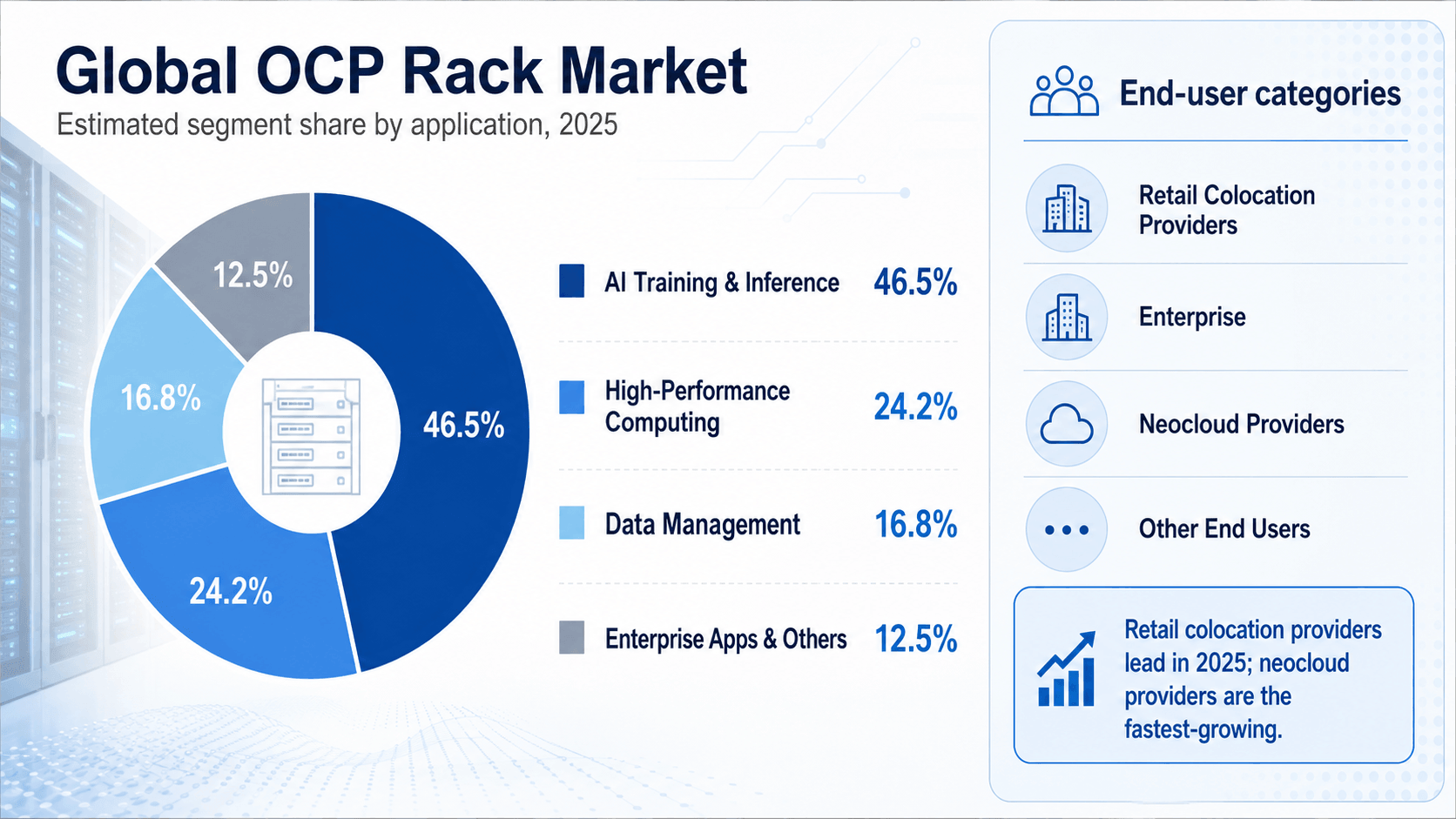
The Global OCP Rack Market by workload application includes AI training and inference workloads, high-performance computing, data management and storage and enterprise applications and other workloads. AI training and inference workloads led the segment with an estimated 46.5% share in 2025 because GPU-dense infrastructure requires high-power racks, stronger airflow, liquid cooling readiness and rack-scale integration. High-performance computing remains an important segment due to scientific simulation, research computing and engineering workloads. Data management and storage applications use OCP racks where operators need large-scale, serviceable infrastructure. Enterprise applications and other workloads hold smaller but growing demand as enterprises adopt cloud-native and AI-ready infrastructure.
By Customer Type
The Global OCP Rack Market by customer type includes retail colocation providers, enterprise users, neocloud providers and other end users. Retail colocation providers held the largest share with an estimated 38.2% in 2025 because they support enterprise customers seeking high-density AI-ready space without building dedicated facilities. Neocloud providers represent the fastest-growing segment because GPU cloud companies require open, scalable and power-dense rack systems for AI training and inference services. Enterprise users are adopting OCP racks selectively for private AI, HPC and large-scale data management workloads. Other end users include research institutions, telecom operators and public-sector infrastructure users.
Regional Insights
North America Maintains Leadership Through AI Infrastructure, Cloud Scale And OCP Ecosystem Depth
North America leads the Global OCP Rack Market because the region hosts major hyperscale cloud providers, AI infrastructure developers, colocation operators and OCP ecosystem participants. The United States remains the largest demand center due to large AI data center investments, strong cloud adoption and early deployment of OCP-based rack-scale systems. Demand is supported by major technology firms, neocloud providers and colocation operators building AI-ready campuses. OCP stated in 2025 that it had opened an AI portal on the OCP Marketplace as part of its effort to accelerate open systems for AI, reinforcing the region’s role in open infrastructure development.
Europe Advances Through Open Infrastructure Adoption And Energy-Efficient Data Center Design
Europe represents a major regional market due to strong demand from colocation providers, cloud platforms, HPC centers and energy-conscious data center operators. Germany, France, the UK, the Netherlands, Ireland and the Nordic countries are key data center markets where operators need efficient rack, power and cooling systems. European demand is supported by sustainability requirements, grid constraints and high interest in efficient hardware infrastructure. Rittal, Legrand and Eaton strengthen the regional supply base through OCP-compliant racks, power systems and data center infrastructure platforms.
Asia Pacific Emerges As A High-Growth Region With Strong Manufacturing And AI Infrastructure Demand
Asia Pacific is expected to show the fastest growth in the Global OCP Rack Market due to its strong electronics manufacturing ecosystem, cloud infrastructure expansion and rising AI data center investment. Taiwan plays a major role through Wiwynn, Lite-On Cloud Infrastructure and Gigabyte, while Thailand contributes through Cheval Group. China, Japan, South Korea, India and Southeast Asia are expanding data center capacity to support AI, cloud, telecom and digital services. OCP’s AI marketplace lists Cheval Group’s Open Rack V3 NVIDIA MGX Rack for GB200 NVL72, highlighting Asia Pacific’s role in supplying rack infrastructure for next-generation AI platforms.
Middle East And Other Emerging Regions Gain Ground Through AI Data Center Investment
The Middle East, Latin America and parts of Africa remain smaller but growing markets for OCP racks. Growth is supported by sovereign AI programs, cloud regions, smart city infrastructure, colocation expansion and enterprise digitalization. The Middle East is becoming more attractive for high-density AI infrastructure because of government-backed digital strategies and new data center campuses. OCP rack adoption in emerging markets will depend on availability of high-density power, skilled integration partners, liquid cooling readiness and access to compatible server ecosystems. Vendors that can provide standardized, prevalidated and serviceable rack systems will be better positioned as these regions scale AI infrastructure.
Competitive Insights
- Rittal
- Dell Technologies
- Sanmina Corporation
- Legrand
- Vertiv
- Eaton
- Belden
- Wiwynn Corporation
- Lite-On Cloud Infrastructure
- Cheval Group
- Gigabyte
- Chatsworth Products
The Global OCP Rack Market features competition among rack enclosure suppliers, power infrastructure providers, server OEMs, ODMs, cloud infrastructure manufacturers and data center equipment vendors. Rittal, Legrand, Vertiv, Eaton, Belden and Chatsworth Products compete through rack frames, power distribution, cabling, containment and infrastructure integration. Dell Technologies competes through integrated rack-scale systems for AI and HPC deployments. Sanmina supports the market through OCP Open Rack V3 platforms and manufacturing capability. Wiwynn, Lite-On Cloud Infrastructure, Cheval Group and Gigabyte strengthen the Asia Pacific supplier ecosystem through cloud servers, AI infrastructure, rack systems and ODM manufacturing scale. Competition is shaped by OCP compliance, high-density power capability, liquid cooling readiness, compatibility with GPU platforms, serviceability, manufacturing scale and ability to support rapid AI infrastructure deployment.
Recent Developments
- In 2024, NVIDIA contributed GB200 NVL72 rack, compute and switch tray liquid-cooled designs to the Open Compute Project. The contribution included a reinforced OCP ORv3 rack architecture and liquid-cooled MGX compute and switch trays for AI infrastructure.
- In 2025, Dell highlighted its IR7000 integrated rack-scale system as an OCP standards-based 21-inch rack platform designed for high-density AI and HPC workloads with direct liquid cooling or hybrid direct liquid cooling support.
- In 2025, Wiwynn debuted a double-wide rack architecture for next-generation AI at OCP Global Summit 2025, combining high-voltage DC power delivery, advanced liquid cooling and layouts optimized for high-power AI computing.
- In 2025, Legrand said its OCP ORv3-compliant rack and power solutions included a 33 kW power shelf, vertical DC busbar options of 400 A, 700 A and 1,400 A and rack capacity up to 5,000 pounds.
- In 2025, Rittal unveiled an MGX Architecture Rack at the OCP Global Summit, describing it as a purpose-built cabinet for AI applications designed to support NVIDIA GB200 NVL72, GB300 NVL72 and Vera Rubin NVL144 systems.
Table of contents
- 01Report Introduction
- 1.1Report Description and Purpose
- 1.1.1Report Title and Market Definition
- 1.1.2Scope of OCP Rack Infrastructure
- 1.1.3Value Proposition for Stakeholders
- 1.2Research Objectives
- 1.2.1Market Sizing Objectives
- 1.2.2Segmentation Objectives
- 1.2.3Competitive Intelligence Objectives
- 1.2.4Forecast and Scenario Objectives
- 1.3Report Scope
- 1.3.1OCP Rack Scope by Application
- 1.3.2OCP Rack Scope by End User
- 1.3.3Geographic Scope
- 1.3.4Historical Period, Base Year and Forecast Period
- 1.4Currency, Units and Pricing Basis
- 1.5Target Stakeholders
- 1.6Limitations and Assumptions
- 02Executive Summary
- 2.1Global OCP Rack Market Snapshot
- 2.2Market Size and Forecast, 2025-2035
- 2.3Key Market Trends and Investment Highlights
- 2.4Segmental Highlights
- 2.5Regional Highlights
- 2.6Competitive Landscape Snapshot
- 03Market Overview
- 3.1Market Definition
- 3.2Evolution of OCP Rack Infrastructure
- 3.3Role of OCP Racks in AI and HPC Data Centers
- 3.4OCP Rack Architecture and Standards Overview
- 3.5Market Ecosystem Analysis
- 3.6Supply Chain Overview
- 3.7Regulatory and Standards Landscape
- 04Global OCP Rack Market Dynamics
- 4.1Market Drivers
- 4.1.1Rising Demand for AI Training and Inference Infrastructure
- 4.1.2Expansion of Hyperscale, Neocloud and Colocation Infrastructure
- 4.1.3Need for Higher Rack Power Density and Efficient Power Distribution
- 4.1.4Growing Preference for Open and Interoperable Data Center Hardware Standards
- 4.2Market Restraints
- 4.2.1High Transition Cost From Traditional 19-Inch Rack Infrastructure
- 4.2.2Integration Complexity Across Multi-Vendor AI Infrastructure Stacks
- 4.2.3Limited Adoption Among Smaller Enterprises and Conventional Workloads
- 4.3Market Opportunities
- 4.3.1AI Factory and Rack-Scale Deployment Opportunities
- 4.3.2Rising Demand From Retail Colocation Providers
- 4.3.3Growth of Liquid Cooling and Advanced Thermal Management
- 4.3.4Expansion in Asia Pacific and Global Manufacturing Ecosystems
- 4.4Technology Trends
- 4.4.1Shift Toward ORv3 and High-Density AI Rack Architectures
- 4.4.2Integration of Rack-Level Power, Cooling and Monitoring
- 4.4.3Development of Larger and Specialized Rack Formats for AI Systems
- 4.4.4Compatibility Between OCP and Traditional 19-Inch Infrastructure
- 05Global OCP Rack Market Size and Forecast
- 5.1Market Size, 2025
- 5.2Market Forecast, 2035
- 5.3CAGR Analysis, 2025-2035
- 5.4Market Attractiveness Analysis
- 5.5Revenue Opportunity Analysis
- 06Global OCP Rack Market, by Application
- 6.1Overview
- 6.2AI Training and Inference
- 6.3High-Performance Computing
- 6.4Data Management and Storage
- 6.5Enterprise Applications and Other Workloads
- 07Global OCP Rack Market, by End User
- 7.1Overview
- 7.2Retail Colocation Providers
- 7.3Enterprise Users
- 7.4Neocloud Providers
- 7.5Other End Users
- 08Global OCP Rack Market, by Region
- 8.1Overview
- 8.2North America
- 8.2.1United States
- 8.2.2Canada
- 8.2.3Mexico
- 8.3Europe
- 8.3.1Germany
- 8.3.2United Kingdom
- 8.3.3France
- 8.3.4Italy
- 8.3.5Spain
- 8.3.6Rest of Europe
- 8.4Asia Pacific
- 8.4.1China
- 8.4.2Japan
- 8.4.3India
- 8.4.4South Korea
- 8.4.5Taiwan
- 8.4.6Southeast Asia
- 8.4.7Rest of Asia Pacific
- 8.5Latin America
- 8.5.1Brazil
- 8.5.2Mexico
- 8.5.3Rest of Latin America
- 8.6Middle East
- 8.6.1GCC Countries
- 8.6.2Israel
- 8.6.3Turkey
- 8.6.4Rest of Middle East
- 8.7Africa
- 8.7.1South Africa
- 8.7.2Rest of Africa
- 09Competitive Landscape
- 9.1Market Competition Overview
- 9.2Competitive Positioning Matrix
- 9.3Company Market Share Analysis
- 9.4Product Portfolio Comparison
- 9.5Strategic Initiatives
- 9.6Recent Developments
- 9.7Vendor Benchmarking
- 10Company Profiles
- 10.1Rittal
- 10.2Dell Technologies
- 10.3Sanmina Corporation
- 10.4Legrand
- 10.5Vertiv
- 10.6Eaton
- 10.7Belden
- 10.8Wiwynn Corporation
- 10.9Lite-On Cloud Infrastructure
- 10.10Cheval Group
- 10.11Gigabyte
- 10.12Chatsworth Products
- 11Strategic Recommendations
- 11.1Recommendations for Rack Manufacturers
- 11.2Recommendations for Colocation Providers
- 11.3Recommendations for Neocloud Providers
- 11.4Recommendations for Enterprise Buyers
- 11.5Investment and Growth Strategy
- 12Research Methodology
- 12.1Research Approach
- 12.2Primary Research
- 12.3Secondary Research
- 12.4Market Size Estimation
- 12.5Forecasting Methodology
- 12.6Data Triangulation
- 12.7Assumptions and Limitations
- 13Appendix
- 13.1Abbreviations
- 13.2Glossary
- 13.3Related Reports
- 13.4Disclaimer
About this report
Written by Satyabrat Rajawat and reviewed by Deepti Agrawal, Senior Editor, Research. Figures are built top-down and bottom-up and reconciled before publication, with 2025 as the base year.
Read our methodologyHow we built this
- Historical period2020-2024
- Base year2025
- Forecast period2025-2032
- Sizing approachTop-down + bottom-up
Need more than the report?
Advisory on this market
Due diligence, site selection and market entry work, by the analysts who wrote this report.
See consulting servicesFrequently asked questions
The Global OCP Rack Market size was valued at USD 1.63 billion in 2025 and is projected to reach USD 13.34 billion by 2035.
The Global OCP Rack Market is projected to grow at a CAGR of 23.4% between 2025 and 2035.
By workload application, AI training and inference workloads held the largest share in 2025 with an estimated 46.5% share. By customer type, retail colocation providers led with an estimated 38.2% share due to rising customer demand for high-density AI-ready rack environments.
The market is primarily driven by rising AI training and inference workloads, expansion of hyperscale and neocloud infrastructure, increasing rack power density requirements and growing demand for open and interoperable data center hardware standards.
The leading companies in the Global OCP Rack Market include Rittal, Dell Technologies, Sanmina Corporation, Legrand, Vertiv, Eaton, Belden, Wiwynn Corporation, Lite-On Cloud Infrastructure, Cheval Group, Gigabyte and Chatsworth Products.
Neocloud providers are expected to grow fastest because GPU-focused cloud platforms require open, scalable and high-density rack infrastructure for AI training, inference, model fine-tuning and GPU-as-a-Service workloads.
Licences, delivery and payment
Which licence should I choose?
Single User is a view-only PDF for one person. Multi User adds a printable PDF and the Excel data for unlimited users at one location. Enterprise covers your whole company and includes 100 free analyst hours.
How and when will I receive the report?
By email, within 24–48 business hours of payment, in the formats of your licence.
How can I pay?
Securely through PayPal: with a PayPal account, a debit or credit card, or PayPal Pay Later where available. Prices are in US dollars.
Can I see a sample first?
Yes. Request a free sample and we will email it to you.
Can the report be tailored to my needs?
Yes. We can add countries, segments or data cuts. Talk to an analyst about the scope you need.
Can I get an invoice or pay against a purchase order?
Write to sales@dcmarketinsights.com and our team will help.