
Secure Access Service Edge (SASE) Market Size, Share & Forecast to 2032
Market at a glance
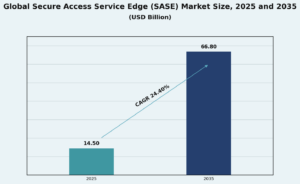
The Secure Access Service Edge (SASE) market was worth USD 14.50 billion in 2025 and is forecast to reach USD 66.80 billion by 2035, growing at a 24.4% CAGR.
 By Amit Jain, Senior Consultant, ICT & Emerging Technologies
 Reviewed by Deepti Agrawal
Last updated 7 Sep 2026
Base year 2025 PDF + Excel
Reviewed by Deepti Agrawal
Last updated 7 Sep 2026
Base year 2025 PDF + Excel
Key findings
Complex Migration From Legacy Network And Security Architectures
Growth Of Single-Vendor And Unified SASE Platforms
What is inside the report
- 01Report Introduction1.1 Report Description and Purpose1.1.1 Report Title and Market Definition1.1.2 Scope of Secure Access Service Edge Solutions1.1.3 Value Proposition for Stakeholders1.2 Research Objectives1.2.1 Market Sizing Objectives1.2.2 Segmentation Objectives1.2.3 Competitive Intelligence Objectives1.2.4 Forecast and Scenario Objectives1.3 Report Scope1.3.1 SASE Market Scope by Offering1.3.2 SASE Market Scope by Type1.3.3 SASE Market Scope by Organization Size1.3.4 SASE Market Scope by End User1.3.5 Geographic Scope1.4 Currency, Units and Pricing Basis1.5 Target Stakeholders1.6 Limitations and Assumptions
- 02Executive Summary2.1 Global Secure Access Service Edge (SASE) Market Snapshot2.2 Market Size and Forecast, 2025-20352.3 Key Market Trends and Investment Highlights2.4 Segmental Highlights2.5 Regional Highlights2.6 Competitive Landscape Snapshot
- 03Market Overview3.1 Market Definition3.2 Evolution of SASE Architecture3.3 Role of SASE in Cloud Security and Zero Trust Access3.4 Role of SD-WAN and SSE in SASE Convergence3.5 Market Ecosystem Analysis3.6 Supply Chain and Partner Ecosystem Overview3.7 Standards, Compliance and Security Framework Overview
- 04Global Secure Access Service Edge (SASE) Market Dynamics4.1 Market Drivers4.1.1 Rising Adoption of Cloud Applications, Hybrid Work and Zero Trust Security4.1.2 Expansion of SD-WAN and Network Security Convergence4.1.3 Growing Threat Exposure From SaaS, Cloud, AI and Distributed Users4.1.4 Rising Demand From Service Providers for Managed SASE Offerings4.2 Market Restraints4.2.1 Complex Migration From Legacy Network and Security Architectures4.2.2 Data Privacy, Sovereignty and Compliance Requirements4.2.3 Vendor Lock-In and Integration Risk4.3 Market Opportunities4.3.1 Growth of Single-Vendor and Unified SASE Platforms4.3.2 Expansion of SSE Across Web, Cloud and Private Application Security4.3.3 AI Security and Secure Access for Generative AI Applications4.3.4 Managed SASE Services for Telecom and Service Provider Channels4.4 Technology Trends4.4.1 Shift Toward AI-Powered SASE Platforms4.4.2 Convergence of SWG, CASB, ZTNA and FWaaS in SSE Platforms4.4.3 Integration of SD-WAN, SSE and Secure Branch Networking4.4.4 Expansion of Global Cloud Points of Presence and Private Backbones
- 05Global Secure Access Service Edge (SASE) Market Size and Forecast5.1 Market Size, 20255.2 Market Forecast, 20355.3 CAGR Analysis, 2025-20355.4 Revenue Opportunity Analysis5.5 Market Attractiveness Analysis
- 06Global Secure Access Service Edge (SASE) Market, by Offering6.1 Overview6.2 SD-WAN6.3 SSE
- 07Global Secure Access Service Edge (SASE) Market, by Type7.1 Overview7.2 Secure Web Gateway7.3 Cloud Access Security Broker7.4 Zero Trust Network Access7.5 Firewall as a Service
- 08Global Secure Access Service Edge (SASE) Market, by Organization Size8.1 Overview8.2 Large Enterprises8.3 Small and Medium-Sized Enterprises
- 09Global Secure Access Service Edge (SASE) Market, by End User9.1 Overview9.2 Enterprises9.3 Service Providers
- 10Global Secure Access Service Edge (SASE) Market, by Region10.1 Overview10.2 North America10.2.1 United States10.2.2 Canada10.2.3 Mexico10.3 Europe10.3.1 United Kingdom10.3.2 Germany10.3.3 France10.3.4 Italy10.3.5 Spain10.3.6 Rest of Europe10.4 Asia Pacific10.4.1 China10.4.2 Japan10.4.3 India10.4.4 South Korea10.4.5 Australia10.4.6 Southeast Asia10.4.7 Rest of Asia Pacific10.5 Latin America10.5.1 Brazil10.5.2 Mexico10.5.3 Rest of Latin America10.6 Middle East10.6.1 GCC Countries10.6.2 Israel10.6.3 Turkey10.6.4 Rest of Middle East10.7 Africa10.7.1 South Africa10.7.2 Rest of Africa
- 15chapters
- 2020-2024Historical period
- 2025-2032Forecast period
- 18Companies profiled
Segmentation
Companies profiled
- Cisco Systems (US)
- Kyndryl Solutions (US)
- Akamai (US)
- HPE (US)
- Verizon (US)
- Oracle (US)
- Zscaler (US)
- Netskope (US)
- Extreme Networks (US)
- Palo Alto Networks (US)
- AT&T (US)
- Cloudflare (US)
- Huawei (China)
- Riverbed Technology (US)
- Lumen Technologies (US)
- Forcepoint (US)
- Fortinet (US)
- Broadcom (US)
Recent developments
HPE announced expansions across HPE Aruba Networking and GreenLake cloud, including new SASE capabilities for tighter integration between HPE Aruba Networking EdgeConnect SD-WAN and HPE Aruba Networking SSE.
Netskope announced that MetTel selected Netskope to deliver AI-driven managed SASE network security services for enterprise and government customers using the Netskope One platform.
Fortinet said it was recognized as a Leader in the 2025 Gartner Magic Quadrant for SASE Platforms and ranked No. 1 in the Secure Branch Network Modernization use case in the related Gartner Critical Capabilities report.
Netskope said it was named a Leader in the Gartner Magic Quadrant for SASE Platforms for the second consecutive year, supported by the Netskope One platform and its NewEdge network.
Full analysis
Executive summary
The Global Secure Access Service Edge (SASE) Market size was valued at USD 14.5 billion in 2025 and is anticipated to reach USD 66.8 billion by 2035, at a CAGR of 24.40% during the forecast period.
| REPORT ATTRIBUTE | DETAILS |
|---|---|
| Historical Period | 2020-2024 |
| Base Year | 2025 |
| Forecast Period | 2025-2032 |
| Secure Access Service Edge (SASE) Market Size 2025 | USD 14.5 Billion |
| Secure Access Service Edge (SASE) Market, CAGR | 24.40% |
| Secure Access Service Edge (SASE) Market Size 2035 | USD 66.8 Billion |
The market is driven by rising adoption of cloud security, zero trust access, hybrid work, SD-WAN modernization and network security convergence across enterprises and service providers. Secure access service edge combines wide-area networking and cloud-delivered security into a unified architecture that helps organizations connect users, branches, devices and applications through consistent policy enforcement. Cisco defines SASE as a cloud-delivered architecture that combines SD-WAN with security services such as secure web gateway, cloud access security broker, firewall as a service and zero trust network access.
Demand is rising as enterprises replace fragmented VPN, firewall, web gateway and point-security tools with integrated platforms that support cloud applications, SaaS usage, remote users and distributed branch networks. Security service edge is also becoming a critical SASE component because it secures access to the web, cloud services and private applications regardless of user, device or application location. Gartner describes SSE as a cloud-centric, converged offering that consolidates access-related security point products into a single platform.
Market Dynamics
Market Drivers
Rising Adoption Of Cloud Applications, Hybrid Work And Zero Trust Security
Cloud application growth and hybrid work adoption are major drivers for the Global Secure Access Service Edge (SASE) Market. Enterprises now need secure access for users working from offices, homes, branch sites and mobile environments. Traditional perimeter-based security models are less effective because applications are hosted across SaaS, public cloud, private cloud and data center environments. SASE helps solve this problem by combining identity-based access, traffic inspection, secure web access and cloud-delivered policy enforcement. The shift toward zero trust also supports demand because organizations want access decisions based on identity, device posture, risk and context. Palo Alto Networks states that Prisma SASE protects users, applications, data and devices while supporting security, user experience and simplified operations across the modern workforce.
Expansion Of SD-WAN And Network Security Convergence
The convergence of SD-WAN and cloud security is strengthening SASE adoption across large enterprises, distributed organizations and service providers. SD-WAN improves branch connectivity and application routing, while SSE services provide secure web gateway, CASB, ZTNA and firewall as a service. Together, these capabilities help enterprises reduce appliance sprawl and simplify network-security operations. This is important as organizations manage multiple branches, remote users and cloud applications across global environments. Cisco describes SASE as an architecture that delivers converged network and security-as-a-service capabilities, including SD-WAN and cloud-native security functions such as SWG, CASB, FWaaS and ZTNA.
Growing Threat Exposure From SaaS, Cloud, AI And Distributed Users
Rising exposure from SaaS usage, cloud workloads, unmanaged devices, shadow IT and AI applications is increasing demand for integrated SASE platforms. Enterprises need visibility and control across web traffic, private applications, SaaS platforms and emerging generative AI tools. SASE platforms support this need by combining data protection, access control, threat prevention and traffic inspection into a cloud-delivered model. Netskope says its Netskope One platform unifies SASE, AI security and data security capabilities, including SWG, CASB, ZTNA, AI gateway, unified DLP, FWaaS and SD-WAN, under a single policy framework.
Rising Demand From Service Providers For Managed SASE Offerings
Service providers are becoming important demand generators because enterprises often prefer managed SASE services instead of building and operating complex security stacks internally. Telecom, managed network and managed security providers use SASE platforms to deliver secure connectivity, zero trust access and cloud security to enterprise and government customers. This driver supports demand from AT&T, Verizon, Lumen Technologies and Kyndryl-type service ecosystems. Netskope announced in 2025 that MetTel selected Netskope to deliver fully managed AI-driven SASE network security services to enterprise and government customers using the Netskope One platform.
Market Restraints
Complex Migration From Legacy Network And Security Architectures
Migration complexity remains a major restraint for the Global Secure Access Service Edge (SASE) Market. Many enterprises still depend on legacy firewalls, VPNs, MPLS networks, web gateways, secure email gateways, appliance-based proxies and separate cloud security tools. Moving to SASE requires changes in network design, identity integration, traffic routing, branch connectivity, device posture checks and security operations workflows. This can delay adoption, especially in large organizations with complex global networks. Buyers must also decide between single-vendor and dual-vendor SASE models, which can add procurement and architecture complexity. Gartner notes that the SASE platform market is still evolving as more vendors enter and offerings mature.
Data Privacy, Sovereignty And Compliance Requirements
Data privacy, sovereignty and compliance requirements can slow SASE deployment in regulated industries and public-sector environments. Enterprises in BFSI, health care, government, telecom and defense must ensure that traffic inspection, logs, access policies and sensitive data handling meet regional and industry-specific rules. This becomes more complex when SASE traffic is processed through global cloud points of presence. Buyers often require regional data residency, private access controls, audit trails and strong encryption. Fortinet highlighted sovereign SASE at Mobile World Congress 2025, reflecting rising demand for SASE architectures that address national and regulated-sector security requirements.
Vendor Lock-In And Integration Risk
Vendor lock-in remains a restraint because SASE platforms combine many capabilities into one architecture. Buyers may worry that adopting a single vendor for SD-WAN, SWG, CASB, ZTNA and FWaaS could reduce flexibility or create switching costs. Integration risk also rises when enterprises use different identity providers, endpoint tools, cloud platforms, network services and security information systems. This restraint is particularly relevant for global enterprises with multi-vendor environments. Customers often require open APIs, flexible integration and staged migration models. The market is therefore shaped by vendors that can support interoperability while still offering a unified policy and management experience.
Market Opportunities
Growth Of Single-Vendor And Unified SASE Platforms
Single-vendor and unified SASE platforms create a major opportunity because enterprises increasingly want simpler operations, consistent policy and reduced tool sprawl. Unified platforms can combine networking, security, data protection and user experience monitoring in one architecture. This opportunity is strongest among large enterprises that want to reduce complexity across branches, remote users and cloud environments. Gartner’s 2025 strategic roadmap for SASE convergence states that 50% of new SASE deployments are expected to be based on a single-vendor SASE platform offering by 2028, up from 30% in 2025.
Expansion Of SSE Across Web, Cloud And Private Application Security
SSE creates a strong growth opportunity within the SASE market because it addresses the security side of cloud-delivered access. Enterprises use SSE to protect web access, SaaS applications, cloud resources and private applications without relying on legacy appliance-based models. Demand is supported by secure web gateway, CASB, ZTNA and firewall-as-a-service adoption. Gartner describes SSE as a cloud-delivered platform that simplifies operations and consolidates cloud-based access control for public sites and cloud applications. This creates opportunities for vendors with strong cloud security, data protection and zero trust capabilities.
AI Security And Secure Access For Generative AI Applications
Generative AI adoption creates a new opportunity for SASE vendors because enterprises need visibility and control over AI application usage, prompt data, file sharing and sensitive-data exposure. SASE platforms can extend DLP, CASB, browser security and ZTNA policies to AI applications and agentic workflows. This opportunity is expected to become more important as employees use sanctioned and unsanctioned AI tools across business functions. Palo Alto Networks says its AI Access Security helps monitor sanctioned and shadow AI apps and prevent sensitive data leakage into third-party AI and large language model training systems.
Managed SASE Services For Telecom And Service Provider Channels
Managed SASE services create strong opportunity for telecom operators, systems integrators and managed security providers. Many enterprises lack the internal skills to design, deploy and operate SASE platforms across global networks. Service providers can package SD-WAN, SSE, zero trust access, monitoring and managed threat protection into subscription services. This supports recurring revenue and strengthens customer retention. Palo Alto Networks introduced Prisma SASE 5G to help service providers deliver secure access protection for 5G connectivity, reflecting the role of telecom channels in expanding SASE adoption.
Technology Trends
Shift Toward AI-Powered SASE Platforms
AI-powered SASE is becoming a key technology trend as vendors add AI-driven threat detection, user behavior analytics, automated policy recommendations and experience monitoring. Enterprises need faster detection and response because network traffic, SaaS usage, cloud workloads and AI applications are expanding. AI can help identify anomalies, improve routing decisions, reduce alert fatigue and strengthen data protection. Palo Alto Networks announced Prisma SASE 4.0 in 2025 and described it as an AI-driven secure access service edge solution, highlighting the role of AI in next-generation platform design.
Convergence Of SWG, CASB, ZTNA And FWaaS In SSE Platforms
SSE consolidation is reshaping product strategy in the SASE market. Enterprises increasingly want one cloud-delivered platform for secure web access, SaaS control, private application access, firewall inspection and data protection. This trend reduces reliance on separate appliances and standalone tools. Cloudflare states that Cloudflare One converges zero trust network access, secure web gateway, cloud access security broker, network as a service and firewall as a service into a single SASE platform. Vendors with tightly integrated SSE services are better positioned to capture enterprise modernization demand.
Integration Of SD-WAN, SSE And Secure Branch Networking
SASE architecture is moving toward deeper integration of SD-WAN, SSE and secure branch networking. Enterprises want consistent connectivity and security across users, branches, data centers and cloud applications. This trend supports demand for platforms that combine traffic optimization, application-aware routing, threat protection, zero trust access and policy management. HPE announced in 2025 that HPE Aruba Networking EdgeConnect SD-WAN added new SASE capabilities for tighter integration with HPE Aruba Networking SSE, along with Adaptive DDoS defense features that use machine learning.
Expansion Of Global Cloud Points Of Presence And Private Backbones
SASE performance depends heavily on cloud delivery infrastructure, global points of presence and private backbone capacity. Vendors are investing in distributed networks to improve latency, reliability and secure traffic inspection. This trend is important because customers expect SASE platforms to improve security without degrading application performance. Zscaler states that its SASE-based Zero Trust Exchange is distributed across more than 150 data centers globally. Cloudflare also says its SASE cloud platform provides network, security and operational services through the Cloudflare network.
Market Segmentation
By Offering
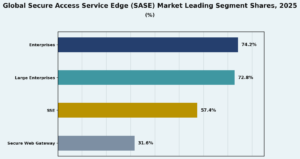
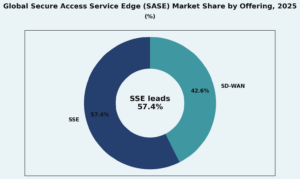
The Global Secure Access Service Edge (SASE) Market by offering includes SD-WAN and SSE. SSE led the segment with an estimated 57.4% share in 2025 because enterprises are prioritizing cloud-delivered security functions, including secure web gateway, cloud access security broker, zero trust network access and firewall as a service. SD-WAN remains critical because it provides the networking foundation for secure branch and cloud connectivity. The two offerings are increasingly sold together as buyers move toward unified or closely integrated SASE architectures. SSE is expected to retain leadership as cloud security, SaaS protection, private application access and AI security needs expand.
By Type
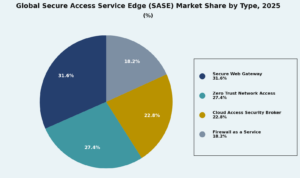
The market by type includes secure web gateway, cloud access security broker, zero trust network access and firewall as a service. Secure web gateway held the largest share at about 31.6% in 2025 because enterprises continue to require web traffic inspection, malware protection, URL filtering and internet access control for distributed users. Zero trust network access is expected to grow fastest as companies replace legacy VPNs and enforce identity-based private application access. CASB demand is rising due to SaaS and cloud application security needs. Firewall as a service is gaining traction as enterprises move firewall inspection from physical appliances to cloud-native platforms.
By Organization Size
The Global Secure Access Service Edge (SASE) Market by organization size includes large enterprises and small and medium-sized enterprises. Large enterprises dominated with an estimated 72.8% share in 2025 because they operate complex global networks, large branch footprints, hybrid workforces and multi-cloud environments. These organizations also have stronger budgets for platform transformation and managed SASE services. Small and medium-sized enterprises are expected to grow faster as cloud-delivered SASE lowers the need for dedicated hardware and large security teams. SMEs benefit from subscription-based models, simplified management and bundled security services from telecom and managed service providers.
By End User
The market by end user includes enterprises and service providers. Enterprises held the largest share with an estimated 74.2% in 2025 because SASE adoption is driven by corporate demand for secure access, hybrid work, cloud security and branch modernization. Service providers represent a smaller but strategically important segment because they package SASE into managed network security, telecom, 5G and enterprise connectivity services. This segment is expected to grow steadily as companies seek outsourced SASE operations. AT&T, Verizon, Lumen Technologies, Kyndryl and other service providers are positioned to benefit from managed SASE demand.
Regional Insights
North America Maintains Leadership Through Cloud Security Adoption And Strong Vendor Presence
North America leads the Global Secure Access Service Edge (SASE) Market due to high cloud adoption, mature cybersecurity spending, strong hybrid work penetration and the presence of major SASE vendors. The United States remains the largest demand center because enterprises, government agencies and service providers continue to modernize secure access and branch networking. Cisco, Kyndryl, Akamai, HPE, Verizon, Oracle, Zscaler, Netskope, Palo Alto Networks, AT&T, Cloudflare, Riverbed Technology, Lumen Technologies, Forcepoint, Fortinet and Broadcom all strengthen the North American vendor ecosystem. Market growth is supported by enterprise zero trust adoption, AI security requirements and replacement of legacy VPN and perimeter tools.
Europe Advances Through Data Protection, Hybrid Work And Managed Security Demand
Europe represents a major regional market due to strict data protection requirements, hybrid work adoption, cloud migration and demand for secure connectivity across multinational organizations. Enterprises in BFSI, manufacturing, retail, health care, telecom and public sectors require SASE platforms that support compliance, data residency and secure access to SaaS and private applications. Service providers also play an important role by delivering managed SD-WAN and SASE services to enterprises with distributed branch networks. European adoption is shaped by data sovereignty, regulatory requirements and demand for consolidated security architectures that can reduce tool complexity while improving visibility.
Asia Pacific Emerges As A High-Growth Region With Cloud, Telecom And Digital Transformation Momentum
Asia Pacific is expected to be one of the fastest-growing regions in the Global Secure Access Service Edge (SASE) Market. China, India, Japan, South Korea, Australia and Southeast Asia are seeing rising cloud adoption, telecom modernization, mobile workforce growth and digital transformation. Enterprises need secure access to cloud applications, while telecom providers require SASE capabilities for 5G, edge and managed network services. Huawei strengthens the regional competitive landscape through its presence in China and broader Asia Pacific telecom and enterprise markets. Growth is also supported by rising cybersecurity investment and demand for cloud-delivered security among large enterprises and service providers.
Latin America, Middle East And Africa Gain Ground Through Cloud Migration And Network Modernization
Latin America, the Middle East and Africa remain smaller but expanding markets for SASE solutions. Brazil, Mexico, the UAE, Saudi Arabia and South Africa are key demand centers due to cloud migration, smart city projects, banking digitization, telecom upgrades and public-sector modernization. Enterprises in these regions are increasingly adopting SD-WAN and cloud security to support distributed branches and hybrid work. Managed SASE services are likely to gain traction because many organizations prefer service provider support for deployment and ongoing management. Growth will depend on cloud maturity, cybersecurity awareness, connectivity quality and regulatory development.
Competitive Insights
- Cisco Systems (US)
- Kyndryl Solutions (US)
- Akamai (US)
- HPE (US)
- Verizon (US)
- Oracle (US)
- Zscaler (US)
- Netskope (US)
- Extreme Networks (US)
- Palo Alto Networks (US)
- AT&T (US)
- Cloudflare (US)
- Huawei (China)
- Riverbed Technology (US)
- Lumen Technologies (US)
- Forcepoint (US)
- Fortinet (US)
- Broadcom (US)
The Global Secure Access Service Edge (SASE) Market is highly competitive, with networking vendors, cloud security firms, telecom providers, managed service providers and cybersecurity platforms competing across SD-WAN, SSE, ZTNA, SWG, CASB and FWaaS capabilities. Cisco Systems, HPE, Extreme Networks, Fortinet and Huawei compete through SD-WAN, secure branch and networking-security convergence. Zscaler, Netskope, Palo Alto Networks, Cloudflare, Akamai, Forcepoint and Broadcom compete through cloud security, SSE, zero trust access, web security, CASB and data protection. Verizon, AT&T, Lumen Technologies and Kyndryl Solutions compete through managed SASE and enterprise connectivity services. Oracle brings cloud and enterprise security capabilities, while Riverbed Technology contributes network visibility and digital experience management. Competition is shaped by platform convergence, cloud delivery footprint, AI security, data protection, zero trust maturity, managed services, performance and interoperability.
Recent Developments
- In April 2025, HPE announced expansions across HPE Aruba Networking and GreenLake cloud, including new SASE capabilities for tighter integration between HPE Aruba Networking EdgeConnect SD-WAN and HPE Aruba Networking SSE.
- In May 2025, Netskope announced that MetTel selected Netskope to deliver AI-driven managed SASE network security services for enterprise and government customers using the Netskope One platform.
- In July 2025, Fortinet said it was recognized as a Leader in the 2025 Gartner Magic Quadrant for SASE Platforms and ranked No. 1 in the Secure Branch Network Modernization use case in the related Gartner Critical Capabilities report.
- In July 2025, Netskope said it was named a Leader in the Gartner Magic Quadrant for SASE Platforms for the second consecutive year, supported by the Netskope One platform and its NewEdge network.
- In 2025, Palo Alto Networks announced Prisma SASE 4.0, describing it as an AI-driven SASE solution designed to extend protection against evasive threats and support secure access for modern enterprise users.
- In 2025, Zscaler launched new Zero Trust solutions at Zenith Live 2025 and said its SASE-based Zero Trust Exchange is distributed across more than 150 data centers globally.
Table of contents
- 01Report Introduction1.1 Report Description and Purpose1.1.1 Report Title and Market Definition1.1.2 Scope of Secure Access Service Edge Solutions1.1.3 Value Proposition for Stakeholders1.2 Research Objectives1.2.1 Market Sizing Objectives1.2.2 Segmentation Objectives1.2.3 Competitive Intelligence Objectives1.2.4 Forecast and Scenario Objectives1.3 Report Scope1.3.1 SASE Market Scope by Offering1.3.2 SASE Market Scope by Type1.3.3 SASE Market Scope by Organization Size1.3.4 SASE Market Scope by End User1.3.5 Geographic Scope1.4 Currency, Units and Pricing Basis1.5 Target Stakeholders1.6 Limitations and Assumptions
- 02Executive Summary2.1 Global Secure Access Service Edge (SASE) Market Snapshot2.2 Market Size and Forecast, 2025-20352.3 Key Market Trends and Investment Highlights2.4 Segmental Highlights2.5 Regional Highlights2.6 Competitive Landscape Snapshot
- 03Market Overview3.1 Market Definition3.2 Evolution of SASE Architecture3.3 Role of SASE in Cloud Security and Zero Trust Access3.4 Role of SD-WAN and SSE in SASE Convergence3.5 Market Ecosystem Analysis3.6 Supply Chain and Partner Ecosystem Overview3.7 Standards, Compliance and Security Framework Overview
- 04Global Secure Access Service Edge (SASE) Market Dynamics4.1 Market Drivers4.1.1 Rising Adoption of Cloud Applications, Hybrid Work and Zero Trust Security4.1.2 Expansion of SD-WAN and Network Security Convergence4.1.3 Growing Threat Exposure From SaaS, Cloud, AI and Distributed Users4.1.4 Rising Demand From Service Providers for Managed SASE Offerings4.2 Market Restraints4.2.1 Complex Migration From Legacy Network and Security Architectures4.2.2 Data Privacy, Sovereignty and Compliance Requirements4.2.3 Vendor Lock-In and Integration Risk4.3 Market Opportunities4.3.1 Growth of Single-Vendor and Unified SASE Platforms4.3.2 Expansion of SSE Across Web, Cloud and Private Application Security4.3.3 AI Security and Secure Access for Generative AI Applications4.3.4 Managed SASE Services for Telecom and Service Provider Channels4.4 Technology Trends4.4.1 Shift Toward AI-Powered SASE Platforms4.4.2 Convergence of SWG, CASB, ZTNA and FWaaS in SSE Platforms4.4.3 Integration of SD-WAN, SSE and Secure Branch Networking4.4.4 Expansion of Global Cloud Points of Presence and Private Backbones
- 05Global Secure Access Service Edge (SASE) Market Size and Forecast5.1 Market Size, 20255.2 Market Forecast, 20355.3 CAGR Analysis, 2025-20355.4 Revenue Opportunity Analysis5.5 Market Attractiveness Analysis
- 06Global Secure Access Service Edge (SASE) Market, by Offering6.1 Overview6.2 SD-WAN6.3 SSE
- 07Global Secure Access Service Edge (SASE) Market, by Type7.1 Overview7.2 Secure Web Gateway7.3 Cloud Access Security Broker7.4 Zero Trust Network Access7.5 Firewall as a Service
- 08Global Secure Access Service Edge (SASE) Market, by Organization Size8.1 Overview8.2 Large Enterprises8.3 Small and Medium-Sized Enterprises
- 09Global Secure Access Service Edge (SASE) Market, by End User9.1 Overview9.2 Enterprises9.3 Service Providers
- 10Global Secure Access Service Edge (SASE) Market, by Region10.1 Overview10.2 North America10.2.1 United States10.2.2 Canada10.2.3 Mexico10.3 Europe10.3.1 United Kingdom10.3.2 Germany10.3.3 France10.3.4 Italy10.3.5 Spain10.3.6 Rest of Europe10.4 Asia Pacific10.4.1 China10.4.2 Japan10.4.3 India10.4.4 South Korea10.4.5 Australia10.4.6 Southeast Asia10.4.7 Rest of Asia Pacific10.5 Latin America10.5.1 Brazil10.5.2 Mexico10.5.3 Rest of Latin America10.6 Middle East10.6.1 GCC Countries10.6.2 Israel10.6.3 Turkey10.6.4 Rest of Middle East10.7 Africa10.7.1 South Africa10.7.2 Rest of Africa
- 11Competitive Landscape11.1 Market Competition Overview11.2 Competitive Positioning Matrix11.3 Company Market Share Analysis11.4 Product Portfolio Comparison11.5 SASE Platform Capability Benchmarking11.6 Strategic Initiatives11.7 Partnerships, Mergers and Acquisitions11.8 Recent Developments11.9 Vendor Benchmarking
- 12Company Profiles12.1 Cisco Systems12.2 Kyndryl Solutions12.3 Akamai12.4 HPE12.5 Verizon12.6 Oracle12.7 Zscaler12.8 Netskope12.9 Extreme Networks12.10 Palo Alto Networks12.11 AT&T12.12 Cloudflare12.13 Huawei12.14 Riverbed Technology12.15 Lumen Technologies12.16 Forcepoint12.17 Fortinet12.18 Broadcom
- 13Strategic Recommendations13.1 Recommendations for SASE Vendors13.2 Recommendations for Cloud Security Providers13.3 Recommendations for Telecom and Managed Service Providers13.4 Recommendations for Enterprise Buyers13.5 Investment and Growth Strategy
- 14Research Methodology14.1 Research Approach14.2 Primary Research14.3 Secondary Research14.4 Market Size Estimation14.5 Forecasting Methodology14.6 Data Triangulation14.7 Assumptions and Limitations
- 15Appendix15.1 Abbreviations15.2 Glossary15.3 Related Reports15.4 Disclaimer
About this report
Written by Amit Jain and reviewed by Deepti Agrawal, Senior Editor, Research. Figures are built top-down and bottom-up and reconciled before publication, with 2025 as the base year.
Read our methodologyHow we built this
- Historical period2020-2024
- Base year2025
- Forecast period2025-2032
- Sizing approachTop-down + bottom-up
Need more than the report?
Advisory on this market
Due diligence, site selection and market entry work, by the analysts who wrote this report.
See consulting servicesFrequently asked questions
The Global Secure Access Service Edge (SASE) Market size was valued at USD 14.5 billion in 2025 and is projected to reach USD 66.8 billion by 2035.
The Global Secure Access Service Edge (SASE) Market is projected to grow at a CAGR of 24.40% between 2025 and 2035.
By offering, SSE held the largest share in 2025 with an estimated 57.4% share because enterprises are prioritizing cloud-delivered security functions such as secure web gateway, CASB, ZTNA and firewall as a service. By end user, enterprises led with an estimated 74.2% share.
The market is primarily driven by rising cloud adoption, hybrid work, zero trust security, SD-WAN modernization and the need to consolidate network and security tools. Growth is also supported by SaaS adoption, AI security requirements, distributed branch networks and managed SASE services.
The leading companies in the Global Secure Access Service Edge (SASE) Market include Cisco Systems, Kyndryl Solutions, Akamai, HPE, Verizon, Oracle, Zscaler, Netskope, Extreme Networks, Palo Alto Networks, AT&T, Cloudflare, Huawei, Riverbed Technology, Lumen Technologies, Forcepoint, Fortinet and Broadcom.
Licences, delivery and payment
Which licence should I choose?
Single User is a view-only PDF for one person. Multi User adds a printable PDF and the Excel data for unlimited users at one location. Enterprise covers your whole company and includes 100 free analyst hours.
How and when will I receive the report?
By email, within 24–48 business hours of payment, in the formats of your licence.
How can I pay?
Securely through PayPal: with a PayPal account, a debit or credit card, or PayPal Pay Later where available. Prices are in US dollars.
Can I see a sample first?
Yes. Request a free sample and we will email it to you.
Can the report be tailored to my needs?
Yes. We can add countries, segments or data cuts. Talk to an analyst about the scope you need.
Can I get an invoice or pay against a purchase order?
Write to sales@dcmarketinsights.com and our team will help.