Executive summary:
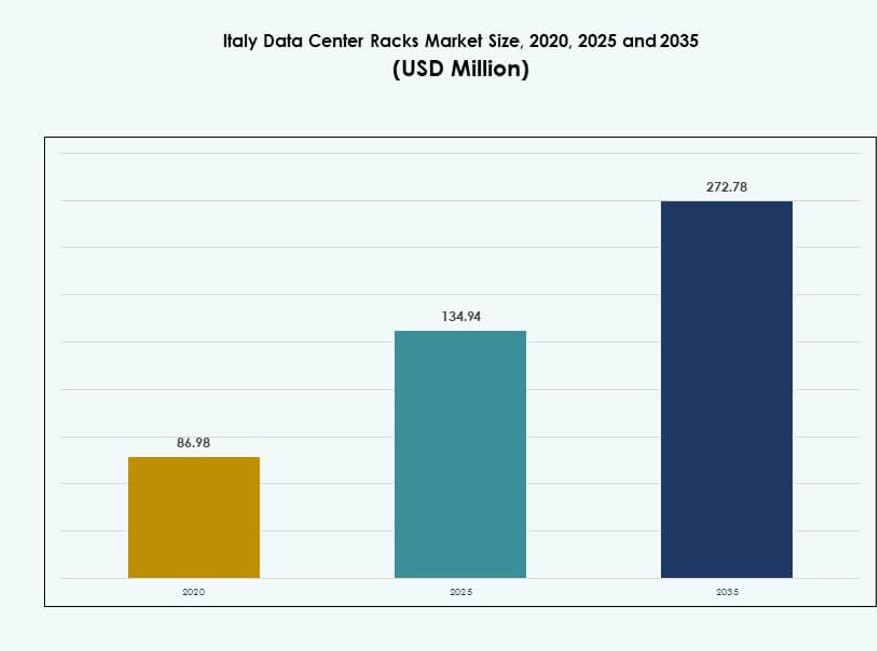
The Italy Data Center Racks Market size was valued at USD 86.98 million in 2020 to USD 134.94 million in 2025 and is anticipated to reach USD 272.78 million by 2035, at a CAGR of 7.25% during the forecast period.
| REPORT ATTRIBUTE |
DETAILS |
| Historical Period |
2020-2023 |
| Base Year |
2024 |
| Forecast Period |
2025-2035 |
| Italy Data Center Racks Market Size 2025 |
USD 134.94 Million |
| Italy Data Center Racks Market, CAGR |
7.25% |
| Italy Data Center Racks Market Size 2035 |
USD 272.78 Million |
The market is driven by rising cloud adoption, AI workloads, and higher rack density needs. Enterprises are upgrading infrastructure to support virtualization and high-performance computing. Innovation in modular racks and advanced cooling supports efficiency and uptime. Colocation growth strengthens demand for standardized rack systems. The market holds strategic value for investors due to stable demand, long-term contracts, and alignment with digital transformation goals.
Northern Italy leads due to strong colocation presence and hyperscale activity centered around Milan. Central Italy shows steady growth supported by government and enterprise digital projects. Southern Italy is emerging with edge deployments and telecom expansion. These regional dynamics reflect differences in connectivity, enterprise density, and public digital initiatives across the country.
Market Dynamics:
Market Drivers
Rising Demand for High-Density Racks to Support AI, HPC, and Hyperscale Deployments
The Italy Data Center Racks Market is witnessing strong demand due to the increasing shift toward high-density computing environments. Enterprises and hyperscale players are deploying AI and HPC workloads that require advanced rack configurations. Traditional 10–15 kW racks are no longer sufficient for handling modern GPU-intensive clusters. IT managers are adopting 30–60 kW racks with integrated liquid cooling to optimize thermal management. Rack-level power distribution and monitoring are becoming essential in maintaining uptime. It is driving procurement of modular and scalable rack systems. Vendors are investing in racks with higher load capacities, dynamic airflow design, and better cable management. Businesses and colocation providers view these advanced racks as critical for long-term operational efficiency.
- For instance, NVIDIA’s DGX H100 system delivers up to 32 petaFLOPS of FP8 AI performance using 8 H100 GPUs, with a maximum system power of 10.2 kW making it suitable for high-density data center deployments across Europe.
Integration of Liquid Cooling and Rack-Level Cooling Enhances Rack Efficiency and Design Complexity
A key driver for the Italy Data Center Racks Market is the integration of liquid cooling technologies. Colocation operators are adopting direct-to-chip and rear-door heat exchangers to reduce reliance on room-level cooling. Rack-level cooling improves heat extraction and reduces energy consumption. Data centers are deploying racks pre-configured for liquid loops, minimizing installation time and increasing compatibility with immersion-ready systems. It supports higher compute densities without increasing floor space requirements. Liquid-ready racks attract investments from AI service providers and research institutions handling compute-heavy workloads. The shift reflects broader trends in data center sustainability and efficiency. Rack vendors that offer turnkey integration solutions are gaining strong traction.
Shift Toward Edge Data Centers and Regional Hubs Increases Rack Standardization and Scalability Needs
The rise in edge computing deployments across Italy is shaping rack demand in distributed locations. Telecom firms and digital infrastructure providers require compact, secure, and easily deployable racks for regional and remote edge sites. It fuels demand for prefabricated rack enclosures with in-built monitoring, security, and power features. Companies aim to reduce on-site configuration time and ensure uniformity across dispersed networks. Regional cities outside Milan are seeing growing data center investments, requiring adaptable and space-efficient rack formats. This trend is pushing vendors to design racks optimized for edge constraints. Standardized rack configurations help service providers scale faster while reducing operational complexity.
- For instance, Aruba S.p.A.’s Global Cloud Data Center near Milan supports high-density racks with floating floor systems and multi-level ducting, engineered for customized network infrastructure and high load capacities up to 2,400 kg/m², enabling scalable performance for edge and cloud applications in Italy.
Strategic Investment by Global and Local Players Strengthens the Rack Procurement Pipeline
Strategic expansions by colocation and cloud operators are driving large-scale rack procurement. Milan remains the primary hub for hyperscale and interconnection investments in Italy. It supports rack growth through continuous expansion of availability zones, cloud regions, and digital services. Global players like Equinix and STACK Infrastructure are scaling their Italian footprints, directly impacting demand for high-volume rack systems. Government-backed digitalization programs and data sovereignty policies are encouraging localized infrastructure rollouts. Vendors with deep inventory and integration capabilities benefit from such planned expansions. Rack standardization aligned with global compliance norms remains a strategic priority for multinationals operating in the Italy Data Center Racks Market.
Market Trends
Growth in AI-Centric Infrastructure Is Driving Rack Designs with Integrated GPU-Optimized Features
AI adoption across enterprise and research workloads is pushing innovation in rack configurations. Rack designs are evolving to accommodate GPU-heavy nodes, with increased airflow and power delivery standards. Rear-door heat exchangers and vertical airflow chassis are gaining traction. It pushes demand for racks with high-weight tolerance, integrated cooling support, and rack-level telemetry. AI clusters also need enhanced cable management due to dense interconnects. Vendors are offering rack kits pre-aligned with GPU server dimensions and airflow pathways. Organizations deploying LLMs and ML training environments prioritize these GPU-optimized racks. The Italy Data Center Racks Market is steadily shifting toward these advanced formats.
Rack Designs Are Becoming Modular to Support Colocation, Cloud, and Hybrid Deployments
Vendors are launching modular racks that allow tool-less assembly, repositionable rails, and flexible depth adjustments. Modular designs reduce setup time and support rapid infrastructure scaling. It enables operators to swap server configurations without requiring structural changes. The market benefits from rack formats tailored for hybrid IT setups that combine cloud, on-premises, and colocation models. Cabinets with segmented airflow zones, integrated PDUs, and removable side panels improve flexibility. Modular racks are also supporting future-readiness by easing integration with automation hardware. The Italy Data Center Racks Market sees strong preference for modularity across enterprise and commercial segments.
Software-Defined Rack Management and Smart Rack Telemetry Are Gaining Enterprise Adoption
Organizations are increasingly adopting racks equipped with built-in environmental and power monitoring. Smart racks with sensor-enabled PDUs help in real-time thermal tracking and predictive maintenance. It supports proactive issue identification, improving uptime and resource planning. Integration with DCIM platforms gives visibility into power draw, component health, and utilization metrics. Rack-level telemetry is particularly useful for multi-tenant and colocation environments. Vendors are embedding firmware for automated alerts, access control, and remote diagnostics. The Italy Data Center Racks Market is seeing growth in software-defined rack solutions that offer digital twins and AI-based insights.
Demand for Energy-Efficient, Sustainable Rack Solutions Is Growing Across Colocation Facilities
Operators are prioritizing racks that align with green data center certifications. Use of recyclable materials, passive airflow systems, and low-footprint enclosures is becoming common. It aligns with broader carbon reduction goals and ESG mandates. Rack vendors are introducing designs that improve airflow containment, reduce cooling loads, and lower energy waste. The trend supports rising adoption of carbon-neutral colocation sites across Italy. It is prompting rack buyers to demand lifecycle-compliant documentation and eco-labels. The Italy Data Center Racks Market benefits from rack solutions aligned with LEED, ISO 50001, and other energy efficiency standards.
Market Challenges
High Cost of Advanced Rack Configurations and Integration with Cooling Systems Limits SME Adoption
One major challenge in the Italy Data Center Racks Market is the high upfront cost of advanced rack systems. Racks supporting liquid cooling, smart telemetry, or GPU densities come with steep price points. Small and mid-sized enterprises often delay adoption due to budget limitations. It creates a gap in modernization between large colocation players and smaller operators. Complexity in integrating racks with in-row or direct-to-chip cooling adds further cost and engineering efforts. Incompatibility between legacy infrastructure and new rack formats also slows rollout. Vendors must address cost-to-performance value for broader market coverage. Technical training for on-site personnel is also lacking in smaller deployments.
Fragmented Edge Rack Standards and Regulatory Complexity Slow Deployment in Remote Regions
Edge and distributed deployments face challenges due to the lack of standardization in rack enclosures and certification requirements. Different municipalities and regional authorities require varying safety, fire, and access compliance for small data facilities. It delays rack installation timelines and increases project costs. Telecom operators deploying mobile edge networks struggle to maintain uniform rack quality across sites. It affects operational consistency and long-term reliability. Import regulations on smart components or integrated PDUs further complicate supply chains. The Italy Data Center Racks Market must overcome these inconsistencies through harmonized edge rack design standards.
Market Opportunities
Growth of 5G, IoT, and Smart Cities Enables Strong Demand for Compact, Secure Edge Racks
Italy’s nationwide 5G rollout and smart city projects are creating strong demand for edge data centers. Compact racks with integrated security, cooling, and power features are ideal for street-level and remote installations. Telecom companies, municipal agencies, and industrial IoT operators are key customers. The Italy Data Center Racks Market will benefit from these decentralized deployments across utilities and urban monitoring.
Rising Colocation Investments and AI Clusters Create Opportunities for High-Density Rack Solutions
Large colocation providers are investing in multi-MW expansions in Milan and Rome. AI-focused companies seek rack formats supporting 30–50 kW densities. Vendors offering pre-configured racks with thermal optimization and liquid cooling will find strong demand. It will open supply chain opportunities for local manufacturers and system integrators in the Italy Data Center Racks Market.
Market Segmentation
By Rack Type
The cabinet segment dominates the Italy Data Center Racks Market due to its enclosed design, better airflow control, and security features. Open frame racks find usage in controlled environments but lack containment benefits. Cabinets offer high compatibility with PDUs and in-rack cooling units, supporting medium to high-density deployments. Their popularity continues to grow across colocation and enterprise data centers.
By Rack Height
42U racks remain the standard height used across most facilities in the Italy Data Center Racks Market. They offer a balance between physical stability, equipment capacity, and cable management. Below 42U racks serve edge and compact data centers, while above 42U racks are preferred in high-density AI clusters where vertical scaling is viable. 42U continues to dominate due to its versatility and widespread infrastructure fit.
By Width
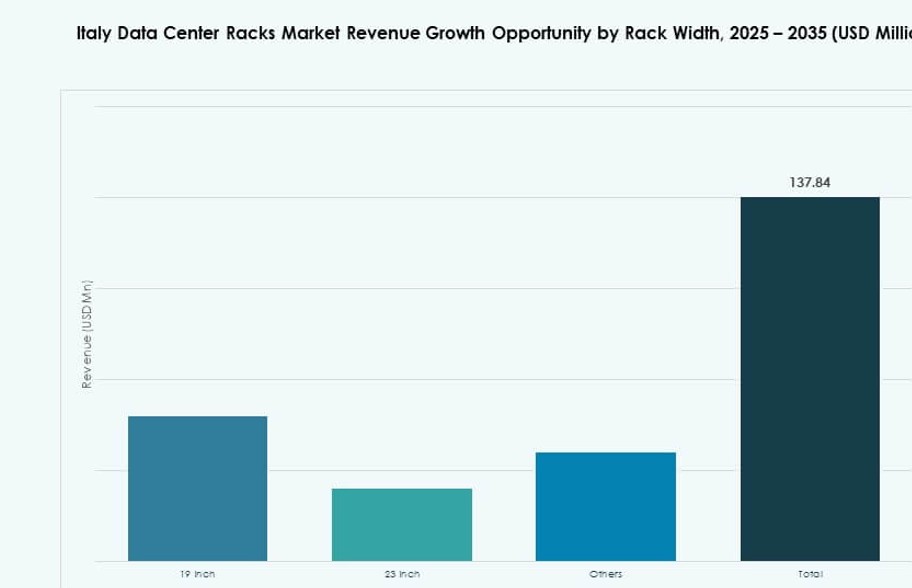
The 19-inch rack width is the industry standard and holds the majority share in the Italy Data Center Racks Market. It supports the largest ecosystem of IT equipment including servers, storage, and switches. The 23-inch segment caters to high-volume storage and specialized equipment but remains niche. Demand for standardized 19-inch racks will persist across public and private sector deployments.
By Application
Server racks lead the application segment due to high demand for compute-intensive workloads and cloud deployments. They form the backbone of most hyperscale and colocation facilities. Network racks, while essential, occupy a smaller share and serve switching, routing, and patching needs. The Italy Data Center Racks Market is heavily driven by server racks due to increased virtualization and AI adoption.
By End-user
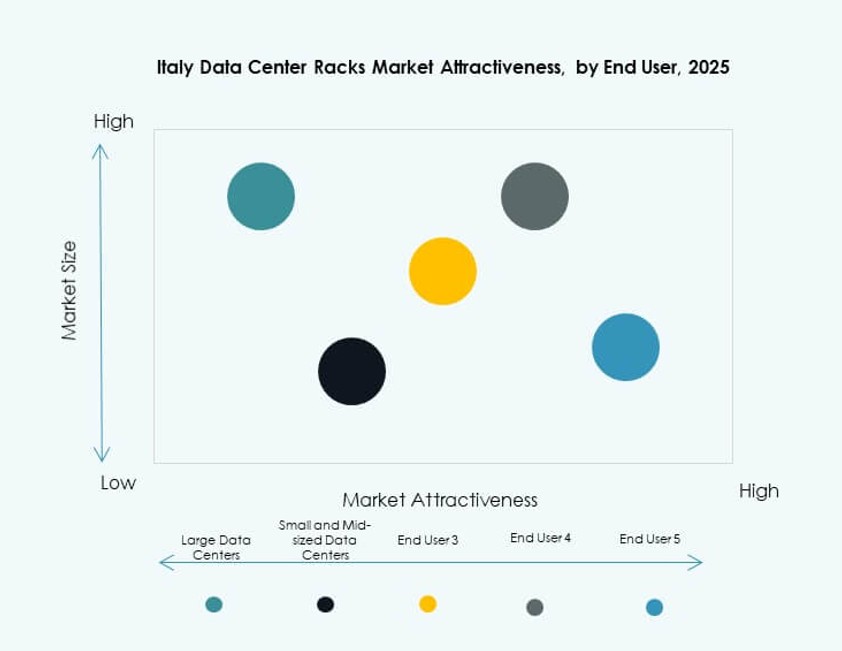
Large data centers dominate the market due to their scale, density, and requirement for advanced rack solutions. These include hyperscale, cloud, and carrier-neutral colocation facilities. Small and mid-sized data centers are growing but often delay rack modernization due to budget constraints. The Italy Data Center Racks Market sees its core revenue from large facilities deploying thousands of racks.
By Vertical
The IT & Telecom sector leads the vertical segment in the Italy Data Center Racks Market. Rapid expansion of 5G, cloud, and managed hosting drives sustained rack demand. BFSI and Government & Defense sectors follow, with increased digitization and security requirements. Healthcare and Retail sectors also adopt modern racks, but at a slower rate. Energy sector investments in edge infrastructure support niche rack deployments.
Regional Insights
Northern Italy Leads with 58% Market Share Driven by Hyperscale Investments and Interconnection Growth
Northern Italy dominates the Italy Data Center Racks Market with about 58% market share, led by Milan’s dense colocation and cloud footprint. Milan hosts many hyperscale campuses and is the primary landing zone for new submarine cables and cloud availability zones. The region attracts strong investments from global data center operators and benefits from advanced digital infrastructure. It leads in rack deployments optimized for AI, high-density compute, and interconnectivity.
Central Italy Holds 24% Share with Steady Rack Adoption Across Government and Enterprise Workloads
Central Italy contributes around 24% of the Italy Data Center Racks Market, supported by cities like Rome and Florence. Public sector IT modernization and expansion of secure government data facilities drive demand. It sees steady rack procurement by telecom carriers and managed service providers serving small to mid-sized enterprises. The region’s importance is growing as organizations relocate infrastructure closer to regulated data zones.
- For instance, IRIDEOS operates carrier-neutral data centers in Rome and Milan, offering infrastructure for sovereign cloud and enterprise services. Its facilities support high-availability configurations aligned with national and EU data residency requirements.
Southern Italy and Islands Account for 18% Market Share as Edge Deployments and Smart City Projects Expand
Southern regions and island territories make up 18% of the Italy Data Center Racks Market. Growth here is driven by rising telecom edge deployments and smart city rollouts. Cities like Naples and Palermo are investing in localized data centers supported by regional connectivity upgrades. The shift toward decentralized infrastructure opens demand for pre-configured compact racks and rugged enclosures. Southern Italy is an emerging hub for edge-specific rack designs.
- For instance, Aruba S.p.A. supports edge computing and IoT services through its nationwide network infrastructure in Italy, offering localized data processing capabilities. Its data centers are designed to handle high-density workloads and are aligned with smart city and 5G deployment needs.
Competitive Insights:
- Schneider Electric
- Vertiv Group
- Rittal
- Dell Inc.
- Cisco Systems, Inc.
- Hewlett Packard Enterprise (HPE)
- Fujitsu
- Eaton
- Legrand
- Chatsworth Products
The Italy Data Center Racks Market features strong competition between global OEMs and specialized local vendors. It is driven by continuous rack innovation, rising demand for high-density designs, and tailored thermal management. Global players like Schneider Electric, Vertiv, and Rittal dominate through robust supply chains, wide product portfolios, and energy-efficient solutions. Vendors are strengthening positions via modular, liquid-cooled, and smart rack systems to serve AI and edge workloads. Strategic expansions in Milan and regional cities give multinationals an edge in hyperscale deployments. Local manufacturers such as ITA Cabinets and MPGAMMA focus on custom-built solutions for enterprise and SME facilities. Market leaders are forming partnerships with integrators and colocation providers to align with Italy’s digital growth roadmap.
Recent Developments:
- In September 2025, Schneider Electric was featured in the Data Centre Rack Company Evaluation Report for its advanced rack enclosures. The company was recognized for delivering energy-efficient, scalable rack solutions tailored to support high-density computing environments.
- In September 2025, Vertiv Group was highlighted in an industry report for its enterprise and hyperscale rack solutions. Following its acquisition of E+I Engineering, Vertiv strengthened its portfolio in power distribution systems optimized for edge computing and AI workloads.
- In March 2025, Vertiv launched its SmartRun modular prefabricated infrastructure, capable of deploying 1 MW of capacity per day an approach reported to be 85% faster than conventional builds. This solution directly targets hyperscale campuses in Milan.