Executive summary:
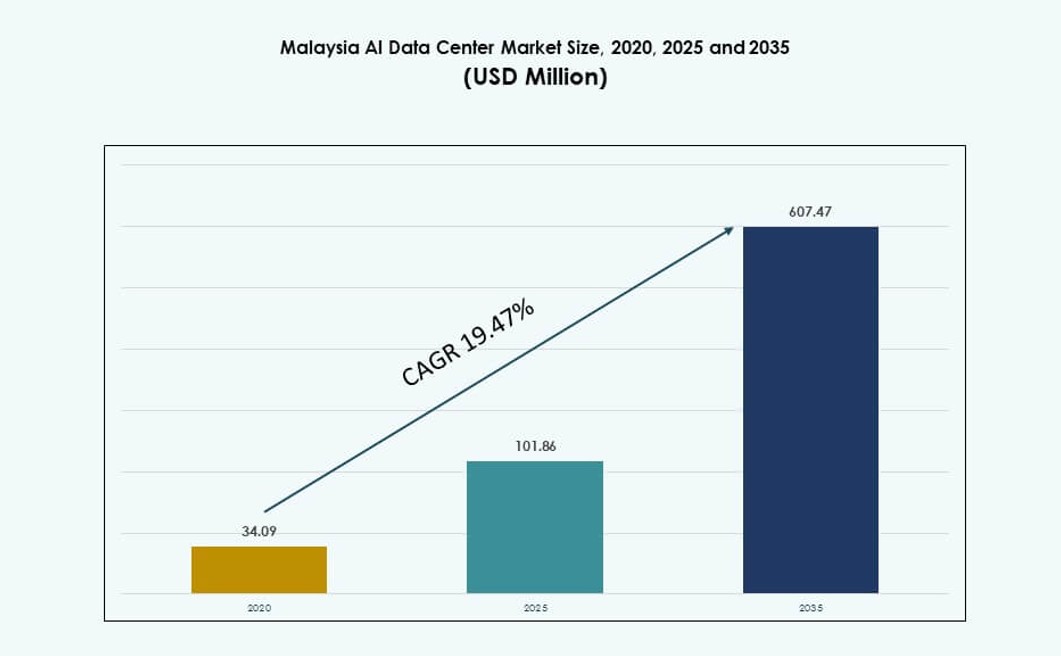
The Malaysia AI Data Center Market size was valued at USD 34.09 million in 2020 to USD 101.86 million in 2025 and is anticipated to reach USD 607.47 million by 2035, at a CAGR of 19.47% during the forecast period.
| REPORT ATTRIBUTE |
DETAILS |
| Historical Period |
2020-2023 |
| Base Year |
2024 |
| Forecast Period |
2025-2035 |
| Malaysia AI Data Center Market Size 2025 |
USD 885.58 Million |
| Malaysia AI Data Center Market, CAGR |
17.53% |
| Malaysia AI Data Center Market Size 2035 |
USD 4,478.17 Million |
The market is driven by strong AI adoption across enterprises, cloud platforms, and public sector programs. Companies deploy AI for analytics, automation, and digital services at scale. Hyperscale cloud expansion and GPU-based infrastructure upgrades support complex AI workloads. Cooling innovation and high-density racks improve performance efficiency. These shifts increase investor interest and long-term capacity planning opportunities.
Malaysia is emerging as a regional AI infrastructure hub within Southeast Asia. Cyberjaya and Greater Kuala Lumpur lead due to connectivity, enterprise demand, and government support. Johor is gaining momentum from spillover demand from Singapore and land availability. Penang shows early progress through electronics and manufacturing use cases. These regions shape balanced and scalable market growth.
Market Dynamics:
Market Drivers
Government Digitalization Push and Strategic Investment Momentum
The Malaysia AI Data Center Market is driven by strong national digital transformation programs. The MyDIGITAL blueprint and Malaysia Digital Economy Blueprint guide the AI infrastructure rollout. The government aims to position Malaysia as a regional digital hub through incentives and regulatory support. Tech-friendly zones such as Cyberjaya and Iskandar provide land, connectivity, and policy alignment. These zones attract hyperscale operators and investors. Demand from public and private sectors for AI analytics and machine learning also continues to grow. Investors see long-term gains from Malaysia’s digital-first approach. AI-specific workloads need scalable compute and storage infrastructure. The market’s strategic growth supports Malaysia’s ambition to become a regional AI innovation leader.
- For instance, in May 2024 Microsoft announced a US$2.2 billion investment over four years to build cloud and AI infrastructure in Malaysia, explicitly framed as supporting the country’s MyDIGITAL and digital transformation agenda.
Enterprise AI Adoption and Industrial Transformation Across Verticals
Malaysia’s businesses are accelerating AI adoption for automation, analytics, and real-time intelligence. Banks, telecoms, and manufacturers use AI to optimize services, customer experiences, and operations. AI-ready data centers meet high GPU density needs and stringent uptime standards. It enables firms to experiment and scale quickly with AI models and tools. Digital-native startups and legacy firms alike benefit from this infrastructure shift. Malaysia AI Data Center Market supports real-time compute workloads and flexible deployment models. Emerging AI tools in fraud detection, supply chain, and retail personalization increase demand for fast processing and secure data environments. This push toward AI maturity makes the market a key enabler for productivity and efficiency upgrades across sectors.
Cloud Ecosystem Expansion and AI-Centric Infrastructure Upgrades
Malaysia’s expanding cloud infrastructure drives hybrid and public cloud adoption for AI model training and deployment. Global cloud providers are partnering with local operators or investing directly in new facilities. Cloud regions enable access to advanced compute power while ensuring data sovereignty. AI workloads require optimized network latency, security, and compute configurations. The Malaysia AI Data Center Market is becoming a central node in Southeast Asia’s cloud-driven innovation network. The rise of cloud-native development tools and platforms increases reliance on backend AI infrastructure. Businesses deploy AI services across cloud, edge, and hybrid environments. This shift compels data centers to invest in liquid cooling, modular builds, and energy-efficient operations.
- For instance, Google announced a US$2 billion commitment to develop a data center and Google Cloud region in Malaysia, with the cloud region explicitly designed to provide low‑latency access to AI and analytics services for local organizations while maintaining data residency within the country.
High-Density GPU Compute and Cooling Technology Integration
AI model training and inferencing demand high GPU concentration per rack and advanced cooling systems. Traditional cooling systems struggle with the heat generated by AI hardware. Operators integrate direct-to-chip liquid cooling and immersion technologies to address thermal challenges. The Malaysia AI Data Center Market reflects this hardware evolution trend. New facilities prioritize energy-efficient design and smart workload orchestration. Equipment layouts are redesigned to optimize airflow and load distribution. Liquid cooling helps meet ESG goals and supports the deployment of next-gen AI chips. These innovations attract enterprises and service providers looking to run power-intensive AI models with minimal downtime or risk.
Market Trends
Shift Toward Liquid-Cooled Racks for AI and HPC Workloads
Operators across Malaysia are embracing liquid cooling systems to meet AI’s thermal demands. Direct liquid cooling improves efficiency and lowers operational risks at high-density rack configurations. Traditional air-cooled setups fall short in managing GPU-driven compute needs. The Malaysia AI Data Center Market is now seeing pilots of immersion cooling and hybrid cooling methods. Vendors offer modular cooling kits for edge AI deployments. Cooling-as-a-service models also gain traction for colocation environments. Liquid-cooled infrastructure reduces space requirements and energy use. Facilities enhance PUE levels through thermal design upgrades. Data center developers now prioritize cooling innovation as a core component of AI readiness.
Rise in AI-Oriented Colocation Models and Flexible Infrastructure Offerings
Flexible colocation models are gaining interest from AI start-ups and enterprises needing scalable compute without owning infrastructure. Modular colocation offerings support GPU clustering, dedicated power circuits, and software-defined networking. It helps AI projects scale faster and more cost-effectively. The Malaysia AI Data Center Market benefits from this model shift. Enterprises select between full-rack, half-rack, and cage solutions tailored for AI performance. Some providers offer AI-as-a-service with preconfigured training environments. These flexible setups enable faster experimentation cycles. Colocation vendors now compete on AI workload support features rather than space alone. This change influences data center designs and value propositions across Malaysia.
Focus on AI-Integrated Edge Data Centers for Low-Latency Processing
Edge computing expansion is reshaping Malaysia’s AI data center landscape. Enterprises require low-latency processing near data generation points. AI-enabled edge data centers support applications in retail, healthcare, and smart cities. The Malaysia AI Data Center Market now includes micro edge nodes across industrial zones and cities. These units process video feeds, sensor data, and real-time analytics locally. Edge nodes reduce cloud dependency while maintaining AI model accuracy. Telecom operators collaborate with AI startups to deploy regional edge sites. Energy-efficient design and remote orchestration are standard in new builds. Edge infrastructure complements hyperscale facilities for hybrid deployment scenarios.
Software-Led Orchestration and AI Infrastructure Automation Tools
Operators are integrating AI-specific orchestration platforms to manage infrastructure more efficiently. These tools optimize resource allocation, monitor thermal dynamics, and improve energy use in real time. The Malaysia AI Data Center Market embraces software-defined automation to enhance AI performance. AI workload orchestration software aligns hardware utilization with application demand. Some platforms use predictive algorithms to shift loads or rebalance clusters. Operators reduce downtime risk and maximize GPU usage through real-time data feeds. Automation reduces manual intervention and improves reliability metrics. This software-first approach helps meet both operational and ESG targets. It is reshaping how AI data centers are built and managed in Malaysia.
Market Challenges
Power Supply Constraints and Grid Readiness Limit AI Scale-Up
High-performance AI data centers need consistent, high-capacity electricity supply, but grid infrastructure poses limitations. Urban centers like Cyberjaya and Johor face periodic congestion or load imbalances. New facilities must wait for grid upgrades or private substation approvals. Malaysia AI Data Center Market growth may slow without power infrastructure coordination. Diesel backup is unsustainable for long-term AI operations. Green power procurement remains limited, adding further risk. Developers also face regulatory delays in power distribution permits. Meeting GPU power densities of over 30 kW per rack requires careful load planning. This challenge adds complexity to site selection and expansion decisions.
Talent Gaps in AI Infrastructure Design and Operations
Malaysia faces a shortfall in skilled professionals to manage AI-specific infrastructure, especially for HPC and GPU-centric systems. While universities expand AI-related programs, hands-on expertise in AI workload design remains rare. The Malaysia AI Data Center Market struggles with this talent gap in architecture, thermal management, and orchestration platforms. Hiring qualified engineers for liquid cooling or AI workload tuning is difficult. This limits deployment speed and system optimization. International players often import talent, raising project costs. Training programs have yet to meet the evolving demands of AI-ready infrastructure. The shortage can delay commissioning and increase operational risks.
Market Opportunities
Public Cloud AI Regions and Strategic Hyperscaler Partnerships
Malaysia offers strong potential for AI cloud region development by global hyperscalers. Partnerships with telecoms and local governments can unlock large-scale AI data center investments. The Malaysia AI Data Center Market benefits from digital sovereignty policies and bilingual tech talent. AI cloud zones enable secure access for BFSI, healthcare, and government workloads. Hyperscaler partnerships also trigger local ecosystem growth.
Smart Industry AI Integration and Sector-Specific Infrastructure Growth
AI data center operators can tap into growing demand from manufacturing, logistics, and automotive verticals. AI helps optimize supply chains, predict equipment failures, and automate inspections. The Malaysia AI Data Center Market aligns with these trends through GPU-rich colocation zones and edge deployment nodes. Industry-specific AI tools drive sustained infrastructure demand.
Market Segmentation
By Type
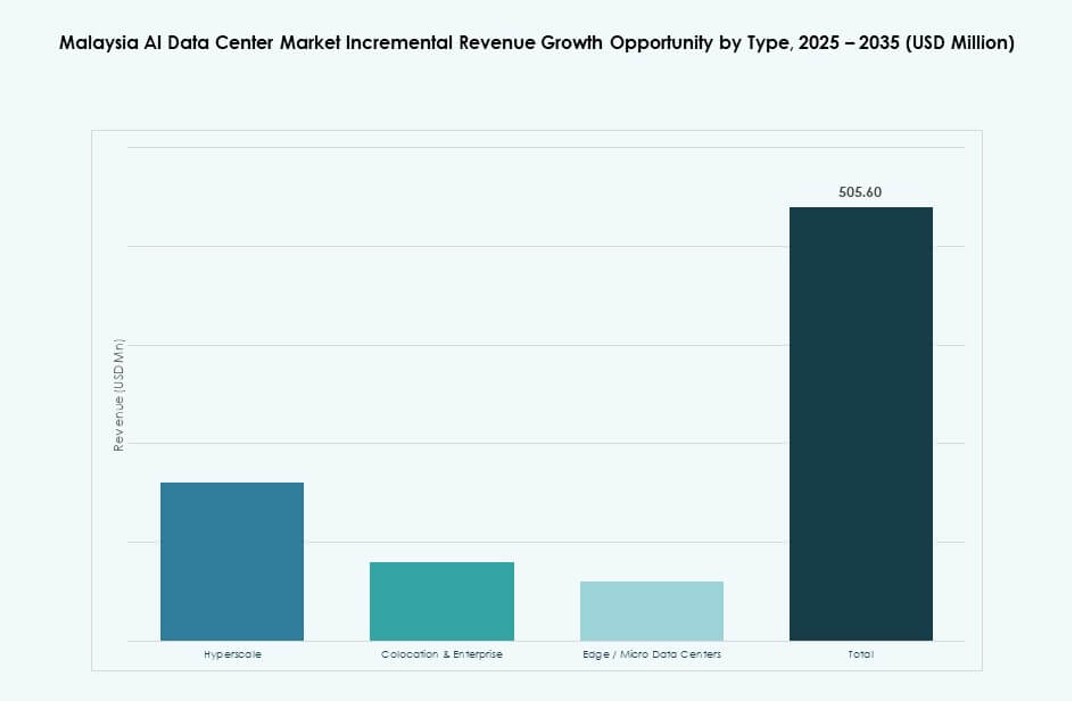
The Malaysia AI Data Center Market is led by the colocation & enterprise segment due to high AI demand from financial services, telecoms, and retail sectors. Hyperscale deployments are rising, driven by cloud region expansions and international partnerships. Edge/micro data centers also gain traction for smart city and real-time analytics use cases. Colocation remains dominant due to flexibility, cost efficiency, and faster deployment cycles.
By Component
Hardware holds the largest share in the Malaysia AI Data Center Market due to increased demand for GPU clusters, liquid cooling systems, and high-density racks. Software & orchestration is growing fast as operators adopt AI-specific infrastructure management tools. Services follow closely, providing design, integration, and maintenance support for AI deployments. Hardware remains the investment priority in large-scale builds.
By Deployment
Cloud deployment dominates the Malaysia AI Data Center Market, supported by hyperscaler presence and growing SaaS AI platforms. Hybrid models are expanding as businesses demand local compliance with cloud flexibility. On-premise deployments are limited but remain critical for sensitive government and BFSI workloads. Cloud infrastructure remains the enabler of AI democratization across industries.
By Application
Machine Learning leads the Malaysia AI Data Center Market by application segment, used in fraud detection, predictive analytics, and process automation. Generative AI is emerging fast, especially in media and marketing sectors. Computer Vision and NLP are growing in security, logistics, and customer service. The “Others” category includes speech recognition, recommendation systems, and robotics use cases. Machine Learning holds the widest use-case adoption.
By Vertical
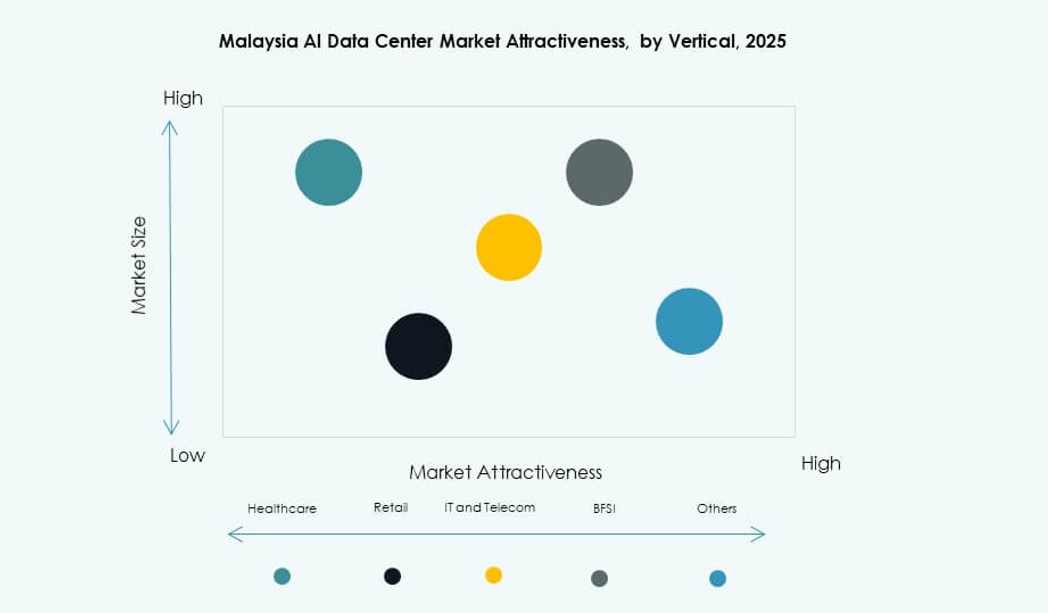
The BFSI sector leads in AI infrastructure adoption in the Malaysia AI Data Center Market. Healthcare and telecom follow closely, using AI for diagnostics, customer service, and network optimization. Manufacturing, automotive, and retail adopt AI for supply chain and customer behavior analytics. Media & entertainment drives demand for GenAI-based content creation. BFSI remains dominant due to data volume and compliance needs.
Regional Insights
Central Region (Cyberjaya, Kuala Lumpur, Selangor)
The Central Region holds around 55% of the Malaysia AI Data Center Market due to the concentration of hyperscale campuses and technology clusters. Cyberjaya remains the preferred zone due to connectivity, regulatory ease, and proximity to enterprise customers. Kuala Lumpur adds demand through its financial and business hubs. Selangor supports new builds with infrastructure and land availability. The Central Region benefits from robust power grids and transport links. Its dominance will continue as operators expand capacity near urban centers.
- For instance, Vantage Data Centers has started constructing its second campus in Cyberjaya (KUL2), designed as an AI‑ready site with a planned total IT load in the hundreds of megawatts, adding to more than twenty existing data center facilities already clustered in Cyberjaya and reinforcing the Central Region’s role as Malaysia’s primary data center hub.
Southern Region (Johor, Iskandar Malaysia)
The Southern Region accounts for nearly 30% of the Malaysia AI Data Center Market, led by Johor’s strategic proximity to Singapore. Iskandar Malaysia offers land, low operating costs, and cross-border connectivity. Several global firms view it as a spillover hub for Singapore’s constrained data center market. AI infrastructure investments are growing due to regional cloud needs. The region’s government incentives further boost development pace. Power reliability remains a focus area.
- For instance, Johor’s Iskandar Puteri area has attracted large greenfield hyperscale projects, including multi‑building campuses announced by global colocation and cloud players that are explicitly marketed as serving spillover demand from Singapore, underlining Johor’s positioning as a regional extension of Singapore’s constrained data center market.
Northern and Eastern Regions (Penang, Kedah, Terengganu, Sabah, Sarawak)
These regions collectively contribute 15% of the Malaysia AI Data Center Market. Penang shows early interest due to its electronics industry and skilled labor. Eastern Malaysia, including Sabah and Sarawak, is still in early AI infrastructure development stages. Connectivity gaps and power challenges limit current deployments. However, green energy potential and state-level digital programs offer long-term opportunity. These regions may support edge and sector-specific AI builds in future phases.
Competitive Insights:
- Amazon Web Services (AWS)
- Microsoft (Azure)
- Google Cloud / Alphabet
- TM One
- AIMS Data Centre
- Bridge Data Centres
- Digital Realty Trust
- Equinix
- NVIDIA
- Dell Technologies
The Malaysia AI Data Center Market features a diverse competitive landscape, with global hyperscalers, regional colocation providers, and hardware vendors all vying for market share. AWS, Microsoft, and Google Cloud lead in hyperscale infrastructure and AI cloud services. Local players like TM One and AIMS Data Centre drive enterprise and government-focused deployments. Bridge Data Centres and Digital Realty are expanding their regional footprints with high-density, AI-ready facilities. Infrastructure partners like NVIDIA, Dell, and HPE supply critical GPUs, servers, and orchestration platforms to meet AI workload demands. The market rewards innovation in cooling, orchestration, and edge integration. It continues to attract strategic investments through partnerships, sustainability efforts, and national digitalization programs.
Recent Developments:
- In January 2025, TM One expanded its AI-focused data center services for government and regulated industries. The update emphasized secure AI platforms and sovereign data handling. TM One aligned services with national digital priorities. This expansion strengthened local enterprise confidence in AI infrastructure adoption.
- In December 2025. GIBO Holdings Ltd. announced the development of its initial 30MW AI data center featuring a 14,000-GPU supercomputing cluster in Malaysia. In this strategic initiative, the facility targets large language model training, inference workloads, and AI applications across industries like fintech, healthcare, and manufacturing, positioning Malaysia as an AI hub in Asia-Pacific.
- In September 2024, Bridge Data Centres partnered with a global hyperscale client to develop AI-ready capacity in Johor. The project targets high-density GPU workloads and scalable power design. The site supports cross-border demand from Singapore. This partnership highlighted Johor’s growing appeal for AI infrastructure.
- In May 2024, Microsoft announced expanded cloud and AI partnerships in Malaysia under its regional growth strategy. The initiative focuses on AI services, enterprise productivity tools, and local ecosystem development. Microsoft aligned the effort with skills training and partner-led deployments.