Executive summary:
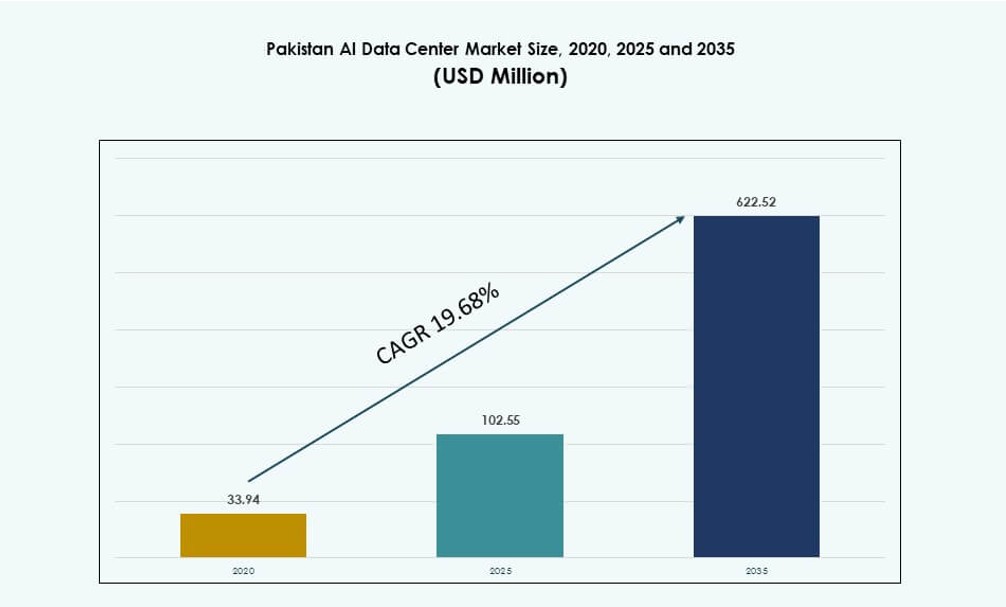
The Pakistan AI Data Center Market size was valued at USD 33.94 million in 2020 to USD 102.55 million in 2025 and is anticipated to reach USD 622.52 million by 2035, at a CAGR of 19.68% during the forecast period.
| REPORT ATTRIBUTE |
DETAILS |
| Historical Period |
2020-2023 |
| Base Year |
2024 |
| Forecast Period |
2025-2035 |
| Pakistan AI Data Center Market Size 2025 |
USD 102.55 Million |
| Pakistan AI Data Center Market, CAGR |
19.68% |
| Pakistan AI Data Center Market Size 2035 |
USD 622.52 Million |
The market is gaining momentum from sovereign cloud initiatives, AI infrastructure investments, and public-private collaborations. Sectors like finance, logistics, and healthcare are driving demand for AI-ready compute capacity. National focus on digital sovereignty and local data hosting further boosts infrastructure build-outs. Companies are adopting GPU-powered systems to support model training, language processing, and real-time analytics. Investors are targeting edge deployments and sovereign stacks. Policy support and domestic capability-building enhance the market’s long-term appeal. It presents scalable opportunities for infrastructure vendors and hyperscale operators.
Islamabad and Rawalpindi lead the market with strong public sector demand and regulatory alignment. Lahore is emerging as a key hub for fintech-driven AI services and software innovation. Karachi, with its connectivity advantages, supports commercial and enterprise workloads. Smaller cities like Faisalabad and Multan show growth in edge deployments. These regional shifts reflect distributed demand patterns. Strategic location and fiber presence guide AI center expansion. The market’s geography is shaped by a mix of policy, talent, and infrastructure availability.
Market Dynamics:
Market Drivers
Growing Enterprise Digitalization and AI Integration Across BFSI and Public Sectors
The Pakistan AI Data Center Market is witnessing a rapid push from digital transformation initiatives, especially in banking and government services. Financial institutions use AI to improve fraud detection, credit risk modeling, and personalized service delivery. Public sector departments deploy AI for citizen services, surveillance, and language processing. These use cases create demand for scalable compute resources within national boundaries. Investments in localized GPU clusters and cloud-native stacks are rising. Private and state-led programs also back this adoption. Investors see strong returns in infrastructure aligned with sovereign AI requirements. It reinforces strategic relevance across both enterprise and policy landscapes.
- For instance, Data Vault and Telenor Pakistan launched the country’s first sovereign AI data center in Karachi in 2025, supporting public and enterprise workloads through GPU-as-a-service infrastructure powered by thousands of Nvidia GPUs.
Expanding Local AI Startups and Ecosystem Development in Tier-1 Cities
A growing wave of AI startups in cities like Karachi, Lahore, and Islamabad is fueling demand for low-latency infrastructure. Startups in healthcare, logistics, and retail increasingly use AI for diagnosis, inventory prediction, and recommendation systems. These firms need access to advanced AI training and inference capabilities. The Pakistan AI Data Center Market responds to this need with new edge nodes and AI-specific compute zones. University-backed R&D in machine learning tools supports continuous growth. Local incubation programs foster scalable AI models requiring onshore compute. It boosts domestic platform development. This startup-led demand adds competitive depth to the data center landscape.
National Cloud and Digital Sovereignty Push Driving Infrastructure Localization
Pakistan’s push for digital sovereignty is encouraging public cloud deployments with local data residency controls. Government directives emphasize storing and processing sensitive workloads within national borders. This regulatory stance drives investment in AI-ready local data centers. Multinational cloud providers explore partnerships with domestic firms to align with policy. Local enterprises prefer infrastructure within reach for compliance and performance. The Pakistan AI Data Center Market benefits from this policy-to-tech alignment. It opens scope for new facilities certified for security and low-latency AI workloads. Strategic focus on national AI self-sufficiency strengthens infrastructure demand.
Power Infrastructure Reforms and Renewable Integration Supporting AI Workloads
High-density AI deployments require stable and scalable power. Recent reforms in Pakistan’s energy sector include plans for grid modernization and captive solar power. Operators integrate these solutions to support AI computing clusters sustainably. Renewable microgrids and efficient cooling systems reduce operating costs. Such improvements enable higher rack density per square meter. The Pakistan AI Data Center Market benefits from these shifts by offering energy-aligned facility planning. Power-predictive AI tools are also tested in live data center environments. These operational efficiencies make AI infrastructure viable in more regions and reduce total cost of ownership.
- For instance, XDS DATACENTRE and Al Nahal IT Park signed a 2025 GITEX Global agreement to build a liquid-immersion AI data center in Karachi with containerized, energy-efficient cooling systems.
Market Trends
Rising Demand for Sovereign AI Cloud Zones and GPU-as-a-Service Offerings
Pakistan’s tech providers are launching AI-focused cloud zones to host sensitive and high-compute workloads. These sovereign clouds offer dedicated GPU access with tiered services for AI developers and startups. GPU-as-a-Service allows flexible access to compute resources without upfront infrastructure costs. The Pakistan AI Data Center Market supports this shift by building dedicated zones for AI training and inference. Such models allow developers to scale AI pipelines efficiently. Public institutions and financial firms prefer these sovereign platforms for local compliance. It boosts value proposition for domestic and hybrid infrastructure solutions.
AI-Native Design Adoption in Next-Gen Colocation and Hyperscale Facilities
Colocation providers and hyperscale builders are designing new facilities optimized for AI-native operations. These include high-ceiling halls, liquid cooling support, and dense power zones above 40 kW per rack. Providers use AI-based telemetry for predictive operations and workload balancing. The Pakistan AI Data Center Market reflects this shift through upgraded site planning and high-performance network fabrics. Data centers now support edge AI, model validation, and full-stack orchestration tools. Facility designs also integrate AI-specific security protocols. This trend elevates Pakistan’s infrastructure readiness for generative AI and large model hosting.
Cross-Border AI Compute Partnerships with GCC and Chinese Tech Providers
Cross-border deals between Pakistan-based operators and Gulf or Chinese firms are expanding compute collaboration. These include joint ventures for AI-capable zones, fiber sharing, and energy pooling. China’s Belt and Road tech infrastructure overlaps with Pakistan’s digital corridor initiatives. The Pakistan AI Data Center Market benefits from such arrangements by accessing advanced chipsets, capital, and deployment expertise. New AI clusters are built near SEZs to support industrial AI workloads. These alliances support training compute and inference capacity for export-facing AI services. Strategic foreign ties accelerate technical maturity.
Adoption of AI for Infrastructure Automation and Management Analytics
AI is being used inside data centers to optimize energy use, cooling loads, and predictive maintenance. Operators deploy machine learning for real-time thermal mapping, fault prediction, and anomaly detection. These smart features increase uptime and reduce manual interventions. The Pakistan AI Data Center Market shows early adoption of AI operations software by large campuses. AI-assisted DCIM tools manage rack provisioning and workload scheduling dynamically. Automation reduces operational cost while meeting AI workload demands. This trend enables higher efficiency at scale.
Market Challenges
Limited High-Density Power Availability and Transmission Bottlenecks
Many regions in Pakistan still face unreliable grid access and limited capacity for high-density power delivery. AI workloads require 20–50 kW per rack, while existing centers often cap below that range. Aging transformers, frequent outages, and diesel dependence raise energy costs. Transmission losses further restrict expansion beyond metro areas. The Pakistan AI Data Center Market faces delay in scaling capacity across secondary regions due to these factors. It impacts the ability to meet rising demand from AI application providers. Investors assess power availability before committing to large-scale deployment.
Lack of Local Chip Fabrication and Dependence on Import Supply Chains
Pakistan lacks advanced semiconductor fabrication or packaging capability, making the AI infrastructure sector dependent on imported GPUs and switches. Delays in customs, limited foreign reserves, and licensing constraints slow hardware onboarding. This bottleneck affects GPU cluster deployment timelines. The Pakistan AI Data Center Market requires reliable import channels and local integration facilities to maintain momentum. Long procurement cycles hinder rapid scaling for generative AI startups. Delays reduce competitiveness against faster-moving peers in India or UAE. Strategic stockpiling and diplomatic alignment are being considered to mitigate this risk.
Market Opportunities
Edge AI Deployments and Tier-2 Data Center Expansions for Regional Services
Opportunities are emerging in deploying micro AI data centers closer to end users. Industries like healthcare and retail demand faster insights from regional zones. The Pakistan AI Data Center Market can capture this demand through edge AI deployments in Sialkot, Multan, and Faisalabad. These deployments allow real-time processing without relying on central facilities. Local governments seek private partnerships to scale these nodes. The trend aligns with regional digital service decentralization.
AI Upskilling and Research Hubs Creating Demand for Public Training Clusters
Universities and public institutions are expanding AI programs, creating need for shared training clusters. The Pakistan AI Data Center Market sees this as a catalyst for infrastructure demand near academic zones. National AI strategies support open-access compute hubs. These research-aligned clusters support innovation, NLP research, and open-source model training. Such hubs attract talent and grant funding.
Market Segmentation
By Type
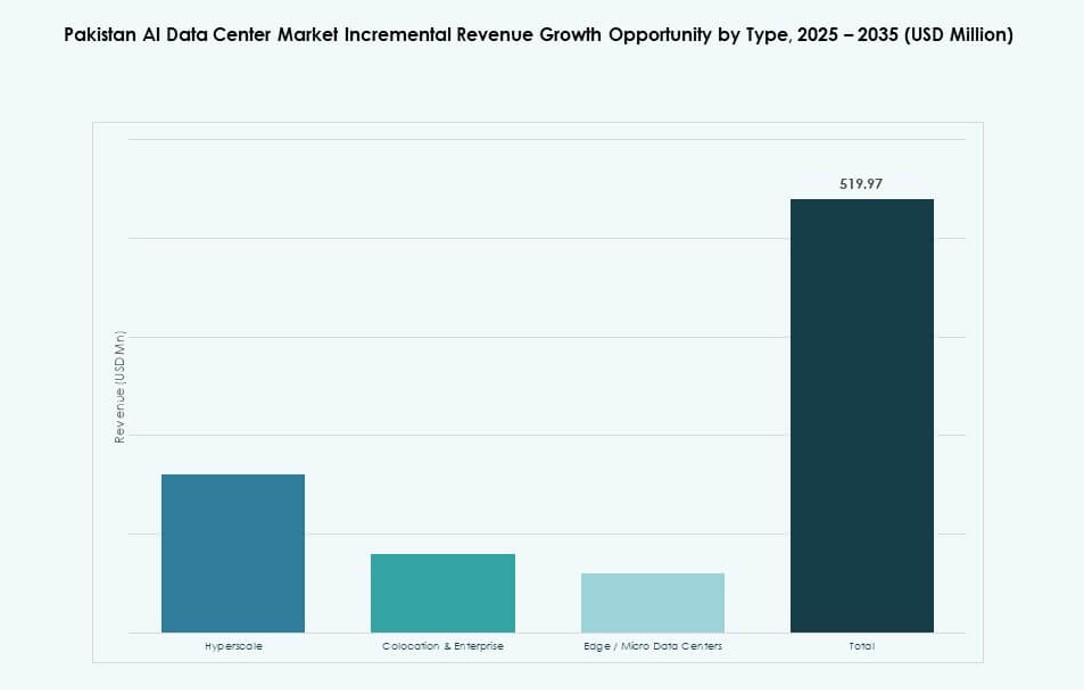
Hyperscale data centers dominate the Pakistan AI Data Center Market due to centralized compute demand from telecom, cloud, and public sector workloads. Colocation and enterprise segments follow, supporting hosted GPU and hybrid deployments for mid-size firms. Edge and micro data centers are emerging, especially in retail and logistics sectors, where real-time AI processing at the edge is critical. This segment is projected to grow faster due to low-latency service demand and localized application deployment.
By Component
Hardware represents the largest share in the Pakistan AI Data Center Market, driven by demand for GPUs, high-density racks, and power infrastructure. Software and orchestration tools are rapidly growing, enabling workload management, resource scaling, and observability. Services, including managed operations, maintenance, and consulting, contribute to operational efficiency. Growth in hardware reflects high initial capital needs, while orchestration software enables real-time AI workload adaptation and cost optimization.
By Deployment
Cloud deployment leads the Pakistan AI Data Center Market as enterprises seek scalability, compliance, and AI tools through IaaS and PaaS models. On-premise remains relevant in BFSI and defense sectors requiring strict data control. Hybrid deployment is gaining traction, combining cost benefits of cloud with security of local hosting. The shift toward hybrid models supports AI development in regulated environments, offering flexibility and compliance.
By Application
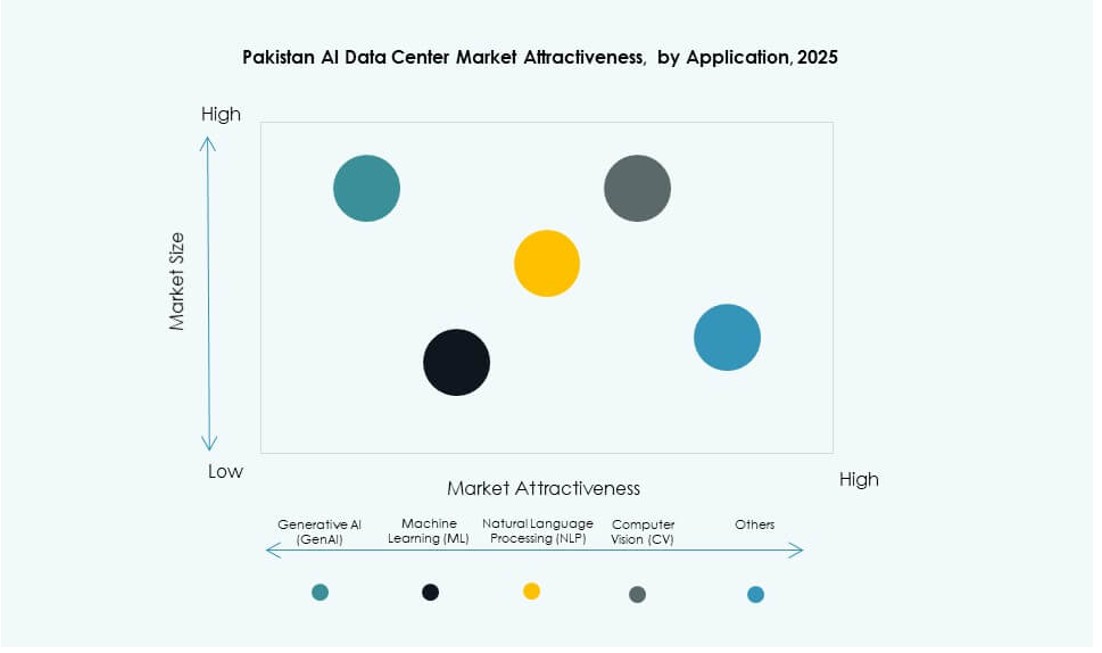
Machine Learning (ML) leads AI workload deployment, including fraud detection, recommendation engines, and predictive analytics. Generative AI (GenAI) is expanding across media and fintech, requiring high-density compute. NLP workloads grow rapidly due to Urdu and regional language processing. Computer Vision (CV) supports surveillance, healthcare imaging, and automotive AI. ML holds the highest share, but GenAI is the fastest-growing application in the Pakistan AI Data Center Market.
By Vertical
BFSI and IT & Telecom are dominant verticals due to AI-driven automation, fraud detection, and customer analytics. Healthcare uses AI for diagnostics, medical records analysis, and imaging. Retail applies AI in inventory forecasting and customer personalization. Manufacturing leverages AI for predictive maintenance. Media & Entertainment explore GenAI in content creation. BFSI leads overall market share in the Pakistan AI Data Center Market due to continuous investment in digital transformation.
Regional Insights
North Region – Islamabad, Rawalpindi, and Peshawar Corridor (40% Share)
The north region leads the Pakistan AI Data Center Market with approximately 40% share, driven by government agencies, telecom hubs, and national cloud infrastructure. Islamabad hosts key public sector data centers and regulatory institutions. Operators invest in AI-specific zones to support policy-driven digitalization. Fiber connectivity, power reliability, and proximity to national stakeholders support expansion. AI cluster projects near academic and government campuses further boost demand. Private firms also co-locate in this region for low-latency access to federal systems.
- For instance, PTCL operates a Tier III+ certified data center in Islamabad’s H‑9/1 sector built for high‑reliability server colocation with redundant power and cooling systems. The facility supports e‑governance platforms, enterprise services, and critical workloads requiring continuous uptime.
Central Region – Lahore, Faisalabad, and Multan (32% Share)
The central region holds around 32% of the market, led by commercial enterprise demand from manufacturing, logistics, and retail. Lahore is a hub for fintech startups and software parks deploying AI solutions. Growth in generative AI tools for design and content boosts workload density. Faisalabad and Multan are emerging edge zones with potential for localized AI data centers. Regional smart city projects and textile automation programs are key drivers. The central region benefits from strong industrial demand and expanding digital economy.
South Region – Karachi and Hyderabad Belt (28% Share)
The south region contributes 28% to the Pakistan AI Data Center Market, with Karachi as the financial and commercial center. Large enterprises deploy AI infrastructure for fraud detection, transaction monitoring, and logistics optimization. Port access and undersea cable landings enhance connectivity. New data center parks in this region support hyperscale and colocation growth. AI-specific expansions by telecoms and digital banks are underway. The region’s strategic coastal location enables regional cross-border AI service delivery.
- For instance, Data Vault and Telenor Pakistan launched the country’s first domestically operated AI data center and sovereign AI cloud in Karachi in 2025. The facility supports locally hosted AI workloads and GPU‑enabled computing for sectors such as finance, healthcare, and enterprise analytics.
Competitive Insights:
- Pakistan Data Management Services
- Netsol Cloud
- Microsoft (Azure)
- Amazon Web Services (AWS)
- Google Cloud / Alphabet
- Equinix
- Digital Realty Trust
- Dell Technologies
- IBM
- NVIDIA
The Pakistan AI Data Center Market features a diverse mix of global cloud giants, regional data center firms, and hardware leaders. AWS, Microsoft, and Google Cloud lead cloud-based AI infrastructure deployments through regional availability zones and sovereign cloud solutions. Local providers like Pakistan Data Management Services and Netsol Cloud support compliance-focused colocation and private cloud setups. Global players including Dell, IBM, and NVIDIA contribute essential hardware, GPUs, and orchestration platforms to enable AI training and inference workloads. It remains competitive across verticals, with hyperscale and hybrid deployments gaining traction. Collaborations and technology partnerships help players address regulatory needs, optimize costs, and deliver scalable AI capacity across metro hubs.
Recent Developments:
- In December 2025, Telenor partnered with Data Vault to launch Pakistan’s first domestically operated AI data center and sovereign AI cloud, enhancing AI adoption in sectors like finance, healthcare, and logistics with over 3,000 Nvidia GPUs.
- In December 2025, Data Vault Pakistan partnered with Rafay Systems to enhance its sovereign AI data center with advanced Kubernetes management for scalable AI workloads.
- In October 2025, Pakistan’s Ministry of IT and Saudi Arabia’s GO Telecom inaugurated the GO AI Hub in Islamabad, a joint venture to advance AI innovation, data centers, and cybersecurity infrastructure while connecting Pakistani talent to global markets.
- In October 2025, XDS DATACENTRE and Al Nahal IT Park signed an agreement at GITEX Global to build Pakistan’s first AI liquid immersion data center in Karachi using containerized solutions for rapid AI compute deployment.