
High Bandwidth Memory Market Size, Share & Forecast to 2035
Market at a glance
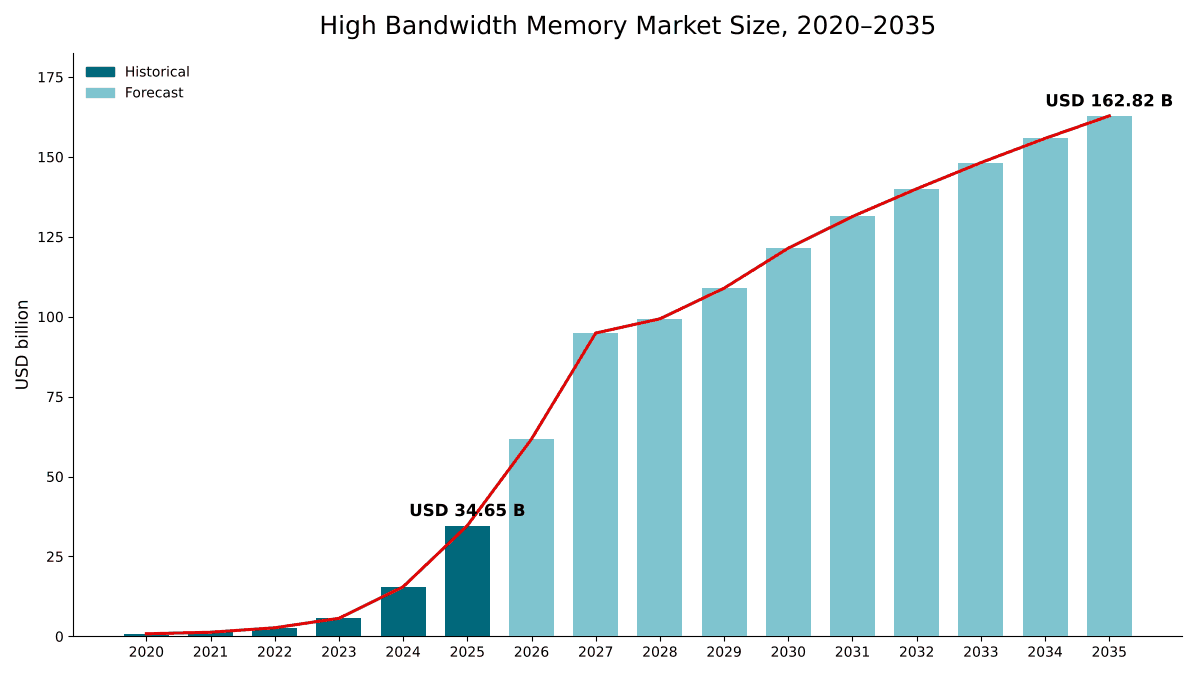
The High Bandwidth Memory market was worth USD 34.65 billion in 2025 and is forecast to reach USD 162.82 billion by 2035, growing at a 16.73% CAGR. North America accounts for 58.4% of the market.
 By Amit Jain, Senior Consultant, ICT & Emerging Technologies
 Reviewed by Deepti Agrawal
Last updated 10 Oct 2026
Base year 2025 PDF + Excel
Reviewed by Deepti Agrawal
Last updated 10 Oct 2026
Base year 2025 PDF + Excel
Source: DC Market Insights analysis
Key findings
HBM per Accelerator Rises from 185 GB to 640 GB by 2035
HBM4 Doubles the Interface to 2,048 Bits
Cleanroom Shortages Limit Bit Supply Until 2027
Custom AI Accelerators Grow from USD 7.87 Billion to USD 60.73 Billion
What is inside the report
- 01Introduction
- 02Research Methodology
- 03Executive Summary
- 04Market Dynamics
- 05Pricing Analysis
- 06Standards and Regulation
- 07Supply Chain Analysis
- 08Market Size and Forecast
- 09High Bandwidth Memory Market, By Generation
- 10High Bandwidth Memory Market, By Capacity per Stack
- 20chapters
- 2020-2024Historical period
- 2026-2035Forecast period
- 10Companies profiled
Regional insights
- North America58.4%
- Asia Pacific24.6%
- Europe10.3%
- Middle East and Africa4.2%
- Latin America2.5%
Segmentation
Companies profiled
- SK hynix
- Samsung Electronics
- Micron Technology
- TSMC
- NVIDIA
- AMD
- Amazon Web Services
- Broadcom
- Intel
Recent developments
SK hynix completed HBM4 development and prepared for mass production, with 2,048 I/O terminals, over 10 Gbps operating speed and more than 40% better power efficiency (Source: SK hynix press release).
Micron said it had completed price and volume agreements for its entire calendar 2026 HBM supply (Source: Micron earnings call).
Samsung began shipping commercial HBM4 with a consistent 11.7 Gbps speed and up to 3.3 TB/s of bandwidth per stack (Source: Samsung newsroom).
Micron reported volume shipments of HBM4 36GB 12H designed for NVIDIA Vera Rubin and sampled a 48 GB 16-high HBM4 product (Source: Micron earnings call prepared remarks).
SK hynix reported that it began mass shipments of HBM4 in the second quarter of 2026, and Samsung reported shipping the industry's first HBM4E samples to major customers (Source: SK hynix and Samsung quarterly results).
Micron said it had completed agreements for the vast majority of its calendar 2027 HBM bit supply with significant price increases (Source: Micron earnings call).
Full analysis
The High Bandwidth Memory Market covers the stacked dynamic random-access memory (DRAM) devices, known as high bandwidth memory (HBM), that memory makers sell for mounting beside graphics processing units (GPUs), custom AI accelerators and other processors on a shared package, valued at first sale by the memory maker. DC Market Insights values the global High Bandwidth Memory Market at USD 34.65 billion in 2025 and forecasts USD 162.82 billion by 2035, a CAGR of 16.73%. The 2025 value is built from shipments: about 8.40 million HBM-equipped processors carrying an average of 185 gigabytes (GB) of HBM each gives about 1,554 million GB, and at an average selling price of about USD 22.30 per GB that equals USD 34.65 billion. HBM4 and later generations are the fastest-growing segment at 78.97% a year because NVIDIA’s Rubin and other 2026 flagship accelerators move to the 2,048-bit HBM4 interface, and the Middle East and Africa is the fastest-growing region at 20.14% a year as DC Market Insights expects Saudi Arabia and the United Arab Emirates to add AI accelerator capacity from a small base.
Executive Summary
The Global High Bandwidth Memory Market size was valued at USD 817.92 million in 2020, reached USD 34.65 billion in 2025, and is anticipated to reach USD 162.82 billion by 2035, at a CAGR of 16.73% during the forecast period.
| Report attribute | Details |
|---|---|
| Historical Period | 2020-2024 |
| Base Year | 2025 |
| Forecast Period | 2026-2035 |
| High Bandwidth Memory Market Size 2025 | USD 34.65 Billion |
| High Bandwidth Memory Market, CAGR | 16.73% |
| High Bandwidth Memory Market Size 2035 | USD 162.82 Billion |
DC Market Insights estimates that the market grew at 111.55% a year between 2020 and 2025, and 2025 alone more than doubled the 2024 value of USD 15.52 billion. SK hynix reported that its HBM revenue more than doubled year on year in 2025, and Micron reported HBM revenue of nearly USD 2 billion in its fiscal fourth quarter of 2025, an annualized run rate of nearly USD 8 billion. DC Market Insights forecasts USD 61.74 billion in 2026, driven by HBM4 price premiums and larger memory per accelerator, and USD 99.34 billion in 2028.
Growth slows to 16.73% a year from 2025 to 2035 for two reasons. Unit growth slows as accelerator shipments mature, rising from 8.40 million processors in 2025 to 24.00 million in 2035, and the price per GB falls from USD 22.30 to USD 10.60 as new HBM capacity from all three memory makers comes online after 2027. Memory per processor keeps rising, from 185 GB to 640 GB, which keeps the market growing even as prices fall.
Market Scope: What Does the High Bandwidth Memory Market Cover?
The High Bandwidth Memory Market covers every HBM stack sold worldwide, valued at the memory maker’s selling price in current US dollars, with 2025 as the base year and forecasts to 2035. DC Market Insights sizes it at USD 34.65 billion in 2025, almost all of it for data center accelerators.
Included. HBM2E, HBM3, HBM3E, HBM4 and HBM4E stacks in every height from 4-high to 16-high, including the logic base die, sold to GPU makers, custom AI accelerator designers, CPU and FPGA makers and networking chip makers, whether shipped to the processor maker or to its packaging partner.
Excluded. Conventional DDR5 server DRAM, LPDDR and SOCAMM modules, GDDR graphics memory, the GPU or accelerator die itself, interposers, substrates and packaging services, and the HBM content of consumer graphics products.
How the segments fit together. Generation, capacity per stack, processor type, application and end-user each re-cut the same USD 34.65 billion total. Regions and countries allocate value to where the HBM-equipped processors are deployed in data centers, not where the memory is made, so South Korea and Taiwan appear by deployment only.
Market Drivers: What Drives the High Bandwidth Memory Market?
Three drivers explain most of the growth in the High Bandwidth Memory Market: memory per accelerator that rises from 185 GB to 640 GB, AI capital spending that took NVIDIA’s fiscal 2026 Data Center revenue to USD 193.70 billion, and multi-year supply agreements that sell out HBM output before it is made.
HBM per Accelerator Rises from 185 GB to 640 GB by 2035
Each new accelerator generation carries more HBM. AMD’s Instinct MI355X carries 288 GB of HBM3E with 8 TB/s of memory bandwidth, and NVIDIA’s Rubin GPU carries 288 GB of HBM4 arranged in eight stacks. Custom accelerators follow the same path: Google’s Ironwood TPU offers 192 GB of HBM per chip, and AWS Trainium3 carries 144 GB of HBM3e. DC Market Insights estimates the average HBM content of an HBM-equipped processor at 185 GB in 2025 and forecasts 360 GB in 2028 and 640 GB in 2035, the single largest driver of the High Bandwidth Memory Market. Accelerator shipments behind these figures are covered in the Data Center Accelerator Market report.
AI Capital Spending Lifts NVIDIA Data Center Revenue to USD 193.70 Billion
HBM demand follows accelerator demand. NVIDIA reported fiscal 2026 revenue of USD 215.90 billion, with Data Center revenue up 68% to a record USD 193.70 billion. NVIDIA said in January 2026 that Rubin was in full production, with Rubin-based products available from partners in the second half of 2026; a Vera Rubin NVL72 rack combines 72 Rubin GPUs and 36 Vera CPUs. DC Market Insights estimates that merchant GPUs took 71.8% of HBM value in 2025.
Supply Agreements Sell Out HBM Output Through 2027
Buyers now contract HBM a year or more ahead. Micron said on its December 2025 earnings call that it had completed agreements on price and volume for its entire calendar 2026 HBM supply, and on its fiscal fourth-quarter 2026 earnings call at the end of September 2026 that it had completed agreements for the vast majority of its calendar 2027 HBM bit supply with significant price increases. Samsung said it expects its HBM sales to more than triple in 2026 compared with 2025. DC Market Insights builds a rise in the average price per GB from USD 22.30 in 2025 to USD 25.10 in 2027 into the forecast.
Market Trends: How Is HBM Technology Changing?
The High Bandwidth Memory Market is moving to HBM4 in 2026, with a 2,048-bit interface, taller stacks and logic base dies made on foundry processes, and HBM4 and later generations are forecast to reach 93.3% of value by 2035.
HBM4 Doubles the Interface to 2,048 Bits
The JEDEC Solid State Technology Association published the JESD270-4 HBM4 standard in April 2025, with transfer speeds of up to 8 Gb/s across a 2,048-bit interface and total bandwidth of up to 2 TB/s per stack. Memory makers ship above that speed: Samsung’s HBM4 runs at a consistent 11.7 Gbps with up to 3.3 TB/s per stack, SK hynix said its HBM4 exceeds 10 Gbps, and Micron said its HBM4 runs at over 11 gigabits per second. DC Market Insights forecasts HBM4 and later generations, 1.3% of value in 2025, to reach USD 151.91 billion by 2035.
Stacks Grow from 12-High to 16-High and 48 GB
Capacity per stack rises with stack height. Samsung’s 12-layer HBM4 offers 24 GB to 36 GB, and Samsung plans 16-layer stacks of up to 48 GB. Micron has sampled an HBM4 16-high product with 48 GB per cube, 33% more than its 12-high part. Stacks of 36 GB and above held 32.5% of 2025 value and are forecast to reach 89.5% by 2035.
Logic Base Dies Move to Foundry Processes
From HBM4, the base die at the bottom of each stack becomes a logic chip that can be customized. SK hynix and TSMC agreed in April 2024 to use TSMC’s advanced logic processes for the HBM4 base die and to improve integration of SK hynix HBM with TSMC’s CoWoS packaging. Samsung’s HBM4 uses a 4 nm logic base die, and Samsung reported that HBM base-die demand helped its foundry business in the second quarter of 2026. Custom HBM samples from Samsung are due to reach customers in 2027.
Market Challenges: What Holds the High Bandwidth Memory Market Back?
Cleanroom space and export controls are the two constraints that DC Market Insights expects to cap the High Bandwidth Memory Market below its high case, worth USD 191.47 billion by 2035.
Cleanroom Shortages Limit Bit Supply Until 2027
HBM competes with other DRAM for the same cleanrooms. Micron said in March 2026 that cleanroom constraints, long construction lead times and a higher HBM trade ratio constrain DRAM bit supply growth, and that it expects fiscal 2027 capital spending to step up meaningfully for HBM and DRAM. SK hynix cites the opening of the Yongin Phase 1 cleanroom, expected in early 2027. DC Market Insights expects price per GB to stay above USD 24.00 until new capacity arrives, then fall to USD 18.90 in 2028.
Export Controls Restrict HBM Sales to China
On December 2, 2024, the US Department of Commerce’s Bureau of Industry and Security (BIS) added HBM stacks with memory bandwidth density above 2 GB per second per square millimeter to export control classification 3A090.c. Exports of these items to Macau or Country Group D:5, which includes China, now require a license. DC Market Insights estimates China’s share of global HBM value at 7.8% in 2025.
Market Opportunities: Where Are the New Revenue Pools?
The two largest new revenue pools in the High Bandwidth Memory Market are custom AI accelerators, growing at 22.68% a year, and AI inference, which overtakes training by 2030 and grows at 21.88% a year.
Custom AI Accelerators Grow from USD 7.87 Billion to USD 60.73 Billion
Cloud providers design their own accelerators and buy HBM for them. Broadcom’s 3.5D XDSiP platform for custom accelerators integrates more than 6,000 mm2 of silicon and up to 12 HBM stacks in one packaged device. DC Market Insights forecasts custom AI ASICs to lift their share of HBM value from 22.7% in 2025 to 37.3% in 2035. The chips themselves are covered in the AI Chip Market report.
AI Inference Reaches USD 92.48 Billion by 2035
DC Market Insights assumes inference accelerators carry HBM content close to that of training parts. DC Market Insights values inference at USD 12.79 billion (36.9%) in 2025 and forecasts USD 92.48 billion (56.8%) by 2035.
Pricing: How Much Does HBM Cost per GB?
HBM sold for an average of about USD 22.30 per GB in 2025, and an HBM-equipped processor carried about USD 4,125.50 of HBM. These are DC Market Insights estimates across all generations and stack heights, at the memory maker’s selling price.
| HBM pricing and content | 2020 | 2025 | 2027 | 2030 | 2035 |
|---|---|---|---|---|---|
| Average price (USD per GB) | 28.40 | 22.30 | 25.10 | 15.00 | 10.60 |
| HBM per processor (GB) | 32 | 185 | 300 | 460 | 640 |
| HBM-equipped processors (million) | 0.90 | 8.40 | 12.60 | 17.60 | 24.00 |
DC Market Insights expects price per GB to rise from 2025 to 2027 as HBM4 enters volume and supply stays sold out, then to fall by about 10.2% a year from 2027 to 2035 as yields mature and new fabs and packaging lines open. HBM content per processor rises faster than price falls until 2028, which is why the market keeps growing.
Standards and Regulation: Which Rules Shape HBM?
Two sets of rules shape the High Bandwidth Memory Market: the JEDEC HBM standards that fix the interface, and US export controls that decide where HBM may be shipped.
JEDEC JESD270-4 (April 2025). The HBM4 standard supports 4-high, 8-high, 12-high and 16-high stacks with 24 Gb or 32 Gb dies, up to 64 GB per stack (32 Gb, 16-high), and doubles the independent channels from 16 in HBM3 to 32, with 2 pseudo-channels per channel. Memory makers compete on how far above the 8 Gb/s base speed they can run.
US export controls (December 2024). The BIS interim final rule created ECCN 3A090.c for HBM above 2 GB per second per square millimeter and a new License Exception HBM for stacks below 3.3 GB per second per square millimeter shipped directly to a packaging site by companies headquartered in the United States or Country Group A:5. Applications from companies that are not headquartered in, and whose ultimate parent is not headquartered in, Macau or Country Group D:5 receive a presumption of approval; all others receive a presumption of denial.
Supplier filings. Memory makers disclose HBM only in part. Micron’s fiscal 2026 results filed with the US Securities and Exchange Commission report revenue of USD 133.19 billion, against USD 37.38 billion a year earlier, and Cloud Memory Business Unit revenue, which includes HBM, of USD 16.28 billion in the fourth quarter.
Market Segmentation: Which Segment Leads the High Bandwidth Memory Market?
DC Market Insights estimates that HBM3E leads the High Bandwidth Memory Market with 84.3% of 2025 value, merchant GPUs lead processor types with 71.8%, and hyperscale cloud providers lead buyers with 61.2%. HBM4 and later generations are the fastest-growing segment at 78.97% a year, because NVIDIA’s Rubin and other 2026 flagship accelerators move to HBM4 and all three memory makers began volume HBM4 shipments in 2026.
By Generation: HBM3E Leads with 84.3%
| Generation | 2025 (USD billion) | Share 2025 | 2035 (USD billion) | CAGR 2025-2035 |
|---|---|---|---|---|
| HBM2E and Earlier | 0.90 | 2.6% | 0.24 | -12.24% |
| HBM3 | 4.09 | 11.8% | 0.57 | -17.89% |
| HBM3E | 29.21 | 84.3% | 10.09 | -10.08% |
| HBM4 and Later | 0.45 | 1.3% | 151.91 | 78.97% |
DC Market Insights estimates that HBM3E carried most accelerator shipments in 2025. HBM4 and later generations take 93.3% of value by 2035, while HBM3E falls to USD 10.09 billion as it moves to lower-cost inference parts.
By Capacity per Stack: 24 GB Stacks Lead with 49.6%
| Capacity per stack | 2025 (USD billion) | Share 2025 | 2035 (USD billion) | CAGR 2025-2035 |
|---|---|---|---|---|
| Up to 16 GB | 6.20 | 17.9% | 1.79 | -11.68% |
| 24 GB | 17.19 | 49.6% | 15.30 | -1.15% |
| 36 GB and Above | 11.26 | 32.5% | 145.72 | 29.18% |
The 24 GB class led 2025 in the DC Market Insights model. Stacks of 36 GB and above grow at 29.18% a year and take 89.5% of value by 2035.
By Processor Type: Merchant GPUs Lead with 71.8%
| Processor type | 2025 (USD billion) | Share 2025 | 2035 (USD billion) | CAGR 2025-2035 |
|---|---|---|---|---|
| Merchant GPUs | 24.88 | 71.8% | 95.41 | 14.39% |
| Custom AI ASICs | 7.87 | 22.7% | 60.73 | 22.68% |
| CPUs, FPGAs and Other | 1.91 | 5.5% | 6.68 | 13.35% |
Merchant GPUs from NVIDIA and AMD buy most HBM, but custom AI ASICs grow faster at 22.68% a year. CPUs, FPGAs and other processors, including Intel’s Gaudi 3 accelerator with 128 GB of HBM2e, hold 5.5%.
By Application: Generative AI Training Leads with 53.6%
| Application | 2025 (USD billion) | Share 2025 | 2035 (USD billion) | CAGR 2025-2035 |
|---|---|---|---|---|
| Generative AI Training | 18.57 | 53.6% | 58.94 | 12.24% |
| AI Inference | 12.79 | 36.9% | 92.48 | 21.88% |
| HPC and Scientific Computing | 2.22 | 6.4% | 7.16 | 12.44% |
| Networking and Other | 1.07 | 3.1% | 4.23 | 14.70% |
DC Market Insights estimates that training led in 2025. AI inference is the fastest-growing application at 21.88% a year. HPC and scientific computing holds 6.4%, and networking and other uses 3.1%.
By End-user: Hyperscale Cloud Providers Lead with 61.2%
| End-user | 2025 (USD billion) | Share 2025 | 2035 (USD billion) | CAGR 2025-2035 |
|---|---|---|---|---|
| Hyperscale Cloud Providers | 21.21 | 61.2% | 94.27 | 16.09% |
| GPU and Neocloud Providers | 6.03 | 17.4% | 28.98 | 17.00% |
| Enterprise and Sovereign AI | 5.16 | 14.9% | 32.73 | 20.28% |
| Government and Research HPC | 2.25 | 6.5% | 6.84 | 11.74% |
Hyperscale cloud providers buy HBM through both merchant GPUs and their own accelerators. Enterprise and sovereign AI buyers grow fastest at 20.28% a year as governments and large companies build national and private AI clusters, while government and research HPC grows slowest at 11.74%.
DC Exclusive: The HBM Bit-Value Model and Generation × Processor Matrix
At USD 21.45 billion in 2025, HBM3E sold for merchant GPUs is the single largest cell of the matrix and 61.9% of all HBM value. The matrix cross-tabulates the two splits that memory buyers and investors ask about most: which generation is bought, and for which kind of processor.
| 2025, USD billion | Merchant GPUs | Custom AI ASICs | CPUs, FPGAs and Other | Total |
|---|---|---|---|---|
| HBM2E and Earlier | 0.36 | 0.31 | 0.22 | 0.90 |
| HBM3 | 2.72 | 0.97 | 0.40 | 4.09 |
| HBM3E | 21.45 | 6.50 | 1.27 | 29.21 |
| HBM4 and Later | 0.35 | 0.09 | 0.01 | 0.45 |
| Total | 24.88 | 7.87 | 1.91 | 34.65 |
Merchant GPUs spend 86.2% of their HBM budget on HBM3E, while custom AI ASICs still spend 16.3% on HBM3 and earlier generations in the DC Market Insights model. CPUs, FPGAs and other processors spend 33.0% of their HBM budget on HBM3 and earlier parts. The HBM4 row is small in 2025 because volume HBM4 shipments began in 2026.
The matrix is a DC Market Insights model, not a shipment count. It is built from 48 inputs: 16 annual processor shipment counts, 16 annual HBM-per-processor values and 16 annual price-per-GB values (2020 to 2035), each split by 4 generations and 3 processor types, and checked against the HBM revenue and market outlook disclosed by Micron and the growth disclosed by SK hynix and Samsung. Multiplying processors by GB per processor by price per GB gives the market for each year. The model and its assumptions are explained on our research methodology page.
Regional Insights: Which Region Leads the High Bandwidth Memory Market?
DC Market Insights estimates that North America leads the High Bandwidth Memory Market with 58.4% of 2025 value, and the Middle East and Africa is the fastest-growing region at 20.14% a year, because DC Market Insights expects Saudi Arabia and the United Arab Emirates to add AI accelerator capacity from a small base.
North America Leads with 58.4% Share
DC Market Insights estimates that processors deployed in North American data centers carried USD 20.24 billion of HBM in 2025, and DC Market Insights forecasts USD 84.34 billion by 2035, a CAGR of 15.34%. In the DC Market Insights model, the United States accounts for 92.1% of regional value. North America loses 6.6 points of share by 2035 as other regions build their own AI capacity.
Asia Pacific Holds 24.6% Share
Asia Pacific is worth USD 8.52 billion in 2025 and USD 45.43 billion by 2035, a CAGR of 18.21%. In the DC Market Insights model, China is the largest country market in the region, but US export controls cap the value of HBM shipped into China, and DC Market Insights forecasts India to grow fastest.
Europe Holds 10.3% Share
Europe is worth USD 3.57 billion in 2025 and USD 18.89 billion by 2035, a CAGR of 18.13%. The United Kingdom, Germany and France are the three largest European country markets in the DC Market Insights model.
Middle East and Africa Holds 4.2% Share
The Middle East and Africa is worth USD 1.46 billion in 2025 and USD 9.12 billion by 2035, the fastest growth of any region at 20.14% a year. DC Market Insights allocates to Saudi Arabia and the United Arab Emirates 71.5% of regional value in 2025.
Latin America Holds 2.5% Share
Latin America is worth USD 866.36 million in 2025 and USD 5.05 billion by 2035, a CAGR of 19.27%.
Country Analysis: Which Countries Deploy the Most HBM?
DC Market Insights estimates that the United States is the largest country market for HBM at USD 18.64 billion in 2025, 53.8% of global value, followed by China at USD 2.71 billion (7.8%) and Japan at USD 1.60 billion (4.6%). The 12 largest countries account for 87.6% of 2025 value.
| Rank | Country | Region | 2025 (USD billion) | Share 2025 | 2035 (USD billion) | CAGR 2025-2035 |
|---|---|---|---|---|---|---|
| 1 | United States | North America | 18.64 | 53.8% | 76.07 | 15.10% |
| 2 | China | Asia Pacific | 2.71 | 7.8% | 11.90 | 15.94% |
| 3 | Japan | Asia Pacific | 1.60 | 4.6% | 7.99 | 17.43% |
| 4 | Canada | North America | 1.60 | 4.6% | 8.27 | 17.85% |
| 5 | South Korea | Asia Pacific | 1.12 | 3.2% | 5.81 | 17.94% |
| 6 | United Kingdom | Europe | 0.89 | 2.6% | 4.36 | 17.29% |
| 7 | India | Asia Pacific | 0.83 | 2.4% | 6.90 | 23.64% |
| 8 | Germany | Europe | 0.76 | 2.2% | 3.95 | 17.85% |
| 9 | Australia | Asia Pacific | 0.61 | 1.7% | 3.59 | 19.48% |
| 10 | France | Europe | 0.56 | 1.6% | 3.06 | 18.58% |
| 11 | Saudi Arabia | Middle East and Africa | 0.55 | 1.6% | 3.67 | 20.79% |
| 12 | United Arab Emirates | Middle East and Africa | 0.49 | 1.4% | 3.20 | 20.74% |
India is the fastest-growing country market at 23.64% a year, ahead of Saudi Arabia at 20.79% and the United Arab Emirates at 20.74%, as GPU cloud and sovereign AI capacity grows from a small base. The country figures are a DC Market Insights allocation of the regional totals, weighted by each country’s estimated share of installed and new AI accelerator capacity.
Forecast Scenarios: How Could the 2035 Forecast Change?
The High Bandwidth Memory Market reaches USD 162.82 billion by 2035 in the base case, with a range of USD 129.13 billion to USD 191.47 billion across the low and high scenarios.
| Scenario | Assumption from 2026 | 2035 (USD billion) | CAGR 2025-2035 |
|---|---|---|---|
| Low | Processor shipments 12% below base; price per GB 10% below base by 2035 | 129.13 | 14.06% |
| Base | Shipments reach 24.00 million; 640 GB per processor; USD 10.60 per GB | 162.82 | 16.73% |
| High | HBM per processor 10% above base; supply tightness keeps prices 7% higher | 191.47 | 18.64% |
The low case is what a pause in AI capital spending after 2027 looks like: accelerator orders slip just as new HBM fabs open, and prices fall faster. The high case assumes 16-high stacks become standard sooner and prices stay closer to their 2027 level. DC Market Insights sees alternative memory such as SOCAMM and CXL-attached DRAM as the main swing factor for inference parts, where some capacity can move off-package.
Competitive Insights: Who Leads the High Bandwidth Memory Market?
- SK hynix
- Samsung Electronics
- Micron Technology
- TSMC
- NVIDIA
- AMD
- Amazon Web Services
- Broadcom
- Intel
SK hynix is the market leader with about half of 2025 HBM revenue, and SK hynix, Samsung Electronics and Micron Technology together supply more than 95% of the market (both DC Market Insights estimates, based on company disclosures). SK hynix reported 2025 revenue of KRW 97.1467 trillion, with HBM revenue more than doubling, and said in September 2025 that it had completed the preparation stages to mass produce HBM4, which it described as an industry first. Micron’s annualized HBM run rate of nearly USD 8 billion in its fiscal fourth quarter of 2025 equals about 23% of the DC Market Insights 2025 market value, and Micron said in September 2025 that it had six HBM customers. Samsung began shipping commercial HBM4 in February 2026 (Source: Samsung newsroom) and shipped HBM4E samples in the second quarter of 2026. Under a 2024 agreement, SK hynix uses TSMC’s advanced logic processes for its HBM4 base die, and the two companies work to integrate SK hynix HBM with TSMC’s CoWoS packaging. NVIDIA’s Rubin and AMD’s MI355X merchant GPUs each carry 288 GB of HBM; Google’s Ironwood and AWS Trainium3 accelerators carry 192 GB and 144 GB; Broadcom’s custom accelerator platform takes up to 12 HBM stacks; Intel’s Gaudi 3 uses HBM2e.
Recent Developments
- In September 2025, SK hynix completed HBM4 development and prepared for mass production, with 2,048 I/O terminals, over 10 Gbps operating speed and more than 40% better power efficiency (Source: SK hynix press release).
- In December 2025, Micron said it had completed price and volume agreements for its entire calendar 2026 HBM supply (Source: Micron earnings call).
- In February 2026, Samsung began shipping commercial HBM4 with a consistent 11.7 Gbps speed and up to 3.3 TB/s of bandwidth per stack (Source: Samsung newsroom).
- In March 2026, Micron reported volume shipments of HBM4 36GB 12H designed for NVIDIA Vera Rubin and sampled a 48 GB 16-high HBM4 product (Source: Micron earnings call prepared remarks).
- In July 2026, SK hynix reported that it began mass shipments of HBM4 in the second quarter of 2026, and Samsung reported shipping the industry’s first HBM4E samples to major customers (Source: SK hynix and Samsung quarterly results).
- In September 2026, Micron said it had completed agreements for the vast majority of its calendar 2027 HBM bit supply with significant price increases (Source: Micron earnings call).
We follow these launches, supply agreements and capacity announcements as they happen in our data center industry updates.
Methodology: How We Built the High Bandwidth Memory Market Model
DC Market Insights built this market bottom-up from 16 annual cohorts (2020 to 2035) of HBM-equipped processors, each multiplied by an average HBM content in GB and an average selling price per GB. In 2025, 8.40 million processors with 185 GB each at USD 22.30 per GB give USD 34.65 billion; in 2035, 24.00 million processors with 640 GB each at USD 10.60 per GB give USD 162.82 billion. The total was split by 4 generations, 3 capacity classes, 3 processor types, 4 applications, 4 end-users and 5 regions, and every split sums to the market total. The result was checked top-down against three disclosures: Micron’s outlook of an HBM market of about USD 35 billion in 2025 and around USD 100 billion in 2028 (the model gives USD 34.65 billion and USD 99.34 billion), Micron’s HBM run rate of nearly USD 8 billion in its fiscal fourth quarter of 2025, and SK hynix’s report that its HBM revenue more than doubled in 2025 (the model grows 2.23 times). Country values allocate each regional total by country weights for installed and new AI accelerator capacity. Processor specifications come from NVIDIA, AMD, Google, AWS and Intel, and HBM specifications from JEDEC and the three memory makers. The analyst named on this page built the model, and the reviewer checked the arithmetic, the sources and the dates before publication.
Table of contents
- 01Introduction
- 1.1Market Definition and Scope
- 1.2Generations and Stack Configurations Covered
- 1.3Currency, Pricing and Base Year
- 1.4Key Stakeholders
- 02Research Methodology
- 2.1Bottom-Up Processor × GB × Price Model
- 2.2Top-Down Checks Against Supplier Disclosures
- 2.3Primary and Secondary Sources
- 2.4Assumptions and Limitations
- 03Executive Summary
- 3.1Market Snapshot, 2025 and 2035
- 3.2Key Findings
- 3.3Analyst View
- 04Market Dynamics
- 4.1Drivers
- 4.2Trends
- 4.3Challenges
- 4.4Opportunities
- 05Pricing Analysis
- 5.1Average Price per GB, 2020-2035
- 5.2HBM Content per Processor
- 5.3HBM Value per Processor
- 06Standards and Regulation
- 6.1JEDEC JESD270-4 HBM4 Standard
- 6.2US Export Controls on HBM (ECCN 3A090.c)
- 6.3Supplier Disclosures
- 07Supply Chain Analysis
- 7.1DRAM Wafer Supply and Cleanroom Capacity
- 7.2Logic Base Die and Foundry Partners
- 7.3Advanced Packaging and Integration
- 7.4Supply Agreements and Allocation
- 08Market Size and Forecast
- 8.1Market Size, 2020-2035
- 8.2HBM-Equipped Processor Shipments
- 8.3HBM per Processor and Bits Shipped
- 09High Bandwidth Memory Market, By Generation
- 9.1HBM2E and Earlier
- 9.2HBM3
- 9.3HBM3E
- 9.4HBM4 and Later
- 10High Bandwidth Memory Market, By Capacity per Stack
- 10.1Up to 16 GB
- 10.224 GB
- 10.336 GB and Above
- 11High Bandwidth Memory Market, By Processor Type
- 11.1Merchant GPUs
- 11.2Custom AI ASICs
- 11.3CPUs, FPGAs and Other
- 12High Bandwidth Memory Market, By Application
- 12.1Generative AI Training
- 12.2AI Inference
- 12.3HPC and Scientific Computing
- 12.4Networking and Other
- 13High Bandwidth Memory Market, By End-user
- 13.1Hyperscale Cloud Providers
- 13.2GPU and Neocloud Providers
- 13.3Enterprise and Sovereign AI
- 13.4Government and Research HPC
- 14DC Exclusive: HBM Bit-Value Model
- 14.1Generation × Processor Type Matrix, 2025
- 14.2Model Inputs and Checks
- 15High Bandwidth Memory Market, By Region
- 15.1Regional Overview, 2025 and 2035
- 15.2North America: United States, Canada
- 15.3Asia Pacific: China, Japan, South Korea, India, Australia, Rest of Asia Pacific
- 15.4Europe: United Kingdom, Germany, France, Rest of Europe
- 15.5Middle East and Africa: Saudi Arabia, United Arab Emirates, Rest of Middle East and Africa
- 15.6Latin America: Regional Total
- 16Regional Cross-Sections
- 16.1Region × Country Share, 2025
- 16.2Regional Growth Comparison, 2025-2035
- 17Forecast Scenarios
- 17.1Low Scenario
- 17.2Base Scenario
- 17.3High Scenario
- 18Competitive Landscape
- 18.1Market Share Analysis, 2025
- 18.2Supplier Positioning by Generation
- 18.3Supply Agreements and Partnerships
- 19Company Profiles
- 19.1SK hynix
- 19.2Samsung Electronics
- 19.3Micron Technology
- 19.4TSMC
- 19.5NVIDIA
- 19.6AMD
- 19.7Google
- 19.8Amazon Web Services
- 19.9Broadcom
- 19.10Intel
- 20Analyst Recommendations
- 20.1For Memory Makers
- 20.2For Accelerator Designers
- 20.3For Data Center Operators and Investors
- Fig. 1High Bandwidth Memory Market Size, 2020–2035 (USD billion)
- Fig. 2High Bandwidth Memory Market by Generation, 2025 and 2035
- Fig. 3High Bandwidth Memory Market by Processor Type, 2025 and 2035
- Fig. 4High Bandwidth Memory Market by Region, 2025 and 2035
- Fig. 5HBM Average Price per GB, 2020–2035
- Fig. 6HBM Content per Processor, 2020–2035
- Fig. 7High Bandwidth Memory Market Forecast Scenarios, 2035
- Table 1High Bandwidth Memory Market Size, 2020–2035 (USD billion)
- Table 2HBM Pricing and Content, 2020, 2025, 2027, 2030 and 2035
- Table 3High Bandwidth Memory Market by Generation, 2025 and 2035
- Table 4High Bandwidth Memory Market by Capacity per Stack, 2025 and 2035
- Table 5High Bandwidth Memory Market by Processor Type, 2025 and 2035
- Table 6High Bandwidth Memory Market by Application, 2025 and 2035
- Table 7High Bandwidth Memory Market by End-user, 2025 and 2035
- Table 8Generation × Processor Type Matrix, 2025
- Table 9High Bandwidth Memory Market by Region, 2025 and 2035
- Table 10Top 12 Countries, 2025 and 2035
- Table 11Forecast Scenarios, 2035
About this report
Written by Amit Jain and reviewed by Deepti Agrawal, Senior Editor, Research. Figures are built top-down and bottom-up and reconciled before publication, with 2025 as the base year.
Read our methodologyHow we built this
- Historical period2020-2024
- Base year2025
- Forecast period2026-2035
- Sizing approachTop-down + bottom-up
Need more than the report?
Advisory on this market
Due diligence, site selection and market entry work, by the analysts who wrote this report.
See consulting servicesFrequently asked questions
USD 34.65 billion in 2025, rising to USD 162.82 billion by 2035. DC Market Insights estimates the market at USD 817.92 million in 2020.
16.73% a year from 2025 to 2035. Growth was far faster, at 111.55% a year, between 2020 and 2025 as AI accelerators moved into volume production.
HBM3E, with USD 29.21 billion or 84.3% of the market in 2025. HBM4 and later generations are the fastest-growing segment at 78.97% a year.
About USD 22.30 per GB on average in 2025, according to DC Market Insights estimates, rising to USD 25.10 in 2027 before falling to USD 10.60 by 2035 as new capacity opens.
185 GB on average across HBM-equipped processors in 2025, rising to 640 GB by 2035 (DC Market Insights estimate). AMD’s MI355X and NVIDIA’s Rubin GPU each carry 288 GB.
North America, with USD 20.24 billion or 58.4% of 2025 value. The Middle East and Africa grows fastest at 20.14% a year.
SK hynix leads with about half of 2025 HBM revenue, and SK hynix, Samsung Electronics and Micron Technology together supply more than 95% of the market (both DC Market Insights estimates). TSMC, NVIDIA, AMD, Google, Amazon Web Services, Broadcom and Intel shape demand and packaging.
Hyperscale cloud providers, with USD 21.21 billion or 61.2% of 2025 demand. Enterprise and sovereign AI buyers grow fastest at 20.28% a year.
Licences, delivery and payment
Which licence should I choose?
Single User is a view-only PDF for one person. Multi User adds a printable PDF and the Excel data for unlimited users at one location. Enterprise covers your whole company and includes 100 free analyst hours.
How and when will I receive the report?
By email, within 24–48 business hours of payment, in the formats of your licence.
How can I pay?
Securely through PayPal: with a PayPal account, a debit or credit card, or PayPal Pay Later where available. Prices are in US dollars.
Can I see a sample first?
Yes. Request a free sample and we will email it to you.
Can the report be tailored to my needs?
Yes. We can add countries, segments or data cuts. Talk to an analyst about the scope you need.
Can I get an invoice or pay against a purchase order?
Write to sales@dcmarketinsights.com and our team will help.