
AI Chip Market Size, Share & Forecast to 2035
Market at a glance
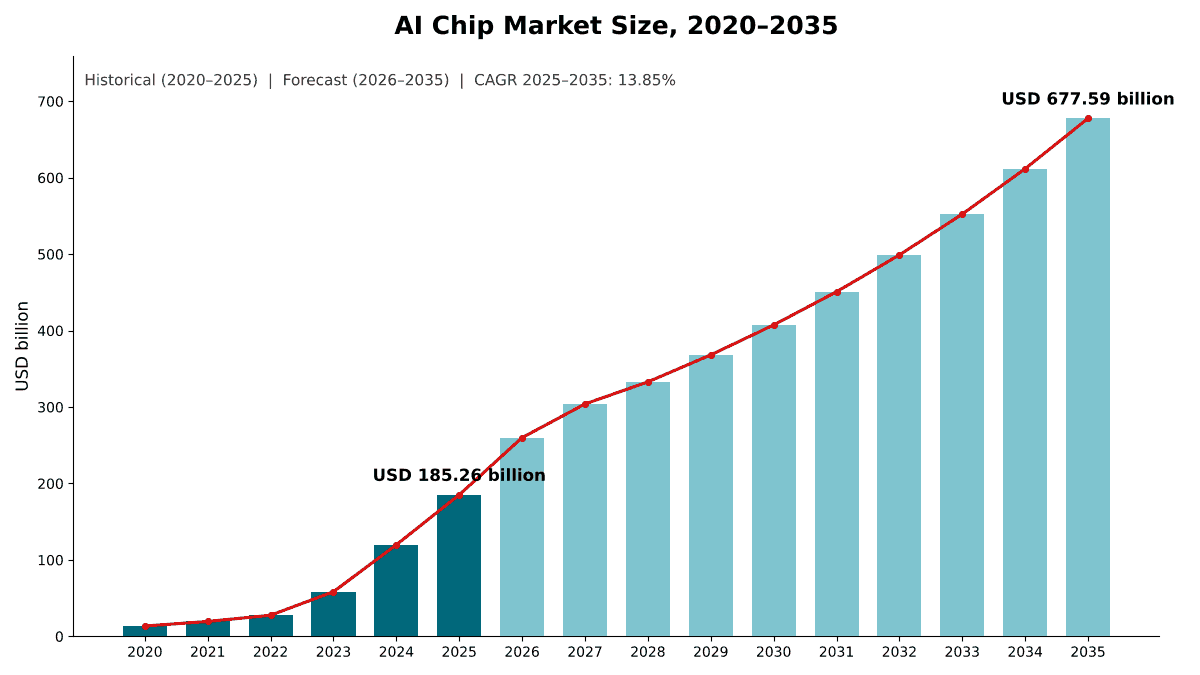
The AI Chip market was worth USD 185.26 billion in 2025 and is forecast to reach USD 677.59 billion by 2035, growing at a 13.85% CAGR. North America accounts for 56.4% of the market.
 By Amit Jain, Senior Consultant, ICT & Emerging Technologies
 Reviewed by Deepti Agrawal
Last updated 8 Oct 2026
Base year 2025 PDF + Excel
Reviewed by Deepti Agrawal
Last updated 8 Oct 2026
Base year 2025 PDF + Excel
Source: DC Market Insights analysis
Key findings
Data Center AI Revenue Rose 117% in the Quarter to July 2026
Custom Silicon Rises from 17.6% to 28.9% of Spending
Export Controls Cost AMD About USD 440 Million
Inference Accelerators Open the Data Center to New Suppliers
What is inside the report
- 01Introduction
- 02Research Methodology
- 03Executive Summary
- 04Market Dynamics
- 05Pricing Analysis
- 06Standards and Regulation
- 07Supply Chain Analysis
- 08Market Size and Forecast
- 09AI Chip Market, by Chip Type
- 10AI Chip Market, by Deployment
- 21chapters
- 2020-2024Historical period
- 2026-2035Forecast period
- 14Companies profiled
Regional insights
- North America56.4%
- Asia Pacific26.8%
- Europe10%
- Middle East and Africa4.8%
- Latin America2.1%
Segmentation
Companies profiled
- NVIDIA
- AMD
- Broadcom
- Google (TPU)
- Amazon Web Services (Trainium)
- Microsoft (Maia)
- Intel
- Qualcomm
- Huawei (Ascend)
- Mobileye
- Horizon Robotics
- Marvell Technology
- Cambricon Technologies
- Hailo
Recent developments
AMD and OpenAI announced a 6 GW agreement for AMD GPUs, starting with 1 GW of Instinct MI450 in the second half of 2026 (Source: AMD press release).
OpenAI and Broadcom agreed to deploy 10 GW of OpenAI-designed custom AI accelerators, targeted to start in the second half of 2026 and complete by the end of 2029 (Source: OpenAI announcement).
Qualcomm introduced its AI200 and AI250 data center inference chips, with AI200 availability expected in 2026 and AI250 in 2027 (Source: HPCwire report).
Intel launched Core Ultra Series 3, its first AI PC platform on the Intel 18A process, with up to 50 TOPS of NPU performance (Source: StorageReview report).
Microsoft introduced its Maia 200 inference accelerator on TSMC's 3-nanometer process with 216 GB of HBM3e (Source: Microsoft announcement).
NVIDIA reported second-quarter fiscal 2027 data center revenue of USD 89.00 billion, up 117%, and said Vera Rubin was in full production (Source: NVIDIA earnings release).
Full analysis
The AI Chip Market covers the processors built to run artificial intelligence (AI) workloads: data center graphics processing units (GPUs), AI application-specific integrated circuits (ASICs) and systems-on-chip (SoCs), neural processing units (NPUs) integrated in PC and smartphone processors, field-programmable gate arrays (FPGAs) used for AI, and other AI accelerators, sold for data centers, vehicles, consumer devices and industrial edge systems. DC Market Insights values the global AI Chip Market at USD 185.26 billion in 2025 and forecasts USD 677.59 billion by 2035, a CAGR of 13.85%. The 2025 value is built from units and prices: about 12.85 million data center accelerators worth USD 169.77 billion, about 20.7 million automotive AI SoCs at roughly USD 310 each worth USD 6.42 billion, NPU silicon in about 590 million smartphones and 100 million PCs worth USD 5.13 billion, and about 21 million industrial and edge AI chips worth USD 3.94 billion. AI ASICs and SoCs are the fastest-growing segment at 19.61% a year because cloud providers and AI labs now design their own inference chips, and the Middle East and Africa is the fastest-growing region at 16.60% a year as Gulf AI programs install accelerators from a small base.
Executive Summary
The Global AI Chip Market size was valued at USD 13.57 billion in 2020, reached USD 185.26 billion in 2025, and is anticipated to reach USD 677.59 billion by 2035, at a CAGR of 13.85% during the forecast period.
| Report attribute | Details |
|---|---|
| Historical Period | 2020-2024 |
| Base Year | 2025 |
| Forecast Period | 2026-2035 |
| AI Chip Market Size 2025 | USD 185.26 Billion |
| AI Chip Market, CAGR | 13.85% |
| AI Chip Market Size 2035 | USD 677.59 Billion |
The AI Chip Market grew at 68.67% a year between 2020 and 2025, and 2025 alone added 54.6% over 2024 as Blackwell-generation systems and custom accelerators moved into volume. Data center accelerators carried 91.6% of 2025 value. NVIDIA, the largest supplier, reported fiscal 2026 data center revenue of USD 193.70 billion, up 68%, for the year ended January 25, 2026 (Source: NVIDIA filing with the US Securities and Exchange Commission), and its data center revenue for the quarter ended July 26, 2026 reached USD 89.00 billion, up 117% from a year earlier.
DC Market Insights forecasts USD 260.01 billion in 2026, a further 40.3% rise, followed by slower growth to 13.85% a year over the full decade. Three forces slow the rate: accelerator prices rise more slowly than in the Hopper and Blackwell generations, custom ASICs take share at lower prices per chip, and the base is already 13.7 times its 2020 size. Edge and device AI chips grow faster than the data center at 16.64% a year, but stay a minority of value, rising from 8.4% of the market in 2025 to 10.7% in 2035.
Market Scope: What Does the AI Chip Market Cover?
The AI Chip Market covers every chip whose main job is AI computation, valued at first sale in current US dollars, with 2025 as the base year and forecasts to 2035. DC Market Insights sizes it at USD 185.26 billion in 2025.
Included. Data center GPUs, custom AI ASICs, data center FPGAs used for AI and other data center accelerators, valued as packaged modules, boards or cards with their on-package high-bandwidth memory (HBM); automotive AI SoCs for driver assistance and automated driving; edge AI accelerators, modules and vision SoCs for robotics, industrial machines, smart cameras and edge gateways; and the value of the NPU block inside AI-capable PC and smartphone processors.
Excluded. Server central processing units (CPUs), the rest of a PC or smartphone processor outside its NPU, memory sold separately from the AI chip, network switches and interface cards, complete servers and vehicles, software licenses and cloud rental revenue.
How the segments fit together. The data center part of this market equals the USD 169.77 billion valued in our Data Center Accelerator Market report. The edge and device part adds USD 15.49 billion. The chip type, function, deployment and end use splits each re-cut the same USD 185.26 billion total for 2025. Regions and countries are allocated by where the chips are installed, not where they are designed or made.
Market Drivers: What Drives the AI Chip Market?
Three drivers explain most of the growth in the AI Chip Market, which DC Market Insights forecasts to add USD 492.33 billion of annual value between 2025 and 2035: data center accelerator demand that more than doubled in a year, gigawatt-scale supply agreements, and inference that spreads from the data center to vehicles, PCs and machines.
Data Center AI Revenue Rose 117% in the Quarter to July 2026
Demand for data center AI chips still accelerated in 2026. NVIDIA reported revenue of USD 96.20 billion for its second quarter of fiscal 2027, up 106% from a year earlier, with data center revenue of USD 89.00 billion, up 117%, and guided third-quarter revenue to USD 108.00 billion, plus or minus 2%. AMD’s Data Center segment reached a record USD 16.60 billion for full-year 2025, up 32%, and Broadcom reported fourth-quarter fiscal 2025 AI semiconductor revenue up 74% year over year, guiding first-quarter fiscal 2026 AI semiconductor revenue to double year over year to USD 8.20 billion. DC Market Insights values data center accelerators at USD 169.77 billion in 2025 and USD 605.42 billion by 2035, a CAGR of 13.56%.
Gigawatt Supply Agreements Lock In Volumes Through 2029
AI labs now buy chips by the gigawatt. In October 2025, OpenAI and Broadcom agreed to deploy 10 GW of custom AI accelerators, with racks targeted to start in the second half of 2026 and complete by the end of 2029, and AMD and OpenAI agreed a 6 GW deal that starts with 1 GW of Instinct MI450 GPUs in the second half of 2026. DC Market Insights estimates the accelerator content of one gigawatt of AI capacity at USD 17 billion to USD 22 billion at 2025 prices, so these two programs alone represent more than a year of 2025 market value.
Inference Rises from 46.2% to 64.8% of Value
AI inference accounted for USD 85.60 billion, or 46.2% of 2025 value, against USD 86.92 billion (46.9%) for training. DC Market Insights forecasts inference to grow at 17.76% a year to USD 439.05 billion, 64.8% of the 2035 market, because every deployed model serves requests for years after it is trained and because every edge and device AI chip is an inference chip. NVIDIA states that its Rubin platform, made up of six new chips, will deliver up to a 10x reduction in inference token cost, which widens the set of workloads worth running on accelerators.
Market Trends: How Are AI Chips Changing?
The AI Chip Market is moving to custom silicon, faster memory and on-device NPUs, with AI ASICs and SoCs rising from 17.6% of value in 2025 to 28.9% by 2035.
Custom Silicon Rises from 17.6% to 28.9% of Spending
Cloud providers design their own chips to cut the cost of inference at scale. Microsoft’s Maia 200 inference accelerator is built on TSMC’s 3-nanometer process with more than 140 billion transistors and 216 gigabytes (GB) of HBM3e at 7 terabytes per second (TB/s), and is deployed in Microsoft’s US Central region near Des Moines, Iowa. DC Market Insights values AI ASICs and SoCs at USD 32.64 billion in 2025, of which USD 26.52 billion are data center custom accelerators, and forecasts USD 195.65 billion by 2035. Custom design also shapes demand across the Data Center Chip Market.
HBM4 Raises Memory Bandwidth to 2 TB/s per Stack
Memory bandwidth limits many AI workloads. The HBM4 standard from the Joint Electron Device Engineering Council (JEDEC) allows transfer speeds up to 8 gigabits per second across a 2048-bit interface, for up to 2 TB/s per stack. DC Market Insights includes HBM in the value of each accelerator when it sits on the package.
NPUs Above 40 TOPS Become Standard in New PCs
Microsoft defines Copilot+ PCs as Windows 11 hardware powered by an NPU that can perform more than 40 trillion operations per second (TOPS). Intel’s Core Ultra Series 3, its first AI PC platform built on the Intel 18A process, offers up to 50 TOPS of NPU performance and up to 180 TOPS across the platform in more than 200 PC designs, and AMD introduced Ryzen AI 400 Series platforms at CES 2026. DC Market Insights values client NPUs at USD 5.13 billion in 2025, growing at 14.85% a year to USD 20.48 billion.
Market Challenges: What Holds the AI Chip Market Back?
Export controls and power availability are the two constraints that DC Market Insights expects to cap the AI Chip Market below unconstrained demand, with China growing at 13.49% a year, below the Asia Pacific rate of 14.76%.
Export Controls Cost AMD About USD 440 Million
US export rules decide which AI chips can be sold into China, the second-largest country market. AMD’s 2025 results included about USD 440 million of net inventory and related charges because of US export controls on its Instinct MI308 products. In May 2025, the US Department of Commerce rescinded the AI Diffusion Rule and issued guidance warning industry of the risks of using Chinese advanced computing chips, including specific Huawei Ascend chips (Source: Bureau of Industry and Security announcement). NVIDIA’s outlook for its third quarter of fiscal 2027 does not assume any data center compute revenue from China, so domestic Chinese chips fill most of that demand in the DC Market Insights model.
Power Limits Decide Where Accelerators Can Run
Qualcomm’s AI200 rack-scale inference systems carry a rated power draw of 160 kW per rack, and the gigawatt agreements above need new grid connections at campus scale. DC Market Insights estimates that each gigawatt of AI capacity absorbs about 1.0 million to 1.3 million accelerators at Blackwell-generation power levels, so a delayed grid connection is a delayed chip shipment. The low scenario below models a two-year slip in AI power delivery, which cuts the 2035 market by USD 149.46 billion.
Market Opportunities: Where Are the New Revenue Pools?
The two largest new revenue pools in the AI Chip Market are inference accelerators from new suppliers and edge AI chips for vehicles and machines, which grow at 17.04% and 18.06% a year.
Inference Accelerators Open the Data Center to New Suppliers
Inference rewards memory capacity and cost per token more than peak training throughput. Qualcomm plans AI200 systems for 2026 and AI250 for 2027, with 768 GB of LPDDR memory per AI200 card, and Saudi AI company Humain plans up to 200 MW of Qualcomm AI systems. DC Market Insights values other AI chips, the category most new inference suppliers sell into, at USD 2.77 billion in 2025, growing at 18.40% a year to USD 15.01 billion. The servers that carry these chips are sized in our AI Server Market report.
Automotive and Edge AI Chips Grow to USD 51.69 Billion
Driver assistance, automated driving, robots and smart cameras run AI at the edge, where latency and connectivity rule out the cloud. Mobileye’s 2025 revenue rose 15% to USD 1.89 billion, NVIDIA’s automotive revenue rose 39% to a record USD 2.30 billion in fiscal 2026, and Horizon Robotics delivered more than four million sets of Journey-series automotive chips in 2025, up 39%. DC Market Insights values automotive AI chips at USD 6.42 billion and industrial, robotics and edge AI chips at USD 3.94 billion in 2025, together USD 51.69 billion by 2035.
Pricing: How Much Does an AI Chip Cost?
A data center GPU sold for about USD 22,060 on average in 2025, a custom data center AI ASIC for about USD 5,120 and an automotive AI SoC for about USD 310. These are DC Market Insights estimates of blended average selling prices across all models, including on-package memory and excluding the board, server or vehicle around the chip.
| AI chip class (2025) | Average selling price or value (USD) | Units (million) | Value (USD billion) |
|---|---|---|---|
| Data center GPUs | 22,060 | 6.30 | 138.98 |
| Data center custom AI ASICs | 5,120 | 5.18 | 26.52 |
| Automotive AI SoCs | 310 | 20.7 | 6.42 |
| Industrial and edge AI chips | 188 | 20.95 | 3.94 |
| NPU value per smartphone | 6.10 | 590 | 3.60 |
| NPU value per PC | 15.30 | 100 | 1.53 |
Data center FPGAs and other accelerators add USD 4.27 billion. The price ladder runs from about USD 6 to more than USD 22,000 per chip, so unit counts mislead: client devices account for most AI chips shipped but only 2.8% of value.
Standards and Regulation: Which Rules Shape AI Chips?
Four sets of rules shape the AI Chip Market: the JEDEC HBM4 memory standard at up to 2 TB/s per stack, the UALink scale-up specification for up to 1,024 accelerators, US export controls, and the European Union (EU) AI Act threshold of 10^25 floating-point operations for systemic-risk models.
JEDEC HBM4 (JESD270-4). The JEDEC JESD270-4 HBM4 standard, published in April 2025, supports 4-high, 8-high, 12-high and 16-high DRAM stacks and up to 2 TB/s per stack, and DC Market Insights expects it to become the main memory interface for new data center accelerators.
UALink 200G 1.0. The Ultra Accelerator Link Consortium’s UALink 200G 1.0 specification, released in April 2025, enables 200G-per-lane scale-up connections for up to 1,024 accelerators in one AI computing pod, which gives chip makers other than NVIDIA an open scale-up fabric.
US export controls. Rules administered by the Bureau of Industry and Security decide which AI chips can ship to China and other controlled destinations; the rescission of the AI Diffusion Rule in May 2025 came with guidance on Huawei Ascend chips.
EU AI Act. Obligations for providers of general-purpose AI models apply from 2 August 2025, and models trained with more than 10^25 floating-point operations are presumed to pose systemic risk, a threshold the European Commission says is under review. The rule regulates models, not chips.
Market Segmentation: Which Segment Leads the AI Chip Market?
GPUs lead the AI Chip Market with 76.9% of 2025 value, data centers lead deployment with 91.6%, and hyperscale cloud providers lead end use with 56.5%. AI ASICs and SoCs are the fastest-growing segment at 19.61% a year, against 11.96% for GPUs, because cloud providers and AI labs use their own designs to cut the cost of inference at scale.
By Chip Type: GPUs Lead with 76.9%
| Chip type | 2025 (USD billion) | Share 2025 | 2035 (USD billion) | CAGR 2025-2035 |
|---|---|---|---|---|
| GPUs | 142.39 | 76.9% | 440.85 | 11.96% |
| AI ASICs and SoCs | 32.64 | 17.6% | 195.65 | 19.61% |
| Client NPUs | 5.13 | 2.8% | 20.48 | 14.85% |
| FPGAs | 2.33 | 1.3% | 5.60 | 9.19% |
| Other AI Chips | 2.77 | 1.5% | 15.01 | 18.40% |
GPUs lose 11.8 points of share by 2035 but still triple in value, because their software ecosystem keeps them the default for training.
By Deployment: Data Centers Lead with 91.6%
Data center chips are worth USD 169.77 billion in 2025 and USD 605.42 billion by 2035, a CAGR of 13.56%. Edge and device chips are worth USD 15.49 billion and grow faster, at 16.64% a year, to USD 72.17 billion; they ship in far greater numbers but sell at a fraction of a data center accelerator’s price. NVIDIA reported Edge Computing revenue of USD 7.20 billion for the second quarter of its fiscal 2027, up 27% from a year earlier.
By Function: AI Training Leads with 46.9%
| Function | 2025 (USD billion) | Share 2025 | 2035 (USD billion) | CAGR 2025-2035 |
|---|---|---|---|---|
| AI Training | 86.92 | 46.9% | 204.63 | 8.94% |
| AI Inference | 85.60 | 46.2% | 439.05 | 17.76% |
| HPC and Other | 12.74 | 6.9% | 33.91 | 10.28% |
Training and inference were almost level in 2025. Inference pulls ahead of training within the forecast period in the DC Market Insights model, while high-performance computing (HPC) and other uses keep a shrinking share.
By End Use: Hyperscale Cloud Providers Lead with 56.5%
| End use | 2025 (USD billion) | Share 2025 | 2035 (USD billion) | CAGR 2025-2035 |
|---|---|---|---|---|
| Hyperscale Cloud Providers | 104.75 | 56.5% | 352.96 | 12.92% |
| Enterprises and Government | 39.89 | 21.5% | 154.99 | 14.54% |
| GPU Cloud and Neocloud Providers | 25.13 | 13.6% | 97.47 | 14.52% |
| Automotive | 6.42 | 3.5% | 30.96 | 17.04% |
| Consumer Devices | 5.13 | 2.8% | 20.48 | 14.85% |
| Industrial, Robotics and Edge | 3.94 | 2.1% | 20.73 | 18.06% |
Industrial, robotics and edge buyers grow fastest at 18.06% a year as factories, warehouses and cities add vision and robot control systems, and automotive follows at 17.04% as higher levels of driver assistance need more compute per vehicle.
DC Exclusive: The AI Chip Type × Deployment Matrix
Data center GPUs are the single largest cell of the matrix at USD 138.98 billion, 75.0% of all 2025 AI chip value, while edge and device deployments together account for USD 15.49 billion. The matrix below cross-tabulates what is bought and where it runs.
| 2025, USD billion | GPUs | AI ASICs and SoCs | Client NPUs | FPGAs | Other AI Chips | Total |
|---|---|---|---|---|---|---|
| Data Center | 138.98 | 26.52 | 0.00 | 2.01 | 2.26 | 169.77 |
| Automotive | 1.99 | 4.43 | 0.00 | 0.00 | 0.00 | 6.42 |
| Consumer Devices | 0.00 | 0.00 | 5.13 | 0.00 | 0.00 | 5.13 |
| Industrial, Robotics and Edge | 1.42 | 1.69 | 0.00 | 0.32 | 0.51 | 3.94 |
| Total | 142.39 | 32.64 | 5.13 | 2.33 | 2.77 | 185.26 |
ASICs already hold 69.0% of automotive AI chip value, against 15.6% in the data center, because carmakers and their suppliers standardized on dedicated driving SoCs years before cloud providers built their own accelerators. Industrial and edge buyers use the most varied mix, with no chip type above 43.0% of the row, which makes it the hardest segment to win with one product line.
The matrix is a DC Market Insights model, not a shipment count, built from 56 inputs: 16 annual data center totals (2020 to 2035), 9 edge anchor values (3 edge segments for 2020, 2025 and 2035), 6 unit and price assumptions, 4 data center chip-type values, 6 edge chip-type shares, 10 regional weights and 5 supplier disclosures used as a cross-check. The model and its assumptions are explained on our research methodology page.
Regional Insights: Which Region Leads the AI Chip Market?
North America leads the AI Chip Market with 56.4% of 2025 value. The Middle East and Africa is the fastest-growing region at 16.60% a year, because Gulf AI programs are installing accelerators from a small base (DC Market Insights estimate).
North America Leads with 56.4% Share
North America installed AI chips worth USD 104.42 billion in 2025, and the region is forecast to grow at 12.83% a year to USD 349.15 billion. The 10 GW Broadcom and 6 GW AMD programs with OpenAI both begin deliveries in the second half of 2026. North America loses 4.9 points of share by 2035 as other regions build their own AI capacity.
Asia Pacific Holds 26.8% Share
Asia Pacific is worth USD 49.69 billion in 2025 and USD 196.82 billion by 2035, a CAGR of 14.76%. The region holds the largest share of edge and device AI chips, at about half of that segment, because most smartphones, PCs and vehicles with AI processors are built and sold there.
Europe Holds 10.0% Share
Europe is worth USD 18.47 billion in 2025 and USD 73.56 billion by 2035, a CAGR of 14.82%. The United Kingdom is the largest European market at USD 4.34 billion, ahead of Germany at USD 3.82 billion, where automotive AI chips and industrial automation add edge demand.
Middle East and Africa Holds 4.8% Share
The Middle East and Africa is worth USD 8.80 billion in 2025 and USD 40.88 billion by 2035, the fastest regional growth at 16.60% a year. Saudi Arabia and the United Arab Emirates account for most of the region in the DC Market Insights allocation, and Humain’s plan for up to 200 MW of Qualcomm AI systems adds inference capacity in Saudi Arabia.
Latin America Holds 2.1% Share
Latin America is worth USD 3.88 billion in 2025 and USD 17.17 billion by 2035, a CAGR of 16.03%, led by Brazil and Mexico.
Country Analysis: Which Countries Buy the Most AI Chips?
The United States is the largest country market for AI chips at USD 96.30 billion in 2025, 52.0% of global value, followed by China at USD 22.94 billion (12.4%) and Canada at USD 8.01 billion (4.3%). The 12 largest countries account for 86.8% of 2025 value.
| Rank | Country | Region | 2025 (USD billion) | Share 2025 | 2035 (USD billion) | CAGR 2025-2035 |
|---|---|---|---|---|---|---|
| 1 | United States | North America | 96.30 | 52.0% | 317.20 | 12.66% |
| 2 | China | Asia Pacific | 22.94 | 12.4% | 81.31 | 13.49% |
| 3 | Canada | North America | 8.01 | 4.3% | 31.45 | 14.66% |
| 4 | Japan | Asia Pacific | 6.99 | 3.8% | 24.75 | 13.48% |
| 5 | South Korea | Asia Pacific | 4.67 | 2.5% | 18.92 | 15.01% |
| 6 | United Kingdom | Europe | 4.34 | 2.3% | 15.60 | 13.65% |
| 7 | Germany | Europe | 3.82 | 2.1% | 14.53 | 14.31% |
| 8 | India | Asia Pacific | 3.60 | 1.9% | 23.15 | 20.46% |
| 9 | Saudi Arabia | Middle East and Africa | 3.18 | 1.7% | 15.87 | 17.43% |
| 10 | United Arab Emirates | Middle East and Africa | 2.71 | 1.5% | 13.25 | 17.19% |
| 11 | France | Europe | 2.65 | 1.4% | 11.02 | 15.31% |
| 12 | Taiwan | Asia Pacific | 1.64 | 0.9% | 6.45 | 14.70% |
India is the fastest-growing large country market at 20.46% a year, as hyperscale operators and domestic cloud providers build AI capacity from a small installed base, ahead of Saudi Arabia at 17.43%. Taiwan completes the top 12 at USD 1.64 billion. The country figures are a DC Market Insights allocation of the regional totals, weighted by each country’s estimated share of installed and new AI data center capacity and of AI device and vehicle sales.
Forecast Scenarios: How Could the 2035 Forecast Change?
The AI Chip Market reaches USD 677.59 billion by 2035 in the base case, with a range of USD 528.13 billion to USD 823.51 billion across the low and high scenarios.
| Scenario | Assumption from 2026 | 2035 (USD billion) | CAGR 2025-2035 |
|---|---|---|---|
| Low | Two-year slip in AI power delivery; AI capital spending flat in real terms after 2028; edge and device value 20% below base | 528.13 | 11.04% |
| Base | Announced gigawatt programs delivered by 2030; AI ASICs and SoCs reach 28.9% of value | 677.59 | 13.85% |
| High | Grid and HBM supply keep pace with announced plans; edge and device value 20% above base | 823.51 | 16.09% |
The high case assumes HBM, advanced packaging and grid connections all keep pace with the gigawatt agreements. Supplier mix is the main swing factor inside the total: a faster move to custom ASICs lowers the average price per chip but raises unit volumes.
Competitive Insights: Who Leads the AI Chip Market?
- NVIDIA
- AMD
- Broadcom
- Google (TPU)
- Amazon Web Services (Trainium)
- Microsoft (Maia)
- Intel
- Qualcomm
- Huawei (Ascend)
- Mobileye
- Horizon Robotics
- Marvell Technology
- Cambricon Technologies
- Hailo
NVIDIA leads the AI Chip Market with about 72% of 2025 value (DC Market Insights estimate: about 77% of the USD 169.77 billion data center accelerator market, plus most automotive and edge GPUs, set against the USD 185.26 billion total). NVIDIA’s fiscal 2026 revenue reached USD 215.90 billion, up 65%. AMD’s Data Center segment reached USD 16.60 billion in 2025, covering EPYC processors and Instinct GPUs. Broadcom is the largest custom AI ASIC partner in the DC Market Insights estimate, with fourth-quarter fiscal 2025 AI semiconductor revenue up 74% and the 10 GW OpenAI program. Intel’s 2025 revenue was USD 52.90 billion, flat year over year, with its Client Computing Group at USD 32.20 billion, where Core Ultra Series 3 carries its NPU strategy. Qualcomm’s fiscal 2025 chip business revenue was USD 38.37 billion, including USD 27.79 billion from handsets and USD 3.96 billion from automotive, and it enters the data center with AI200 and AI250. In vehicles, Mobileye (USD 1.89 billion of 2025 revenue) and Horizon Robotics (RMB 3.76 billion of 2025 revenue, up 57.7%) compete with NVIDIA.
Recent Developments
- In October 2025, AMD and OpenAI announced a 6 GW agreement for AMD GPUs, starting with 1 GW of Instinct MI450 in the second half of 2026 (Source: AMD press release).
- In October 2025, OpenAI and Broadcom agreed to deploy 10 GW of OpenAI-designed custom AI accelerators, targeted to start in the second half of 2026 and complete by the end of 2029 (Source: OpenAI announcement).
- In October 2025, Qualcomm introduced its AI200 and AI250 data center inference chips, with AI200 availability expected in 2026 and AI250 in 2027 (Source: HPCwire report).
- In January 2026, Intel launched Core Ultra Series 3, its first AI PC platform on the Intel 18A process, with up to 50 TOPS of NPU performance (Source: StorageReview report).
- In January 2026, Microsoft introduced its Maia 200 inference accelerator on TSMC’s 3-nanometer process with 216 GB of HBM3e (Source: Microsoft announcement).
- In August 2026, NVIDIA reported second-quarter fiscal 2027 data center revenue of USD 89.00 billion, up 117%, and said Vera Rubin was in full production (Source: NVIDIA earnings release).
We follow these deals, launches and capacity announcements as they happen in our data center industry updates.
Methodology: How We Built the AI Chip Market Model
DC Market Insights built this market bottom-up from units and prices in four deployment segments. The data center segment reuses the DC Market Insights Data Center Accelerator Market model: about 6.30 million GPUs at USD 22,060, 5.18 million custom AI ASICs at USD 5,120, plus FPGAs and other accelerators, USD 169.77 billion in 2025. The edge and device segments are DC Market Insights estimates: about 20.7 million automotive AI SoCs at about USD 310 (USD 6.42 billion), NPU value of about USD 6.10 in 590 million smartphones and about USD 15.30 in 100 million PCs (USD 5.13 billion), and about 21 million industrial and edge AI chips at about USD 188 (USD 3.94 billion). Three bound checks frame the result. A floor: the disclosed 2025 automotive revenue of Mobileye (USD 1.89 billion), NVIDIA (USD 2.30 billion) and Horizon Robotics product and solutions (RMB 1.62 billion) sums to about USD 4.42 billion, below the USD 6.42 billion automotive segment, which also covers other suppliers and in-house chips. A ceiling: client NPU value of USD 5.13 billion equals about 8.6% of the USD 59.99 billion that Qualcomm’s handset chips and Intel’s Client Computing Group sold in their latest fiscal years. A top-down check: NVIDIA’s fiscal 2026 data center revenue of USD 193.70 billion, which also includes networking, CPUs and systems, exceeds the USD 169.77 billion data center accelerator segment, and TSMC reported that AI accelerators made up a high-teens percentage of its 2025 revenue. The total was split by 5 chip types, 2 deployments, 3 functions, 6 end uses, 5 regions and 12 countries, and every split sums to the market total. The analyst named on this page built the model, and the reviewer checked the arithmetic, the sources and the dates before publication.
Table of contents
- 01Introduction
- 1.1Market Definition and Scope
- 1.2Chips Included and Excluded
- 1.3Currency, Pricing and Base Year
- 1.4Key Stakeholders
- 02Research Methodology
- 2.1Units and Price Build
- 2.2Data Center Accelerator Base
- 2.3Edge and Device Estimates
- 2.4Bound Checks and Supplier Disclosures
- 2.5Assumptions and Limitations
- 03Executive Summary
- 3.1AI Chip Market Snapshot, 2025 and 2035
- 3.2Key Findings
- 3.3Analyst View
- 04Market Dynamics
- 4.1Drivers
- 4.2Restraints
- 4.3Opportunities
- 4.4Trends
- 4.5Impact of Gigawatt Supply Agreements
- 05Pricing Analysis
- 5.1Average Selling Price by Chip Class, 2025
- 5.2NPU Value per Device
- 5.3Accelerator Content per Gigawatt
- 06Standards and Regulation
- 6.1JEDEC HBM4 (JESD270-4)
- 6.2UALink 200G 1.0
- 6.3US Export Controls
- 6.4EU AI Act
- 07Supply Chain Analysis
- 7.1Chip Design and Custom Silicon Partners
- 7.2Foundry and Advanced Packaging
- 7.3High-Bandwidth Memory Supply
- 7.4System Integration
- 08Market Size and Forecast
- 8.1Market Size, 2020-2035
- 8.2Year-on-Year Growth
- 8.3Data Center and Edge Contribution
- 09AI Chip Market, by Chip Type
- 9.1GPUs
- 9.2AI ASICs and SoCs
- 9.3Client NPUs
- 9.4FPGAs
- 9.5Other AI Chips
- 10AI Chip Market, by Deployment
- 10.1Data Center
- 10.2Edge and Device
- 11AI Chip Market, by Function
- 11.1AI Training
- 11.2AI Inference
- 11.3HPC and Other
- 12AI Chip Market, by End Use
- 12.1Hyperscale Cloud Providers
- 12.2Enterprises and Government
- 12.3GPU Cloud and Neocloud Providers
- 12.4Automotive
- 12.5Consumer Devices
- 12.6Industrial, Robotics and Edge
- 13DC Exclusive: AI Chip Type × Deployment Matrix
- 13.1Matrix, 2025
- 13.2Model Inputs
- 14AI Chip Market, by Region
- 14.1North America (United States, Canada)
- 14.2Asia Pacific (China, Japan, South Korea, India, Taiwan)
- 14.3Europe (United Kingdom, Germany, France)
- 14.4Middle East and Africa (Saudi Arabia, United Arab Emirates)
- 14.5Latin America (Brazil, Mexico)
- 15Country Analysis
- 15.1Top 12 Countries, 2025 and 2035
- 15.2Fastest-Growing Countries
- 16Regional Cross-Sections
- 16.1Data Center versus Edge Mix by Region
- 16.2Region Share Shift, 2025 to 2035
- 17Edge and Device AI Chips
- 17.1Automotive AI SoCs
- 17.2Client NPUs in PCs and Smartphones
- 17.3Industrial and Robotics AI Chips
- 18Forecast Scenarios
- 18.1Low Scenario
- 18.2Base Scenario
- 18.3High Scenario
- 19Competitive Landscape
- 19.1Market Share Estimate, 2025
- 19.2Merchant versus Custom Silicon
- 19.3Recent Developments
- 20Company Profiles
- 20.1NVIDIA
- 20.2AMD
- 20.3Broadcom
- 20.4Google (TPU)
- 20.5Amazon Web Services (Trainium)
- 20.6Microsoft (Maia)
- 20.7Intel
- 20.8Qualcomm
- 20.9Huawei (Ascend)
- 20.10Mobileye
- 20.11Horizon Robotics
- 20.12Marvell Technology
- 20.13Cambricon Technologies
- 20.14Hailo
- 21Analyst Recommendations
- 21.1For Chip Suppliers
- 21.2For Data Center Operators
- 21.3For Investors
- Fig. 1AI Chip Market Size, 2020-2035 (USD billion)
- Fig. 2AI Chip Market by Region, 2025 and 2035 (USD billion)
- Fig. 3AI Chip Market by Chip Type, 2025 and 2035
- Fig. 4AI Chip Market by Deployment, 2025 and 2035
- Fig. 5AI Chip Market by Function, 2025 and 2035
- Fig. 6AI Chip Market by End Use, 2025 and 2035
- Fig. 7AI Chip Type × Deployment Matrix, 2025
- Fig. 8Top 12 Countries, 2025
- Table 1AI Chip Market Snapshot, 2025 and 2035
- Table 2Average Selling Price and Units by Chip Class, 2025
- Table 3AI Chip Market by Chip Type, 2025 and 2035 (USD billion)
- Table 4AI Chip Market by Deployment, 2025 and 2035 (USD billion)
- Table 5AI Chip Market by Function, 2025 and 2035 (USD billion)
- Table 6AI Chip Market by End Use, 2025 and 2035 (USD billion)
- Table 7AI Chip Type × Deployment Matrix, 2025 (USD billion)
- Table 8AI Chip Market by Region, 2025 and 2035 (USD billion)
- Table 9Top 12 Countries, 2025 and 2035 (USD billion)
- Table 10Forecast Scenarios, 2035 (USD billion)
- Table 11Recent Developments
About this report
Written by Amit Jain and reviewed by Deepti Agrawal, Senior Editor, Research. Figures are built top-down and bottom-up and reconciled before publication, with 2025 as the base year.
Read our methodologyHow we built this
- Historical period2020-2024
- Base year2025
- Forecast period2026-2035
- Sizing approachTop-down + bottom-up
Need more than the report?
Advisory on this market
Due diligence, site selection and market entry work, by the analysts who wrote this report.
See consulting servicesFrequently asked questions
USD 185.26 billion in 2025, rising to USD 677.59 billion by 2035. DC Market Insights estimates the market at USD 13.57 billion in 2020.
13.85% a year from 2025 to 2035. Growth was faster, at 68.67% a year, between 2020 and 2025 as data center AI accelerators moved into volume.
GPUs, with USD 142.39 billion or 76.9% of the market in 2025. AI ASICs and SoCs are the fastest-growing chip type at 19.61% a year.
91.6%, or USD 169.77 billion in 2025. Edge and device AI chips are worth USD 15.49 billion and grow faster, at 16.64% a year.
About USD 22,060 for a data center GPU in 2025, USD 5,120 for a custom data center AI ASIC and USD 310 for an automotive AI SoC, according to DC Market Insights estimates.
North America, with USD 104.42 billion or 56.4% of 2025 value. The Middle East and Africa grows fastest at 16.60% a year.
NVIDIA leads with about 72% of 2025 value (DC Market Insights estimate). AMD, Broadcom, Google, Amazon Web Services, Microsoft, Intel, Qualcomm, Huawei, Mobileye, Horizon Robotics, Marvell Technology, Cambricon Technologies and Hailo also compete.
USD 96.30 billion in the United States, or 52.0% of 2025 value, followed by China at USD 22.94 billion. India grows fastest among large country markets at 20.46% a year (DC Market Insights estimate).
Licences, delivery and payment
Which licence should I choose?
Single User is a view-only PDF for one person. Multi User adds a printable PDF and the Excel data for unlimited users at one location. Enterprise covers your whole company and includes 100 free analyst hours.
How and when will I receive the report?
By email, within 24–48 business hours of payment, in the formats of your licence.
How can I pay?
Securely through PayPal: with a PayPal account, a debit or credit card, or PayPal Pay Later where available. Prices are in US dollars.
Can I see a sample first?
Yes. Request a free sample and we will email it to you.
Can the report be tailored to my needs?
Yes. We can add countries, segments or data cuts. Talk to an analyst about the scope you need.
Can I get an invoice or pay against a purchase order?
Write to sales@dcmarketinsights.com and our team will help.