

Key takeaways
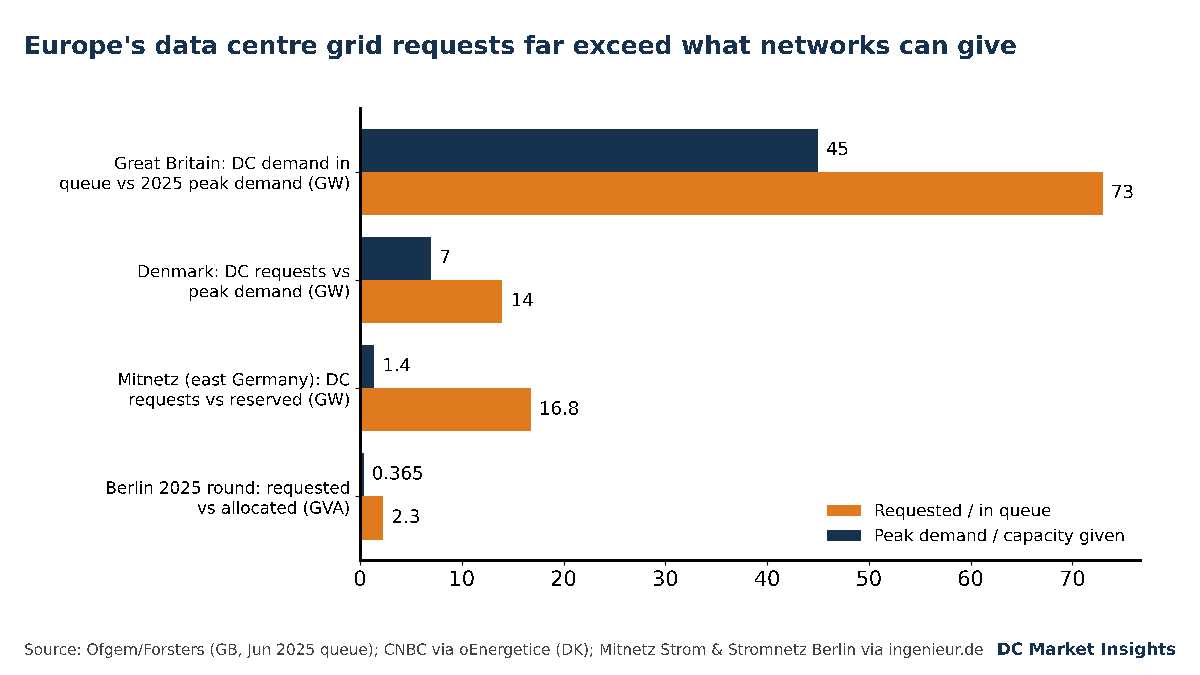
- Great Britain’s demand connection queue grew from 41 GW to 125 GW between November 2024 and June 2025, with about 73 GW of it tied to data centres, against peak demand of about 45 GW in 2025 (Ofgem, Forsters).
- Ofgem has proposed a Data Centre Commitment Fee of £237,500 to £712,500 per MW for projects of 40 MW or more, posted as security until energisation. Consultation closed on 16 September; a decision is due later in 2026 (Ofgem).
- In east Germany, Mitnetz Strom had 90 data centre requests for 16.8 GW at the end of 2025 and firmly reserved about 1.4 GW for nine projects, or 8% (ingenieur.de; share is our calculation).
- If every megawatt of Britain’s 73 GW data centre queue had to post Ofgem’s fee, the security would total £17.3 billion to £52.0 billion (our calculation).
- Germany’s grid connection package, which ends first-come, first-served connections, is expected to reach its final Bundestag vote in the week of 9-13 November, with the Bundesrat targeted for 20 November (pv magazine, citing BEE).
Europe’s grid operators can no longer connect every data centre that asks. In Britain, the queue of data centre demand is larger than the country’s whole peak load. In Berlin, applicants asked for more than six times the capacity on offer. Regulators are now deciding who gets a connection, in what order, and who pays for the wires.
Why now: in the last two weeks the cost question went mainstream. On 7 October RWE’s chief executive said grid build-out for data centres “is currently not paid by those who are causing the problem”. On 13 October Moody’s warned that data centres could use up to 30% of Ireland’s electricity and 17% of the Netherlands’ by 2035. And Germany’s grid connection package moved to its final votes, now expected in November. This post looks at who is hurting, how much, and what the next rules will cost.
How Europe got here: queues bigger than the grids behind them
The pattern is the same in every major market. Requests arrive faster than transmission can be built, and many of them are speculative. Developers file in several places at once, because a grid slot is worth more than land.
Great Britain. Contracted demand in the connection queue rose from 41 GW in November 2024 to 125 GW in June 2025, and about 73 GW of that relates to data centres, according to Ofgem’s July consultation as summarised by Forsters. Peak electricity demand in Great Britain was about 45 GW in 2025. The data centre share of the queue alone is therefore about 1.6 times the country’s peak load (our calculation).
Germany. The federal government’s own data centre strategy speaks of an “Antragsstau”, a backlog of applications, ingenieur.de reported on 8 October. In Frankfurt, demand for new connections clearly exceeds what the upstream transmission grid can supply, and local network operator NRM now shares out new capacity of 3.5 MW or more pro rata, or from 1 MW in local bottleneck areas. Stromnetz Berlin ran an allocation round in 2025: 70 applicants asked for about 2,300 MVA, roughly 10% above the whole city grid’s annual peak load, and only 365 MVA was available across three network areas, the operator said. Thirty-seven applicants received capacity; ten eligible ones received none. The second 2026 round has been postponed.
Denmark. Grid operator Energinet stopped signing new connection agreements this spring after an “explosion” in requests. About 60 GW of projects were waiting, against peak demand of about 7 GW, and data centres made up about 14 GW of the queue, oEnergetice reported, citing CNBC.
demand exceeds the capacity we can realistically make available in the short term
Greece. Data centre requests to grid operator ADMIE rose from 1.2 GW at the end of 2025 to nearly 5 GW, and the energy ministry is drafting a framework to separate ready-to-build projects from speculative ones, iefimerida reported on 15 September.
| Market | Requested or queued | Available, reserved or peak | Ratio (our calculation) | Source |
|---|---|---|---|---|
| Great Britain (data centres in queue, Jun 2025) | ~73 GW | ~45 GW peak demand (2025) | 1.6x peak | Ofgem, via Forsters |
| Denmark (data centre requests) | ~14 GW | ~7 GW peak demand | 2.0x peak | CNBC, via oEnergetice |
| Mitnetz Strom, east Germany (end-2025) | 16.8 GW, 90 requests | ~1.4 GW firmly reserved, 9 projects | 8% reserved | Mitnetz, via ingenieur.de |
| Stromnetz Berlin (2025 round, all users) | ~2,300 MVA, 70 requests | 365 MVA allocated, 37 requests | 16% allocated | Stromnetz Berlin |
| Greece (data centre requests to ADMIE) | ~5 GW | 1.2 GW requested at end-2025 | 4.2x in under a year | iefimerida |
Sources as listed. Requests can overlap or be withdrawn, so requested capacity is not expected consumption, as Mitnetz itself notes. Ofgem’s press release gives “at least 80GW” of data centre applications, while its consultation refers to about 73 GW in the queue; we use the lower figure. Figures use different bases and dates and should not be added together.
What changed: regulators are putting a price on a queue position
The common answer is to make a grid slot cost money, and to rank projects by readiness instead of filing date.
Britain’s commitment fee. On 29 July Ofgem proposed a Data Centre Commitment Fee for data centres of 40 MW or more that connect to the transmission system, or to distribution networks that need a transmission assessment. The fee would be 2.5% to 7.5% of average data centre capex, which Ofgem puts at £9.5 million per MW, giving £237,500 to £712,500 per MW. Developers would post 100% of it as security from accepting a Gate 2 offer until energisation. It is returned if the project energises and forfeited if it exits early or cuts capacity, Forsters explained. Both the threshold and the level were open for consultation, which closed on 16 September.
consumers should not bear the risks created by speculative projects taking up space in the system.
Germany’s readiness rules. The four transmission system operators moved large consumers such as data centres, batteries and electrolysers to a maturity-based procedure this year, replacing first-come, first-served. The federal cabinet adopted the wider grid connection package (Netzanschlusspaket) on 29 July. It lets grid operators prioritise requests using criteria including land designated for data centres in local plans, ties capacity reservations to planning maturity, and allows capacity unused for more than five years to be reduced or released, law firm GÖRG wrote. Transmission operators must submit their connection rules to the Federal Network Agency by 1 January 2027. The Bundestag’s economics committee held its public hearing on 7 October, Denkstrom reported.
Ireland’s bring-your-own-power rule. Ireland replaced its Dublin-area restriction with a framework from the regulator CRU. Applicants for connections of 10 MVA or more must provide matching on-site or nearby generation or storage, and meet at least 80% of annual demand through additional Irish renewable projects, The Register reported, summarising Moody’s.
| Market | Rule | Who it covers | Cost or condition | Status (19 Oct 2026) |
|---|---|---|---|---|
| Great Britain | Data Centre Commitment Fee (Ofgem) | Data centres of 40 MW or more on, or needing, the transmission system | £237,500-£712,500 per MW as security until energisation | Consultation closed 16 Sep; decision later in 2026 |
| Germany | Grid connection package; TSO maturity procedure | Large consumers, incl. data centres | Readiness ranking; reservations tied to planning maturity; unused capacity can be released after 5 years | Bundestag vote expected 9-13 Nov; Bundesrat targeted 20 Nov |
| Frankfurt (NRM) | Pro-rata allocation | New connections of 3.5 MW or more (1 MW in bottleneck areas) | Capacity shared out pro rata | In force |
| Ireland | CRU large energy user connection policy | Connections of 10 MVA or more | Matching on-site generation or storage; 80% of annual demand from additional Irish renewables | In force |
| Denmark | Energinet pause on new agreements | All new connection agreements | No new agreements during the pause; longer processing | Introduced spring 2026 |
| Greece | Readiness framework (draft) | Data centre grid requests | Mature, financed projects first | Being drafted by the ministry |
Sources: Ofgem; Forsters; GÖRG; pv magazine; ingenieur.de; The Register; DCD; iefimerida.
Who is hurting, and how much
Speculative queue holders in Britain. They are the intended target. At Ofgem’s figures, a 100 MW request would tie up £23.75 million to £71.25 million of security until it energises (our calculation). Applied to the whole 73 GW of data centre demand in the queue, the security would come to £17.3 billion to £52.0 billion (our calculation, upper bound, since smaller projects would be exempt). In our view, few land-only projects can post that, which is the point. Ofgem says its earlier reforms already pulled about 7.8 GW of projects forward by an average of six years.
Credible developers who still wait. The pain is not only for speculators. DC Market Insights data tracks 183 UK facilities with about 760 MW live, 286 MW under construction and 6,834 MW planned, where a megawatt figure is published. The 73 GW in the queue is about nine times everything we track in the UK, and about 30 times the 2.4 GW of UK data centre capacity that NESO estimated in July 2025 (our calculation). Even if most of the queue goes, real projects sit behind it until it is cleared.
German projects outside the hubs. Mitnetz’s 16.8 GW of requests is about three times the 5.3 GW DC Market Insights tracks across Germany as live, under construction and planned (843.8 MW, 2,013.9 MW and 2,448.8 MW; our calculation). Only about 1.4 GW was firmly reserved. In Frankfurt, Mainova and TenneT plan about 1,000 MW of extra supply and Mainova plans about €900 million of grid investment over five years, but local constraints are expected to last until the mid-2030s, ingenieur.de reported. Germany’s strategy aims to at least double data centre capacity by 2030, and from 1 January 2027 operators must cover 100% of their electricity from renewables on a balance-sheet basis under the Energy Efficiency Act.
Households and other grid users. This is the political side of the pain. Grid fees, added to every consumer’s bill, fund network build-out. RWE’s chief executive put it bluntly in a Bloomberg interview.
This is currently not paid by those who are causing the problem.
The same report noted that Google reportedly pays €80 per MWh under a deal with Fortum, about 57% above 2030 power futures of €51 per MWh, according to research firm Inderes. Large buyers are already paying a premium for firm power; the question now is whether they also pay for the wires.
The wider pattern: Moody’s sees bills and balance sheets at risk
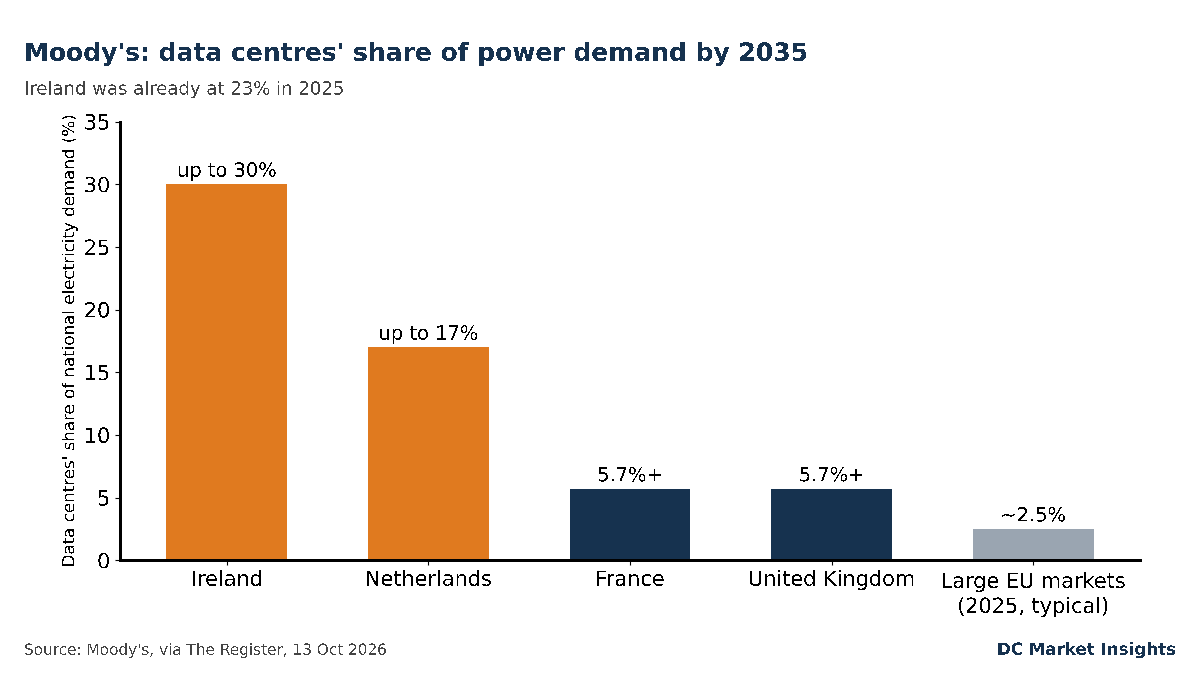
Moody’s expects data centres to take up to 17% of Dutch electricity demand and up to 30% of Irish demand by 2035, and at least 5.7% in France and the UK, against a low single-digit share, about 2.5%, in the largest European markets in 2025. Ireland is already the outlier: data centres used 23% of its electricity in 2025, up from 5% in 2015, The Register reported on 13 October.
The agency also flagged short-term balance-sheet pressure on grid operators. Transmission networks are more exposed than distribution networks, it said, because data centre operators fund only the cost of their own connection, not the reinforcement behind it. That is why transmission operators increasingly ask for financial guarantees to screen out speculative projects, and why Moody’s expects more governments to intervene, through levies, taxes, subsidies or price caps, if growth continues on its current path.
The EU wants to more than triple the bloc’s data centre capacity within five to seven years. In our view, the grid rules being written this autumn decide where that capacity lands. Markets that price queue positions and rank by readiness will connect faster; markets that keep first-come, first-served queues will keep losing projects to the Nordics and southern Europe.
What it means for operators, investors and vendors
Our view, based on the figures above:
- Budget for queue security in Britain now. At up to £712,500 per MW, a 250 MW campus could tie up as much as £178 million until energisation. Line up letters of credit before Ofgem’s decision later in 2026.
- Prune your own queue positions. With fees, readiness tests and five-year use-it-or-lose-it rules coming, holding duplicate slots across Europe becomes expensive. Keep the sites with land, permits and a customer.
- Plan Germany around 1 January 2027. That is when transmission operators must file their new connection rules and when the 100% renewables duty begins. Projects with designated land in local plans should document it now.
- Price on-site power and storage into Irish and constrained sites. Ireland already requires matching generation or storage for connections of 10 MVA or more; expect other grid operators to copy it.
- Investors: discount queue numbers. Mitnetz reserved 8% of what was requested and Berlin allocated 16%. Treat announced gigawatts outside firm grid agreements as options.
- Vendors: expect demand for generators, batteries and grid equipment to shift to the developer’s balance sheet. As regulators push reinforcement costs onto the projects that cause them, more of the spend sits inside the data centre budget.
For on-site and backup power, which these rules push developers toward, see our Data Center Generator Market report. For batteries at constrained sites, see the Data Center Energy Storage Market report, and for the demand behind the queues, the AI Data Center Market report. Country capacity figures, including the UK and Germany, are on our global data center capacity pages.
What to watch next
- 9-13 November 2026: expected second and third readings of Germany’s grid connection package in the Bundestag, according to the renewable energy association BEE.
- 20 November 2026: BEE’s target date for the Bundesrat to clear the package.
- Later in 2026: Ofgem’s final decision on the Data Centre Commitment Fee, including the 40 MW threshold and the fee level.
- 1 January 2027: German transmission operators must submit connection rules to the Federal Network Agency; Germany’s 100% renewables duty for data centres starts.
- Not yet dated: Greece’s readiness framework for data centre grid requests and the reopening terms of Energinet’s connection pause.
Frequently asked questions
How much data centre demand is in Britain’s grid queue?
About 73 GW, according to Ofgem’s July 2026 consultation, out of 125 GW of contracted demand in June 2025. Peak demand in Great Britain was about 45 GW in 2025, so the data centre share alone is about 1.6 times peak load, by our calculation.
What is Ofgem’s Data Centre Commitment Fee?
A proposed fee of £237,500 to £712,500 per MW for data centres of 40 MW or more, equal to 2.5% to 7.5% of average capex. It is posted as security from a Gate 2 offer until energisation, refunded if the project connects and forfeited if it exits. Ofgem plans to decide later in 2026.
How is Germany changing data centre grid connections?
Germany is moving from first-come, first-served to readiness-based allocation. The grid connection package lets operators prioritise data centre land in local plans and release capacity unused for five years. Its final Bundestag vote is expected on 9-13 November 2026.
How much of Europe’s power could data centres use by 2035?
Moody’s estimates up to 30% of Ireland’s electricity demand and up to 17% of the Netherlands’ by 2035, and at least 5.7% in France and the UK. Ireland’s data centres already used 23% of its power in 2025.
Sources
- Ofgem, “Ofgem acts to free up grid capacity by tackling speculative data centre projects”, 29 Jul 2026. Link
- Forsters LLP, “A price for holding power? Ofgem consults on a Data Centre Grid Commitment Fee of up to £712,500 per MW”, 2026. Link
- The Register, “European datacenter boom threatens higher energy bills unless governments intervene” (on Moody’s), 13 Oct 2026. Link
- Bloomberg via Energy Connects, “Data Center Boom Raises Issue of Who Pays for Grid, RWE Says”, 7 Oct 2026. Link
- ingenieur.de, “Zu wenig Strom für KI: Wie Deutschland jetzt Anschlüsse für Rechenzentren verteilt”, 8 Oct 2026. Link
- Stromnetz Berlin, “Antragsteller für sehr große Netzanschlüsse wurden über Ergebnis im diesjährigen Zuteilungsverfahren informiert”, 23 Jul 2025. Link
- GÖRG, “Bundesregierung beschließt Netzpaket: Kein Anschluss unter dieser Nummer?”, 22 Sep 2026. Link
- pv magazine Deutschland, “Bundestag wird EEG 2027 und Netzpaket wohl erst im November verabschieden”, 15 Oct 2026. Link
- Denkstrom, “Bundestag hält Anhörung zum Netzanschlusspaket ab”, 5 Oct 2026. Link
- DCD, “Danish grid operator introduces three-month moratorium for new grid connections”, 7 May 2026. Link
- oEnergetice, “Europe puts the brakes on data centers. Power is running short and grids are hitting limits”, 6 May 2026. Link
- iefimerida.gr, “Greek Grid Operator Moves to Filter 5 GW of Data Center Requests as Investment Surges”, 15 Sep 2026. Link
- DC Market Insights, country data for the United Kingdom and Germany (bus read 19 Oct 2026), and global data center capacity pages. Link