

Key takeaways
- Malaysia’s investment minister Johari Abdul Ghani told Parliament on 15 October that data centre investors must pay for the transmission upgrades their projects need and for their full reserved power, even if they use only half of it (The Star, Business Today).
- The same day, Deputy Prime Minister Fadillah Yusof said the government plans “user-pays” electricity pricing for data centres and other large users and is reviewing the tariff structure for 2027 (The Edge Malaysia, The Sun).
- Tenaga Nasional (TNB) reported 61 data centre projects with 8.35 GW of maximum demand under supply agreements, 5.65 GW of it already on the system, but actual data centre load of only 1,256 MW in June 2026 (TNB).
- That means data centres draw about 22% of the demand they have connected, leaving about 4.4 GW reserved but unused (our calculation from TNB figures).
- Approved data centre investment since 2021 totals RM385.7 billion, and data centres’ direct GDP contribution rose from RM900 million in 2021 to RM14.1 billion in 2025, Johari said (The Star).
Malaysia has stopped selling cheap power to data centres. In Parliament last Thursday, two senior ministers set out a new deal for the industry that turned Johor into Southeast Asia’s fastest-growing data centre market: pay for the grid you need, pay for the capacity you reserve, and expect your electricity price to carry no subsidy.
The timing is not an accident. TNB’s own figures show a large gap between what data centre developers have reserved on the grid and what they actually draw. Every megawatt reserved but not used is a megawatt that TNB cannot give to a factory or a new town. With a tariff review for 2027 now under way, the question for operators is no longer whether Malaysia will raise their costs, but by how much and how soon.
What changed on 15 October
The new terms came out during question time in the Dewan Rakyat, Malaysia’s lower house, on Thursday 15 October. Investment, Trade and Industry Minister Johari Abdul Ghani was asked by Rodziah Ismail (PH-Ampang) how the government would make sure the cost of data centre infrastructure did not fall on other users. His answer set out four conditions, as reported by The Star, Business Today and EdgeProp.
- Grid upgrades are the investor’s cost. Transmission upgrades needed to meet a project’s power demand should sit in the investor’s project budget, with TNB advising on what is required. “If a data centre wants 1,000 megawatts of power, investment in transmission line upgrades will be required,” Johari said.
- Reserved capacity is billed in full. An operator that reserves 200 MW and uses 100 MW pays for all 200 MW. TNB cannot hand the unused 100 MW to anyone else because it stays committed to that operator.
- No subsidy in the price. Electricity for data centres should carry no subsidy element, and where gas is used to generate it, the market price of gas should be passed through. Data centre demand is to be managed separately from households and other industries.
- Local content and water. A data centre task force has set a minimum of 30% local content per facility, and water-recycling technology is now mandatory. Johari also told state governments not to promise water to investors before checking what is available.
If you do not pay, we tell you that you cannot operate.
The energy ministry added the tariff side. Deputy Prime Minister Fadillah Yusof, who is also Energy Transition and Water Transformation Minister, said the government plans a “user-pays” pricing system for large consumers, including data centres and energy-intensive industries, so that households are shielded from rising supply costs. Rates, thresholds and dates have not been announced, The Edge Malaysia reported. Separately, Fadillah said the government is reviewing the electricity tariff structure for next year, with data centres a particular focus, The Sun reported.
We welcome them to come, but it is not about getting cheap energy from us.
| Condition announced 15 Oct 2026 | What it means for an operator | Who said it |
|---|---|---|
| Transmission upgrades paid by the investor | Grid connection cost moves into project capex; TNB advises on scope | Johari Abdul Ghani (MITI) |
| Full reserved capacity billed, used or not | 200 MW reserved, 100 MW used: pay for 200 MW, or no licence to operate | Johari Abdul Ghani (MITI) |
| No subsidy; market gas price passed through | Power price tracks fuel cost rather than regulated averages | Johari Abdul Ghani (MITI) |
| Data centre demand managed separately | Separate planning and, in time, a separate tariff category | Johari Abdul Ghani (MITI); Fadillah Yusof (Petra) |
| “User-pays” pricing for large consumers | Higher share of network and supply costs; rates and dates not yet set | Fadillah Yusof (Petra) |
| 30% minimum local content; water recycling mandatory | Procurement and cooling design rules for new facilities | Johari Abdul Ghani (MITI) |
Sources: The Star, EdgeProp, The Edge Malaysia, all 15 Oct 2026. No legal text or tariff schedule has been published yet; these are ministers’ statements in Parliament.
Why now: a 4.4 GW gap between reserved and used power
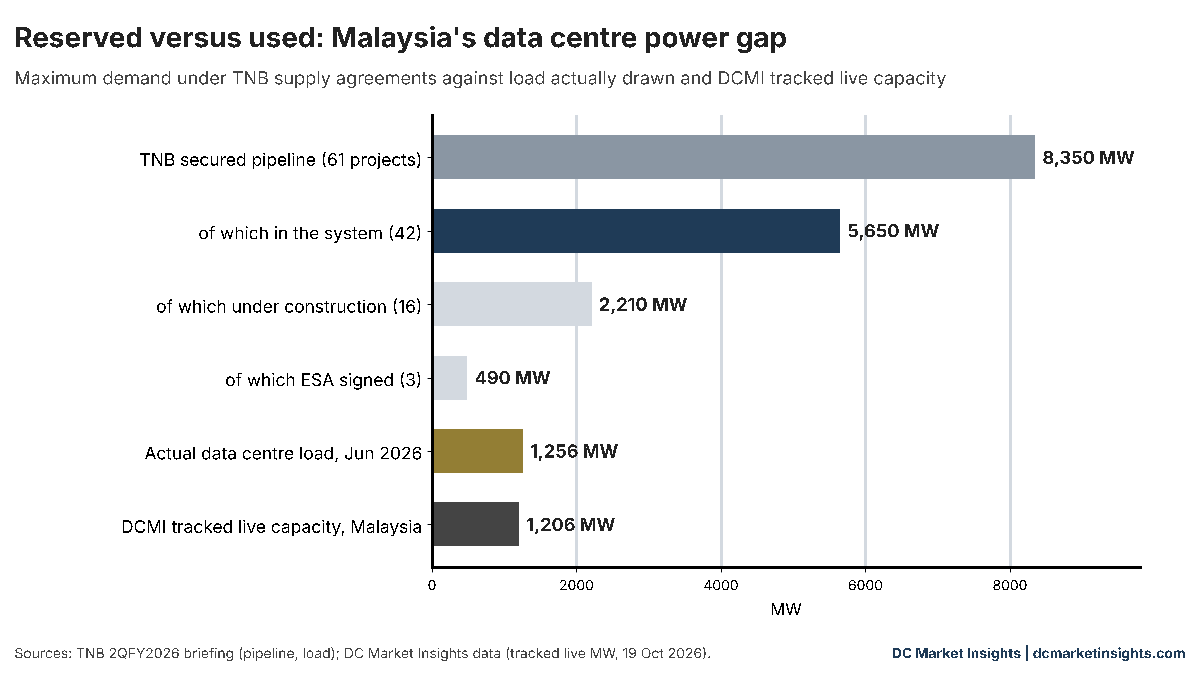
TNB’s latest analyst briefing, dated 28 August 2026, gives the clearest view of the problem. It lists a secured pipeline of 61 data centre projects with 8.35 GW of maximum demand: 42 projects with 5.65 GW already in the system, 16 projects with 2.21 GW under construction and 3 projects with 0.49 GW at the supply agreement stage. Johor alone holds 29 of the 61 projects and 5.6 GW, or 67% of the total, TNB said.
The load those projects actually draw is far smaller. TNB put actual data centre load at 1,256 MW in June 2026, up from 603 MW a year earlier. Our calculation: data centres are drawing about 22% of the 5.65 GW of maximum demand already connected, and about 15% of the full 8.35 GW pipeline. Roughly 4.4 GW is reserved on the system but not used.
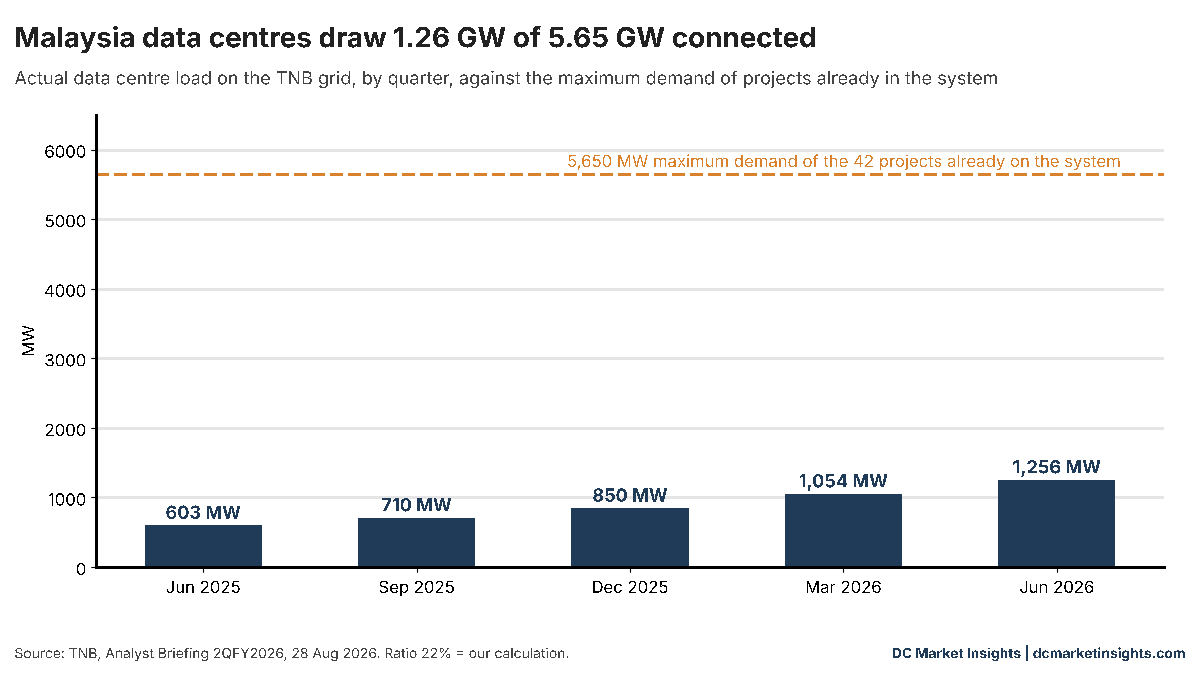
Load is growing fast. It doubled in twelve months, by about 653 MW. But at that pace, our calculation shows the projects already on the system would not draw their full reserved demand for close to seven years, around 2033. That is the capacity Johari wants paid for. Under TNB’s current terms, data centre customers already sign five-year take-or-pay agreements, Business Today reported from TNB’s July briefing. The new message is that reserved capacity must be paid for in full, with no right to operate if it is not.
| TNB data centre pipeline (Aug 2026 briefing) | Projects | Maximum demand |
|---|---|---|
| In the system | 42 | 5.65 GW |
| Under construction | 16 | 2.21 GW |
| Electricity supply agreement signed | 3 | 0.49 GW |
| Total secured pipeline | 61 | 8.35 GW |
| of which Johor | 29 | 5.6 GW (67%) |
| Actual data centre load, June 2026 | – | 1,256 MW |
| Actual data centre load, June 2025 | – | 603 MW |
Source: TNB, Analyst Briefing 2QFY2026, 28 Aug 2026. Johari told Parliament that 57 operational data centres “require” 6,237 MW and 60 more in approval or development could need 11,172 MW (The Star). Those figures use a different count and basis from TNB’s and are not added to them here; on Johari’s figures, actual load would be about 20% of the requirement (our calculation).
How Malaysia got here
The boom was built on a simple offer: land and power near Singapore at prices Singapore could not match. By the end of the first quarter of 2026, TNB was supplying 36 operating data centres with about 4.5 GW of planned supply capacity and 23 projects under construction with 3.8 GW of maximum demand, the energy ministry said in a written parliamentary answer reported by Malay Mail. The same answer projected national peak demand rising from 21.3 GW in 2026 to 33.5 GW in 2035, with data centres growing from 7% of electricity demand to up to 31%, or 73,274 GWh, in 2035.
That 2035 figure is equal to an average data centre load of about 8.4 GW running all year, our calculation shows, or 6.7 times today’s 1,256 MW. The grid plan has to be built for that.
The state has been tightening for two years. According to the Power & Policy tracker in DC Market Insights data, Johor halted approvals of Tier 1 and Tier 2 data centres and set a reclaimed-water requirement in November 2025, and Prime Minister Anwar Ibrahim told Parliament in February 2026 that approvals for non-AI data centres had been limited. Johor’s colocation vacancy was 0.7% against 4.9% in Singapore, Knight Frank’s Data Centre Atlas 2026 found, as TechRepublic reported.
Johor’s real constraint is the wires, not the plants
Wood Mackenzie’s June study of Johor explains why the minister led with transmission. It estimated data centre maximum demand in Johor at about 3.8 GW, nearly 1.5 times the state’s current demand of about 2.6 GW, against about 6.8 GW of installed generation. The bottleneck it flagged was shortages at 132 kV main intake substations, with 275 kV connections as a possible fix. It expects data centres to rise from about 24% of Johor’s electricity demand today to about 40% by 2035, Wood Mackenzie said.
The issue is increasingly about where power is available rather than whether it is available.
Public money is going into the grid as well. The Budget 2027 speech on 9 October said TNB will invest RM15 billion to strengthen the national grid and set up a New Economy Venture Fund of RM1.25 billion to develop data centres, according to the Ministry of Finance text. The same budget raised the household electricity bill exemption threshold from 600 kWh to 800 kWh a month. The direction is clear: protect households, and make the largest new users carry their own grid cost.
Who is hurting, and how much
Developers holding large reservations. These face the most direct bill. Our calculation from TNB’s figures puts the reserved but unused demand on the system at about 4.4 GW. If every reserved megawatt is billed whether used or not, the cost of a slow ramp-up moves from TNB and other customers onto the developer. Campuses that reserved hundreds of megawatts for tenants who have not yet arrived will feel it first.
Projects in the queue. The 2.7 GW under construction or at the supply agreement stage (2.21 GW plus 0.49 GW in TNB’s figures) will now be underwritten with transmission upgrades inside project capex. DC Market Insights data tracks 64 facilities in Malaysia with 1,205.5 MW live, 1,103.2 MW under construction and 1,658 MW planned. Our tracked live figure is within 4% of TNB’s actual load, which gives us confidence that the 2.76 GW tracked build and plan pipeline is a realistic picture of the next wave, and of who will pay the new costs first.
Operators who sell on price. Johor competed with Singapore partly on cheap power. A no-subsidy rule, a market gas price and “user-pays” network charges narrow that gap. Batam in Indonesia is the obvious alternative, but it is not trouble-free: West Java’s governor ordered a halt to BDx’s 640 MW AI campus at Jatiluhur on 30 September over missing permits and an incomplete environmental impact assessment, The Star reported.
Hyperscale tenants. Higher power and grid costs are usually passed through in colocation contracts. Tenants signing in 2027 should expect power pass-through clauses to carry new network and capacity lines.
The wider pattern in Asia-Pacific
Malaysia is not alone in pushing grid costs back to the data centre. Johor’s own reclaimed-water rule, Indonesia’s permit halt and the tightening of non-AI approvals all point the same way: host governments still want the investment, but on terms that protect households and other industry. Malaysia’s approach is notable because it targets reserved capacity directly. That is the most common form of speculation in a fast market, where developers book power years before they have tenants.
For investors, the economics still look strong. Johari said the sector’s direct GDP contribution rose from RM900 million in 2021 to RM14.1 billion in 2025, using Bank Negara Malaysia estimates. TNB has guided about RM18 billion of group capex for FY2026. The government is not trying to shut the market. It is changing who pays to keep it growing.
What it means for operators, investors and vendors
Our view, based on the statements and figures above:
- Right-size reservations now. With about 78% of connected demand unused, any reservation not backed by a signed tenant becomes a cost line. Phase supply agreements in steps that match lease-up, not the campus master plan.
- Put the grid in the capex model. Treat transmission and 132 kV or 275 kV intake work as a project cost from day one, using TNB’s scope advice, rather than as a utility obligation.
- Re-price 2027 contracts. A tariff review for 2027 and “user-pays” pricing are coming. Lease power pass-through clauses should cover new capacity, network and fuel-price lines.
- Design for water recycling and 30% local content. Both are now conditions. Cooling vendors and Malaysian electrical contractors stand to gain share.
- Investors: value secured megawatts, not reserved ones. At the past year’s ramp of about 653 MW, Malaysia’s connected demand would take close to seven years to fill (our calculation). Discount land and power positions with no tenant.
For market sizing on cooling and water, see our Malaysia Data Center Thermal Management Market report. For on-site and backup power as grid rules tighten, see the Data Center Generator Market report, and for the AI demand behind the build-out, the AI Data Center Market report. Country rules are tracked on our Malaysia power and policy page in the Data Center Power & Policy Tracker.
What to watch next
- Coming weeks: details of the “user-pays” pricing system for large consumers: rates, consumption thresholds and start date, none of which have been announced (The Edge Malaysia).
- Before 1 January 2027: the outcome of the government’s review of the electricity tariff structure for 2027, with data centres a particular focus (The Sun).
- 31 December 2026: end of the current household relief for users up to 800 kWh a month, unless extended (The Edge Malaysia). Whether it is extended shows how much of the cost the government wants large users to carry.
- TNB’s next quarterly briefing: the next update to actual data centre load (1,256 MW in June 2026) and to the 8.35 GW secured pipeline.
- 2035: data centres projected at up to 31% of Malaysia’s electricity demand (energy ministry) and about 40% of Johor’s (Wood Mackenzie).
Frequently asked questions
Do Malaysian data centres have to pay for power they do not use?
Yes. On 15 October Johari Abdul Ghani said an operator that reserves 200 MW and uses 100 MW will be charged for all 200 MW, and cannot operate if it does not pay. No tariff text has been published yet.
Who pays for grid upgrades for data centres in Malaysia?
The investor. Johari said transmission upgrades needed for a data centre’s power demand should be part of the investor’s project cost, with TNB advising on the work required. He gave the example of a 1,000 MW request needing transmission investment.
How much power do Malaysian data centres actually use?
About 1,256 MW of actual load in June 2026, TNB said, against 5.65 GW of maximum demand already on the system and 8.35 GW in its secured pipeline. That is about 22% of connected demand (our calculation).
Will Malaysia’s electricity tariff for data centres rise in 2027?
Likely. Fadillah Yusof said the government is reviewing the tariff structure for 2027 with data centres in focus and plans “user-pays” pricing for large users. Rates and dates have not been announced.
Sources
- The Star, “Data centres must pay for unused power allocations, says Johari”, 15 Oct 2026. Link
- Business Today, “MITI: Data Centre Investors To Bear Cost Of Power Transmission Upgrades”, 15 Oct 2026. Link
- EdgeProp, “Data centre investors must fund grid upgrades, says Johari”, 15 Oct 2026. Link
- The Edge Malaysia, “Govt plans ‘user-pays’ electricity pricing for data centres, energy-intensive industries”, 15 Oct 2026. Link
- The Sun, “Govt reviews electricity tariffs for 2027, with data centres in focus”, 15 Oct 2026. Link
- Tenaga Nasional Berhad, “Analyst Briefing 2QFY2026”, 28 Aug 2026. Link
- Business Today, “TNB Locks In Growth Securing 59 Data Centre Projects With 8.3GW Capacity”, 11 Jul 2026. Link
- Malay Mail (Bernama), “TNB powering 36 data centres as of Q1 2026, says Energy Ministry”, 7 Jul 2026. Link
- Wood Mackenzie, “Johor data centre expansion” press release, 18 Jun 2026. Link
- Ministry of Finance Malaysia, “Speech: The Fifth MADANI Budget 2027”, 9 Oct 2026. Link
- TechRepublic, “Malaysia Data Center Growth Surges as Johor Capacity Tightens”, 17 Aug 2026. Link
- The Star, “Indonesian governor orders halt on data centre project by Singapore’s BDx due to lack of permits”, 30 Sep 2026. Link
- DC Market Insights, “Malaysia Data Center Policy: Moratoriums, Incentives & Power Prices” (Power & Policy tracker and facility data, read 19 Oct 2026). Link