
DDR5 AI Server Memory Market Size, Share & Forecast to 2035
Market at a glance
The DDR5 AI Server Memory market was worth USD 2,140.0 million in 2025 and is forecast to reach USD 6,800.0 million by 2035, growing at a 12.25% CAGR. North America accounts for 50% of the market.
 By Amit Jain, Senior Consultant, ICT & Emerging Technologies
 Reviewed by Deepti Agrawal
Last updated 12 Oct 2026
Base year 2025 PDF + Excel
Reviewed by Deepti Agrawal
Last updated 12 Oct 2026
Base year 2025 PDF + Excel
Source: DC Market Insights analysis
Key findings
AI Capacity Additions Rise from 4.2 GW to 17.8 GW a Year
256 GB Modules Reach Volume Qualification in 2026
Low-Power Memory Takes Half of AI Host Capacity by 2035
Servers Above 2 TB Reach USD 4.42 Billion by 2035
What is inside the report
- 01Introduction
- 02Research Methodology
- 03Executive Summary
- 04Scope Comparison: Why Market Estimates Differ
- 05Market Dynamics
- 06Pricing Analysis
- 07Standards and Regulation
- 08Supply Chain and Value Chain Analysis
- 09Market Size and Forecast, 2020-2035
- 10Market by Module Type
- 23chapters
- 2020-2024Historical period
- 2026-2035Forecast period
- 15Companies profiled
Regional insights
- North America50%
- Asia Pacific28%
- Europe14%
- Middle East and Africa4.5%
- Latin America3.5%
Segmentation
Companies profiled
- Samsung Electronics
- SK hynix
- Micron Technology
- Kingston Technology
- Nanya Technology
- CXMT (ChangXin Memory Technologies)
- Winbond Electronics
- SMART Global (Penguin Solutions)
- Netlist
- ADATA Technology
- Montage Technology
- Rambus
- Renesas Electronics
- Astera Labs
- Microchip Technology
Recent developments
SK hynix completed Intel Xeon 6 validation of a 256 GB DDR5 RDIMM built on 32 Gb dies (Source: SK hynix newsroom).
JEDEC announced new MRDIMM interface logic standards, with MRCD02 for 12,800 MT/s expected soon (Source: JEDEC).
Micron began sampling a 256 GB DDR5 server module at up to 9,200 MT/s for AI infrastructure (Source: Micron press release).
AMD showed EPYC 9006 processors with up to 16 DDR5 channels and MRDIMM support up to 12,800 MT/s (Source: AMD).
Dell Technologies reported record AI server orders of USD 60.9 billion and AI server revenue of USD 16.4 billion for its second fiscal quarter (Source: Dell Technologies).
Micron reported DRAM price increases in the high-teens percentage range and completed qualifications of 8,800 MT/s server RDIMMs (Source: Micron prepared remarks).
Full analysis
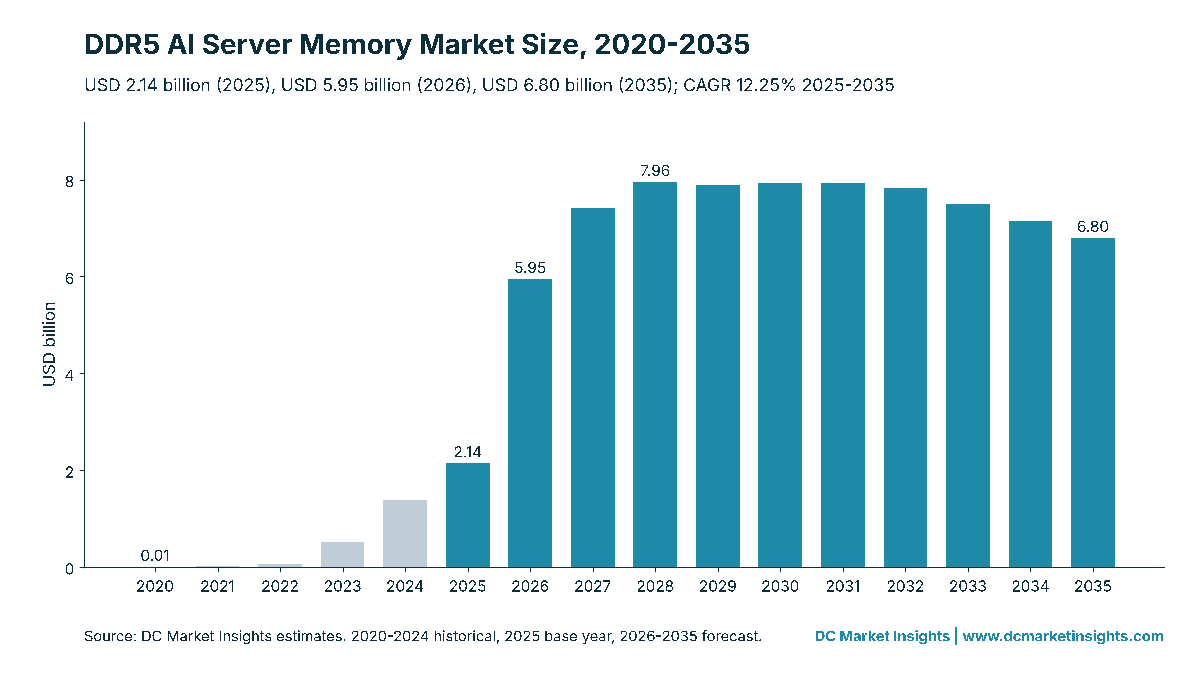
The DDR5 AI Server Memory Market is valued at USD 5.95 billion in 2026 and is projected to reach USD 6.80 billion by 2035, up from USD 2.14 billion in 2025, a CAGR of 12.25% from 2025 to 2035 (DC Market Insights estimate). The market covers the Double Data Rate 5 (DDR5) dynamic random-access memory (DRAM) modules that serve as host memory in artificial intelligence (AI) servers, meaning servers built around graphics processing units (GPUs), custom application-specific integrated circuits (ASICs) or other accelerators: registered dual in-line memory modules (RDIMMs), multiplexed rank DIMMs (MRDIMMs) and DDR5 memory attached over Compute Express Link (CXL). The build receipt: about 460,000 DDR5-hosted AI servers deployed in 2025 × 1,200 GB of host memory each × USD 4.00 per GB, with 97% of that memory on DDR5, gives USD 2.14 billion. MRDIMMs are the fastest-growing module type at 32.29% a year because AI host processors move to 12 and 16 memory channels at 8,800 to 12,800 megatransfers per second (MT/s), and the Middle East and Africa is the fastest-growing region at 18.13% a year as sovereign AI campuses start from a small base.
Key Market Statistics: How Big Is the DDR5 AI Server Memory Market in 2026?
DC Market Insights values the DDR5 AI Server Memory Market at USD 5.95 billion in 2026, 177.9% above the USD 2.14 billion of 2025, because the average DDR5 server module price doubled while host memory per AI server rose by 30%.
- Market size 2025: USD 2.14 billion
- Market size 2026: USD 5.95 billion
- Market size 2030: USD 7.92 billion
- Market size 2035: USD 6.80 billion
- CAGR 2025-2035: 12.25% in the base case, 9.12% in the low case and 15.23% in the high case
- Largest module type: standard RDIMMs of up to 64 GB, 52.0% of 2025 value (USD 1.11 billion)
- Fastest-growing module type: MRDIMMs, 32.29% a year
- Leading region: North America, 50.0% of 2025 value (USD 1.07 billion)
- Fastest-growing region: Middle East and Africa, 18.13% a year
- Largest country: the United States, USD 985.21 million in 2025 (46.0% of global value)
- Market leaders: Samsung Electronics, SK hynix and Micron Technology (DC Market Insights assessment)
Executive Summary
The Global DDR5 AI Server Memory Market size was valued at USD 7.53 million in 2020, reached USD 2.14 billion in 2025, and is anticipated to reach USD 6.80 billion by 2035, at a CAGR of 12.25% during the forecast period.
| Report attribute | Details |
|---|---|
| Historical Period | 2020-2024 |
| Base Year | 2025 |
| Forecast Period | 2026-2035 |
| DDR5 AI Server Memory Market Size 2025 | USD 2.14 Billion |
| DDR5 AI Server Memory Market Size 2026 | USD 5.95 Billion |
| DDR5 AI Server Memory Market, CAGR | 12.25% |
| DDR5 AI Server Memory Market Size 2035 | USD 6.80 Billion |
The 2020 value of USD 7.53 million reflects validation modules only: JEDEC, the semiconductor standards body, published the JESD79-5 DDR5 standard on 14 July 2020, and AI servers ran on DDR4 until DDR5 server processors shipped in late 2022 and 2023. DDR5 then took 45% of AI server host memory in 2023, 85% in 2024 and 97% in 2025, so the 2020 to 2025 growth rate of 209.6% a year describes a technology switch rather than demand. From 2025 the drivers are volume and capacity. DDR5 host memory shipped into AI servers grows from about 552 petabytes (PB) in 2025 to about 3,490 PB in 2035, because AI capacity additions rise and each server carries more memory: NVIDIA’s DGX B200 ships with 2 TB of system memory, configurable to 4 TB. Value peaks at USD 7.96 billion in 2028 and eases to USD 6.80 billion by 2035, as the next memory generation takes 43% of AI server host memory and price per GB normalises from the 2026 high.
Market Scope: What Does the DDR5 AI Server Memory Market Cover?
The DDR5 AI Server Memory Market covers the DDR5 DRAM modules installed as host processor memory in accelerator-equipped servers, valued at module selling price in current US dollars; DC Market Insights sizes it at USD 2.14 billion in 2025 and USD 5.95 billion in 2026.
Included. Standard DDR5 RDIMMs of up to 64 GB, high-capacity RDIMMs of 128 GB and above, including three-dimensional stacked (3DS) modules, MRDIMMs, and CXL memory expansion modules built on DDR5 dies, when they are installed in servers that carry GPUs, custom ASICs, field-programmable gate arrays (FPGAs) or other AI accelerators. The scope covers new AI servers and AI servers bought to refresh older accelerator fleets.
Excluded. High-bandwidth memory (HBM) stacked next to the accelerator, low-power memory such as LPDDR5X used by Arm-based AI host processors and in SOCAMM modules, DDR4 modules, DDR5 in general-purpose servers without accelerators, client and workstation memory, and the registering clock driver (RCD) and data buffer chips sold to module makers, which are counted inside module prices.
How the segments fit together. The module type split adds standard RDIMMs, high-capacity RDIMMs, MRDIMMs and CXL modules to the USD 2.14 billion total. The memory capacity per server, accelerator type and end user splits re-cut the same total by server configuration, by the accelerator inside the server and by buyer.
Why Do DDR5 AI Server Memory Market Estimates Differ?
Public estimates under this market name differ because they draw the line in different places; DC Market Insights counts only DDR5 host memory in accelerator-equipped servers, which gives USD 5.95 billion in 2026.
Broader definitions add DDR5 in every server, including general-purpose servers that run databases, web services and virtual machines, which multiplies the total several times over. Some also add HBM, which is the largest memory pool in an AI server by value but sits on the accelerator package and is sized in our High Bandwidth Memory Market report. Others add LPDDR5X and SOCAMM modules on Arm host processors; NVIDIA’s Vera CPU is built on LPDDR5X memory, and Samsung Electronics named HBM4, DDR5 and SOCAMM2 as separate focus products in July 2026. Narrower definitions count only memory chips, not modules, or only training servers.
| Element | In this report | Why |
|---|---|---|
| DDR5 RDIMMs and MRDIMMs in AI servers | Yes, USD 1.24 billion in 2025 for MRDIMMs and standard RDIMMs combined | Host memory feeding the accelerators |
| High-capacity and 3DS RDIMMs in AI servers | Yes, USD 813.87 million in 2025 | Same function, larger modules |
| CXL memory expansion on DDR5 | Yes, USD 85.66 million in 2025 | Adds host memory capacity beyond DIMM slots |
| HBM on accelerators | No | Separate device on the accelerator package |
| LPDDR5X and SOCAMM on Arm hosts | No | Different memory standard |
| DDR5 in general-purpose servers | No | No AI accelerator in the server |
Out-of-scope terms that broader estimates count include general-purpose server memory, HBM stacks, LPDDR5X, SOCAMM, DDR4, client memory and memory interface chips sold separately. In-scope buyer groups include hyperscale cloud providers, GPU cloud and colocation providers, enterprises, small and medium-sized enterprises (SMEs) that buy single AI servers, research institutions and sovereign AI programmes.
Market Drivers: What Drives the DDR5 AI Server Memory Market?
Three drivers lift DDR5 host memory spending in AI servers from USD 2.14 billion in 2025 to USD 6.80 billion by 2035: more AI capacity, more memory per server and more memory channels per processor.
AI Capacity Additions Rise from 4.2 GW to 17.8 GW a Year
New AI data center capacity rises from about 4.2 GW in 2025 to about 17.8 GW in 2035 in the DC Market Insights capacity model, and AI fleets installed five years earlier are refreshed on top. Spending signals confirm the pace. NVIDIA reported fiscal 2026 Data Center revenue of a record USD 193.7 billion, up 68%, and USD 89.0 billion in the quarter to July 2026, up 117%. Dell Technologies booked a record USD 60.9 billion of AI server orders in the same quarter. Micron Technology expects server unit growth in the high-teens percentage range in both 2026 and 2027. Together these lift DDR5-hosted AI server deployments from about 460,000 in 2025 to about 683,600 in 2030.
Host Memory per AI Server Grows from 1,200 GB to 4,500 GB
Average DDR5 host memory per AI server rises from about 1,200 GB in 2025 to 3,000 GB in 2030 and 4,500 GB in 2035 (DC Market Insights estimate), because agentic and long-context inference keeps model weights, key-value caches and data pipelines in host memory. Eight-GPU systems already ship with 2 TB: NVIDIA documents the DGX H100 with 2 TB using 32 DIMMs and the DGX B300 with 2 TB by default and up to 4 TB with 128 GB DIMMs. Dell’s PowerEdge XE9785 for AMD Instinct MI355X accelerators takes 24 DDR5 RDIMMs and up to 6 TB. Each extra terabyte at the 2025 price of USD 4.00 per GB adds about USD 4,000 of memory to a server.
Memory Channels per Processor Rise from 12 to 16
The number of DDR5 channels per host processor rises from 8 on the first DDR5 server processors to 12 on current AMD EPYC and Intel Xeon 6 parts and up to 16 on the next AMD generation, which raises the number of DIMM slots per server by up to 33%. AMD’s EPYC 9005 processors carry 12 channels of DDR5 memory per CPU (central processing unit), and AMD showed EPYC 9006 in July 2026 with up to 16 DDR5 channels and JEDEC-standard MRDIMM support up to 12,800 MT/s. Micron also noted in March 2026 that traditional server demand is robust, driven by agentic AI workloads, and SK hynix said in January 2026 that demand for conventional server memory increased sharply.
Market Trends: How Is DDR5 AI Server Memory Changing?
Module mix shifts to higher value per slot: high-capacity RDIMMs and MRDIMMs rise from 44.0% of 2025 value to 77.0% by 2035.
256 GB Modules Reach Volume Qualification in 2026
High-capacity and 3DS RDIMMs grow at 14.42% a year, from USD 813.87 million in 2025 to USD 3.13 billion by 2035, as 256 GB modules replace 64 GB and 96 GB parts. SK hynix completed Intel Xeon 6 validation of a 256 GB DDR5 RDIMM built on 32 Gb dies in December 2025, and Micron began sampling a 256 GB DDR5 server module at up to 9,200 MT/s in May 2026.
MRDIMMs Grow from 6.0% to 31.0% of Value
MRDIMMs grow from USD 128.51 million in 2025 to USD 2.11 billion by 2035, because they double the data rate of a DIMM slot without new processor pins. Intel’s Xeon 6 was the first server processor to support MRDIMMs in September 2024, and the Xeon 6980P supports DDR5-6400 and MRDIMM-8800. Each MRDIMM carries one MRCD chip and ten MDB chips (multiplexed registering clock driver and data buffer), which adds cost per module, and JEDEC announced in April 2026 that the second-generation MRCD02 standard was expected soon for 12,800 MT/s modules.
Price Swings Dominate 2026
The average DDR5 server module price rises from about USD 4.00 per GB in 2025 to USD 8.00 per GB in 2026 (DC Market Insights estimate). Micron reported DRAM price increases of about 20% in the quarter to November 2025, the mid-60s percentage range in the quarter to February 2026 and the high-teens percentage range in the quarter to August 2026.
Market Challenges: What Holds the DDR5 AI Server Memory Market Back?
Two challenges cap DDR5 spending in AI servers: Arm host processors that use low-power memory, and the move to the next DRAM generation after 2029.
Low-Power Memory Takes Half of AI Host Capacity by 2035
The share of AI capacity built on DDR5-hosted x86 servers falls from 65% in 2025 to 55% in 2030 and 50% in 2035 (DC Market Insights estimate), because rack-scale systems with Arm host processors use LPDDR5X. NVIDIA’s Vera CPU, launched in March 2026, is built on LPDDR5X and delivers up to 1.2 TB/s of bandwidth. Every 5 points of share lost to low-power memory removes about USD 680 million of 2035 value from this market.
The Next DRAM Generation Takes 43% of AI Host Memory by 2035
DDR5’s share of AI server host memory peaks at 99% in 2028 and falls to 92% in 2030 and 57% in 2035 as the next registered memory generation ramps on new processors. This transition turns 2028 into the value peak at USD 7.96 billion. Price also works against value: after the 2026 high, the model assumes DDR5 falls to USD 4.20 per GB by 2030 and USD 3.42 per GB by 2035 as new DRAM capacity comes online, which would cut 2035 value by 57% against 2026 prices.
Market Opportunities: Where Are the New Revenue Pools?
Two pools add the most new value: memory-rich inference servers above 2 TB and CXL memory expansion.
Servers Above 2 TB Reach USD 4.42 Billion by 2035
Servers with more than 2 TB of DDR5 grow from USD 428.35 million in 2025 to USD 4.42 billion by 2035, at 26.29% a year, and rise from 20.0% to 65.0% of value. Platforms already allow it: Supermicro’s 8U systems for AMD Instinct MI350X and MI355X take 24 DIMM slots for up to 9 TB of DDR5-6000 RDIMMs, and Dell’s XE9780 and XE9680 take 32 DDR5 RDIMMs and up to 4 TB.
CXL Memory Expansion Reaches USD 748.32 Million by 2035
CXL memory expansion modules grow from USD 85.66 million in 2025 to USD 748.32 million by 2035, at 24.20% a year, because they add host memory beyond the DIMM slots. The CXL Consortium released the CXL 3.2 specification in December 2024. Micron’s CZ120 modules come in 128 GB and 256 GB and add up to 2 TB per server, and Samsung’s CMM-D module uses DDR5 behind a CXL interface over PCIe Gen5 (Peripheral Component Interconnect Express).
Pricing: How Much Does DDR5 Memory for an AI Server Cost?
DDR5 memory for an average AI server costs about USD 4,800 in 2025 (1,200 GB at USD 4.00 per GB) and about USD 15,390 in 2035 (4,500 GB at USD 3.42 per GB), according to DC Market Insights estimates.
| Year | Average price (USD per GB) | Host memory per AI server (GB) | DDR5 content per AI server (USD) |
|---|---|---|---|
| 2020 | 8.00 | 768 | 6,144 (validation modules only) |
| 2025 | 4.00 | 1,200 | 4,800 |
| 2030 | 4.20 | 3,000 | 12,600 |
| 2035 | 3.42 | 4,500 | 15,390 |
The 2026 average of USD 8.00 per GB puts a 2 TB server at about USD 16,400 of DDR5, against about USD 8,200 at 2025 prices. SK hynix reported in July 2026 that high-performance products for AI servers led price increases. MRDIMMs carry a premium of about 20% to 30% per GB over RDIMMs of the same capacity, and 256 GB 3DS modules about 15% (DC Market Insights estimates), because of extra buffer chips and stacked dies. A 64 GB RDIMM, the most common standard part, cost about USD 256 in 2025 at the average price.
Standards and Regulation: Which Rules Shape DDR5 AI Server Memory?
Four JEDEC and industry standards and one export-control regime shape the USD 2.14 billion market.
- JEDEC JESD79-5 (DDR5 SDRAM, synchronous DRAM). Published on 14 July 2020; sets the DDR5 device standard used by every module in scope.
- JEDEC JESD79-5C. Adds Per-Row Activation Counting (PRAC) for data integrity and extends speed grades to 8,800 MT/s (April 2024).
- JEDEC MRDIMM standards. MRCD and MDB logic for multiplexed rank modules; the MRCD02 generation for 12,800 MT/s was announced as expected in April 2026.
- CXL 3.2. The CXL 3.2 specification (December 2024) defines memory expansion and pooling for CXL modules.
- US export controls. The US Bureau of Industry and Security (BIS) tightened controls on advanced semiconductors including HBM in December 2024; controls on accelerators decide where high-end AI servers, and the DDR5 inside them, can be shipped.
Platform qualification works like a standard in practice: a module must pass validation on each host processor before hyperscale buyers deploy it, as SK hynix’s December 2025 Intel Xeon 6 validation shows.
Market Segmentation: Which Segment Leads the DDR5 AI Server Memory Market?
Standard RDIMMs lead the DDR5 AI Server Memory Market with 52.0% of 2025 value, servers with 1 TB to 2 TB of memory lead by configuration with 50.0%, GPU servers lead by accelerator with 80.0% and hyperscale cloud providers lead by buyer with 62.0%.
By Module Type: Standard RDIMMs Lead with 52.0%
| Module type | 2025 (USD million) | Share 2025 | 2035 (USD million) | CAGR 2025-2035 |
|---|---|---|---|---|
| Standard RDIMM (up to 64 GB) | 1,113.72 | 52.0% | 816.35 | -3.06% |
| High-Capacity and 3DS RDIMM (128 GB and above) | 813.87 | 38.0% | 3,129.34 | 14.42% |
| MRDIMM | 128.51 | 6.0% | 2,108.91 | 32.29% |
| CXL Memory Expansion Modules | 85.66 | 4.0% | 748.32 | 24.20% |
| Total | 2,141.76 | 100.0% | 6,802.92 | 12.25% |
Standard RDIMM spending shrinks at 3.06% a year because 256 GB modules and MRDIMMs fill the slots of new servers; MRDIMMs are the fastest-growing segment.
By Memory Capacity per Server: 1 TB to 2 TB Leads with 50.0%
| Capacity per server | 2025 (USD million) | Share 2025 | 2035 (USD million) | CAGR 2025-2035 |
|---|---|---|---|---|
| Up to 1 TB | 642.53 | 30.0% | 476.20 | -2.95% |
| 1 TB to 2 TB | 1,070.88 | 50.0% | 1,904.82 | 5.93% |
| Above 2 TB | 428.35 | 20.0% | 4,421.90 | 26.29% |
| Total | 2,141.76 | 100.0% | 6,802.92 | 12.25% |
By Accelerator Type: GPU Servers Lead with 80.0%
| Accelerator type | 2025 (USD million) | Share 2025 | 2035 (USD million) | CAGR 2025-2035 |
|---|---|---|---|---|
| GPU Servers | 1,713.41 | 80.0% | 4,353.87 | 9.77% |
| Custom ASIC Servers | 364.10 | 17.0% | 2,244.96 | 19.95% |
| Other Accelerator Servers | 64.25 | 3.0% | 204.09 | 12.25% |
| Total | 2,141.76 | 100.0% | 6,802.92 | 12.25% |
Custom ASIC servers grow fastest at 19.95% a year as hyperscale operators deploy their own training and inference chips, most of them hosted by x86 processors with DDR5.
By End User: Hyperscale Cloud Providers Lead with 62.0%
| End user | 2025 (USD million) | Share 2025 | 2035 (USD million) | CAGR 2025-2035 |
|---|---|---|---|---|
| Hyperscale Cloud Providers | 1,327.89 | 62.0% | 3,673.58 | 10.71% |
| GPU Cloud and Colocation Providers | 385.52 | 18.0% | 1,360.58 | 13.44% |
| Enterprise and Sovereign AI | 428.35 | 20.0% | 1,768.76 | 15.24% |
| Total | 2,141.76 | 100.0% | 6,802.92 | 12.25% |
Enterprise and sovereign AI buyers grow fastest at 15.24% a year, because on-premises inference servers are configured with more host memory per GPU than cloud training clusters.
DC Exclusive: The Host Memory per AI Server Model and Module Type × Accelerator Matrix
At USD 862.59 million in 2025, standard RDIMMs in GPU servers are the largest cell of the matrix and 40.3% of all DDR5 AI server memory spending. The matrix below cross-tabulates what is bought against the accelerator it serves. It is a DC Market Insights model, not a shipment count: it is built from 34 inputs, namely 16 capacity cohorts, 5 annual curves (AI share, DDR5-hosted share, kW per server, GB per server and DDR5 share of host memory), a price curve, 4 mix tables and 8 regional and country weights, and then tested against 3 bound checks.
| 2025, USD million | GPU Servers | Custom ASIC Servers | Other Accelerator Servers |
|---|---|---|---|
| Standard RDIMM (up to 64 GB) | 862.59 | 212.44 | 38.69 |
| High-Capacity and 3DS RDIMM (128 GB and above) | 659.47 | 132.89 | 21.51 |
| MRDIMM | 116.07 | 10.21 | 2.23 |
| CXL Memory Expansion Modules | 75.28 | 8.56 | 1.82 |
| Total | 1,713.41 | 364.10 | 64.25 |
GPU servers spend 6.8% of their DDR5 budget on MRDIMMs and 4.4% on CXL modules, the highest shares of any accelerator type, because eight-GPU systems are the first to use 12-channel processors at full speed. Custom ASIC servers spend 58.3% of theirs on standard RDIMMs, because many hyperscale ASIC hosts run one DIMM per channel at 64 GB.
The host memory model has inputs any reader can check: AI capacity added each year (4.2 GW in 2025), IT power per AI server (about 6.5 kW in 2025, 20 kW in 2035) and memory per server (1,200 GB in 2025). Dividing DDR5-hosted AI megawatts by kW per server gives servers; multiplying by GB per server, DDR5 share and price per GB gives the market. The model and its assumptions are explained on our research methodology page.
Regional Insights: Which Region Leads the DDR5 AI Server Memory Market?
North America leads the DDR5 AI Server Memory Market with 50.0% of 2025 value, and the Middle East and Africa is the fastest-growing region at 18.13% a year, because sovereign AI campuses in Saudi Arabia and the United Arab Emirates (UAE) add large GPU clusters to a small base.
North America Leads with 50.0% Share
North America accounts for USD 1.07 billion in 2025 and USD 3.06 billion by 2035, growing at 11.08% a year. Hyperscale budgets drive it: Alphabet guided 2026 capital expenditure of USD 175 billion to USD 185 billion and Meta USD 130 billion to USD 145 billion, and Supermicro reported fiscal 2026 net sales of USD 39.1 billion.
Asia Pacific Holds 28.0% Share
Asia Pacific accounts for USD 599.69 million in 2025 and USD 2.04 billion by 2035, growing at 13.03% a year. The region also builds most of the hardware: Taiwan, where most AI servers are assembled, reported record 2025 exports of USD 640.7 billion, and South Korea is home to two of the three main DRAM makers. China accounts for USD 203.89 million in 2025, held back by US accelerator export controls.
Europe Holds 14.0% Share
Europe accounts for USD 299.85 million in 2025 and USD 918.39 million by 2035, growing at 11.84% a year. Germany, the United Kingdom and France take 57.0% of European spending in 2025, mostly through cloud regions and national AI supercomputing programmes.
Middle East and Africa Holds 4.5% Share
The Middle East and Africa accounts for USD 96.38 million in 2025 and USD 510.22 million by 2035, the fastest growth of any region at 18.13% a year. Saudi Arabia and the UAE together take 64.0% of regional spending in 2025, at USD 28.91 million and USD 32.77 million.
Latin America Holds 3.5% Share
Latin America accounts for USD 74.96 million in 2025 and USD 272.12 million by 2035, growing at 13.76% a year. Brazil takes 45.0% of the region at USD 33.73 million in 2025.
Country Analysis: Which Countries Spend the Most on DDR5 AI Server Memory?
The United States is the largest country market for DDR5 AI server memory at USD 985.21 million in 2025, 46.0% of global value, followed by China at USD 203.89 million (9.5%) and Japan at USD 83.96 million (3.9%). The 12 largest countries account for 82.6% of 2025 spending.
| Rank | Country | Region | 2025 (USD million) | Share 2025 | 2035 (USD million) | CAGR 2025-2035 |
|---|---|---|---|---|---|---|
| 1 | United States | North America | 985.21 | 46.0% | 2,785.79 | 10.95% |
| 2 | China | Asia Pacific | 203.89 | 9.5% | 571.45 | 10.86% |
| 3 | Japan | Asia Pacific | 83.96 | 3.9% | 265.31 | 12.19% |
| 4 | Canada | North America | 74.96 | 3.5% | 229.60 | 11.84% |
| 5 | Germany | Europe | 65.97 | 3.1% | 192.86 | 11.32% |
| 6 | South Korea | Asia Pacific | 65.97 | 3.1% | 224.50 | 13.03% |
| 7 | United Kingdom | Europe | 62.97 | 2.9% | 183.68 | 11.30% |
| 8 | India | Asia Pacific | 53.97 | 2.5% | 346.95 | 20.45% |
| 9 | Australia | Asia Pacific | 47.98 | 2.2% | 163.27 | 13.03% |
| 10 | Singapore | Asia Pacific | 47.98 | 2.2% | 132.66 | 10.71% |
| 11 | France | Europe | 41.98 | 2.0% | 128.57 | 11.84% |
| 12 | Brazil | Latin America | 33.73 | 1.6% | 119.73 | 13.51% |
India is the fastest-growing large country market at 20.45% a year, ahead of Brazil at 13.51% and South Korea at 13.03%, as national AI compute programmes and hyperscale regions add GPU clusters. The country figures are a DC Market Insights allocation of the regional totals, weighted by each country’s estimated share of installed and new AI server capacity.
Forecast Scenarios: How Could the 2035 Forecast Change?
The DDR5 AI Server Memory Market reaches USD 6.80 billion by 2035 in the base case, with a range of USD 5.13 billion to USD 8.84 billion across the low and high scenarios.
| Scenario | Assumption for 2035 | 2035 (USD billion) | CAGR 2025-2035 |
|---|---|---|---|
| Low | 4,000 GB per AI server; USD 2.90 per GB | 5.13 | 9.12% |
| Base | 4,500 GB per AI server; USD 3.42 per GB; DDR5 57% of host memory | 6.80 | 12.25% |
| High | 5,000 GB per AI server; USD 4.00 per GB | 8.84 | 15.23% |
The low case reflects faster DRAM capacity additions and a quicker move of AI host memory to low-power modules. The high case assumes that long-context inference keeps raising memory per server and that DRAM supply stays tight well beyond 2026.
Competitive Insights: Who Leads the DDR5 AI Server Memory Market?
- Samsung Electronics
- SK hynix
- Micron Technology
- Kingston Technology
- Nanya Technology
- CXMT (ChangXin Memory Technologies)
- Winbond Electronics
- SMART Global (Penguin Solutions)
- Netlist
- ADATA Technology
- Montage Technology
- Rambus
- Renesas Electronics
- Astera Labs
- Microchip Technology
The DDR5 AI Server Memory Market is highly concentrated: DC Market Insights estimates that Samsung Electronics, SK hynix and Micron Technology together supply about 93% of the market, because server-grade 32 Gb DDR5 dies and platform qualification are concentrated in these three DRAM makers. Samsung said in July 2026 that growth in demand for server DRAM is expected to accelerate. SK hynix reported a record second quarter in which AI server products led price increases. Micron reported record fiscal third-quarter 2026 revenue of USD 41.46 billion, against USD 9.30 billion a year earlier, and has completed customer qualifications of 8,800 MT/s server RDIMMs. Interface chip suppliers set module speed: Rambus reported 2025 product revenue of USD 347.8 million, up 41%, Montage Technology’s interconnect chip line sold RMB 5,139 million (Chinese yuan) in 2025, and Renesas Electronics launched a Gen6 DDR5 RCD at 9,600 MT/s in November 2025.
Recent Developments
- In December 2025, SK hynix completed Intel Xeon 6 validation of a 256 GB DDR5 RDIMM built on 32 Gb dies (Source: SK hynix newsroom).
- In April 2026, JEDEC announced new MRDIMM interface logic standards, with MRCD02 for 12,800 MT/s expected soon (Source: JEDEC).
- In May 2026, Micron began sampling a 256 GB DDR5 server module at up to 9,200 MT/s for AI infrastructure (Source: Micron press release).
- In July 2026, AMD showed EPYC 9006 processors with up to 16 DDR5 channels and MRDIMM support up to 12,800 MT/s (Source: AMD).
- In September 2026, Dell Technologies reported record AI server orders of USD 60.9 billion and AI server revenue of USD 16.4 billion for its second fiscal quarter (Source: Dell Technologies).
- In September 2026, Micron reported DRAM price increases in the high-teens percentage range and completed qualifications of 8,800 MT/s server RDIMMs (Source: Micron prepared remarks).
We follow these launches, qualifications and price moves as they happen in our data center industry updates. Buyers planning AI server memory can compare host DDR5 with accelerator memory in the High Bandwidth Memory Market report and with the interface chips on each module in the DDR5 Server Memory RCD IC Market report.
Methodology: How We Built the DDR5 AI Server Memory Market Model
DC Market Insights built this market bottom-up from 16 annual capacity cohorts (2020 to 2035). AI capacity each year is new data center capacity times the AI share (12.0 GW × 35% = 4.2 GW in 2025), plus AI capacity installed five years earlier that is refreshed with new servers (0.4 GW in 2025). The DDR5-hosted share of that capacity (65% in 2025) divided by IT power per AI server (6.5 kW in 2025) gives about 460,000 servers; multiplying by 1,200 GB of host memory, a 97% DDR5 share and USD 4.00 per GB gives USD 2.14 billion. In 2035 the same chain reads 31.0 GW of new and refreshed AI capacity, a 50% DDR5-hosted share, 20 kW per server, 775,500 servers, 4,500 GB, a 57% DDR5 share and USD 3.42 per GB, for USD 6.80 billion. The total was split by 4 module types, 3 capacity bands, 3 accelerator types, 3 end users and 5 regions, and every split sums to the market total in every year.
Because no supplier discloses DDR5 sales to AI servers, the result was tested against three bounds. Ceiling one: the 2025 market of USD 2.14 billion is 1.1% of NVIDIA’s fiscal 2026 Data Center revenue of USD 193.7 billion, in line with about USD 8,200 of DDR5 in a 2 TB server that sells for several hundred thousand dollars. Ceiling two: the 2026 market of USD 5.95 billion is 14.4% of Micron’s revenue in a single quarter, USD 41.46 billion, while three suppliers share it. Floor: 460,000 servers with only 512 GB each at the 2023 low of USD 3.20 per GB would still spend USD 753.66 million, so the modeled USD 2.14 billion sits well above the minimum. The analyst named on this page built the model, and the reviewer checked the arithmetic, the sources and the dates before publication.
Table of contents
- 01Introduction
- 1.1Market Definition and Scope
- 1.2Included and Excluded Memory
- 1.3Currency, Pricing Basis and Years Considered
- 02Research Methodology
- 2.1Bottom-Up Host Memory per AI Server Model
- 2.2AI Capacity Cohorts and Server Refresh
- 2.3Bound Checks and Data Sources
- 2.4Assumptions and Limitations
- 03Executive Summary
- 3.1Market Snapshot, 2025, 2026 and 2035
- 3.2Key Market Statistics
- 3.3Analyst Viewpoint
- 04Scope Comparison: Why Market Estimates Differ
- 4.1AI Servers versus All Servers
- 4.2DDR5 Host Memory versus HBM and LPDDR5X
- 05Market Dynamics
- 5.1Drivers
- 5.2Trends
- 5.3Challenges
- 5.4Opportunities
- 06Pricing Analysis
- 6.1Average Price per GB, 2020-2035
- 6.2DDR5 Content per AI Server
- 6.3MRDIMM and 3DS Module Premiums
- 07Standards and Regulation
- 7.1JEDEC JESD79-5 and JESD79-5C
- 7.2JEDEC MRDIMM Standards
- 7.3CXL 3.2 Specification
- 7.4US Export Controls on AI Accelerators
- 08Supply Chain and Value Chain Analysis
- 8.1DRAM Die Makers
- 8.2Interface Chip Suppliers
- 8.3Module Makers and Server OEMs
- 09Market Size and Forecast, 2020-2035
- 9.1Historical Market Size, 2020-2024
- 9.2Forecast, 2026-2035
- 9.3AI Servers, Memory per Server and Price per GB
- 10Market by Module Type
- 10.1Standard RDIMM (up to 64 GB)
- 10.2High-Capacity and 3DS RDIMM (128 GB and above)
- 10.3MRDIMM
- 10.4CXL Memory Expansion Modules
- 11Market by Memory Capacity per Server
- 11.1Up to 1 TB
- 11.21 TB to 2 TB
- 11.3Above 2 TB
- 12Market by Accelerator Type
- 12.1GPU Servers
- 12.2Custom ASIC Servers
- 12.3Other Accelerator Servers
- 13Market by End User
- 13.1Hyperscale Cloud Providers
- 13.2GPU Cloud and Colocation Providers
- 13.3Enterprise and Sovereign AI
- 14DC Exclusive: Module Type × Accelerator Matrix
- 14.1Results by Cell, 2025
- 14.2Model Inputs and Bound Checks
- 15North America Market
- 15.1United States
- 15.2Canada
- 16Europe Market
- 16.1Germany
- 16.2United Kingdom
- 16.3France
- 16.4Netherlands
- 16.5Rest of Europe
- 17Asia Pacific Market
- 17.1China
- 17.2Japan
- 17.3South Korea
- 17.4India
- 17.5Australia
- 17.6Singapore
- 17.7Rest of Asia Pacific
- 18Latin America Market
- 18.1Brazil
- 18.2Rest of Latin America
- 19Middle East and Africa Market
- 19.1Saudi Arabia
- 19.2United Arab Emirates
- 19.3Rest of Middle East and Africa
- 20Country Analysis: Top 12 Countries
- 20.1Country Ranking, 2025
- 20.2Fastest-Growing Large Countries
- 21Forecast Scenarios
- 21.1Low, Base and High Cases, 2035
- 21.2Scenario Assumptions
- 22Competitive Landscape
- 22.1Market Concentration
- 22.2Company Profiles: Samsung Electronics, SK hynix, Micron Technology, Kingston Technology, Nanya Technology, CXMT, Montage Technology, Rambus, Renesas Electronics, Astera Labs
- 22.3Recent Developments
- 23Analyst Recommendations
- 23.1For AI Server Buyers
- 23.2For Memory Suppliers
- 23.3For Investors
- Fig. 1DDR5 AI Server Memory Market Size, 2020-2035
- Fig. 2Market Share by Module Type, 2025 and 2035
- Fig. 3Market Share by Region, 2025
- Fig. 4Host Memory per AI Server, 2020-2035
- Fig. 5Forecast Scenarios, 2035
- Table 1Report Attributes
- Table 2Scope Comparison
- Table 3Price per GB and DDR5 Content per AI Server
- Table 4Market by Module Type, 2025 and 2035
- Table 5Market by Memory Capacity per Server, 2025 and 2035
- Table 6Market by Accelerator Type, 2025 and 2035
- Table 7Market by End User, 2025 and 2035
- Table 8Module Type × Accelerator Matrix, 2025
- Table 9Top 12 Countries, 2025 and 2035
- Table 10Forecast Scenarios, 2035
About this report
Written by Amit Jain and reviewed by Deepti Agrawal, Senior Editor, Research. Figures are built top-down and bottom-up and reconciled before publication, with 2025 as the base year.
Read our methodologyHow we built this
- Historical period2020-2024
- Base year2025
- Forecast period2026-2035
- Sizing approachTop-down + bottom-up
Need more than the report?
Advisory on this market
Due diligence, site selection and market entry work, by the analysts who wrote this report.
See consulting servicesFrequently asked questions
USD 5.95 billion in 2026, up 177.9% from USD 2.14 billion in 2025, according to DC Market Insights estimates. The market is projected to reach USD 6.80 billion by 2035.
12.25% a year from 2025 to 2035. Value peaks at USD 7.96 billion in 2028, then eases as the next DRAM generation takes 43% of AI server host memory by 2035.
USD 2.14 billion of 2025 spending covers DDR5 RDIMMs, MRDIMMs and CXL memory modules used as host processor memory in GPU, ASIC and other accelerator servers. HBM and LPDDR5X are excluded.
52.0% of 2025 value, or USD 1.11 billion, goes to standard RDIMMs of up to 64 GB. MRDIMMs grow fastest at 32.29% a year, to USD 2.11 billion by 2035.
About 1,200 GB on average in 2025, rising to 4,500 GB by 2035 (DC Market Insights estimate). NVIDIA’s DGX B200 and DGX B300 ship with 2 TB, configurable to 4 TB.
About USD 4,800 for an average AI server in 2025 at USD 4.00 per GB, and about USD 16,400 for a 2 TB server at the 2026 average of USD 8.00 per GB, according to DC Market Insights estimates.
50.0% of 2025 value, or USD 1.07 billion, is spent in North America. The Middle East and Africa grows fastest at 18.13% a year, and India is the fastest large country at 20.45%.
About 93% of the market is supplied by Samsung Electronics, SK hynix and Micron Technology together (DC Market Insights estimate). Kingston Technology, Nanya Technology, CXMT, SMART Global and Netlist also compete.
USD 5.95 billion in 2026 is the DC Market Insights figure for DDR5 host memory in accelerator servers only. Estimates that add DDR5 in general-purpose servers, HBM or LPDDR5X come out several times larger.
MRDIMMs at 32.29% a year, ahead of servers above 2 TB at 26.29% and CXL memory expansion modules at 24.20%, as 16-channel processors and long-context inference raise memory per server.
Licences, delivery and payment
Which licence should I choose?
Single User is a view-only PDF for one person. Multi User adds a printable PDF and the Excel data for unlimited users at one location. Enterprise covers your whole company and includes 100 free analyst hours.
How and when will I receive the report?
By email, within 24–48 business hours of payment, in the formats of your licence.
How can I pay?
Securely through PayPal: with a PayPal account, a debit or credit card, or PayPal Pay Later where available. Prices are in US dollars.
Can I see a sample first?
Yes. Request a free sample and we will email it to you.
Can the report be tailored to my needs?
Yes. We can add countries, segments or data cuts. Talk to an analyst about the scope you need.
Can I get an invoice or pay against a purchase order?
Write to sales@dcmarketinsights.com and our team will help.