

Key takeaways
- Google has committed at least €13 billion to four Finnish data centre sites over 2027 and 2028, and Sesterce more than €10 billion to a 600 MW AI campus in Jämsä: over €23 billion of named pledges since 9 September (Helsinki Times, Sesterce; total is our calculation).
- Finland moved data centre electricity from the 0.05 c/kWh tax class to the general 2.24 c/kWh rate on 1 July 2026, and in September dropped a planned €30 million-a-year replacement subsidy (Finnish Government, Yle).
- For a 100 MW data centre at 90% load, the tax change lifts the annual electricity tax bill from about €0.39 million to €17.66 million (our calculation).
- Fingrid received about 68 GW of consumption connection enquiries in 12 months, and data centres with signed connection agreements passed 3 GW by the end of June (Fingrid).
- A draft law would replace first-come, first-served grid connections with four priority groups from 1 January 2027, putting data centres above 10 MW in the third group (Hannes Snellman, ESS News).
Finland took away its data centre tax break this summer, and the money kept coming. In six weeks, Google, Sesterce and Applied Digital have tied more than €23 billion of named investment and up to 1.6 GW of named new capacity to Finnish sites. The opportunity is real. The question is now who gets grid capacity, and in what order.
Why now: three things happened inside a fortnight. On 6 October Applied Digital said it had secured up to 1 GW of potential power capacity in Finland, its first project outside the US. On the same day Finland’s supervisory agency ordered Google’s local subsidiary to halt forest clearing at two of its four sites by 23 October. On 8 October the French AI cloud firm Sesterce announced a €10 billion campus on a former paper mill site. The consultation on a new grid queue law closed on 9 October. This post looks at where the money is going, who gains, and what the new rules will cost.
Where the money is going
Google. On 9 September Google said it would invest at least €13 billion in Finland across 2027 and 2028, its largest single investment in Europe, Helsinki Times reported. The plan expands the Hamina campus, a former paper mill site where Google has invested €4.5 billion over 15 years, and adds new data centres in Kajaani, Muhos and Vaala. Google estimates more than 37,000 jobs during construction, including contractors and suppliers, and about 7,000 direct and indirect jobs once the four sites run. It also pledged a €31 million community fund.
This means jobs, lots of jobs for Finns across Finland,
The power side came on the same day. Fortum and Google signed a 22-year power purchase agreement for up to 50% of the Loviisa nuclear plant’s capacity. It starts in 2028 at a smaller volume and covers up to half the plant during 2030-2049, tied to a life extension that keeps Loviisa running to 2050, Fortum said. Fortum puts the life-extension programme at about €1 billion, and Loviisa supplies about 10% of Finland’s electricity. The companies also agreed on a 94 MW battery near Google’s Kajaani operations, due to start in late 2027.
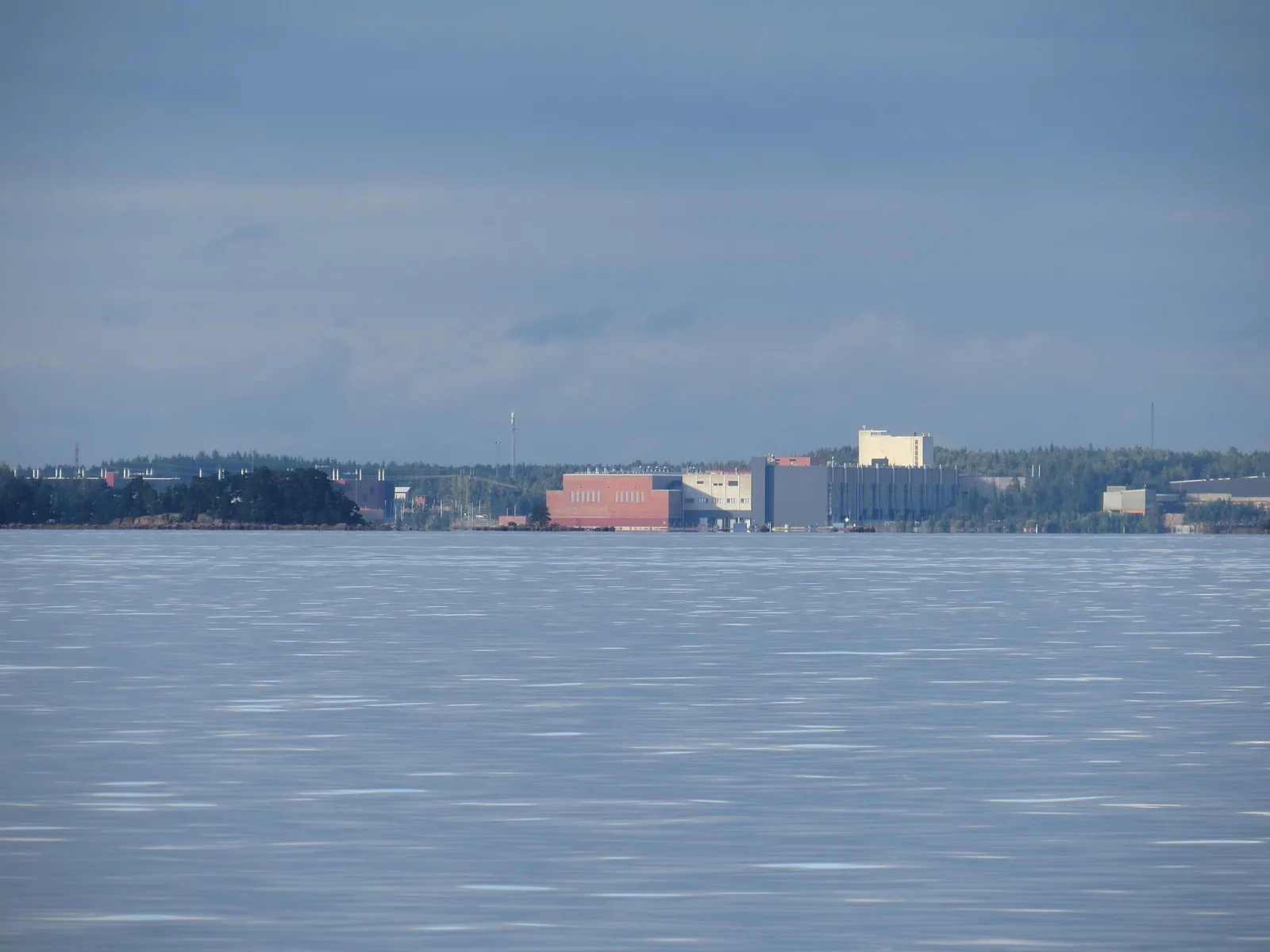
Sesterce. On 8 October Sesterce announced a campus of more than €10 billion at the former Kaipola paper mill in Jämsä. Phase one is 200 MW, with works planned to start in 2026; phase two takes the site to 600 MW; the company’s longer-term goal is more than 1 GW of AI capacity in Finland on existing industrial sites. Sesterce expects about 2,000 people in construction and around 300 permanent jobs, and pledged 1 MW of new renewable generation for every MW the campus consumes within ten years of operation. Its chief executive told Yle the unnamed customer is one of two leading AI labs, Helsinki Times reported.
Jämsä needs new investments, business activity and jobs.
Applied Digital. The US developer said on 6 October that it had an agreement for up to 1 GW of potential power capacity in Finland, with initial power expected from 2028, DCD reported. It has not named a customer, a site or an investment figure, and says decisions depend on customer demand and regulatory milestones. In our view, the 1 GW is a ceiling, not a project.
The long tail. The Confederation of Finnish Industries (EK) counts 145 data centre projects in Finland, 60 of them launched in 2026 so far and more than 50 last year, Daily Northern reported on 6 October, citing Yle.
| Project | Location | Investment | Capacity | Timing | Source |
|---|---|---|---|---|---|
| Google (four sites) | Hamina (expansion), Kajaani, Muhos, Vaala | At least €13bn | Not disclosed; 94 MW battery; up to 50% of Loviisa nuclear output | Construction 2027-2028; PPA from 2028 | Helsinki Times, Fortum |
| Sesterce | Kaipola, Jämsä | More than €10bn | 200 MW phase 1; 600 MW phase 2 | Works from 2026 | Sesterce |
| Applied Digital | Not disclosed | Not disclosed | Up to 1 GW of potential power | Initial power from 2028 | DCD |
| Named total | More than €23bn | Up to 1.6 GW (Sesterce and Applied Digital only) | Our calculation |
Sources: Helsinki Times, 9 Sep 2026; Fortum, 9 Sep 2026; Sesterce, 8 Oct 2026; DCD, 6 Oct 2026. Google’s figure covers data centres and energy infrastructure; Sesterce’s is a headline campus figure. Neither includes a published IT capacity breakdown, so the euro and megawatt totals are not comparable.
What changed: the tax break ended and the money did not leave
Until 30 June, Finnish data centres paid electricity tax in the lower class II, at 0.05 cents per kWh. From 1 July 2026 they pay the general class I rate of 2.24 cents per kWh, the Finnish Government said, roughly a 45-fold increase. The government had planned a replacement support scheme. In early September, after budget talks, Finance Minister Riikka Purra said it would be dropped, arguing that Finland’s appeal does not rest on tax subsidies, The Star reported. Yle reported that the old tax support cost about €47 million a year and the planned scheme would have cost about €30 million.
Google announced its €13 billion plan a week later. Sesterce and Applied Digital followed within a month. That sequence is the clearest signal in this story: in Finland, investors are buying power, land and cooling, not a tax rate.
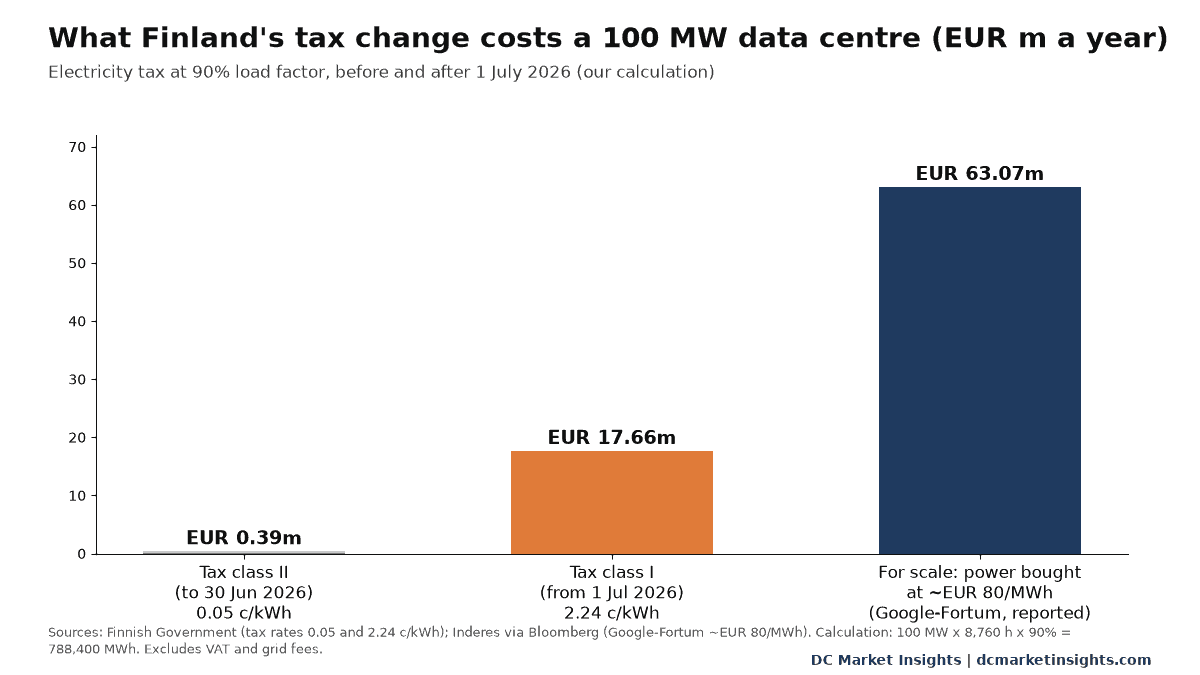
What it costs. A 100 MW data centre running at a 90% load factor uses about 788,400 MWh a year. At the old rate, its electricity tax was about €0.39 million; at the new rate it is about €17.66 million (our calculation). Sesterce’s 200 MW first phase would pay about €35 million a year in electricity tax at the same load. The increase is €21.90 per MWh. Against the roughly €80 per MWh that Google reportedly pays under its Fortum deal, according to research firm Inderes as cited by Bloomberg, the tax adds about 27% to the energy price (our calculation).
The old support also tells us how much data centre load Finland had before the boom. Dividing €47 million a year by the €21.90 per MWh difference gives about 2.15 TWh a year, or about 245 MW of average load benefiting from the lower class (our calculation, assuming the full support went to data centres). DC Market Insights data tracks 151.6 MW live in Finland across the eight of 21 facilities that publish a megawatt figure, which fits that order of magnitude.
| Measure | Before 1 July 2026 | From 1 July 2026 | Source |
|---|---|---|---|
| Electricity tax class for data centres | Class II | Class I (general) | Finnish Government |
| Tax rate | 0.05 c/kWh (€0.50/MWh) | 2.24 c/kWh (€22.40/MWh) | Finnish Government |
| Annual tax, 100 MW at 90% load | €0.39m | €17.66m | Our calculation |
| Annual tax, 200 MW at 90% load (Sesterce phase 1 size) | €0.79m | €35.3m | Our calculation |
| Cost of the support to the state | ~€47m a year | Replacement (~€30m a year) dropped in September | Yle, via The Star |
Sources: Finnish Government; The Star, 2 Sep 2026. Tax figures exclude VAT and grid fees. Some reports say the lower rate ended in June; the government gives 1 July 2026 as the effective date, which we use.
The grid is now the gate
Finland’s constraint is not demand for sites. It is transmission. In its half-year report, Fingrid said it received grid connection enquiries of about 68 GW for consumption, 13 GW for generation and 32 GW for storage over the previous 12 months. Of some 50 new connection agreements in that period, roughly a third concerned data centres, and data centre projects with signed agreements had a planned capacity of more than 3 GW by the end of June. Finnish electricity consumption rose 6.3% in January-June, to 46.1 TWh.
Data centre and electric boiler projects, in particular, are now driving growth in consumption.
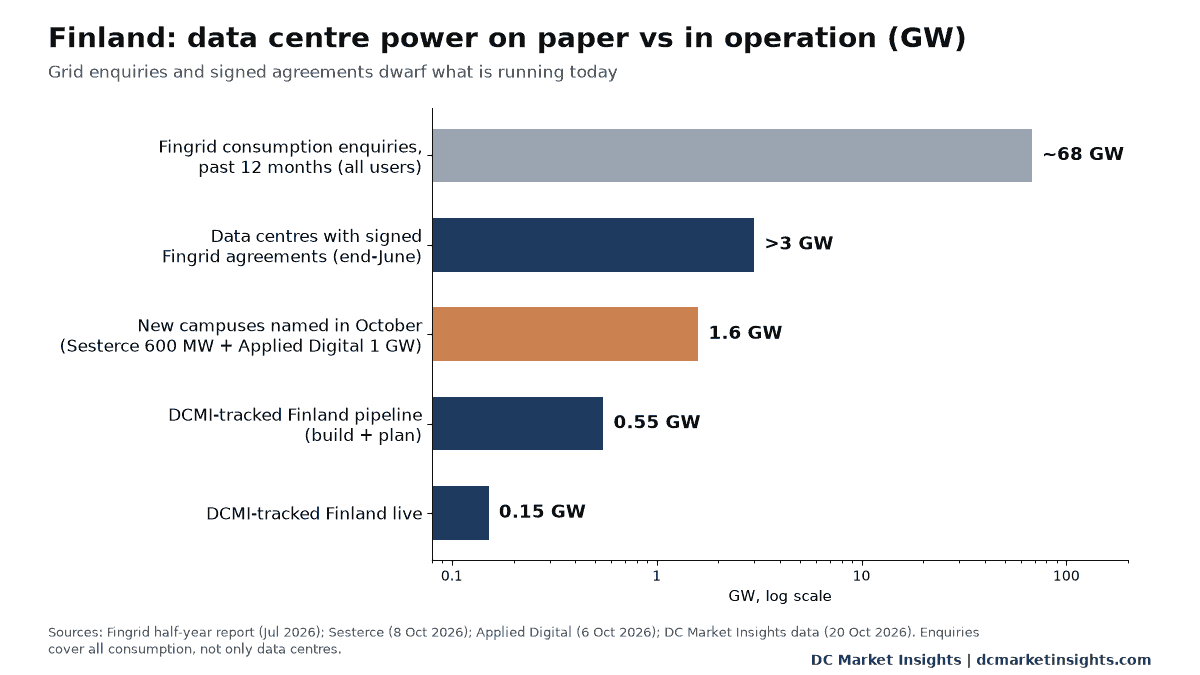
The gap is the opportunity and the risk. The more than 3 GW with signed Fingrid agreements is about 20 times the 151.6 MW of live capacity DC Market Insights tracks in Finland, and about 5.5 times the 550 MW we track under construction or planned (our calculation). Part of that gap is our own coverage, which has not yet added the Google, Sesterce and Applied Digital campuses. Most of it is capacity that has a grid contract but no building yet.
The draft priority law. On 18 September the Ministry of Economic Affairs and Employment put a draft amendment to the Electricity Market Act out for consultation until 9 October. It would end first-come, first-served processing when grid capacity is scarce and sort consumption into four groups, according to law firm Hannes Snellman and ESS News. Data centres face lower thresholds than other users.
| Priority group (draft) | Who is in it | Data centre threshold | How processed |
|---|---|---|---|
| Group 1 | Consumers, SMEs and charging points under 3 MW; critical facilities | Up to 1 MW | First come, first served |
| Group 2 | Consumption sites of 3-100 MW | 1-10 MW | Group rounds, twice a year |
| Group 3 | Larger consumption sites | Above 10 MW | Group rounds, twice a year |
| Group 4 | Standalone grid-charged storage | – | Group rounds, twice a year |
Sources: ESS News, 21 Sep 2026; Hannes Snellman, 24 Sep 2026. The proposal is a draft; thresholds can change after consultation.
Large data centres can improve their place. A flexibility commitment of at least 10% of peak output, offered on an organised market in the same bidding area, improves a project’s position within its group; at least 80% moves a group 3 application into group 2. A production commitment, covering at least 50% of annual consumption from a plant commissioned within 36 months of the site in the same area, also improves position within the group. The law is meant to take effect on 1 January 2027, apply to earlier applications without a connection agreement, and have the first group rounds run by 31 December 2027, Hannes Snellman wrote. Separately, Fingrid has applied new technical requirements to large transmission-connected loads since 12 June, and its draft KJV2026 grid code sets duties for demand sites above 30 MW.
Who gains, and how much
Projects that already hold a grid contract. They are the biggest winners. The draft law applies to applications without a connection or binding conditional agreement, so the more than 3 GW of data centres with signed Fingrid agreements sit ahead of the new queue. In our view, a signed agreement in Finland is now worth more than land.
Old industrial sites. Hamina and Kaipola are former paper mills, with heavy grid connections, water and industrial zoning. Sesterce says it will build its 1 GW Finnish goal on existing industrial sites. Google estimates €3.6 billion a year added to Finnish GDP during 2027-2028.
Generators and flexibility providers. The draft law rewards data centres that bring flexibility or new production. That makes batteries, demand response and new wind or nuclear contracts part of a connection strategy, not just an energy bill. Loviisa’s two reactors are rated at 507 MW each, DCD reported, so half the plant is roughly 507 MW of firm supply for 2030-2049 (our calculation).
Who pays. The state gains about €47 million a year from the ended tax support, and avoids the €30 million scheme it dropped. Developers pay instead: about €17.66 million a year for every 100 MW running at 90%. Households and other grid users carry the risk of higher prices; the government’s decision came amid concern about grid pressure and its potential impact on electricity prices, The Star reported.
The first friction: Google’s forest clearing
On 6 October Finland’s supervisory agency LVV ordered Tuike Finland, a Google subsidiary, to stop environmentally significant preparatory work at Muhos and Kajaani immediately, and no later than 23 October, Helsinki Times reported. The order covers tree removal, excavation, blasting, soil removal, drainage and site roads until environmental impact assessments are complete; those are expected during 2026. Planning, measurements and soil surveys may continue. The Finnish Association for Nature Conservation said more than 300 hectares had been cleared at the Leppiniemi site in Muhos. Google said it will comply and plans to replant 130 hectares at Muhos. The order does not cancel the projects, CNBC reported.
In this case, we did not meet the high standards we set ourselves,
In our view, the order is a timing risk, not a demand signal: Google’s construction phase was set for 2027-2028 anyway. But Finland’s welcome comes with process, including a planned data centre register (DC Market Insights policy data) and now a ranked grid queue.
The wider pattern: the Nordics win on rules, not subsidies
Across Europe, grid operators are ending first-come, first-served queues. Britain is pricing queue positions and Germany is moving to readiness rules, as we wrote on 19 October. Finland is doing the same, while also removing a tax break. That it still drew more than €23 billion of named pledges in six weeks suggests investors weigh firm power, cold climate and industrial land above the tax rate. The EU’s AI gigafactory tender, with bids due on 12 November, adds a public reason to look north.
What it means for operators, investors and vendors
Our view, based on the figures above:
- Price the tax in. Budget about €17.66 million a year of electricity tax per 100 MW at 90% load, about 27% on top of an €80 per MWh power price. Any Finnish model still using 0.05 c/kWh is out of date.
- File before 1 January 2027. Applications without a connection agreement fall under the new groups. A data centre above 10 MW lands in group 3 unless it offers flexibility of at least 80% of peak output.
- Bring flexibility or production. A 10% flexibility commitment improves position; 80% moves a project up a group. For a 200 MW site, that means 20 MW to 160 MW of batteries, demand response or contracted output.
- Favour brownfield sites. Former mills such as Hamina and Kaipola come with grid, water and zoning. Expect them to trade at a premium to greenfield forest land.
- Investors: discount the gigawatts. Of the 1.6 GW named in October, only Sesterce’s 200 MW first phase has works planned this year. Applied Digital’s 1 GW has no customer.
- Vendors: plan for 2027-2028 deliveries. Google’s construction window and Applied Digital’s first power in 2028 set when transformers, cooling and generators will be ordered.
For the AI demand behind these campuses, see our AI Data Center Market report. For state-backed AI compute, such as the EU gigafactories, see the Sovereign AI Infrastructure Market report, and for batteries like Google’s 94 MW Kajaani system, the Data Center Energy Storage Market report. Finland’s facility and capacity figures are on our global data center capacity pages.
What to watch next
- 23 October 2026: deadline for Google’s Tuike Finland to stop environmentally significant work at Muhos and Kajaani (LVV).
- 12 November 2026: bids due in the EU AI gigafactory tender (EuroHPC), a further route to market for Nordic sites.
- Late 2026: government bill on the grid priority procedure, after the consultation closed on 9 October; no date published. Environmental impact assessments for Muhos and Kajaani are expected to finish during 2026.
- 1 January 2027: intended entry into force of the priority procedure.
- March 2027: Fingrid’s target for confirming the KJV2026 grid code for demand connections.
- Late 2027: Google’s 94 MW battery near Kajaani starts; first priority-group rounds due by 31 December 2027.
- 2028: Loviisa power purchase agreement and Applied Digital’s initial power begin.
Frequently asked questions
How much are companies investing in Finnish data centres?
More than €23 billion has been named since 9 September 2026: at least €13 billion from Google for four sites over 2027-2028 and more than €10 billion from Sesterce for a 600 MW campus in Jämsä. Applied Digital has secured up to 1 GW of power but given no investment figure.
What electricity tax do Finnish data centres pay?
Since 1 July 2026, the general class I rate of 2.24 cents per kWh, up from 0.05 cents in class II. For a 100 MW site at 90% load that is about €17.66 million a year, against €0.39 million before, by our calculation. A planned replacement subsidy was dropped in September.
How will Finland prioritise grid connections for data centres?
A draft law sorts consumption into four groups from 1 January 2027. Data centres up to 1 MW are in group 1, 1-10 MW in group 2 and above 10 MW in group 3. Flexibility commitments of 80% of peak output move a group 3 project to group 2.
How much data centre capacity has a Fingrid grid agreement?
More than 3 GW of data centre projects had signed connection agreements with Fingrid by the end of June 2026. Fingrid received about 68 GW of consumption connection enquiries over 12 months. DC Market Insights tracks 151.6 MW live in Finland.
Sources
- Helsinki Times, “Google invests €13bn in Finland and plans three new data centres”, 9 Sep 2026. Link
- Fortum, “Fortum and Google partner to drive sustainable growth for Finland, sign nuclear power purchase agreement”, 9 Sep 2026. Link
- Sesterce, “Sesterce plans a €10 billion AI campus in Jämsä”, 8 Oct 2026. Link
- Helsinki Times, “French firm Sesterce plans €10 billion AI data centre in Finland”, Oct 2026. Link
- DCD, “Applied Digital to develop 1GW data center campus in Finland”, 6 Oct 2026. Link
- Fingrid, “Fingrid group’s half-year report 1.1.–30.6.2026”, Jul 2026. Link
- Finnish Government, “Government safeguards Finland’s competitiveness in attracting data centre investments”. Link
- The Star, “Finland drops planned financial support for data centers”, 2 Sep 2026. Link
- Hannes Snellman, “Proposed Priority Procedure for Grid Connections in Finland — Significant Changes for Data Centers and BESS”, 24 Sep 2026. Link
- ESS News, “Finland proposes priority system for grid connections”, 21 Sep 2026. Link
- Helsinki Times, “Google ordered to halt data centre works in Finland over environmental concerns”, 6 Oct 2026. Link
- CNBC, “Google ordered to halt work on two data centers in ‘Texas of Europe’”, 7 Oct 2026. Link
- Daily Northern, “Finland has launched 60 data centre projects this year”, 6 Oct 2026. Link
- Bloomberg via Energy Connects, “Data Center Boom Raises Issue of Who Pays for Grid, RWE Says”, 7 Oct 2026. Link
- DC Market Insights, country data for Finland (bus read 20 Oct 2026), and global data center capacity pages. Link