
Sovereign AI Infrastructure Market Size, Share & Forecast to 2035
Market at a glance
The Sovereign AI Infrastructure market was worth USD 19.06 billion in 2025 and is forecast to reach USD 134.93 billion by 2035, growing at a 21.62% CAGR. Asia Pacific accounts for 35.86% of the market.
 By Amit Jain, Senior Consultant, ICT & Emerging Technologies
 Reviewed by Deepti Agrawal
Last updated 16 Oct 2026
Base year 2025 PDF + Excel
Reviewed by Deepti Agrawal
Last updated 16 Oct 2026
Base year 2025 PDF + Excel
Source: DC Market Insights analysis
Key findings
National AI compute budgets
From research supercomputers to public AI factories
Dependence on imported accelerators
Platform software and managed national GPU clouds
What is inside the report
- 01Introduction
- 02Executive Summary
- 03Market Scope and Estimate Comparison
- 04Market Dynamics
- 05Pricing Analysis
- 06Standards and Regulation
- 07Market Segmentation
- 08DC Exclusive
- 09Regional Insights
- 10Country Analysis
- 13chapters
- 2020-2024Historical period
- 2026-2035Forecast period
- 17Companies profiled
Regional insights
- Asia Pacific35.86%
- Europe22.43%
- North America21.37%
- Middle East and Africa16.94%
- Latin America3.4%
Segmentation
Companies profiled
- NVIDIA (GPUs, networking, DGX systems)
- Huawei (Ascend accelerators and clusters)
- Hewlett Packard Enterprise (HPE Cray supercomputers)
- AMD (Instinct accelerators)
- Eviden (BullSequana supercomputers)
- Fujitsu
- Dell Technologies
- Supermicro
- Lenovo
- Oracle
- G42
- HUMAIN
- Deutsche Telekom (T-Systems)
- Mistral AI
- Sakura Internet
- NAVER Cloud
- KDDI
Recent developments
NAVER, NVIDIA and Brookfield announced plans to expand Korea's national AI factory to 200 MW, with Brookfield funding up to USD 9 billion (Source: NVIDIA newsroom).
Deutsche Telekom put Germany's first industrial AI factory into operation in Munich with nearly 10,000 NVIDIA Blackwell GPUs (Source: Deutsche Telekom).
the IndiaAI Mission reported 38,000 GPUs onboarded at a subsidised INR 65 an hour (Source: Press Information Bureau).
Korea's Ministry of Science and ICT announced sovereign AI infrastructure with over 50,000 NVIDIA GPUs, starting with 13,000 (Source: NVIDIA newsroom).
the EuroHPC JU selected six more AI Factories, bringing the total to 19 sites (Source: EuroHPC JU).
Mistral AI launched Mistral Compute with tens of thousands of GPUs for sovereigns, companies and research institutions (Source: Mistral AI).
Full analysis
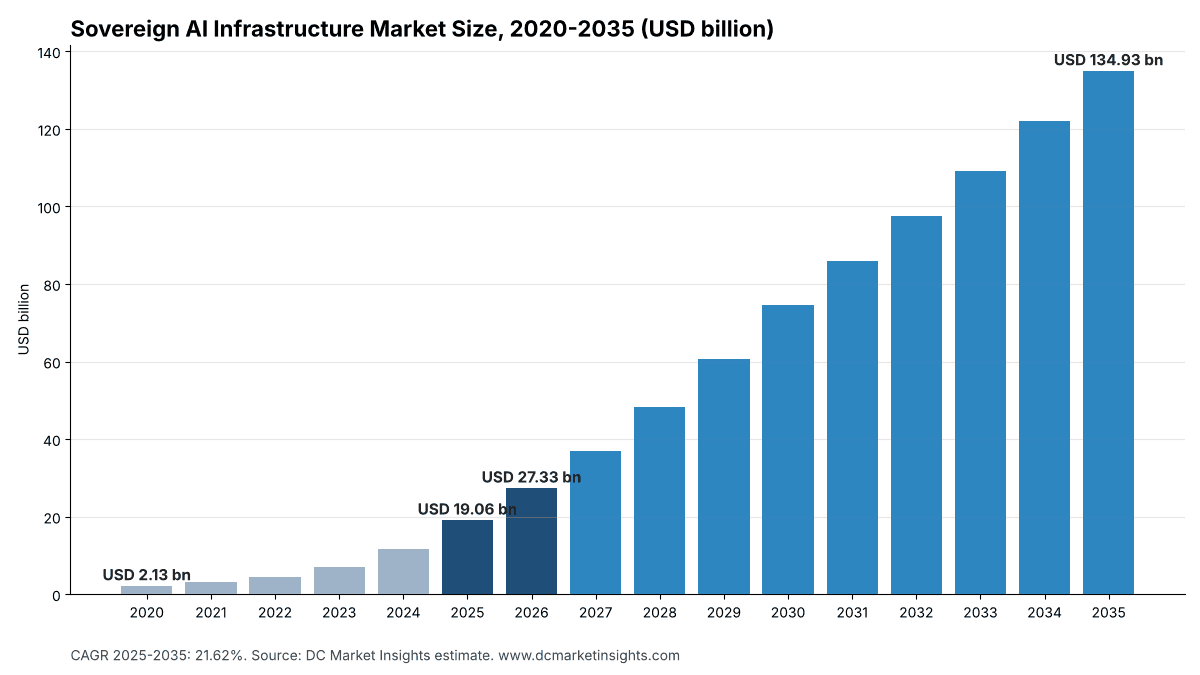
The Sovereign AI Infrastructure Market is valued at USD 27.33 billion in 2026 and is projected to reach USD 134.93 billion by 2035, up from USD 19.06 billion in 2025, a CAGR of 21.62% from 2025 to 2035 (DC Market Insights estimate). The market covers the artificial intelligence (AI) compute that governments, state-backed companies and national operators build and control inside their own borders: graphics processing unit (GPU) servers, networking, storage, the data center halls and power that house them, and the software and services that run them. The 2025 build receipt is 12,000 megawatts (MW) of new data center capacity x 35% built for AI x 8.3% under sovereign control = 348.6 MW, and 348.6 MW x USD 44.6 million of all-in build cost per MW = USD 15.55 billion; adding 1,224.9 MW of installed sovereign AI capacity x USD 2.87 million a year of operations, software and refresh spend = USD 3.52 billion gives a total of USD 19.06 billion. Software and Cloud Services is the fastest-growing segment at 27.14% a year because national GPU clouds sell compute by the hour once the halls are built, and the Middle East and Africa is the fastest-growing region at 26.86% a year as Saudi Arabia and the United Arab Emirates build gigawatt-scale AI campuses. Sovereign AI infrastructure is the state-controlled slice of the AI Data Center Market.
Key Market Statistics: How Big Is the Sovereign AI Infrastructure Market in 2026?
DC Market Insights values the Sovereign AI Infrastructure Market at USD 27.33 billion in 2026, 43.35% above the USD 19.06 billion of 2025, as national AI campuses in the Gulf, Europe and Asia come online.
- Market size 2025: USD 19.06 billion
- Market size 2026: USD 27.33 billion
- Market size 2030: USD 74.57 billion
- Market size 2035: USD 134.93 billion
- CAGR 2025-2035: 21.62% (low case 19.75%, high case 23.26%)
- Largest component: AI Compute Hardware, 57.38% of 2025 revenue
- Fastest segment: Software and Cloud Services, 27.14% a year
- Largest ownership model: State-Backed National AI Champions, 31.46% of 2025 revenue
- Fastest workload: Inference and Public Services, 27.00% a year
- Leading region: Asia Pacific, 35.86% of 2025 revenue
- Fastest-growing region: Middle East and Africa, 16.94% of 2025 revenue, growing 26.86% a year
- Largest country: China, 19.64% of 2025 revenue
- Market leader: NVIDIA, about 38% of 2025 revenue (DC Market Insights assessment)
Executive Summary: How Did Sovereign AI Compute Grow Ninefold After 2020?
Governments and national operators spent USD 19.06 billion on sovereign AI infrastructure in 2025. The Global Sovereign AI Infrastructure Market size was valued at USD 2.13 billion in 2020, reached USD 19.06 billion in 2025, and is anticipated to reach USD 134.93 billion by 2035, at a CAGR of 21.62% during the forecast period. Between 2020 and 2025 the market grew 55.05% a year, from a base of national research supercomputers to dedicated AI factories, after generative AI made domestic compute a question of economic security.
| Report attribute | Details |
|---|---|
| Historical Period | 2020-2024 |
| Base Year | 2025 |
| Forecast Period | 2026-2035 |
| Sovereign AI Infrastructure Market Size 2025 | USD 19.06 billion |
| Sovereign AI Infrastructure Market Size 2026 | USD 27.33 billion |
| Sovereign AI Infrastructure Market CAGR (2025-2035) | 21.62% |
| Sovereign AI Infrastructure Market Size 2035 | USD 134.93 billion |
Growth slows from 55.05% to 21.62% a year because the base is now much larger, not because demand fades. Sovereign programmes moved from pilot clusters to campuses of hundreds of MW: HUMAIN, the AI company of Saudi Arabia’s Public Investment Fund (PIF), plans AI factories of up to 500 MW with several hundred thousand NVIDIA GPUs over five years (Source: NVIDIA and HUMAIN announcement, May 2025), and Stargate UAE is a 1 gigawatt (GW) cluster in Abu Dhabi with 200 MW expected to go live in 2026 (Source: OpenAI, May 2025). The sovereign share of new AI capacity rises from 8.3% in 2025 to a peak of 11.9% in 2030 in the DC Market Insights model, then eases to 10.8% by 2035 as private hyperscale AI campuses grow faster.
Key takeaways:
- USD 19.06 billion in 2025, USD 27.33 billion in 2026 and USD 134.93 billion by 2035, a 21.62% CAGR.
- AI Compute Hardware takes 57.38% of revenue; facility and power take 18.27%.
- Software and Cloud Services grows fastest, from 8.71% to 13.58% of revenue by 2035.
- State-Backed National AI Champions such as HUMAIN and G42 lead with 31.46% of spend.
- Asia Pacific leads with 35.86%; the Middle East and Africa grows fastest at 26.86%.
Market Scope: What Makes AI Infrastructure Sovereign?
The Sovereign AI Infrastructure Market is the annual spend on AI compute that a state owns, funds or legally controls inside its territory, USD 19.06 billion in 2025 across about 1,573 MW of sovereign AI capacity (DC Market Insights estimate).
Included. GPU and other accelerator servers, high-speed networking, storage, and the data center shell, power and cooling for AI systems that are (a) owned by a government, a public research body or a defense agency; (b) built by a state-backed national AI company such as HUMAIN in Saudi Arabia or G42 in the United Arab Emirates; or (c) run by a domestic cloud or telecom operator under a public subsidy or a sovereign-control mandate, such as the METI-subsidized GPU clouds in Japan or the Deutsche Telekom Industrial AI Cloud in Germany. Operations, platform software, accelerator refresh and managed services on that installed base are included.
Excluded. AI capacity built by global hyperscale cloud providers for their own commercial regions, even when sold as a sovereign cloud region; enterprise AI clusters bought by private companies without a public mandate; conventional government IT and non-AI supercomputing; chips, models and data sets bought outside an infrastructure project; and electricity bills.
Related searches outside this scope. Sovereign cloud software licences, national large language model (LLM) development budgets and AI talent programmes are not infrastructure and are excluded; the AI data center buildout by private operators is sized in the Mega Data Center Market report.
Related segments and end use. By end use, government organizations are counted under Defense and Government Agencies and Public Research and National Supercomputers. AI infrastructure that cloud service providers build for their own commercial cloud service is excluded unless a state funds or controls it. Asia Pacific AI infrastructure built by private operators sits in the AI Data Center Market report; only the state-controlled share of Asia Pacific AI capacity is counted here.
How the segments fit together. Every split in this report sums to the same total: five components, four ownership models, five workloads, three deployment models and five regions. AI Compute Hardware accounts for a 2025 spend of USD 10.94 billion.
Why Do Sovereign AI Infrastructure Market Estimates Differ?
DC Market Insights values the Sovereign AI Infrastructure Market at USD 27.33 billion in 2026. Published estimates differ mainly because some count every AI data center in a country as sovereign, while this report counts only capacity a state owns, funds or controls.
| Element | In this report | Why |
|---|---|---|
| State-owned and state-funded AI clusters | Yes | The core of sovereign AI |
| National AI champions backed by sovereign funds | Yes | State capital and a national mandate |
| Subsidized domestic GPU clouds | Yes | Public money buys domestic control |
| Hyperscaler sovereign cloud regions | No | Owned and controlled by foreign commercial providers |
| Private enterprise AI clusters | No | No public mandate |
| National LLM and talent budgets | No | Not infrastructure |
Market Drivers: Why Are Governments Buying Their Own AI Compute?
Three drivers lift the Sovereign AI Infrastructure Market from USD 19.06 billion in 2025 to USD 134.93 billion by 2035: national AI budgets, sovereign wealth fund capital, and fast-rising AI power demand.
National AI compute budgets
Public budgets for domestic compute now run to billions. The European Commission launched InvestAI in February 2025 to mobilise EUR 200 billion for AI, including a EUR 20 billion fund for AI gigafactories (Source: European Commission, February 2025). The Canadian Sovereign AI Compute Strategy invests up to CAD 2 billion, of which up to CAD 1 billion builds public supercomputing infrastructure (Source: Innovation, Science and Economic Development Canada, December 2024). India approved the IndiaAI Mission with an outlay of INR 10,371.92 crore over five years (Source: Press Information Bureau, December 2025), and the United Kingdom committed an extra GBP 1 billion to scale up public compute by a factor of 20 (Source: GOV.UK, July 2025).
Sovereign wealth funds and national AI champions
Gulf states fund sovereign AI infrastructure through state-backed companies rather than ministries. HUMAIN, a subsidiary of the Saudi PIF, started with an 18,000-unit NVIDIA GB300 supercomputer (Source: NVIDIA, May 2025). G42 leads a consortium building a 5 GW UAE-US AI Campus, which it calls the largest AI infrastructure project outside the United States (Source: G42, May 2025). State-Backed National AI Champions grow 24.23% a year in the DC Market Insights model, the fastest ownership model.
AI power demand and grid access
Data centers used about 415 terawatt-hours (TWh) of electricity in 2024, around 1.5% of world consumption, and the International Energy Agency (IEA) expects about 945 TWh by 2030 (Source: IEA Energy and AI, April 2025). Countries with cheap power and land, such as Saudi Arabia, the United Arab Emirates and the Nordic states, can host national AI campuses at scale, which shifts sovereign spend toward Dedicated Sovereign AI Campuses (44.37% of 2025 revenue, rising to 53.18% by 2035).
Market Trends: How Is Sovereign AI Moving from Supercomputers to AI Factories?
Three trends reshape sovereign AI infrastructure: public AI factories in Europe, sovereign GPU clouds run by telecom operators, and national compute sold by the hour.
From research supercomputers to public AI factories
The amendment to the European High Performance Computing Joint Undertaking (EuroHPC JU) regulation that lets it acquire and operate AI-optimised supercomputers entered into force on 9 July 2024 (Source: EuroHPC JU, July 2024). The first seven AI Factories represented a EUR 1.5 billion investment (Source: European Commission, December 2024), six more followed in March 2025 with about EUR 485 million (Source: European Commission, March 2025), and by October 2025 there were 19 sites (Source: EuroHPC JU, October 2025). Public Research and National Supercomputers still hold 27.83% of 2025 sovereign AI spend but grow only 16.67% a year.
Telecom operators build sovereign GPU clouds
Deutsche Telekom and NVIDIA launched a EUR 1 billion Industrial AI Cloud in Munich with up to 10,000 Blackwell GPUs, about 50% more AI computing power for Germany (Source: Deutsche Telekom, November 2025). Mistral AI is building a cloud platform with NVIDIA on 18,000 Grace Blackwell systems in its first phase (Source: NVIDIA, June 2025). Sovereign Cloud and Telecom Operators rise from 24.19% to 27.66% of sovereign AI revenue by 2035.
Subsidized compute by the hour
Governments increasingly buy access rather than machines. The IndiaAI Mission has onboarded 38,000 GPUs that start-ups and researchers rent at a subsidised INR 65 an hour (Source: Press Information Bureau, December 2025). Japan’s Ministry of Economy, Trade and Industry (METI) approved up to JPY 72.5 billion of subsidies for five AI compute projects, including about JPY 50.1 billion for Sakura Internet (Source: METI, April 2024). This model makes Inference and Public Services the fastest workload at 27.00% a year.
Market Challenges: What Holds Sovereign AI Infrastructure Back?
Two challenges hold sovereign AI infrastructure back: dependence on a few foreign chip suppliers, and the power and cost of each new MW.
Dependence on imported accelerators
Almost every sovereign AI project outside China runs on NVIDIA accelerators, whose data center revenue reached USD 193.7 billion in fiscal 2026 (Source: NVIDIA fiscal 2026 results, SEC filing, February 2026). Export licensing, delivery slots and chip generations decide when a national cluster goes live, so sovereignty over the hall does not mean sovereignty over the silicon. China builds on domestic accelerators from Huawei and others, which keeps its sovereign AI spend inside the country but at lower performance per MW.
Power and capital per MW
A sovereign AI MW carries a 2025 build cost of about USD 44.6 million, against a 2020 cost of USD 21.4 million, because denser racks carry more expensive accelerators. These cost values are DC Market Insights estimates. Few national budgets can fund hundreds of MW, so many governments hand the build to state-backed champions or telecom operators. Government-Owned On-Premises Data Centers grow only 16.12% a year.
Market Opportunities: Where Are the New Sovereign AI Revenue Pools?
The two largest new revenue pools in the sovereign AI infrastructure market are national GPU cloud platforms and Gulf AI campuses, which together add the most revenue between 2025 and 2035.
Platform software and managed national GPU clouds
Software and Cloud Services rises from 8.71% of sovereign AI revenue in 2025 to 13.58% by 2035, the largest share gain of any component. Operators that can run a national GPU cloud with scheduling, security clearance and local support, such as Sakura Internet, Deutsche Telekom or NAVER Cloud, gain most.
Gulf and Asian national AI campuses
Saudi Arabia and the United Arab Emirates together grow from 14.45% to 22.25% of sovereign AI revenue by 2035. In South Korea, NAVER, NVIDIA and Brookfield plan to expand the national AI factory from 55 MW to 200 MW, with Brookfield funding up to USD 9 billion (Source: NVIDIA, July 2026). Suppliers of liquid cooling, power and high-density racks win the facility share of these campuses.
Pricing: How Much Does Sovereign AI Capacity Cost per MW?
A sovereign AI campus carries a 2025 build cost of about USD 44.6 million per MW of IT capacity (DC Market Insights estimate). The sovereign AI infrastructure build cost covers accelerators, networking, storage and the facility, and running and refreshing each installed MW adds USD 2.87 million a year.
| Year | All-in build cost (USD million per new MW) | Operations, software and refresh (USD million per installed MW a year) |
|---|---|---|
| 2020 | 21.40 | 1.62 |
| 2025 | 44.60 | 2.87 |
| 2030 | 49.80 | 3.61 |
| 2035 | 46.30 | 3.86 |
Public price anchors:
- Deutsche Telekom’s EUR 1 billion Industrial AI Cloud for up to 10,000 NVIDIA Blackwell GPUs works out at about EUR 100,000 per GPU, all-in (Source: Deutsche Telekom, November 2025).
- Brookfield’s up to USD 9 billion for expanding Korea’s national AI factory from 55 MW to 200 MW is about USD 62 million per added MW, including buildings and power (Source: NVIDIA, July 2026).
- IndiaAI Mission GPUs rent at a subsidised INR 65 an hour (Source: Press Information Bureau, December 2025).
- Canada allocates up to CAD 700 million to AI data centres, up to CAD 1 billion to public supercomputing and up to CAD 300 million to an AI Compute Access Fund (Source: Innovation, Science and Economic Development Canada, December 2024).
The model’s cost per MW values are DC Market Insights estimates; they sit below the Korean anchor because older and smaller national clusters cost less per MW.
Standards and Regulation: Which Rules Shape Sovereign AI Compute?
Three sets of rules shape sovereign AI infrastructure: the EU AI Act, the legal basis for public AI factories, and economic security laws that fund domestic compute.
EU AI Act. Regulation (EU) 2024/1689 of 13 June 2024 lays down harmonised rules on artificial intelligence. Its obligations on general-purpose AI models push European developers to train and host models on infrastructure they can document and audit, which favors EU AI Factories and domestic GPU clouds.
EuroHPC AI Factories. Council Regulation (EU) 2024/1732 amended the EuroHPC JU regulation so the Joint Undertaking can acquire and operate AI-optimised supercomputers; it entered into force on 9 July 2024 (Source: EuroHPC JU).
Economic security subsidies. Japan funds domestic AI compute under Article 9 of its Economic Security Promotion Act, which METI used for up to JPY 72.5 billion of GPU cloud subsidies in April 2024 (Source: METI). Canada, India and the United Kingdom fund compute through budget programmes rather than a dedicated law.
Market Segmentation: Which Segment Leads the Sovereign AI Infrastructure Market?
AI Compute Hardware leads the Sovereign AI Infrastructure Market with 57.38% of 2025 revenue, and Software and Cloud Services is the fastest-growing segment at 27.14% a year to 2035 (DC Market Insights estimate).
By Component: AI Compute Hardware Leads with 57.38%
Accelerator servers take most of every sovereign AI budget; software and services gain share as clusters turn into national clouds.
| Component | 2025 (USD million) | Share 2025 | 2035 (USD million) | CAGR 2025-2035 |
|---|---|---|---|---|
| AI Compute Hardware | 10,938.41 | 57.38% | 71,027.88 | 20.57% |
| Data Center Facility and Power | 3,482.83 | 18.27% | 24,166.21 | 21.37% |
| Networking and Interconnect | 1,803.37 | 9.46% | 13,803.48 | 22.57% |
| Software and Cloud Services | 1,660.40 | 8.71% | 18,323.68 | 27.14% |
| Storage | 1,178.10 | 6.18% | 7,610.13 | 20.51% |
By Ownership Model: State-Backed National AI Champions Lead with 31.46%
Sovereign wealth fund companies in the Gulf and Asia spend more than any ministry; research supercomputers lose share.
| Ownership model | 2025 (USD million) | Share 2025 | 2035 (USD million) | CAGR 2025-2035 |
|---|---|---|---|---|
| State-Backed National AI Champions | 5,997.25 | 31.46% | 52,515.30 | 24.23% |
| Public Research and National Supercomputers | 5,305.26 | 27.83% | 24,786.90 | 16.67% |
| Sovereign Cloud and Telecom Operators | 4,611.36 | 24.19% | 37,322.02 | 23.26% |
| Defense and Government Agencies | 3,149.22 | 16.52% | 20,307.17 | 20.49% |
By Workload: Foundation Model Training Leads with 38.74%
National models need training clusters first; inference for public services overtakes training as models are deployed.
| Workload | 2025 (USD million) | Share 2025 | 2035 (USD million) | CAGR 2025-2035 |
|---|---|---|---|---|
| Foundation Model Training | 7,385.05 | 38.74% | 40,223.05 | 18.47% |
| Inference and Public Services | 4,508.42 | 23.65% | 49,209.48 | 27.00% |
| Scientific Research | 3,296.01 | 17.29% | 16,677.52 | 17.60% |
| Defense and Security | 2,302.82 | 12.08% | 15,409.16 | 20.93% |
| Industrial and Enterprise AI | 1,570.80 | 8.24% | 13,412.18 | 23.92% |
By Deployment: Dedicated Sovereign AI Campuses Lead with 44.37%
New purpose-built campuses take the largest share; colocation-hosted GPU clouds let smaller states start without building halls.
| Deployment | 2025 (USD million) | Share 2025 | 2035 (USD million) | CAGR 2025-2035 |
|---|---|---|---|---|
| Dedicated Sovereign AI Campuses | 8,458.30 | 44.37% | 71,756.51 | 23.84% |
| Colocation-Hosted Sovereign GPU Clouds | 5,894.31 | 30.92% | 42,179.55 | 21.75% |
| Government-Owned On-Premises Data Centers | 4,710.49 | 24.71% | 20,995.32 | 16.12% |
DC Exclusive: The Sovereign AI MW Model and Region x Ownership Matrix
The largest cell of the sovereign AI infrastructure market is Middle East and Africa State-Backed National AI Champions, with a 2025 spend of USD 2.30 billion. This is a DC Market Insights model built from 16 inputs and tested against 3 bound checks, listed under Methodology.
The 16 inputs are new data center capacity for 2025 and 2035, the AI share of new capacity for 2025 and 2035, the sovereign share of new AI capacity for 2025, 2030 and 2035, four build costs per MW, four operations and refresh costs per installed MW, and the sovereign AI base installed by 2019. The table below shows the 2025 build.
| Step (2025) | Value |
|---|---|
| New data center capacity completed | 12,000 MW |
| Share built for AI | 35% |
| Sovereign share of new AI capacity | 8.3% |
| New sovereign AI capacity | 348.6 MW |
| Build spend (348.6 MW x USD 44.6 million) | USD 15,547.56 million |
| Installed sovereign AI base at start of year | 1,224.9 MW |
| Operations and refresh spend (x USD 2.87 million) | USD 3,515.54 million |
| Total | USD 19,063.10 million |
The matrix below splits the 2025 market by region and ownership model; rows sum to the regional totals in this report.
| Region (USD million, 2025) | National AI Champions | Research Supercomputers | Sovereign Cloud and Telecom | Defense and Government | Total |
|---|---|---|---|---|---|
| Asia Pacific | 2,174.47 | 1,834.85 | 1,682.26 | 1,144.45 | 6,836.03 |
| Europe | 752.80 | 1,606.90 | 1,411.88 | 504.27 | 4,275.85 |
| North America | 598.22 | 1,511.90 | 914.18 | 1,049.49 | 4,073.79 |
| Middle East and Africa | 2,299.72 | 162.25 | 418.18 | 349.14 | 3,229.29 |
| Latin America | 172.05 | 189.36 | 184.87 | 101.87 | 648.15 |
| Total | 5,997.26 | 5,305.26 | 4,611.37 | 3,149.22 | 19,063.11 |
Regional Insights: Which Region Leads the Sovereign AI Infrastructure Market?
Asia Pacific leads the sovereign AI infrastructure market with 35.86% of 2025 revenue, and the fastest-growing region is the Middle East and Africa, which holds 16.94% and grows 26.86% a year to 2035 (DC Market Insights estimate). The Middle East and Africa is the fastest growing region for sovereign AI infrastructure because Saudi Arabia and the United Arab Emirates fund national AI campuses from sovereign wealth funds.
| Region | 2025 (USD million) | Share 2025 | 2035 (USD million) | CAGR 2025-2035 |
|---|---|---|---|---|
| Asia Pacific | 6,836.03 | 35.86% | 44,689.28 | 20.65% |
| Europe | 4,275.85 | 22.43% | 26,541.00 | 20.03% |
| North America | 4,073.79 | 21.37% | 22,992.31 | 18.89% |
| Middle East and Africa | 3,229.29 | 16.94% | 34,852.78 | 26.86% |
| Latin America | 648.15 | 3.40% | 5,856.02 | 24.62% |
Asia Pacific Leads with 35.86% Share
China’s state-directed computing hubs, Japan’s METI-subsidized GPU clouds and the AI Bridging Cloud Infrastructure (ABCI) 3.0 system with 6,128 NVIDIA H200 GPUs at the National Institute of Advanced Industrial Science and Technology (AIST), in service since April 2025 (Source: AIST), India’s IndiaAI Mission and South Korea’s national AI factory make Asia Pacific the largest region. It grows 20.65% a year.
Europe Holds 22.43% Share
Europe builds sovereign AI through EuroHPC AI Factories, national programmes and telecom operators. France secured EUR 109 billion of private AI investment pledges at the February 2025 AI Action Summit (Source: Elysee, February 2025). Europe grows 20.03% a year.
North America Holds 21.37% Share
In North America, sovereign spend is mostly national laboratory and defense AI systems in the United States and the CAD 2 billion Canadian strategy. Private hyperscalers build most US AI capacity, so the region grows the slowest at 18.89% a year.
Middle East and Africa Holds 16.94% Share and Grows Fastest
The Middle East and Africa is the fastest-growing region at 26.86% a year because Saudi Arabia (HUMAIN) and the United Arab Emirates (G42, Stargate UAE) fund gigawatt-scale AI campuses from sovereign wealth funds with cheap power and land.
Latin America Holds 3.40% Share
Latin America grows 24.62% a year from a small base, led by Brazil’s national AI plan and public research supercomputers in Brazil, Mexico and Chile.
Country Analysis: Which Countries Spend the Most on Sovereign AI Compute?
China leads the sovereign AI infrastructure market with 19.64% of 2025 revenue, and Saudi Arabia is the fastest-growing country in the top 12 at 27.29% a year (DC Market Insights estimate). The 12 countries below hold 84.80% of 2025 revenue.
| Rank | Country | Region | 2025 (USD million) | Share 2025 | 2035 (USD million) | CAGR |
|---|---|---|---|---|---|---|
| 1 | China | Asia Pacific | 3,743.99 | 19.64% | 22,708.95 | 19.75% |
| 2 | United States | North America | 3,606.74 | 18.92% | 19,929.37 | 18.64% |
| 3 | Saudi Arabia | Middle East and Africa | 1,595.58 | 8.37% | 17,824.44 | 27.29% |
| 4 | Japan | Asia Pacific | 1,172.38 | 6.15% | 7,326.77 | 20.11% |
| 5 | United Arab Emirates | Middle East and Africa | 1,159.04 | 6.08% | 12,197.80 | 26.54% |
| 6 | France | Europe | 1,042.75 | 5.47% | 6,179.86 | 19.48% |
| 7 | India | Asia Pacific | 812.09 | 4.26% | 7,583.14 | 25.03% |
| 8 | Germany | Europe | 787.31 | 4.13% | 5,005.95 | 20.32% |
| 9 | United Kingdom | Europe | 751.09 | 3.94% | 4,574.17 | 19.80% |
| 10 | South Korea | Asia Pacific | 707.24 | 3.71% | 4,695.61 | 20.84% |
| 11 | Canada | North America | 467.05 | 2.45% | 3,062.94 | 20.69% |
| 12 | Brazil | Latin America | 320.26 | 1.68% | 2,955.00 | 24.88% |
Outside the top 12, Italy holds 2.31% of sovereign AI infrastructure revenue, Spain 1.62%, Singapore 0.94%, the Netherlands 1.07%, Qatar 1.04%, Taiwan 0.68% and Australia 0.41%. These shares are DC Market Insights estimates.
Forecast Scenarios: What Could Change the 2035 Sovereign AI Forecast?
The 2035 Sovereign AI Infrastructure Market ranges from USD 115.60 billion to USD 154.26 billion around a base case of USD 134.93 billion, depending on how much new AI capacity states keep under national control.
| Scenario | Assumption from 2026 | 2035 value | CAGR 2025-2035 |
|---|---|---|---|
| Low | Sovereign share of new AI capacity 15% below base (more reliance on hyperscaler sovereign regions) | USD 115.60 billion | 19.75% |
| Base | Sovereign share of new AI capacity rises from 8.3% to 11.9% in 2030, then 10.8% by 2035 | USD 134.93 billion | 21.62% |
| High | Sovereign share of new AI capacity 15% above base (more national AI factories and Gulf campuses) | USD 154.26 billion | 23.26% |
Competitive Insights: Who Leads the Sovereign AI Infrastructure Market?
NVIDIA leads the sovereign AI infrastructure market with about 38% of 2025 revenue, and the three largest suppliers (NVIDIA, Huawei and Hewlett Packard Enterprise) hold about 52% (DC Market Insights assessment).
- NVIDIA (GPUs, networking, DGX systems)
- Huawei (Ascend accelerators and clusters)
- Hewlett Packard Enterprise (HPE Cray supercomputers)
- AMD (Instinct accelerators)
- Eviden (BullSequana supercomputers)
- Fujitsu
- Dell Technologies
- Supermicro
- Lenovo
- Oracle
- G42
- HUMAIN
- Deutsche Telekom (T-Systems)
- Mistral AI
- Sakura Internet
- NAVER Cloud
- KDDI
NVIDIA’s advantage is that nearly every non-Chinese national AI factory is built on its platform; its data center revenue was USD 115.2 billion in fiscal 2025 (Source: NVIDIA CFO commentary, SEC filing, February 2025). Huawei supplies most Chinese state computing hubs with domestic accelerators. HPE builds many national research supercomputers, including the Isambard-AI system with 5,448 NVIDIA GH200 superchips (Source: GOV.UK, July 2025). State-backed operators such as HUMAIN and G42 are buyers and operators rather than suppliers.
Recent Developments
Recent sovereign AI infrastructure projects span Asia, Europe and the Gulf.
- In July 2026, NAVER, NVIDIA and Brookfield announced plans to expand Korea’s national AI factory to 200 MW, with Brookfield funding up to USD 9 billion (Source: NVIDIA newsroom).
- In February 2026, Deutsche Telekom put Germany’s first industrial AI factory into operation in Munich with nearly 10,000 NVIDIA Blackwell GPUs (Source: Deutsche Telekom).
- In December 2025, the IndiaAI Mission reported 38,000 GPUs onboarded at a subsidised INR 65 an hour (Source: Press Information Bureau).
- In October 2025, Korea’s Ministry of Science and ICT announced sovereign AI infrastructure with over 50,000 NVIDIA GPUs, starting with 13,000 (Source: NVIDIA newsroom).
- In October 2025, the EuroHPC JU selected six more AI Factories, bringing the total to 19 sites (Source: EuroHPC JU).
- In June 2025, Mistral AI launched Mistral Compute with tens of thousands of GPUs for sovereigns, companies and research institutions (Source: Mistral AI).
More AI and data center reports are listed under DC Market Insights industry reports; private AI campuses are covered in the Mega Data Center Market report, and shared high-performance computing (HPC) capacity in the HPC as a Service Market report.
Methodology: How We Built the Sovereign AI Infrastructure Market Model
The sovereign AI infrastructure model multiplies new sovereign AI capacity by an all-in build cost per MW and adds operations, software and refresh spend on the installed sovereign base. New data center capacity rises from 12,000 MW in 2025 to 27,000 MW in 2035, in line with the DC Market Insights Capacity model (installed base 116,000 MW in 2025 and 314,368 MW in 2035). The AI share of new capacity rises from 35% to 66%, and the sovereign share of new AI capacity is 8.3% in 2025, 11.9% in 2030 and 10.8% in 2035. Build cost per MW is USD 21.4 million (2020), 44.6 (2025), 49.8 (2030) and 46.3 (2035); operations and refresh cost per installed MW a year is 1.62, 2.87, 3.61 and 3.86. Segment shares are set for 2025 and 2035 and scaled so every split sums to the total.
Three bound checks:
- Ceiling 1: USD 19.06 billion is about 3.8% of the roughly half a trillion dollars the world invested in data centers in 2024 (Source: IEA Energy and AI, April 2025).
- Ceiling 2: the model’s 2025 AI Compute Hardware and Networking spend of USD 12.74 billion is 6.58% of NVIDIA’s fiscal 2026 data center revenue of USD 193.7 billion (Source: NVIDIA, SEC filing, February 2026).
- Floor: five public programmes alone (Canada CAD 2 billion, EU AI Factories EUR 1.5 billion plus about EUR 485 million, METI JPY 72.5 billion, IndiaAI INR 10,371.92 crore and the Deutsche Telekom EUR 1 billion cloud) total more than USD 6 billion at 2025 exchange rates, before the Gulf campuses; the model’s cumulative 2024-2026 spend of USD 58.13 billion covers these plus HUMAIN, G42 and Chinese state hubs.
Full approach: DC Market Insights research methodology. The analyst named on this page built the model, and the reviewer checked the arithmetic, the sources and the dates before publication.
Table of contents
- 01Introduction
- 1.1Market Definition and Scope
- 1.2Research Methodology
- 1.3Key Market Statistics
- 02Executive Summary
- 2.1Market Size 2020-2035
- 2.2Key Takeaways
- 03Market Scope and Estimate Comparison
- 3.1Included and Excluded
- 3.2Why Estimates Differ
- 04Market Dynamics
- 4.1Market Drivers
- 4.2Market Trends
- 4.3Market Challenges
- 4.4Market Opportunities
- 05Pricing Analysis
- 5.1Build and Operating Cost per MW, 2020-2035
- 5.2Public Price Anchors
- 06Standards and Regulation
- 6.1EU AI Act
- 6.2EuroHPC AI Factories
- 6.3Economic Security Subsidies
- 07Market Segmentation
- 7.1By Component
- 7.2By Ownership Model
- 7.3By Workload
- 7.4By Deployment
- 08DC Exclusive
- 8.1Sovereign AI MW Model
- 8.2Region x Ownership Matrix
- 09Regional Insights
- 9.1Asia Pacific
- 9.2Europe
- 9.3North America
- 9.4Middle East and Africa
- 9.5Latin America
- 10Country Analysis
- 10.1Top 12 Countries
- 11Forecast Scenarios
- 11.1Low, Base and High Cases
- 12Competitive Landscape
- 12.1Company List
- 12.2Market Share and Advantages
- 13Recent Developments
- Fig. 1Sovereign AI Infrastructure Market Size, 2020-2035
- Table 1Report Attributes
- Table 2Scope Comparison
- Table 3Build and Operating Cost per MW
- Table 4Segment Tables
- Table 5Sovereign AI MW Model
- Table 6Region x Ownership Matrix
- Table 7Regional Split
- Table 8Top 12 Countries
- Table 9Forecast Scenarios
About this report
Written by Amit Jain and reviewed by Deepti Agrawal, Senior Editor, Research. Figures are built top-down and bottom-up and reconciled before publication, with 2025 as the base year.
Read our methodologyHow we built this
- Historical period2020-2024
- Base year2025
- Forecast period2026-2035
- Sizing approachTop-down + bottom-up
Need more than the report?
Advisory on this market
Due diligence, site selection and market entry work, by the analysts who wrote this report.
See consulting servicesFrequently asked questions
USD 27.33 billion in 2026, up 43.35% from USD 19.06 billion in 2025, according to DC Market Insights estimates. The market is projected to reach USD 134.93 billion by 2035, a CAGR of 21.62% from 2025 to 2035.
USD 19.06 billion in 2025 and USD 134.93 billion by 2035 (DC Market Insights estimate), after USD 2.13 billion in 2020. The 2025 figure covers GPU servers, networking, storage, facilities and services for about 1,573 MW of state-controlled AI capacity.
21.62% a year from 2025 to 2035 (DC Market Insights estimate), down from 55.05% in 2020-2025 because the base is now much larger as national AI factories move from pilots to campuses of hundreds of MW.
USD 19.06 billion of 2025 spending went on sovereign AI infrastructure: AI compute that a government, a state-backed company or a mandated national operator owns, funds or controls inside its own borders. Hyperscaler cloud regions and private enterprise clusters are excluded.
57.38% of 2025 revenue goes to AI Compute Hardware, the leading component, because GPU and accelerator servers take most of every national AI budget. Facility and power, networking, software and services, and storage make up the rest (DC Market Insights estimate).
27.14% a year is the growth rate of Software and Cloud Services, the fastest segment, rising from 8.71% of revenue in 2025 to 13.58% by 2035 as national GPU clouds sell compute by the hour (DC Market Insights estimate).
USD 44.6 million is the all-in 2025 build cost of one sovereign AI MW in the DC Market Insights model, including accelerators, networking, storage and the facility. Deutsche Telekom’s EUR 1 billion cloud for up to 10,000 Blackwell GPUs works out at about EUR 100,000 per GPU.
35.86% of 2025 revenue comes from Asia Pacific, the leading region. The Middle East and Africa is the fastest-growing region at 26.86% a year because Saudi Arabia and the United Arab Emirates fund gigawatt-scale AI campuses from sovereign wealth funds (DC Market Insights estimate).
About 38% of 2025 revenue goes to NVIDIA, the leading supplier, and NVIDIA, Huawei and Hewlett Packard Enterprise together hold about 52% (DC Market Insights assessment). AMD, Eviden, Fujitsu, Dell Technologies, Supermicro and Lenovo follow.
31.46% of 2025 revenue comes from State-Backed National AI Champions such as HUMAIN and G42, the leading ownership model, which also grows fastest at 24.23% a year (DC Market Insights estimate).
19.64% of 2025 revenue comes from China, the largest country, followed by the United States at 18.92%. Saudi Arabia is the fastest-growing country in the top 12 at 27.29% a year (DC Market Insights estimate).
38,000 GPUs had been onboarded by the IndiaAI Mission by December 2025, Korea’s science ministry plans over 50,000 NVIDIA GPUs, and HUMAIN in Saudi Arabia started with an 18,000-unit NVIDIA GB300 supercomputer.
Licences, delivery and payment
Which licence should I choose?
Single User is a view-only PDF for one person. Multi User adds a printable PDF and the Excel data for unlimited users at one location. Enterprise covers your whole company and includes 100 free analyst hours.
How and when will I receive the report?
By email, within 24–48 business hours of payment, in the formats of your licence.
How can I pay?
Securely through PayPal: with a PayPal account, a debit or credit card, or PayPal Pay Later where available. Prices are in US dollars.
Can I see a sample first?
Yes. Request a free sample and we will email it to you.
Can the report be tailored to my needs?
Yes. We can add countries, segments or data cuts. Talk to an analyst about the scope you need.
Can I get an invoice or pay against a purchase order?
Write to sales@dcmarketinsights.com and our team will help.