

Key takeaways
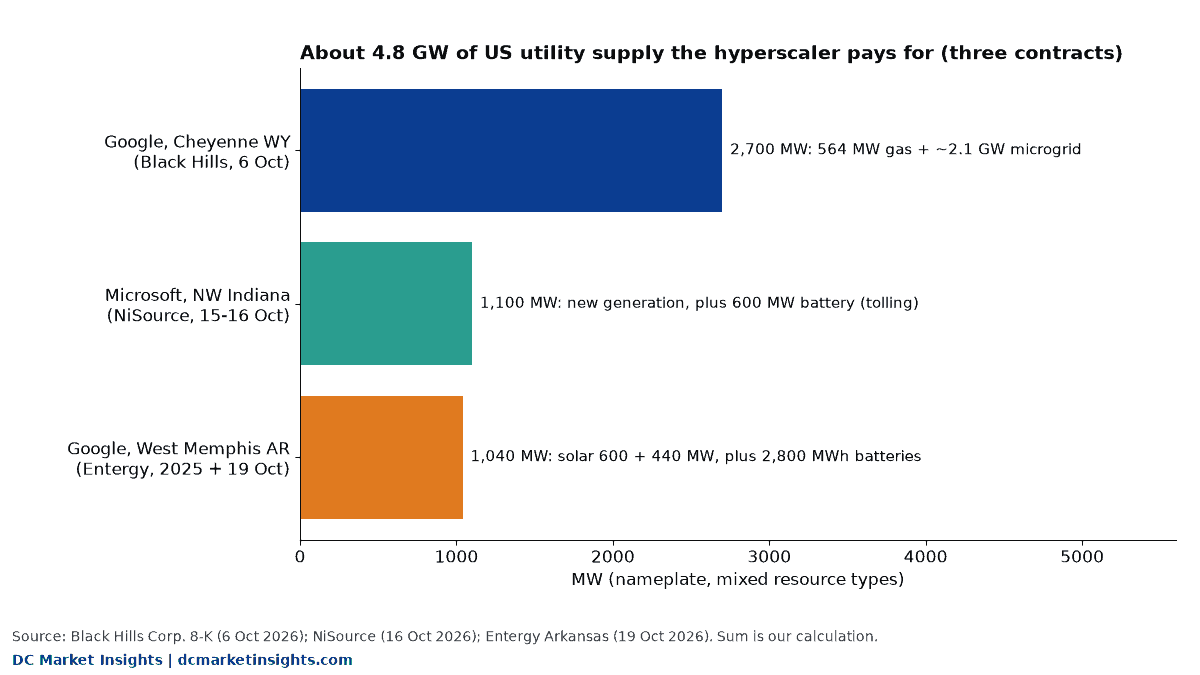
- In two weeks, three US utilities signed contracts under which Google or Microsoft pays for about 4.8 GW of new supply: 2.7 GW in Wyoming, about 1.1 GW in Indiana and 1.04 GW of solar in Arkansas (our calculation from Black Hills, NiSource and Entergy figures).
- On 19 October Entergy Arkansas added a second phase for Google’s West Memphis campus: about US$600 million of batteries, substation and 230 kV lines plus a 440 MW solar contract, all paid by Google over 20 years (Entergy).
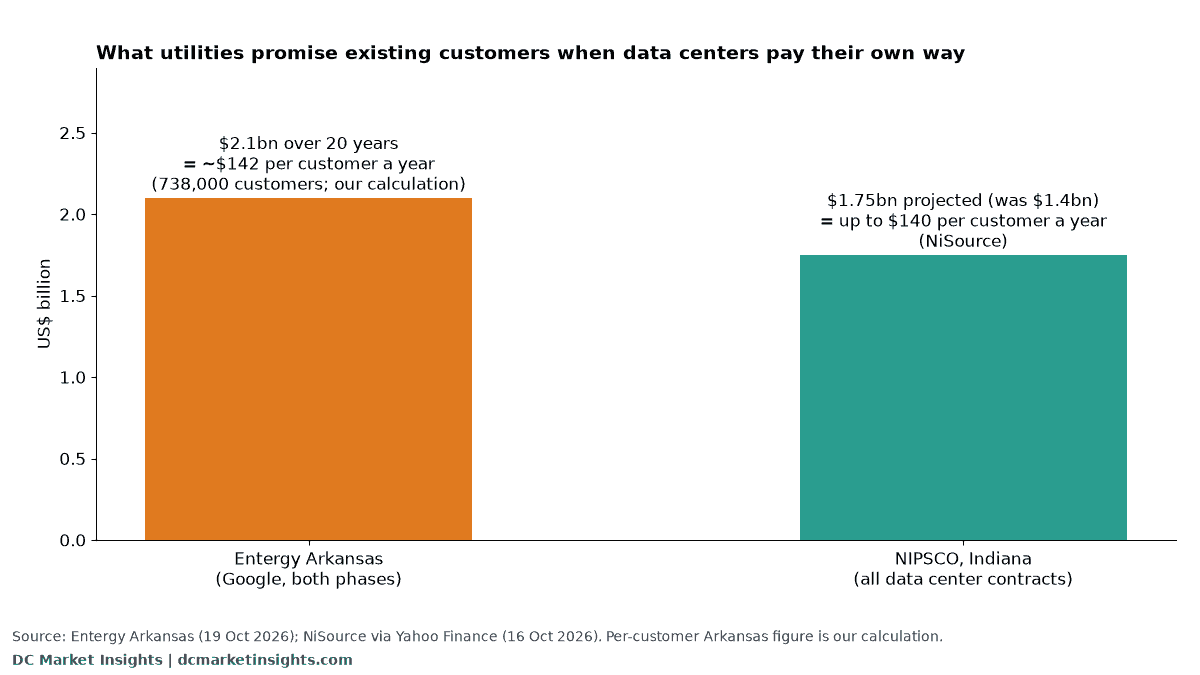
- Entergy says Google’s two agreements give its 738,000 customers US$2.1 billion of net benefits. That is about US$142 per customer a year over 20 years (our calculation), close to the up to US$140 a year NiSource projects in Indiana.
- Black Hills will build 564 MW of gas for Google in Cheyenne for US$1.8 billion, about US$3,190 per kW (our calculation from its 8-K), with Google advancing US$399 million for equipment.
- NiSource reports third-quarter results on 28 October; the Arkansas phase still needs approval from the Arkansas Public Service Commission before a 2028 in-service date.
The money for America’s AI campuses is now buying the grid as well as the buildings. In the first three weeks of October, Google and Microsoft signed utility contracts in Wyoming, Indiana and Arkansas under which they fund the power plants, batteries and lines needed to serve them, and the utilities promise lower bills for everyone else.
Why now: utilities need a way to grow fast without asking households to carry the risk, and regulators are asking hard questions about who pays. A contract where the hyperscaler pays the full cost of service, posts collateral and signs for 20 years turns a political problem into a rate-base opportunity. This analysis looks at what each deal buys, who gains and what the regulators still have to approve.
How we got here: from “who pays” to “the customer pays it all”
The fight over data center power bills has run through 2026. Entergy set the tone on 5 March, when it said its data center agreements would deliver about US$5 billion of savings over 20 years to customers in Arkansas, Louisiana and Mississippi and issued a “Fair Share Plus” pledge, Entergy said. Its principles for future contracts include long terms, liquid collateral and parent guarantees, rates that cover the incremental cost to serve and the existing grid, and continued oversight by state commissions.
The same month, large technology companies signed the White House’s voluntary Ratepayer Protection Pledge, which we covered in our 18 October analysis of campuses on former federal nuclear sites. October is when the pledge turned into signed utility contracts with numbers attached.
Arkansas also shows the politics. At a Joint Energy Committee hearing on 15 September, Entergy testified that Google’s payments under the first West Memphis agreement total more than US$2.1 billion over 20 years. Legislators questioned why the payments are spread over two decades rather than paid up front, MGRID reported.
say that it looks like a shell game to them.
What changed in October: three contracts in three weeks
Wyoming, 6 October. Black Hills Corp. said it had signed definitive agreements, effective 30 September and running through 2048, to serve Google’s planned data center in Cheyenne, according to its 8-K filing. The resource mix totals 2.7 GW including reserve margins: up to 590 MW of grid service and about 2.1 GW of third-party Wyoming capacity managed through a private microgrid. A non-regulated affiliate will build 564 MW of gas at the Cheyenne Prairie Generating Station for US$1.8 billion between 2027 and 2029. Google has advanced US$399 million for long-lead equipment, which Black Hills expects to repay by 30 June 2027. Service starts in late 2027 and ramps to peak load in 2030.
Google bears all costs associated with serving the planned data center throughout the life of the project
Indiana, 15-16 October. NiSource signed a 20-year agreement with Microsoft for a campus in northwest Indiana, with service from 2028. Its generation subsidiary GenCo will add about 1,100 MW of resources, and Microsoft will fund all generation and transmission needed to serve the site. NiSource raised its projected savings for existing NIPSCO electric customers to about US$1.75 billion over the life of its data center contracts, from US$1.4 billion, or up to US$140 per customer a year. GenCo has also contracted 600 MW of battery storage under a long-term tolling agreement, Yahoo Finance reported from the NiSource announcement. NiSource has not disclosed the capital cost.
committed to paying our own way
Arkansas, 19 October. Entergy Arkansas announced a second phase for Google’s US$4 billion West Memphis campus, Entergy said. Google will cover about US$600 million of planned investment and a power purchase agreement under a new 20-year contract. The new resources are a 1,000 MWh battery at Driver Solar near Osceola and a 400 MWh battery near Hot Springs (Jones Mill), both due in 2028; a 440 MW(ac) solar purchase from the Big Island facility in Mississippi County, added after guidance from the Arkansas Public Service Commission on the first filing; and an expansion of the Galet substation with two new 230 kV lines. Entergy said the phase adds at least US$500 million of customer savings from 2028, on top of US$1.6 billion from the first phase.
Google is increasing its investment in West Memphis and building on the significant success of its first phase.
| Contract | Hyperscaler | Term | New supply | Customer side | Service |
|---|---|---|---|---|---|
| Black Hills, Cheyenne, Wyoming (6 Oct) | To 2048 | 2.7 GW mix incl. reserves: 564 MW new gas, ~2.1 GW third-party via microgrid, up to 590 MW grid service | Cost pass-through keeps data center costs off retail customers; stranded asset protection | Late 2027; peak 2030 | |
| NiSource GenCo, northwest Indiana (15-16 Oct) | Microsoft | 20 years | ~1,100 MW generation, plus 600 MW battery tolling at GenCo | US$1.75B projected savings (all data center contracts); up to US$140 per customer a year | 2028 |
| Entergy Arkansas, West Memphis, phase 2 (19 Oct) | 20 years | 440 MW(ac) solar PPA; 1,400 MWh batteries; Galet substation; two 230 kV lines | At least US$500M new savings from 2028 | 2028, pending APSC approval | |
| Entergy Arkansas, West Memphis, phase 1 (2025) | 20 years | 600 MW Cypress Solar + 350 MW battery | US$1.6B savings (Entergy) | In development | |
| Total new supply | ~4.84 GW nameplate (2,700 + 1,100 + 1,040 MW solar) | US$3.85B (Arkansas + Indiana) | Our calculation |
Sources: Black Hills 8-K, 6 Oct 2026; Yahoo Finance, 16 Oct 2026; Entergy, 19 Oct 2026; pv magazine USA, 23 Sep 2026. The 4.84 GW adds gas, third-party capacity, generation of unstated type and solar nameplate; it excludes batteries in Indiana and Arkansas. It is indicative, not a firm-capacity figure. The savings total adds two utilities’ own projections, which use different methods.
Who gains, and how much
Existing utility customers, on paper. Entergy says payments under Google’s original and updated agreements produce US$2.1 billion of net benefits toward fixed costs that all customers share. Spread across 738,000 customers over 20 years, that is about US$142 per customer a year (our calculation). NiSource projects up to US$140 a year in Indiana. The two utilities use the same pitch: the hyperscaler pays for its own plants and for a share of the existing grid, so the fixed costs are spread over a much larger bill.
Utilities and their shareholders. The contracts turn data center demand into owned assets with long, guaranteed revenue. Black Hills expects about US$150 million of net income in 2030 and about US$2.4 billion of unlevered free cash flow through 2048, net of US$1.8 billion of generation capital, according to its 8-K. It earns a return on the generation investment from the start of construction in 2027, with stranded-asset protection and full recovery of the capital over the contract term.
Solar and storage developers. The Arkansas deals are mostly solar and batteries. Google also buys all the output of the first two phases of Cypress Creek’s Steel River Energy Center in Mississippi County, 1.6 GW of solar and 1.9 GWh of storage, which feeds the Entergy Arkansas grid; the full site reaches about 2.45 GW and 2.9 GWh by the end of 2029 and closed US$3.5 billion of project financing in June, Canary Media reported.
Gas turbine and equipment vendors. Wyoming’s 564 MW is new gas. Entergy is also planning more than 1,000 MW of new gas capacity alongside the solar, pv magazine USA reported.
The economics: what a hyperscaler pays per kW
Only Wyoming discloses a clean capital figure. US$1.8 billion for 564 MW of gas is about US$3,190 per kW (our calculation). That sits between the roughly US$2,670 per kW implied by NRG’s 1.2 GW combined-cycle deal and the about US$3,620 per kW at SoftBank’s Ohio campus, both covered in earlier DC Market Insights analysis. Google’s US$399 million advance equals about 22% of the generation budget (our calculation), which shows how much of the early cash risk the customer now carries.
Arkansas is harder to read. The first phase paired 600 MW of Cypress Solar with a 350 MW battery at a combined US$1.6 billion. Reports differ on Google’s up-front share: pv magazine USA and Action News 5 put it at US$526 million, while the Arkansas Times reported US$443 million plus annual payments, both from the same commission records, MGRID noted. Google also pays US$190 million for dedicated transmission. The second phase adds about US$600 million.
| Measure | Value | Basis |
|---|---|---|
| Wyoming gas cost per kW | ~US$3,190 | Our calculation: US$1.8B / 564 MW (Black Hills 8-K) |
| Google equipment advance, Wyoming | US$399M (~22% of generation capex) | Black Hills 8-K; share is our calculation |
| Arkansas net benefits per customer | ~US$142 a year | Our calculation: US$2.1B / 738,000 customers / 20 years (Entergy) |
| Indiana savings per customer | Up to US$140 a year | NiSource, via Yahoo Finance |
| Arkansas phase 1 cost, Cypress Solar + battery | US$1.6B for 600 MW + 350 MW | pv magazine USA |
| Arkansas phase 1 dedicated transmission paid by Google | US$190M | pv magazine USA |
| Arkansas termination fee if Google breaches | About US$2B, first 13 years, declining after | Arkansas Democrat-Gazette, via MGRID |
| Arkansas residential bill increase since June | US$5.77 a month (three new generation projects) | MGRID |
Sources: Black Hills 8-K; Entergy, 19 Oct 2026; pv magazine USA, 23 Sep 2026; MGRID, 23 Sep 2026. Entergy’s 19 October release gives US$2.1 billion as net benefits from both agreements; September reports gave US$2.1 billion as Google’s total payments and US$1.1 billion as net system benefits for the first agreement. We use Entergy’s latest figure and do not combine the two.
What DC Market Insights data shows
Our United States tracker holds 1,231 facilities, 431 of them with a stated capacity: 10,219 MW live, 18,199 MW under construction and 38,440 MW planned, as of 20 October 2026. The 4.84 GW of new supply in these three contracts equals about 47% of tracked live US capacity, or about 8.5% of everything under construction or planned (our calculation). Three campuses are buying supply equal to almost half of today’s tracked live US data center load.
The rules behind these contracts are spreading. Our United States power and policy page already tracks AEP Ohio’s data center tariff, Georgia’s minimum billing and contract terms for new large loads, Oregon’s POWER Act for large energy users and Texas Senate Bill 6, and FERC’s advance notice of proposed rulemaking on large-load interconnection (RM26-4). The October contracts take the same idea further: rather than a tariff that sets a floor, the customer funds named plants and lines.
The wider pattern, and the risks
The model is not risk-free for households. Consumer advocates in Arkansas argue that spreading Google’s payments over 20 years, rather than collecting them up front, could expand Entergy’s rate base and shift long-term risk onto residential customers if the load arrives smaller or later than forecast, pv magazine USA reported. Entergy Arkansas’s chief executive said the reporting mischaracterized the agreement’s financial mechanics. Entergy also filed a federal trade-secret suit against local outlets that published unredacted commission records; a federal judge denied its emergency request on 2 September.
The protections that answer that risk are in the contracts: termination fees, collateral, stranded-asset recovery and, in Wyoming, a non-regulated affiliate owning the gas plant. In our view, the October deals show that utilities in fast-growing regions can now set these terms, because the hyperscalers need power in 2027-2028 more than the utilities need any single customer.
What it means for operators, investors and vendors
Our view, based on the contracts above:
- Operators: budget to pay for the grid. Wyoming implies about US$3,190 per kW for dedicated gas and a cash advance of about 22% of generation capex. Treat full cost of service as the price of a 2027-2028 energization date.
- Offer a savings number. Regulators now see US$140 per customer a year in Indiana and about US$142 in Arkansas. A campus proposal without a customer-benefit figure will look weak next to these.
- Investors: back the utilities with large-load subsidiaries. Black Hills expects about US$150 million of net income in 2030 from one customer. NiSource’s GenCo and Entergy’s contracts follow the same pattern of ring-fenced, long-term revenue.
- Vendors: batteries and gas move together. Arkansas adds 1,400 MWh of batteries and Indiana 600 MW of battery tolling, while Wyoming adds 564 MW of gas. Expect paired orders through 2029.
- Price in regulatory time. The Arkansas phase still needs Arkansas Public Service Commission approval, and Black Hills must still file a Wyoming transmission certificate in the fourth quarter of 2026.
For the battery side of these deals, see our Data Center Energy Storage Market report. For on-site and dedicated gas, see the Data Center Generator Market report, and for the demand behind the contracts, the AI Data Center Market report. Follow state rules on our United States power and policy page and campus deals in our Deal Tracker.
What to watch next
- 28 October 2026: NiSource third-quarter results and call, where it is expected to give more detail on the Microsoft agreement and GenCo’s capital plan.
- Pending, no date given: Entergy Arkansas’s filing of the second-phase agreement with the Arkansas Public Service Commission, with contract terms visible to the commission, its staff and the Attorney General.
- Fourth quarter 2026: Black Hills to file its Wyoming transmission expansion certificate (CPCN).
- 30 June 2027: date by which Black Hills expects to repay Google’s US$399 million equipment advance.
- Late 2027: energy service starts for Google in Cheyenne.
- 2028: Arkansas batteries and the Microsoft service in Indiana due to start; Arkansas savings begin.
- 2029-2030: Steel River fully online in Arkansas (2029); Cheyenne reaches peak load (2030).
Frequently asked questions
How much new power are Google and Microsoft paying for in these utility deals?
About 4.8 GW of nameplate supply across three contracts, by our calculation: a 2.7 GW mix for Google in Wyoming, about 1,100 MW for Microsoft in Indiana and 1,040 MW of solar for Google in Arkansas, plus batteries.
What is in Google’s second-phase deal with Entergy Arkansas?
About US$600 million of investment and a power purchase agreement paid by Google over 20 years: 1,400 MWh of batteries, a 440 MW solar contract, a substation expansion and two 230 kV lines. Entergy projects at least US$500 million of new customer savings from 2028.
Do these data center deals raise household electricity bills?
The utilities say no. Entergy projects US$2.1 billion of net benefits, about US$142 per customer a year by our calculation, and NiSource up to US$140 a year. Critics in Arkansas say risk could shift to households if the load arrives late.
How much does Black Hills’ gas plant for Google cost?
US$1.8 billion for 564 MW, built from 2027 to 2029, or about US$3,190 per kW by our calculation. Google advanced US$399 million for long-lead equipment, which Black Hills expects to repay by 30 June 2027.
Sources
- Entergy, “Entergy Arkansas announces enhanced partnership at Google West Memphis campus, delivering at least $500M in new savings for all customers”, 19 Oct 2026. Link
- Entergy, “Entergy announces $5B in customer savings delivered by data center agreements; issues ‘Fair Share Plus’ pledge”, 5 Mar 2026. Link
- Black Hills Corp., Form 8-K, Exhibit 99.1, Google data center agreements, 6 Oct 2026. Link
- NiSource, “NiSource announces long-term agreement with Microsoft expected to increase customer savings and support Indiana’s economic growth”, Oct 2026. Link
- Yahoo Finance, “NiSource Signs 20-Year Microsoft Power Agreement for 1,100 MW Indiana Data Centre Campus”, 16 Oct 2026. Link
- Talk Business & Politics, “Entergy, Google announce second phase partnership”, 19 Oct 2026. Link
- Mugglehead, “Entergy outlines US$600M Arkansas grid expansion”, 19 Oct 2026. Link
- Construction Review Online, “$4bn West Memphis Data Center Project: Google Adds $600M in Solar, Storage and Grid Upgrades”, 20 Oct 2026. Link
- MGRID, “Entergy Puts Google’s Arkansas Power Bill at $2.1 Billion Over 20 Years”, 23 Sep 2026. Link
- pv magazine USA, “Google’s ‘Fair Share Plus’ data center deal with Entergy sparks Arkansas ratepayer concerns”, 23 Sep 2026. Link
- Canary Media, “Google buys power from record-busting solar-battery site in Arkansas”, 15 Jul 2026. Link
- DC Market Insights, “Old US uranium sites now host 12.8 GW of planned AI campuses. FERC’s call on Ohio’s 10 GW study is next”, 18 Oct 2026. Link
- DC Market Insights, United States country data (1,231 facilities) and policy tracker, retrieved 20 Oct 2026. Link