
HPC as a Service Market Size, Share & Forecast to 2035
Market at a glance
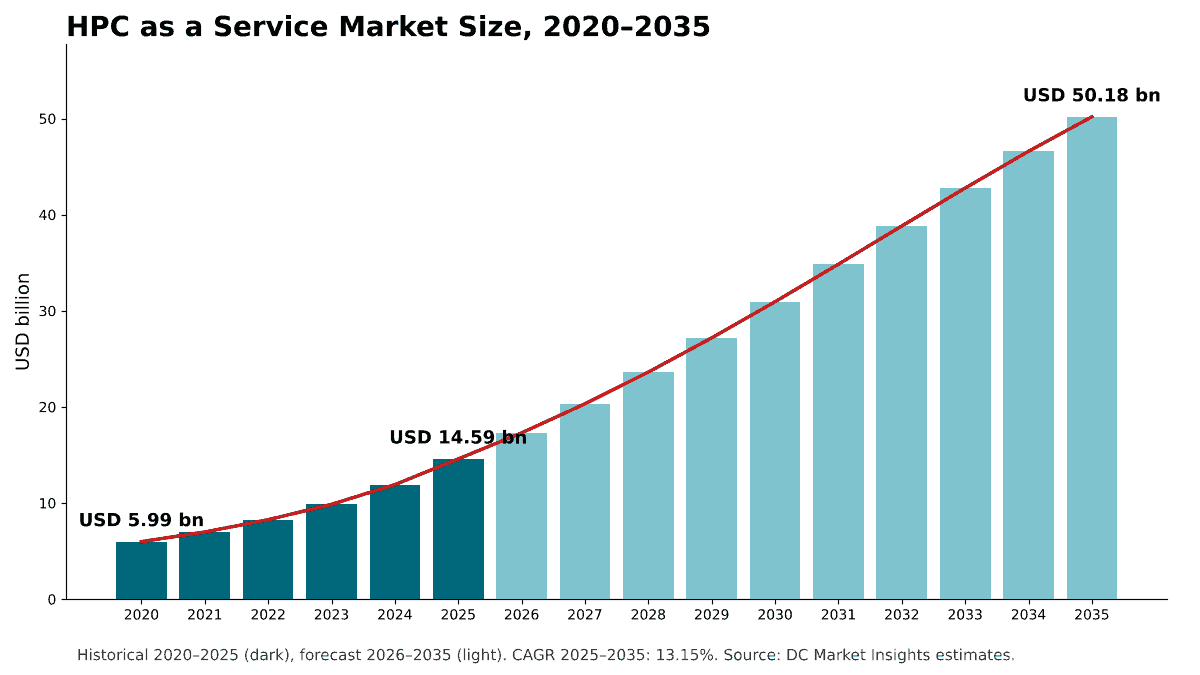
The HPC as a Service market was worth USD 14.59 billion in 2025 and is forecast to reach USD 50.18 billion by 2035, growing at a 13.15% CAGR. North America accounts for 47.6% of the market.
 By Amit Jain, Senior Consultant, ICT & Emerging Technologies
 Reviewed by Deepti Agrawal
Last updated 10 Oct 2026
Base year 2025 PDF + Excel
Reviewed by Deepti Agrawal
Last updated 10 Oct 2026
Base year 2025 PDF + Excel
Source: DC Market Insights analysis
Key findings
GPU-Accelerated HPC Instances Grow at 18.95% a Year to USD 17.36 Billion
Managed Slurm Replaces Self-Built Cloud Clusters
HPC Fabrics of 300 to 800 Gb/s Limit Where Tightly Coupled Jobs Run
SMEs Raise Their Share to 35.8% by 2035
What is inside the report
- 01Introduction
- 02Research Methodology
- 03Executive Summary
- 04Market Dynamics
- 05Pricing Analysis
- 06Standards and Regulation
- 07Supply Chain and Delivery Model
- 08Market Size and Forecast
- 09Market by Service Model
- 10Market by Compute Type
- 23chapters
- 2020-2024Historical period
- 2026-2035Forecast period
- 14Companies profiled
Regional insights
- North America47.6%
- Europe24.1%
- Asia Pacific21.8%
- Middle East and Africa3.6%
- Latin America2.9%
Segmentation
Companies profiled
- Amazon Web Services (AWS)
- Microsoft Azure
- Google Cloud
- Oracle Cloud Infrastructure
- Alibaba Cloud
- IBM Cloud
- Hewlett Packard Enterprise (HPE)
- Penguin Solutions
- Eviden
- Fujitsu
- Rescale
- Synopsys (Ansys)
- Siemens (Altair)
- TotalCAE
Recent developments
Siemens completed its acquisition of Altair Engineering for an enterprise value of approximately USD 10 billion, adding HPC capabilities to its portfolio (Source: Digital Engineering 24/7 news report).
Synopsys completed its acquisition of Ansys, which had been announced on January 16, 2024 (Source: Synopsys press release filed with the US Securities and Exchange Commission).
the EuroHPC Joint Undertaking selected six additional AI Factories in Czechia, Lithuania, the Netherlands, Poland, Romania and Spain, bringing the total to 19 sites (Source: EuroHPC Joint Undertaking press release).
Amazon announced an investment of up to USD 50 billion to add nearly 1.3 gigawatts of AI and supercomputing capacity for US government customers (Source: Amazon announcement).
AWS launched Amazon EC2 Hpc8a instances with up to 40% higher performance than Hpc7a instances (Source: AWS product announcement).
Google Cloud announced general availability of H4D virtual machines, its first CPU virtual machine family with Cloud RDMA (Source: Google Cloud blog).
Full analysis
The HPC as a Service Market covers high performance computing (HPC) capacity that buyers rent or subscribe to instead of owning: HPC-optimized public cloud instances, hosted and managed HPC clusters billed as a service, and the cloud platforms and software-as-a-service (SaaS) layers that run simulation jobs on that capacity. DC Market Insights values the global HPC as a Service Market at USD 14.59 billion in 2025 and forecasts USD 50.18 billion by 2035, a CAGR of 13.15%. The 2025 value is built from billed compute: about 255.48 billion CPU core-hours at a blended realized price of USD 0.036 per core-hour gives USD 9.20 billion, GPU instances used for simulation add USD 1.74 billion, hosted and managed HPC adds USD 2.49 billion, and HPC cloud platforms and SaaS add USD 1.16 billion. AI-enhanced HPC is the fastest-growing segment at 21.09% a year because DC Market Insights expects simulation teams to pair physics solvers with trained surrogate models on GPU instances, and Asia Pacific is the fastest-growing region at 14.99% a year as Japan opens shared national compute through ABCI 3.0 and, in our model, manufacturers and chip designers in India, South Korea and China move simulation to the cloud.
Executive Summary
The Global HPC as a Service Market size was valued at USD 5.99 billion in 2020, reached USD 14.59 billion in 2025, and is anticipated to reach USD 50.18 billion by 2035, at a CAGR of 13.15% during the forecast period.
| Report attribute | Details |
|---|---|
| Historical Period | 2020-2024 |
| Base Year | 2025 |
| Forecast Period | 2026-2035 |
| HPC as a Service Market Size 2025 | USD 14.59 Billion |
| HPC as a Service Market, CAGR | 13.15% |
| HPC as a Service Market Size 2035 | USD 50.18 Billion |
The market grew at 19.50% a year between 2020 and 2025, and 2025 alone added 22.4% over the USD 11.92 billion of 2024 as engineering teams moved burst simulation off on-premises queues and cloud providers prepared a new round of HPC instances with high-bandwidth memory and remote direct memory access (RDMA) networking; Azure HBv5 reached general availability in November 2025. DC Market Insights forecasts growth of 18.6% in 2026, slowing to 7.7% by 2035, because cheaper compute per core-hour offsets part of the volume gain and because the largest simulation users already run a hybrid of owned and rented capacity.
Public cloud HPC infrastructure is three quarters of the market at USD 10.94 billion in 2025. That line matches the cloud HPC services estimate in our High Performance Computing Market report, so the two reports describe the same rented compute from different angles: the HPC report sizes all HPC spending at USD 48.80 billion in 2025, and this report adds the hosted, managed and platform layers that sit around the rented capacity.
Market Scope: What Does the HPC as a Service Market Cover?
The HPC as a Service Market covers spending on HPC capacity delivered as a service, valued at what the buyer pays in current US dollars, with 2025 as the base year and forecasts to 2035. DC Market Insights sizes it at USD 14.59 billion in 2025.
Included. HPC-optimized cloud instances (CPU, high-memory and GPU) with their bundled fabric, parallel storage and schedulers, managed cluster services, HPC capacity billed on a consumption or subscription basis, access to shared supercomputers sold as a service, and HPC platforms and simulation SaaS billed per job or per core-hour.
Excluded. Purchased HPC servers, storage and networking, perpetual and term software licenses not tied to cloud consumption, GPU rental for AI model training and inference, general-purpose cloud workloads that do not run HPC jobs, and in-house operating labor.
How the segments fit together. Service model, compute type, pricing model, workload, end-user and organization size each re-cut the same USD 14.59 billion. GPU rental for training and inference is sized in our GPU as a Service Market report; only the USD 1.74 billion of public cloud GPU instances that run simulation sits inside this report’s public cloud line, and that value is smaller than the HPC and rendering workload measured there.
Market Drivers: What Drives the HPC as a Service Market?
Three drivers explain most of the growth in the HPC as a Service Market: GPU-accelerated HPC instances growing at 18.95% a year, new CPU instance generations that lower the cost of each simulation, and public programs that buy shared compute for researchers and small firms.
GPU-Accelerated HPC Instances Grow at 18.95% a Year to USD 17.36 Billion
DC Market Insights expects more computational fluid dynamics (CFD), molecular dynamics and weather codes to run on GPUs, together with AI surrogate models trained on their output. DC Market Insights estimates that GPU-accelerated HPC instances were worth USD 3.06 billion in 2025, or 21.0% of the market, and forecasts USD 17.36 billion by 2035, when they reach 34.6% of spending. On the June 2026 TOP500 list, Eagle, a system installed by Microsoft in its Azure cloud, ranks No. 7 with an HPL score of 561.2 Petaflop/s.
AWS Hpc8a Delivers Up to 40% More Performance than Hpc7a
In February 2026, AWS launched Hpc8a instances with 192 cores, 768 GiB of memory and 300 Gbps of Elastic Fabric Adapter (EFA) bandwidth, which AWS says deliver up to 40% higher performance and up to 25% better price performance than Hpc7a instances. Google Cloud made its H4D virtual machines generally available in March 2026, quoting compute for as low as 3 cents per core-hour without long-term commitments, and Jump Trading reported up to 50% better price/performance compared to prior generation machines. DC Market Insights models the blended realized price of a CPU core-hour falling from USD 0.036 in 2025 to USD 0.021 in 2035, while billed core-hours grow faster than the price falls.
Public Programs Fund Shared Compute for Researchers and SMEs
Governments now buy HPC capacity as a service for researchers and start-ups instead of only funding single machines. The EuroHPC Joint Undertaking had selected 19 sites across Europe to host AI Factories by October 2025, each offering start-ups, small and medium enterprises (SMEs) and researchers access to AI-optimized HPC resources. In the United States, the National Science Foundation awarded the San Diego Supercomputer Center USD 35 million over five years in September 2026 to run the National AI Research Resource (NAIRR) Operations Center with the Texas Advanced Computing Center, after the NAIRR Pilot gave about 900 research teams and educators across all 50 states access to compute. DC Market Insights estimates academic and government research spending on HPC as a service at USD 2.17 billion in 2025, growing at 13.82% a year.
Market Trends: How Is HPC as a Service Changing?
The HPC as a Service Market is moving toward managed cluster services, consolidation of simulation software into larger industrial software groups, and AI physics models delivered on the same platforms as classical solvers. HPC cloud platforms and SaaS are the fastest-growing service model at 14.76% a year.
Managed Slurm Replaces Self-Built Cloud Clusters
Buyers increasingly rent a managed scheduler instead of building their own cluster in the cloud. AWS Parallel Computing Service (PCS) is a managed service for running and scaling HPC workloads on AWS using Slurm, and AWS made it available in the AWS GovCloud (US) Regions in June 2025. DC Market Insights expects managed offers to lift the hosted and managed HPC line from USD 2.49 billion in 2025 to USD 7.06 billion in 2035, a CAGR of 11.01%.
Simulation Software Moves Inside Larger Industrial Software Groups
Two major engineering simulation acquisitions closed in 2025. Siemens completed its acquisition of Altair Engineering in March 2025 for an enterprise value of approximately USD 10 billion, adding HPC capabilities to its portfolio, and Synopsys completed its acquisition of Ansys in July 2025. DC Market Insights forecasts HPC cloud platforms and SaaS to grow from USD 1.16 billion in 2025 to USD 4.60 billion in 2035.
AI Physics Models Join Classical Solvers on HPC Platforms
HPC platforms now sell AI physics models next to the solvers that produce their training data. Rescale said in December 2025 that NVIDIA’s Apollo AI physics models will be available on its platform in 2026. DC Market Insights expects AI-enhanced HPC, which combines simulation with trained surrogate models, to rise from 9.8% of spending in 2025 to 19.3% by 2035.
Market Challenges: What Holds the HPC as a Service Market Back?
Network performance for tightly coupled jobs and the cost of moving large data sets between providers are the two constraints that DC Market Insights expects to slow annual growth in the HPC as a Service Market from 18.6% in 2026 to 8.9% by 2034.
HPC Fabrics of 300 to 800 Gb/s Limit Where Tightly Coupled Jobs Run
A CFD or weather model split across thousands of cores stalls if the network between nodes is slow, so only instance families with HPC fabrics can host those jobs. Azure HBv5 virtual machines offer 800 Gb/s per node of InfiniBand connectivity and 6.7 TB/s of memory bandwidth across 432 GB of high-bandwidth memory (HBM), while AWS Hpc8a offers 300 Gbps of EFA bandwidth. Hpc8a launched in two regions, US East (Ohio) and Europe (Stockholm), and H4D in three, which is one reason DC Market Insights holds Latin America at 2.9% of 2025 value.
Data Gravity and Egress Fees Lock Workloads In
Large simulation result sets make moving work between providers costly in time and fees. The EU Data Act applies to data processing services from 12 September 2025 and bars providers from charging for switching from 12 January 2027, which lowers the cost of a multi-cloud HPC strategy in Europe. Until then, DC Market Insights expects reserved and committed capacity to grow at 14.25% a year, faster than on-demand at 11.27%.
Market Opportunities: Where Are the New Revenue Pools?
The two largest new revenue pools in the HPC as a Service Market are small and medium enterprises, growing at 15.72% a year, and government and sovereign compute bought as a service.
SMEs Raise Their Share to 35.8% by 2035
Small and medium enterprises spent USD 4.17 billion on HPC as a service in 2025, and DC Market Insights expects their spending to reach USD 17.97 billion by 2035, when SMEs hold 35.8% of the market. Price cuts per core-hour and subsidized access through the EuroHPC AI Factories reach SMEs first.
Government and Sovereign Capacity Adds New Demand
Public sector buyers are committing to rented supercomputing at a new scale. In November 2025, Amazon announced an investment of up to USD 50 billion to expand AI and supercomputing capabilities for US government customers, adding nearly 1.3 gigawatts of capacity across the AWS Top Secret, AWS Secret and AWS GovCloud (US) Regions, with construction set to begin in 2026. In Japan, the ABCI system was upgraded to ABCI 3.0 in January 2025 and provides computing resources primarily for public use by domestic industry, academia and government. DC Market Insights forecasts academic and government research spending to reach USD 7.93 billion by 2035.
Pricing: How Much Does a Core-Hour of Cloud HPC Cost?
A CPU core-hour of cloud HPC cost a blended USD 0.036 in 2025 after discounts, reserved capacity and spot pricing, according to DC Market Insights estimates. List prices sit higher: the on-demand Linux price of an AWS hpc7a.96xlarge instance with 192 vCPUs is about USD 9.08 per hour, or about USD 0.047 per vCPU-hour, while Google Cloud quotes H4D compute from 3 cents per core-hour without long-term commitments.
| Price per CPU core-hour (USD) | 2020 | 2025 | 2030 | 2035 |
|---|---|---|---|---|
| Blended realized price (DC Market Insights estimate) | 0.052 | 0.036 | 0.027 | 0.021 |
| Price index (2025 = 100) | 144 | 100 | 75 | 58 |
The realized price falls about 5.3% a year because each instance generation delivers more performance per core and because a larger share of hours is bought on committed or spot terms. In the DC Market Insights model, GPU and high-memory instances carry a higher price per hour, so GPU-accelerated instances hold 21.0% of spending with a much smaller share of billed hours. Reserved and committed capacity takes 37.4% of 2025 spending and spot and preemptible capacity 12.6%.
Standards and Regulation: Which Rules Shape HPC as a Service?
Three sets of rules shape how HPC is sold as a service: European law on cloud switching, European law on publicly funded supercomputing access, and the benchmarks and scheduler standards that buyers use to compare offers.
EU Data Act. The Data Act applies directly to data processing services from 12 September 2025. Article 23 sets the core obligations to remove obstacles to switching: customers may begin a switch after a maximum of two months’ notice, the transitional phase is capped at 30 calendar days, and providers cannot charge for switching from 12 January 2027. For HPC buyers with large result sets, the rule lowers the cost of placing jobs with more than one provider.
Council Regulation (EU) 2024/1732. The amendment to the EuroHPC regulation entered into force on 9 July 2024. It lets the EuroHPC Joint Undertaking acquire and operate dedicated AI-optimized supercomputers and creates AI Factories that serve start-ups, SMEs and other European users, which brings public capacity into the service market.
Benchmarks and schedulers. The TOP500 list ranks systems by the HPL benchmark and now includes cloud-hosted systems such as Eagle. AWS PCS runs HPC workloads using Slurm, so buyers can keep Slurm job scheduling when they move to a managed cloud service.
Market Segmentation: Which Segment Leads the HPC as a Service Market?
Public cloud HPC infrastructure leads the HPC as a Service Market with 75.0% of 2025 value, CPU-based instances lead compute types with 66.7%, and manufacturing and engineering lead buyers with 24.6%. AI-enhanced HPC is the fastest-growing segment at 21.09% a year because DC Market Insights expects simulation teams to train surrogate models on solver output and run both on the same GPU instances.
By Service Model: Public Cloud HPC Infrastructure Leads with 75.0%
| Service model | 2025 (USD billion) | Share 2025 | 2035 (USD billion) | CAGR 2025-2035 |
|---|---|---|---|---|
| Public Cloud HPC Infrastructure | 10.94 | 75.0% | 38.51 | 13.41% |
| Hosted and Managed HPC | 2.49 | 17.0% | 7.06 | 11.01% |
| HPC Cloud Platforms and SaaS | 1.16 | 8.0% | 4.60 | 14.76% |
Hosted and managed HPC grows slowest because much of it replaces owned clusters at organizations that already run HPC.
By Compute Type: CPU-Based HPC Instances Lead with 66.7%
| Compute type | 2025 (USD billion) | Share 2025 | 2035 (USD billion) | CAGR 2025-2035 |
|---|---|---|---|---|
| CPU-Based HPC Instances | 9.73 | 66.7% | 27.80 | 11.07% |
| GPU-Accelerated HPC Instances | 3.06 | 21.0% | 17.36 | 18.95% |
| Memory-Optimized and Other Instances | 1.79 | 12.3% | 5.02 | 10.83% |
CPU instances still carry most CFD, finite element analysis (FEA) and electronic design automation (EDA) work; GPU instances gain 13.6 points of share by 2035.
By Pricing Model: Reserved and Committed Capacity Leads with 37.4%
Reserved and committed capacity is worth USD 5.45 billion in 2025 and USD 20.68 billion by 2035, growing at 14.25% a year. On-demand capacity holds 31.8% (USD 4.64 billion) and grows at 11.27%, subscription and managed contracts hold 18.2% and grow at 13.28%, and spot and preemptible capacity holds 12.6% and grows at 13.94%.
By Workload: Engineering Simulation Leads with 27.3%
| Workload | 2025 (USD billion) | Share 2025 | 2035 (USD billion) | CAGR 2025-2035 |
|---|---|---|---|---|
| Engineering Simulation (CFD and FEA) | 3.98 | 27.3% | 11.44 | 11.13% |
| Life Sciences and Molecular Modeling | 2.28 | 15.6% | 8.58 | 14.20% |
| Electronic Design Automation (EDA) | 2.07 | 14.2% | 6.72 | 12.50% |
| Financial Risk and Quantitative Analytics | 1.74 | 11.9% | 5.32 | 11.85% |
| Weather, Climate and Geoscience | 1.52 | 10.4% | 4.37 | 11.15% |
| AI-Enhanced HPC | 1.43 | 9.8% | 9.69 | 21.09% |
| Other Workloads | 1.58 | 10.8% | 4.06 | 9.94% |
AI-enhanced HPC moves from the smallest workload in 2025 to the second-largest by 2035. Life sciences grows at 14.20% a year as DC Market Insights expects molecular dynamics and drug discovery work to move to GPU instances.
By End-User: Manufacturing and Engineering Lead with 24.6%
| End-user | 2025 (USD billion) | Share 2025 | 2035 (USD billion) | CAGR 2025-2035 |
|---|---|---|---|---|
| Manufacturing and Engineering | 3.59 | 24.6% | 11.09 | 11.95% |
| Life Sciences and Healthcare | 2.35 | 16.1% | 9.03 | 14.42% |
| Academic and Government Research | 2.17 | 14.9% | 7.93 | 13.82% |
| Semiconductor and Electronics | 2.00 | 13.7% | 6.62 | 12.73% |
| Financial Services | 1.87 | 12.8% | 5.82 | 12.04% |
| Energy and Utilities | 1.21 | 8.3% | 3.51 | 11.24% |
| Others | 1.40 | 9.6% | 6.17 | 15.99% |
Others, including media, retail and logistics users, grow fastest at 15.99% a year from a small base.
By Organization Size: Large Enterprises and Institutions Lead with 71.4%
Large enterprises and institutions spend USD 10.41 billion in 2025 and grow at 11.96% a year; SMEs grow faster, at 15.72%.
DC Exclusive: The Core-Hour Build Model and Service Model × Buyer Matrix
At USD 2.61 billion in 2025, manufacturing and engineering on public cloud HPC infrastructure is the single largest cell of the matrix and 17.9% of all HPC as a service spending. The matrix below cross-tabulates how capacity is bought against who buys it.
| 2025, USD billion | Public Cloud HPC | Hosted and Managed HPC | Platforms and SaaS | Total |
|---|---|---|---|---|
| Manufacturing and Engineering | 2.61 | 0.59 | 0.39 | 3.59 |
| Life Sciences and Healthcare | 1.82 | 0.33 | 0.20 | 2.35 |
| Academic and Government Research | 1.41 | 0.65 | 0.11 | 2.17 |
| Semiconductor and Electronics | 1.61 | 0.23 | 0.16 | 2.00 |
| Financial Services | 1.51 | 0.25 | 0.11 | 1.87 |
| Energy and Utilities | 0.86 | 0.25 | 0.10 | 1.21 |
| Others | 1.12 | 0.19 | 0.09 | 1.40 |
| Total | 10.94 | 2.49 | 1.16 | 14.59 |
Academic and government research is the only buyer group that spends more than a quarter of its budget on hosted and managed HPC, at about 30%, because national centers and funded programs buy dedicated capacity rather than public cloud hours. Semiconductor and financial services buyers spend more than 80% on public cloud for burst EDA and risk runs. Manufacturing and engineering is the largest buyer of HPC cloud platforms at USD 0.39 billion, a third of that service model.
The core-hour build model behind these figures is a DC Market Insights model, built from 38 inputs: 9 service model anchors (2020, 2025 and 2035 values for each of 3 service models), 21 service-by-buyer weights, 7 end-user shares and 1 blended price per core-hour. Its two checkable inputs are billed CPU core-hours (255.48 billion in 2025) and the realized price per core-hour (USD 0.036). The model and its assumptions are explained on our research methodology page.
Regional Insights: Which Region Leads the HPC as a Service Market?
North America leads the HPC as a Service Market with 47.6% of 2025 value, and Asia Pacific is the fastest-growing region at 14.99% a year, because Japan opens shared national compute through ABCI 3.0 and, in the DC Market Insights model, manufacturers and chip designers across the region move simulation to the cloud.
North America Leads with 47.6% Share
North American buyers spent USD 6.94 billion on HPC as a service in 2025, and the region is forecast to reach USD 22.03 billion by 2035, a CAGR of 12.24%. Federal programs such as the NAIRR Operations Center and AWS’s planned government capacity add public demand.
Europe Holds 24.1% Share
Europe is worth USD 3.52 billion in 2025 and USD 11.64 billion by 2035, a CAGR of 12.72%. DC Market Insights attributes most European demand to automotive and aerospace simulation in Germany, France and the United Kingdom, while the EuroHPC AI Factories open public capacity to SMEs, and the Data Act lowers switching costs from 2027.
Asia Pacific Holds 21.8% Share and Grows Fastest
Asia Pacific is worth USD 3.18 billion in 2025 and USD 12.85 billion by 2035, growing at 14.99% a year. Japan’s ABCI 3.0 serves domestic industry, academia and government as a shared resource, and DC Market Insights expects semiconductor design in South Korea, Japan and China to drive EDA demand. Asia Pacific gains 3.8 points of share by 2035, the largest gain of any region.
Middle East and Africa Holds 3.6% Share
The Middle East and Africa is worth USD 525.08 million in 2025 and USD 2.01 billion by 2035, a CAGR of 14.35%; DC Market Insights allocates the largest part of it to energy-sector reservoir simulation.
Latin America Holds 2.9% Share
Latin America is worth USD 422.98 million in 2025 and USD 1.66 billion by 2035, a CAGR of 14.62%; DC Market Insights allocates the largest part of it to Brazil.
Country Analysis: Which Countries Spend the Most on HPC as a Service?
The United States is the largest country market for HPC as a service at USD 6.29 billion in 2025, 43.1% of global value, followed by China at USD 933.47 million (6.4%) and Germany at USD 860.54 million (5.9%). The 12 largest countries account for 83.6% of 2025 spending.
| Rank | Country | Region | 2025 (USD billion) | Share 2025 | 2035 (USD billion) | CAGR 2025-2035 |
|---|---|---|---|---|---|---|
| 1 | United States | North America | 6.29 | 43.1% | 19.72 | 12.11% |
| 2 | China | Asia Pacific | 0.93 | 6.4% | 3.46 | 14.01% |
| 3 | Germany | Europe | 0.86 | 5.9% | 2.76 | 12.36% |
| 4 | United Kingdom | Europe | 0.79 | 5.4% | 2.61 | 12.73% |
| 5 | Japan | Asia Pacific | 0.77 | 5.3% | 2.81 | 13.78% |
| 6 | Canada | North America | 0.66 | 4.5% | 2.31 | 13.40% |
| 7 | France | Europe | 0.53 | 3.6% | 1.71 | 12.51% |
| 8 | India | Asia Pacific | 0.34 | 2.3% | 1.81 | 18.34% |
| 9 | South Korea | Asia Pacific | 0.31 | 2.1% | 1.20 | 14.67% |
| 10 | Netherlands | Europe | 0.26 | 1.8% | 0.95 | 13.77% |
| 11 | Australia | Asia Pacific | 0.25 | 1.7% | 1.00 | 15.01% |
| 12 | Italy | Europe | 0.22 | 1.5% | 0.70 | 12.37% |
India is the fastest-growing country market at 18.34% a year, ahead of Australia at 15.01% and South Korea at 14.67%, on DC Market Insights’ assumption that engineering services and pharmaceutical firms in India rent capacity rather than build clusters. The country figures are a DC Market Insights allocation of the regional totals, weighted by each country’s estimated share of cloud HPC usage, national HPC programs and simulation-intensive industry.
Forecast Scenarios: How Could the 2035 Forecast Change?
The HPC as a Service Market reaches USD 50.18 billion by 2035 in the base case, with a range of USD 41.21 billion to USD 59.45 billion across the low and high scenarios.
| Scenario | Assumption from 2026 | 2035 (USD billion) | CAGR 2025-2035 |
|---|---|---|---|
| Low | Billed core-hours grow 2 points a year slower; GPU share of spending capped at 28% | 41.21 | 10.95% |
| Base | Core-hour price falls 5.3% a year; GPU share reaches 34.6% | 50.18 | 13.15% |
| High | Switching rules and public programs move 5 more points of HPC spending to service models | 59.45 | 15.09% |
The low case reflects GPU supply going first to AI training; the high case assumes rented capacity becomes the default for new HPC projects.
Competitive Insights: Who Leads the HPC as a Service Market?
- Amazon Web Services (AWS)
- Microsoft Azure
- Google Cloud
- Oracle Cloud Infrastructure
- Alibaba Cloud
- IBM Cloud
- Hewlett Packard Enterprise (HPE)
- Penguin Solutions
- Eviden
- Fujitsu
- Rescale
- Synopsys (Ansys)
- Siemens (Altair)
- TotalCAE
AWS is the market leader with about 27% of the HPC as a Service Market in 2025, and AWS, Microsoft Azure and Google Cloud together hold about 61% (DC Market Insights estimate: the public cloud HPC line allocated by the relative scale of each provider’s disclosed cloud revenue). AWS segment sales rose 20% to USD 128.7 billion in 2025, Azure revenue exceeded USD 75 billion in the fiscal year ended June 30, 2025, up 34%, and Google Cloud revenue rose 48% to USD 17.7 billion in the fourth quarter of 2025. Each of the three launched a new HPC instance family within the past twelve months: Azure HBv5 reached general availability in November 2025, AWS Hpc8a launched in February 2026 and Google Cloud H4D in March 2026. Oracle Cloud Infrastructure sells bare metal HPC instances with RDMA cluster networking, and HPE offers its HPC solutions as a service through HPE GreenLake. Alibaba Cloud, IBM Cloud, Penguin Solutions, Eviden and Fujitsu complete the group of infrastructure suppliers that DC Market Insights tracks. Rescale, Synopsys (through Ansys), Siemens (through Altair) and managed providers such as TotalCAE compete on the platform and simulation software layer; TotalCAE, a managed HPC provider for computer-aided engineering, evaluated H4D for tightly coupled simulation.
Recent Developments
- In March 2025, Siemens completed its acquisition of Altair Engineering for an enterprise value of approximately USD 10 billion, adding HPC capabilities to its portfolio (Source: Digital Engineering 24/7 news report).
- In July 2025, Synopsys completed its acquisition of Ansys, which had been announced on January 16, 2024 (Source: Synopsys press release filed with the US Securities and Exchange Commission).
- In October 2025, the EuroHPC Joint Undertaking selected six additional AI Factories in Czechia, Lithuania, the Netherlands, Poland, Romania and Spain, bringing the total to 19 sites (Source: EuroHPC Joint Undertaking press release).
- In November 2025, Amazon announced an investment of up to USD 50 billion to add nearly 1.3 gigawatts of AI and supercomputing capacity for US government customers (Source: Amazon announcement).
- In February 2026, AWS launched Amazon EC2 Hpc8a instances with up to 40% higher performance than Hpc7a instances (Source: AWS product announcement).
- In March 2026, Google Cloud announced general availability of H4D virtual machines, its first CPU virtual machine family with Cloud RDMA (Source: Google Cloud blog).
We follow these launches, deals and public compute programs as they happen in our data center industry updates.
Methodology: How We Built the HPC as a Service Market Model
DC Market Insights built this market bottom-up from billed compute. The public cloud line multiplies 255.48 billion CPU core-hours in 2025 by a blended realized price of USD 0.036 per core-hour (USD 9.20 billion) and adds USD 1.74 billion of GPU instances used for simulation, giving USD 10.94 billion. Hosted and managed HPC (USD 2.49 billion) and HPC cloud platforms and SaaS (USD 1.16 billion) were sized from the consumption-billed share of HPC services and software spending, giving USD 14.59 billion. Each service model has its own yearly path from 2020 to 2035, and every split sums to the market total. The result was checked against three bounds: the public cloud line equals 8.5% of AWS’s USD 128.7 billion of 2025 segment sales alone and a smaller share of combined AWS, Azure and Google Cloud revenue; it matches the cloud HPC services line in our High Performance Computing Market model, inside a total HPC market of USD 48.80 billion; and the GPU simulation line stays below the HPC and rendering workload in our GPU as a Service Market model. The analyst named on this page built the model, and the reviewer checked the arithmetic, the sources and the dates before publication.
Table of contents
- 01Introduction
- 1.1Market Definition and Scope
- 1.2Service Models Covered
- 1.3Currency, Base Year and Forecast Period
- 1.4Key Stakeholders
- 02Research Methodology
- 2.1Core-Hour Build Model
- 2.2Service Model Paths, 2020-2035
- 2.3Bound Checks Against Cloud Revenue and Related Reports
- 2.4Data Sources and Fact Verification
- 03Executive Summary
- 3.1Market Snapshot, 2025 and 2035
- 3.2Key Findings
- 04Market Dynamics
- 4.1Drivers
- 4.2Trends
- 4.3Challenges
- 4.4Opportunities
- 05Pricing Analysis
- 5.1Blended Price per CPU Core-Hour, 2020-2035
- 5.2List Price Benchmarks for HPC Instances
- 5.3Pricing Model Mix
- 06Standards and Regulation
- 6.1EU Data Act and Cloud Switching
- 6.2Council Regulation (EU) 2024/1732 and EuroHPC AI Factories
- 6.3TOP500 Benchmarks and Slurm Scheduling
- 07Supply Chain and Delivery Model
- 7.1Cloud Infrastructure Providers
- 7.2Hosted and Managed HPC Providers
- 7.3HPC Platforms and Simulation Software Vendors
- 08Market Size and Forecast
- 8.1Market Size, 2020-2035
- 8.2Year-on-Year Growth, 2021-2035
- 09Market by Service Model
- 9.1Public Cloud HPC Infrastructure
- 9.2Hosted and Managed HPC
- 9.3HPC Cloud Platforms and SaaS
- 10Market by Compute Type
- 10.1CPU-Based HPC Instances
- 10.2GPU-Accelerated HPC Instances
- 10.3Memory-Optimized and Other Instances
- 11Market by Pricing Model
- 11.1On-Demand
- 11.2Reserved and Committed Capacity
- 11.3Spot and Preemptible
- 11.4Subscription and Managed Contracts
- 12Market by Workload
- 12.1Engineering Simulation (CFD and FEA)
- 12.2Life Sciences and Molecular Modeling
- 12.3Electronic Design Automation (EDA)
- 12.4Financial Risk and Quantitative Analytics
- 12.5Weather, Climate and Geoscience
- 12.6AI-Enhanced HPC
- 12.7Other Workloads
- 13Market by End-User
- 13.1Manufacturing and Engineering
- 13.2Life Sciences and Healthcare
- 13.3Academic and Government Research
- 13.4Semiconductor and Electronics
- 13.5Financial Services
- 13.6Energy and Utilities
- 13.7Others
- 14Market by Organization Size
- 14.1Large Enterprises and Institutions
- 14.2Small and Medium Enterprises (SMEs)
- 15DC Exclusive: Core-Hour Build Model and Service Model × Buyer Matrix
- 15.1Matrix, 2025
- 15.2Model Inputs
- 16Market by Region
- 16.1North America (United States, Canada)
- 16.2Europe (Germany, United Kingdom, France, Netherlands, Italy, Rest of Europe)
- 16.3Asia Pacific (China, Japan, India, South Korea, Australia, Rest of Asia Pacific)
- 16.4Latin America
- 16.5Middle East and Africa
- 17Country Analysis
- 17.1Top 12 Countries, 2025 and 2035
- 17.2Fastest-Growing Countries
- 18Regional Cross-Sections
- 18.1Regional Shares, 2025 and 2035
- 18.2Regional Growth Comparison, 2025-2035
- 19Forecast Scenarios
- 19.1Low, Base and High Scenarios, 2035
- 19.2Scenario Assumptions
- 20Competitive Landscape
- 20.1Market Share Estimate, 2025
- 20.2Competitive Positioning by Service Model
- 21Company Profiles
- 21.1Amazon Web Services (AWS)
- 21.2Microsoft Azure
- 21.3Google Cloud
- 21.4Oracle Cloud Infrastructure
- 21.5Alibaba Cloud
- 21.6IBM Cloud
- 21.7Hewlett Packard Enterprise (HPE)
- 21.8Penguin Solutions
- 21.9Eviden
- 21.10Fujitsu
- 21.11Rescale
- 21.12Synopsys (Ansys)
- 21.13Siemens (Altair)
- 21.14TotalCAE
- 22Recent Developments
- 22.1Acquisitions
- 22.2Product Launches
- 22.3Public Compute Programs
- 23Analyst Recommendations
- 23.1For Cloud and HPC Providers
- 23.2For Software Vendors
- 23.3For Buyers
- Fig. 1HPC as a Service Market Size, 2020-2035
- Fig. 2HPC as a Service Market by Service Model, 2025 and 2035
- Fig. 3HPC as a Service Market by Compute Type, 2025 and 2035
- Fig. 4HPC as a Service Market by Workload, 2025 and 2035
- Fig. 5HPC as a Service Market by End-User, 2025 and 2035
- Fig. 6HPC as a Service Market by Region, 2025 and 2035
- Fig. 7Blended Price per CPU Core-Hour, 2020-2035
- Fig. 8Service Model × End-User Matrix, 2025
- Fig. 9Forecast Scenarios, 2035
- Table 1Report Attributes
- Table 2Price per CPU Core-Hour, 2020-2035
- Table 3Market by Service Model, 2025 and 2035
- Table 4Market by Compute Type, 2025 and 2035
- Table 5Market by Pricing Model, 2025 and 2035
- Table 6Market by Workload, 2025 and 2035
- Table 7Market by End-User, 2025 and 2035
- Table 8Market by Organization Size, 2025 and 2035
- Table 9Service Model × End-User Matrix, 2025
- Table 10Market by Region, 2025 and 2035
- Table 11Top 12 Countries, 2025 and 2035
- Table 12Forecast Scenarios, 2035
- Table 13Companies Covered
About this report
Written by Amit Jain and reviewed by Deepti Agrawal, Senior Editor, Research. Figures are built top-down and bottom-up and reconciled before publication, with 2025 as the base year.
Read our methodologyHow we built this
- Historical period2020-2024
- Base year2025
- Forecast period2026-2035
- Sizing approachTop-down + bottom-up
Need more than the report?
Advisory on this market
Due diligence, site selection and market entry work, by the analysts who wrote this report.
See consulting servicesFrequently asked questions
USD 14.59 billion in 2025, rising to USD 50.18 billion by 2035. DC Market Insights estimates the market at USD 5.99 billion in 2020.
13.15% a year from 2025 to 2035. Growth was faster, at 19.50% a year, between 2020 and 2025 as engineering teams moved burst simulation to the cloud.
Public cloud HPC infrastructure, with USD 10.94 billion or 75.0% of the market in 2025. HPC cloud platforms and SaaS grow fastest among service models at 14.76% a year.
About USD 0.036 per CPU core-hour in 2025 as a blended realized price, according to DC Market Insights estimates, falling to USD 0.021 by 2035.
AI-enhanced HPC, at 21.09% a year from USD 1.43 billion in 2025 to USD 9.69 billion by 2035, as simulation teams pair solvers with trained surrogate models.
North America, with USD 6.94 billion or 47.6% of 2025 value. Asia Pacific grows fastest at 14.99% a year.
AWS leads with about 27% of the market, and AWS, Microsoft Azure and Google Cloud together hold about 61% (DC Market Insights estimate). Oracle Cloud Infrastructure, HPE, Rescale, Synopsys and Siemens also compete.
USD 6.29 billion in the United States, or 43.1% of 2025 spending, followed by China at USD 933.47 million. India grows fastest at 18.34% a year (DC Market Insights estimate).
Licences, delivery and payment
Which licence should I choose?
Single User is a view-only PDF for one person. Multi User adds a printable PDF and the Excel data for unlimited users at one location. Enterprise covers your whole company and includes 100 free analyst hours.
How and when will I receive the report?
By email, within 24–48 business hours of payment, in the formats of your licence.
How can I pay?
Securely through PayPal: with a PayPal account, a debit or credit card, or PayPal Pay Later where available. Prices are in US dollars.
Can I see a sample first?
Yes. Request a free sample and we will email it to you.
Can the report be tailored to my needs?
Yes. We can add countries, segments or data cuts. Talk to an analyst about the scope you need.
Can I get an invoice or pay against a purchase order?
Write to sales@dcmarketinsights.com and our team will help.