Executive summary:
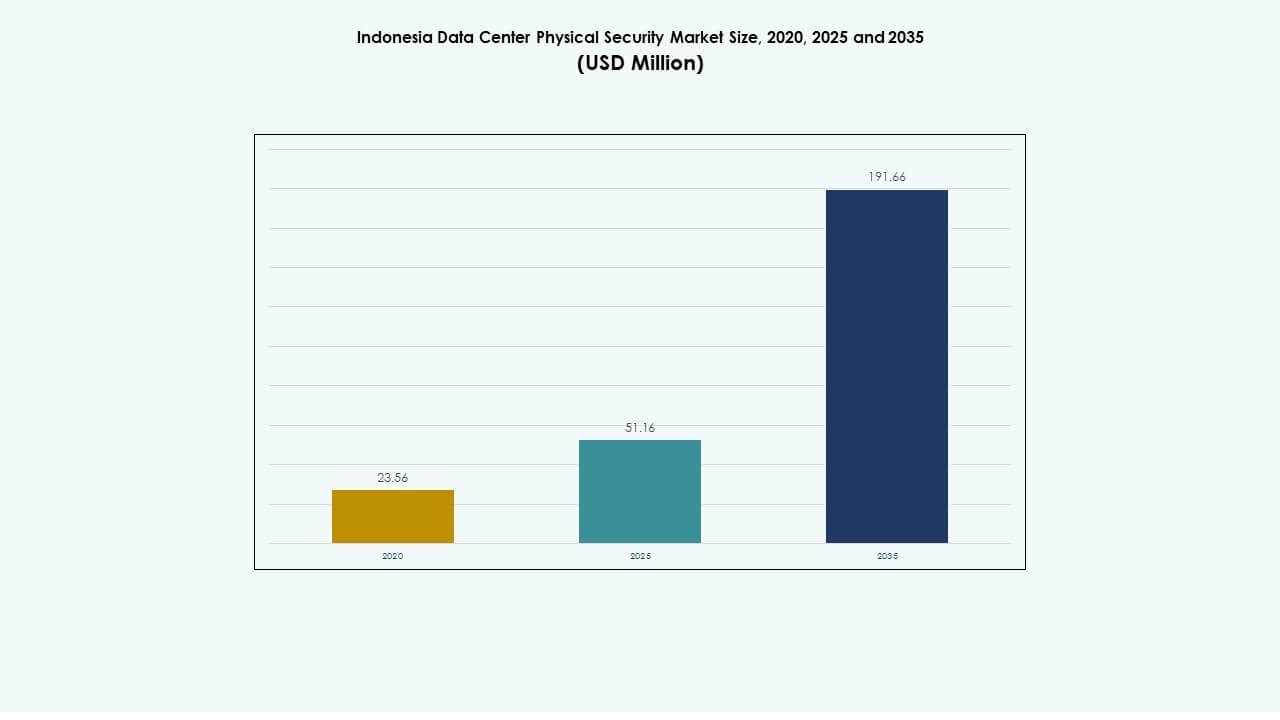
The Indonesia Data Center Physical Security Market size was valued at USD 23.56 million in 2020 to USD 51.16 million in 2025 and is anticipated to reach USD 191.66 million by 2035, at a CAGR of 14.04% during the forecast period.
| REPORT ATTRIBUTE |
DETAILS |
| Historical Period |
2020-2023 |
| Base Year |
2024 |
| Forecast Period |
2025-2035 |
| Indonesia Data Center Physical Security Market Size 2025 |
USD 51.16 Million |
| Indonesia Data Center Physical Security Market, CAGR |
14.04% |
| Indonesia Data Center Physical Security Market Size 2035 |
USD 191.66 Million |
Growing cloud adoption and hyperscale data center expansion drive the need for robust physical security frameworks. The market gains momentum from the integration of AI-based surveillance, biometric access control, and IoT-enabled monitoring. It holds strategic importance for investors as digital transformation accelerates across BFSI, telecom, and government sectors. Rising emphasis on data compliance and localized storage further strengthens security infrastructure development across Indonesia.
Jakarta leads the Indonesia Data Center Physical Security Market due to its strong enterprise base and high connectivity. Batam is emerging as a cross-border data hub benefiting from proximity to Singapore and economic incentives. Surabaya and secondary regions show rapid progress supported by decentralization policies and new industrial zones. These areas collectively enhance Indonesia’s regional data resilience and security readiness.
 Market Drivers
Expanding Hyperscale Infrastructure and Demand for Secure Facilities
The Indonesia Data Center Physical Security Market benefits from rapid hyperscale development and growing enterprise demand for secure facilities. Cloud providers and colocation operators build advanced campuses with multi-layered access control and biometric authentication. The adoption of AI-powered monitoring and perimeter defense tools supports continuous risk management. Rising data localization requirements encourage investments in local data protection systems. Enterprises seek compliance with international certifications such as ISO 27001 and SOC 2. It strengthens investor confidence through transparent governance and operational integrity. These changes elevate Indonesia’s standing in Southeast Asia’s digital economy. Growth in e-commerce and fintech accelerates infrastructure expansion with integrated security measures.
- For instance, EdgeConneX, through its subsidiary PT Graha Teknologi Nusantara, secured US$ 403.8 million in sustainability-linked financing to develop a 120 MW hyperscale data center campus in Jakarta.
Government Support for Digital Infrastructure and Security Compliance
Government-led initiatives such as the National Data Center and the Digital Economy Blueprint boost infrastructure modernization. Regulatory policies emphasize secure cloud adoption, fostering investments in surveillance, monitoring, and analytics platforms. The Indonesia Data Center Physical Security Market expands through initiatives aligned with cybersecurity resilience. Increased demand for colocation services supports higher installation of security sensors and smart video systems. Businesses prioritize facility resilience against physical intrusion, fire, and unauthorized access. Implementation of biometric verification improves operational transparency. Domestic players collaborate with international vendors to integrate automation and predictive analytics. These developments strengthen Indonesia’s position as a trusted regional data hub.
- For instance, Indonesia’s government is developing the National Data Center (Pusat Data Nasional) in Cikarang, West Java, scheduled for completion by 2025. The facility is designed with around 40 petabytes of storage capacity and supports secure cloud infrastructure aligned with national cybersecurity and data sovereignty goals.
Technological Advancement Driving Smart Monitoring and Automation
Data centers implement intelligent surveillance tools integrated with real-time analytics and IoT sensors. Operators deploy centralized control systems that synchronize access, lighting, and threat response. The adoption of automation reduces human dependency and enhances detection accuracy. The Indonesia Data Center Physical Security Market benefits from strong innovation in video analytics and energy-efficient monitoring. Investments in AI and machine learning optimize event correlation and predictive maintenance. Vendors provide modular solutions adaptable to multi-tenant environments. Strategic collaborations promote the use of cloud-based management platforms. It builds stronger operational continuity and ensures faster response to potential disruptions.
Private and Public Investment Stimulating Ecosystem Growth
Large-scale investments by private equity firms and telecom providers transform Indonesia’s data security ecosystem. Regional hubs such as Jakarta, Batam, and Surabaya attract hyperscale and colocation projects. Investors view physical security infrastructure as a key differentiator for reliability and uptime. The Indonesia Data Center Physical Security Market gains from partnerships with global integrators offering end-to-end managed services. Enterprises adopt hybrid models combining physical and logical security. New campuses feature redundant security architecture and fire suppression technologies. It supports Indonesia’s growing role as a primary data processing and cloud exchange center. These developments reinforce sustainable economic growth and investor trust.
 Market Trends
Rising Integration of Artificial Intelligence and Edge Analytics
AI-enabled surveillance and analytics define modern data center security in Indonesia. Operators integrate AI models that detect anomalies, track movement patterns, and flag potential breaches in real time. Edge computing solutions process data locally, reducing latency in decision-making. The Indonesia Data Center Physical Security Market reflects a shift toward predictive security systems. Vendors design adaptive tools that combine thermal imaging, facial recognition, and sensor fusion. This transition improves security response efficiency and energy use. Smart systems allow real-time alerts and central oversight across multiple sites. It helps companies meet both performance and compliance requirements effectively.
Adoption of Biometric and Multi-Factor Authentication Systems
Growing cybersecurity awareness fuels integration of biometric systems into physical infrastructure. Fingerprint, iris, and facial recognition technologies are deployed for restricted zone access. Multi-factor authentication ensures identity validation beyond standard credentials. The Indonesia Data Center Physical Security Market witnesses steady adoption of touchless and contactless entry solutions. Facilities incorporate AI-backed verification and encrypted credential storage for higher trust levels. Cloud platforms enable secure data exchange between access points and servers. Vendors deliver scalable identity management tools supporting hybrid data centers. It enhances security precision and ensures operational continuity across diverse environments.
Growing Role of Cloud-Based Security Management Platforms
Data centers are increasingly managed through unified cloud platforms offering centralized control. Operators integrate physical access, alarm, and video systems within a single digital interface. The Indonesia Data Center Physical Security Market experiences rapid adoption of cloud-native management systems. Real-time monitoring across multiple facilities improves efficiency and reduces downtime. Vendors deliver subscription-based services for smaller enterprises seeking affordable scalability. Cloud integration ensures seamless updates and compliance with evolving regulations. Unified dashboards simplify maintenance, analytics, and predictive alerts. It drives strong momentum for digital transformation in Indonesia’s security management landscape.
Sustainability and Energy Efficiency in Security Operations
Data center operators align security investments with sustainability goals. Energy-efficient surveillance cameras and smart lighting systems minimize power consumption. Vendors design low-power access systems and sensors that operate with reduced thermal output. The Indonesia Data Center Physical Security Market embraces eco-conscious designs that balance safety with environmental responsibility. Facilities implement motion-based lighting and AI-optimized cooling zones. Green building certifications encourage sustainable design and efficient energy distribution. Security systems integrate renewable energy monitoring to optimize performance. It enables operators to achieve compliance and reduce long-term operational costs.
 Market Challenges
High Implementation Costs and Legacy Infrastructure Limitations
The Indonesia Data Center Physical Security Market faces cost barriers in implementing next-generation systems. Many facilities still rely on legacy cabling and outdated surveillance tools. Integration of AI and IoT-driven security demands large capital investment. Smaller operators struggle to align budgets with modern security requirements. Compatibility issues arise between old and new access control technologies. Maintenance of multi-layered infrastructure raises operational expenditure. It challenges scalability and delays upgrades in mid-sized centers. Investors require clear ROI justification before deploying advanced security architectures.
Regulatory Complexity and Limited Skilled Workforce
Evolving regulatory frameworks pose compliance challenges for data center operators. Frequent updates to national cybersecurity and privacy standards create uncertainty in planning. The Indonesia Data Center Physical Security Market requires continuous adaptation to changing policies. Limited availability of trained professionals slows implementation of sophisticated monitoring tools. Delayed certification processes hinder expansion timelines. Vendors face pressure to meet global standards while aligning with local norms. It constrains innovation and reduces speed to market for new projects. Workforce development remains a crucial area for long-term improvement.
Market Opportunities
Rising Hyperscale Development and Regional Digital Expansion
Indonesia’s growing hyperscale ecosystem provides vast opportunities for advanced security adoption. Global cloud providers and telecom companies expand infrastructure to meet digital demand. The Indonesia Data Center Physical Security Market benefits from new facility launches backed by foreign investments. Partnerships between international and local integrators enhance solution customization. Government-backed smart city projects drive installation of modern access and monitoring systems. Strong economic growth supports wider enterprise digitization. It opens opportunities for vendors offering scalable, AI-driven solutions across verticals.
Growing Demand for Managed Security Services
Managed service providers gain traction as enterprises seek expertise in facility protection. Companies outsource monitoring, integration, and system maintenance for higher efficiency. The Indonesia Data Center Physical Security Market sees increasing service contracts in colocation and hyperscale environments. Vendors offer subscription-based support to optimize costs and uptime. Automation and remote analytics strengthen incident management and predictive monitoring. These services enhance scalability for small and medium players. It positions Indonesia as a regional hub for outsourced security operations and data resilience.
Market Segmentation
By Data Center Size
Large data centers dominate the Indonesia Data Center Physical Security Market due to heavy enterprise and hyperscale demand. These facilities invest heavily in multi-layered access control, AI monitoring, and perimeter defense. Medium centers show rising growth supported by digital transformation in mid-tier businesses. Small data centers rely on modular and cost-effective systems to manage risks efficiently. Investments in scalability and energy-efficient surveillance boost long-term adoption across all size categories.
By Component
Solutions hold the largest share of the Indonesia Data Center Physical Security Market, driven by adoption of surveillance, access control, and analytics tools. Service components grow steadily through demand for integration and support. Vendors focus on delivering flexible hardware-software bundles to enhance facility safety. The combination of preventive monitoring and responsive service architecture strengthens operational security. Ongoing investments in software-defined security platforms elevate the solutions segment’s dominance.
By Solution
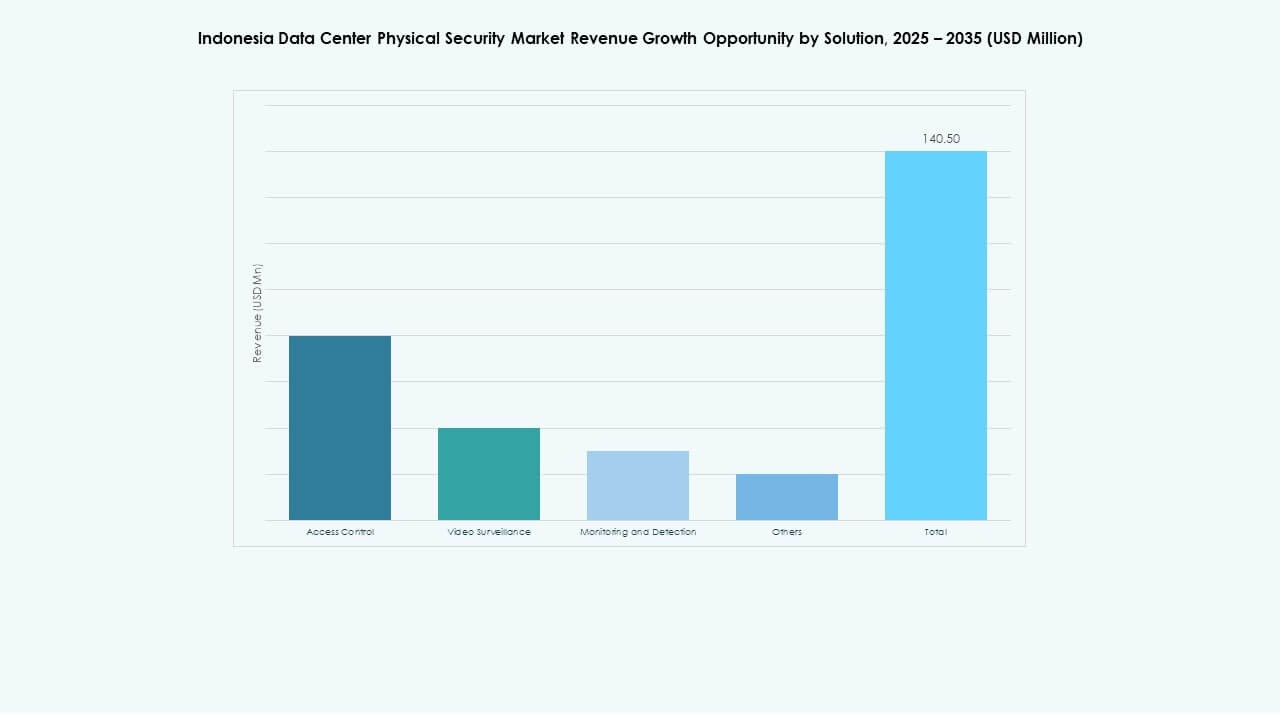
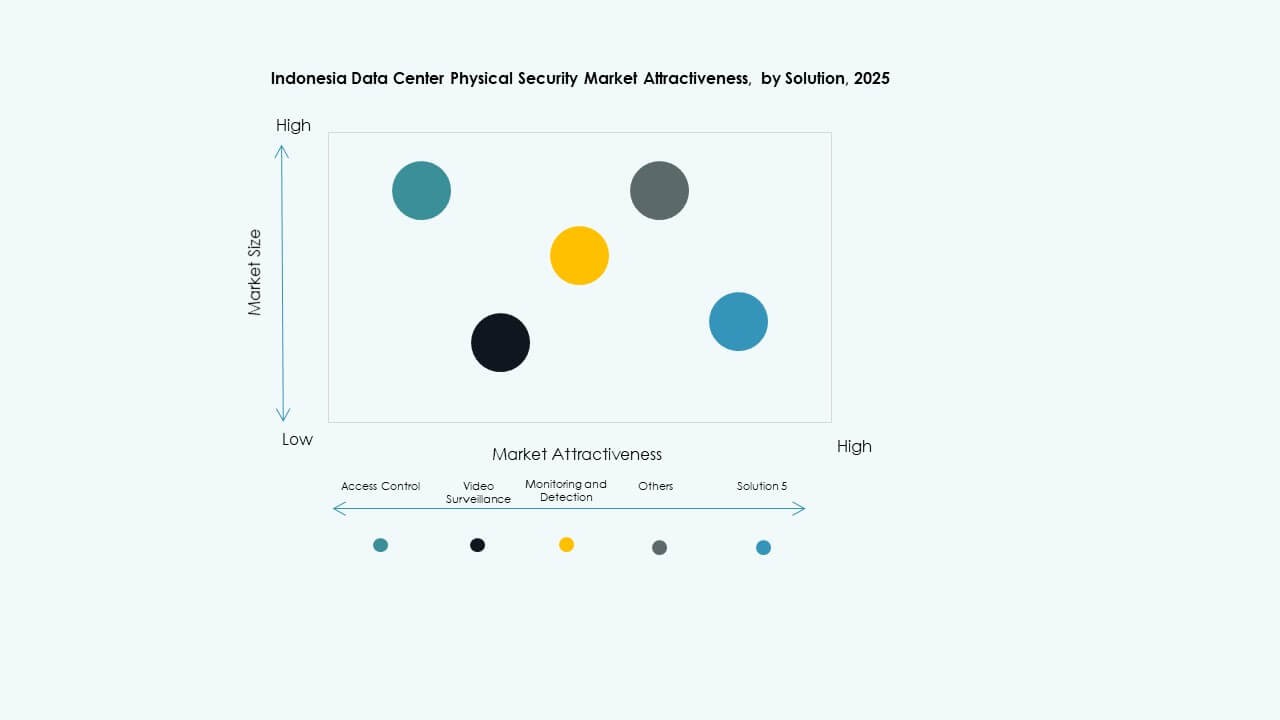
Video surveillance leads the market segment with widespread use in perimeter and data hall protection. Access control systems and detection tools follow closely, supporting multi-factor and biometric authentication. Monitoring and detection systems integrate with analytics for predictive insights. The Indonesia Data Center Physical Security Market benefits from AI-enhanced platforms that detect anomalies in real time. Vendors innovate to create scalable architectures for hyperscale and colocation environments.
By Services
System integration services account for a major share due to the complexity of multi-tier facilities. Consulting services guide enterprises in planning and implementing security upgrades. Maintenance and support remain critical for ensuring uptime and compliance. The Indonesia Data Center Physical Security Market gains from managed services tailored for large operators. Integration of automation tools helps reduce manual intervention and error margins in maintenance operations.
By Security Layer
Perimeter and building access layers dominate due to their critical role in preventing unauthorized entry. Data hall and rack-level security gain prominence with the rise of edge computing. The Indonesia Data Center Physical Security Market evolves through modular solutions supporting physical and cyber convergence. Advanced alarm systems and environment sensors improve situational awareness. Vendors focus on layered designs that maintain resilience under multi-tenant conditions.
By Data Center Type
Hyperscale data centers lead in adoption due to expansion by global cloud providers. Colocation facilities follow with high demand for secure shared infrastructure. Enterprise and edge data centers drive niche opportunities for customized protection tools. The Indonesia Data Center Physical Security Market strengthens as operators pursue automation and compliance. Investments in hybrid security infrastructure foster resilience across deployment types.
By End-user
IT & Telecom represents the largest end-user segment due to cloud and network expansion. BFSI follows, driven by regulatory obligations for data protection and facility integrity. Government and defense agencies invest in secure on-premises centers supporting digital governance. The Indonesia Data Center Physical Security Market also gains traction in healthcare and retail. Rising e-commerce and manufacturing activity contribute to multi-industry adoption of physical security systems.
Regional Insights
Jakarta – Core Market Hub with Over 60% Share
Jakarta dominates the Indonesia Data Center Physical Security Market with around 60–62% of the total share. Its dense business ecosystem and advanced digital infrastructure attract hyperscale providers and fintech operators. The region hosts leading colocation and enterprise data centers equipped with AI-based surveillance and biometric systems. Strategic connectivity to international networks enhances uptime and reliability. Jakarta’s favorable regulatory environment encourages compliant, energy-efficient facility design. It continues to serve as the national and regional epicenter for data hosting and processing.
- For instance, EDGNEX Data Centers by DAMAC is developing a 144 MW AI-powered hyperscale data center in the Jakarta region, targeting a Power Usage Effectiveness (PUE) of 1.32. The project, valued at USD 2.3 billion, is expected to begin operations by late 2026 as part of Indonesia’s growing digital infrastructure network.
Batam – Emerging Hyperscale and Cross-Border Gateway
Batam accounts for approximately 20–22% of the Indonesia Data Center Physical Security Market, supported by its strategic location near Singapore. The region experiences rapid growth through large-scale hyperscale projects and special economic zone benefits. New facilities deploy AI-enabled monitoring, perimeter defense, and fire control systems. Strong undersea cable connectivity improves cross-border data exchange. Investments from telecoms and global hyperscalers strengthen Batam’s infrastructure base. It evolves as Indonesia’s next-generation cross-border data and security corridor.
- For instance, Batam will host what is described as Asia’s first quantum-AI data center, backed by a US$400 million investment.
Surabaya and Secondary Regions – Rising Digital Infrastructure Nodes
Surabaya and secondary cities collectively hold around 16–18% of the Indonesia Data Center Physical Security Market. These regions grow under government decentralization initiatives and industrial development policies. Data centers in these areas adopt advanced access control, CCTV, and analytics-based monitoring systems. Expanding manufacturing and logistics sectors drive enterprise data storage demand. Local collaborations enhance skill development and technology transfer. These emerging nodes collectively improve Indonesia’s national data resilience and coverage network.
Competitive Insights:
- Bosch Sicherheitssysteme GmbH
- Honeywell International Inc.
- Cisco Systems Inc.
- Huawei Technologies Co. Ltd.
- IBM Corporation
- Dell Technologies Inc.
- Intel Corporation
- PT Telkomsigma (Telkom Indonesia)
- PT Daya Cipta Mandiri Solusi (Noosc)
- Amazon Web Services Inc.
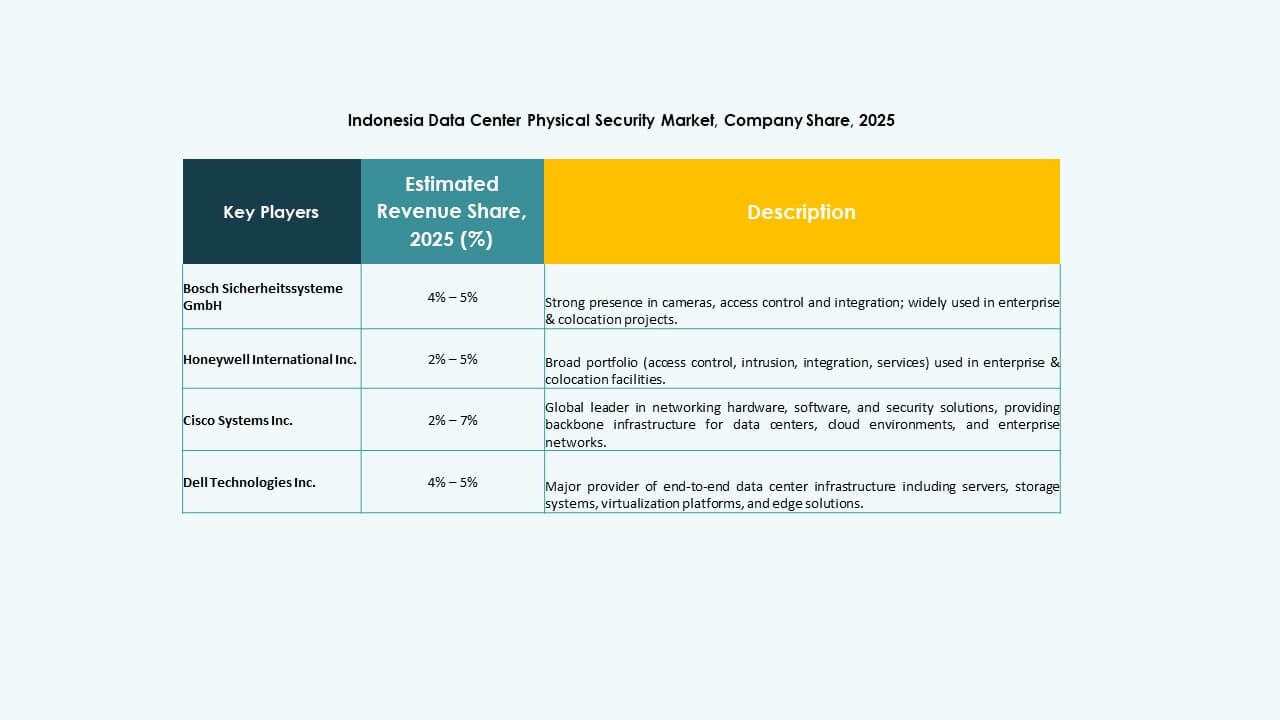
The Indonesia Data Center Physical Security Market features a blend of global technology leaders and regional system integrators. Global vendors such as Bosch, Honeywell, and Huawei focus on advanced access control and AI-based surveillance systems, while local players like PT Telkomsigma and Noosc strengthen deployment and maintenance capabilities. Strategic collaborations between international suppliers and domestic firms support compliance with national security regulations. It remains highly competitive, with companies investing in automation, energy efficiency, and predictive analytics to differentiate their offerings. Vendors compete on scalability, integration flexibility, and service reliability across hyperscale and colocation environments.
Recent Developments:
- In October 2025, ASSA ABLOY acquired Kentix GmbH, a German company specializing in monitoring and access control products designed for data centers, enhancing their capabilities in physical security for this sector.
- In May 2025, Microsoft opened its first cloud region in Indonesia, called Indonesia Central, establishing an AI-ready hyperscale cloud infrastructure that will enhance cloud capabilities and digital transformation in the country.
- In March 2025, Digital Realty formed a 50-50 joint venture with Bersama Digital Infrastructure Asia (BDIA) to develop and operate data centers across Indonesia. This new joint venture, Digital Realty Bersama, aims to provide advanced data center capacity in central Jakarta to support growth driven by high-performance computing and AI advancements.
- In January 2025, ASSA ABLOY also acquired InVue, a Charlotte-based provider of asset protection and access control solutions, aligning with their strategy to expand globally in access control and asset protection.
- In June 2024, Honeywell International Inc. completed the acquisition of Carrier Global Corporation’s Global Access Solutions business for $4.95 billion, enhancing its building automation portfolio with advanced access control solutions like LenelS2, Onity, and Supra, which support security needs in data centers including those in Spain.
- In December 2024, Bosch Sicherheitssysteme GmbH sold its security and communications technology product business to the European investment firm Triton. The transaction included three business units Video, Access and Intrusion, and Communication as Bosch aims to focus more on systems integration business.