

Key takeaways
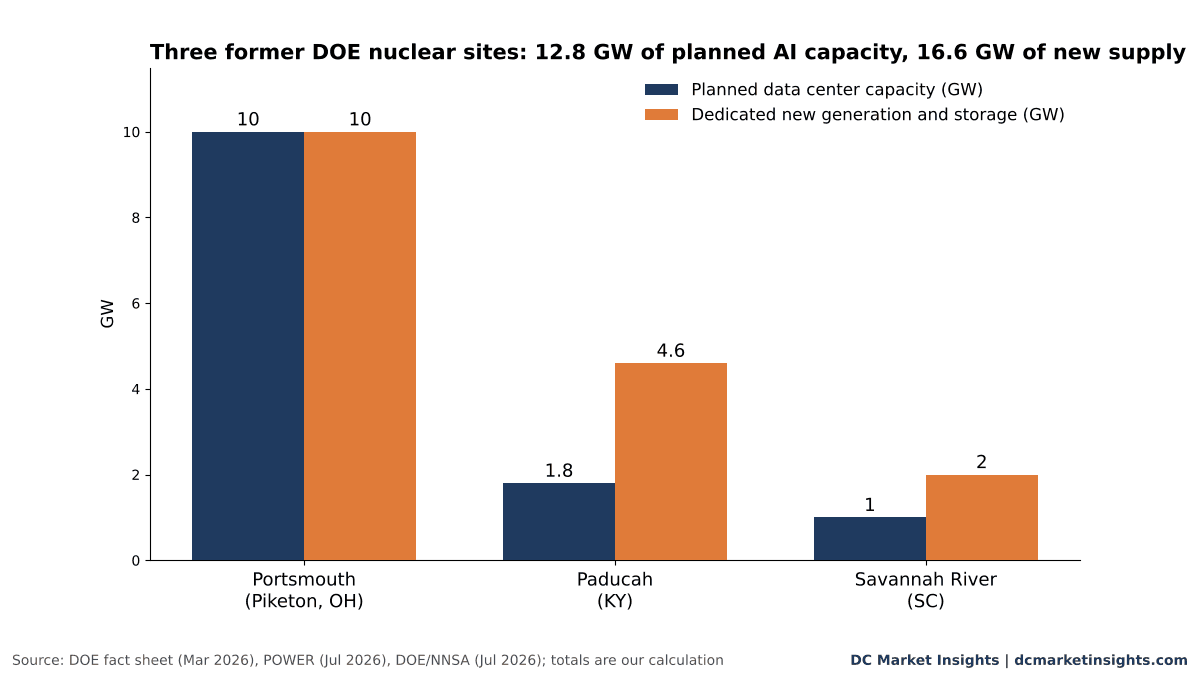
- Three former Department of Energy nuclear sites now carry 12.8 GW of planned AI data center capacity: about 10 GW at Portsmouth in Ohio, 1.8 GW at Paducah in Kentucky and 1 GW at Savannah River in South Carolina (our calculation from DOE and POWER figures).
- On 13 October PJM filed a study agreement at FERC to examine 9.6 GW of new load and 10.2 GW of new gas generation for SB Energy’s Ohio campus, at the request of the Public Utilities Commission of Ohio, Utility Dive reported.
- Japanese funding of US$33.3 billion is tied to at least 9.2 GW of gas generation at the Ohio site, and SB Energy will pay US$4.2 billion for 765 kV lines and four substations, according to a DOE fact sheet. That is about US$3,620 per kW of generation (our calculation).
- At Paducah, Brookfield and NextEra plan a campus with more than US$100 billion of private investment and up to 4.6 GW of dedicated gas and battery capacity, completing in 2031, POWER reported.
- FERC’s 60-day clock on the PJM filing runs to about 12 December 2026 (our calculation under section 205 of the Federal Power Act). Ohio then decides whether to proceed.
The cheapest route to a gigawatt of AI capacity in the United States now runs through Cold War uranium plants. The federal government owns the land, the sites already have heavy transmission, and the developers have promised to pay for their own power. Three of these sites now hold more planned data center capacity than every live US facility in our tracker with a stated MW figure.
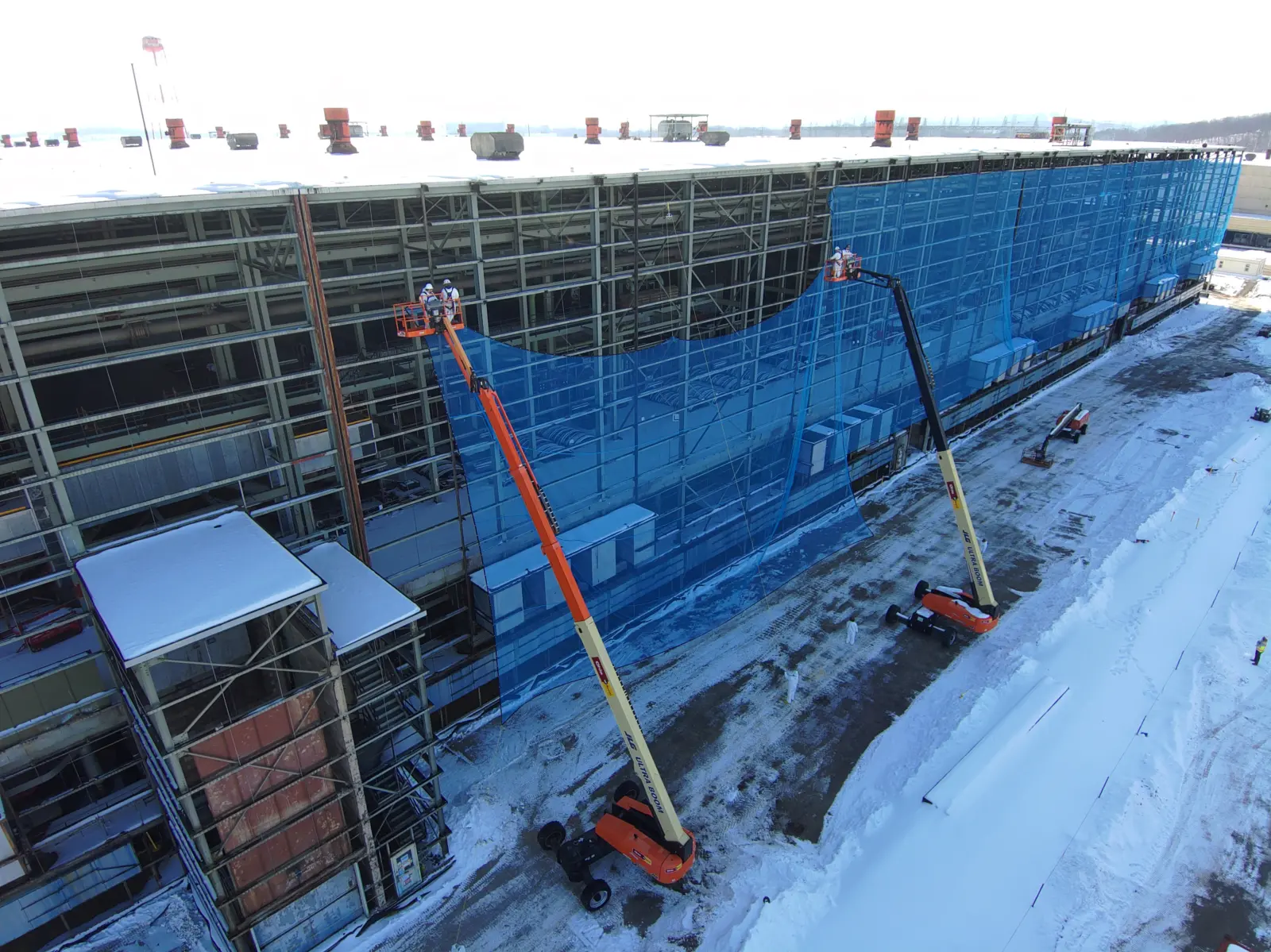
The week made it concrete. On 13 October PJM, the grid operator for 13 states, filed at FERC to study the generation and lines needed for SB Energy’s 10 GW campus at the former Portsmouth Gaseous Diffusion Plant in Pike County, Ohio. Two days later the Assistant Secretary for Environmental Management, Tim Walsh, toured the site and told reporters that demolition was underway. This analysis looks at where the money is going, who gains and what is still unsigned.
How we got here: from uranium enrichment to powered land
DOE named its first four federal sites for AI data centers and new generation on 24 July 2025: Idaho National Laboratory, the Oak Ridge Reservation, the Paducah Gaseous Diffusion Plant and the Savannah River Site. It chose them from a wider list after a request for information that drew what it called “enormous interest”, and said site-specific solicitations would follow.
These sites are uniquely positioned to host data centers as well as power generation to bolster grid reliability.
The solicitations set the model. For Idaho, DOE offered up to about 100,000 acres and asked for fully resourced teams with energy partners, with no minimum project size; applications closed on 7 November 2025, Hogan Lovells reported. Oak Ridge proposals were due on 1 December and Savannah River proposals on 5 December 2025. DOE would not provide its internal distribution network, its federal water rights or fiber. Developers bring their own power, water and connectivity and take a long-term lease on federal land.
Portsmouth was not on the first list, but it moved fastest. The Commerce Department named a 9.2 GW, US$33 billion gas plant near Portsmouth, to be developed by SoftBank’s US affiliate SB Energy, in the first tranche of Japan’s US$550 billion investment pledge on 17 February 2026, POWER reported. DOE and Commerce held a groundbreaking at the Piketon site on 20 March 2026. DOE said the initial phase would use 189 acres of a site that once covered more than 3,700 acres.
What changed this week: PJM opens the Ohio study
On 13 October PJM filed a study agreement at FERC for the project, which it calls “Flagship”. It will study an additional 9.6 GW of load and 10.2 GW of new gas-fired generation, built in phases through 2032, plus three 765 kV lines planned by AEP Ohio, Utility Dive reported. The first 800 MW phase will be served under AEP Ohio’s data center tariff.
The route matters as much as the size. PJM is using the State Agreement Approach that Ohio regulators requested in a letter of 15 June 2026. Under that framework a state asks PJM to study projects that serve state policy, and the state’s consumers normally pay. Here the Public Utilities Commission of Ohio (PUCO) will assign the transmission costs to SB Energy, which has committed to pay them, MGRID reported. PJM was clear that the study does not settle that question: cost allocation and recovery remain subject to future PUCO and FERC proceedings, and the study will not select projects or grant interconnection rights.
In our view, this is the first test of a new template. A single customer asks a state to sponsor a grid study, promises to pay for the lines and plants, and agrees to make spare generation and transmission available to the grid. If FERC accepts it without changes, other states with federal or brownfield megasites will copy it.
| Portsmouth “Flagship” term | Value | Source |
|---|---|---|
| Planned data center development | About 10 GW | DOE fact sheet |
| New generation planned | 10 GW, at least 9.2 GW natural gas | DOE fact sheet |
| Japanese funding for the gas generation | US$33.3 billion | DOE fact sheet |
| Transmission paid by SB Energy | US$4.2 billion: 765 kV lines and four substations | DOE fact sheet |
| Load and gas generation in PJM’s study | 9.6 GW load; 10.2 GW gas, phased to 2032 | PJM filing, via Utility Dive |
| First phase | 800 MW under AEP Ohio’s data center tariff | Utility Dive |
| Community benefits agreement | US$40 million | DOE fact sheet |
| Implied generation cost | About US$3,620 per kW | Our calculation: US$33.3 billion / 9,200 MW |
| Implied transmission cost | About US$440 per kW of studied load | Our calculation: US$4.2 billion / 9,600 MW |
Sources: DOE fact sheet, 20 Mar 2026; Utility Dive, 14 Oct 2026. DOE cites at least 9.2 GW of gas; PJM’s study covers 10.2 GW. Neither source explains the difference, so we use 9.2 GW for the cost per kW. The US$33.3 billion is funding tied to the generation, not a disclosed contract price.
The other sites: Paducah and Savannah River
Paducah, Kentucky. On 29 July 2026 DOE selected Brookfield and NextEra Energy for a campus at the former Paducah Gaseous Diffusion Plant, the last government-owned US enrichment plant, which stopped enriching in 2013. Brookfield will lease 3,556 acres and develop the campus: up to 1.8 GW of utility capacity and more than 1.2 GW of compute load. NextEra will own up to 2 GW of grid-connected gas generation and up to 2.6 GW of battery storage, a total of 4.6 GW, with excess power going to the regional grid, POWER reported. Construction is due to finish in 2031, with full buildout in 2032. The selection is subject to definitive documents, and the power supply agreement between Big Rivers Electric and Jackson Purchase Energy Cooperative needs Kentucky Public Service Commission approval.
The data center will bring its own power, pay for its own power infrastructure.
Savannah River, South Carolina. On 20 July 2026 DOE’s National Nuclear Security Administration selected Amentum to negotiate a phased lease for a 1 GW AI data center with about 2 GW of on-site generation, described as natural gas bridging to nuclear energy, according to NNSA. NNSA said it is not a final lease award and depends on negotiations, permitting, and safety and security reviews. No acreage, cost or schedule was given.
Idaho and Oak Ridge. Both solicitations closed in late 2025. We found no public selection announcement for either site as of 18 October 2026.
| Site | Developer | Data center capacity | Dedicated supply | Status |
|---|---|---|---|---|
| Portsmouth, Piketon, Ohio | SB Energy (SoftBank), AEP Ohio for transmission | About 10 GW | 10 GW, at least 9.2 GW gas | Groundbreaking 20 Mar 2026; PJM study filed 13 Oct 2026 |
| Paducah, Kentucky | Brookfield (campus), NextEra (generation) | Up to 1.8 GW utility capacity; more than 1.2 GW compute | Up to 2 GW gas + 2.6 GW batteries | Selected 29 Jul 2026; definitive documents pending; completion 2031 |
| Savannah River, South Carolina | Amentum | 1 GW | About 2 GW, gas bridging to nuclear | Selected for lease negotiations 20 Jul 2026 |
| Idaho National Laboratory | Not announced | No minimum size; up to about 100,000 acres offered | Nuclear and geothermal preferred | Applications closed 7 Nov 2025 |
| Oak Ridge Reservation, Tennessee | Not announced | Not disclosed | Not disclosed | Proposals closed 1 Dec 2025 |
| Total, three selected sites | 12.8 GW | 16.6 GW | Our calculation |
Sources: DOE, 20 Mar 2026; POWER, 29 Jul 2026; NNSA, 20 Jul 2026; ANS Nuclear Newswire, 31 Jul 2026; Hogan Lovells, 1 Oct 2025. Paducah’s 1.8 GW is utility capacity, not IT load; the Portsmouth and Savannah River figures are stated as data center capacity. The totals mix these bases and are indicative.
Who gains, and how much
OpenAI and SoftBank. MGRID reported in August that OpenAI agreed to take about 8 GW of IT load at the Pike County site and that NVIDIA guaranteed up to US$105 billion in conditional lease and power payments to SB Energy. By our calculation, 8 GW is close to the 9.04 GW of AI IT load that DC Market Insights estimates was deployed worldwide in all of 2025. One tenant on one federal site would roughly match a year of global AI build.
Gas turbine, transformer and switchgear vendors. At least 11.2 GW of the 16.6 GW of dedicated supply at the three sites is gas (9.2 GW at Portsmouth and 2 GW at Paducah), before counting the gas phase at Savannah River (our calculation). DOE says long-lead high-voltage equipment for Portsmouth is already secured. Paducah adds up to 2.6 GW of batteries, a large single order for the storage chain.
Utilities that wire it. AEP Ohio builds the 765 kV backbone at a cost SB Energy pays. In Kentucky, Big Rivers, a member-owned cooperative serving 22 counties, becomes the wholesale supplier to a campus larger than many cooperatives’ entire peak.
DOE and host communities. SB Energy will fund accelerated cleanup at Portsmouth and a US$40 million community benefits agreement. DOE projects more than 10,000 construction jobs over four years and more than 2,000 permanent jobs in Ohio; Paducah expects about 8,000 construction and 600 permanent jobs, according to ANS Nuclear Newswire.
The cost isn’t being borne by the people of Ohio.
Job estimates differ. DOE’s fact sheet gives more than 10,000 construction and more than 2,000 permanent jobs at Portsmouth; POWER cites projections of 35,000 construction and 2,500 permanent positions. Start dates also differ: POWER reported that construction of the first 800 MW phase was expected to begin in 2026, while WCPO reported on 15 October that construction is expected to begin in 2027, with the first shell and generation online by the end of 2028 or 2029.
The economics: what US$137 billion buys
The headline commitments are large but not like for like. Portsmouth’s US$33.3 billion covers generation; its US$4.2 billion covers transmission; Paducah’s US$100 billion covers the whole campus, including the buildings and, in all likelihood, the compute. Added together, these figures reach about US$137.5 billion (our calculation), but they should be read as three different scopes.
Two ratios are useful. On generation, about US$3,620 per kW at Portsmouth sits above the roughly US$2,670 per kW implied by NRG’s 1.2 GW combined-cycle plant for a hyperscaler and the roughly US$2,500 per kW implied by AEP’s linear generator deal, both covered in our 14 October analysis. Scope again differs: the Portsmouth figure may include a pipeline and site works. On the campus, Paducah’s US$100 billion over 1.8 GW is about US$55.6 million per MW of utility capacity (our calculation). That is above the US$44.6 million per MW in DC Market Insights’ build-cost model for sovereign AI capacity, which suggests the Paducah total includes several generations of chips over the build period.
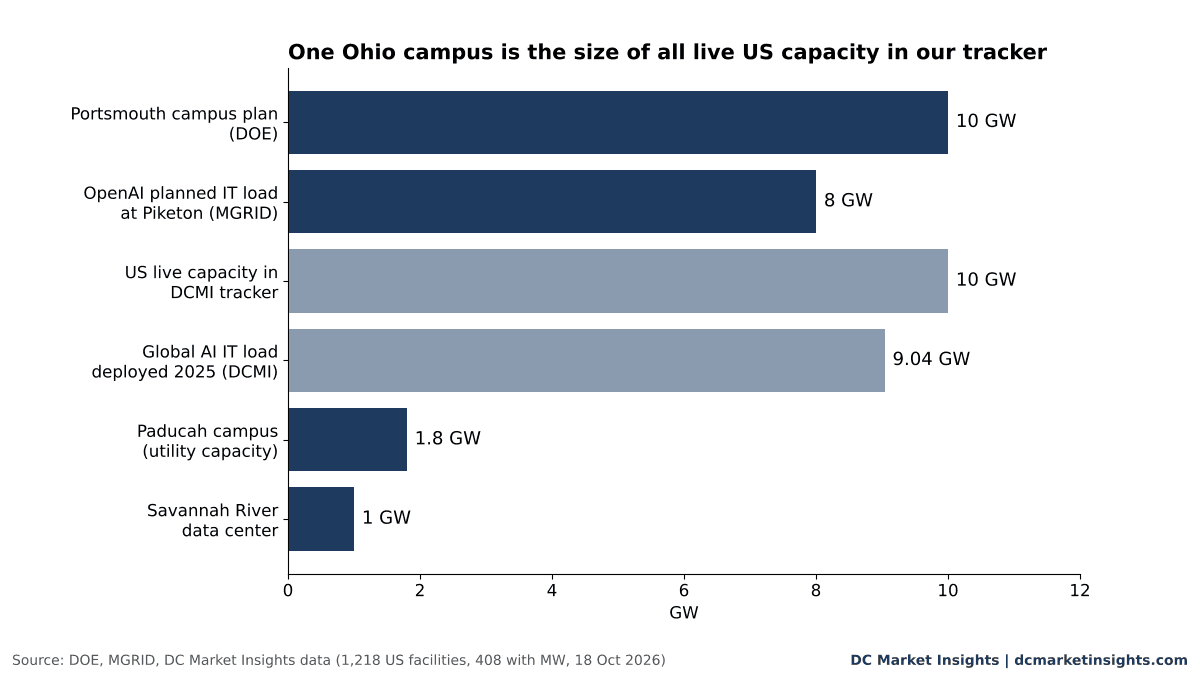
DC Market Insights data puts the projects in context. Our US tracker holds 1,218 facilities, 408 of them with a stated capacity: 10,019 MW live, 17,931 MW under construction and 25,708 MW planned, as of 18 October 2026. The 12.8 GW at the three federal sites equals about 29% of all tracked US capacity under construction or planned (our calculation), and the Portsmouth plan alone equals the live total. Coverage is partial, so the shares are a floor on how concentrated the pipeline is becoming, not a market share.
The wider pattern: bring your own power, everywhere
The federal sites are the largest examples of a model now spreading across the Americas: the developer pays for the generation and the wires so the costs stay off household bills. The White House’s voluntary Ratepayer Protection Pledge was signed on 4 March 2026 by Amazon, Google, Meta, Microsoft, OpenAI, Oracle and xAI and expanded to more than 200 organisations in July, POWER reported. In Canada, EverWind announced a $10 billion, 420 MW campus at Point Tupper, Nova Scotia, on 16 October with a 20-year lease to Anthropic, and said it will pay the full cost of grid connections and upgrades, CP24 reported.
Opposition is the constraint. A Bowling Green State University poll of 1,000 likely Ohio voters found 75% would oppose or strongly oppose a data center in their community, WCPO reported, and the group Conserve Ohio argues data centers should be no larger than 25 MW.
No economic development project should come off the backs of humans living around the project.
In our view, federal land is the answer the administration has found to that problem. A lease on a fenced former enrichment site avoids local zoning fights, comes with transmission already in the ground and, with FAST-41 coverage granted to Portsmouth on 16 June, a single federal permitting lead in the U.S. Army Corps of Engineers, according to POWER.
What it means for operators, investors and vendors
Our view, based on the filings and selections above:
- Operators: bid for the next federal sites. Idaho and Oak Ridge have closed solicitations and no announced winners. DOE has said more sites may follow. The model rewards teams that arrive with generation, water and fiber already lined up.
- Budget US$3,500 to US$3,700 per kW for dedicated gas. Portsmouth implies about US$3,620 per kW, above recent bilateral gas deals at about US$2,670. Plan for the higher figure when the plant is sized to the campus.
- Plan to pay for transmission. Portsmouth’s US$4.2 billion is about US$440 per kW of load. Treat that as a reference for 765 kV-scale campuses where the customer funds the lines.
- Investors: discount by stage. Of the 12.8 GW, only the first 800 MW at Portsmouth has a tariff path. Paducah needs definitive documents and a state approval; Savannah River is still in lease talks.
- Vendors: the order book is gas and batteries. At least 11.2 GW of gas and 2.6 GW of storage are tied to three sites. Turbine, transformer, 765 kV switchgear and battery suppliers should expect phased orders through 2032.
- Watch the FERC record. A clean acceptance of PJM’s study agreement would make the State Agreement Approach a working template for single-customer megaprojects.
For the market behind these campuses, see our AI Data Center Market report. For the on-site gas and backup power they depend on, see the Data Center Generator Market report, and for the battery side of Paducah’s 4.6 GW, the Data Center Energy Storage Market report. Track the rules on our United States power and policy page and campus deals in our Deal Tracker.
What to watch next
- About 12 December 2026: end of FERC’s 60-day window to act on PJM’s 13 October study agreement for the Ohio project (our calculation; PJM asked for an effective date of 25 September 2026).
- After the PJM study: PUCO proceedings on cost allocation for the Ohio transmission, followed by any FERC filing.
- Pending, no date set: definitive documents for Paducah and Kentucky Public Service Commission approval of the Big Rivers and Jackson Purchase power agreement.
- Pending, no date set: a final lease for Amentum at Savannah River, and selections at Idaho National Laboratory and Oak Ridge.
- 2027: construction start at Portsmouth, according to DOE’s Tim Walsh, as reported by WCPO.
- End of 2028 or 2029: first data center shell and generation online at Portsmouth.
- 2031 to 2032: completion and full buildout at Paducah; final phases of Portsmouth generation in PJM’s study.
Frequently asked questions
How much AI data center capacity is planned on former DOE nuclear sites?
About 12.8 GW across three selected sites, by our calculation: about 10 GW at Portsmouth in Ohio, up to 1.8 GW at Paducah in Kentucky and 1 GW at Savannah River in South Carolina. Idaho and Oak Ridge have no announced developer yet.
Who is building the data center in Piketon, Ohio?
SB Energy, a SoftBank company, on leased land at the former Portsmouth Gaseous Diffusion Plant. DOE says it plans 10 GW of new generation, at least 9.2 GW of it gas, backed by US$33.3 billion of Japanese funding, with AEP Ohio building the transmission.
Who pays for the power and transmission at these sites?
The developers, under current plans. SB Energy will pay US$4.2 billion for 765 kV lines and four substations in Ohio, and NextEra will own up to 4.6 GW of gas and batteries at Paducah. Final cost allocation in Ohio still needs PUCO and FERC decisions.
What is PJM studying for the Ohio project?
An additional 9.6 GW of load and 10.2 GW of new gas generation, phased through 2032, plus three 765 kV lines, under a study agreement PJM filed at FERC on 13 October 2026. The study does not set cost allocation or grant interconnection rights.
Sources
- U.S. Department of Energy, “Fact Sheet: Department of Energy Ensuring Affordable Energy Access in Ohio While Powering the Future”, 20 Mar 2026. Link
- U.S. Department of Energy, Office of Environmental Management, “Partnership Ensures Affordable Energy, Powers AI Future at Portsmouth Site”, 24 Mar 2026. Link
- U.S. Department of Energy, “DOE Announces Site Selection for AI Data Center and Energy Infrastructure Development on Federal Lands”, 24 Jul 2025. Link
- National Nuclear Security Administration, “NNSA Selects Amentum for AI Data Center and Energy Project at Savannah River Site”, 20 Jul 2026. Link
- Utility Dive, “PJM to study SoftBank’s Ohio AI ‘Flagship’ project under state agreement approach”, 14 Oct 2026. Link
- MGRID, “PJM Will Study SoftBank’s 9.6 GW Ohio Data Center Load at the State’s Request, But the Study Sets No Cost Allocation”, 14 Oct 2026. Link
- WCPO, “Federal officials tout $33B energy investment, massive data center in Southern Ohio”, 15 Oct 2026. Link
- POWER, “SB Energy Tapped for Proposed 9.2-GW Ohio Gas Power Plant in First Tranche of $550B U.S.–Japan Deal: What We Know”, Feb 2026. Link
- POWER, “Brookfield, NextEra to Develop $100B Data Center Campus at DOE’s Paducah Site, Paired With 4.6 GW of Dedicated Generation”, 29 Jul 2026. Link
- ANS Nuclear Newswire, “Private-sector data center plans advance for Paducah and Savannah River sites”, 31 Jul 2026. Link
- Hogan Lovells, “DOE opens the door to AI data centers and energy projects at the Idaho National Laboratory”, 1 Oct 2025. Link
- CP24 (The Canadian Press), “EverWind says $10B AI data centre proposal largest private investment in N.S. history”, 16 Oct 2026. Link
- Utility Dive, “NRG nears 1.2-GW hyperscaler deal amid Texas data center pause”, 6 Aug 2026. Link
- DC Market Insights, United States country data (1,218 facilities), retrieved 18 Oct 2026, and AI Data Center Market report. Link