

Key takeaways
- TSMC reported third-quarter 2026 revenue of US$46.72 billion on 15 October, up 41.2% from a year earlier, with net income up 68.7% to NT$763.06 billion (TSMC).
- TSMC guided fourth-quarter revenue to US$52.3 billion to US$54.3 billion and kept its 2026 capital budget at US$60 billion to US$64 billion. Chairman C.C. Wei said AI demand is still higher than supply.
- ASML said on 14 October that its planned supply for 2027 and 2028 will not fully meet customer demand, and that some customers want to place orders for 2029 and 2030 (ASML).
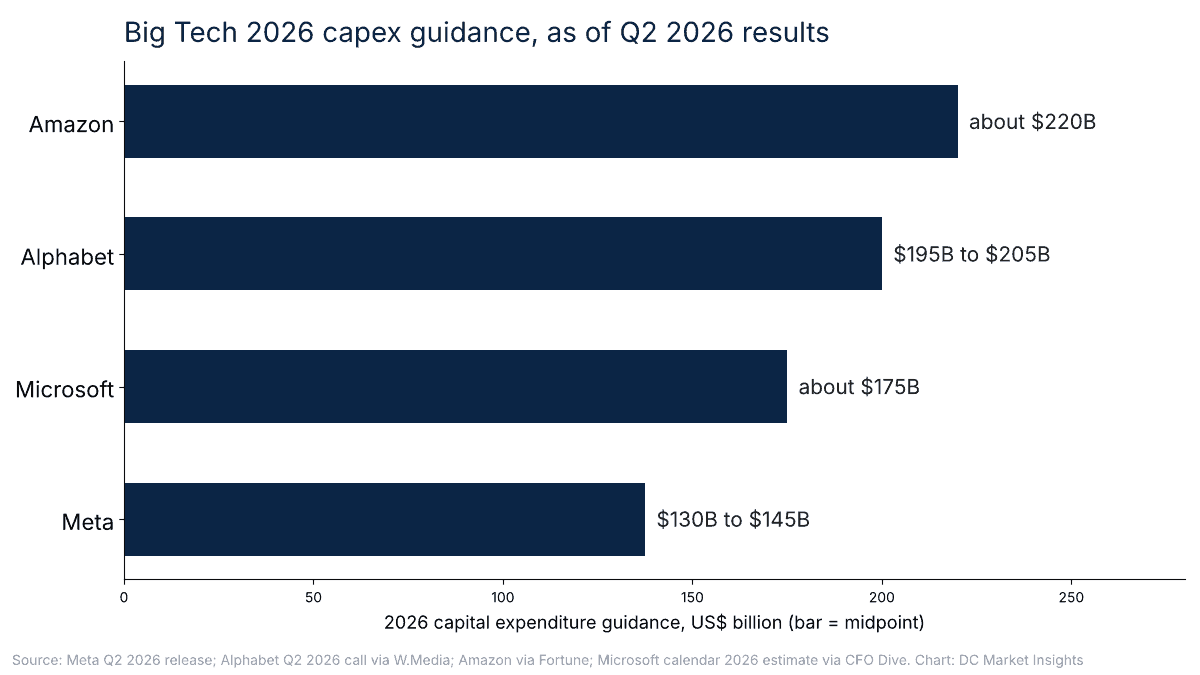
- Amazon, Alphabet, Microsoft and Meta guided to roughly US$733 billion of 2026 capital spending at the midpoints of their latest ranges (our calculation from company figures).
- The next test comes fast: Meta reports on 21 October, Alphabet and Microsoft on 28 October and Amazon on 29 October.
The world’s largest contract chipmaker has just told the market that the AI build-out is not slowing. TSMC’s third quarter beat its own guidance, its fourth-quarter outlook implies another step up, and its chairman said demand for AI chips still runs ahead of what the company can make. One day earlier, ASML, which supplies the lithography tools behind those chips, said its customers are already asking about orders for 2029 and 2030.
This is the market signal of the week for data centers. Chips ordered today become racks that need power, cooling and buildings in 2027 and 2028. The question for the next two weeks is whether the four largest buyers confirm that signal with their own spending plans.
What the signal says: TSMC’s quarter in numbers
TSMC’s third-quarter release, filed with the US Securities and Exchange Commission on 15 October, shows revenue of NT$1,494.24 billion, or US$46.72 billion. That is up 50.9% year on year in New Taiwan dollars and up 16.2% from the second quarter in US dollars. Net income rose 68.7% to NT$763.06 billion and the gross margin was 66.4%.
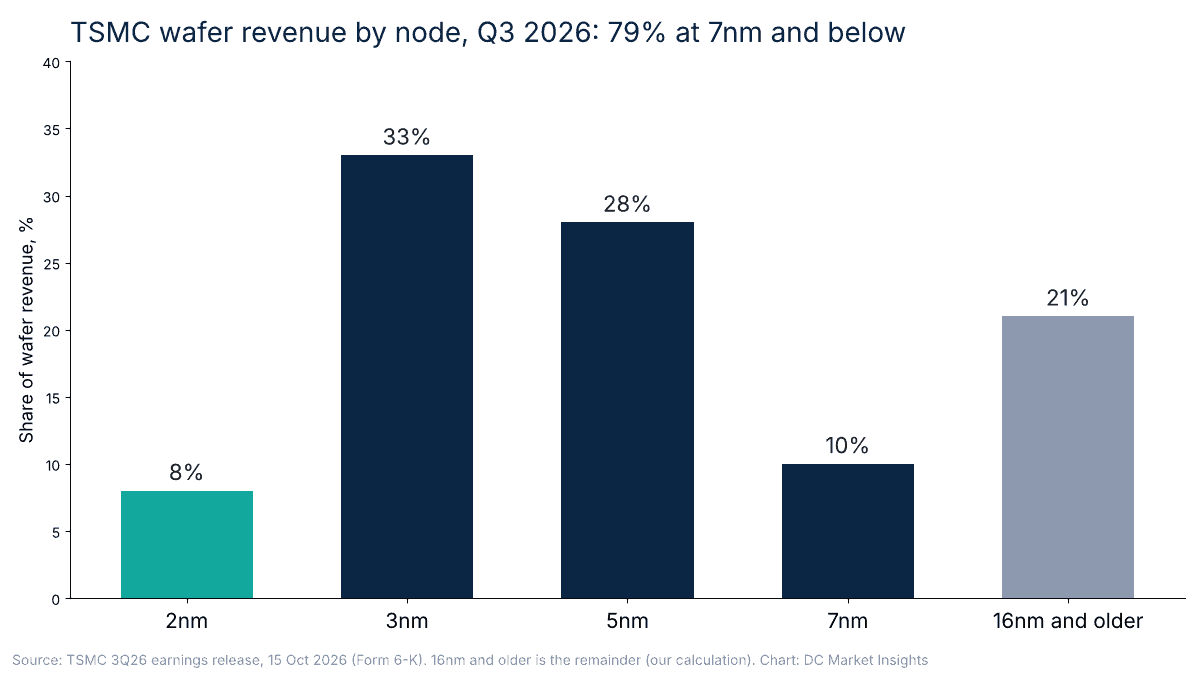
The mix matters more than the total. Advanced technologies at 7 nanometres and below made up 79% of wafer revenue. The 3 nm node alone was 33%, and the new 2 nm node, which only began its ramp this year, already reached 8%. High-performance computing, the platform that holds AI accelerators and data center processors, was 68% of revenue and grew 22% from the prior quarter, CRN Asia reported.
Chief Financial Officer Wendell Huang tied the quarter directly to leading-edge demand.
Our business in the third quarter was supported by strong demand for our leading-edge process technologies.
| TSMC measure | Value | Source |
|---|---|---|
| Q3 2026 revenue | US$46.72 billion (NT$1,494.24 billion) | TSMC |
| Year-on-year growth, US dollars | 41.2% | TSMC |
| Q3 2026 gross margin | 66.4% | TSMC |
| Q4 2026 revenue guidance | US$52.3 billion to US$54.3 billion | TSMC |
| Q4 2026 gross margin guidance | 65% to 67% | TSMC |
| 2026 revenue growth outlook, US dollars | About 44% | TSMC call, via The Motley Fool transcript |
| 2026 capital budget | US$60 billion to US$64 billion | TSMC call, via The Motley Fool transcript |
| Capex spent in Q3 2026 | US$13.8 billion | CRN Asia |
Sources: TSMC, 15 Oct 2026; The Motley Fool, 15 Oct 2026; CRN Asia, 16 Oct 2026. The Q3 figures had not yet been approved by TSMC’s board when released.
Where it points next: demand still ahead of supply
On the earnings call, Wei was asked whether AI demand is cooling. His answer was the opposite. He said TSMC’s earlier forecast for AI accelerator revenue to grow at a compound rate in the mid to high 50s percent from 2024 to 2029 would “probably” be exceeded, according to The Motley Fool’s transcript.
We still think the demand is higher than the supply, and we are working very hard to narrow the gap.
Huang added that TSMC expects capital spending from 2026 to 2028 to be “even more significantly higher than the past three years”, though he declined to give a 2027 figure. Wei also said volume production at TSMC’s next Arizona fab will begin in the third quarter of 2027, slightly ahead of schedule. Asked about where new capacity goes, he said the power supply situation is “one of the consideration factor” in TSMC’s planning.
In our view, that last remark is the bridge to the data center market. A chipmaker that is short of supply and planning more fabs is betting that its customers’ customers, the cloud and AI operators, will have buildings and grid connections ready for the output. Wei said TSMC plans capacity with “our customer’s customer” in mind.
Upstream confirms it: ASML and Samsung
TSMC was not alone this week. ASML reported record third-quarter net sales of €11.7 billion and net income of €5.0 billion on 14 October, with a gross margin of 57.5%. It guided fourth-quarter sales to €14.2 billion to €15.2 billion and full-year 2026 sales to €44 billion to €45 billion.
We now expect that our supply as currently planned for both 2027 and 2028 will not fully meet the demand of our customers.
Fouquet said customers keep raising their equipment demand forecasts, “driven primarily by their views on the size and duration of AI-related investments”, and that ASML is studying ways to raise 2028 capacity beyond the 30% increase it had already announced.
Memory points the same way. Samsung Electronics guided on 8 October to third-quarter operating profit of about KRW 107.4 trillion on sales of about KRW 195 trillion. A year earlier, operating profit was KRW 12.17 trillion, so profit is up nearly ninefold (our calculation from Samsung’s figures).
| Company | Signal this month | Date |
|---|---|---|
| Samsung Electronics | Q3 operating profit guidance about KRW 107.4 trillion, against KRW 12.17 trillion a year earlier | 8 Oct 2026 |
| ASML | Planned 2027 and 2028 supply will not fully meet customer demand; 2026 sales outlook €44 billion to €45 billion | 14 Oct 2026 |
| TSMC | Q3 revenue US$46.72 billion; Q4 guidance US$52.3 billion to US$54.3 billion; AI demand above supply | 15 Oct 2026 |
Sources: Samsung Electronics, 8 Oct 2026; ASML, 14 Oct 2026; TSMC, 15 Oct 2026. Samsung figures are preliminary guidance under K-IFRS. Figures come from different companies, currencies and periods and should not be added together.
Where the money lands: Big Tech’s 2026 spending plans
The chip signal only turns into data center demand if the buyers keep spending. Their last updates, given with second-quarter results in late July, pointed up.
- Amazon. Amazon raised its 2026 capital spending estimate to about US$220 billion from US$200 billion, citing higher memory costs, Fortune reported. CEO Andy Jassy said Amazon would not have enough capacity to meet all of its 2026 demand and expected the same in 2027. AWS revenue grew 37% to US$42.2 billion, its backlog stood at US$496 billion and AWS is on pace to double its power capacity by the end of 2027 compared with 2025.
- Alphabet. Alphabet raised its 2026 capex guidance to US$195 billion to US$205 billion from US$180 billion to US$190 billion. Of its roughly US$44.9 billion second-quarter capex, about 60% went to servers and 40% to data centers and networking equipment, W.Media reported. Google Cloud’s backlog reached US$514 billion.
- Meta. Meta narrowed its 2026 capex outlook to US$130 billion to US$145 billion, including principal payments on finance leases, from US$125 billion to US$145 billion. Second-quarter capex was US$31.08 billion, according to its results release.
- Microsoft. Microsoft’s calendar 2026 capex is now about US$175 billion, down from an earlier estimate of US$190 billion, because of an accounting change that moves future data center leases from finance to operating leases, CFO Dive reported. The company said its AI infrastructure plans were unchanged.
Microsoft Chief Financial Officer Amy Hood explained why the headline number fell even though the build plan did not.
Finance leases are included in capital expenditures, while operating leases are not.
| Company | 2026 capex guidance | Next results |
|---|---|---|
| Amazon | About US$220 billion | 29 Oct 2026 |
| Alphabet | US$195 billion to US$205 billion | 28 Oct 2026 |
| Microsoft | About US$175 billion (calendar 2026) | 28 Oct 2026 |
| Meta | US$130 billion to US$145 billion | 21 Oct 2026 |
| Total at midpoints | About US$733 billion (our calculation) |
Sources: Fortune, 30 Jul 2026; W.Media, 23 Jul 2026; CFO Dive, 30 Jul 2026; Meta, 29 Jul 2026; results dates from Amazon, Alphabet and Meta investor notices; Microsoft’s date from its 7 October investor notice. Our total uses US$220 billion, US$200 billion, US$175 billion and US$137.5 billion. Company definitions differ (Meta includes finance lease principal; Microsoft’s figure excludes operating leases), so the total is indicative only.
What it means for the data center build
Chip revenue is the earliest hard number in the AI supply chain. Wafers TSMC ships in the fourth quarter become accelerators and servers in 2027, and those servers need powered halls. Alphabet’s split gives a rough sense of scale: if about 40% of its 2026 capex midpoint of US$200 billion goes to data centers and networking, as in its second quarter, that is about US$80 billion in one year from one company (our calculation, assuming the second-quarter split holds for the year).
The constraint is moving from chips to sites. Jassy’s warning that AWS cannot meet all of its demand in 2026, and its plan to double power capacity by the end of 2027, describe a market where powered capacity, not silicon, sets the pace. That is consistent with the grid and permitting limits we covered in our Texas queue analysis and our PJM analysis.
In our view, this is the core of the signal. Upstream suppliers are now planning for 2028 and beyond. Data center developers that can deliver power on a 2027 and 2028 timeline are in the strongest position they have been in, and those that cannot will watch demand move to other markets.
What could weaken the signal
Margins. TSMC’s gross margin slipped 1.3 points from the second quarter to 66.4%, CRN Asia reported, and fourth-quarter guidance of 65% to 67% does not rise. The 2 nm ramp is expensive.
Accounting, not appetite. Microsoft’s lower capex number shows that headline capex can fall while the build continues through leases. Investors comparing quarters need to read lease disclosures as well as capex lines.
Supply caps. If ASML cannot ship enough tools for 2027 and 2028, chip output and the server pipeline behind it are capped. That would slow, not end, the data center demand the chips imply.
Memory costs. Amazon said higher memory prices pushed its capex estimate up by US$20 billion. Part of the growth in spending is price, not volume.
What it means for operators, investors and vendors
Our view, based on the results above:
- Plan for 2027 and 2028 demand now. ASML says its planned 2027 and 2028 supply will fall short of demand, and TSMC’s Arizona fab starts volume output in the third quarter of 2027. Powered capacity that lands in that window is the scarce asset.
- Price power, not just space. AWS plans to double its power capacity by the end of 2027 against 2025. Leases and land deals should be valued on deliverable megawatts and energization dates.
- Read lease notes alongside capex. Microsoft’s estimate fell from US$190 billion to about US$175 billion through an accounting change alone. Operating leases with developers are now a larger share of how hyperscalers build.
- Vendors: the order book extends past 2027. ASML customers asking about 2029 and 2030 orders suggests a long cycle for electrical, cooling and construction suppliers too.
- Watch memory costs in server budgets. Amazon’s US$20 billion capex increase was tied to memory prices, which can squeeze budgets for facilities.
- Treat 21 to 29 October as the confirmation window. Any cut to the roughly US$733 billion of combined 2026 guidance (our calculation) would be the first sign the chip signal is running ahead of buyers.
For market sizing on the demand behind these results, see our AI Infrastructure Market report, which puts the market at USD 367.61 billion in 2025. For the memory cost pressure Amazon flagged, see the DDR5 AI Server Memory Market report. For the buildings this spending pays for, see the Data Center Construction Market report. Track announced projects and financings in our Deal Tracker and installed capacity by country in our global data center capacity data.
What to watch next
- 21 October 2026: Meta reports third-quarter results after the US market close, with any update to its US$130 billion to US$145 billion 2026 capex range.
- 28 October 2026: Alphabet and Microsoft report. Alphabet’s capex range and cloud backlog, and Microsoft’s lease disclosures, are the key lines.
- 29 October 2026: Amazon reports, including AWS growth, backlog and its US$220 billion 2026 capex estimate.
- January 2027: TSMC fourth-quarter results (date not yet set) and the first 2027 capex figure, which Huang declined to give this week.
- Third quarter 2027: volume production at TSMC’s next Arizona fab, slightly ahead of the previous schedule, Wei said.
Frequently asked questions
How much revenue did TSMC report for the third quarter of 2026?
US$46.72 billion, or NT$1,494.24 billion, up 41.2% year on year in US dollars. Net income rose 68.7% to NT$763.06 billion and the gross margin was 66.4%.
What did TSMC say about AI demand?
Chairman C.C. Wei said demand is still higher than supply and that TSMC’s forecast of mid to high 50s percent compound growth in AI accelerator revenue from 2024 to 2029 will probably be exceeded. TSMC guided fourth-quarter revenue to US$52.3 billion to US$54.3 billion.
Why does a chipmaker’s result matter for data centers?
About 68% of TSMC’s revenue now comes from high-performance computing, which includes AI accelerators. Chips shipped now become servers that need powered data center capacity in 2027 and 2028.
How much are the largest cloud companies spending in 2026?
About US$733 billion combined at the midpoints of their latest ranges, by our calculation: Amazon about US$220 billion, Alphabet US$195 billion to US$205 billion, Microsoft about US$175 billion and Meta US$130 billion to US$145 billion. Updates come between 21 and 29 October.
Sources
- TSMC, “3Q26 Earnings Release” (Form 6-K), 15 Oct 2026. Link
- ASML, “ASML reports €11.7 billion total net sales and €5.0 billion net income in Q3 2026” (Form 6-K), 14 Oct 2026. Link
- Samsung Electronics, “Samsung Electronics Announces Earnings Guidance for Third Quarter 2026”, 8 Oct 2026. Link
- Meta, “Meta Reports Second Quarter 2026 Results”, 29 Jul 2026. Link
- Meta, “Meta to Announce Third Quarter 2026 Results”, 12 Oct 2026. Link
- Alphabet, “Alphabet Announces Date of Third Quarter 2026 Financial Results Conference Call”, 6 Oct 2026. Link
- Amazon, “Amazon.com to Webcast Third Quarter 2026 Financial Results Conference Call”, 15 Oct 2026. Link
- The Motley Fool, “TSMC (TSM) Q3 2026 Earnings Call Transcript”, 15 Oct 2026. Link
- CRN Asia, “TSMC third quarter revenue tops guidance as CEO says AI demand still exceeds supply”, 16 Oct 2026. Link
- W.Media, “AI infrastructure demand pushes Alphabet’s 2026 capex guidance to US$ 205 billion”, 23 Jul 2026. Link
- Fortune, “Andy Jassy said Amazon will spend $220 billion this year, and still won’t have enough capacity to meet demand”, 30 Jul 2026. Link
- CFO Dive, “Microsoft holds the line on AI spending plans”, 30 Jul 2026. Link