

Key takeaways
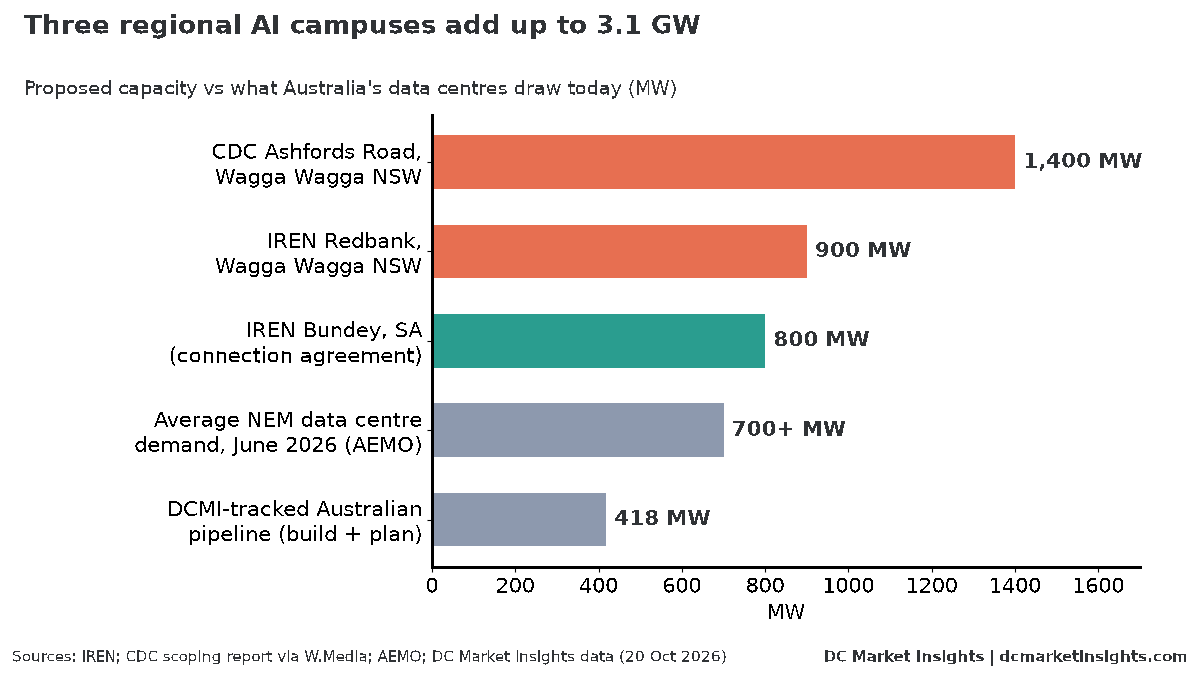
- Three proposed AI campuses outside Australia’s capital cities add up to 3,100 MW: CDC’s 1.4 GW Ashfords Road campus and IREN’s 900 MW Redbank campus, both at Gregadoo near Wagga Wagga in New South Wales, and IREN’s 800 MW Bundey campus in South Australia (company statements, NSW Planning Portal).
- That is about 4.4 times the 700+ MW that all data centres on the National Electricity Market (NEM) drew on average in June 2026, according to AEMO data (our calculation).
- AEMO expects NEM data centre use to grow from about 5 TWh in FY2026 to about 34 TWh in FY2036, or 13% of operational consumption, in its Step Change scenario.
- The two Wagga Wagga projects carry about A$25 billion of stated investment: about A$15 billion for CDC and more than A$10 billion for IREN, roughly A$11 million per MW (W.Media, our calculation).
- The next test is near: IREN plans to lodge its Redbank scoping report with the NSW planning department at the end of October, and CDC’s project has moved to the environmental impact statement stage.
Australia’s next wave of AI data centre capital is heading inland. In the past five weeks, two developers have put 2.3 GW of proposed capacity on the edge of Wagga Wagga, a regional city in southern New South Wales. Add IREN’s 800 MW site at Bundey, north-east of Adelaide, and three regional campuses now propose 3.1 GW.
The timing matters. AEMO’s latest forecast says data centre demand on the east coast grid will nearly septuple in a decade, and 96% of today’s demand sits in New South Wales and Victoria. Regulators have also told developers they will be expected to bring their own clean, firm power and pay for their own connections. Regional sites next to existing 330 kV lines are the developers’ answer. This post looks at where the money is going, who gains, and how much of it is real.
How we got here: demand that has tripled in eight years
AEMO counts around 165 data centres on the NEM. They used about 5 TWh of electricity in the 2026 financial year, roughly 3% of operational consumption, according to the 2026 ESOO data centre forecasting overview. Their average monthly demand rose from nearly 200 MW in January 2018 to more than 700 MW in June 2026.
That demand is concentrated. New South Wales took 66% of it in FY2026 and Victoria 30%. South Australia had 2%, Queensland 1% and Tasmania less than 1%. In practice that means western Sydney and western Melbourne, where most hyperscale and colocation capacity sits today.
AEMO’s forecast for the decade ahead is steep. Under its Step Change scenario, which it treats as the most likely one, data centre consumption triples to around 15 TWh, or 7.8% of operational consumption, by FY2030. It then grows to about 34 TWh, or 13%, by FY2036 before growth starts to taper off. iTnews reported that last year’s forecast was 21.4 TWh by 2034-35, so the new outlook is materially higher.
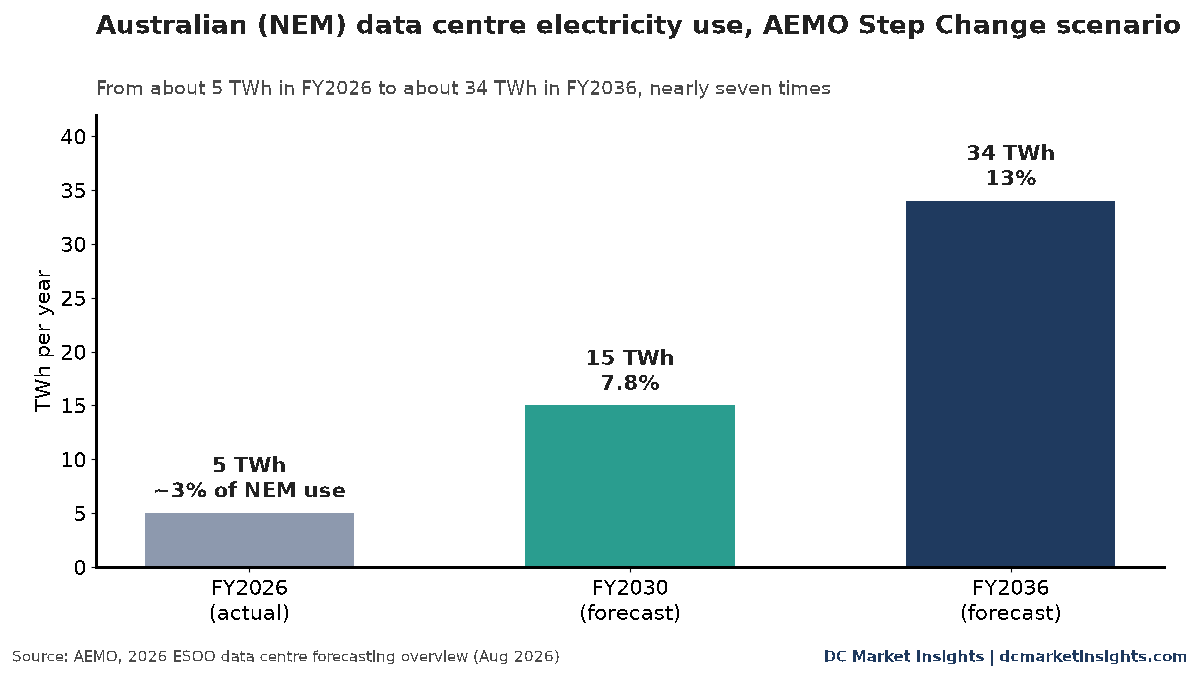
In our calculation, 34 TWh a year is an average load of about 3.9 GW, against about 0.6 GW implied by 5 TWh today. Somewhere in Australia, roughly 3.3 GW of average data centre load has to be connected and supplied within ten years. The question is where.
What changed: the build moves to 330 kV country
Three projects have answered that question with regional sites.
CDC Ashfords Road, Gregadoo (NSW). CDC Data Centres has proposed four single-storey data centre buildings with about 189,325 square metres of floor area and up to 1.4 GW of power demand, W.Media reported from the project’s scoping report. The estimated development cost is about A$15 billion excluding GST. The site sits about 1.3 km from a 330 kV Transgrid substation. The scoping report also lists up to 384 diesel generators and a 13.1 MWp rooftop solar array. The NSW Planning Portal lists the project as State Significant Development SSD-144289240, now at the “Prepare EIS” stage. On 12 October, Wagga Wagga City Council authorised its general manager to enter a contract to sell the land to CDC.
IREN Redbank, Gregadoo (NSW). On 15 October, W.Media reported that IREN, the Nasdaq-listed AI cloud provider, plans a 900 MW campus called Redbank in the same area, with reported investment of more than A$10 billion. IREN targets initial energisation in 2029 and a staged build over six to eight years. The company says it will fund its own grid connection and contract new generation and storage. Redbank is not part of IREN’s announced 5 GW secured-power portfolio, and no connection agreement has been announced.
IREN Bundey (South Australia). IREN announced its first Australian campus in June: 800 MW at Bundey, about 125 km north-east of Adelaide. Unlike the two NSW projects, it has a transmission connection agreement covering four 330 kV feeder exits that can support up to 800 MW without network upgrades, W.Media reported. IREN expects energisation from 2028.
| Project | Location | Proposed MW | Stated investment | Grid position | Stage and next step |
|---|---|---|---|---|---|
| CDC Ashfords Road | Gregadoo, Wagga Wagga, NSW | Up to 1,400 | About A$15bn (excl. GST) | 330 kV Transgrid substation 1.3 km away; connection process started | SSD-144289240 at “Prepare EIS”; council land sale authorised 12 Oct 2026 |
| IREN Redbank | Gregadoo, Wagga Wagga, NSW | 900 | More than A$10bn (reported) | No connection agreement; outside IREN’s 5 GW secured portfolio | Scoping report to NSW planning end of Oct 2026; energisation target 2029 |
| IREN Bundey | Bundey, about 125 km NE of Adelaide, SA | 800 | Not disclosed | Connection agreement for four 330 kV feeder exits, no network upgrades needed | Early works and approvals; energisation from 2028 |
| Total | 3,100 | More than A$25bn (two NSW projects) |
Sources: W.Media, 22 Sep 2026; W.Media, 14 Oct 2026; W.Media, 15 Oct 2026; W.Media, 4 Jun 2026; NSW Planning Portal. Reported CDC site areas differ (103.8 ha and 103.4 ha), and the council resolution cites 232 Ashfords Road while the scoping report cites 216.
IREN’s co-chief executive explained the Bundey choice in June in terms that apply to all three sites.
South Australia offers what AI infrastructure at scale requires: abundant clean energy
Why regional: the new rules reward bringing your own power
The policy direction of 2026 favours developers that can show they will not crowd out households on the grid.
In March, the Australian Government released its Expectations of data centres and AI infrastructure developers. The five expectations cover the national interest, the energy transition, water, skills and jobs, and local research capability. They are not binding, but the government has said that proposals most closely aligned with them will be prioritised. The energy expectation asks operators to pay their share of connection and transmission costs and to support new clean generation.
In July, the Australian Energy Market Commission (AEMC) gave energy ministers its advice on regulatory pathways for data centres, considered at the 28 July ministerial meeting. pv magazine Australia reported four linked recommendations: surrender renewable certificates from new, additional generators; show demand is backed by new firm capacity; register as market participants; and use connection agreements that reward flexible demand and co-location with generation.
Our starting point is simple, this growth must not leave other consumers worse off.
New South Wales has also started sorting the queue. Its Investment Delivery Authority endorsed 15 data centre projects worth A$51.9 billion in March, while about A$40.7 billion of data centre and technology proposals were not endorsed because they were judged premature or speculative, Government Technology Review reported.
| Date | Rule or report | What it means for regional campuses |
|---|---|---|
| 23 Mar 2026 | National expectations for data centres and AI infrastructure | Priority for projects that pay for connections and back new clean energy |
| Late Mar 2026 | NSW Investment Delivery Authority endorses 15 projects (A$51.9bn) | A fast lane for credible projects; A$40.7bn of proposals left out |
| 28 Jul 2026 | AEMC advice to energy ministers | Data centres to bring clean, firm energy, register and be flexible |
| 25 Aug 2026 | AEMO 2026 ESOO | Data centres to reach 13% of NEM use by FY2036 |
| Late Oct 2026 | AEMC final determination on access standards for large inverter-based loads (due) | Sets technical connection standards for large data centre loads |
Sources: Department of Industry, Science and Resources; Government Technology Review, 30 Mar 2026; pv magazine Australia, 6 Aug 2026; AEMO. The late-October date for the access-standards decision is as reported by pv magazine in August and may move.
In our view, these rules change the site maths. A developer that must bring its own renewables and firming, and pay for its own connection, gains more from land next to existing high-voltage lines and large renewable zones than from a few extra kilometres of fibre to Sydney. CDC’s Wagga Wagga site is 1.3 km from a 330 kV Transgrid substation. Bundey sits at the centre of ElectraNet’s proposed Northern Transmission Project.
Who gains, and how much
Regional councils and communities. CDC has offered a package of up to A$225 million, W.Media reported: at least A$150 million through a voluntary planning agreement tied to the land sale, equal to at least 1% of the A$15 billion cost, plus A$75 million of community initiatives. That is 1.5% of the project’s estimated cost (our calculation). IREN has put its own Redbank figure at more than A$200 million over 30 years in community benefits, local infrastructure and council rates. Both depend on the projects being approved and built.
This is not about building a data centre and walking away. We want to be part of Wagga Wagga’s future.
Construction and local labour. IREN targets more than 500 construction jobs and more than 200 ongoing roles at Redbank, and gave the same figures for Bundey. Staged builds over six to eight years mean steady work rather than a single peak.
Generation, storage and network builders. If the AEMC’s recommendations become rules, every regional campus needs contracted new renewables, firming capacity and storage. CDC’s own scoping report also lists up to 384 diesel generators for backup. Transgrid and ElectraNet gain large, creditworthy customers that pay for their own connections.
Equipment vendors. At about A$11 million per MW of stated investment, 3.1 GW of regional campuses would imply more than A$30 billion of building and power infrastructure spend if all three proceed at the same rate (our calculation, before servers and GPUs).
| Measure | CDC Ashfords Road | IREN Redbank |
|---|---|---|
| Proposed capacity | 1,400 MW | 900 MW |
| Stated investment | About A$15bn (development cost, excl. GST) | More than A$10bn (reported) |
| Investment per MW (our calculation) | About A$10.7m | More than A$11.1m |
| Community package | Up to A$225m (1.5% of cost) | More than A$200m over 30 years |
| Expected average load at 27% grid utilisation (our calculation) | About 380 MW | About 240 MW |
Sources: W.Media (22 Sep, 14 Oct and 15 Oct 2026); AEMO 2026 ESOO overview (27% average grid connection utilisation in FY2026). Calculations by DC Market Insights. The two investment figures come from different documents and may not cover the same scope, so they are compared only per MW, not added for a market total.
How much of it is real
The opportunity is large, but AEMO’s own numbers say most proposed capacity will not show up as load on schedule. Network providers reported 225 data centre projects with 67 GW of combined capacity in development, against about 0.7 GW of average demand today. AEMO’s overview says 36% of the developing projects in the 2025 ESOO were cancelled. Grid connections were used at about 27% on average in FY2026, and new sites take five to ten years to reach load maturity.
AEMO’s overview reports that 36% of developing projects in the 2025 ESOO were cancelled; iTnews reported AEMO saying more than 40% of projects since 2025 have dropped out or regressed in connection status. The two figures measure different things and are not combined here.
Apply those ratios to the three regional campuses and the picture changes. At 27% utilisation, 3,100 MW of connection capacity means about 840 MW of average load. At the roughly 50% utilisation iTnews reported AEMO expects for mature sites, it is about 1.55 GW, or about 13.6 TWh a year. That would be around 40% of AEMO’s entire FY2036 data centre forecast from just three regional sites (our calculation). Either these campuses take a large share of national growth, or some of them will be built more slowly or smaller than proposed.
Our own tracker shows how early this is. DC Market Insights data for Australia currently lists four facilities from two operators, with 170 MW live and 418 MW planned. None of the three regional campuses is yet in that count; together they are about 7.4 times our tracked Australian pipeline. We will add them as they reach planning and connection milestones.
The wider pattern in Asia-Pacific
The move to power-first regional sites is not only Australian. In Malaysia, the government has told data centres to pay for the full power they reserve and for their own transmission upgrades, which we covered on 19 October. In India, new money is moving beyond Mumbai to Hyderabad, Bihar and Raigad, as we reported on 18 October. In Japan, NTT Data was reported by Nikkei on 13 October to be in final talks to build a data centre of up to 500 MW in Osaka for Anthropic, with on-site generation under study because drawing that much from the grid is hard. The common thread is that power, not fibre or land, now decides where AI capacity lands.
What it means for operators, investors and vendors
Our view, based on the figures above:
- Operators: price regional land against connection certainty. Bundey’s 800 MW connection agreement without network upgrades is worth more than a larger site with none. Of the 3,100 MW, only 800 MW (26%) has a connection agreement today.
- Investors: discount gigawatts by AEMO’s ratios. At 27% utilisation, 3.1 GW of connections is about 840 MW of average load. Underwrite revenue on ramp curves of five to ten years, not on headline MW.
- Developers: budget for community packages of 1-2% of cost. CDC’s A$225 million is 1.5% of A$15 billion, and councils now tie land sales to binding agreements.
- Energy developers: sell firming, not just energy. If the AEMC’s four recommendations become rules, each GW of data centre load needs new firm capacity and certificates from new generators.
- Vendors: plan for 2028-2029 first deliveries. Bundey targets energisation from 2028 and Redbank 2029, so switchgear, transformer and cooling orders would start well before then.
For market sizing, see our Australia Data Center Infrastructure Market report (USD 5.81 billion in 2025, USD 19.98 billion by 2035) and the Australia AI Data Center Market report (USD 924.59 million in 2025). For the backup power these campuses specify, see the Data Center Generator Market report. Our DCMI data pages track facilities, deals and power rules by country.
What to watch next
- Late October 2026: AEMC final determination on technical access standards for large inverter-based loads such as data centres, as reported in August.
- End of October 2026: IREN plans to lodge the Redbank scoping report with the NSW Department of Planning, Housing and Infrastructure, the first formal planning step.
- 4-5 November 2026: IREN community drop-in sessions in Wagga Wagga.
- Next stage, no date set: CDC’s environmental impact statement for SSD-144289240, then public exhibition.
- 2028: IREN’s target for first energisation at Bundey.
- 2029: IREN’s target for initial energisation at Redbank.
- FY2030: AEMO’s Step Change checkpoint of about 15 TWh of NEM data centre use.
Frequently asked questions
How much data centre capacity is planned near Wagga Wagga?
Up to 2.3 GW. CDC Data Centres has proposed a campus of up to 1.4 GW at Ashfords Road, Gregadoo, at an estimated A$15 billion, and IREN has proposed the 900 MW Redbank campus nearby, with reported investment above A$10 billion. Neither has final planning approval or a final grid connection agreement.
How much electricity will Australian data centres use?
AEMO forecasts NEM data centre use of about 15 TWh by FY2030 and about 34 TWh by FY2036, or 13% of operational consumption, under its Step Change scenario. That is up from about 5 TWh, or 3%, in FY2026, from around 165 data centres.
Why are AI data centres moving to regional Australia?
Power. Regional sites such as Wagga Wagga and Bundey sit next to 330 kV transmission. New national expectations and AEMC advice ask data centres to fund their own connections and bring new clean, firm energy. IREN’s 800 MW Bundey site has a connection agreement needing no network upgrades.
Will all 3.1 GW be built?
Probably not on the proposed schedule. AEMO says 36% of developing projects in its 2025 forecast were cancelled and grid connections ran at about 27% utilisation in FY2026. At that rate, 3.1 GW of connections would mean about 840 MW of average load (our calculation).
Sources
- AEMO, “2026 ESOO: Data centre forecasting overview”, August 2026. Link
- iTnews, “AEMO predicts seven-fold rise in data centre power use over next decade”, 25 Aug 2026. Link
- W.Media, “IREN plans 900MW data centre campus near Wagga Wagga”, 15 Oct 2026. Link
- W.Media, “CDC plans AUD 15bn, 1.4GW data centre campus near Wagga Wagga”, 22 Sep 2026. Link
- W.Media, “CDC offers Australian community AU$ 225m in proposed data centre benefits”, 14 Oct 2026. Link
- NSW Planning Portal, “Ashfords Road Data Centre, Gregadoo” (SSD-144289240). Link
- W.Media, “IREN targets Bundey transmission hub for 800MW Australian data centre campus”, 4 Jun 2026. Link
- AEMC, “Data centre advice to the Energy and Climate Change Ministerial Council”. Link
- pv magazine Australia, “Data centres to bring clean, firm energy, be flexible and pay their way, AEMC advises Ministers”, 6 Aug 2026. Link
- Department of Industry, Science and Resources, “Expectations of data centres and AI infrastructure developers”, March 2026. Link
- Government Technology Review, “NSW Government approves another 15 data centre projects”, 30 Mar 2026. Link
- The Star, citing Nikkei Asia, “NTT Data in final talks to build Anthropic’s first data centre in Japan”, 13 Oct 2026. Link
- DC Market Insights data, Australia country record, 20 Oct 2026.