
Portugal AI Data Center Market Size, Share & Forecast to 2035
Market at a glance
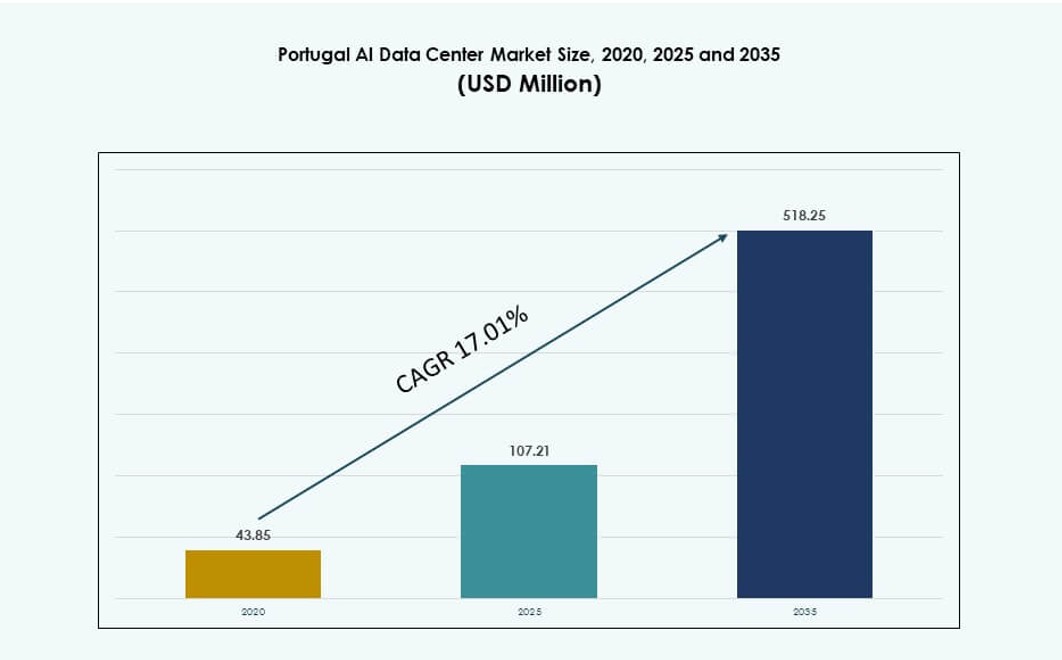
The Portugal AI Data Center market was worth USD 107.2 million in 2025 and is forecast to reach USD 518.3 million by 2035, growing at a 17.01% CAGR. Lisbon Metropolitan Area accounts for over 45% of the market.
 By Amit Jain, Senior Consultant, ICT & Emerging Technologies
 Reviewed by Deepti Agrawal
Last updated 22 Mar 2026
Base year 2024 PDF + Excel
Reviewed by Deepti Agrawal
Last updated 22 Mar 2026
Base year 2024 PDF + Excel
Source: DC Market Insights analysis
Key findings
Rapid Rise in AI Model Complexity Demanding High-Density Compute Infrastructure
Rising Infrastructure Costs and Power Constraints Impacting Facility Expansion
Strategic Positioning for Cross-Regional AI Workloads and Interconnectivity Expansion
Regional insights
- Lisbon Metropolitan Area45%+
- Northern Portugal~25%
- Southern and Central Portugal30%
Segmentation
Companies profiled
- Start Campus
- NOS Data Center
- Claranet Portugal
- Microsoft (Azure)
- Amazon Web Services (AWS)
- Google Cloud / Alphabet
- Equinix
- Digital Realty Trust
- Dell Technologies
- Hewlett Packard Enterprise (HPE)
Recent developments
Spanish firm Templus completed its entry into Portugal’s data center landscape via acquisition. Templus finalized the purchase of three Grupo Aire data centers, including a facility in Lisbon, expanding its footprint and enabling new capacity for regional AI and cloud services
Microsoft announced a major investment to expand AI infrastructure in Portugal. Microsoft revealed plans to invest more than USD 10 billion in a large‑scale artificial intelligence data center hub in Sines, with partners including Start Campus and Nscale to boost Portugal’s AI compute capacity.
Asterion Industrial Partners entered the Portuguese data center sector with a major acquisition. Asterion acquired the Covilhã Data Center Campus from Altice Portugal for approximately €120 million, marking its first investment in the Portuguese market and adding significant modular capacity to serve growing AI and hyperscale demand
Start Campus and Nscale partnered to deploy advanced GPU infrastructure at the SIN01 site in Sines. Start Campus and Nscale revealed they will install Nvidia Blackwell Ultra GPUs to support Microsoft’s advanced AI systems, reinforcing Sines as a strategic European digital hub for AI compute and innovation.
Full analysis
Executive summary
The Portugal AI Data Center Market size was valued at USD 43.85 million in 2020 to USD 107.21 million in 2025 and is anticipated to reach USD 518.25 million by 2035, at a CAGR of 17.01% during the forecast period.
| REPORT ATTRIBUTE | DETAILS |
|---|---|
| Historical Period | 2020-2023 |
| Base Year | 2024 |
| Forecast Period | 2025-2035 |
| Portugal AI Data Center Market Size 2025 | USD 107.21 Million |
| Portugal AI Data Center Market, CAGR | 17.01% |
| Portugal AI Data Center Market Size 2035 | USD 518.25 Million |
The market is advancing due to increased AI workload demand, cloud adoption, and digital transformation across sectors. Key drivers include national AI initiatives, availability of green power, and hyperscale operator interest. Portugal’s stable political and regulatory environment encourages long-term infrastructure investment. Operators focus on deploying high-density racks, AI-ready GPUs, and liquid cooling systems. The rise of AI-as-a-Service models and localized LLM training also push infrastructure growth. These shifts make the market strategically relevant for both enterprise transformation and international cloud providers.
Lisbon leads the market with its urban density, strong fiber backbone, and concentration of enterprises. Sines is emerging rapidly due to hyperscale investments and proximity to renewable energy sources. Northern cities like Porto also show growing relevance, supported by academic and startup ecosystems. These regions are transforming into key AI infrastructure zones. Their geographic position supports low-latency traffic across Southern and Western Europe. Portugal’s positioning boosts its appeal as a regional AI data center hub.
Market Dynamics
Market Drivers
Strong Push for AI Integration Across Government and Private Sector Initiatives
The Portugal AI Data Center Market is gaining traction due to strong national efforts to accelerate AI integration. Government initiatives are expanding digital infrastructure and promoting local AI research hubs. Private companies are investing in AI to optimize operations and unlock competitive advantages. Public-private collaboration strengthens the foundation for large-scale AI deployments. The digital transition across sectors, including healthcare and finance, drives demand for AI-capable data centers. It supports intelligent automation, advanced analytics, and predictive systems. Strong policy backing attracts international interest and infrastructure development. The market stands out as a strategic entry point for regional AI infrastructure expansion.
- For instance, Portugal operates the Minho Advanced Computing Center (MACC) at the University of Minho, which serves as a national high‑performance computing hub. The center supports academic and public research projects across Portugal and provides large‑scale compute resources for scientific and data‑intensive workloads, including early AI research applications.
Advancement of AI-Optimized Cloud and Hybrid Computing Models
Growing enterprise reliance on AI workloads is shifting focus toward scalable cloud and hybrid data center models. These deployments allow Portuguese businesses to run resource-intensive models efficiently. AI training, inferencing, and analytics demand high-performance hardware stacks. The Portugal AI Data Center Market is evolving to support GPU-based systems, high-bandwidth interconnects, and low-latency access. Hybrid environments are gaining favor among firms balancing data sovereignty and flexibility. Rising cloud-native development accelerates container orchestration and AI workload disaggregation. This encourages continuous infrastructure upgrades. The market is vital for companies modernizing compute environments to support AI growth.
- For instance, Nscale selected Start Campus’s SIN01 data center in 2025 to deploy NVIDIA GB200 NVL72 platforms, enabling high-performance AI training and inference operations. This partnership strengthens Portugal’s position as a regional AI infrastructure hub and reflects growing demand for AI-optimized compute environments.
Surge in Demand for Edge Compute Supporting Real-Time AI Applications
Emerging AI use cases are increasing demand for low-latency edge infrastructure in Portugal. Edge data centers enable real-time AI processing near the data source. This is critical for retail automation, autonomous systems, and smart city projects. The Portugal AI Data Center Market is expanding its footprint of micro and modular edge units. Telecom firms and IoT players invest in distributed infrastructure to reduce network strain. It offers regional and urban nodes to manage latency-sensitive tasks. Businesses adopt AI at the edge to improve responsiveness and reduce core load. Portugal’s urban digitization trend drives further edge data center deployment.
Focus on Renewable Energy and Energy-Efficient AI Data Center Infrastructure
Energy efficiency is a primary driver shaping investment in Portugal’s AI data center landscape. The country’s vast renewable capacity offers a stable and sustainable power supply for compute-intensive AI workloads. Operators increasingly adopt liquid cooling, AI-driven thermal controls, and modular hardware designs. The Portugal AI Data Center Market benefits from its ability to align green energy and AI. Energy-conscious businesses seek sustainable infrastructure partners. Operators aim to lower power usage effectiveness (PUE) while maximizing performance. The push toward green AI infrastructure attracts environmentally focused enterprises and foreign investment. Portugal serves as a low-emission compute destination in Southern Europe.
Market Trends
Rapid Rise in AI Model Complexity Demanding High-Density Compute Infrastructure
The Portugal AI Data Center Market is experiencing a shift toward high-density compute environments to support more advanced AI models. AI workloads require larger memory footprints, greater parallelism, and fast input/output throughput. Facilities are scaling their rack power densities to meet this need. Operators deploy direct-to-chip cooling and high-performance GPUs to sustain model training demands. Enterprises upgrading from traditional to AI-ready infrastructure prioritize modular and scalable builds. Racks exceeding 30 kW are becoming more common across urban deployments. This trend enables hosting of transformer models and deep neural networks locally. Portugal’s operators adapt to match evolving AI system needs.
Growth in Specialized AI Infrastructure for Sovereign and Regulated Workloads
Demand is rising for sovereign AI compute zones that comply with European privacy and data governance laws. Enterprises in regulated sectors like BFSI and healthcare seek AI deployment with in-country data residency. The Portugal AI Data Center Market responds with purpose-built AI zones, isolated compute clusters, and trusted cloud offerings. Dedicated AI facilities now support encryption, secure multiparty computation, and GDPR compliance. Regional operators partner with hyperscalers for hybrid sovereign infrastructure. This trend supports strategic control over critical AI systems and sensitive datasets. Portugal’s legal and regulatory alignment with EU norms reinforces market credibility.
Increased AI Adoption Across Creative and Language-Focused Workflows
Content generation, localization, and natural language processing workloads are growing across media and enterprise teams. The Portugal AI Data Center Market is adapting to support AI applications beyond enterprise analytics. Creative industries leverage AI for dubbing, transcription, and generative design tasks. Local language models require consistent compute access, prompting regional hosting preferences. Demand for stable inference infrastructure drives partnerships with cloud-native AI firms. Enterprises build private LLM stacks and fine-tune open models. Growth in voice AI, sentiment analysis, and conversational interfaces strengthens compute demand. Portugal’s multilingual ecosystem makes it an ideal testbed for such applications.
Emergence of AI-as-a-Service Platforms Driving Data Center Integration
AI-as-a-Service (AIaaS) is becoming a preferred model for SMBs and startups in Portugal. These platforms abstract complexity and lower AI entry barriers. The Portugal AI Data Center Market supports this trend by integrating compute, orchestration, and API-level access. Operators offer bundled services with pre-configured GPU nodes and AI dev environments. This trend fosters data center productization and pay-as-you-go pricing. Platforms embed ML pipelines, data versioning, and model deployment tools. The AIaaS wave boosts data center utilization and monetization per watt. Portugal’s service providers create new revenue streams by aligning with this model shift.
Market Challenges
Rising Infrastructure Costs and Power Constraints Impacting Facility Expansion
Power availability and cost volatility continue to challenge new data center builds in Portugal. High-performance AI systems demand dense rack configurations and constant power stability. Grid modernization is still underway, especially outside key metro zones. The Portugal AI Data Center Market faces capacity delays due to long permitting cycles and energy procurement hurdles. Increasing demand places pressure on utility coordination and energy sourcing. Rising construction costs for high-density sites impact margins. Import dependency for key components slows expansion timelines. Developers must optimize design while managing budget constraints.
Workforce Skill Gaps and Limited AI Hardware Supply Slowing Optimization
Skilled labor shortages and limited domestic supply of advanced AI hardware affect operations. The Portugal AI Data Center Market needs more AI-native engineers, DCIM experts, and system integrators. Global supply issues around GPUs and liquid cooling components impact deployment timelines. Talent retention remains a concern amid competition from larger European hubs. It reduces the pace of infrastructure tuning, orchestration, and efficiency gains. Without skilled teams, operators risk underutilizing AI infrastructure. Hiring delays create service bottlenecks for tenants. Education partnerships and workforce development programs are still scaling to meet AI data center demands.
Market Opportunities
Strategic Positioning for Cross-Regional AI Workloads and Interconnectivity Expansion
Portugal offers a geographic edge for linking European, African, and transatlantic digital corridors. The Portugal AI Data Center Market can serve multi-region AI training pipelines and low-latency data exchange. Submarine cables and new interconnect hubs bolster its network role. Operators expanding cross-border AI nodes and federated compute systems will benefit. Its proximity to undersea cables and stable environment attract AI-led cloud deployments.
National Incentives for AI and Digital Infrastructure Strengthening Startup Ecosystem
Government incentives focused on AI, R&D, and digital services support infrastructure investment. Tax breaks, research credits, and EU-backed grants enhance capital access. The Portugal AI Data Center Market gains from rising local demand among startups in mobility, fintech, and digital health. Operators targeting AI-focused startups can unlock long-term growth. The market aligns with Lisbon’s tech ecosystem ambitions.
Market Segmentation
By Type
The Portugal AI Data Center Market is led by the colocation and enterprise segment due to growing enterprise workloads. Many firms prefer scalable infrastructure over building in-house facilities. Hyperscale deployments remain limited but are growing with international operator entry. Edge data centers are expanding in retail and telecom sectors for latency-sensitive AI tasks. Colocation offers flexibility and operational control, making it the dominant segment.
By Component
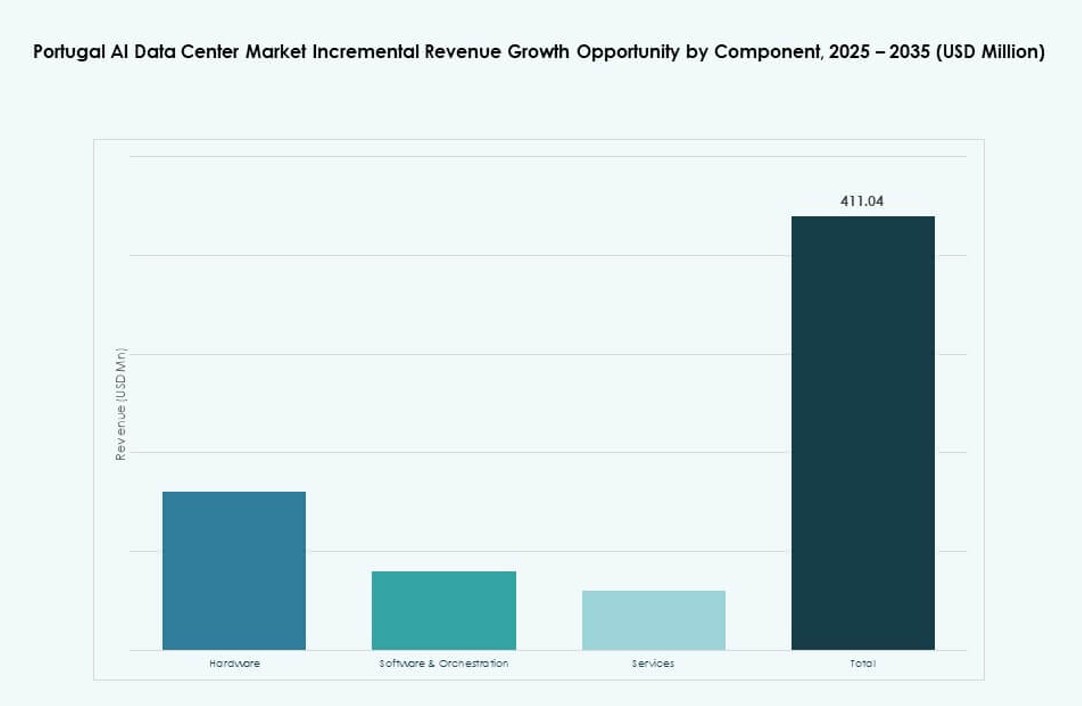
Hardware dominates the Portugal AI Data Center Market, driven by GPU clusters, liquid cooling, and interconnect upgrades. High-density server racks, storage arrays, and power systems see steady investment. Software and orchestration tools are also growing, especially for AI workload management. Services, including consulting and integration, support enterprises during AI transitions. Hardware remains the largest contributor due to compute intensity.
By Deployment
Cloud-based deployments lead the Portugal AI Data Center Market, offering flexible scaling and cost efficiency for AI workloads. Enterprises adopt cloud-first models for model training and real-time inference. Hybrid deployments are increasing among regulated sectors needing data control and agility. On-premise use is declining except in niche or security-sensitive environments. Cloud AI platforms drive infrastructure modernization across industries.
By Application
Machine learning (ML) is the largest application in the Portugal AI Data Center Market, with adoption across financial services, manufacturing, and public services. Generative AI (GenAI) is rapidly gaining traction, particularly in creative and content sectors. NLP supports local language processing in retail and customer service. Computer vision grows in security and smart city deployments. ML remains the most mature and widely used segment.
By Vertical
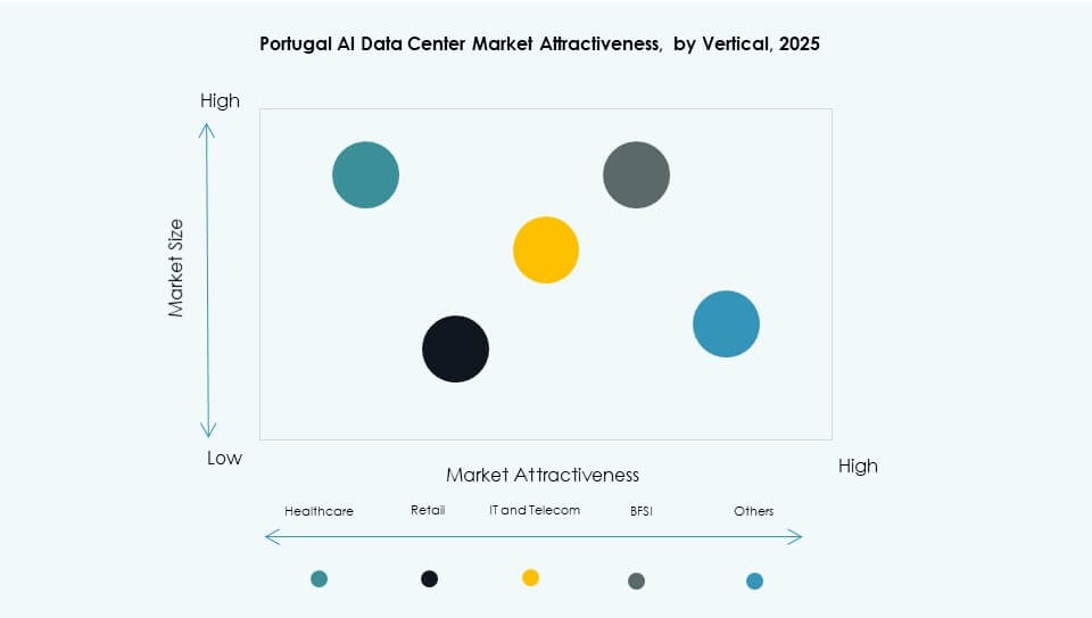
IT and telecom lead in adoption within the Portugal AI Data Center Market, leveraging AI for network optimization and service automation. BFSI follows with fraud detection and customer analytics models. Healthcare is emerging through diagnostic imaging and patient data analysis. Media & entertainment show strong GenAI use for content production. IT and telecom remain dominant, but multiple verticals show strong AI integration growth.
Regional Insights
Lisbon Metropolitan Area Holds Over 45% Market Share Due to Urban Density and Connectivity
The Lisbon region leads the Portugal AI Data Center Market with over 45% share due to strong demand from enterprises, startups, and government institutions. High urban data demand and proximity to international internet exchange points boost its appeal. Dense fiber networks, skilled workforce, and public sector support drive sustained investments. It remains the primary zone for hyperscale and colocation deployments. The capital’s ecosystem of AI research centers adds strategic relevance. It continues to attract both local and foreign operators.
- For instance, Equinix launched its LS2 data center in Prior Velho, Lisbon, in June 2025, offering 625 racks across 2,050 square meters. The facility supports high-density AI workloads and operates on 100% renewable energy, reinforcing Lisbon’s position as a leading AI infrastructure hub.
Northern Portugal Holds Around 25% Share with Growth in Porto and Braga
Northern Portugal, anchored by Porto and Braga, holds about 25% of the market and is gaining share. Lower land and power costs attract operators building regional AI nodes. Universities in Porto support workforce availability for data center operations. The region focuses on edge data centers serving industrial and manufacturing hubs. Interconnectivity with Spain also strengthens its AI hosting potential. It becomes a growing zone for distributed AI workloads.
Southern and Central Portugal Hold a Combined 30% Share with Edge and Rural Deployments
Southern and central regions contribute roughly 30% of the Portugal AI Data Center Market. These areas support telecom edge nodes and AI infrastructure for agriculture and logistics. Proximity to solar power sources supports green data center initiatives. Emerging projects include modular deployments near industrial zones. Rural digitization programs increase infrastructure demand. The regions complement core capacity by enabling broader AI distribution.
- For instance, the Sines Coastal Hub is capturing a growing share of national capacity through Start Campus’s 1.2 GW data center campus, which is among the largest in Europe. The site is designed to host high-density AI clusters and is powered by 100% renewable energy, positioning Sines as a strategic hub for AI infrastructure expansion.
Competitive Insights
- Start Campus
- NOS Data Center
- Claranet Portugal
- Microsoft (Azure)
- Amazon Web Services (AWS)
- Google Cloud / Alphabet
- Equinix
- Digital Realty Trust
- Dell Technologies
- Hewlett Packard Enterprise (HPE)
The Portugal AI Data Center Market features a mix of global cloud providers, regional data center operators, and hardware vendors. Start Campus and NOS lead local infrastructure development with AI-ready facilities and renewable integration. Global players like AWS, Microsoft, and Google scale cloud-native AI services in Lisbon and surrounding regions. Equinix and Digital Realty expand colocation capacity to meet enterprise AI needs. Hardware specialists such as Dell, HPE, and Lenovo provide GPU-based infrastructure across edge and core sites. It remains competitive with growing investment in modular builds, hybrid cloud platforms, and sovereign AI zones. Market participants differentiate through power efficiency, liquid cooling systems, and workload-specific services to capture AI demand across verticals.
Recent Developments
- In January 2026, Spanish firm Templus completed its entry into Portugal’s data center landscape via acquisition. Templus finalized the purchase of three Grupo Aire data centers, including a facility in Lisbon, expanding its footprint and enabling new capacity for regional AI and cloud services
- In November 2025, Microsoft announced a major investment to expand AI infrastructure in Portugal. Microsoft revealed plans to invest more than USD 10 billion in a large‑scale artificial intelligence data center hub in Sines, with partners including Start Campus and Nscale to boost Portugal’s AI compute capacity.
- In November 2025, Asterion Industrial Partners entered the Portuguese data center sector with a major acquisition. Asterion acquired the Covilhã Data Center Campus from Altice Portugal for approximately €120 million, marking its first investment in the Portuguese market and adding significant modular capacity to serve growing AI and hyperscale demand
- In October 2025, Start Campus and Nscale partnered to deploy advanced GPU infrastructure at the SIN01 site in Sines. Start Campus and Nscale revealed they will install Nvidia Blackwell Ultra GPUs to support Microsoft’s advanced AI systems, reinforcing Sines as a strategic European digital hub for AI compute and innovation.
Table of contents
Table of Content
- Introduction
- Market Definition & Scope
- Research Methodology
- Primary Research
- Secondary Research
- Data Validation & Assumptions
- Market Segmentation Framework
- Executive Summary
- Market Snapshot
- Key Findings
- Analyst Recommendations
- Market Outlook (2025–2035)
- Market Dynamics
- Market Drivers
- Market Restraints
- Market Opportunities
- Challenges & Risks
- Value Chain Analysis
- Porter’s Five Forces Analysis
- Portugal AI Data Center Market – Market Sizing & Forecast
- Historical Market Size (2020–2025)
- Forecast Market Size (2026–2035)
- Market Growth Rate Analysis
- Market Outlook by Region
- Market Trends & Insights
- Technology Adoption Trends
- Business & Investment Trends
- Regulatory & Policy Landscape
- Data sovereignty & localization requirements
- Energy efficiency and carbon regulations by region
- Tax incentives or subsidies for green AI data centers
- Compliance standards (ISO, ASHRAE, LEED, BREEAM, Energy Star)
- Risk & Resilience Analysis
- Supply chain risk for servers, accelerators, networking hardware
- Operational risks: power outages, cooling failures, cyberattacks
- Disaster recovery & business continuity strategies for AI data centers
- Cost Analysis & Pricing Trends
- Capex and Opex for AI data centers by type (hyperscale, colocation, edge)
- Cost breakdown: compute, cooling, networking, storage, software
- ROI, TCO analysis, and benchmarking vs traditional data centers
- Future Outlook & Strategic Recommendations
- Market forecasts by sub-segment and geography beyond 2035
- Emerging technologies (quantum computing, neuromorphic computing) impact on AI data centers
- Strategic investment recommendations by region, vertical, and application
- Portugal AI Data Center Market – By Type
- Hyperscale
- Colocation & enterprise
- Edge/micro data centers
- Portugal AI Data Center Market – By Component
- Hardware
- Software & orchestration
- Services
- Portugal AI Data Center Market – By Deployment
- On-premise
- Cloud
- Hybrid
- Portugal AI Data Center Market – By Application
- Generative AI (GenAI)
- Machine Learning (ML)
- Natural Language Processing (NLP)
- Computer Vision (CV)
- Others
- Portugal AI Data Center Market – By Vertical
- Healthcare
- Retail
- IT and Telecom
- BFSI
- Automotive
- Media & Entertainment
- Manufacturing
- Others
- Sustainability & Green AI Data Centers
- Energy Efficiency Initiatives
- Deployment of free cooling, adiabatic cooling, and economizers
- Smart control systems for temperature and airflow optimization
- Case studies of efficiency improvement programs
- Renewable Energy Integration
- Integration of solar, wind, or geothermal sources in cooling operations
- Hybrid systems combining renewable energy with mechanical cooling
- Carbon Footprint & Emission Analysis
- GHG reduction initiatives
- LEED & Green Certifications
- Share of cooling systems installed in LEED, BREEAM, or Energy Star certified facilities
- Compliance with ASHRAE and ISO energy efficiency standards
- Energy Efficiency Initiatives
- Emerging Technologies & Innovations
- Emerging Technologies & Innovations
- Liquid Cooling & Immersion Cooling
- Adoption rate and technology maturity
- Key vendors and installations by region
- Comparative analysis: performance, cost, and energy savings
- AI & HPC Infrastructure Integration
- Cooling demand driven by AI training clusters and HPC systems
- Adaptation of cooling design to high heat density workloads
- Quantum Computing Readiness
- Cooling requirements for quantum processors
- Potential cooling technologies suitable for quantum environments
- Modular & Edge AI Data Center
- Cooling strategies for prefabricated and modular facilities
- Compact and adaptive cooling for edge sites
- Automation, Orchestration & AIOps
- Integration of AI-driven thermal management
- Predictive maintenance and automated cooling optimization
- Competitive Landscape
- Market Share Analysis
- Key Player Strategies
- Mergers, Acquisitions & Partnerships
- Product & Service Launches
- Company Profiles
- Start Campus
- NOS Data Center
- Claranet Portugal
- Microsoft (Azure)
- Equinix
- Amazon Web Services (AWS)
- Digital Realty Trust
- Dell Technologies
- Hewlett Packard Enterprise (HPE)
- Lenovo
- Google Cloud / Alphabet
- Meta Platforms
- NVIDIA
- IBM
- Aligned Data Centers
- Arista Networks / Broadcom
- QTS Realty Trust
- Case Studies & Use Cases
About this report
Written by Amit Jain and reviewed by Deepti Agrawal, Senior Editor, Research. Figures are built top-down and bottom-up and reconciled before publication, with 2024 as the base year.
Read our methodologyHow we built this
- Historical period2020-2023
- Base year2024
- Forecast period2025-2035
- Sizing approachTop-down + bottom-up
Need more than the report?
Advisory on this market
Due diligence, site selection and market entry work, by the analysts who wrote this report.
See consulting servicesFrequently asked questions
The Portugal AI Data Center Market was valued at USD 107.21 million in 2025 and is projected to reach USD 518.25 million by 2035.
The Portugal AI Data Center Market is expected to grow at a CAGR of 17.01% during the forecast period from 2025 to 2035.
In 2025, the colocation and enterprise segment dominated the Portugal AI Data Center Market due to strong enterprise AI workload adoption.
Key growth drivers of the Portugal AI Data Center Market include rising AI adoption, hybrid deployments, renewable energy integration, and edge infrastructure expansion.
Leading companies in the Portugal AI Data Center Market include Start Campus, NOS, AWS, Microsoft, Google Cloud, and Equinix.
Lisbon held the largest share of the Portugal AI Data Center Market in 2025 with over 45%, supported by urban density and strong interconnectivity.
Licences, delivery and payment
Which licence should I choose?
Single User is a view-only PDF for one person. Multi User adds a printable PDF and the Excel data for unlimited users at one location. Enterprise covers your whole company and includes 100 free analyst hours.
How and when will I receive the report?
By email, within 24–48 business hours of payment, in the formats of your licence.
How can I pay?
Securely through PayPal: with a PayPal account, a debit or credit card, or PayPal Pay Later where available. Prices are in US dollars.
Can I see a sample first?
Yes. Request a free sample and we will email it to you.
Can the report be tailored to my needs?
Yes. We can add countries, segments or data cuts. Talk to an analyst about the scope you need.
Can I get an invoice or pay against a purchase order?
Write to sales@dcmarketinsights.com and our team will help.