Executive summary:
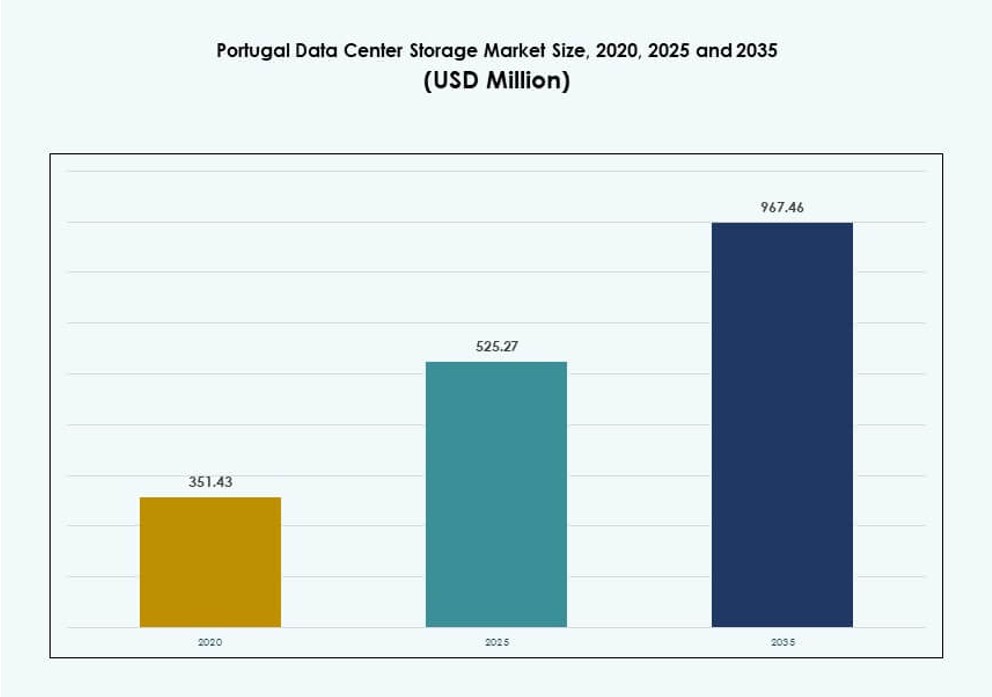
The Portugal Data Center Storage Market size was valued at USD 351.43 million in 2020 to USD 525.27 million in 2025 and is anticipated to reach USD 967.46 million by 2035, at a CAGR of 6.24% during the forecast period.
| REPORT ATTRIBUTE |
DETAILS |
| Historical Period |
2020-2023 |
| Base Year |
2024 |
| Forecast Period |
2025-2035 |
| Portugal Data Center Storage Market Size 2025 |
USD 525.27 Million |
| Portugal Data Center Storage Market, CAGR |
6.24% |
| Portugal Data Center Storage Market Size 2035 |
USD 967.46 Million |
The market is driven by rapid digital transformation, growing demand for secure data storage, and cloud-first strategies. Enterprises are adopting hybrid cloud, AI, and edge computing, which require scalable and high-performance storage solutions. Software-defined storage and flash-based systems are replacing legacy architectures. Sustainability and energy efficiency are influencing new storage investments. The market holds strategic importance for regional and global businesses aiming to optimize latency, data compliance, and infrastructure agility.
Lisbon remains the leading region due to its dense network infrastructure, subsea cable connectivity, and concentration of hyperscale and colocation facilities. Northern cities like Porto and Braga are emerging with growing edge deployments and enterprise cloud adoption. Southern and interior regions show potential for expansion, supported by renewable energy and government-backed digital initiatives. This regional balance is helping diversify the country’s data storage ecosystem.
Market Dynamics:
Market Drivers
Digital Transformation Accelerating the Shift to Modern Storage Infrastructures Across Portugal
Portugal’s digital economy is growing, driving large-scale adoption of advanced storage systems. Enterprises are moving away from legacy systems to scalable, high-performance infrastructure. Growth in cloud-native workloads, AI applications, and real-time analytics is pushing demand for fast, reliable storage. This transition supports business continuity, regulatory compliance, and operational agility. The Portugal Data Center Storage Market is evolving with strong interest in hybrid and all-flash storage. Businesses need resilient infrastructure to support growing datasets and latency-sensitive tasks. Investors view it as a stable market with room for capacity expansion. The government’s digital push is accelerating infrastructure modernization. The shift supports public and private sector innovation across sectors.
Adoption of AI, IoT, and 5G Driving Low-Latency and High-Throughput Storage Needs
Emerging technologies such as AI and IoT require robust backend systems to handle growing volumes of unstructured data. Portugal’s 5G rollout improves network efficiency and requires edge-ready storage capabilities. Storage vendors are aligning their solutions with these next-gen demands. Growth in edge computing is also transforming where and how data is stored. The need for distributed, low-latency access strengthens demand for all-flash and software-defined storage. It expands infrastructure across new Tier II cities. The Portugal Data Center Storage Market benefits from this shift in architectural demand. Organizations are deploying storage that supports dynamic workloads and localized computing. The country is positioned as a supportive environment for innovation-led IT investments.
- For instance, AtlasEdge’s LIS001 facility in Carnaxide provides 5.1 MW IT power with over 3,162 m² space and alternative carrier routing for low-latency edge workloads.
Cloud-First Strategies in Enterprises Fuel Cloud and Hybrid Storage Adoption
Enterprise cloud adoption in Portugal is rising as firms move to scalable, pay-as-you-go models. This shift makes cloud and hybrid storage solutions critical. Businesses require flexible storage systems to accommodate seasonal loads and diverse workloads. Cloud-based disaster recovery and backup services are gaining traction across BFSI, healthcare, and IT sectors. The Portugal Data Center Storage Market supports cloud-centric transformation through infrastructure readiness and low latency. Vendors are enabling seamless data movement across environments. Growth in multi-cloud strategies also promotes demand for API-integrated storage. The market’s flexibility makes it attractive for businesses seeking cost-effective innovation. Stakeholders aim to balance scalability, security, and performance.
- For instance, Ar Telecom’s Grupo Aire data center in Lisbon supports hybrid cloud with triphase A+B N+1 UPS and interconnections to national IXPs for sub-5 ms latency.
Sustainability and Energy Efficiency Priorities Reshaping Storage Architecture
Portugal’s focus on sustainability influences data center infrastructure choices. Green data storage solutions are gaining visibility, especially among hyperscale operators. Energy-efficient all-flash storage and optimized cooling systems are now part of procurement policies. The Portugal Data Center Storage Market aligns with broader ESG goals set by global enterprises. Vendors are introducing energy-saving controllers and software for intelligent tiering. Enterprises prefer low-carbon infrastructure that supports circular economy goals. This focus is accelerating refresh cycles toward SSD-based, energy-efficient deployments. Government support for renewable energy improves long-term sustainability of infrastructure. Energy-efficient storage offers both cost benefits and brand reputation value.
Market Trends
Rising Investments in Edge Data Centers Shaping Localized Storage Demand
Edge computing is expanding across Portugal to support latency-sensitive applications. Localized data center nodes now house critical workloads for AI inference, autonomous systems, and analytics. It pushes demand for compact, high-speed storage with lower power draw. Enterprises seek infrastructure near end users for performance and regulatory needs. The Portugal Data Center Storage Market responds with modular, edge-optimized storage solutions. Vendors are deploying AI-driven software that supports automated storage tiering. The growing demand for low-latency services fuels investments in edge locations. Tier II cities like Porto and Faro are emerging as new storage clusters. This trend supports national digital equity and decentralization.
Shift Toward Software-Defined Storage Enabling Multi-Vendor Flexibility and Cost Optimization
Software-defined storage (SDS) platforms are gaining adoption across enterprises. They decouple storage software from hardware, enabling flexibility and reducing vendor lock-in. Companies prefer SDS for agility, automation, and centralized management across hybrid environments. The Portugal Data Center Storage Market supports this shift with multiple SDS deployments in BFSI and IT sectors. It enhances system resilience and cuts hardware costs. Vendors are integrating AI to predict workloads and auto-adjust performance. SDS simplifies capacity expansion without physical disruption. Businesses with dynamic storage needs are embracing it for its lower TCO. Adoption will continue as firms digitize their operations.
Expansion of Hyperscale Facilities Backed by Subsea Cable Connectivity Boosts Storage Capacity
Portugal is a strategic point for hyperscale investments due to its connectivity to Europe, Africa, and the Americas. New subsea cable landings are making Lisbon a key gateway for data transmission. Hyperscalers are establishing campuses to leverage this location and low latency. The Portugal Data Center Storage Market benefits from demand for large-scale, high-performance storage arrays. It supports AI, analytics, and backup-intensive workloads. Vendors are introducing petabyte-scale storage systems tailored to hyperscale demands. Renewable energy availability is attracting long-term investments in sustainable storage capacity. The country’s global data role is strengthening storage infrastructure needs.
Rise of Industry-Specific Storage Requirements Supporting Vertical-Focused Solutions
Different sectors in Portugal are adopting storage based on their unique regulatory and data processing needs. Healthcare, banking, and public sector users require encrypted, scalable, and certified systems. The Portugal Data Center Storage Market is evolving with tailored offerings for industry compliance. Vendors now provide vertical-optimized appliances for healthcare PACS, financial records, and government archives. It ensures faster deployment and easier integration. These solutions support GDPR compliance and secure edge processing. Sector-specific storage offers better ROI and operational alignment. This shift creates opportunities for niche players and specialized vendors.
Market Challenges
High Cost of Advanced Storage Infrastructure and Limited Access in Smaller Markets
The transition to modern storage systems requires large capital outlays, which many mid-sized firms find challenging. All-flash and hybrid systems carry high upfront costs, limiting adoption outside large enterprises. Rural or less-developed regions lack sufficient infrastructure for modern storage deployment. This creates a digital divide and slows edge expansion. The Portugal Data Center Storage Market faces challenges in making next-gen storage financially viable across segments. SMEs require financing support or storage-as-a-service models to compete. Limited skilled workforce further delays implementation. This cost barrier affects scalability and market penetration for vendors. Broader access is key to sustaining national growth.
Data Sovereignty, Regulatory Complexity, and Vendor Lock-In Risks Restrain Flexibility
GDPR compliance and local data residency rules add layers of complexity to storage architecture. Enterprises must ensure secure, trackable, and auditable storage practices. Vendor-specific lock-ins limit storage flexibility and hinder multi-cloud transitions. The Portugal Data Center Storage Market must balance control and agility without breaching legal requirements. It places strain on IT teams navigating compliance and vendor dependencies. This increases operational risk and slows modernization cycles. Enterprises are now demanding open architecture and auditable storage solutions. Regulatory audits and legal scrutiny raise implementation costs. Future-proofing storage requires ongoing regulatory alignment and technical transparency.
Market Opportunities
Subsea Cable Expansions and Hyperscale Growth Unlocking Export Potential in Data Services
Portugal’s position as a subsea cable hub is transforming it into a global data services corridor. New hyperscale campuses will require robust, high-density storage solutions. The Portugal Data Center Storage Market will benefit from serving regional and cross-continental storage needs. It can offer disaster recovery and content distribution services to international players. Local companies will grow by integrating global connectivity with secure storage. Investors are eyeing export-oriented infrastructure as a strategic asset.
Rising AI and Edge Deployments Creating Demand for Intelligent and Autonomous Storage Systems
AI-driven workloads are increasing across industries, needing fast, autonomous storage systems with real-time data access. Portugal’s tech startups and innovation hubs drive this demand. The Portugal Data Center Storage Market can scale by offering intelligent tiering, predictive caching, and adaptive storage. Vendors who align with AI and edge application trends will gain early market share. Public-private collaborations may further accelerate adoption.
Market Segmentation
By Storage Type
Traditional storage solutions remain in use but are losing share to advanced systems. All-flash storage is gaining rapid momentum for its speed, energy efficiency, and performance. Hybrid storage continues to attract mid-sized enterprises due to its balance of cost and functionality. In the Portugal Data Center Storage Market, all-flash storage holds the fastest growth rate, driven by hyperscale and analytics-heavy use cases. Vendors focus on flash-based offerings to reduce latency and enhance agility across dynamic workloads.
By Storage Deployment
Storage Area Network (SAN) systems dominate the deployment landscape due to their scalability and centralized control. Network-attached Storage (NAS) systems are also expanding, especially among small and medium enterprises. Direct-attached Storage (DAS) finds relevance in edge setups where quick access is needed. In the Portugal Data Center Storage Market, SAN leads in mission-critical deployments, while NAS supports departmental storage. Edge use cases continue to fuel DAS adoption in remote locations and branch offices.
By Component
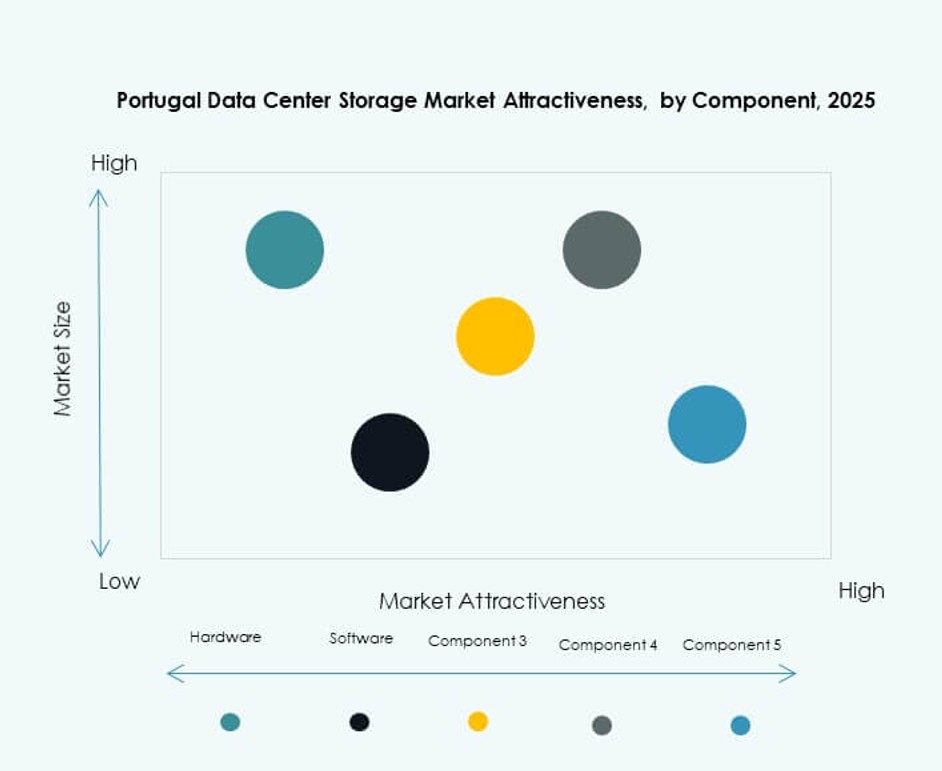
Hardware contributes the majority share due to high investment in servers, storage arrays, and enclosures. However, software is gaining importance, especially in managing hybrid and multi-cloud environments. It includes SDS, automation, backup, and orchestration platforms. The Portugal Data Center Storage Market is seeing rising demand for software to boost efficiency, reduce complexity, and support compliance. Vendors integrate AI to optimize performance and predictive maintenance, enhancing long-term value.
By Medium
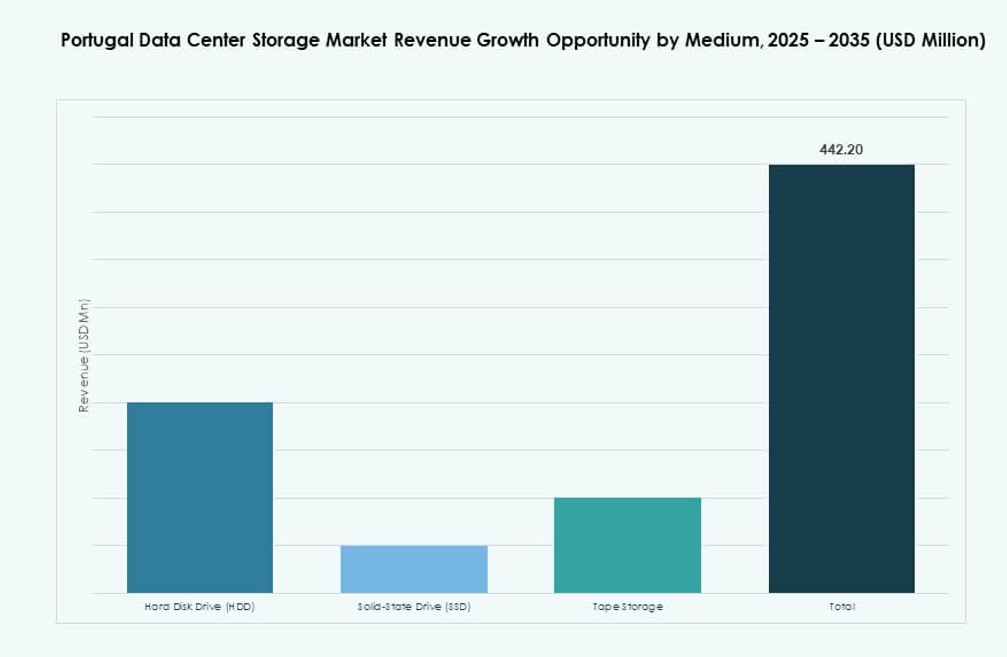
Solid-State Drives (SSD) are taking over traditional Hard Disk Drives (HDD) for speed, durability, and power savings. SSD adoption is especially high in AI, analytics, and virtualized workloads. Tape storage continues to support archival and cold storage use cases. The Portugal Data Center Storage Market favors SSDs in new deployments due to their lower latency and energy benefits. Enterprises choose a mixed medium strategy to balance cost, speed, and compliance.
By Deployment Model
On-premises deployment is still common in sectors requiring strict data control, like BFSI and healthcare. However, cloud-based deployment is growing fastest due to its flexibility and lower capex. Hybrid models are gaining traction by offering control with cloud agility. The Portugal Data Center Storage Market shows increasing adoption of hybrid storage to manage workload diversity. Vendors offer seamless data movement across environments to support resilience and scalability.
By Application
IT and telecommunications dominate application share due to the industry’s high storage demand for content delivery, backup, and virtualization. BFSI follows closely, needing secure and compliant data handling. Government and healthcare sectors rely on certified storage for records, imaging, and secure communications. The Portugal Data Center Storage Market sees these sectors investing in scalable and encrypted storage to ensure business continuity and regulatory compliance.
Regional Insights
Lisbon Metropolitan Area Leading with Over 60% Market Share and Dense Subsea Connectivity
Lisbon leads the Portugal Data Center Storage Market due to its high-density connectivity, hyperscale activity, and subsea cable access. It hosts major facilities catering to enterprise, colocation, and international data flows. The region accounts for more than 60% of the total market share. Vendors concentrate deployments here due to energy availability, strong digital ecosystem, and real estate supply. Lisbon acts as a launchpad for cross-border cloud and storage operations.
- For instance, Start Campus’s Sines DC campus, south of Lisbon, has secured 1.2 GW total IT capacity across six buildings, making it Europe’s largest colocation site with fully secured grid power.
Northern Portugal (Porto, Braga) Emerging with 20–25% Share, Fueled by Edge and R&D Ecosystem
Northern Portugal is gaining importance with growing IT investment and regional digital hubs. Porto is attracting colocation and enterprise data center operators. The area supports edge deployments tied to industrial clusters and university R&D campuses. The subregion holds around 20–25% of market share. Regional governments and incubators drive digital readiness. It helps decentralize storage capacity and supports sector-specific storage such as healthcare and education.
Southern and Interior Regions Accounting for 15–20% Share with Strategic Edge Deployments
Southern Portugal, including Algarve and Évora, shows potential for smaller data hubs and disaster recovery locations. These areas support edge setups and latency-sensitive workloads near energy sites. While market share stands at 15–20%, interest is rising due to land availability and renewable power proximity. Government incentives may push growth in these areas. These regions offer expansion opportunities beyond the congested Lisbon corridor.
- For instance, Start Campus’s SIN02 building in Sines targets 240 MW IT capacity with seawater cooling, operational by 2026.
Competitive Insights:
- Dell Technologies
- Hewlett Packard Enterprise (HPE)
- IBM Corporation
- NetApp
- Huawei Technologies Co., Ltd.
- Cisco Systems, Inc.
- Fujitsu Limited
- NOS Sistemas
- Claranet Portugal
- Lenovo Group
The Portugal Data Center Storage Market features a mix of global technology giants and regional service providers. Dell Technologies and HPE maintain strong enterprise relationships, offering hybrid and all-flash solutions. IBM and NetApp lead in software-defined storage and AI-integrated platforms. Huawei and Cisco offer high-density storage aligned with networked infrastructure. Fujitsu and Lenovo support modular, scalable deployments for mid-sized firms. NOS Sistemas and Claranet Portugal cater to local demand with tailored colocation and managed storage. It reflects healthy competition across hardware, software, and cloud models. Vendors focus on energy efficiency, data compliance, and hybrid cloud readiness. Market players differentiate through vertical-specific offerings and integration with edge, AI, and orchestration technologies.
Recent Developments:
- In March 2025, AtlasEdge announced a strategic partnership with Colt Technology Services to support Portugal’s digital future by combining AtlasEdge’s 100% renewable data center campus in Lisbon with Colt’s low-latency, high-bandwidth connectivity solutions, enabling more sustainable and resilient data center and storage infrastructure in the country.
- In April 2025, Dell Technologies unveiled new data center storage innovations, including updated Dell PowerScale systems with HDD-based nodes and configurations using 122TB drives, scheduled for availability from May–June 2025 to support high‑capacity, AI‑ready data center workloads.
- In June 2025, at HPE Discover 2025 in Las Vegas, Hewlett Packard Enterprise expanded its Alletra storage family with new systems such as Alletra MP X10000, an AI‑focused, object‑based storage platform designed for massive data loads and high‑throughput use cases in modern data centers.