
Edge AI Chip Market Size, Share & Forecast to 2035
Market at a glance
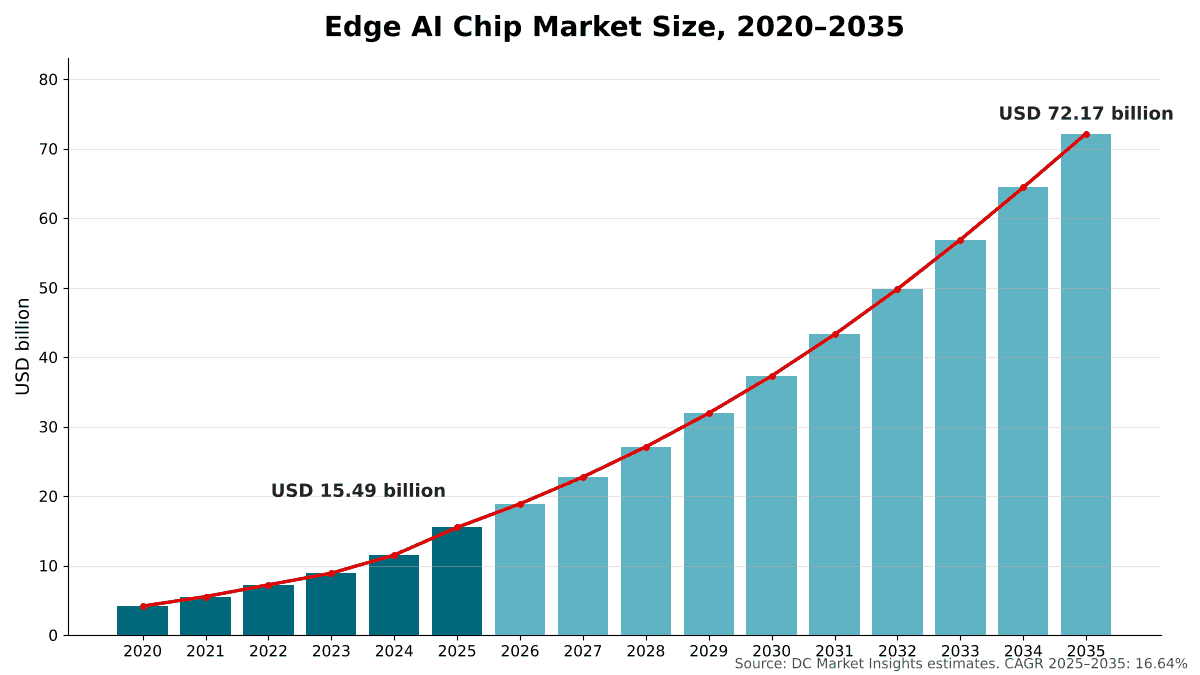
The Edge AI Chip market was worth USD 15.49 billion in 2025 and is forecast to reach USD 72.17 billion by 2035, growing at a 16.64% CAGR. Asia Pacific accounts for 50% of the market.
 By Amit Jain, Senior Consultant, ICT & Emerging Technologies
 Reviewed by Deepti Agrawal
Last updated 10 Oct 2026
Base year 2025 PDF + Excel
Reviewed by Deepti Agrawal
Last updated 10 Oct 2026
Base year 2025 PDF + Excel
Source: DC Market Insights analysis
Key findings
Automotive AI Chips Reach USD 6.42 Billion as Vehicle Compute Rises
Generative AI Rises from 9.8% to 28.8% of Edge AI Chip Value
Smartphone NPU Value Grows Slowest at 12.84%
Edge Servers and Gateways Grow Six-Fold to USD 5.32 Billion
What is inside the report
- 01Introduction
- 02Research Methodology
- 03Executive Summary
- 04Market Dynamics
- 05Pricing Analysis
- 06Standards and Regulation
- 07Supply Chain Analysis
- 08Market Size and Forecast
- 09Edge AI Chip Market, by Device
- 10Edge AI Chip Market, by Chip Type
- 21chapters
- 2020-2024Historical period
- 2026-2035Forecast period
- 16Companies profiled
Regional insights
- Asia Pacific50%
- North America22.8%
- Europe18.4%
- Latin America4.9%
- Middle East and Africa3.9%
Segmentation
Companies profiled
- NVIDIA
- Qualcomm
- Mobileye
- Apple
- MediaTek
- Horizon Robotics
- Intel
- AMD
- Samsung Electronics
- Huawei (HiSilicon)
- Ambarella
- NXP Semiconductors
- STMicroelectronics
- Texas Instruments
- Renesas Electronics
- Hailo
Recent developments
Hailo made the Hailo-10H edge AI accelerator commercially available, with 40 TOPS of INT4 performance at a typical 2.5 W and support for language and vision-language models (Source: All About Circuits report).
NVIDIA made the Jetson AGX Thor developer kit available for USD 3,499, with up to 2,070 teraflops of AI compute (Source: TechRepublic report).
Qualcomm introduced the Snapdragon X2 Elite family with an 80 TOPS NPU, with devices expected in the first half of 2026 (Source: TechRepublic report).
Qualcomm announced the acquisition of Arduino and introduced the Arduino UNO Q built on the Qualcomm Dragonwing platform (Source: Phoronix report).
NXP completed its acquisition of Kinara, a maker of discrete NPUs, for USD 307.00 million in cash (Source: NXP press release).
Mobileye reported first-quarter revenue of USD 558.00 million, up 27%, and said EyeQ6 High-based SuperVision was operating in US pre-production vehicles for the first time (Source: Mobileye press release).
Full analysis
The Edge AI Chip Market covers the processors that run artificial intelligence (AI) inference outside the core data center: automotive AI systems-on-chip (SoCs), neural processing units (NPUs) inside smartphone and PC processors, and the graphics processing units (GPUs), application-specific integrated circuits (ASICs), field-programmable gate arrays (FPGAs) and other accelerators built into robots, smart cameras, edge servers, gateways, drones and connected devices. DC Market Insights values the global Edge AI Chip Market at USD 15.49 billion in 2025 and forecasts USD 72.17 billion by 2035, a CAGR of 16.64%. The 2025 value is built from units and prices: about 20.7 million automotive AI SoCs at roughly USD 310 each give USD 6.42 billion, NPU value of about USD 6.10 in 590 million smartphones and USD 15.30 in 100 million PCs gives USD 5.13 billion, and about 21 million industrial, camera and edge AI chips at roughly USD 188 give USD 3.94 billion. Generative AI and language workloads are the fastest-growing segment at 29.86% a year because small language models now run on phones, PCs and robots, and the Middle East and Africa is the fastest-growing region at 20.34% a year as AI-capable phones and city video analytics spread from a small base.
Executive Summary
The Global Edge AI Chip Market size was valued at USD 4.16 billion in 2020, reached USD 15.49 billion in 2025, and is anticipated to reach USD 72.17 billion by 2035, at a CAGR of 16.64% during the forecast period.
| Report attribute | Details |
|---|---|
| Historical Period | 2020-2024 |
| Base Year | 2025 |
| Forecast Period | 2026-2035 |
| Edge AI Chip Market Size 2025 | USD 15.49 Billion |
| Edge AI Chip Market, CAGR | 16.64% |
| Edge AI Chip Market Size 2035 | USD 72.17 Billion |
The Edge AI Chip Market grew at 30.07% a year between 2020 and 2025, and 2025 alone added 34.6% over 2024 as driver-assistance chips moved into more vehicle models and NPUs spread across new PC processors. Automotive AI SoCs carried 41.4% of 2025 value, client NPUs in phones and PCs 33.1% and industrial, camera and edge systems the remaining 25.4%.
DC Market Insights forecasts USD 18.88 billion in 2026, a further 21.9% rise, with growth easing to 12.0% by 2035 as AI-capable phones and PCs approach full penetration. The mix shifts toward chips above 100 trillion operations per second (TOPS), which rise from 15.4% of value in 2025 to 34.2% in 2035, because robots, vehicles and edge servers now run multimodal and language models locally. The edge figures in this report equal the edge and device segment of the DC Market Insights AI Chip Market model, so the two reports use one set of numbers.
Market Scope: What Does the Edge AI Chip Market Cover?
The Edge AI Chip Market covers every chip, or the AI block of a chip, whose main job is running AI models on a device, vehicle, machine or on-premises edge system rather than in a cloud or colocation data hall, valued at first sale in current US dollars, with 2025 as the base year and forecasts to 2035. DC Market Insights sizes it at USD 15.49 billion in 2025.
Included. Automotive AI SoCs for driver assistance and automated driving; the NPU block inside smartphone and PC processors; robotics and embedded AI modules such as GPU-based system-on-modules; vision SoCs for smart cameras and video analytics; discrete NPU accelerator cards and chips for edge servers, gateways and industrial PCs; FPGAs used for AI inference at the edge; and microcontrollers with integrated neural accelerators in drones, wearables and other connected devices.
Excluded. Data center GPUs and AI ASICs installed in cloud, colocation and enterprise data halls, which are sized in the Data Center Accelerator Market; the rest of a phone or PC processor outside its NPU; memory and storage sold separately; complete servers, vehicles, cameras and robots; and software, licenses and cloud services.
How the segments fit together. The device, chip type, performance and workload splits each re-cut the same USD 15.49 billion total for 2025. Edge servers and gateways cover AI chips in on-premises and telecom edge sites; the wider edge site market, including servers, power and space, is valued in our Edge Computing Market report. Regions and countries are allocated by where devices are sold and installed, not where chips are designed or fabricated.
Market Drivers: What Drives the Edge AI Chip Market?
Three drivers explain most of the growth in the Edge AI Chip Market, which DC Market Insights forecasts to add USD 56.68 billion of annual value between 2025 and 2035: more AI compute per vehicle, an NPU floor of 40 TOPS in new PCs, and robots and edge servers that now run generative models on site.
Automotive AI Chips Reach USD 6.42 Billion as Vehicle Compute Rises
Driver-assistance and automated-driving chips are the largest part of the Edge AI Chip Market at 41.4% of 2025 value. NVIDIA reported that full-year automotive revenue rose 39% to a record USD 2.30 billion in its fiscal 2026 (Source: NVIDIA filing with the US Securities and Exchange Commission). Mobileye’s 2025 revenue rose 15% to USD 1.89 billion, and Horizon Robotics delivered more than four million sets of Journey-series automotive chips in 2025, up 39%, on revenue of RMB 3.76 billion, up 57.7%. Qualcomm’s automotive revenue rose 36% to USD 3.96 billion in its fiscal 2025. DC Market Insights forecasts automotive AI chips to grow at 17.04% a year to USD 30.96 billion by 2035, as higher levels of driver assistance need more TOPS per car.
PC NPUs Above 40 TOPS Lift Client AI Silicon to USD 8.43 Billion
Microsoft defines Copilot+ PCs as Windows 11 hardware powered by an NPU that can perform more than 40 TOPS, and says many new Windows AI features require that level (Source: Microsoft Learn). Qualcomm’s Snapdragon X2 Elite family raises the NPU to 80 TOPS, with devices expected in the first half of 2026. DC Market Insights values PC NPU silicon at USD 1.53 billion in 2025 and forecasts USD 8.43 billion by 2035, a CAGR of 18.61%, the fastest of the client segments, while smartphone NPU value grows at 12.84% a year because, in the DC Market Insights model, most phones sold already carry an NPU.
Robots and Edge Servers Run Generative Models Locally
Edge systems now carry enough compute to run language and vision-language models without a cloud round trip. NVIDIA’s Jetson AGX Thor T5000 module delivers up to 2,070 teraflops of AI compute at 40 to 130 watts, and Hailo’s Hailo-10H accelerator runs 2-billion-parameter language models at 10 tokens per second at a typical 2.5 W. DC Market Insights forecasts industrial automation and robotics chips to grow at 19.68% a year to USD 8.21 billion, and edge servers and gateways at 19.88% a year to USD 5.32 billion by 2035.
Market Trends: How Are Edge AI Chips Changing?
The Edge AI Chip Market is moving to higher TOPS, generative workloads and AI built into microcontrollers, with generative AI and language workloads rising from 9.8% of value in 2025 to 28.8% by 2035.
Generative AI Rises from 9.8% to 28.8% of Edge AI Chip Value
Small language models, speech assistants and vision-language models now run on phones, PCs, robots and gateways. Hailo-10H, made commercially available in July 2025, offers 40 TOPS of INT4 performance and 20 TOPS of INT8, and Hailo states under one second to first token on 2-billion-parameter models. DC Market Insights values generative AI and language workloads at USD 1.52 billion in 2025 and USD 20.80 billion by 2035, a CAGR of 29.86%, the fastest of any segment in this report.
Chips Above 100 TOPS Take 34.2% of Value by 2035
Performance per dollar rises fast at the edge. NVIDIA’s Jetson Orin Nano Super developer kit offers up to 67 TOPS for USD 249, against 40 TOPS for USD 499 on the prior board. At the top end, the Jetson AGX Thor T5000 module sells for USD 2,999. DC Market Insights forecasts chips above 100 TOPS to grow at 26.28% a year, from USD 2.39 billion in 2025 to USD 24.67 billion in 2035, while chips under 10 TOPS grow only 3.67% a year as their price per unit falls.
Microcontrollers Gain Their Own Neural Accelerators
Microcontrollers in sensors, wearables and appliances now include AI blocks. STMicroelectronics’ STM32N6 combines an Arm Cortex-M55 core running at up to 800 MHz with its Neural-ART Accelerator rated at 600 giga-operations per second. DC Market Insights values drones, wearables and other connected-device AI chips at USD 461.60 million in 2025 and USD 2.06 billion by 2035, a CAGR of 16.15%.
Market Challenges: What Holds the Edge AI Chip Market Back?
Falling chip prices in mature device classes and the cost of safety and security compliance are the two constraints that DC Market Insights expects to slow the Edge AI Chip Market, with smartphone NPU value growing at only 12.84% a year.
Smartphone NPU Value Grows Slowest at 12.84%
Smartphone NPUs held USD 3.60 billion, or 23.2% of 2025 value, but in the DC Market Insights model most new phones already carry one, so growth depends on value per phone rather than more units. DC Market Insights forecasts the smartphone share of the Edge AI Chip Market to fall to 16.7% by 2035. Chips under 10 TOPS shrink from 34.4% to 10.6% of value as vendors move entry devices to newer designs at similar prices.
Safety and Cybersecurity Rules Lengthen Design Cycles
The ISO 26262 functional safety standard applies to the electrical and electronic systems in series production road vehicles that automotive AI chips go into, and connected products sold in the European Union (EU) fall under the Cyber Resilience Act (CRA), whose reporting obligations apply from 11 September 2026. DC Market Insights expects certification to add months to each design cycle and to favor suppliers with qualified safety processes, which slows the entry of new chip start-ups into vehicles.
Market Opportunities: Where Are the New Revenue Pools?
The two largest new revenue pools in the Edge AI Chip Market are edge servers and gateways, growing at 19.88% a year, and industrial automation and robotics, growing at 19.68% a year.
Edge Servers and Gateways Grow Six-Fold to USD 5.32 Billion
Enterprises, telecom operators and city operators place AI inference close to cameras, machines and users to cut latency and backhaul. DC Market Insights values AI chips in edge servers and gateways at USD 868.15 million in 2025 and USD 5.32 billion by 2035, with GPUs holding 64.0% of the segment in 2025. NXP added discrete NPUs to its portfolio by completing the USD 307.00 million cash purchase of Kinara in October 2025. Telecom edge sites are covered in our Multi-Access Edge Computing Market report.
Robotics Chips Grow at 19.68% a Year
Humanoid, mobile and industrial robots need on-board perception, planning and language understanding. NVIDIA states that Boston Dynamics, Caterpillar, Franka Robotics, Humanoid, LG Electronics and NEURA Robotics are using its robotics stack. DC Market Insights values industrial automation and robotics AI chips at USD 1.36 billion in 2025 and USD 8.21 billion by 2035, when they reach 11.4% of the Edge AI Chip Market.
Pricing: How Much Does an Edge AI Chip Cost?
An automotive AI SoC sold for about USD 310 on average in 2025 and an industrial or edge AI chip for about USD 188, while the NPU block added about USD 6.10 to a smartphone and USD 15.30 to a PC. These are DC Market Insights estimates of blended average selling prices across all models.
| Edge AI chip class (2025) | Average price or value (USD) | Units (million) | Value (USD billion) |
|---|---|---|---|
| Automotive AI SoCs | 310 | 20.7 | 6.42 |
| NPU value per smartphone | 6.10 | 590 | 3.60 |
| NPU value per PC | 15.30 | 100 | 1.53 |
| Industrial, camera and edge AI chips | 188 | 20.95 | 3.94 |
List prices for developer hardware show the spread at the top of the range: the Jetson Orin Nano Super developer kit sells for USD 249 with up to 67 TOPS, and the Jetson AGX Thor developer kit for USD 3,499.
Standards and Regulation: Which Rules Shape Edge AI Chips?
Four sets of rules shape the Edge AI Chip Market: the ISO 26262 functional safety standard for vehicles, the EU Cyber Resilience Act, the EU AI Act and the Copilot+ PC hardware floor of more than 40 TOPS.
ISO 26262. ISO 26262-1:2018, edition 2, published in December 2018, applies to safety-related systems that include one or more electrical or electronic systems installed in series production road vehicles, excluding mopeds. Driver-assistance systems built on automotive AI SoCs fall within that scope.
EU Cyber Resilience Act. The Cyber Resilience Act entered into force on 10 December 2024 and covers hardware and software products with digital elements; reporting obligations apply from 11 September 2026 and the main obligations from 11 December 2027. Edge AI devices sold in the EU, from cameras to gateways, fall within its scope.
EU AI Act. Under a provisional agreement reached in May 2026, obligations for standalone high-risk AI systems are deferred to December 2, 2027 and obligations for AI embedded in regulated products to August 2, 2028. The rules regulate AI systems rather than chips, but they shape the logging and safety features that device makers ask chip suppliers to support.
Copilot+ PC requirement. Microsoft’s NPU floor of more than 40 TOPS sets the minimum for many new Windows AI features.
Market Segmentation: Which Segment Leads the Edge AI Chip Market?
Automotive leads the Edge AI Chip Market by device with 41.4% of 2025 value, AI ASICs and SoCs lead chip types with 39.5%, chips between 10 and 100 TOPS lead performance classes with 50.1%, and computer vision leads workloads with 55.0%. Generative AI and language workloads are the fastest-growing segment at 29.86% a year, against 11.06% for computer vision, because language and multimodal models are moving from the cloud onto phones, PCs, robots and gateways.
By Device: Automotive Leads with 41.4%
| Device | 2025 (USD billion) | Share 2025 | 2035 (USD billion) | CAGR 2025-2035 |
|---|---|---|---|---|
| Automotive | 6.42 | 41.4% | 30.96 | 17.04% |
| Smartphones | 3.60 | 23.2% | 12.05 | 12.84% |
| PCs | 1.53 | 9.9% | 8.43 | 18.61% |
| Industrial Automation and Robotics | 1.36 | 8.8% | 8.21 | 19.68% |
| Smart Cameras and Video Analytics | 1.25 | 8.1% | 5.13 | 15.19% |
| Edge Servers and Gateways | 0.87 | 5.6% | 5.32 | 19.88% |
| Drones, Wearables and Other IoT | 0.46 | 3.0% | 2.06 | 16.15% |
Automotive gains 1.5 points of share by 2035 and stays the largest device segment. Edge servers and gateways grow fastest by device, while smartphones lose 6.5 points of share as NPU penetration matures.
By Chip Type: AI ASICs and SoCs Lead with 39.5%
| Chip type | 2025 (USD billion) | Share 2025 | 2035 (USD billion) | CAGR 2025-2035 |
|---|---|---|---|---|
| AI ASICs and SoCs | 6.12 | 39.5% | 31.50 | 17.79% |
| Client NPUs | 5.13 | 33.1% | 20.48 | 14.85% |
| GPUs | 3.41 | 22.0% | 15.73 | 16.52% |
| FPGAs | 0.32 | 2.0% | 1.35 | 15.66% |
| Other AI Chips | 0.51 | 3.3% | 3.11 | 19.78% |
Dedicated driving SoCs and vision SoCs make AI ASICs and SoCs the largest chip type. Other AI chips, mainly discrete NPUs and neural accelerators from newer suppliers, grow fastest at 19.78% a year, from USD 512.20 million in 2025.
By Performance: 10 to 100 TOPS Leads with 50.1%
| Performance class | 2025 (USD billion) | Share 2025 | 2035 (USD billion) | CAGR 2025-2035 |
|---|---|---|---|---|
| Under 10 TOPS | 5.33 | 34.4% | 7.65 | 3.67% |
| 10 to 100 TOPS | 7.76 | 50.1% | 39.85 | 17.77% |
| Above 100 TOPS | 2.39 | 15.4% | 24.67 | 26.28% |
The 10 to 100 TOPS class covers most phone and PC NPUs and mid-range driving chips. Chips above 100 TOPS sit in advanced driver assistance, humanoid and mobile robots and edge servers.
By Workload: Computer Vision Leads with 55.0%
| Workload | 2025 (USD billion) | Share 2025 | 2035 (USD billion) | CAGR 2025-2035 |
|---|---|---|---|---|
| Computer Vision | 8.53 | 55.0% | 24.33 | 11.06% |
| Sensor Fusion and Autonomy | 3.47 | 22.4% | 20.20 | 19.28% |
| Generative AI and Language | 1.52 | 9.8% | 20.80 | 29.86% |
| Speech, Audio and Other | 1.97 | 12.7% | 6.84 | 13.24% |
Vision still drives most edge AI silicon, from camera-based driver assistance to factory inspection. By 2035 the three largest workloads are close in size, which means a chip that handles only one workload type addresses a third of the market.
DC Exclusive: The Edge AI Device × Chip Type Matrix
Automotive AI ASICs and SoCs are the single largest cell of the matrix at USD 4.43 billion, 28.6% of all 2025 edge AI chip value, followed by smartphone NPUs at USD 3.60 billion. The matrix below cross-tabulates where edge AI chips run and what type of chip they are.
| 2025, USD billion | GPUs | AI ASICs and SoCs | Client NPUs | FPGAs | Other AI Chips | Total |
|---|---|---|---|---|---|---|
| Automotive | 1.99 | 4.43 | 0.00 | 0.00 | 0.00 | 6.42 |
| Smartphones | 0.00 | 0.00 | 3.60 | 0.00 | 0.00 | 3.60 |
| PCs | 0.00 | 0.00 | 1.53 | 0.00 | 0.00 | 1.53 |
| Industrial Automation and Robotics | 0.57 | 0.57 | 0.00 | 0.11 | 0.11 | 1.36 |
| Smart Cameras and Video Analytics | 0.21 | 0.78 | 0.00 | 0.09 | 0.17 | 1.25 |
| Edge Servers and Gateways | 0.56 | 0.11 | 0.00 | 0.09 | 0.11 | 0.87 |
| Drones, Wearables and Other IoT | 0.08 | 0.23 | 0.00 | 0.03 | 0.12 | 0.46 |
| Total | 3.41 | 6.12 | 5.13 | 0.32 | 0.51 | 15.49 |
GPUs hold 64.0% of edge server and gateway value but only 16.6% of smart camera value, where vision SoCs dominate at 62.8%. Industrial automation and robotics is split almost evenly between GPUs and ASICs, which makes it the most contested device segment. Drones, wearables and other connected devices carry the highest share of other AI chips at 25.0%, the entry point for discrete NPU and microcontroller suppliers.
The matrix is a DC Market Insights model, not a shipment count, built from 61 inputs: 21 device anchor values (7 devices for 2020, 2025 and 2035), 6 unit and price assumptions, 14 chip-type shares, 10 regional anchors and 10 supplier disclosures used as cross-checks. The model and its assumptions are explained on our research methodology page.
Regional Insights: Which Region Leads the Edge AI Chip Market?
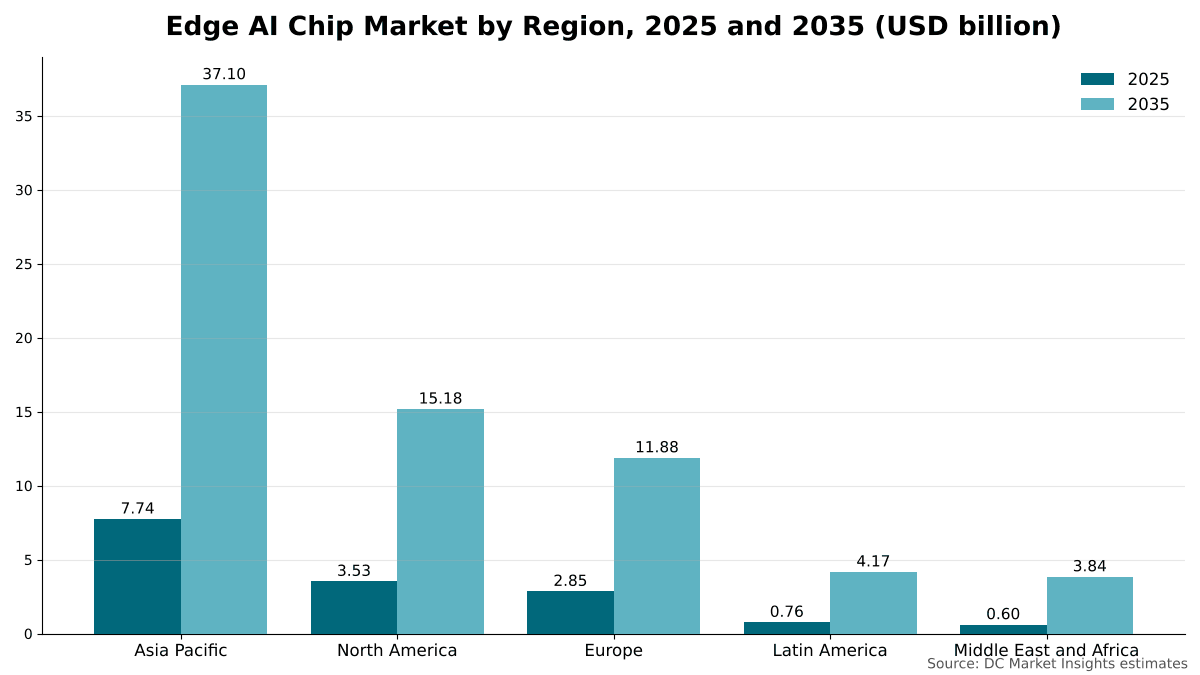
Asia Pacific leads the Edge AI Chip Market with 50.0% of 2025 value, and the Middle East and Africa is the fastest-growing region at 20.34% a year, because AI-capable phones and city video analytics are spreading from a small base (DC Market Insights estimate).
Asia Pacific Leads with 50.0% Share
Asia Pacific bought edge AI chips worth USD 7.74 billion in 2025, and the region is forecast to grow at 16.96% a year to USD 37.10 billion by 2035. China alone accounts for USD 4.18 billion, as the largest market for vehicles with driver assistance and for smartphones. Horizon Robotics’ growth to more than four million chip sets in 2025 shows how fast domestic automotive AI chips are scaling there.
North America Holds 22.8% Share
North America is worth USD 3.53 billion in 2025 and USD 15.18 billion by 2035, a CAGR of 15.71%. In the DC Market Insights model, PC NPUs, robotics and edge servers carry a larger share of North American demand than of global demand.
Europe Holds 18.4% Share
Europe is worth USD 2.85 billion in 2025 and USD 11.88 billion by 2035, a CAGR of 15.33%. Germany leads at USD 821.45 million on the strength of automotive and industrial automation demand, and the Cyber Resilience Act and AI Act add compliance work for every connected product.
Latin America Holds 4.9% Share
Latin America is worth USD 761.85 million in 2025 and USD 4.17 billion by 2035, a CAGR of 18.52%, led by Brazil and Mexico, where AI-capable smartphones and retail video analytics drive demand.
Middle East and Africa Holds 3.9% Share
The Middle East and Africa is worth USD 602.90 million in 2025 and USD 3.84 billion by 2035, the fastest regional growth at 20.34% a year. DC Market Insights assumes rising AI smartphone penetration across Africa and new city video analytics projects in the Gulf states, both starting from a small installed base.
Country Analysis: Which Countries Buy the Most Edge AI Chips?
China is the largest country market for edge AI chips at USD 4.18 billion in 2025, 27.0% of global value, followed by the United States at USD 3.05 billion (19.7%) and Japan at USD 1.24 billion (8.0%). The 12 largest countries account for 83.4% of 2025 value.
| Rank | Country | Region | 2025 (USD billion) | Share 2025 | 2035 (USD billion) | CAGR 2025-2035 |
|---|---|---|---|---|---|---|
| 1 | China | Asia Pacific | 4.18 | 27.0% | 19.60 | 16.70% |
| 2 | United States | North America | 3.05 | 19.7% | 13.00 | 15.61% |
| 3 | Japan | Asia Pacific | 1.24 | 8.0% | 4.95 | 14.87% |
| 4 | Germany | Europe | 0.82 | 5.3% | 3.39 | 15.22% |
| 5 | South Korea | Asia Pacific | 0.76 | 4.9% | 3.52 | 16.61% |
| 6 | India | Asia Pacific | 0.69 | 4.5% | 4.88 | 21.57% |
| 7 | United Kingdom | Europe | 0.45 | 2.9% | 1.88 | 15.31% |
| 8 | France | Europe | 0.40 | 2.6% | 1.62 | 15.06% |
| 9 | Canada | North America | 0.38 | 2.5% | 1.69 | 16.05% |
| 10 | Taiwan | Asia Pacific | 0.34 | 2.2% | 1.36 | 14.78% |
| 11 | Brazil | Latin America | 0.33 | 2.1% | 1.71 | 17.96% |
| 12 | Italy | Europe | 0.27 | 1.7% | 1.05 | 14.61% |
India is the fastest-growing large country market at 21.57% a year, ahead of Brazil at 17.96%, as AI-capable phones and new vehicle platforms reach mass-market price points. The country figures are a DC Market Insights allocation of the regional totals, weighted by each country’s estimated share of vehicle, smartphone, PC and industrial equipment sales and of edge site deployments.
Forecast Scenarios: How Could the 2035 Forecast Change?
The Edge AI Chip Market reaches USD 72.17 billion by 2035 in the base case, with a range of USD 57.95 billion to USD 86.54 billion across the low and high scenarios.
| Scenario | Assumption from 2026 | 2035 (USD billion) | CAGR 2025-2035 |
|---|---|---|---|
| Low | Slower move to higher driver-assistance levels; generative AI stays mainly in the cloud; edge and device value 20% below base by 2035 | 57.95 | 14.10% |
| Base | Above-100-TOPS chips reach 34.2% of value; generative AI and language reach 28.8% of workloads | 72.17 | 16.64% |
| High | Faster robot and edge server deployment; on-device language models standard in phones, PCs and vehicles | 86.54 | 18.77% |
The low case is what a delay in automated-driving programs and a slower shift of generative AI to devices looks like. The high case assumes robots and edge servers adopt above-100-TOPS chips at the pace of current developer platforms.
Competitive Insights: Who Leads the Edge AI Chip Market?
- NVIDIA
- Qualcomm
- Mobileye
- Apple
- MediaTek
- Horizon Robotics
- Intel
- AMD
- Samsung Electronics
- Huawei (HiSilicon)
- Ambarella
- NXP Semiconductors
- STMicroelectronics
- Texas Instruments
- Renesas Electronics
- Hailo
NVIDIA leads the Edge AI Chip Market with about 18% of 2025 value, and the three largest suppliers, NVIDIA, Qualcomm and Mobileye, together hold about 43% (DC Market Insights estimate: NVIDIA’s USD 2.30 billion of fiscal 2026 automotive revenue plus Jetson modules sold for robotics and edge systems, set against the USD 15.49 billion market). Mobileye reported 2025 revenue of USD 1.89 billion and first-quarter 2026 revenue of USD 558.00 million, up 27%, with EyeQ SoC volumes up 28%. Qualcomm’s fiscal 2025 revenue included USD 27.79 billion from handsets, USD 3.96 billion from automotive and USD 6.62 billion from the Internet of Things (IoT). In cameras and embedded vision, Ambarella’s fiscal 2026 revenue rose 37.2% to USD 390.70 million, with edge AI SoCs at 80% of revenue. NXP added discrete NPUs through Kinara, STMicroelectronics builds its Neural-ART Accelerator into STM32N6 microcontrollers, and Hailo sells discrete edge AI accelerators.
Recent Developments
- In July 2025, Hailo made the Hailo-10H edge AI accelerator commercially available, with 40 TOPS of INT4 performance at a typical 2.5 W and support for language and vision-language models (Source: All About Circuits report).
- In August 2025, NVIDIA made the Jetson AGX Thor developer kit available for USD 3,499, with up to 2,070 teraflops of AI compute (Source: TechRepublic report).
- In September 2025, Qualcomm introduced the Snapdragon X2 Elite family with an 80 TOPS NPU, with devices expected in the first half of 2026 (Source: TechRepublic report).
- In October 2025, Qualcomm announced the acquisition of Arduino and introduced the Arduino UNO Q built on the Qualcomm Dragonwing platform (Source: Phoronix report).
- In October 2025, NXP completed its acquisition of Kinara, a maker of discrete NPUs, for USD 307.00 million in cash (Source: NXP press release).
- In April 2026, Mobileye reported first-quarter revenue of USD 558.00 million, up 27%, and said EyeQ6 High-based SuperVision was operating in US pre-production vehicles for the first time (Source: Mobileye press release).
We follow these deals, launches and capacity announcements as they happen in our data center industry updates.
Methodology: How We Built the Edge AI Chip Market Model
DC Market Insights built the Edge AI Chip Market bottom-up from units and prices in seven device segments, anchored on 2020, 2025 and 2035 and interpolated year by year with a growth curve that slows from 21.9% in 2026 to 12.0% in 2035. The 2025 base reuses the edge and device segment of the DC Market Insights AI Chip Market model: about 20.7 million automotive AI SoCs at about USD 310 (USD 6.42 billion), NPU value of about USD 6.10 in 590 million smartphones and about USD 15.30 in 100 million PCs (USD 5.13 billion), and about 20.95 million industrial, camera and edge AI chips at about USD 188 (USD 3.94 billion), which this report splits into four device segments. Three checks frame the result. An automotive cross-check: the disclosed 2025 revenue of Mobileye (USD 1.89 billion), NVIDIA’s fiscal 2026 automotive revenue (USD 2.30 billion) and Horizon Robotics (RMB 3.76 billion, about USD 0.52 billion at an assumed RMB 7.2 per US dollar) sums to about USD 4.72 billion, below the USD 6.42 billion automotive segment, which also covers Qualcomm, other suppliers and in-house chips. A camera check: Ambarella’s edge AI SoC revenue of about USD 312.56 million (80% of USD 390.70 million) equals about a quarter of the USD 1.25 billion smart camera and video analytics segment. A client check: smartphone NPU value of USD 3.60 billion equals 13.0% of Qualcomm’s USD 27.79 billion of handset revenue alone, a modest share for the AI block of phone processors across all suppliers. The total was split by 7 devices, 5 chip types, 3 performance classes, 4 workloads, 5 regions and 12 countries, and every split sums to the market total. The analyst named on this page built the model, and the reviewer checked the arithmetic, the sources and the dates before publication.
Table of contents
- 01Introduction
- 1.1Market Definition and Scope
- 1.2Chips Included and Excluded
- 1.3Currency, Pricing and Base Year
- 1.4Key Stakeholders
- 02Research Methodology
- 2.1Units and Price Build
- 2.2Link to the AI Chip Market Model
- 2.3Device Anchors and Growth Curve
- 2.4Bound Checks and Supplier Disclosures
- 2.5Assumptions and Limitations
- 03Executive Summary
- 3.1Edge AI Chip Market Snapshot, 2025 and 2035
- 3.2Key Findings
- 3.3Analyst View
- 04Market Dynamics
- 4.1Drivers
- 4.2Restraints
- 4.3Opportunities
- 4.4Trends
- 4.5Impact of On-Device Generative AI
- 05Pricing Analysis
- 5.1Average Selling Price by Chip Class, 2025
- 5.2NPU Value per Device
- 5.3Developer Platform Price Points
- 06Standards and Regulation
- 6.1ISO 26262 Functional Safety
- 6.2EU Cyber Resilience Act
- 6.3EU AI Act
- 6.4Copilot+ PC NPU Requirement
- 07Supply Chain Analysis
- 7.1Chip Design and IP Licensing
- 7.2Foundry and Packaging
- 7.3Modules and System Integration
- 7.4Software Toolchains
- 08Market Size and Forecast
- 8.1Market Size, 2020-2035
- 8.2Year-on-Year Growth
- 8.3Device Contribution to Growth
- 09Edge AI Chip Market, by Device
- 9.1Automotive
- 9.2Smartphones
- 9.3PCs
- 9.4Industrial Automation and Robotics
- 9.5Smart Cameras and Video Analytics
- 9.6Edge Servers and Gateways
- 9.7Drones, Wearables and Other IoT
- 10Edge AI Chip Market, by Chip Type
- 10.1AI ASICs and SoCs
- 10.2Client NPUs
- 10.3GPUs
- 10.4FPGAs
- 10.5Other AI Chips
- 11Edge AI Chip Market, by Performance
- 11.1Under 10 TOPS
- 11.210 to 100 TOPS
- 11.3Above 100 TOPS
- 12Edge AI Chip Market, by Workload
- 12.1Computer Vision
- 12.2Sensor Fusion and Autonomy
- 12.3Generative AI and Language
- 12.4Speech, Audio and Other
- 13DC Exclusive: Edge AI Device × Chip Type Matrix
- 13.1Matrix, 2025
- 13.2Model Inputs
- 14Edge AI Chip Market, by Region
- 14.1Asia Pacific (China, Japan, South Korea, India, Taiwan)
- 14.2North America (United States, Canada)
- 14.3Europe (Germany, United Kingdom, France, Italy)
- 14.4Latin America (Brazil)
- 14.5Middle East and Africa
- 15Country Analysis
- 15.1Top 12 Countries, 2025 and 2035
- 15.2Fastest-Growing Countries
- 16Regional Cross-Sections
- 16.1Region Share Shift, 2025 to 2035
- 16.2Country Share within Each Region, 2025
- 17Edge Servers and Gateways
- 17.1Role in Edge Data Centers
- 17.2Chip Type Mix, 2025
- 18Forecast Scenarios
- 18.1Low Scenario
- 18.2Base Scenario
- 18.3High Scenario
- 19Competitive Landscape
- 19.1Market Share Estimate, 2025
- 19.2Automotive versus Client versus Industrial Suppliers
- 19.3Recent Developments
- 20Company Profiles
- 20.1NVIDIA
- 20.2Qualcomm
- 20.3Mobileye
- 20.4Apple
- 20.5MediaTek
- 20.6Horizon Robotics
- 20.7Intel
- 20.8AMD
- 20.9Samsung Electronics
- 20.10Huawei (HiSilicon)
- 20.11Ambarella
- 20.12NXP Semiconductors
- 20.13STMicroelectronics
- 20.14Texas Instruments
- 20.15Renesas Electronics
- 20.16Hailo
- 21Analyst Recommendations
- 21.1For Chip Suppliers
- 21.2For Device and Edge System Makers
- 21.3For Investors
- Fig. 1Edge AI Chip Market Size, 2020-2035 (USD billion)
- Fig. 2Edge AI Chip Market by Region, 2025 and 2035 (USD billion)
- Fig. 3Edge AI Chip Market by Device, 2025 and 2035
- Fig. 4Edge AI Chip Market by Chip Type, 2025 and 2035
- Fig. 5Edge AI Chip Market by Performance, 2025 and 2035
- Fig. 6Edge AI Chip Market by Workload, 2025 and 2035
- Fig. 7Edge AI Device × Chip Type Matrix, 2025
- Fig. 8Top 12 Countries, 2025
- Table 1Edge AI Chip Market Snapshot, 2025 and 2035
- Table 2Average Selling Price and Units by Chip Class, 2025
- Table 3Edge AI Chip Market by Device, 2025 and 2035 (USD billion)
- Table 4Edge AI Chip Market by Chip Type, 2025 and 2035 (USD billion)
- Table 5Edge AI Chip Market by Performance, 2025 and 2035 (USD billion)
- Table 6Edge AI Chip Market by Workload, 2025 and 2035 (USD billion)
- Table 7Edge AI Device × Chip Type Matrix, 2025 (USD billion)
- Table 8Edge AI Chip Market by Region, 2025 and 2035 (USD billion)
- Table 9Top 12 Countries, 2025 and 2035 (USD billion)
- Table 10Forecast Scenarios, 2035 (USD billion)
- Table 11Recent Developments
About this report
Written by Amit Jain and reviewed by Deepti Agrawal, Senior Editor, Research. Figures are built top-down and bottom-up and reconciled before publication, with 2025 as the base year.
Read our methodologyHow we built this
- Historical period2020-2024
- Base year2025
- Forecast period2026-2035
- Sizing approachTop-down + bottom-up
Need more than the report?
Advisory on this market
Due diligence, site selection and market entry work, by the analysts who wrote this report.
See consulting servicesFrequently asked questions
USD 15.49 billion in 2025, rising to USD 72.17 billion by 2035. DC Market Insights estimates the market at USD 4.16 billion in 2020.
16.64% a year from 2025 to 2035. Growth was faster, at 30.07% a year, between 2020 and 2025 as driver-assistance chips and PC NPUs moved into volume.
Automotive, with USD 6.42 billion or 41.4% of 2025 value. Edge servers and gateways grow fastest by device at 19.88% a year.
Generative AI and language workloads, growing 29.86% a year from USD 1.52 billion in 2025 to USD 20.80 billion by 2035, as small language models move onto phones, PCs, robots and gateways.
About USD 310 for an automotive AI SoC and USD 188 for an industrial or edge AI chip in 2025, according to DC Market Insights estimates. The NPU block adds about USD 6.10 to a smartphone and USD 15.30 to a PC.
Asia Pacific, with USD 7.74 billion or 50.0% of 2025 value. The Middle East and Africa grows fastest at 20.34% a year.
NVIDIA leads with about 18% of 2025 value, and NVIDIA, Qualcomm and Mobileye together hold about 43% (DC Market Insights estimate). Apple, MediaTek, Horizon Robotics, Intel, AMD, Ambarella, NXP, STMicroelectronics and Hailo also compete.
USD 4.18 billion in China, or 27.0% of 2025 value, followed by the United States at USD 3.05 billion. India grows fastest among large country markets at 21.57% a year (DC Market Insights estimate).
Licences, delivery and payment
Which licence should I choose?
Single User is a view-only PDF for one person. Multi User adds a printable PDF and the Excel data for unlimited users at one location. Enterprise covers your whole company and includes 100 free analyst hours.
How and when will I receive the report?
By email, within 24–48 business hours of payment, in the formats of your licence.
How can I pay?
Securely through PayPal: with a PayPal account, a debit or credit card, or PayPal Pay Later where available. Prices are in US dollars.
Can I see a sample first?
Yes. Request a free sample and we will email it to you.
Can the report be tailored to my needs?
Yes. We can add countries, segments or data cuts. Talk to an analyst about the scope you need.
Can I get an invoice or pay against a purchase order?
Write to sales@dcmarketinsights.com and our team will help.