Executive summary:
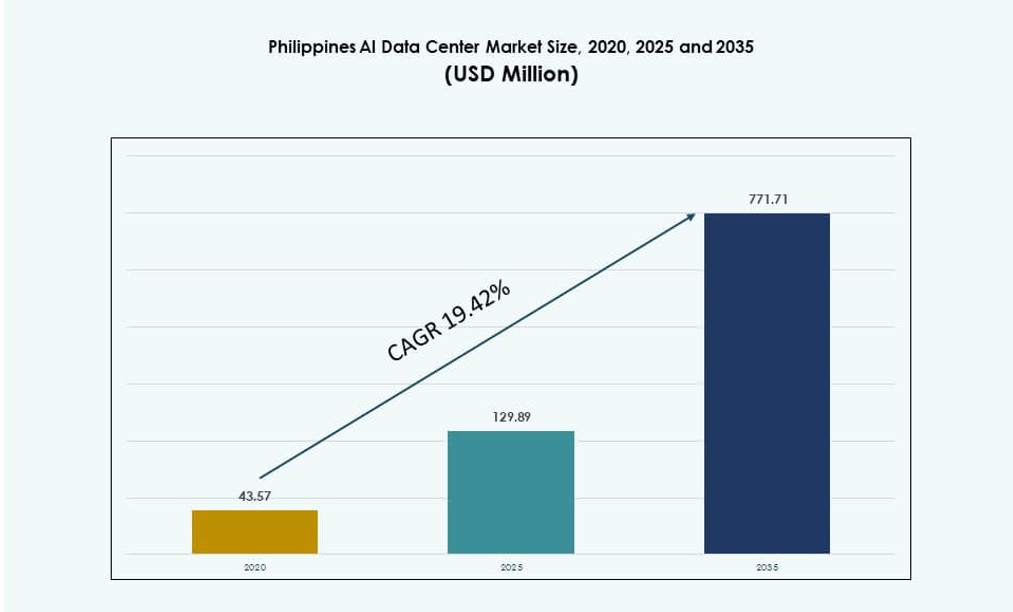
The Philippines AI Data Center Market size was valued at USD 43.57 million in 2020 to USD 129.89 million in 2025 and is anticipated to reach USD 771.71 million by 2035, at a CAGR of 19.42% during the forecast period.
| REPORT ATTRIBUTE |
DETAILS |
| Historical Period |
2020-2023 |
| Base Year |
2024 |
| Forecast Period |
2025-2035 |
| Philippines AI Data Center Market Size 2025 |
USD 129.89 Million |
| Philippines AI Data Center Market, CAGR |
19.42% |
| Philippines AI Data Center Market Size 2035 |
USD 771.71 Million |
The market is expanding due to strong AI adoption across cloud services, telecom, and enterprise IT. Rising use of machine learning and data analytics increases demand for high-density compute. Operators are deploying GPU-ready infrastructure with advanced power and cooling systems. Government digital programs also support localized data processing. These shifts improve service quality and latency. The Philippines AI Data Center Market holds strategic value for investors seeking high-growth digital infrastructure exposure in Southeast Asia.
Metro Manila leads deployment due to strong connectivity, enterprise concentration, and power access. Cebu and Davao are emerging as secondary hubs with cost advantages and policy support. These cities attract edge and backup facilities to support distributed AI workloads. Regional demand from Southeast Asia also supports cross-border cloud usage. The Philippines AI Data Center Market benefits from its central location and growing role in regional digital services.
Market Dynamics:
Market Drivers
Growing Government Push for Digital Infrastructure and Sovereign AI Development
The Philippines AI Data Center Market is gaining momentum through national digital transformation initiatives. The Department of Information and Communications Technology (DICT) is expanding efforts to localize data storage and promote sovereign AI capabilities. These programs support the creation of AI-ready infrastructure and smart city ecosystems. State-led programs help reduce digital gaps while attracting tech investment. AI adoption in e-governance and public services drives data center workloads. It is strategically important to secure domestic data flow and boost national resilience. This alignment enhances the digital economy and builds investor confidence. Strategic AI policy frameworks support long-term infrastructure scalability. The Philippines AI Data Center Market benefits from being part of the country’s broader digital growth agenda.
- For instance, the Department of Information and Communications Technology (DICT) confirmed that the PhilSys national ID system reached 84 million registrations and enabled over 100 million digital transactions. It also completed Phase 1 of the National Fiber Backbone, spanning 1,245 kilometers across 14 provinces to boost domestic digital infrastructure.
Surging Demand from Cloud, Telecom, and Enterprise for AI-Ready Facilities
Demand for AI data centers is rising across cloud service providers, telecoms, and enterprises. Cloud hyperscalers are expanding regional availability zones in Metro Manila to reduce latency and serve local AI workloads. Telecom operators are upgrading edge and core facilities to support next-gen AI applications in 5G networks. Large enterprises are investing in private or hybrid AI data centers for analytics and automation. Data-hungry sectors like BFSI, healthcare, and retail contribute to this demand. It gives businesses the ability to process workloads closer to users and gain faster insights. This demand is pushing the market toward GPU-based, high-density compute environments. The Philippines AI Data Center Market benefits from strong vertical demand for low-latency AI processing.
- For example, in Quezon City, STT GDC Philippines is developing its STT Fairview campus with a planned total IT capacity of 124 MW across four buildings, designed to support hyperscale and AI‑ready workloads for cloud and enterprise customers, highlighting substantial regional capacity expansion in Metro Manila.
AI-Driven Shift in Architecture, Power, and Cooling Standards
The architecture of data centers is changing to meet high-power AI training and inference workloads. Operators are adopting liquid cooling and immersion systems to manage thermal loads from GPUs. Rack densities are rising beyond 20 kW, with AI centers requiring advanced thermal engineering. Power and backup systems must support uninterrupted, scalable compute. These shifts require innovation in infrastructure design and operational models. Colocation firms are offering purpose-built AI racks and power provisioning for hyperscale clients. This shift enhances energy efficiency and optimizes floor utilization. The Philippines AI Data Center Market is adapting to AI-centric design standards for future scalability. It drives capex and opex efficiencies, supporting long-term infrastructure value.
Strategic Role in Regional AI Ecosystem and BPO-Driven Data Growth
The Philippines plays a critical role in Southeast Asia’s AI services and outsourcing ecosystem. The country’s business process outsourcing (BPO) industry is evolving toward AI-powered customer engagement and automation. This transition creates a demand spike for local compute and storage. AI is being embedded into voice, image, and text processing across contact center operations. Foreign investors see it as a cost-effective base for AI service deployment. Metro connectivity and submarine cable upgrades improve regional integration. The Philippines AI Data Center Market supports regional expansion of cloud and AI solutions from neighboring countries. This role boosts its relevance in the APAC digital infrastructure landscape.
Market Trends
Colocation Operators Building High-Density, AI-Focused Data Halls
Colocation providers are expanding infrastructure to support high-density AI workloads. These include 30–50 kW racks with advanced cooling for GPU clusters. Operators are partnering with chipmakers to pre-design data halls for NVIDIA and AMD AI servers. Retrofits of legacy buildings are giving way to AI-first design principles. New builds are focused on modularity, power flexibility, and sustainable materials. AI zones within multi-tenant facilities offer dedicated power and thermal zones. The Philippines AI Data Center Market is seeing increased colocation investment catering to AI-specific client demands. This trend supports local and regional AI workload hosting.
Shift Toward Sustainable and Green AI Infrastructure
Energy efficiency is becoming a core theme in new AI data center builds. Liquid cooling, waste heat reuse, and renewable energy sourcing are being prioritized. Green building certifications such as LEED are now common among hyperscale projects. Firms are deploying AI for workload scheduling and energy optimization. Power usage effectiveness (PUE) below 1.3 is being targeted. Data centers in the country are seeking to align with ESG goals and attract climate-aligned funding. The Philippines AI Data Center Market is transitioning toward sustainability-led designs to balance performance with energy costs. Green infrastructure improves long-term operating efficiency and regulatory alignment.
Edge and Micro Data Centers Gaining Traction for Decentralized AI Inference
Edge and micro data centers are growing across cities beyond Metro Manila. AI applications such as real-time surveillance, autonomous delivery, and retail analytics require low-latency compute. Edge sites offer proximity-based processing without full reliance on central facilities. This decentralization lowers latency and bandwidth usage. Telecoms are leveraging edge for AI-based network optimization and smart city services. Enterprises deploy edge for factory automation and IoT analytics. The Philippines AI Data Center Market is witnessing increased deployment of micro sites to support AI at the edge. These smaller facilities reduce congestion and improve response times.
Integration of AI Workloads into BPO, Retail, and Public Sector Use Cases
AI use cases are expanding into traditional data-intensive sectors. BPO firms are incorporating NLP for chatbots, speech AI, and real-time translations. Retailers use AI for inventory forecasting, behavior prediction, and fraud detection. Public sector agencies implement AI in traffic control, disaster response, and health diagnostics. These use cases generate continuous demand for compute and storage. Industry-specific AI models require localized infrastructure for security and speed. The Philippines AI Data Center Market supports this vertical-specific AI integration. This drives consistent capacity upgrades and workload diversification.
Market Challenges
Power Reliability, Grid Constraints, and Energy Efficiency Risks for AI Workloads
Unstable power supply and grid limitations remain key challenges. AI workloads demand high-density power, often exceeding 20–30 kW per rack. Local grids in key regions experience outages and limited redundancy. Backup systems must scale quickly to avoid downtime. Aging electrical infrastructure limits AI data center site selection. Developers must factor in power cost, stability, and regulatory constraints. Renewable integration is limited by inconsistent supply and storage infrastructure. The Philippines AI Data Center Market faces risk from energy inefficiencies that may hinder hyperscale AI deployment. Solving power-related bottlenecks is critical for long-term infrastructure growth.
Limited Local AI Talent and Ecosystem Maturity for Scalable Operations
The AI talent pool in the Philippines remains in early stages compared to regional peers. Skilled engineers for AI infrastructure operations, model deployment, and maintenance are limited. Most enterprises still rely on external partners for AI solutions. Data center operators face hurdles in hiring AI-focused infrastructure teams. Partnerships with academic and training institutions are only beginning to emerge. The AI developer community is not yet large enough to drive internal demand at scale. This gap slows down enterprise adoption and internal scaling. The Philippines AI Data Center Market must overcome these workforce and maturity gaps to reach full potential.
Market Opportunities
Expansion of AI Zones in Metro Manila and Emerging Digital Hubs
Metro Manila offers infrastructure-readiness and fiber density to support AI-specific zones. Existing hyperscale and colocation players are scaling up to offer dedicated AI data halls. Developers can build high-density, GPU-ready spaces for global cloud players. Edge development in cities like Cebu and Davao creates new growth corridors. The Philippines AI Data Center Market offers strong opportunities in AI-capable zone development. This includes both greenfield and brownfield investment for high-performance infrastructure.
Public-Private Collaborations to Build Sovereign AI Cloud Capabilities
Opportunities exist to partner with the government in sovereign AI cloud programs. These involve hosting national datasets, citizen services, and smart city platforms. Secure, in-country data centers will power such public initiatives. Providers can offer compliance-ready environments and AI-specific compute infrastructure. The Philippines AI Data Center Market stands to benefit from government-backed digitization and infrastructure co-investment. These partnerships strengthen long-term demand visibility.
Market Segmentation
By Type
The Philippines AI Data Center Market is dominated by the colocation & enterprise segment, driven by increasing enterprise AI adoption and cloud service expansion. Colocation providers offer scalable, AI-ready spaces that reduce capex burden for clients. Hyperscale is growing steadily as cloud majors expand presence, while edge/micro data centers are emerging in urban hubs. Growth in decentralized AI workloads will drive demand for edge capacity in the next phase.
By Component
Hardware leads the component segment, driven by strong demand for GPUs, high-density racks, and advanced cooling. AI models require powerful compute, which pushes capital spend on servers and network gear. Software & orchestration is expanding as enterprises seek AI workload management tools. Services are growing as clients need support for deployment, training, and monitoring. The Philippines AI Data Center Market is highly hardware-intensive in the current cycle.
By Deployment
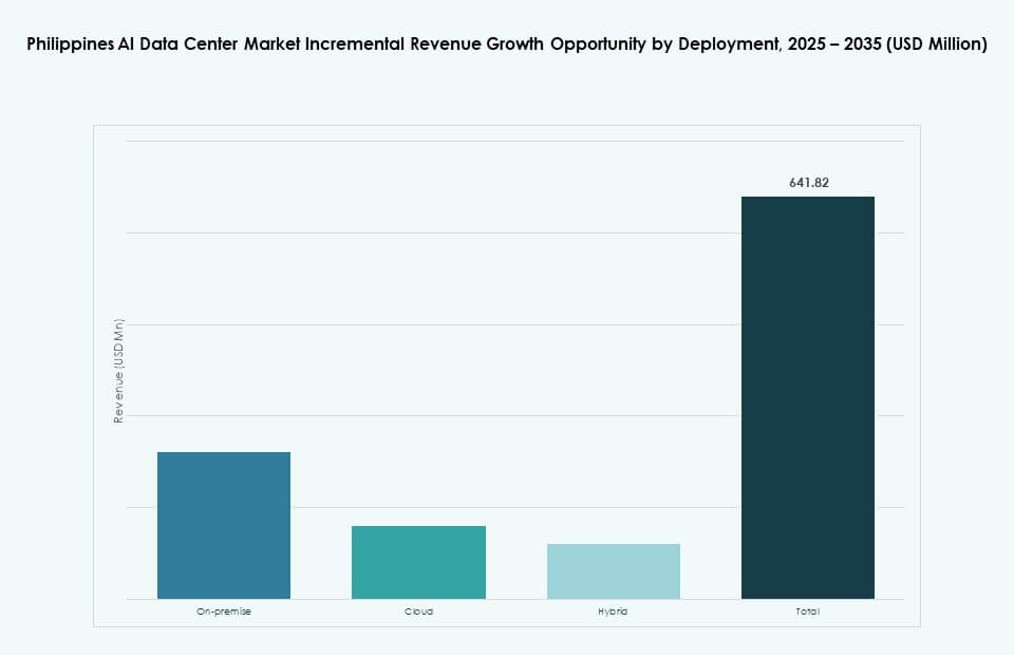
Cloud deployment holds the dominant share, supported by hyperscale availability zones and cost-effective scalability. Enterprises prefer cloud for flexibility and ease of deployment. Hybrid deployment is rising, especially in sectors like BFSI and healthcare that require sensitive data handling. On-premise is limited to large enterprises with in-house IT teams. The Philippines AI Data Center Market is moving toward cloud-native AI infrastructure for flexibility.
By Application
Machine Learning (ML) accounts for the largest share, supporting applications like fraud detection, recommendation engines, and business analytics. NLP is growing in BPO and customer service sectors. Computer Vision is rising in surveillance and retail analytics. Generative AI is still in early adoption but attracting strong enterprise interest. The Philippines AI Data Center Market is led by ML workloads with expanding application diversity across sectors.
By Vertical
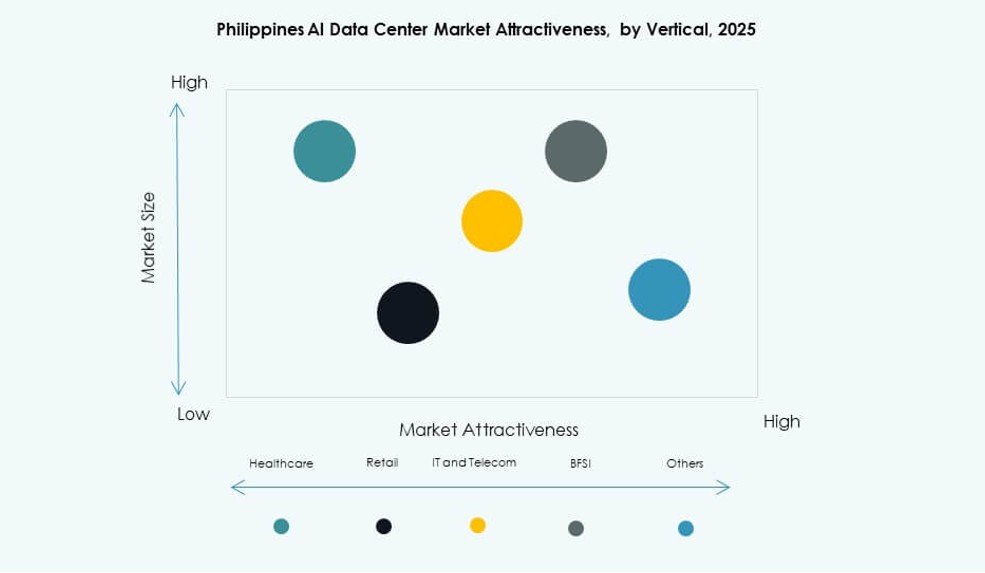
IT and Telecom lead the vertical segmentation, driven by 5G rollout, AI-based network optimization, and cloud expansion. BFSI and Retail follow closely, using AI for customer profiling, credit risk, and personalization. BPO contributes large-scale NLP and speech AI demand. Healthcare is emerging with diagnostic AI and patient data analytics. The Philippines AI Data Center Market serves a diverse base, with IT & telecom setting the pace.
Regional Insights
Metro Manila: The AI Infrastructure Core with Over 70% Market Share
Metro Manila dominates the Philippines AI Data Center Market with over 70% share. It offers robust connectivity, high fiber penetration, and access to enterprise clients. Most hyperscale and colocation providers operate from Quezon City, Makati, and Pasig. It serves financial, telecom, and BPO clients that require low-latency compute. Reliable utility infrastructure and proximity to regulators make it ideal for AI infrastructure. It continues to attract the bulk of new AI data center investment.
- For instance, ePLDT’s VITRO network spans multiple Philippine facilities including Makati 2, Pasig, Parañaque, Clark, and Cebu, with a combined IT power capacity of about 26.5 MW and roughly 9,000 rack slots across its sites, positioning Metro Manila as the core of this footprint and supporting enterprise and cloud workloads with up to 8 kW per rack.
Emerging Urban Hubs: Cebu, Davao, and Clark Expanding Market Access
Secondary cities like Cebu, Davao, and Clark are emerging with 20% combined share. These cities offer lower land costs and growing fiber connectivity. Government SEZ policies and private telecom investment boost infrastructure readiness. Edge data centers and disaster recovery zones are being developed here. These cities appeal to mid-sized enterprises, public services, and regional cloud operations. The Philippines AI Data Center Market is seeing growing investor interest in diversifying beyond Metro Manila.
- For example, in the Clark Special Economic Zone, PLDT’s VITRO Clark data center was designed to accommodate around 1,200 racks and built to TIA‑942 and LEED standard guidelines, supporting regional IT and disaster recovery requirements for enterprises across Central Luzon.
Rural and Provincial Regions: Early-Stage Penetration with Remaining 10% Share
Remote and provincial areas account for under 10% of the market. Infrastructure is still under development, with limited grid stability and fiber backhaul. These regions may benefit from future investments in micro or modular AI data centers. Government programs to digitize rural education, agriculture, and health could drive local demand. The Philippines AI Data Center Market has long-term growth potential in these areas through public-private collaboration. Expansion here will require targeted incentives and infrastructure co-investment.
Competitive Insights:
- ePLDT
- ST Telemedia Global Data Centres (STT GDC)
- Beeinfotech PH
- Equinix
- Digital Realty Trust
- Microsoft (Azure)
- Amazon Web Services (AWS)
- Google Cloud (Alphabet)
- Meta Platforms
- NVIDIA
The Philippines AI Data Center Market features a mix of domestic infrastructure players and global hyperscale cloud providers. Local firms such as ePLDT and Beeinfotech PH lead in colocation and enterprise services, while STT GDC strengthens regional capacity with Singapore-backed investments. Major cloud providers like AWS, Microsoft, and Google are expanding availability zones to meet demand for sovereign AI and latency-sensitive applications. Global hardware and AI chip leaders including NVIDIA and Dell support compute acceleration needs. It is becoming more competitive with specialized infrastructure design, green facility deployment, and AI workload optimization. Strategic partnerships, cross-border investments, and energy-efficient builds define competitive differentiation across the market.
Recent Developments:
- In November 2025, A‑FLOW launched its ML1 data center in the Philippines, introducing a next‑gen facility in Laguna to support rising demand for digital growth across Southeast Asia. The ML1 campus, part of a planned multi‑building development, offers scalable and resilient infrastructure to help enterprises host secure workloads and accelerate local data processing.
- In October 2025, Equinix opened its first data center in the Philippines, enhancing local digital infrastructure to meet growing enterprise demand for cloud and AI services. The facility integrates with Equinix’s global network of more than 270 data centers and offers a vendor-neutral environment that connects businesses to cloud, AI, and network service providers.
- In September 2025, ePLDT partnered with Katonic AI to launch Pilipinas AI, a sovereign AI cloud initiative that aims to establish the country’s first national AI infrastructure platform. This collaboration positions the Philippines to support sovereign AI workloads and enhance data independence while driving innovation across the public and private sectors.
- In June 2025, Equinix completed the acquisition of three data centers in Manila (MN1, MN2, and MN3) from Total Information Management to bolster digital infrastructure for AI services and the growing Philippine digital economy.