Key takeaways
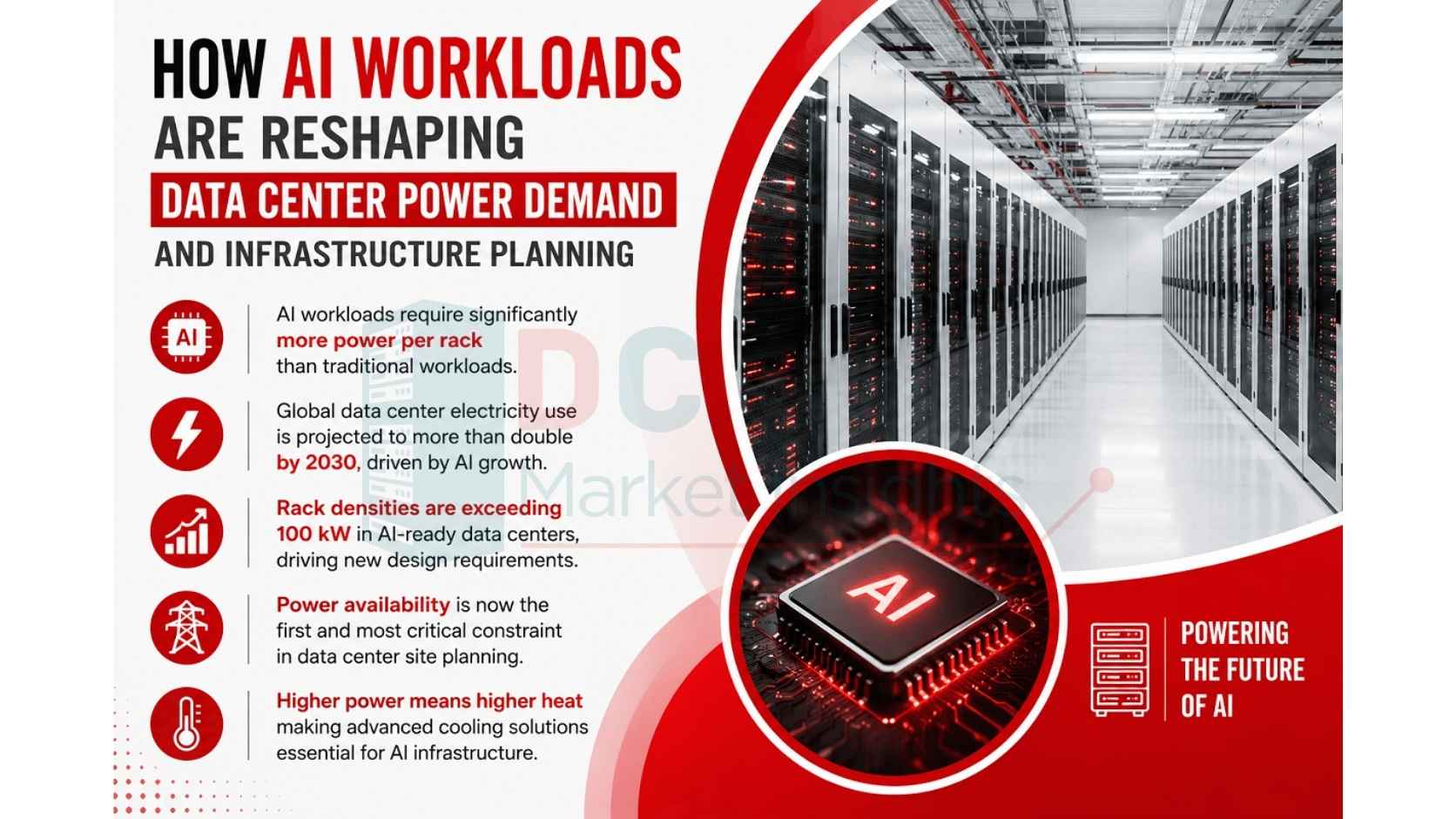
- AI workloads are changing data center planning because they require more power per rack, stronger cooling and faster access to grid capacity.
- Data center electricity demand is no longer a back-end IT issue. It now affects utility planning, site selection, permitting, sustainability reporting and capital spending.
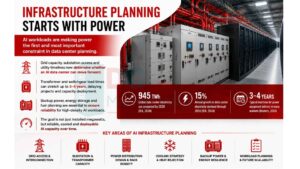
- The International Energy Agency projects global data center electricity consumption will more than double to about 945 terawatt-hours by 2030. That would represent just under 3% of global electricity consumption.
- AI-ready data centers need a different design model. Operators must plan for higher rack densities, liquid cooling, larger substations, stronger backup power and more flexible power distribution.
- The best planning question is not only “How many megawatts can we secure?” It is “How much deployable compute capacity can we support safely, efficiently and reliably over time?”
The issue in one view
AI workloads are reshaping data center power demand because they concentrate more compute, heat and electrical load into each rack. A conventional cloud facility can often spread power across many moderate-density racks. An AI facility may need to support dense clusters of graphics processing units, or GPUs, that draw far more power in a smaller footprint.
This shift changes the role of the data center. It is no longer only a digital facility that hosts servers. It is becoming a major power infrastructure asset that must coordinate with utilities, grid operators, renewable developers, equipment suppliers and local governments.
The International Energy Agency said data center electricity consumption could grow around 15% per year from 2024 to 2030. That growth rate is more than four times faster than electricity demand growth from all other sectors.
The planning challenge is clear. AI growth is moving faster than grid interconnection, transformer supply, cooling retrofits and permitting timelines in many markets.
Why AI workloads need more power
AI workloads need more power because GPUs and accelerators process huge volumes of data in parallel. Training large AI models, running inference at scale and supporting real-time applications all require dense compute clusters.
A standard enterprise application may use central processing unit, or CPU, servers with moderate power draw. AI training clusters use GPUs, high-speed memory, specialized networking and storage systems that work together continuously.
NVIDIA’s GB200 NVL72 platform shows how dense this new architecture has become. The system connects 36 Grace CPUs and 72 Blackwell GPUs in one rack-scale, liquid-cooled design.
This changes facility planning because power and cooling become part of the compute architecture. You cannot treat them as separate support systems anymore.
Power density is becoming the main design constraint
Power density is the amount of electrical power consumed in a rack or data hall. AI is pushing this metric higher than many existing facilities were built to handle.
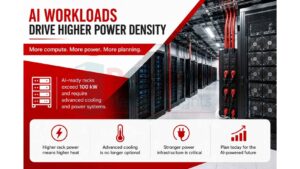
Traditional data centers often planned for lower rack densities. AI-ready sites now need to support racks above 100 kilowatts in many designs. Schneider Electric has said AI-ready data centers face rack densities exceeding 100 kilowatts, power procurement timelines stretching across years and a shift from air to liquid cooling.
NVIDIA has also described the GB200 NVL72 as requiring 120 kilowatts of cooling capacity per rack. The company said it uses direct liquid cooling techniques to manage that thermal load.
This creates a practical issue for operators. A building may have enough floor space but not enough electrical or cooling capacity for AI racks.
AI changes infrastructure planning from the grid to the chip
AI infrastructure planning now starts outside the data hall. Operators must first confirm whether the local grid can support the required load.
Large AI campuses can require hundreds of megawatts. This pushes developers to evaluate transmission capacity, substation expansion, utility timelines and backup generation before finalizing site plans.
U.S. power use is expected to hit record highs in 2026 and 2027 as AI data center demand grows. The U.S. Energy Information Administration projected U.S. power consumption would rise from 4,195 billion kilowatt-hours in 2025 to 4,271 billion kilowatt-hours in 2026 and 4,397 billion kilowatt-hours in 2027.
This means AI data center planning now overlaps with national energy planning. Developers cannot rely only on real estate, fiber access and tax incentives.
Site selection now depends on power availability
Power availability is becoming one of the first filters in data center site selection. Land alone is not enough.
Operators need to know how much grid capacity is available, when it can be delivered and whether the local utility can support future expansion. A site with cheap land can become unattractive if power delivery takes several years.
The Uptime Institute said its 2025 global data center survey found rising costs, worsening power constraints and challenges in meeting AI demand. It also noted that operators must modernize to meet power and density requirements.
This affects regional competition. Markets with fast utility response, strong transmission capacity and clear permitting processes may attract more AI investment.
Power procurement is becoming a strategic function
Power procurement is now a strategic function for data center operators. AI growth requires long-term electricity planning, not short-term utility connections.
Operators are using power purchase agreements, on-site generation, energy storage and grid partnerships to secure capacity. Some are also evaluating nuclear power, natural gas generation and renewable energy contracts.
The business risk is simple. If power delivery slips, AI capacity cannot come online. A delayed substation can become as damaging as a delayed server shipment.
For market readers, this means data center growth should be assessed through a power pipeline lens. Announced capacity does not always equal available capacity.
Cooling and power planning must work together
Cooling and power planning now move together because every watt consumed by IT equipment becomes heat. Higher power density creates higher cooling demand.
Air cooling can still support many workloads. It becomes less practical when rack loads climb into high-density AI ranges. Direct-to-chip liquid cooling and liquid-assisted designs are becoming more important.
Schneider Electric said accelerated compute servers now include two to 16 GPUs per server and can consume over 20 times the power of standard Intel-based CPU cloud servers. It also said these systems output 20 times more heat per server.
This changes the data hall layout. Operators need space for coolant distribution units, manifolds, rear-door heat exchangers, pumps and leak detection systems.
Power distribution needs a redesign
AI workloads are pushing operators to rethink power distribution inside the facility. Higher rack loads can expose limits in busways, switchgear, transformers, uninterruptible power supply systems and branch circuits.
The problem is not only total power. It is how power moves through the facility. A building may have installed megawatts but still face constraints if power cannot be delivered to the right racks.
A 2026 research paper on AI-era data center power delivery argued that the key planning objective is not installed megawatts. It is deployable capacity over time. The study said rising density can strand power and reduce usable capacity when power delivery hierarchies do not match AI deployment patterns.
This is a useful planning insight. Operators should design for flexible power delivery, not only maximum nameplate capacity.
AI workloads create more dynamic power profiles
AI workloads can create fast-changing power profiles. Training, fine-tuning and inference jobs do not always draw power in the same pattern.
This matters because the facility must handle load swings without compromising reliability. Power systems must support stable voltage, backup power transitions and thermal response under changing load.
A 2026 study measured AI workload power consumption at 0.1-second resolution using NVIDIA H100 GPUs. The researchers said high-resolution workload power measurements can help plan grid connections, on-site generation and distributed microgrids.
This points to a new planning need. Data centers should model workload behavior, not only average demand.
Backup power requirements are changing
Backup power requirements are becoming more complex as AI facilities scale. Larger loads require stronger redundancy, larger fuel planning and more careful transition management.
Traditional backup systems were designed around steady enterprise and cloud loads. AI clusters can create high-density blocks that need stable power even during grid events.
Operators must decide which workloads need full redundancy and which can tolerate interruption. Not every AI workload carries the same uptime requirement.
Training jobs may be checkpointed and restarted. Real-time inference for enterprise software, healthcare, finance or autonomous systems may need stronger availability.
Grid stress is becoming a local issue
AI data center power demand is not evenly distributed. It concentrates in specific regions with available land, fiber, tax incentives, cloud ecosystems and existing power infrastructure.
This concentration can create local grid stress. A 2026 research paper found that AI infrastructure is concentrated in North America, Western Europe and Asia-Pacific, which together account for more than 90% of projected compute capacity. The study also identified regions such as Oregon, Virginia and Ireland as potential high-stress areas.
This matters for infrastructure planning because national averages can hide local bottlenecks. A country may have enough generation on paper while one data center corridor faces severe constraints.
Sustainability reporting will become harder
Sustainability reporting will become harder because AI raises electricity use while companies continue to commit to carbon, water and energy goals.
A data center can run efficiently at the facility level and still increase total emissions if it adds large power demand in a fossil-heavy grid. Operators need to report more than power usage effectiveness, or PUE.
The European Union is already moving in this direction. Reuters reported in June 2026 that the EU is proposing minimum energy-efficiency standards and sustainability labels for data centers. The proposal includes disclosure metrics such as water consumption and clean energy use.
This creates pressure for better facility-level transparency. Investors and customers will want to know where power comes from, not only how efficiently the facility uses it.
The role of liquid cooling in AI planning
Liquid cooling is becoming central to AI data center planning because it removes heat closer to the chip. This helps support higher rack densities.
Direct-to-chip systems use cold plates attached to processors or accelerators. Coolant carries heat away from the components through a closed loop.
Immersion cooling places servers or components in a dielectric liquid. This can support dense workloads, but it requires different operations, maintenance and hardware handling.
Liquid cooling does not remove the need for power planning. It changes the facility design. Operators still need heat rejection, pumps, monitoring, maintenance practices and trained staff.
The hidden issue: supply chain readiness
AI infrastructure planning depends on equipment availability. Transformers, switchgear, generators, cooling units, power distribution systems and liquid cooling components can become bottlenecks.
This issue affects project timelines. A data center developer may secure land and customers but still wait for grid equipment or cooling infrastructure.
The Uptime Institute’s 2025 survey described supply chain delays as one of the challenges facing operators as they modernize for AI and higher power density.
This means infrastructure planning should include supplier capacity checks. Procurement is now part of energy strategy.
What operators should do now
Data center operators should start AI planning with a power-readiness audit. The audit should test grid capacity, substation timelines, backup power, rack density, cooling capacity and power distribution.
- They should model several density scenarios. AI hardware changes quickly, so one rack power assumption can become outdated before construction ends.
- They should separate installed power from deployable power. A site may have total megawatts available, but internal distribution can limit how much AI load can be placed.
- They should plan cooling and electrical systems together. Liquid cooling, coolant distribution units, pumps and heat rejection systems all affect power design.
- They should use workload-aware monitoring. AI power profiles can change quickly, so operators need real-time visibility across IT load, cooling load and electrical systems.
- They should engage utilities early. Grid upgrades can define the project schedule more than building construction.
What enterprises should ask before buying AI capacity
- Enterprises buying AI cloud or colocation capacity should ask more specific infrastructure questions.
- Ask where the capacity is located. Local grid conditions affect reliability, cost and emissions.
- Ask how the facility cools high-density racks. A strong answer should mention liquid cooling readiness, rack density limits and heat rejection capacity.
- Ask whether the provider can scale power over time. AI demand can grow quickly, and stranded capacity can limit expansion.
- Ask how the provider reports energy and emissions. Good reporting should include renewable energy matching, grid emissions context and facility-level efficiency metrics.
- Ask whether the provider has contingency plans for power constraints. AI capacity is only useful if it can stay online.
What investors should watch
Investors should watch power availability as closely as data center occupancy. AI demand can support growth, but power constraints can limit revenue conversion.
The strongest data center markets will combine grid access, fast interconnection, liquid cooling readiness, fiber density, favorable permitting and credible sustainability pathways.
Investors should be cautious with announced capacity figures. A project can be marketed as large-scale AI capacity before it has secured the power delivery needed to operate at full load.
They should also evaluate tenant quality. AI tenants may demand large blocks of power, but contract structures, ramp schedules and energy cost pass-through terms matter.
Future outlook
AI will make data centers larger, denser and more integrated with the power system. The next generation of facilities will look less like traditional server rooms and more like specialized compute plants.
Liquid cooling will become more common in AI halls. Air cooling will remain important for lower-density workloads and hybrid facilities.
Power procurement will become a competitive advantage. Operators with secured energy, grid relationships and scalable electrical designs will move faster than those waiting for utility upgrades.
Regulatory pressure will increase. Data centers will face more scrutiny around power use, water use, clean energy sourcing and community impact.
Infrastructure planning will become more flexible. Operators will design facilities that can adapt to changing GPU generations, workload profiles and cooling requirements.
Conclusion
AI workloads are reshaping data center power demand because they concentrate more compute into each rack. That raises power density, heat output, cooling complexity and grid dependence.
Infrastructure planning must now start with energy. Operators need to secure power, design flexible electrical systems, integrate liquid cooling and prepare for dynamic AI load profiles.
The winners will not be the companies that announce the most megawatts. They will be the companies that convert power into reliable, deployable and efficient AI capacity.
For readers, the main lesson is clear. AI data center growth is not only a software story. It is a power, cooling, grid and infrastructure planning story.