

Key takeaways
- The EU’s AI Gigafactories call seeks up to seven sites in at least seven member states, backed by up to €10 billion of EU and national money and at least €20 billion of private capital, the EuroHPC Joint Undertaking said.
- Each site must reach a minimum IT load of 120 MW (medium) or 150 MW (large) in Phase 2. If all seven are awarded, that is at least 930 MW of new AI capacity (our calculation from the tender specifications reported by Sullivan & Cromwell).
- Only €1 billion of the EU’s up to €5 billion share is legally committed today. The other €4 billion depends on the EU’s 2028-2035 budget, which is still being negotiated.
- On DC Market Insights’ build-cost model for sovereign AI (US$44.6 million per MW in 2025), a 150 MW large gigafactory implies about US$6.7 billion of total build, against an EU ceiling of €1 billion per site (our calculation).
- Bids are due on 12 November 2026, according to the Commission and EuroHPC. Awards are expected in early 2027 and first operations by mid-2028.
Europe has opened the largest single public tender for AI data center capacity it has ever run. The prize is a share of more than €30 billion of planned investment, an EU anchor customer for compute time and a political label that host governments want badly. The catch is that most of the public money has not yet been voted, and every site must find well over 100 MW of power within about two years of signing.
Why now: bids close on 12 November, and the last two weeks showed how the field is forming. On 12 October an Italian bid team built around Eni, Enel, Terna and Cassa Depositi e Prestiti was reported to be taking shape. The same day Nebius signed as the first tenant of a €7 billion private AI campus in Rotterdam that sits outside the EU scheme. This post looks at where the money goes, who gains and how much of it is firm.
How Europe got here: from €20 billion and five sites to seven sites in two sizes
The plan began with the InvestAI initiative, presented in Paris on 11 February 2025, which aimed to mobilise €200 billion for AI, including €20 billion for AI gigafactories. A call for expressions of interest in spring 2025 drew 76 responses from 16 member states, European Economics reported. The Council gave the EuroHPC Joint Undertaking the job in Regulation (EU) 2026/150, adopted on 16 January 2026.
The design then shrank and split. The original idea of up to five equal sites became four medium and three large ones, built in phases. On 30 July 2026 EuroHPC opened tender EUROHPC-2026-CEI-AIGF-01, its launch notice says, for “up to seven” AI Gigafactories “located in at least seven Member States”. Selection is expected in early 2027, with operations within 18 months.
The opening of the AI Gigafactories call represents a milestone in our AI Continent ambitions
EuroHPC already runs 12 supercomputers, 19 AI Factories and 13 AI Factory Antennas. The gigafactories are meant to be a step above those. Each must eventually hold “at least three to four times the number of the most advanced AI processors” in Europe’s most powerful AI Factories, the call page says.
What the tender asks for, and what it pays
The detail sits in the tender specifications, summarised by Sullivan & Cromwell on 8 October. Compute is set in H100-equivalent accelerators, and power in megawatts.
| Requirement | Lot 1 (medium, up to 4 sites) | Lot 2 (large, up to 3 sites) |
|---|---|---|
| Phase 1 compute (H100-equivalent) | 25,000 | 40,000 |
| Phase 2 compute (H100-equivalent) | 75,000 | 100,000 |
| Phase 1 power (expected) | 15-30 MW | 20-50 MW |
| Phase 2 minimum IT load | 120 MW | 150 MW |
| EU funding, Phase 1 / Phase 2 | Up to €100 million / up to €400 million | Up to €200 million / up to €800 million |
| EU ceiling per site, both phases | €500 million | €1 billion |
Sources: Sullivan & Cromwell, 8 Oct 2026 (tender specifications dated 30 July 2026); European Commission via EURAXESS, 4 Aug 2026 (phase funding per lot). The EU share is also capped at 17% of each site’s computing-infrastructure capex, whichever is lower.
Three rules shape who can win. The coordinator must be incorporated and headquartered in the EU and controlled by EU entities or nationals. Core operational data must stay in the EU. And each bid needs a formal co-funding letter from its host state, because member states must at least match the EU money. The framework contract runs 6.5 years; Phase 1 capacity must be ready no later than 18 months after signing, followed by a fixed five-year purchasing period.
Scoring rewards money as much as engineering. Part 1 weighs technical quality at 40%, impact at 20% and financial feasibility at 40%. The final ranking then gives 50% to that score, 25% to scale and service quality and 25% to performance-adjusted cost.
On the deadline: the Commission, the EuroHPC launch notice and the tender specifications give 12 November 2026 (16:00 Luxembourg time, per Sullivan & Cromwell). When we checked on 18 October, the EuroHPC call page listed “3 December 2026, 17:00 (CET)”. We have seen no published corrigendum and use 12 November; bidders should confirm on the EU Funding & Tenders Portal.
How much of the money is firm: €1 billion of €30 billion
The headline is €30 billion or more. The EU part is up to €5 billion, member states must at least match it, and private investors are expected to bring at least €20 billion. But “only Phase 1 funding is legally committed” when contracts are signed, the specifications say. That is €1 billion. The €4 billion for Phase 2 is indicative and depends on the 2028-2035 Multiannual Financial Framework, which member states have not agreed. A senior Commission official told Euronews: “We cannot pre-empt the decisions about the next MFF.”
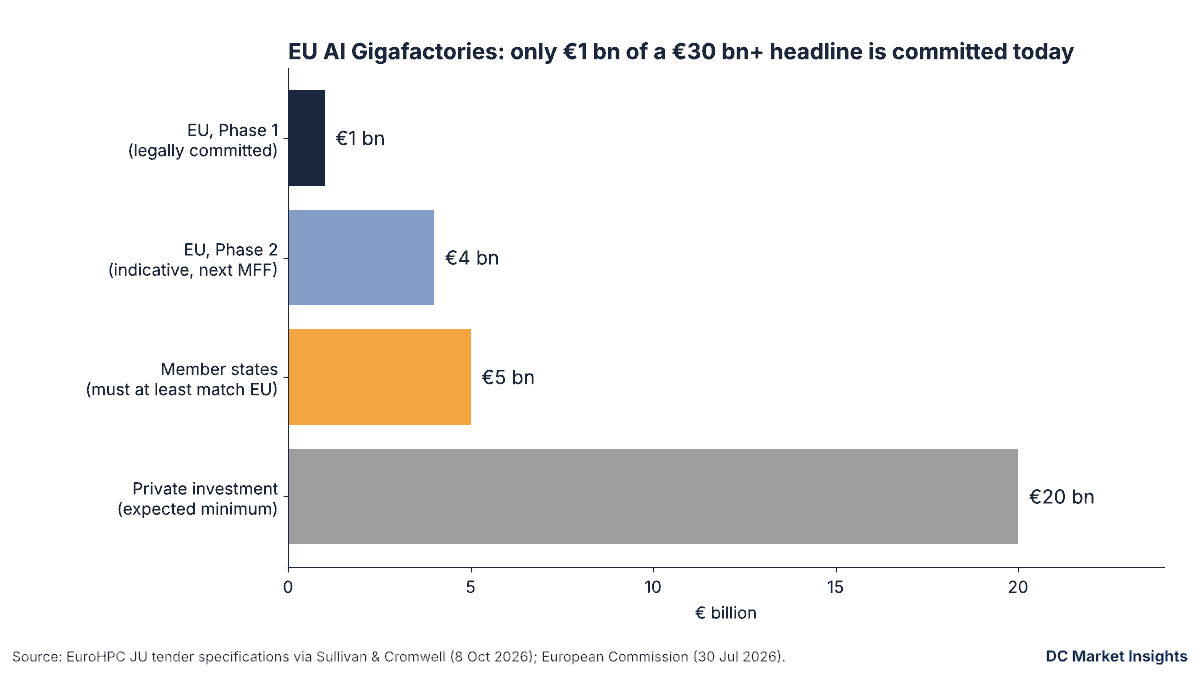
The Phase 1 numbers add up exactly. Four medium sites at up to €100 million and three large ones at up to €200 million come to €1 billion; the Phase 2 maximums (4 × €400 million plus 3 × €800 million) come to €4 billion (our calculation). In other words, the committed money covers the first build-out at every site, but not the scale-up that makes them gigafactories. Contracts are also awarded in ranking order “only as funding allows”, so fewer than seven sites may be chosen.
Who gains, and how much
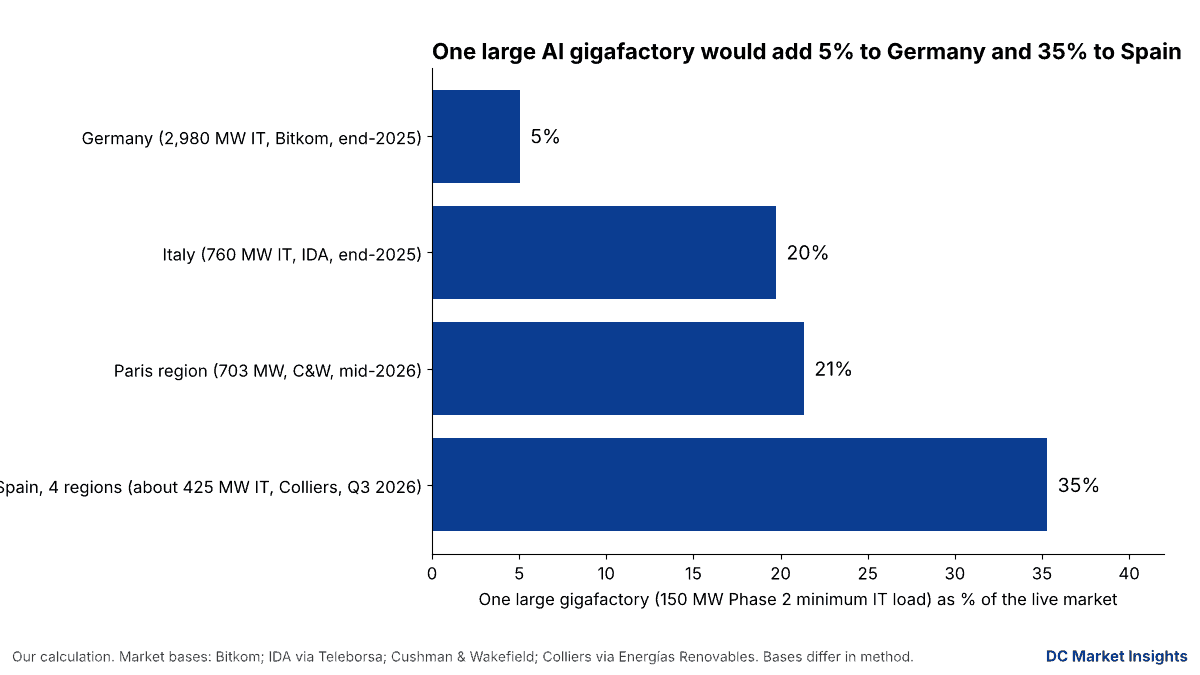
Host countries with spare grid capacity. Ten countries signalled interest in hosting a site: Germany, Italy, France, Poland, Czechia, Denmark, Finland, Greece, Portugal and Spain, Euronews reported. Eighteen member states signed the joint procurement agreement to buy compute time from the sites. For smaller markets, one gigafactory is a step change. A single 150 MW large site would add about 5% to Germany’s 2,980 MW of IT load but about 20% to Italy’s 760 MW and about 35% to the roughly 425 MW live in Spain’s four main regions (our calculation).
| Market (DC Market Insights data) | Live capacity | Basis and date | One 150 MW site as share |
|---|---|---|---|
| Germany | 2,980 MW | IT load, end-2025 (Bitkom) | 5.0% |
| Netherlands (not bidding) | about 1,500 MW | IT load, end-2025 (Dutch Data Center Association) | 10.0% |
| Italy | 760 MW | IT load, end-2025 (IDA) | 19.7% |
| Paris region (Île-de-France) | 703 MW | Operational, mid-2026 (Cushman & Wakefield) | 21.3% |
| Spain, Madrid + Barcelona + Aragón + other | about 425 MW | IT load, Q3 2026 (Colliers; sum is our arithmetic) | 35.3% |
Source: DC Market Insights capacity data pack, compiled 12 October 2026 from the bodies named. Bases differ (IT load versus operational facility capacity) and should not be added together. Shares are our calculation.
Utilities and grid owners inside bid teams. Power is now a selection factor, not just a cost. “The rapid provision of large amounts of electricity is increasingly becoming the decisive location factor,” IWR wrote when the call opened. That is why bid teams include energy companies. France’s candidate brings EDF together with Ardian, Artefact, Bull, Capgemini, iliad, Orange and Scaleway, Orange said in May. Italy’s proposed NewCo names Eni, Enel, Terna, Snam, Saipem, Leonardo, FiberCop and CDP, with about €1.2 billion of initial investment rising to more than €5 billion over time, inno3 reported on 12 October. Undersecretary Alessio Butti said the Italian proposal is still being defined.
European hardware and cloud firms. Consortia may buy hardware from suppliers in Europe or like-minded countries, and part of procurement can be reserved for European start-ups and scale-ups. The Commission signed letters of intent with AMD, NVIDIA and Qualcomm. In Strasbourg, the ÆTHER consortium led by 2CRSi with SiPearl, Axelera AI, Dassault Systèmes’ OUTSCALE and Électricité de Strasbourg plans 42 MW at first and more than 400 MW in the long term, subject to grid capacity, HPCwire reported.
Artificial intelligence represents a historic opportunity for Europe’s reindustrialization.
The Nordics. Nokia wants to host a site in Oulu, Finland, where the city has approved a preliminary land sale in the Toppila district. Finnish MP Ville Skinnari put the project at up to €5 billion, a figure Nokia has not confirmed, MREast reported.
| Bid or project | Country | Named partners | Size or money stated | Status |
|---|---|---|---|---|
| French consortium (AION) | France | Ardian, Artefact, Bull, Capgemini, EDF, iliad, Orange, Scaleway | About US$10 billion for one site (reported) | Candidate, announced May 2026 |
| Italian NewCo | Italy | Eni, Enel, Terna, Snam, Saipem, Leonardo, FiberCop, CDP | €1.2 billion initial, more than €5 billion over time | Being defined (Oct 2026) |
| ÆTHER | France (Strasbourg) | 2CRSi, SiPearl, Axelera AI, OUTSCALE, ÉS Group | 42 MW initial, more than 400 MW long-term | Candidate, sites pending acquisition |
| Nokia, Oulu | Finland | Nokia, City of Oulu | Up to €5 billion (MP estimate, unconfirmed) | Interest stated; land sale approved |
| VOLT Rotterdam (outside the tender) | Netherlands | VOLT, Nebius (anchor tenant) | €7 billion private; Nebius up to 200 MW; site up to 800 MW | Lease signed 12 Oct 2026 |
Sources: Orange; The Next Web (AION value); inno3; HPCwire; MREast; Tech Times. Bid lists are not published by EuroHPC; this table covers only public announcements.
The economics: what a gigafactory costs and what Brussels covers
Sullivan & Cromwell’s summary of the specifications says each site needs roughly €4-5 billion of investment. Our own model points the same way. DC Market Insights’ Sovereign AI Infrastructure Market report puts the 2025 all-in build cost of sovereign AI capacity at US$44.6 million per MW, covering accelerators, networking, storage and facility. On that basis a 120 MW medium site implies about US$5.4 billion and a 150 MW large site about US$6.7 billion (our calculation).
Against that, the EU ceiling is €500 million for a medium site and €1 billion for a large one, and it can never exceed 17% of computing-infrastructure capex. To receive the full €1 billion, a large site needs at least about €5.9 billion of computing capex; a medium site needs about €2.9 billion for the full €500 million (our calculation: ceiling divided by 0.17). With the host state matching, public money can fund up to about a third of computing capex. The rest, and all operating cost, is on the consortium.
In our view, the real value of the award is the anchor contract, not the subsidy. A five-year guaranteed purchase of compute time from the EU and member states is what lets a bid team raise debt for the other two-thirds. That is also why the 40% weight on financial feasibility matters: lenders will read the same scorecard.
The wider pattern: private money is not waiting for Brussels
The Rotterdam deal shows the alternative route. VOLT’s €7 billion campus is entirely privately financed, with about €2.5 billion for civil works and grid and €4.5 billion for chips and compute equipment. Nebius has leased 100,000 GPU slots and up to 200 MW. The site has a direct 380 kV connection, while TenneT has imposed connection moratoria in Noord-Holland with more than 4.6 GW of requests queued, Tech Times reported. The Netherlands did not apply for EU designation.
Europe needs more large-scale AI infrastructure
Elsewhere in the region, demand is moving the same way. Italy’s data center association sees up to €37 billion of potential investment over ten years against 760 MW of installed IT capacity and a qualified pipeline of about 1,800 MW, Teleborsa reported. Across EMEA, Cushman & Wakefield counted 11.4 GW operational, 2.7 GW under construction and 12.1 GW planned in May. The 930 MW minimum for all seven gigafactories would equal about a third of that under-construction figure (our calculation; different methods, so read it as scale only).
What it means for operators, investors and vendors
Our view, based on the figures above:
- Price the award as an anchor lease, not a grant. At most 17% of computing capex comes from the EU, so a large site still needs about €5 billion or more of private capital. Underwrite the five-year compute purchase, not the subsidy.
- Treat Phase 2 as an option. Only €1 billion of €5 billion in EU money is legally committed. Models should work on Phase 1 alone (25,000-40,000 accelerators, 15-50 MW) until the 2028-2035 budget is agreed.
- Lock power before 12 November. Phase 1 must be live within 18 months of signing and Phase 2 within 12 months of activation, at up to 150 MW: the hardest test. Sites with a transmission-level connection, like Rotterdam’s 380 kV line, start ahead.
- Smaller host markets gain most. One large site adds about 35% to Spain’s main-region capacity and 20% to Italy’s, against 5% in Germany. Land, grid and construction firms in those markets have the most upside.
- Vendors: build European content into bids. Procurement can favour European and like-minded suppliers and reserve a share for start-ups. Cooling, power and server firms with EU manufacturing are better placed.
- Expect orders in 2027, not 2026. Awards are due in early 2027 and Phase 1 must be ready within 18 months, so equipment orders cluster in 2027 for mid-2028 operation.
For the size of the state-backed compute build, see our Sovereign AI Infrastructure Market report. For AI capacity and spending across all buyers, see the AI Data Center Market report, and for the whole industry the Data Center Market report. Country-level capacity figures are on our global data center capacity pages.
What to watch next
- 12 November 2026: AI Gigafactories bids due at EuroHPC (16:00 Luxembourg time, per the specifications). Watch for the EuroHPC call page’s 3 December date to be confirmed or corrected.
- Late 2026: host-state co-funding letters, required in every bid, will show which governments are willing to match EU money.
- Early 2027: evaluation and award decisions by the EuroHPC Governing Board; construction is due to start in 2027.
- 2027-2028: negotiations on the 2028-2035 Multiannual Financial Framework decide whether the €4 billion of Phase 2 EU money exists.
- Mid-2028: first gigafactories expected in operation, within 18 months of contract signature.
Frequently asked questions
What are the EU AI Gigafactories?
They are up to seven AI compute sites, four medium and three large, to be built across at least seven EU member states. They are backed by up to €10 billion of EU and national money and at least €20 billion of private investment, more than €30 billion in total, according to the European Commission.
When is the deadline for the AI Gigafactories tender?
12 November 2026, according to the Commission, the EuroHPC launch notice and the tender specifications. The EuroHPC call page showed 3 December 2026 when we checked on 18 October, so bidders should confirm on the EU Funding & Tenders Portal. Awards are expected in early 2027.
How much power does an AI gigafactory need?
A medium site must reach at least 120 MW of IT load in Phase 2 and a large site at least 150 MW, per the tender specifications. Phase 1 is expected at 15-30 MW and 20-50 MW. All seven together need at least 930 MW in Phase 2, by our calculation.
How much will the EU pay for each AI gigafactory?
Up to €500 million for a medium site and €1 billion for a large one across both phases, and never more than 17% of computing capex. Only the €1 billion Phase 1 total is legally committed today; the €4 billion Phase 2 depends on the next EU budget.
Sources
- EuroHPC Joint Undertaking, “The EuroHPC Joint Undertaking launches the AI Gigafactories Call”, 30 Jul 2026. Link
- EuroHPC Joint Undertaking, “Call for tenders for the selection of Artificial Intelligence Gigafactory Consortia and the establishment of AI Gigafactories” (EUROHPC-2026-CEI-AIGF-01), read 18 Oct 2026. Link
- European Commission via EURAXESS, “EU launches AI Gigafactories call to boost Europe’s computing capacity and unlock more than €30 billion in investment”, 4 Aug 2026. Link
- Sullivan & Cromwell, “EuroHPC Joint Undertaking Launches AI Gigafactories Call”, 8 Oct 2026. Link
- Eunews, “Artificial intelligence, EU launches call for tenders for seven gigafactories worth 30 billion euros”, 30 Jul 2026. Link
- Euronews, “EU opens call for seven ‘gigafactories’ to train next-generation AI technologies”, 30 Jul 2026. Link
- European Economics, “AI Gigafactories: the European Union launches its call for tenders worth over €30 billion”, 2026. Link
- IWR, “EU Launches Multi-Billion-Euro Tender for AI Gigafactories: Fast Power Supply Becomes a Competitive Factor”, 31 Jul 2026. Link
- Orange, “Ardian, Artefact, Bull, EDF, Capgemini, the iliad Group, Orange and Scaleway combine their expertise to run as a candidate for a European AI Gigafactory in France”, 21 May 2026. Link
- The Next Web, “French companies bid $10bn for one of the EU’s five planned AI gigafactory sites”, 2026. Link
- inno3, “GigaFactory AI, l’Italia si prepara per la candidatura”, 12 Oct 2026. Link
- HPCwire, “SiPearl, 2CRSi and Partners Launch ÆTHER AI Gigafactory Initiative”, 8 Jul 2026. Link
- MREast, “Nokia Bids for EU AI Gigafactory in Oulu”, 25 Sep 2026. Link
- Tech Times, “Nebius Signs as First Customer for VOLT’s €7 Billion Rotterdam AI Gigafactory”, 13 Oct 2026. Link
- Teleborsa, “Data Center in Italia, investimenti potenziali per 37 miliardi in 10 anni”, 8 Oct 2026. Link
- Bitkom, “Rechenzentren in Deutschland: KI treibt Wachstum”, 10 Nov 2025. Link
- Cushman & Wakefield, “Global Data Center Market Comparison 2026”, 29 May 2026. Link
- DC Market Insights, “Sovereign AI Infrastructure Market” report and global capacity data, read 18 Oct 2026. Link