

Key takeaways
- At the OCP Global Summit on 12 October, NVIDIA’s updated MGX 1.2 open rack design was published for deployments of up to 250 kW per rack, with a liquid-cooled 5,000 A busbar, according to NVIDIA.
- Enverus Intelligence Research estimates that 800 VDC distribution cuts electrical capex by 13% against 415 VAC, lifts end-to-end efficiency from 79.8% to 93.8% and uses up to 60% less copper per MW.
- By our calculation, that efficiency gap means about 938 MW reaches IT equipment for every 1,000 MW drawn, against about 798 MW today, roughly 140 MW more compute per gigawatt.
- On 22 July 2026 about 3,900 MW of data center load in PJM switched to backup power after a grid fault, the largest such event so far and 2.6 times the 2024 event (PJM figures, our calculation).
- FERC has made NERC’s computational-load standards mandatory. They are due at FERC by 31 December 2026, and PJM plans its own ride-through filing in November, POWER and PJM reported.
For three years the cost story in AI data centers has been about chips and land. This week in San Jose it moved to the electrical room. At the Open Compute Project (OCP) Global Summit, NVIDIA contributed Vera Rubin rack and tray designs and an MGX 1.2 specification that runs to 250 kW per rack. NVIDIA, AMD, Google and Meta published a common facility blueprint. Google, Meta, Microsoft and NVIDIA published a specification for how AI sites should behave when the grid wobbles.
This is the cost and tech story of the quarter. Racks at 250 kW cannot be fed economically with today’s 415 VAC and 54 V gear, and the grid can no longer absorb sites that drop gigawatts of load in a fault. Both problems now have a spec, a price tag and a deadline.
What changed this week: the open rack reaches 250 kW
The OCP Global Summit ran from 12 to 15 October at the McEnery Convention Center in San Jose. In its 12 October post, NVIDIA said MGX 1.2 “supports rack deployments up to 250kW”, adds a liquid-cooled 5,000 A busbar, rack-scale blind-mate liquid cooling, fanless liquid-cooled compute trays and native 19-inch equipment support. A separate Vera CPU rack specification extends the same open architecture to CPU-heavy agentic workloads.
Two facility documents matter more for builders than the rack itself. The Open Data Center Specification v0.7, from NVIDIA, AMD, Google and Meta, sets a common blueprint for power architecture, cooling and physical layout. Yahoo Finance reported that the aim is to give system makers, colocation providers and operators predefined templates instead of many different customer designs. The OCP Grid Resilience Specification, from Google, Meta, Microsoft and NVIDIA, sets how AI facilities stay connected through grid disturbances and return to near-full load in less than two seconds.
| Published at OCP, 12 to 13 Oct 2026 | What it sets | Backers |
|---|---|---|
| MGX 1.2 rack specification | Racks up to 250 kW, liquid-cooled 5,000 A busbar, blind-mate liquid cooling, 19-inch support | NVIDIA and OCP partners |
| Open Data Center Specification v0.7 | Facility blueprint for power architecture, cooling and layout | NVIDIA, AMD, Google, Meta |
| OCP Grid Resilience Specification | Stay connected in grid disturbances, recover to near-full load in under two seconds | Google, Meta, Microsoft, NVIDIA |
| Visionbay K-1 platform | 800 VDC AI factory design, phased in rather than all at once on day one | Visionbay, with Vertiv power and thermal technology |
Sources: NVIDIA, 12 Oct 2026; HPCwire, 13 Oct 2026. The Open Data Center Specification is a v0.7 draft. These are designs and standards, not shipments.
The density step is large. At 250 kW, four racks draw a megawatt (our calculation). The DC Market Insights Data Center Rack Power Distribution Unit Market report puts current AI racks at 60 kW to 132 kW. Vertiv’s summit programme went further, with sessions on 300 kW, 600 kW and MW-class racks and on how 800 VDC changes fault behaviour, according to Vertiv’s event page.
What it costs: why 800 VDC is a capex and copper story
The physics is simple. At a fixed power, higher voltage means lower current, and lower current means thinner conductors and fewer conversion stages. NVIDIA’s own technical blog says that feeding a single 1 MW rack at 54 VDC “requires up to 200 kg of copper busbar”. It claims 800 VDC cuts copper requirements by 45%, improves end-to-end efficiency by up to 5% against 54 V systems, cuts maintenance costs by up to 70% and total cost of ownership by up to 30%.
An independent estimate goes further on efficiency. In June, Enverus Intelligence Research compared 800 VDC with a legacy 415 VAC design. It found electrical capex 13% lower, end-to-end efficiency 14 percentage points higher (93.8% against 79.8%) and copper mass up to 60% lower per MW. Paired with DC-coupled behind-the-meter solar, batteries and fuel cells, it put the 10-year value at $1.63 billion per 1 GW campus, of which $440 million comes from removing AC conversion losses.
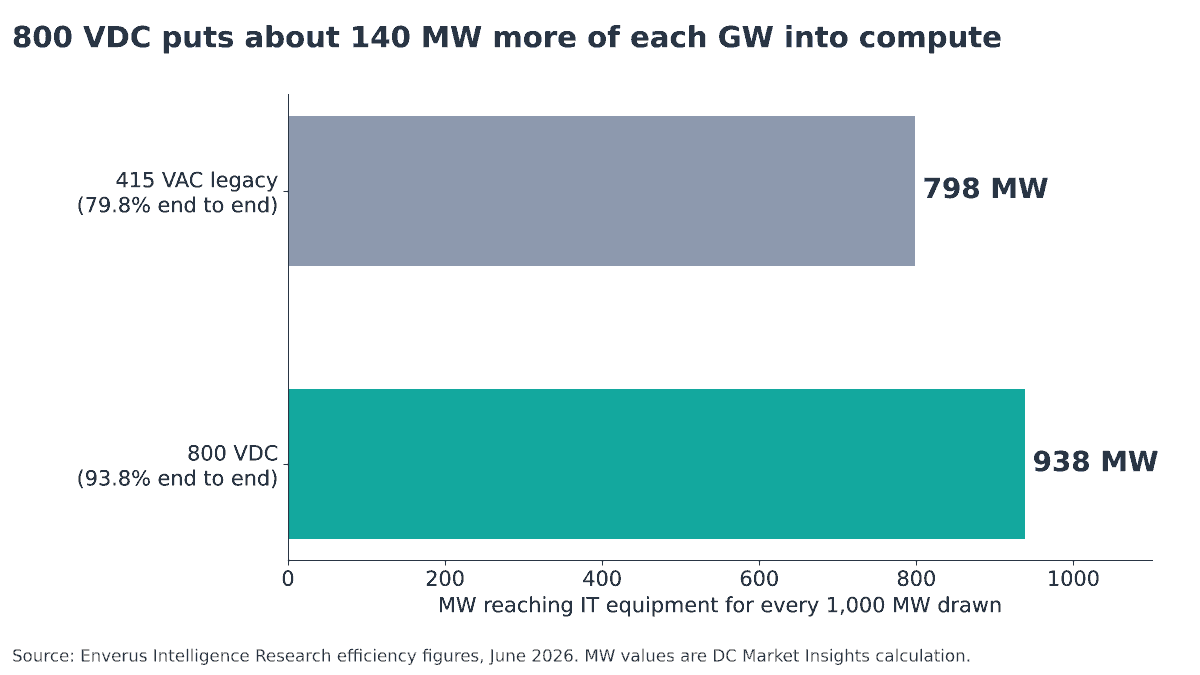
By our calculation, the Enverus efficiency figures mean about 140 MW more of every gigawatt reaches the chips, or about 17.5% more compute from the same grid connection. In a market where the grid connection is the scarcest input, that is the number that matters most. Of the $1.63 billion value stack, the $440 million from conversion losses is about 27% (our calculation). The rest depends on on-site generation and storage choices.
| Measure, 800 VDC against today | Value | Source |
|---|---|---|
| Electrical capex against 415 VAC | 13% lower | Enverus, Jun 2026 |
| End-to-end efficiency | 79.8% to 93.8% | Enverus, Jun 2026 |
| Copper mass per MW against 415 VAC | Up to 60% lower | Enverus, Jun 2026 |
| Copper requirement against 54 V in-rack | 45% lower | NVIDIA, May 2025 |
| Maintenance cost | Up to 70% lower | NVIDIA, May 2025 |
| Total cost of ownership | Up to 30% lower | NVIDIA, May 2025 |
| 10-year value per 1 GW campus, with DC-coupled on-site power | $1.63 billion | Enverus, Jun 2026 |
Sources: Enverus, 24 Jun 2026; NVIDIA Technical Blog, 20 May 2025. The two sources use different baselines (415 VAC facility distribution and 54 V in-rack distribution) and should not be compared or added directly. NVIDIA figures are vendor claims.
Next-generation AI chips are forcing a rethink of data center power architecture.
Copper prices make the case stronger. LME copper traded at about $14,650 a tonne on 14 October, up 17% this year, after a record $14,875 on 10 September, and Aurubis raised its 2027 European premium to a record $347 a tonne, Reuters reported. At that price the 200 kg of busbar in NVIDIA’s 1 MW example holds about $2,930 of copper metal, and a 45% cut saves about 90 kg per rack (our calculation). In our view the metal bill is the smaller part. The bigger costs are the weight, the floor space and the labour of installing and maintaining heavy low-voltage conductors at these densities.
How the technology changes the build
800 VDC does not arrive in one step. NVIDIA said in August that more than 80 equipment makers and infrastructure companies are building to its 800 VDC specification. An MGX-compatible 800 VDC power rack arrives in the second half of 2026, and a row power center supporting up to 2 MW per row is expected in 2027. NVIDIA has said full-scale production of 800 VDC data centers will coincide with its Kyber rack-scale systems in 2027. Visionbay’s K-1 platform, shown at OCP with Vertiv technology, is built to phase in 800 VDC distribution rather than require a full switch on day one.
That changes the electrical bill of materials:
- Rack power distribution. The DC Market Insights rack PDU report estimates traditional rack PDU content at about $205,000 per MW in 2025 and expects 800 VDC to reduce PDU value per MW in AI racks. Units rated above 30 kW are the fastest-growing segment.
- Busways and busbars. Overhead busway runs at about $110,000 per MW of white space by DC Market Insights estimates. At 800 VDC the current falls and conductors shrink, while the in-rack busbar becomes a liquid-cooled 5,000 A part in MGX 1.2.
- Conversion and protection. Value moves upstream into solid-state conversion, sidecar power racks and DC fault protection. Vertiv’s OCP session on an open DC Fault Manager reference architecture shows how new this layer still is.
- Power management. NVIDIA’s DSX MaxLPS allocates power by actual demand. In a previously published evaluation at Nscale in Iceland, managed GPUs rose from 140 to 192 inside the same 264.4 kW budget, Data Center Frontier reported. That is 37% more GPUs on the same power (our calculation), in a test environment.
In our view the winners in this shift are suppliers of DC conversion, protection and liquid-cooled power hardware. Suppliers whose revenue scales with low-voltage AC copper and outlet counts per MW face slower growth in AI halls, even as total megawatts rise.
The grid side: one fault, 3,900 MW
The second cost is outside the fence. On 6 October, PJM’s reliability engineering team took its Planning Committee through three events in which data center load switched to backup generation after a single grid disturbance. The PJM presentation puts them at about 1,500 MW on 10 July 2024, about 1,800 MW on 17 February 2025 and about 3,900 MW on 22 July 2026, the largest event to date. In July, about 2,900 MW transferred first and about 1,000 MW followed a minute later. Eastern Interconnection frequency reached 60.092 Hz.
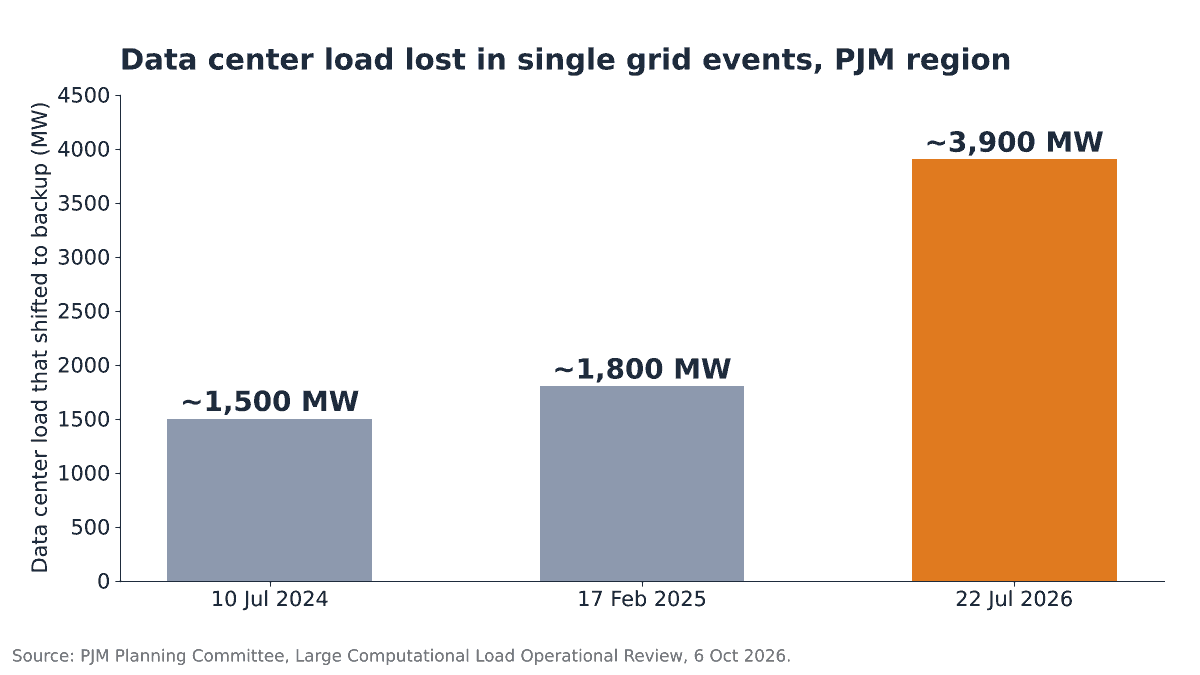
The July load was about 3% of PJM demand at the time, and PJM reported no reliability impact on the bulk power system, POWER reported. The 2024 investigation showed why these events happen. All of the 1.5 GW tripped on customer-side protection, and about 1.26 GW stayed off for hours because a scheme held facilities on backup after three voltage dips in a minute. POWER put the July 2026 figure at more than 3 GW; PJM’s own review gives about 3,900 MW, which we use here.
This is the problem the Grid Resilience Specification is written to solve. NVIDIA’s Ian Buck framed it at the summit.
AI factories need to be part of the grid, not just consumers but contributors.
The rulebook: ride-through becomes a cost line
Regulators are moving on the same timeline as the hardware. NERC issued a rare Level 3 alert on computational loads on 4 May 2026, with responses due on 3 August, Utility Dive reported. It asks for commissioning tests at full and no load and at a voltage change of at least 10%, and for fault recorders at sites.
Entities generally did not have sufficient processes, procedures, or methods to address emerging computational loads.
On 16 July, FERC ordered NERC to file mandatory reliability standards for computational loads, POWER reported. All five commissioners voted for the order.
This schedule NERC has proposed is not optional.
| Rule or step | Requirement | Date |
|---|---|---|
| NERC Level 3 alert | Modelling data, commissioning tests, fault recorders for computational loads | Issued 4 May 2026, responses 3 Aug 2026 |
| FERC order, RD26-7-000 | Mandatory NERC standards for computational loads | Ordered 16 Jul 2026, due 31 Dec 2026 |
| PJM draft ride-through, voltage | ERCOT voltage ride-through as minimum baseline, full duration of credible disturbances | PJM filing to FERC targeted Nov 2026 |
| PJM draft ride-through, recovery | Post-fault power back to at least 90% of pre-disturbance use | PJM filing to FERC targeted Nov 2026 |
| PJM draft, existing sites | Must comply unless technical limits are documented | PJM filing to FERC targeted Nov 2026 |
| NERC Phase II | Informational filing on further standards | 1 Mar 2027 |
Sources: PJM, 6 Oct 2026; POWER, 16 Jul 2026; Utility Dive, 5 May 2026. PJM requirements are drafts from its Large Load Working Group and may change.
In our view the clause on existing sites is the expensive one. A new campus can design UPS settings, protection schemes and controls to a ride-through standard from the start. An operating hall in Northern Virginia may need protection studies, firmware and control changes, and in some cases new hardware, to meet a 90% recovery rule it was never built for.
The wider pattern: build costs keep climbing
All of this lands on a cost base that is already rising. Turner & Townsend’s latest data center cost index found traditional construction costs up 5.5% on average in 2025 across 52 markets, and a 7% to 10% construction premium for US AI data centers over traditional facilities of similar IT capacity. It ranked Tokyo highest at $15.2 per watt, followed by Singapore at $14.5 and Zurich at $14.2, with Silicon Valley at $13.3. By our calculation, a 100 MW hall at the Silicon Valley rate costs about $1.33 billion, and the AI premium adds roughly $93 million to $133 million.
Power availability remains a critical barrier, with long-lead times for grid connection the main constraint.
Standard designs are the industry’s answer to that pressure. Meta said its Prometheus cluster in New Albany, Ohio, is at roughly 1 GW in 2026 and Hyperion is scaling toward 5 GW, Meta Engineering wrote. Data Center Frontier reported that some Prometheus facilities reached operational readiness in about three to five months using simplified power and cooling. In our view an open facility template is worth more to colocation providers than any single rack spec, because it lets them build one hall that several hyperscale tenants will accept.
What it means for operators, investors and vendors
Our view, based on the specifications and filings above:
- Design new halls for 800 VDC now, even if day one is AC. Space for sidecar power racks, DC busway routes and DC protection costs little at design stage. Retrofitting it later into a hall built for 132 kW racks will cost far more.
- Value the grid connection in compute, not megawatts. On the Enverus figures, the same 1 GW connection delivers about 140 MW more to IT under 800 VDC (our calculation). That gap belongs in every power purchase and site valuation model.
- Budget for ride-through on existing sites. PJM’s draft would apply to operating halls unless technical limits are documented. Owners of Northern Virginia capacity should start protection and UPS setting studies before the November filing.
- Vendors: follow the value upstream. Content per MW is moving from low-voltage AC distribution and outlets toward solid-state conversion, DC protection and liquid-cooled busbars.
- Treat vendor savings claims as ranges. NVIDIA’s 30% TCO and 70% maintenance figures are its own claims. Enverus’s 13% capex estimate is the more conservative planning number.
- Watch copper as a schedule risk, not just a price. With LME copper near $14,650 a tonne and record 2027 premiums, designs that cut copper by 45% to 60% also cut exposure to supply delays.
For market sizing on the DC power shift, see our Data Center High-Voltage Direct Current (HVDC) Market report, which values the market at USD 388.20 million in 2025 and forecasts USD 6.27 billion by 2035. For rack-level power hardware, see the Data Center Rack Power Distribution Unit Market report. For overhead power distribution, see the Data Center Busway Market report. Rules on grid connection and large loads are tracked in our United States data center power and policy tracker, and installed capacity in the United States data center capacity page.
What to watch next
- 21 October 2026: NVIDIA GTC Berlin keynote, the next venue for Vera Rubin and 800 VDC deployment news.
- November 2026: PJM’s target date to file its large-load ride-through response with FERC in docket EL26-67-000.
- 5 December 2026: NERC Board vote expected on the computational-load standards.
- December 2026: NERC’s Large Load Disturbance Performance paper expected.
- 31 December 2026: NERC standards and Rules of Procedure changes due at FERC under RD26-7-000.
- 1 March 2027: NERC Phase II informational filing due.
- 2027: NVIDIA’s 2 MW row power center and Kyber rack-scale systems, the point at which NVIDIA expects full-scale 800 VDC production.
Frequently asked questions
How much power does the new open AI rack design support?
Up to 250 kW per rack. NVIDIA’s MGX 1.2 specification, published at the OCP Global Summit on 12 October 2026, adds a liquid-cooled 5,000 A busbar and fanless liquid-cooled compute trays. At that density four racks draw a megawatt.
How much does 800 VDC save compared with today’s power designs?
Enverus estimates 13% lower electrical capex, efficiency up from 79.8% to 93.8% and up to 60% less copper per MW against 415 VAC. NVIDIA claims 45% less copper, up to 70% lower maintenance and up to 30% lower total cost of ownership against 54 V in-rack systems. The two use different baselines.
Why do data centers drop load during grid faults?
Customer-side protection moves the site to backup power when voltage dips. In PJM this has happened three times since 2024, with the largest event, about 3,900 MW, on 22 July 2026. NERC found that the 2024 event was caused entirely by customer-side protection, not utility equipment.
When do the new ride-through rules apply?
NERC must file mandatory standards with FERC by 31 December 2026, after a Board vote expected on 5 December. PJM plans its own filing in November 2026, and its draft would cover existing sites unless technical limits are documented.
Sources
- NVIDIA, “OCP Global Summit: Amid Ecosystem Adoption, NVIDIA Opens Vera Rubin Architecture to Help Scale AI Factories Worldwide”, 12 Oct 2026. Link
- PJM Planning Committee, “Large Computational Load (LCL) Operational Review”, 6 Oct 2026. Link
- NVIDIA, “Why Scaling AI Compute Performance Requires a New Power Architecture”, 11 Aug 2026. Link
- NVIDIA Technical Blog, “NVIDIA 800 VDC Architecture Will Power the Next Generation of AI Factories”, 20 May 2025. Link
- Enverus, “800 VDC rewrites AI data center power economics”, 24 Jun 2026. Link
- Vertiv, “OCP Global Summit 2026”, Oct 2026. Link
- Meta Engineering, “OCP Summit 2026: Powering AI with Open Innovations in Scale-Up, Scale-Out, and Scale-Across Networks”, 12 Oct 2026. Link
- Turner & Townsend, “AI data center rush raises alarm over construction supply chain”, 5 Nov 2025. Link
- POWER magazine, “FERC Orders Mandatory NERC Reliability Standards for Data Center and Other Computational Loads”, 16 Jul 2026. Link
- POWER magazine, “3 GW Off PJM, Again: What NERC’s 2024 Investigation Already Told Us”, 10 Aug 2026. Link
- Utility Dive, “NERC issues Level 3 alert, mandates action to address data center load losses”, 5 May 2026. Link
- Data Center Frontier, “OCP 2026: Agentic AI Drives the Data Center’s Chip-to-Grid Transformation”, 13 Oct 2026. Link
- Reuters via Kitco News, “Aurubis raises 2027 European copper premium to record $347 a ton, sources say”, 14 Oct 2026. Link
- Yahoo Finance, “Nvidia, AMD, Google, and Meta team up on global blueprint for data center design”, 12 Oct 2026. Link
- HPCwire, “NVIDIA Details Open Designs for AI Power, Cooling and Networking”, 13 Oct 2026. Link