

Key takeaways
- NEXTDC cut its FY27 Underlying EBITDA guidance to A$245-265 million from A$385-410 million on 21 October, after Jemena suspended grid works for its M3 Melbourne campus. The shares fell as much as 44%, Reuters reported.
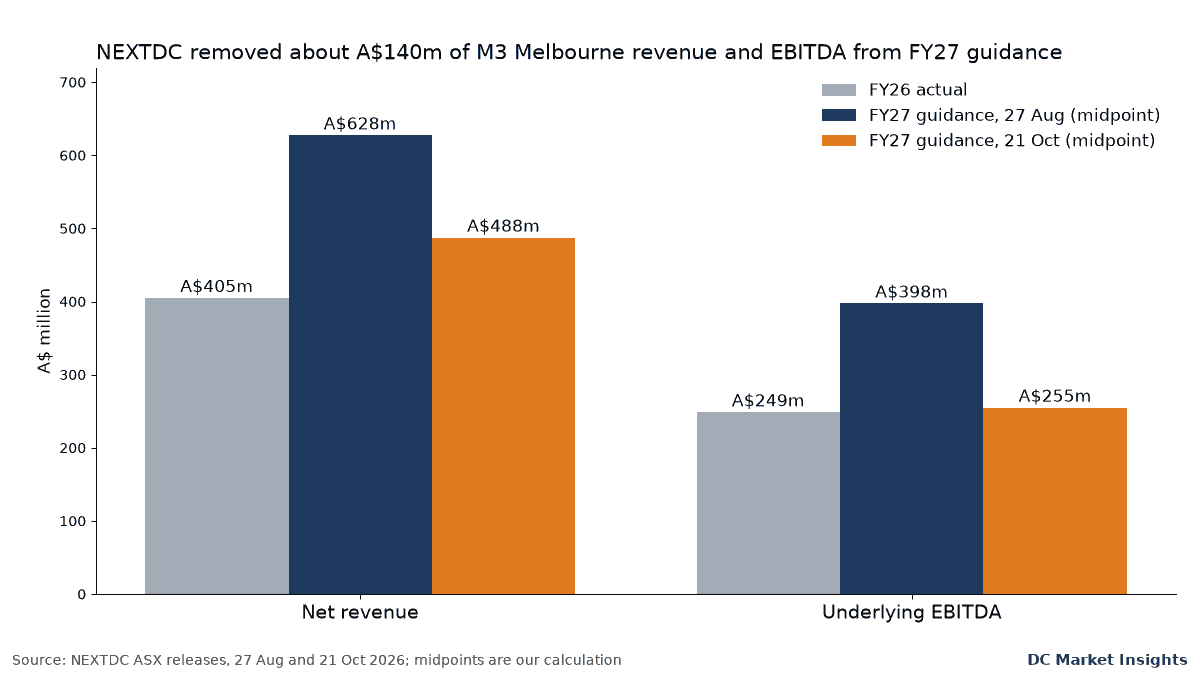
- About A$140 million of net revenue and the same amount of EBITDA from M3 contracts left the guidance. That is 100% drop-through: power, not demand, set the number (our calculation from NEXTDC’s release).
- AirTrunk delayed a planned US$1.5 billion Singapore REIT IPO to next year and had weighed raising the offer yield to about 6% from 5.5%, Bloomberg reported via The Star.
- AirTrunk is close to selling its Johor data centres to investors including Malaysian pension fund KWAP at a valuation of about US$2 billion, a figure Reuters corrected from US$1 billion, W.Media reported.
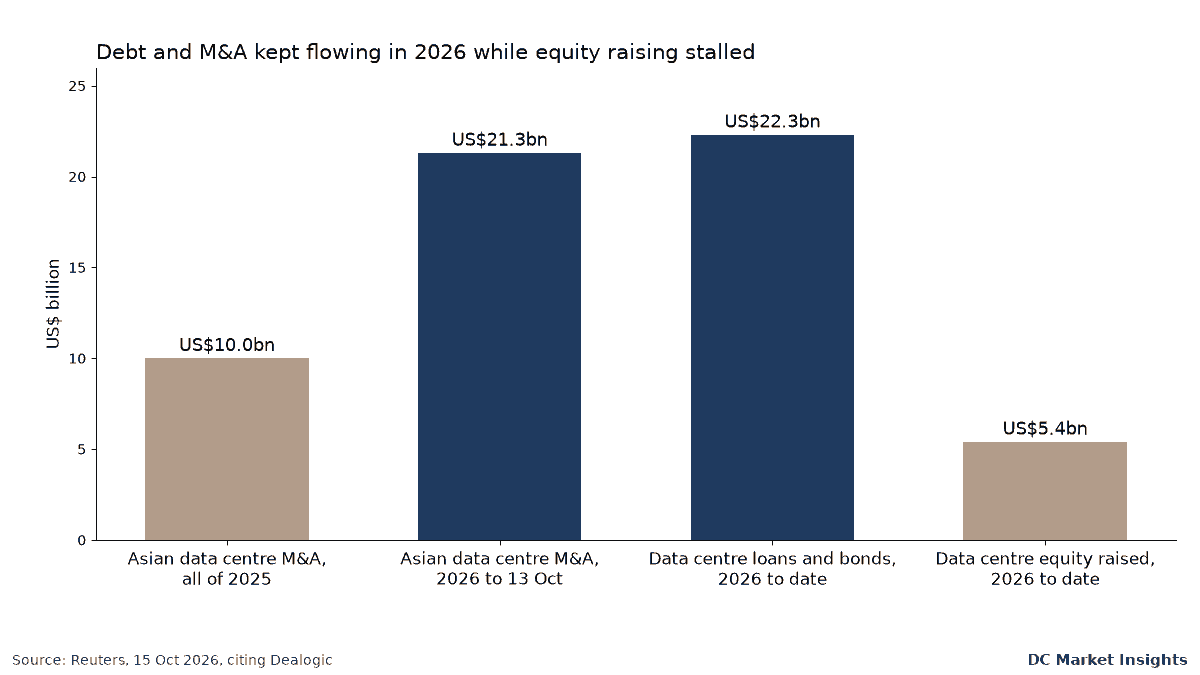
- Debt still flows: Asian data centre M&A reached US$21.3 billion in 2026 to 13 October and loans and bonds US$22.3 billion, against US$5.4 billion of equity, Reuters reported citing Dealogic.
Asia-Pacific’s two biggest data centre names gave the market its prices this week. Blackstone-backed AirTrunk pulled a US$1.5 billion listing and is selling its Malaysian campuses to a pension fund instead. NEXTDC, the region’s largest listed pure-play operator, lost about two fifths of its market value in one session after a power line in Melbourne stalled.
Read together, the two deals answer the question every buyer in the region is asking: what is a megawatt worth when interest rates are higher and grid connections are slower? The answer is that contracted, powered capacity still sells, while capacity that is waiting on a substation or on public markets is being marked down. The next fixed date is 20 November, when NEXTDC has promised the outcome of a full capital expenditure review at its annual general meeting.
What happened: one listing pulled, one sale agreed in principle, one guidance cut
On 13 October, Bloomberg and The Wall Street Journal reported that AirTrunk was delaying the initial public offering of a Singapore real estate investment trust that could have raised about US$1.5 billion. AirTrunk had planned to start gauging investor interest in early October and is now aiming for next year, The Star reported. It had considered offering a yield of about 6%, up from the 5.5% it first envisaged. Singapore’s main REIT index has fallen 12% since late July.
Two days later, Reuters reported that AirTrunk was about to sell its Johor data centres to a group of investors including KWAP, Malaysia’s civil service pension fund. Reuters first put the valuation at about US$1 billion and corrected it to about US$2 billion on 16 October, W.Media reported. Blackstone and KWAP declined to comment. Neither the stake being sold nor the exact campuses have been disclosed.
Then, before the Australian market opened on 21 October, NEXTDC released a revised FY27 outlook. Jemena, the distributor that supplies M3 Melbourne, suspended parts of its 66 kV line augmentation works in September and has told NEXTDC it does not expect to restart them before February 2027. NEXTDC now expects the next increase in grid supply to M3 during FY28, and has taken the affected contracts out of FY27 guidance.
We have taken the affected M3 contracts out of FY27 guidance until we can reliably estimate their contribution.
Decoding NEXTDC: what a delayed substation costs
The guidance change is unusually clean to read. NEXTDC said the August guidance included approximately A$140 million of each of net revenue and Underlying EBITDA from the affected M3 contracts, and that their removal is the main reason for the cut. Revenue that arrives with no extra cost is revenue from capacity that is already built and paid for. In other words, the halls are being built; the power is what is missing.
| NEXTDC FY27 guidance | 27 Aug 2026 | 21 Oct 2026 | Change at midpoint |
|---|---|---|---|
| Net revenue | A$615-640m | A$475-500m | -A$140m (-22%) |
| Underlying EBITDA | A$385-410m | A$245-265m | -A$142.5m (-36%) |
| Capital expenditure | A$5,250-5,750m | A$4,500-5,000m | -A$750m (-13% to -14%) |
| Capex before capitalised interest (like for like) | A$5,250-5,750m | ~A$4,270-4,770m | ~-A$980m (-17% to -19%) |
| FY26 actual, for reference | Net revenue A$405.0m; Underlying EBITDA A$248.8m | ||
Sources: NEXTDC ASX releases of 27 Aug 2026 (FY26 results) and 21 Oct 2026 (M3 Melbourne Power Delay and Revised FY27 Guidance). Midpoint changes are our calculation. The revised guidance excludes possible service level credits on the M3 contracts, which NEXTDC says could push EBITDA below the new range.
Three numbers show how much of the growth story moved with the power line, in our calculation. In August, NEXTDC’s FY27 EBITDA midpoint implied growth of about 60% on FY26. The new midpoint, A$255 million, implies about 2.5%. Net revenue is still guided to grow by about 20%, because capacity outside M3 keeps converting to billing. NEXTDC’s FY26 results showed a forward order book of 565.1 MW and expected 197 MW of it to convert to billing during FY27, Techpartner News reported.
The balance sheet is not the problem, at least not yet. NEXTDC had A$8,675 million of liquidity at 30 September, made up of A$1,275 million of cash, A$6,700 million of undrawn senior debt and a A$700 million hybrid tranche. It is in compliance with its covenants, a gearing ratio of no more than 60% and interest cover of at least 1.5 times. But the release warns that its ability to draw the full senior facilities depends on the billing profile of new contracts, and that delays to grid supply at M3 “could be such a change”. It has put all new development projects and land acquisitions on hold and will look at selling development sites it does not need soon.
Market reports of the share fall differ by source and time of day: 44% (Reuters, Bloomberg), 42% to a near nine-year low (Investing.com) and about 40% (ABC News, The Australian Financial Review). We use “as much as 44%”.
Decoding AirTrunk: two exits, two prices
AirTrunk’s two transactions show what each kind of buyer is willing to pay. Public REIT investors wanted a higher yield. Moving the offer yield from 5.5% to 6% means investors pay about 8% less for each dollar of distributions, 16.7 times instead of 18.2 times (our calculation). On a US$1.5 billion raise, it means about US$7.5 million more in distributions each year to the same buyers.
Private buyers with long-dated money are still writing cheques. AirTrunk said in April that its Malaysian platform will exceed 700 MW across four Johor campuses, with total committed investment of about MYR27 billion (US$6.8 billion). The two existing campuses, JHB1 and JHB2, total more than 420 MW of IT load and are “almost 100% contracted”, AirTrunk said.
| Reading of the Johor deal | Capacity base | Implied value per MW |
|---|---|---|
| US$2bn for the two contracted campuses (JHB1 and JHB2) | >420 MW | up to ~US$4.8m |
| US$2bn for the full four-campus platform | >700 MW | up to ~US$2.9m |
| AirTrunk’s committed Malaysian investment, for reference | >700 MW | ~US$9.7m invested |
Our calculation from the reported ~US$2 billion valuation (Reuters, as reported by W.Media, 16 Oct 2026) and AirTrunk’s capacity and investment figures (30 Apr 2026). Reports do not say which campuses or what share is being sold, or whether US$2 billion is equity value or enterprise value, so these are bounds rather than a price. Reuters’ first report gave about US$1 billion.
The gap between the bottom two rows is the point. If the reported valuation covers the whole platform, a buyer would be paying well under what AirTrunk has committed to spend. If it covers only the contracted JHB1 and JHB2 campuses, the price per contracted megawatt looks firmer. Until the terms are filed, the deal tells us that private capital wants contracted, energised capacity, and that a seller who needs liquidity will take it from a patient domestic buyer rather than from the public market.
Blackstone and CPP Investments bought AirTrunk in 2024 in a deal worth about US$16 billion, when it had more than 3 GW of operating and planned capacity across 20 hyperscale campuses, Bisnow reported. Recycling Johor at a fixed price, while waiting for a better REIT window, is a classic private equity move when exits through listing are closed.
The wider pattern: debt is open, equity is shut
The week’s deals fit a regional split. Reuters, citing Dealogic, reported on 15 October that Asian data centre M&A had reached US$21.3 billion in 2026, more than double the US$10 billion recorded in all of 2025, and that syndicated loans and bonds for the sector totalled US$22.3 billion. Equity raised was only US$5.4 billion, down 4.6% on a year earlier, according to the Reuters analysis. That is about four dollars of debt for every dollar of new equity (our calculation).
The listings that failed share a profile: large, new or growth-stage, and priced before the September rise in US rates. Nvidia-backed Firmus aimed to raise US$5 billion in what would have been Australia’s second-largest listing and pulled it. Philippine data centre REIT Vitro deferred its IPO to 2027, and SoftBank-backed SB Energy delayed a planned listing, Bisnow reported. The deals that closed are backed by contracts and banks. On 13 October, DayOne added RM15 billion of financing for Johor from seven lenders, a US$2.4 billion offshore term loan and a RM5.5 billion Islamic facility, taking its Johor financing to RM30 billion, The Star reported. DayOne filed for a Nasdaq IPO on 6 October, EdgeProp reported.
The conversation has shifted from growth at any cost to a much sharper focus on quality
There may not be fundamental asset value when you peel it all back.
Who gains and who pays
Patient domestic capital. Pension funds such as KWAP can buy contracted hyperscale capacity from sellers who would rather not wait for a listing window. In Malaysia, DC Market Insights data tracks 64 facilities with 1,205.5 MW live, 1,103.2 MW under construction and 1,658 MW planned. AirTrunk’s four Johor campuses, at more than 700 MW, equal about 18% of all that tracked capacity (our calculation).
Banks. Seven lenders took RM15 billion of fresh DayOne exposure in one week. In a market where equity is scarce, lenders set the terms, and contracted billing is what they lend against. NEXTDC’s own covenant test counts the annualised EBITDA of contracts expected to start billing within 24 months, which is why a power delay can reach the balance sheet.
Customers at M3. NEXTDC says its contracts provide for service level credits when capacity is delivered late or not fully powered and, in some cases, give the customer the right to terminate. NEXTDC is assessing whether force majeure relief applies. Its revised guidance does not include any credits.
Listed operators and growth equity. They pay the higher cost of capital. NEXTDC’s A$980 million like-for-like capex cut and its land and development freeze mean less new capacity in Australia in FY27 than planned in August.
The power problem is not only Australian. Malaysia moved this month to make data centres pay for the power they reserve and for their own grid upgrades, as we reported on 19 October. Regional Australia’s 3.1 GW of proposed AI campuses also depend on new connections, as we covered on 20 October.
What it means for operators, investors and vendors
Our view, based on the deals above:
- Price power dates, not just megawatts. At M3, one distributor’s suspended 66 kV works moved A$140 million of EBITDA out of a year. Underwrite every grid milestone with its own owner, permit and fallback date.
- Read contracts for the delay clauses. Service level credits and termination rights turn a utility’s delay into an operator’s loss. Customers should check what they are owed; operators should check what force majeure covers.
- Expect more private sales, fewer listings, until rates settle. With equity at US$5.4 billion against US$22.3 billion of debt this year, sellers like AirTrunk will keep turning to pension funds and infrastructure funds. A 0.5-point yield move is worth about 8% of value.
- Use the Johor bounds, not a single number. Until terms are filed, the reported deal implies up to about US$4.8 million per contracted MW, or up to US$2.9 million per MW across the full platform. Neither is a comparable yet.
- Vendors: watch NEXTDC’s 20 November list. A capex cut of about A$980 million like for like means some Australian equipment orders will slip. Contracted near-term halls keep priority.
For the size of the markets these deals touch, see our Australia Data Center Infrastructure Market report, the Malaysia Data Center Thermal Management Market report and the AI Data Center Market report. Deal data and valuation benchmarks are on our Deal Tracker and Data Center Transaction Comps pages, and Malaysia’s rules are on the Malaysia power and policy page.
What to watch next
- 3 November 2026: the Victorian Government enters caretaker mode, NEXTDC said; no planning decision on M3 Stages 6 and 7 (application PA2604231) is expected before 2027.
- 20 November 2026: NEXTDC’s annual general meeting, where the board has committed to announce the outcome of its capital expenditure review and give further updates on M3.
- 28 November 2026: Victorian State election.
- Late 2026: signing and terms of AirTrunk’s Johor sale to the KWAP-led group, if the deal completes as reported; and any update on DayOne’s Nasdaq IPO.
- Early 2027: AirTrunk’s target window for the delayed Singapore REIT; February 2027 is the earliest date Jemena expects to restart its M3 works; NEXTDC’s half-year results will show any fair value change on M3.
Frequently asked questions
Why did NEXTDC shares fall 44%?
NEXTDC cut FY27 Underlying EBITDA guidance to A$245-265 million from A$385-410 million on 21 October. About A$140 million from M3 Melbourne contracts was removed because Jemena suspended grid works; the next supply increase is now expected in FY28.
Why did AirTrunk delay its Singapore REIT IPO?
The roughly US$1.5 billion listing met weak demand after higher US rates and an AI stock sell-off. AirTrunk weighed raising the offer yield to about 6% from 5.5% and now aims for next year, Bloomberg reported.
How much is AirTrunk’s Johor business worth?
About US$2 billion in a sale to investors including KWAP, Reuters reported after correcting an earlier US$1 billion figure. AirTrunk’s Malaysian platform will exceed 700 MW, so that implies up to US$2.9-4.8 million per MW, depending on what is sold.
Is money still flowing into Asian data centres?
Yes, mostly as debt and M&A. Asian data centre M&A reached US$21.3 billion in 2026 to 13 October and loans and bonds US$22.3 billion, but equity raising was only US$5.4 billion, Reuters reported citing Dealogic.
Sources
- NEXTDC, “M3 Melbourne Power Delay and Revised FY27 Guidance”, ASX release, 21 Oct 2026 (as published via The Motley Fool Australia). Link
- NEXTDC, FY26 results, ASX release, 27 Aug 2026. Link
- AirTrunk, “AirTrunk doubles down in Malaysia with two new hyperscale campuses in Johor Bahru”, 30 Apr 2026. Link
- Reuters, “Market selloff, rising rates test AI data centre deal boom”, 15 Oct 2026 (via Kitco). Link
- W.Media, “AirTrunk nears deal to sell its Johor data centers”, 16 Oct 2026. Link
- The Star (Bloomberg), “AirTrunk puts Singapore REIT listing on hold amid volatility”, 14 Oct 2026. Link
- Bisnow, “Blackstone-Backed Data Center Firm AirTrunk Reportedly Delaying $1.5B IPO”, 13 Oct 2026. Link
- The Motley Fool Australia, “NEXTDC slashes FY27 guidance after M3 Melbourne power delay”, 21 Oct 2026. Link
- Techpartner News, “NEXTDC’s FY26 become largest contracting year in company history”, Aug 2026. Link
- The Star, “S’pore DC developer gets US$3.67bil boost”, 14 Oct 2026. Link
- EdgeProp, “DayOne secures RM15b multicurrency financing for data centres in Johor”, 13 Oct 2026. Link
- DC Market Insights data, Malaysia country data (64 facilities; AirTrunk 4 sites), 21 Oct 2026. Link