

Key takeaways
- NVIDIA said at GTC Berlin on 21 October that its DSX designs, which cool Vera Rubin chips with liquid at up to 45°C and reject the heat through dry coolers, could save 54 million litres of water a day at 2 GW against cooling towers (NVIDIA).
- That is about 9,855 cubic metres per MW a year, within 1% of the 9,800 m³ per MW that DC Market Insights models for an open cooling tower (our calculation).
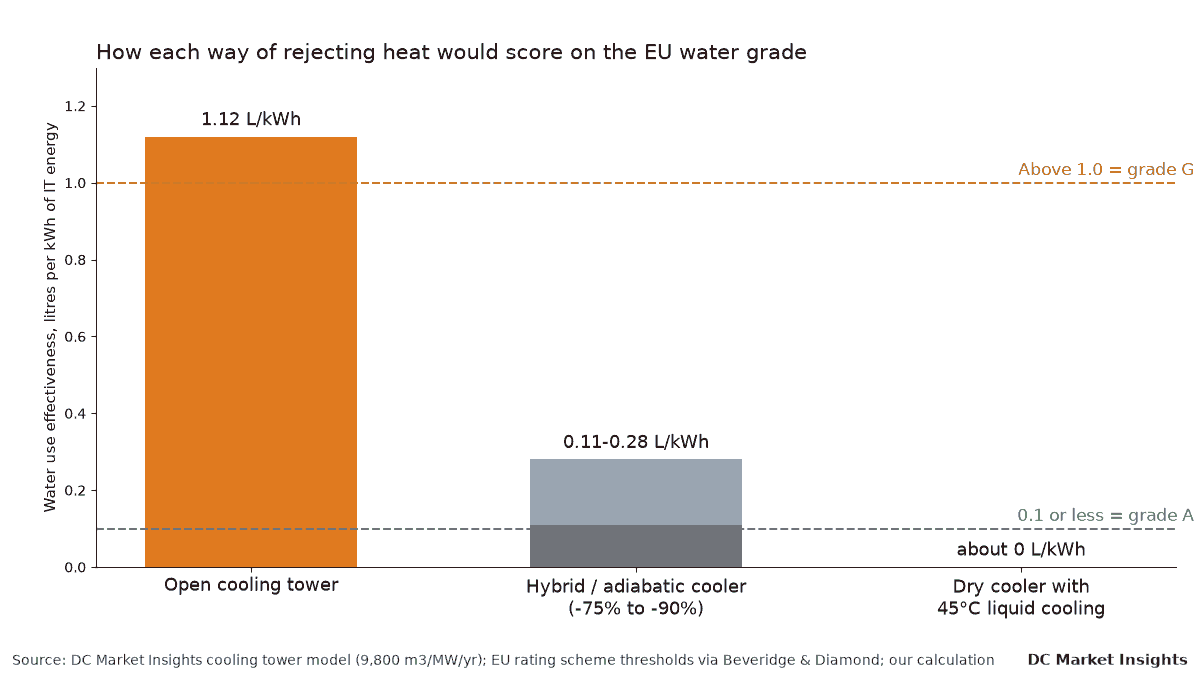
- On the EU’s proposed data centre label, an open tower works out at about 1.12 litres per kWh, a grade G for water; a dry cooler scores close to zero, a grade A at 0.1 or less (our calculation; EU thresholds via Beveridge & Diamond).
- Taking the chiller out also cuts heat-rejection equipment in an AI hall from about US$400,000 to US$205,000 per MW, before installation (DC Market Insights estimate).
- The Commission’s consultation on minimum performance standards for data centres closes on 14 December 2026; the first labels are due by 15 August 2027 (European Commission; Arthur Cox).
The cheapest litre of water in a European AI data centre is now the one it never evaporates. NVIDIA used its GTC Berlin keynote on 21 October to tell European builders that its next AI factories can run their cooling loops at 45°C and dump the heat into the air, with no cooling towers and, for most of the year, no chillers.
Why now: Brussels is about to start grading every data centre of 500 kW or more on water and power. The rating scheme is in its two-month scrutiny period at the European Parliament and the Council, the consultation on binding minimum standards closes on 14 December, and Germany is rewriting its own efficiency law in the Bundestag. The cooling choice an operator signs this winter will decide which grade its halls carry from 2027.
What NVIDIA announced in Berlin
NVIDIA’s GTC Berlin conference ran from 20 to 22 October. In the keynote on 21 October, chief executive Jensen Huang presented the DSX POD, a reference design for complete Vera Rubin AI factories that partners build inside modular containers, test before delivery and connect at a prepared site. NVIDIA says on-site deployment drops from six months to as little as 14 days once site utilities are ready, with first deliveries in early 2027. Seventeen companies are building them, among them Bull, Dell Technologies, HPE, Lenovo, Schneider Electric and Vertiv, according to NVIDIA’s announcement.
An AI factory creates value when it starts producing tokens — not when construction is complete.
The cooling claims came in a second release the same day. NVIDIA said Vera Rubin systems are fully liquid cooled at coolant temperatures of up to 45°C, that dry coolers reject that heat without evaporating water, and that the DSX designs could save 54 million litres a day at 2 GW compared with cooling-tower systems, equal to the daily water use of 180,000 households, according to NVIDIA’s DSX ecosystem release. Trane Technologies published three 250 MW cooling reference designs based on DSX, and Vertiv qualified a 2.3 MW coolant distribution unit. Separately, NVIDIA says its DSX MaxLPS software can produce the same number of tokens with up to 30% less power. That is a computing claim, not a cooling one, and we do not add it to the water figures.
The 45°C figure is not new to Berlin. NVIDIA first set it out in June: coolant enters a fully liquid-cooled chip at up to 45°C and leaves at about 55°C, the loop is 75% water and 25% propylene glycol, and chillers may be needed for about 1% of the year in some climates, according to NVIDIA’s technical blog. What changed this week is that NVIDIA and its European partners now sell it as a standard, factory-built product.
The NVIDIA DSX reference design for AI factories has zero water consumption
The water arithmetic: from 9,800 m³ per MW to almost none
NVIDIA’s own baseline is that cooling-tower systems use about 2.6 million US gallons per MW a year. That is about 9,842 cubic metres. DC Market Insights models an open-circuit cooling tower at about 9,800 m³ per MW of IT load a year in its Data Center Cooling Tower Market report. NVIDIA’s Berlin figure, 54 million litres a day at 2 GW, works out at about 9,855 m³ per MW a year. The three numbers agree within 1%, so the saving is not a marketing artefact: it is simply the water a tower would have evaporated.
Hybrid and adiabatic coolers, which spray water only on the hottest days, cut tower water by 75% to 90% in our model. A dry cooler uses no water in normal operation; it pushes air across finned coils with fans.
What changed in Brussels and Berlin
On 21 September the European Commission proposed a common EU rating scheme for data centres with an installed IT power demand of at least 500 kW, as a delegated regulation under the Energy Efficiency Directive. The label will show actual energy and water use, waste heat reuse, clean energy and how flexibly a site can adjust its demand to the grid, the Commission said. Parliament and Council have two months to object; they cannot amend the text. It enters into force 20 days after publication in the Official Journal, and labels are created automatically from the EU database by 15 August 2027 and every year after, Arthur Cox noted.
The grades are tight. Grade A for power usage effectiveness (PUE) needs 1.15 or less, and grade G applies above 1.9. Grade A for water usage effectiveness (WUE) needs 0.1 litres per kWh or less, and grade G applies above 1.0, according to a summary by the law firm Beveridge & Diamond. The final text also replaces “potable water input” with “freshwater input”, which widens what counts as water use.
The label is only the first step. The Commission has opened a consultation on minimum performance standards, which could become binding floors on PUE, WUE, energy reuse and renewable energy. It closes on 14 December 2026, and the Commission plans a proposal in the second quarter of 2027, according to the consultation page and the Beveridge & Diamond summary. Germany and China already set minimum standards for new data centres.
| Rule | What it requires | Date |
|---|---|---|
| EU rating scheme (delegated regulation) | Label for sites of 500 kW+ on energy, water, waste heat, clean energy, flexibility; PUE grade A at 1.15 or less, WUE grade A at 0.1 L/kWh or less | Proposed 21 Sep 2026; labels by 15 Aug 2027 |
| EU minimum performance standards | Possible binding floors on PUE, WUE, energy reuse factor (ERF), renewable energy factor (REF) | Consultation to 14 Dec 2026; proposal Q2 2027 |
| Germany EnEfG § 11, new data centres | PUE 1.2 or less; reused energy at least 10% (15% from 1 Jul 2027, 20% from 1 Jul 2028) | Operation from 1 Jul 2026 |
| Germany EnEfG § 11, existing data centres | PUE 1.5 or less from 1 Jul 2027, 1.3 or less from 1 Jul 2030 | In force |
| Germany EnEfG § 11(5), all data centres | 50% renewable electricity from 1 Jan 2024, 100% from 1 Jan 2027 | In force |
| Germany amendment bill 21/8027 | Existing sites 1.6 from 2027 and 1.4 from 2030; four years for new sites to reach 1.2; 100% renewable moves to 2030; new waste heat exceptions | First reading 24 Sep 2026; hearing 5 Oct 2026 |
Source: European Commission, 21 Sep 2026; Commission Delegated Regulation C(2026) 3472; Beveridge & Diamond; Energieeffizienzgesetz § 11; FPS Law, 26 Jun 2026 (amendment as adopted by the cabinet on 24 Jun 2026; the Bundestag may still change it).
Germany is moving the other way on some of its own limits. The government’s bill 21/8027, debated in first reading on 24 September and heard by the Bundestag’s economy and energy committee on 5 October, would relax the PUE limits for existing sites and push the 100% renewable deadline from 2027 to 2030. It keeps 1.2 for new sites but gives them four years instead of two to reach it, FPS Law wrote. At the hearing, the German Datacenter Association backed ambitious requirements but asked that they be measurable and within operators’ control, while environmental groups warned against weakening the law, the Bundestag reported. No date for the final vote has been set.
The economics: what a chiller-free AI hall saves per MW
Water is only half of the case. A 45°C loop also removes most of the chiller plant. DC Market Insights estimates heat-rejection equipment for an AI hall in 2025 at about US$140,000 per MW of IT load for cooling towers, US$205,000 for dry coolers and US$260,000 for chillers, all before 15% to 18% installation. An AI hall with towers and chillers therefore carries about US$400,000 per MW of this equipment. A chiller-free hall on dry coolers carries US$205,000, which is US$195,000, or 49%, less (our calculation).
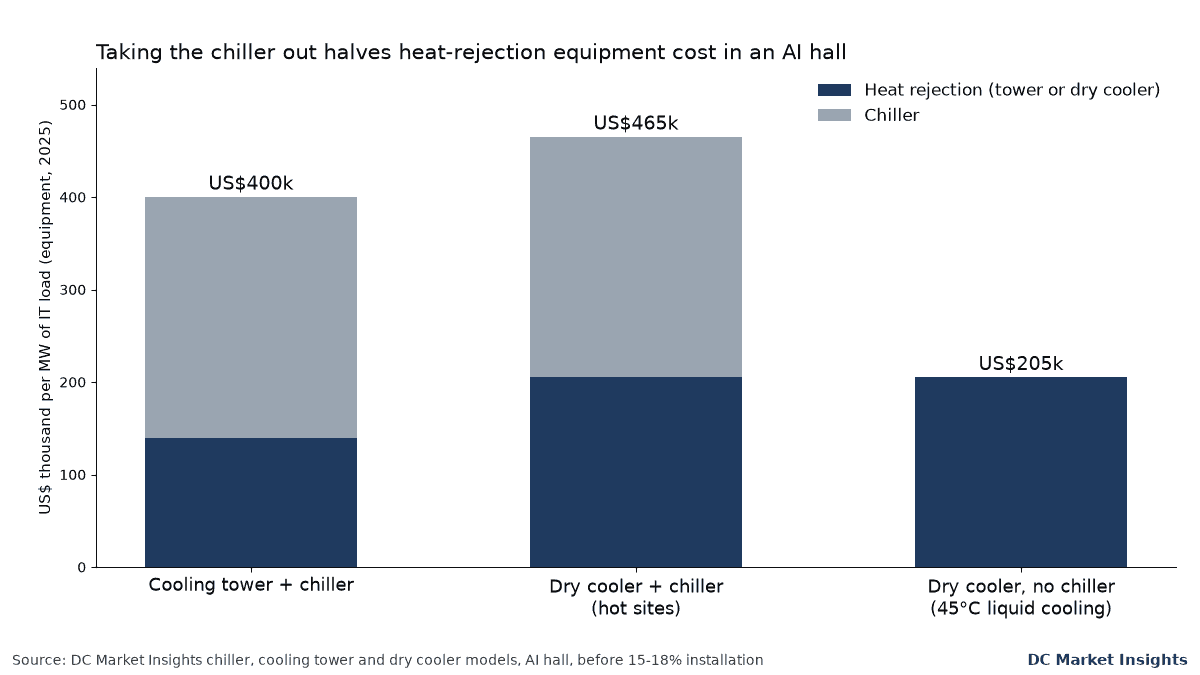
The saving is not free everywhere. A dry cooler is bigger and dearer than a tower for the same heat, and on hot sites where the outside air can approach the loop temperature the chiller stays. A hot site with dry coolers and chillers carries about US$465,000 per MW, 16% more than the tower design, but with far less water. That is why DC Market Insights expects the dry-cooled share of new AI capacity to rise from 50% in 2025 to 70% by 2035, the share using chillers to fall from 80% to 50%, and the evaporative share to fall from 48% to 30%. The cooler the site, the fewer hours the chiller runs; in our model, hot sites such as Riyadh and Mumbai keep them.
| AI hall design | Equipment per MW (2025) | Water per MW a year | EU water grade (our estimate) |
|---|---|---|---|
| Open cooling tower + chiller | About US$400,000 | About 9,800 m³ | G (about 1.12 L/kWh) |
| Hybrid or adiabatic cooler + chiller | Not modelled separately | About 980-2,450 m³ | Between A and G (0.11-0.28 L/kWh) |
| Dry cooler + chiller (hot sites) | About US$465,000 | About 0 | A |
| Dry cooler, no chiller (45°C liquid cooling) | About US$205,000 | About 0 | A |
Source: DC Market Insights chiller, cooling tower and dry cooler market models (AI hall, equipment before 15-18% installation); EU grade thresholds via Beveridge & Diamond; our calculation. WUE assumes full IT load across 8,760 hours; the B to F class limits were not available to us, so grades are given only where a value is at or beyond the A or G threshold.
What 45°C does to the PUE race
Cooling has historically used up to 40% of a data centre’s electricity, NVIDIA says. On that share alone a site’s PUE would be at least 1.67, well above every European limit. Germany’s 1.2 for new sites leaves at most 16.7% of total facility energy for everything that is not IT, and the EU’s grade A at 1.15 leaves 13.0% (our calculation). Industry estimates put the saving from raising chiller temperatures at about 4% of cooling energy per degree, Cooling Post reported. A loop that runs at 45°C instead of the 18°C to 27°C long recommended for air is the largest single step an operator can take towards those limits.
There is a second benefit in Germany. New sites must reuse 10% of their energy from July 2026, rising to 20% for sites opening from July 2028. Heat leaving a chip at about 55°C is much closer to what a district heating network can use than the warm air of an older hall, so less heat-pump work is needed to lift it. The Commission says reusing about half of the waste heat from EU data centres could heat four million households. The amendment bill would let operators skip reuse where no heat network is economic, which lowers the cost of failing that test.
Europe’s AI ambitions demand that we make every megawatt count
The wider pattern: Germany’s 4.4 GW pipeline as a test case
DC Market Insights tracks 177 data centres in Germany, with 843.8 MW live, 2,013.9 MW under construction and 2,414.8 MW planned, as of 22 October. If all 4,428.7 MW in the pipeline were IT load running at full use on open cooling towers, they would evaporate about 43.4 million m³ of water a year, the daily use of about 396,000 households at the 300 litres a day implied by NVIDIA’s household comparison. On dry coolers that falls to about zero. Built chiller-free, the same pipeline would need about US$864 million less heat-rejection equipment than a tower-and-chiller design (our calculation). Both are upper bounds: tracked MW are not all IT load, and not every hall will run AI racks at 45°C.
The same choice is being made across Europe. Nscale, which runs AI factories in Iceland and Portugal, reported 49% higher inference throughput within a 264 kW power budget in an NVIDIA trial, and Nebius took part in a grid-flexibility test with the UK’s National Grid, according to NVIDIA. The Commission wants EU data centre capacity to triple over the next five to seven years and cites the International Energy Agency’s projection that data centres will use more than 3% of EU electricity by 2030. With labels due in 2027, buyers will be able to compare the grades of competing campuses for the first time.
What it means for operators, investors and vendors
Our view: water is about to become a visible, graded number on every European data centre, and the 45°C liquid loop is the cheapest way to score well on it.
- Operators: price a chiller-free option for every new AI hall north of the Alps. It cuts heat-rejection equipment by about US$195,000 per MW and takes WUE from about 1.12 to about zero.
- Operators with towers: an open-tower site sits in grade G for water on our arithmetic. Hybrid or adiabatic retrofits that cut water by 75% to 90% move it towards 0.11-0.28 L/kWh; budget them before the first labels in August 2027.
- Investors: ask for modelled PUE and WUE grades in diligence. A 1.2 PUE leaves no more than 16.7% of energy for cooling and losses; a hall that misses it in Germany has four years under the bill, not forever.
- Vendors: dry-cooler demand is rising fastest. DC Market Insights puts the market at US$1.34 billion in 2026, growing 16.72% a year to US$4.75 billion by 2035, while the cooling tower market grows 8.06% a year.
- Everyone: answer the Commission’s consultation by 14 December 2026 with real retrofit costs and lead times; that evidence will shape the floors proposed in 2027.
For the full models behind these figures, see our Data Center Dry Cooler Market, Data Center Cooling Tower Market and Data Center Chiller Market reports. Germany’s efficiency and grid rules are tracked on our Power & Policy tracker, the sites behind the 4.4 GW pipeline are in the data centre database, and you can test a site against the PUE limits with our PUE calculator.
What to watch next
- About 21 November 2026: the two-month objection window of Parliament and Council on the EU rating scheme ends, counted from 21 September (our calculation; the formal clock runs from notification). Publication in the Official Journal follows.
- 14 December 2026: the Commission’s consultation on minimum performance standards for data centres closes.
- Not yet scheduled: the Bundestag’s second and third readings of the EnEfG amendment 21/8027.
- 1 January 2027: Germany’s 100% renewable electricity rule for data centres takes effect under current law; the bill would move it to 2030.
- Early 2027: first NVIDIA DSX POD deliveries.
- Second quarter of 2027: the Commission’s proposal on minimum performance standards.
- 1 July 2027: Germany’s PUE limit for existing data centres (1.5 under current law, 1.6 under the bill); new sites opening from this date need 15% energy reuse.
- 15 August 2027: the first EU data centre labels are due.
Frequently asked questions
How much water does a data centre cooling tower use?
About 9,800 cubic metres per MW of IT load a year for an open tower, in line with the 2.6 million gallons per MW that NVIDIA cites. NVIDIA’s Berlin figure, 54 million litres a day at 2 GW, equals about 9,855 m³ per MW a year.
What is NVIDIA’s 45°C liquid cooling?
Vera Rubin chips are cooled by a closed liquid loop at up to 45°C, leaving at about 55°C. That heat can be rejected by dry coolers without evaporating water; NVIDIA says chillers may be needed for about 1% of the year in some climates.
What grades will the EU data centre label give for water?
Grade A needs a WUE of 0.1 litres per kWh or less; grade G applies above 1.0. On our arithmetic an open cooling tower is about 1.12 L/kWh, a grade G, and a dry cooler is close to zero, a grade A. Labels are due by 15 August 2027.
Does dry cooling cost more than a cooling tower?
The dry cooler itself does, about US$205,000 per MW in an AI hall against US$140,000 for towers. But with a 45°C loop the US$260,000 chiller can go, so total heat-rejection equipment falls from about US$400,000 to US$205,000 per MW (DC Market Insights).
Sources
- NVIDIA, “European Ecosystem Builds World’s Most Efficient AI Factories With NVIDIA DSX”, 21 Oct 2026. Link
- NVIDIA, “NVIDIA Introduces DSX POD AI Factories to Accelerate Europe’s Infrastructure Deployment”, 21 Oct 2026. Link
- NVIDIA Blog, “GTC Berlin 2026: Live Updates From NVIDIA CEO Jensen Huang’s Keynote”, 21 Oct 2026. Link
- NVIDIA Blog, “Hotter Than a Hot Tub: The 45°C Breakthrough to Cool AI’s Biggest Machines”, 21 Jun 2026. Link
- Cooling Post, “NVIDIA raises data centre cooling to 45ºC”, 5 Jul 2026. Link
- European Commission, “Making data centres energy efficient thanks to new EU rating system”, 21 Sep 2026. Link
- European Commission, Delegated Regulation establishing a common Union rating scheme for data centres, C(2026) 3472, EUR-Lex. Link
- European Commission, “Data centres in Europe – minimum performance standards”, call for evidence and public consultation (Have your say 19293). Link
- Beveridge & Diamond, “European Commission Advances Data Center Sustainability Ratings and Consults on Minimum Performance Standards”, Sep 2026. Link
- Arthur Cox, “Data centres: new regulation on rating scheme and consultation on minimum performance standards”, 21 Sep 2026. Link
- Bundesministerium der Justiz, Energieeffizienzgesetz (EnEfG) § 11, gesetze-im-internet.de. Link
- Deutscher Bundestag, public hearing of the Committee on Economic Affairs and Energy on bill 21/8027, 5 Oct 2026. Link
- FPS Law, “EnEfG-Novelle 2026: Was der Kabinettsbeschluss für Rechenzentren bedeutet”, 26 Jun 2026. Link
- DC Market Insights, facilities data for Germany, 22 Oct 2026; Data Center Dry Cooler Market, Data Center Cooling Tower Market and Data Center Chiller Market reports, Oct 2026.