

Key takeaways
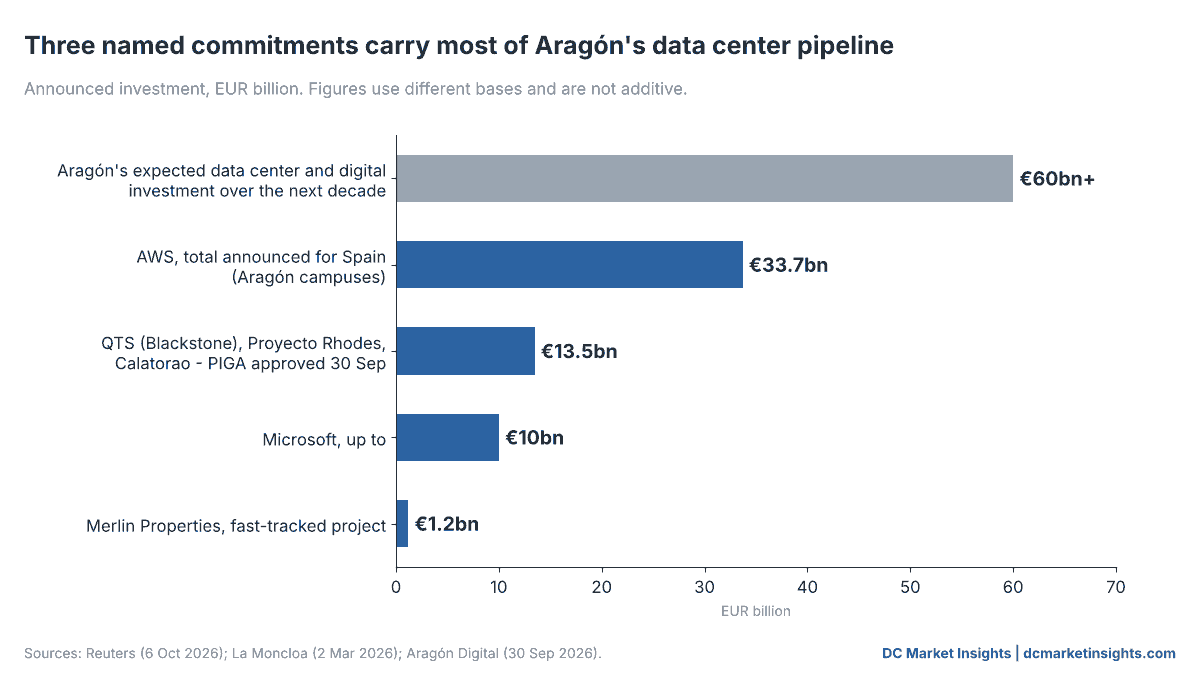
- Aragón expects more than €60 billion of data center and digital infrastructure investment over the next decade, Reuters reported on 6 October, and has fast-tracked more than a dozen large projects.
- Spain has granted more than 12 GW of grid access and connection rights to data centers since 2021, against 3.5-4 GW of demand its AI strategy needs by 2030, according to the Ministry for the Ecological Transition (MITECO).
- Aragón approved QTS’s (Blackstone) Proyecto Rhodes in Calatorao on 30 September, a project of up to €13.471 billion, Aragón Digital reported.
- A draft royal decree would tie grid access to 80% hourly-matched renewable supply, EU data residency and top-class PUE and WUE. Lawyers at Ashurst expect approval around October-November 2026.
- Spain votes in a snap general election on 29 November. The opposition People’s Party has signalled that projects would be “re-evaluated” if the decree passes.
Spain’s north-east has become one of the largest open doors for data center capital in Europe. The question for the next seven weeks is who gets through it, and on what terms.
Three things landed within a fortnight. Aragón approved a Blackstone-backed campus of up to €13.5 billion on 30 September. Madrid said in early October that it plans to approve this month the decree that will decide which of Spain’s 12 GW of granted grid access gets built. And on 5 October, Prime Minister Pedro Sánchez called a general election for 29 November, putting a clock on the whole rulebook.
How Aragón became Europe’s fast lane
Aragón’s tool is a status, not a subsidy. A project declared a “Project of General Interest of Aragón” (PIGA) gets swift planning decisions, land expropriation powers and local tax breaks, and a one-stop investor service sends weekly progress updates, Reuters reported. PIGA can cut approval times from years to under 12 months. Aragón has fast-tracked more than a dozen large data center projects this way.
We’re simply streamlining a process that can be very complex.
The anchor is Amazon Web Services. In March, AWS raised its planned investment in Spain to €33.7 billion, adding €18 billion to the €15.7 billion confirmed in 2024, with new facilities planned in Teruel, Huesca and Zaragoza, La Moncloa said. The government called it Amazon’s largest investment in the country. Reuters reported that it is AWS’s largest such investment outside the United States. Microsoft plans up to €10 billion in Aragón, and Merlin Properties has a €1.2 billion project on the fast track.
What changed in the last two weeks
The biggest single approval yet. On 30 September the Government of Aragón approved the PIGA for QTS’s Proyecto Rhodes campus in Calatorao, with investment of up to €13.471 billion, Aragón Digital reported. QTS said site works would start immediately. Aragón’s president, Jorge Azcón, said the campus could create 3,400 jobs when fully developed, including 1,200 direct construction jobs in phase one and up to 200 permanent jobs once operating.
A national rulebook with a date. On 4 October, Energías Renovables reported that the government plans to approve in October the royal decree that regulates data centers. MITECO opened the draft to public consultation on 27 August, with comments due by 4 September. The ministry’s own figures show why it wants a filter: Spain’s AI strategy needs about 2.5 GW of computing capacity by 2030, which means 3.5 to 4 GW of electricity demand, yet more than 12 GW of grid access and connection rights have been granted to data centers since 2021, MITECO said.
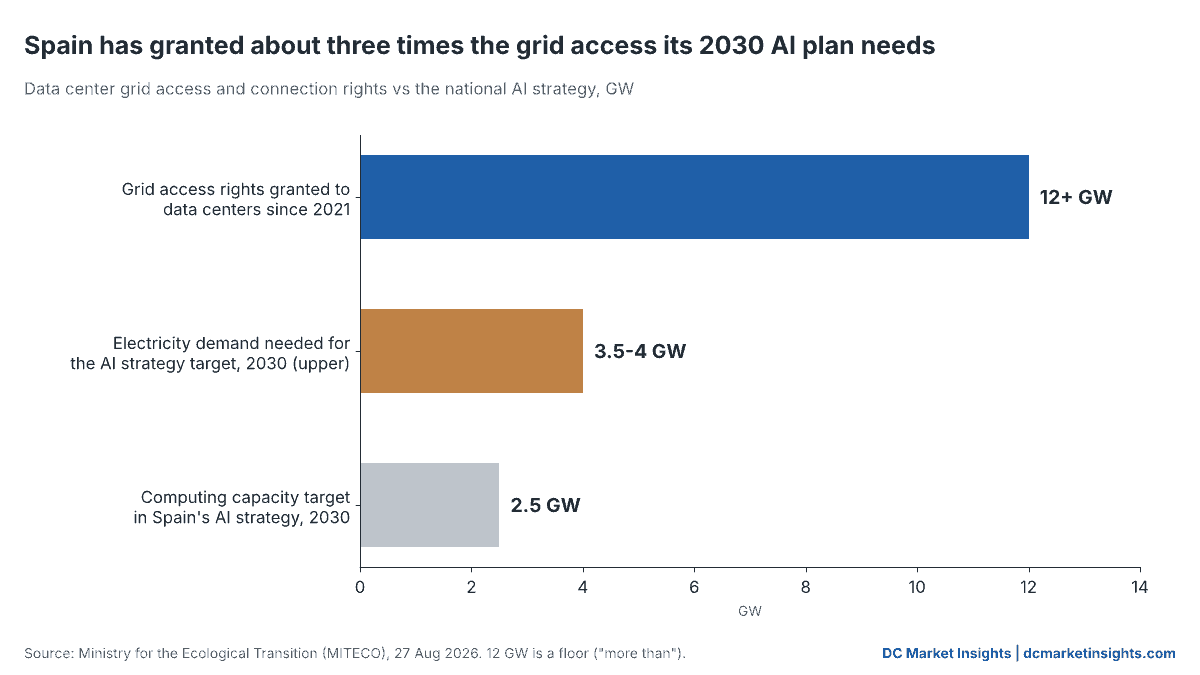
By our calculation, the access already granted is three to 3.4 times the demand the national AI strategy needs by 2030 (12 GW against 3.5-4 GW). That gap is the opportunity and the risk in one number. There is room for far more projects than the plan assumes, but not all of the paper capacity will survive a stricter test.
An election that puts the rulebook on a clock. On 5 October, Sánchez called a snap general election for 29 November after parliament rejected his government’s housing measures, Al Jazeera reported. The opposition has already said what it would do with the decree.
If the proposed decree is approved, many of the projects will surely be re-evaluated
What the draft decree asks of a new data center
The draft would make grid access and connection permits conditional on three blocks at once: digital sovereignty, efficiency and renewable supply. It applies to facilities of 1 MW or more of access power, according to a client alert from Ashurst.
| Draft royal decree requirement | What it means |
|---|---|
| Scope | Facilities of 1 MW or more of access power; annual reporting from 500 kW of IT power, including centers already connected |
| Digital sovereignty | Operator established in the EU; data, metadata and operating records kept in EU territory; control of access by non-EU authorities. Enforced only after a ministerial order |
| Efficiency | Class A for PUE and WUE under the EU rating scheme, expected from August 2027; interim caps of PUE 1.15 and WUE 0.1 |
| Renewable supply | At least 80% of consumption renewable until renewables pass 90% of the mix; each new MW matched by a new renewable MW installed in the 18 months before start-up; 80% matched hour by hour |
| Projects already in the pipeline | Pending applications: three months to prove compliance. Permits granted but not connected: six months, or the permit lapses; holders may waive within six months without losing their guarantees |
| Centers already connected | Exempt from the access conditions; reporting duties still apply |
Sources: MITECO, 27 Aug 2026; Ashurst, 1 Sep 2026. The text is a draft and may change. MITECO says pending projects have three months only when awaiting a grid access tender.
The transitional clock is the part investors should model. If the decree took effect in late November, a project holding granted but unconnected access would have until about late May 2027 to prove it meets every block, or lose the permit (our calculation from the six-month rule as described by Ashurst). The industry says that is too tight.
Podemos negociar, pero lo que no es negociable es que España se convierta en el país más restrictivo de Europa
In English: “We can negotiate, but it is not negotiable that Spain becomes the most restrictive country in Europe.” SpainDC, the national data center association, said three international companies had warned they would halt projects worth €9 billion if the draft goes ahead, ESdiario reported. It put those projects at 15% of the €66.9 billion of data center investment planned for Spain through 2030.
SpainDC’s two figures do not reconcile exactly: €9 billion is 13.5% of €66.9 billion (our calculation), not 15%. ESdiario does not explain the difference.
Who gains, and how much
Hyperscalers with land, power and permits already in hand. AWS’s €33.7 billion plan and Microsoft’s up-to-€10 billion plan sit on approved or advancing PIGAs. Centers already connected are exempt from the new access test. Every month a competitor spends proving compliance is a month of advantage for capacity that is already energised or close to it.
Blackstone and QTS. Proyecto Rhodes has regional approval and a start on site. Its exposure is the national test: renewable additionality and hourly matching at that scale will need a large, dedicated renewable portfolio. Aragón has the resource; contracting it inside 18 months of start-up is the job.
Renewable developers and storage. The 80% hourly-matching rule is, in effect, an order book. Each new data center megawatt must be matched by a new renewable megawatt, and an hour-by-hour test pushes buyers towards firming with storage.
Efficiency and cooling vendors. In our view, interim caps of PUE 1.15 and WUE 0.1 would be demanding for new builds. They favour liquid and closed-loop cooling and high-efficiency power trains. DC Market Insights estimates the Spain Data Center Market at USD 6,379.05 million in 2025, rising to USD 14,652.80 million by 2035.
Towns, and the doubters. The gains are less clear locally. On 8 October, PSOE deputy Jesús Morales told the Cortes de Aragón that data centers would triple the region’s energy consumption and create 2,000 to 3,000 permanent jobs, about 0.5% of Aragón’s employment, citing the Fundación Basilio Paraíso, the party said. In 2025, elDiario.es reported that five projects then in the PIGA process would use nearly 16,000 GWh a year, against about 10,000 GWh consumed by the whole of Aragón the previous year. Ecologistas en Acción has filed what is believed to be Spain’s first lawsuit against a major data center development, challenging the Amazon fast track, Reuters reported.
| Project (Aragón) | Investment | Status | Source |
|---|---|---|---|
| AWS, campuses in Aragón (Spain-wide plan) | €33.7 billion | Announced March 2026; earlier PIGA approved 2025 | La Moncloa; elDiario.es |
| QTS (Blackstone), Proyecto Rhodes, Calatorao | Up to €13.471 billion | PIGA approved 30 Sep 2026; site works starting | Aragón Digital |
| Microsoft | Up to €10 billion | Fast-tracked | Reuters |
| Merlin Properties | €1.2 billion | Fast-tracked | Reuters |
| Aragón total expected over the next decade | More than €60 billion | Regional expectation | Reuters |
Sources: Reuters via Khaleej Times, 6 Oct 2026; La Moncloa, 2 Mar 2026; Aragón Digital, 30 Sep 2026. The AWS figure covers Spain, not only Aragón, so the rows should not be added to the regional total.
The grid is the real gate
Money is not the scarce input. Grid capacity is. In September 2025, the government’s proposed transmission plan foresaw more than €13.5 billion of investment. It noted that more than 43 GW of access rights had been granted to demand projects nationally since 2020, while the plan expected to serve 27.7 GW on the transmission grid and 5.3 GW on distribution grids, Energías Renovables reported. In Aragón, the plan proposed raising capacity by more than 250% above the region’s 2024 peak of 1.6 GW, with data centers taking the bulk of the access. Red Eléctrica listed 71 grid nodes where demand exceeds capacity, 10 of them in Aragón, elDiario.es reported in 2025.
That is why the decree matters more than any single campus. In our view, it works as a sorting machine for a queue that is several times larger than the grid the country plans to build. Projects that cannot show EU residency, hourly renewables and class-A efficiency would free up capacity for those that can.
The wider pattern: Southern and Northern Europe compete for the same capital
Spain is not the only market racing to turn grid and land into data center investment. In the same week, three other markets set out their offers.
| Market | Latest figure | The offer | Date |
|---|---|---|---|
| Aragón, Spain | More than €60 billion expected over a decade | PIGA fast track: approvals in under 12 months | 6 Oct 2026 |
| Italy | €36.9 billion of commercial data center investment through 2036; 460 MW in 2025 to about 2.3 GW by 2031 | Grid connection requests of 60 to more than 100 GW, only about 1.9 GW at an advanced stage | 8 Oct 2026 |
| Finland | Applied Digital: up to 1 GW of potential power, first power from 2028 | Cool climate and power, in talks with hyperscale customers | 6 Oct 2026 |
| New South Wales, Australia | 19 projects worth A$50.3 billion in the state significant pipeline | Assessment within 75 days for projects that meet six principles, including no net cost to consumers | 17 Aug 2026 |
Sources: Reuters; The Next Web, citing the Italian Datacenter Association; DCD; NSW Government. Figures use different scopes and currencies and are not comparable line by line.
The pattern is the same everywhere. Requests run far ahead of what the grid can deliver, as Italy’s 60-100+ GW of requests against 1.9 GW of advanced projects shows. Governments are answering with faster permits for projects that pay their own way. New South Wales asks for no net cost to consumers. Spain’s draft asks for new renewables, hour by hour. The markets that win will be those that make the condition clear and the clock short.
No queremos burbujas digitales, sino océanos digitales.
In English: “We don’t want digital bubbles, but digital oceans.”
What it means for operators, investors and vendors
Our view, based on the timeline above:
- Price the decree into every Spanish access right. With more than 12 GW granted against 3.5-4 GW of planned demand, a permit is not a project. Value access rights by how fast they can meet the 80% hourly renewable test, not by the MW on paper.
- Start renewable procurement now. New renewable capacity must be in place in the 18 months before start-up. For a campus energising in 2028, PPAs and self-supply contracts signed in 2026-27 are on the critical path.
- Plan for the six-month window. If the decree takes effect in late November, granted but unconnected permits would face a compliance deadline around late May 2027 (our calculation). Prepare the file now: EU entity, data residency, PUE and WUE design.
- Design to PUE 1.15 and WUE 0.1. These interim caps rule out much of today’s air-cooled, evaporative design. Vendors of liquid cooling and dry or closed-loop heat rejection should treat Aragón as a lead market.
- Treat 29 November as a scenario date. A decree approved before the vote could be reopened by a new government; one not approved before it may be redrafted. Keep two timelines for Spanish projects until the new government is formed.
- Do not treat Aragón as risk-free because the region says yes. National grid access, the Ecologistas lawsuit and local consultations sit above regional approval. Build community benefit and water plans into the budget from day one.
For market sizing, see our Spain Data Center Market report, the wider Iberia Data Center Market report and the Spain AI Data Center Market report. For capacity and rules, see our Spain data center capacity page and the Data Center Power & Policy Tracker.
What to watch next
- October-November 2026: Council of Ministers decision on the data center royal decree, after the Council of State’s report. The government said it planned to approve it in October; Ashurst expects October-November.
- 29 November 2026: Spain’s snap general election.
- About six months after the decree takes effect: deadline for projects with granted but unconnected access to prove compliance (three months for pending applications).
- August 2027: EU data center efficiency rating classes expected to apply; class A for PUE and WUE required under the draft.
- 2028: first power expected at Applied Digital’s Finnish site, a benchmark for the Nordic alternative.
Frequently asked questions
How much data center investment is going to Aragón?
Aragón expects more than €60 billion of data center and digital infrastructure investment over the next decade, Reuters reported. The largest named plans are AWS (€33.7 billion for Spain), QTS/Blackstone (up to €13.471 billion at Calatorao) and Microsoft (up to €10 billion).
How much grid access has Spain granted to data centers?
More than 12 GW of grid access and connection rights since 2021, according to MITECO. Spain’s AI strategy needs 3.5 to 4 GW of electricity demand by 2030, so granted access is about three to 3.4 times the planned need (our calculation).
What does Spain’s draft data center decree require?
For facilities of 1 MW or more: an EU-established operator with EU data residency; class-A PUE and WUE, with interim caps of 1.15 and 0.1; and at least 80% renewable supply, matched hour by hour, from new capacity added in the 18 months before start-up.
When will Spain approve the data center decree?
The government said in early October it planned to approve it that month; Ashurst expects October-November 2026. Spain holds a snap general election on 29 November, and the People’s Party has said many projects would be “re-evaluated” if the decree passes.
Sources
- Ministry for the Ecological Transition and the Demographic Challenge (MITECO), “El Gobierno plantea impulsar los centros de datos sostenibles, eficientes y soberanos”, 27 Aug 2026. Link
- La Moncloa, Ministry for Digital Transformation and Civil Service, Óscar López and Amazon at Mobile World Congress, 2 Mar 2026. Link
- Reuters via Khaleej Times, “Fast-track permits turn Spain’s Aragon into a $70 billion data centre magnet. At what cost?”, 6 Oct 2026. Link
- Aragón Digital, “Comienza la construcción de los centros de datos de Calatorao: ‘Generará hasta 3.400 empleos’”, 30 Sep 2026. Link
- Ashurst, “Centros de Datos: el proyecto normativo que redefine las reglas de acceso a la red y consumo en España”, 1 Sep 2026. Link
- Energías Renovables, “El Gobierno prevé aprobar este mes el nuevo real decreto para regular los centros de datos en España”, 4 Oct 2026. Link
- Al Jazeera, “Spain’s Pedro Sanchez announces snap election amid housing crisis”, 5 Oct 2026. Link
- ESdiario, “Los centros de datos alertan de que el decreto del Gobierno amenaza 9.000 millones de inversiones”, 14 Sep 2026. Link
- PSOE Aragón, “El PSOE denuncia que el Gobierno de Aragón concede los PIGA para centros de datos ‘con alfombra roja’”, 8 Oct 2026. Link
- elDiario.es, “La explosión de los centros de datos en Aragón: entre la opacidad, el choque institucional y el riesgo de colapso”, 27 Aug 2025. Link
- Energías Renovables, “El plan de redes del Gobierno prevé…”, 23 Sep 2025. Link
- The Next Web, “Italian data centre group expects €37B of investment by 2036”, 8 Oct 2026. Link
- DCD, “Applied Digital to develop 1GW data center campus in Finland”, 6 Oct 2026. Link
- NSW Government, “Nation-leading framework to harness NSW data centre investment”, 17 Aug 2026. Link