Executive summary:
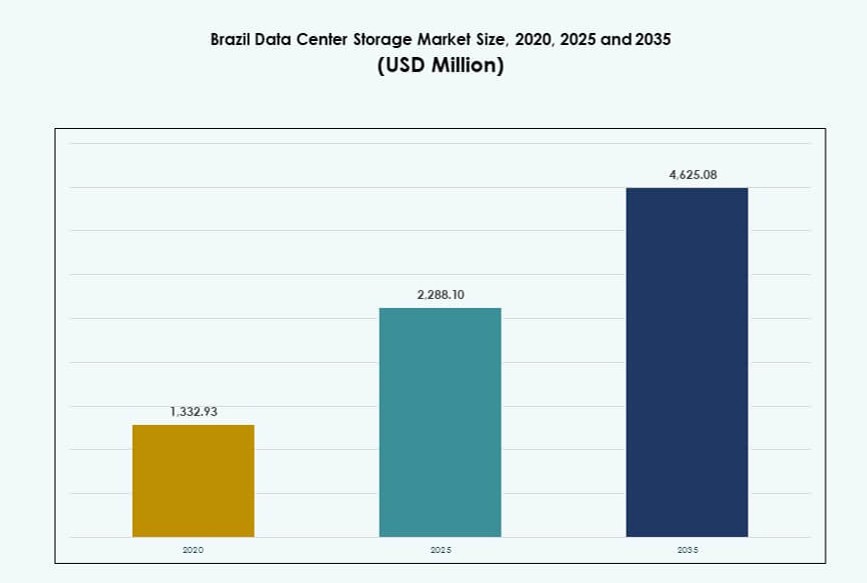
The Brazil Data Center Storage Market size was valued at USD 1,332.93 million in 2020 to USD 2,288.10 million in 2025 and is anticipated to reach USD 4,625.08 million by 2035, at a CAGR of 7.22% during the forecast period.
| REPORT ATTRIBUTE |
DETAILS |
| Historical Period |
2020-2023 |
| Base Year |
2024 |
| Forecast Period |
2025-2035 |
| Brazil Data Center Storage Market Size 2025 |
USD 2,288.10 Million |
| Brazil Data Center Storage Market, CAGR |
7.22% |
| Brazil Data Center Storage Market Size 2035 |
USD 4,625.08 Million |
Rising demand for cloud migration, fintech expansion, and AI adoption is transforming storage infrastructure across Brazil. Enterprises are investing in all-flash systems, hybrid storage models, and software-defined platforms to manage high-volume, low-latency data flows. Regulatory compliance and local data sovereignty requirements further boost domestic storage deployments. The market holds strategic value for hyperscalers and investors targeting cloud, telecom, and public sector digitization. Evolving workloads demand scalable, efficient, and high-performance storage solutions to ensure business continuity.
Southeast Brazil, particularly São Paulo and Rio de Janeiro, leads the market due to hyperscale activity and enterprise density. These cities offer advanced telecom networks, submarine cable access, and rich interconnection hubs. Southern regions like Porto Alegre are emerging with enterprise demand and new colocation builds. Northeast states are gaining traction from government projects and edge deployments. Regional growth reflects Brazil’s effort to decentralize digital infrastructure and ensure nationwide storage access.
Market Dynamics:
Market Drivers
Surge in Cloud Migration and Storage Demand Across Financial and Digital Platforms
Rapid cloud adoption across Brazil’s banking, fintech, and e-commerce sectors is driving strong demand for scalable storage infrastructure. Enterprises are shifting to hybrid cloud environments for agility, leading to higher storage requirements. Regulatory compliance and data residency mandates increase reliance on domestic storage platforms. Tier III and Tier IV data center projects are becoming more common across urban hubs. These facilities require high-performance, redundant storage architectures. The Brazil Data Center Storage Market benefits from rising customer data volumes and 24/7 digital service needs. Cloud-native applications and virtualization push storage to operate with low latency. The market plays a key role in supporting secure, always-available business environments. It positions Brazil as a regional leader in cloud-first transformation.
- For instance, Hospital Sírio-Libanês migrated financial workloads to AWS, processing over 1 petabyte of healthcare data with 99.99% availability.
Rise of 5G and Edge Computing Strengthening the Role of Localized Storage Infrastructure
5G rollout across Brazil is creating more edge workloads that demand local, real-time storage. Telcos and data center providers are deploying edge nodes in cities to handle traffic from IoT, video, and mobile applications. These nodes require scalable, low-latency storage systems close to users. High-speed applications such as augmented reality and autonomous logistics increase bandwidth and performance expectations. The market is adapting by expanding all-flash and software-defined storage deployments. Edge storage growth is especially notable in logistics, agriculture, and smart city projects. Decentralized data generation across Brazil’s vast territory enhances the need for distributed storage. The Brazil Data Center Storage Market is essential to the functioning of these emerging services. It enables seamless digital experiences at the edge.
- For instance, V.tal’s V.OA edge data center in Porto Alegre supports up to 400 racks across 6 MW IT load for low-latency 5G processing.
Digital Transformation of Public Sector and Healthcare Fueling High-Availability Storage Demand
Government agencies and healthcare institutions are digitizing operations and citizen services. This shift brings a surge in data storage for patient records, legal documents, and cloud-based public portals. Public cloud services are supporting these transitions with highly available, compliant infrastructure. At the same time, private operators are hosting government workloads under strict data sovereignty rules. Healthcare applications such as PACS imaging and telemedicine require large-capacity, high-throughput storage arrays. The Brazil Data Center Storage Market plays a vital role in maintaining service continuity in these mission-critical sectors. It supports national digital initiatives and resilient infrastructure frameworks. Enterprises in these fields prioritize fault-tolerant storage designs for uninterrupted access.
Growth of AI and Big Data Creating Demand for High-Performance Scalable Storage Systems
Artificial intelligence and big data analytics workloads are increasing storage capacity and performance needs. Enterprises deploy storage with GPU servers to manage unstructured datasets and enable faster processing. Sectors like retail, telecom, and energy use predictive analytics requiring real-time data access. Object storage and NVMe technologies are gaining traction to support these use cases. AI training models need fast read/write performance and high IOPS, driving all-flash adoption. Hyperscale operators in Brazil are scaling out with distributed storage architectures. The Brazil Data Center Storage Market supports AI-powered services such as fraud detection, recommendation engines, and smart grids. It provides the digital backbone for innovation and advanced computing in the country.
Market Trends
Shift Toward All-Flash Arrays Driven by Performance, Energy Efficiency, and Rack Density
Data center operators are replacing traditional hard drives with all-flash arrays to improve speed and efficiency. These arrays reduce latency, enable high throughput, and lower power consumption. Dense flash storage supports space-saving architecture, critical for colocation providers and urban data centers. Workloads such as virtual desktops and AI training see major gains from flash. Brazilian firms use flash to meet real-time user demands from mobile platforms and CRM systems. Power savings and lower cooling needs contribute to sustainability goals. Demand for NVMe over Fabrics further boosts flash adoption. The Brazil Data Center Storage Market is evolving through increased flash deployments. It reflects a broader shift toward energy-optimized performance.
Adoption of Software-Defined Storage for Flexibility, Automation, and Lower TCO
Operators are deploying software-defined storage (SDS) to decouple hardware and improve scalability. SDS enables dynamic provisioning, simplifies backup, and automates tiering based on usage. This flexibility is ideal for multi-tenant and hybrid environments across Brazil’s cloud-first ecosystem. SDS platforms help reduce total cost of ownership while improving manageability. Service providers use SDS to deliver storage-as-a-service models to SMEs and large firms. Integration with container platforms and Kubernetes environments strengthens its relevance. SDS improves disaster recovery and workload migration for enterprise users. The Brazil Data Center Storage Market sees strong growth in SDS across verticals. It aligns with the demand for adaptable, vendor-agnostic infrastructure.
Increased Investment in Cold Storage for Archiving, Backup, and Compliance Requirements
Demand for long-term, low-access storage is increasing due to legal retention policies and digital archives. Enterprises store historical data for audits, compliance, and research. Cold storage solutions offer low-cost capacity optimized for infrequent access. Tape storage, object storage, and cloud-based cold tiers are widely adopted. Healthcare, finance, and government are primary users of cold archives in Brazil. Cloud providers offer tiered storage plans with flexible pricing to meet this need. Physical tape libraries remain relevant due to air-gapped backups. The Brazil Data Center Storage Market supports cold storage growth with secure, scalable systems. It helps institutions meet data durability and cost-efficiency targets.
Integration of Green Storage Practices to Support Carbon-Neutral Infrastructure Targets
Sustainability is driving the adoption of energy-efficient storage hardware and management software. Enterprises prefer SSDs and flash systems due to lower power usage per terabyte. Storage systems are designed for thermal efficiency and idle power reduction. Providers use energy-aware tiering to shift data to low-power devices. Green certifications influence hardware procurement decisions across Brazilian data centers. Operators adopt lifecycle management to reduce e-waste from obsolete storage. Recyclable enclosures and energy-optimized drives improve environmental impact. The Brazil Data Center Storage Market aligns with ESG goals by supporting low-emission storage options. It plays a role in meeting national carbon reduction targets.
Market Challenges
High Import Costs, Currency Volatility, and Tariff Structures Impact Storage Hardware Procurement
Brazil’s dependence on imported hardware makes storage procurement expensive and vulnerable to currency fluctuations. Tariffs and import duties raise total infrastructure costs for hyperscale and enterprise deployments. Local assembly is limited, increasing reliance on international vendors. Frequent exchange rate shifts impact pricing of HDDs, SSDs, and backup appliances. Vendors pass on cost fluctuations to clients, limiting predictability for long-term investments. Sourcing delays due to customs or logistics bottlenecks can affect deployment timelines. These constraints make budget planning difficult for storage upgrades or expansions. The Brazil Data Center Storage Market faces structural cost pressures that affect affordability and pace of adoption.
Limited Local Manufacturing and Talent Pool Slows Domestic Innovation in Storage Solutions
Brazil lacks large-scale domestic production of advanced storage systems and components. This limits options for cost-effective procurement and customized solutions. Most storage innovation is imported, which reduces local control over system design and support. Technical expertise in software-defined storage and flash tuning is scarce. Enterprises rely heavily on vendor-certified specialists for installation and troubleshooting. Capacity-building efforts in data center operations are still catching up with demand. This talent shortage raises operating costs and impacts service reliability. The Brazil Data Center Storage Market depends on building localized skill sets to sustain long-term growth and resilience.
Market Opportunities
Digital Inclusion, Regional Expansion, and Government Cloud Programs Create New Storage Demand
National digital transformation strategies aim to extend internet and cloud services beyond major cities. Rural areas and second-tier cities are gaining attention for new data center builds. Public sector cloud programs require compliant, sovereign storage infrastructure. These efforts unlock demand for modular, scalable systems tailored to local workloads. The Brazil Data Center Storage Market benefits by addressing these underserved zones. It offers providers a chance to diversify and decentralize operations while meeting policy goals.
Rising Startup Ecosystem and Fintech Innovation Driving Need for Scalable and API-Driven Storage
Brazil’s startup ecosystem, particularly in fintech, healthtech, and logistics, depends on flexible cloud storage. Startups seek storage with open APIs, quick provisioning, and integration with data pipelines. Subscription-based and pay-as-you-go storage models attract growing businesses. The Brazil Data Center Storage Market offers vendors a high-growth segment with fast-moving, tech-driven clients.
Market Segmentation
By Storage Type
Traditional storage leads in legacy deployments but is gradually losing share to all-flash and hybrid models. All-flash storage is gaining traction in Brazil due to its low latency and performance. Hybrid storage remains a preferred option for mid-sized enterprises balancing cost and performance. The Brazil Data Center Storage Market sees growing adoption of hybrid arrays in multi-cloud settings. Flash-based systems are expected to dominate future growth due to workload intensity.
By Storage Deployment
Storage Area Network (SAN) systems dominate due to their speed and reliability in enterprise environments. SAN is widely used across banks and telecom firms in Brazil. Network-Attached Storage (NAS) gains popularity in media, education, and government. Direct-Attached Storage (DAS) remains relevant in smaller setups and edge locations. The Brazil Data Center Storage Market shows diversified use cases across all deployment types.
By Component
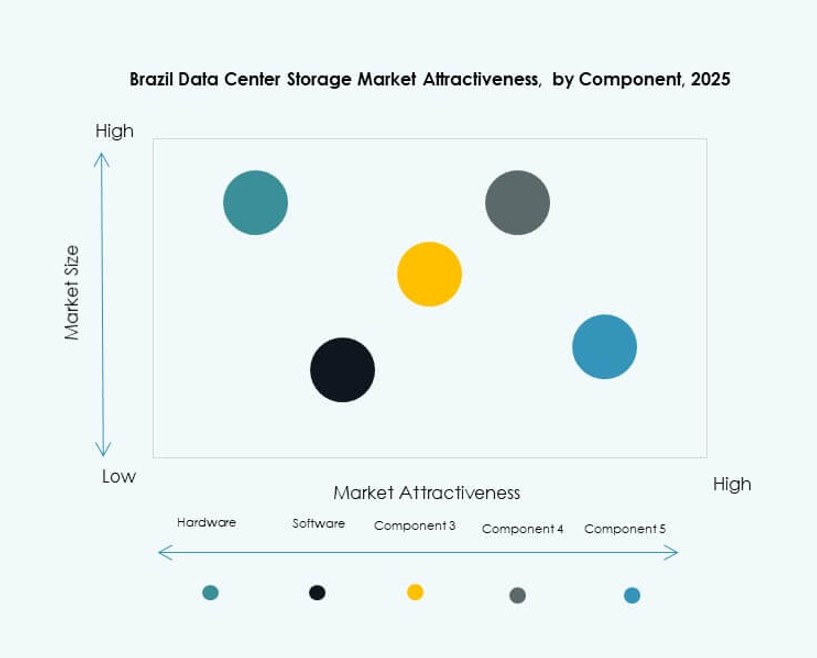
Hardware accounts for the largest market share, driven by investment in SSDs, racks, and controllers. Software is growing due to virtualization, SDS, and backup management tools. Providers bundle storage software with cloud services for SMEs and startups. The Brazil Data Center Storage Market reflects strong demand for both components, with SDS accelerating growth on the software side.
By Medium
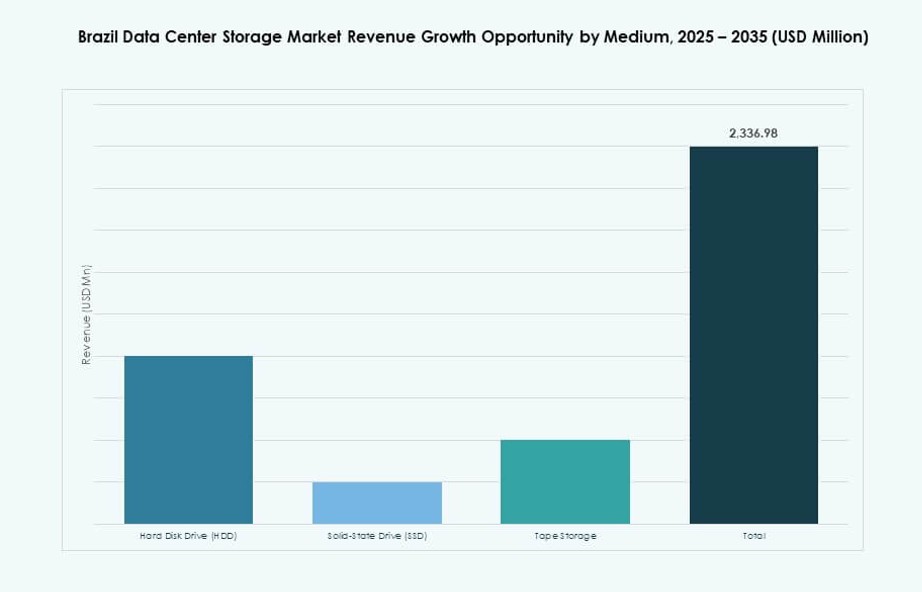
Hard Disk Drives (HDD) still hold a significant share due to lower cost per GB, mainly for cold storage. Solid-State Drives (SSD) are growing fast in all-flash and high-performance workloads. Tape storage remains niche but vital for archival compliance and long-term backup. The Brazil Data Center Storage Market sees rapid SSD adoption in fintech, AI, and telco use cases.
By Deployment Model
Cloud-based deployments lead the market due to flexibility and ease of scaling. On-premises storage is still important in finance and public sector applications for security and control. Hybrid models are increasingly adopted by firms transitioning from legacy to cloud-native systems. The Brazil Data Center Storage Market reflects a strong hybrid trend across regulated industries.
By Application
IT and telecommunications account for the largest share due to core internet infrastructure and digital services. BFSI follows closely, needing high-security storage for real-time transactions. Government and healthcare drive growth through digitalization programs. Other sectors like retail, logistics, and manufacturing use storage for analytics and automation. The Brazil Data Center Storage Market supports cross-sector data transformation.
Regional Insights
Southeast Brazil Dominates with Over 60% Market Share Due to São Paulo and Rio de Janeiro Presence
Southeast Brazil holds the majority of the Brazil Data Center Storage Market, accounting for more than 60%. São Paulo is the epicenter, hosting hyperscale facilities, interconnection hubs, and cloud zones. Rio de Janeiro follows due to demand from finance, media, and public sector workloads. The region benefits from strong telecom infrastructure, high enterprise density, and skilled talent pools. Local cloud zones and submarine cable access add strategic value. The region attracts both global and local providers due to its scale and readiness.
- For instance, Ascenty operates its Rio SRT01 facility with over 1,200 racks and 5 MW IT load capacity, supporting high-density storage for regional media and finance clients.
South Brazil Emerges with 20% Market Share Supported by Regional Enterprise Growth
South Brazil contributes around 20% to the market, led by cities like Porto Alegre, Curitiba, and Florianópolis. Regional enterprises, tech startups, and academic institutions fuel demand for cloud storage. Operators are expanding to offer edge storage and backup services closer to local users. The region benefits from improved power availability and lower operational costs. It is emerging as a decentralized hub for business continuity deployments.
- For instance, Elea Data Centers’ Porto Alegre POA01 site provides 800 racks and 6 MW power, delivering backup services to over 50 regional universities and businesses.
Northeast and Midwest Regions Hold 15% Market Share and Are Gaining Government and Edge Projects
The Northeast and Midwest regions together account for about 15% of the market. These regions are being targeted for edge deployments, public cloud infrastructure, and smart city initiatives. States like Bahia, Pernambuco, and Goiás are witnessing new colocation facilities. Public sector digitization and regional enterprise demand are driving storage installations. These regions present growth potential for providers expanding beyond saturated urban centers. The Brazil Data Center Storage Market sees these areas as emerging frontiers.
Competitive Insights:
- Ascenty
- Odata
- Elea Digital
- HostDime
- Dell Technologies
- Hewlett Packard Enterprise (HPE)
- NetApp
- IBM Corporation
- Huawei Technologies
The competitive landscape of the Brazil Data Center Storage Market reflects a mix of global technology vendors and strong domestic data center operators. Global players lead in storage hardware, flash systems, and software-defined platforms, while local firms dominate colocation-driven storage deployment. Strategic focus centers on all-flash adoption, hybrid architectures, and compliance-ready solutions. Vendors compete on performance, energy efficiency, and integration with cloud ecosystems. Partnerships with hyperscalers and telecom operators strengthen market reach. Pricing discipline and service reliability shape enterprise buying decisions. The market shows moderate consolidation, with scale favoring providers that support AI, fintech, and government workloads. It remains competitive through technology depth and regional expansion strategies.
Recent Developments:
- In October 2025. Equinix expanded operations in Brazil. The company operates eight data centers with a ninth under construction in Sao Paulo and Rio de Janeiro, plus five properties acquired for future growth based on demand.
- in June 2025, Hewlett Packard Enterprise (HPE) expanded its partnerships with Commvault and Veeam to enhance cyber resilience and data protection for hybrid cloud environments, integrating advanced recovery and backup solutions relevant to data center storage needs.
- In May 2025, Patria Investimentos launched Omnia, a hyperscale data center platform. The initiative commits about $1 billion for its first project in Brazil over 18-24 months, focusing on cloud and AI trends with renewable energy.