
Data Center Fuel Cell Market Size, Share & Forecast to 2035
Market at a glance
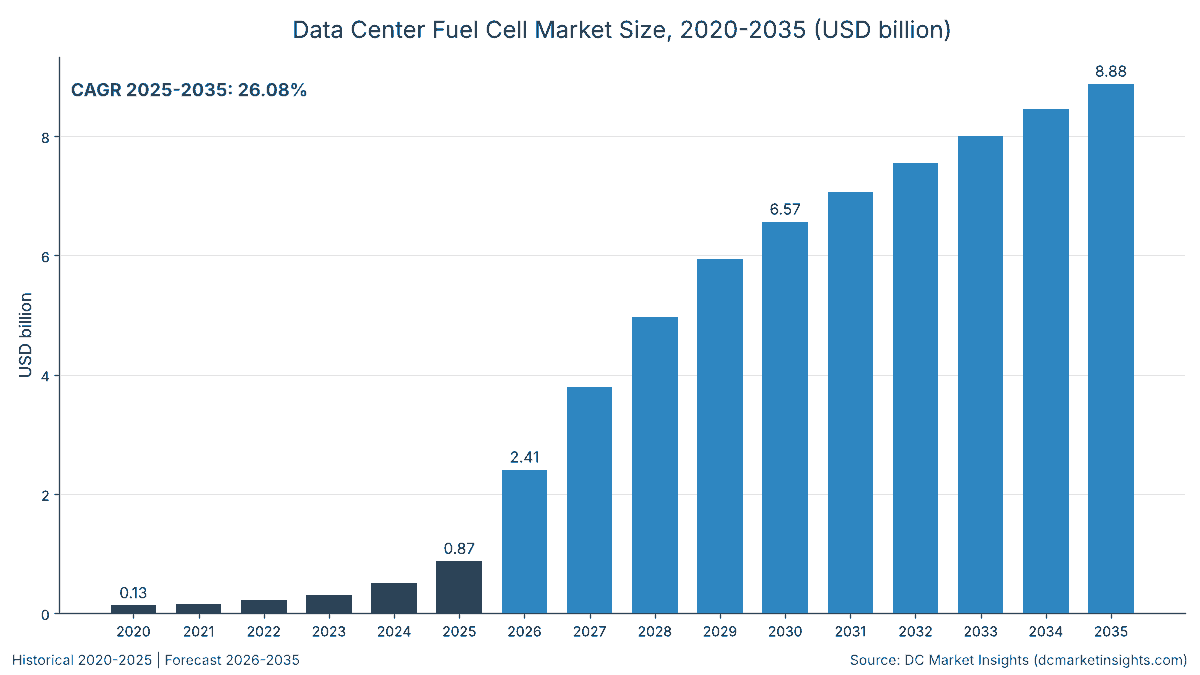
The Data Center Fuel Cell market was worth USD 874.5 million in 2025 and is forecast to reach USD 8,880.0 million by 2035, growing at a 26.08% CAGR.
 By Amit Jain, Senior Consultant, ICT & Emerging Technologies
 Reviewed by Deepti Agrawal
Last updated 18 Oct 2026
Base year 2025 PDF + Excel
Reviewed by Deepti Agrawal
Last updated 18 Oct 2026
Base year 2025 PDF + Excel
Key findings
92% of Value Still Runs on Natural Gas
What is inside the report
- 01Introduction
- 02Research Methodology
- 03Executive Summary
- 04What Is a Data Center Fuel Cell?
- 05Why Do Data Center Fuel Cell Market Estimates Differ?
- 06Market Drivers
- 07Market Trends
- 08Market Restraints
- 09Market Opportunities
- 10Pricing Analysis: Data Center Fuel Cell Cost per kW
- 22chapters
- 2020-2024Historical period
- 2026-2035Forecast period
- —Companies profiled
Segmentation
Recent developments
AEP announced a 702 MW Bloom fuel cell plant near Cheyenne, Wyoming, costing about USD 4 billion, under a 20-year PPA with Google (Source: AEP).
Bloom Energy reported second-quarter revenue of USD 1,065.4 million and raised its 2026 revenue guidance to USD 3.9 billion to USD 4.2 billion (Source: Bloom Energy).
FuelCell Energy presented a 12.5 MW data center block and plans to expand its Torrington plant to 500 MW a year (Source: FuelCell Energy).
Oracle and Bloom Energy expanded their partnership to up to 2.8 GW, with 1.2 GW contracted (Source: Bloom Energy).
Brookfield and Bloom Energy announced a partnership of up to USD 5 billion for AI infrastructure (Source: Bloom Energy).
AEP Ohio said its first Bloom fuel cell projects would serve Amazon Web Services and Cologix data centers (Source: AEP).
Full analysis
The Data Center Fuel Cell Market is valued at USD 2.41 billion in 2026 and is projected to reach USD 8.88 billion by 2035, up from USD 874.50 million in 2025, a compound annual growth rate (CAGR) of 26.08% from 2025 to 2035 (DC Market Insights estimate). The money in this market moves with grid connection queues rather than with server shipments: an artificial intelligence (AI) campus that cannot get a utility connection for several years can install solid oxide fuel cells on site, and Bloom Energy said in July 2025 that it could power an entire Oracle data center within 90 days. Utilities have started to buy the same equipment for data center customers, with American Electric Power (AEP) announcing in October 2026 a 702 megawatt (MW) Bloom fuel cell plant near Cheyenne, Wyoming, costing about USD 4 billion and tied to a 20-year power purchase agreement (PPA) with Google. DC Market Insights estimates that fuel cell installations at data centers rise from 220 MW in 2025 to 650 MW in 2026 and 2,600 MW a year by 2035, while the installed price falls from USD 3,600 to USD 2,600 per kilowatt (kW). Hydrogen fuel cells are the fastest-growing fuel segment at 43.90% a year, and the Middle East and Africa is the fastest-growing region at 45.71% a year.
Key Market Statistics: How Big Is the Data Center Fuel Cell Market in 2026?
DC Market Insights values the Data Center Fuel Cell Market at USD 2.41 billion in 2026, 175.2% above the USD 874.50 million of 2025, as contracted orders from Oracle and AEP move into delivery.
- Market size 2025: USD 874.50 million
- Market size 2026: USD 2.41 billion
- Market size 2030: USD 6.57 billion
- Market size 2035: USD 8.88 billion
- CAGR 2025-2035: 26.08% in the base case, 23.59% in the low case and 28.32% in the high case
- Fuel cell capacity installed at data centers: 220 MW in 2025, 650 MW in 2026 and 2,600 MW in 2035
- Largest technology: solid oxide fuel cells (SOFC), 86.0% of 2025 value (USD 752.07 million)
- Largest application: prime power, 62.0% of 2025 value
- Fastest-growing fuel: hydrogen, 43.90% a year
- Leading region: North America, 78.0% of 2025 value (USD 682.11 million)
- Fastest-growing region: Middle East and Africa, 45.71% a year
- Largest country: the United States, USD 655.88 million in 2025 (75.0% of global value)
- Market leader: Bloom Energy, about 80% of 2025 value (DC Market Insights assessment), followed by FuelCell Energy, Doosan Fuel Cell and Plug Power
Executive Summary
The Global Data Center Fuel Cell Market size was valued at USD 131.00 million in 2020, reached USD 874.50 million in 2025, and is anticipated to reach USD 8.88 billion by 2035, at a CAGR of 26.08% during the forecast period.
| Report attribute | Details |
|---|---|
| Historical Period | 2020-2024 |
| Base Year | 2025 |
| Forecast Period | 2026-2035 |
| Data Center Fuel Cell Market Size 2025 | USD 874.50 Million |
| Data Center Fuel Cell Market Size 2026 | USD 2.41 Billion |
| Data Center Fuel Cell Market, CAGR | 26.08% |
| Data Center Fuel Cell Market Size 2035 | USD 8.88 Billion |
Spending grew 46.18% a year between 2020 and 2025, as annual installations at data centers rose from 25 MW to 220 MW once operators such as Equinix and CoreWeave began to use fuel cells for everyday power rather than only for pilots. Growth to 2035 is slower in percentage terms but larger in dollars: installations reach 1,900 MW a year in 2030 and 2,600 MW in 2035, the installed data center fleet grows from about 660 MW at the end of 2025 to about 18.96 GW in 2035, and service on that fleet rises from USD 82.50 million to USD 2.12 billion. Falling equipment prices, from USD 3,600 to USD 2,600 per kW, hold back value growth per MW.
What Is a Data Center Fuel Cell, and What Does the Market Include?
A data center fuel cell converts natural gas, biogas or hydrogen into electricity on site without combustion, and DC Market Insights values the equipment, installation and service sold for data centers at USD 874.50 million in 2025.
Included. Fuel cell systems installed to power data centers: solid oxide, proton exchange membrane (PEM), molten carbonate and phosphoric acid fuel cells used for prime power, bridge power before a grid connection, and backup power; installation and commissioning; and operations and maintenance service on the installed data center fleet. Systems financed under a PPA are counted at their installed value in the year they are commissioned, whoever owns them.
Excluded. Fuel (natural gas or hydrogen) and the electricity charges paid under PPAs, diesel and gas engine generators (see the Data Center Generator Market), batteries and uninterruptible power supply systems (see the Data Center Energy Storage Market), fuel cells at telecom towers and non-data-center buildings, and utility-scale fuel cell plants that do not serve a named data center.
How the segments fit together. Every dollar is classified by technology, application, fuel, data center type and offering (systems and installation versus service), and each split sums to the total in every year from 2020 to 2035.
Why Do Data Center Fuel Cell Market Estimates Differ?
Estimates differ because of scope: DC Market Insights counts USD 2.41 billion of fuel cell systems and service for data centers in 2026, while broader definitions add fuel and electricity sales, all stationary fuel cells or backup power of every kind.
The largest swing comes from counting energy instead of equipment. A 702 MW plant running under a 20-year PPA sells billions of dollars of electricity over its life, and estimates that add those payments come out several times larger. Other estimates include every stationary fuel cell sold to any building, which pulls in South Korean utility projects that do not serve data centers, or combine fuel cells with diesel generators and batteries as data center onsite power.
| Element | Counted by DC Market Insights | Why |
|---|---|---|
| Fuel cell systems and installation at data centers | Yes, USD 792.00 million in 2025 | Core of the market |
| Operations and maintenance service on the data center fleet | Yes, USD 82.50 million in 2025 | Recurring spend tied to installed MW |
| Natural gas and hydrogen fuel | No | Energy commodity, not equipment |
| Electricity sold under fuel cell PPAs | No | Counted once, as installed equipment |
| Fuel cells for non-data-center buildings and utilities | No | Outside data center scope |
| Diesel generators and batteries | No | Separate DCMI markets |
Buyers inside the scope include hyperscale cloud and AI developers, colocation operators, utilities that install fuel cells for a data center customer, and enterprise and edge sites, including small and medium-sized operators that buy backup systems.
Why Are Data Centers Buying Fuel Cells?
Data centers buy fuel cells to get power years before a grid connection, and DC Market Insights estimates that bridge power alone was worth USD 262.35 million, or 30.0% of the market, in 2025.
Grid Connection Queues for AI Campuses
United States data centers used 176 terawatt-hours (TWh) of electricity in 2023, 4.4% of national consumption, and could use 6.7% to 12% by 2028, according to a report released by the United States Department of Energy (DOE) in December 2024 based on Lawrence Berkeley National Laboratory analysis. Utilities cannot add transmission at that pace, so developers install onsite generation that can be delivered in months. Oracle said in April 2026 it intends to procure up to 2.8 gigawatts (GW) of fuel cell systems from Bloom Energy, with 1.2 GW already contracted, the largest single data center fuel cell commitment so far.
Utilities Build Fuel Cell Plants for Data Center Customers
AEP signed a supply agreement with Bloom Energy for up to 1 GW in November 2024 and placed a first order for 100 MW; AEP Ohio’s first projects serve Amazon Web Services and Cologix sites, according to AEP. In October 2026 AEP announced a 702 MW fuel cell project near Cheyenne, Wyoming, costing about USD 4 billion, under a 20-year PPA with Google. Utility ownership turns fuel cells from a tenant’s emergency fix into regulated generation assets, which is why prime power rises from 62.0% of value in 2025 to 70.0% in 2035.
The 30% Investment Tax Credit Now Names Fuel Cells
The 2025 federal budget law (Public Law 119-21) changed the 30% section 48E investment tax credit to include fuel cells specifically, for projects that begin construction after 31 December 2025 and before 31 December 2033, according to Bloom Energy’s 2025 annual report. A 30% credit on a USD 3,480 per kW system in 2026 lowers the buyer’s cost by about USD 1,044 per kW, enough to close much of the gap with gas engines.
How Are Data Center Fuel Cell Deployments Changing?
Deployments are getting larger and longer-lived: the average new contract has moved from tens of MW at colocation sites to hundreds of MW for AI campuses, and DC Market Insights expects hyperscale and AI data centers to take 68.0% of value by 2035.
From Colocation Pilots to Gigawatt Orders
Bloom Energy’s agreement with Equinix exceeded 100 MW across 19 IBX data centers in six states in February 2025. By April 2026 the largest commitments were measured in gigawatts: AEP up to 1 GW (November 2024) and Oracle up to 2.8 GW (April 2026). Bloom reported in October 2025 that it had deployed 1.5 GW of fuel cells across more than 1,200 installations, and more than 400 MW for data centers by July 2025.
Factory Capacity Doubles to Meet Backlog
Bloom Energy planned to double its factory capacity from 1 GW to 2 GW a year by the end of 2026 and reported a product backlog of about USD 6 billion in February 2026. FuelCell Energy said in June 2026 it would expand its Torrington, Connecticut plant from 100 MW to 500 MW a year and offer a 12.5 MW standard block for data centers, built from ten 1.25 MW modules. Annual data center installations reach 1,050 MW in 2027 in the DC Market Insights model.
Hydrogen Backup Trials Point to Diesel Replacement
Microsoft ran a 3 MW hydrogen fuel cell backup system in 2022, and a 1.5 MW backup demonstration with Caterpillar and a Ballard Power Systems fuel cell module was set up at a Microsoft data center in Quincy, Washington. DC Market Insights expects backup power to rise from 8.0% of value in 2025 to 15.0% in 2035 as hydrogen supply improves.
Market Restraints: What Could Slow Data Center Fuel Cell Adoption?
Gas dependence and supplier concentration are the main restraints, and DC Market Insights estimates that 15% fewer installations and 5% lower prices would cut the 2035 market to USD 7.27 billion.
92% of Value Still Runs on Natural Gas
Natural gas fuel cells emit carbon dioxide, so operators with net-zero targets count them as a transition source. DC Market Insights estimates that natural gas units account for 92.0% of 2025 value, and new pipeline capacity is needed at gigawatt sites such as AEP’s Wyoming project.
One Supplier Holds About 80% of Value
Bloom Energy reported revenue of USD 2.02 billion for 2025 and raised its 2026 revenue guidance to USD 3.9 billion to USD 4.2 billion in July 2026. FuelCell Energy reported USD 158.2 million of revenue for its 2025 fiscal year and a 4 GW proposal pipeline, mostly data centers, but no signed data center contract. A single-supplier market exposes buyers to delivery slips and limits price competition.
Where Are the Growth Opportunities in Data Center Fuel Cells?
The two largest openings are hydrogen fuel cells and fleet service, which DC Market Insights values at USD 1.33 billion and USD 2.12 billion respectively in 2035.
Hydrogen Fuel Cells: USD 1.33 billion in 2035
Hydrogen units grow 43.90% a year, from 4.0% of value in 2025 to 15.0% in 2035, led by PEM backup systems that replace diesel generators. South Korea’s clean hydrogen power bidding market, which opened 6,500 gigawatt-hours (GWh) of 15-year contracts in 2024, shows how governments can create demand for hydrogen generation.
Fleet Service: 38.35% a Year
Every installed MW needs stack replacement and maintenance for 15 to 20 years. With the data center fleet reaching about 18.96 GW, service grows to 23.9% of value in 2035, giving suppliers recurring income after the build-out slows.
How Much Does a Data Center Fuel Cell Cost per kW?
DC Market Insights estimates the installed price of a data center fuel cell system at USD 3,600 per kW in 2025, falling to USD 2,600 per kW by 2035 as factory volumes rise.
| Year | Installed system price (USD per kW) | Service (USD per kW a year) | MW installed at data centers |
|---|---|---|---|
| 2020 | 4,200 | 160 | 25 |
| 2025 | 3,600 | 150 | 220 |
| 2030 | 3,000 | 135 | 1,900 |
| 2035 | 2,600 | 120 | 2,600 |
Public anchors: the DOE technical targets for stationary fuel cells list equipment cost of USD 1,200 to USD 4,500 per kW for natural gas systems of 100 kW to 3 MW, against a target of USD 1,000 per kW. AEP’s Wyoming project, at about USD 4 billion for 702 MW, works out to about USD 5,700 per kW for the whole project, including site, gas and grid works that DC Market Insights excludes. Bloom Energy does not publish a price per kW.
Which Rules and Standards Shape Data Center Fuel Cells?
Tax credits and installation codes shape the market: the 30% section 48E credit applies to fuel cells that begin construction from 2026 to 2033, and DOE sets cost targets of USD 1,000 per kW.
- United States section 48E investment tax credit. Public Law 119-21 (2025) specifically includes fuel cells in the 30% credit for projects beginning construction after 31 December 2025 and before 31 December 2033.
- DOE stationary fuel cell targets. USD 1,000 per kW equipment cost, more than 50% electrical efficiency and an 80,000-hour lifetime for 100 kW to 3 MW natural gas systems.
- NFPA 853. The National Fire Protection Association standard for the installation of stationary fuel cell power systems governs siting, gas piping and fire protection at data center sites.
- South Korea clean hydrogen power bidding. The Ministry of Trade, Industry and Energy opened 6,500 GWh of 15-year clean hydrogen contracts and 1,300 GWh of 20-year general hydrogen contracts in 2024.
Which Segment Leads the Data Center Fuel Cell Market?
Solid oxide fuel cells lead with 86.0% of 2025 value, prime power leads applications with 62.0%, and hyperscale and AI data centers lead buyers with 55.0%.
By Technology: Solid Oxide Leads with 86.0%
Solid oxide units run on natural gas at high efficiency; PEM grows fastest at 35.13% a year on hydrogen backup.
| Technology | 2025 (USD million) | Share 2025 | 2035 (USD million) | CAGR 2025-2035 |
|---|---|---|---|---|
| Solid Oxide Fuel Cells | 752.07 | 86.0% | 6,925.78 | 24.86% |
| Proton Exchange Membrane Fuel Cells | 52.47 | 6.0% | 1,065.50 | 35.13% |
| Molten Carbonate Fuel Cells | 43.73 | 5.0% | 621.54 | 30.40% |
| Phosphoric Acid Fuel Cells | 26.23 | 3.0% | 266.38 | 26.09% |
By Application: Prime Power Leads with 62.0%
Bridge power grows slowest at 17.64% a year because many bridge units become permanent prime power once installed.
| Application | 2025 (USD million) | Share 2025 | 2035 (USD million) | CAGR 2025-2035 |
|---|---|---|---|---|
| Prime Power | 542.19 | 62.0% | 6,215.44 | 27.62% |
| Bridge Power | 262.35 | 30.0% | 1,331.88 | 17.64% |
| Backup Power | 69.96 | 8.0% | 1,331.88 | 34.26% |
By Fuel: Natural Gas Leads with 92.0%
Hydrogen grows fastest at 43.90% a year from a small base.
| Fuel | 2025 (USD million) | Share 2025 | 2035 (USD million) | CAGR 2025-2035 |
|---|---|---|---|---|
| Natural Gas | 804.54 | 92.0% | 7,103.36 | 24.33% |
| Biogas and Blended Gas | 34.98 | 4.0% | 443.96 | 28.93% |
| Hydrogen | 34.98 | 4.0% | 1,331.88 | 43.90% |
By Data Center Type: Hyperscale and AI Data Centers Lead with 55.0%
AI campuses with the longest grid waits buy the largest systems and grow 28.79% a year.
| Data center type | 2025 (USD million) | Share 2025 | 2035 (USD million) | CAGR 2025-2035 |
|---|---|---|---|---|
| Hyperscale and AI Data Centers | 480.98 | 55.0% | 6,037.86 | 28.79% |
| Colocation Data Centers | 306.07 | 35.0% | 2,219.80 | 21.91% |
| Enterprise and Edge Data Centers | 87.45 | 10.0% | 621.54 | 21.67% |
By Offering: Systems and Installation Lead with 90.6%
Service grows faster, at 38.35% a year, as the installed fleet ages.
| Offering | 2025 (USD million) | Share 2025 | 2035 (USD million) | CAGR 2025-2035 |
|---|---|---|---|---|
| Systems and Installation | 792.00 | 90.6% | 6,760.00 | 23.91% |
| Operations and Maintenance Service | 82.50 | 9.4% | 2,119.20 | 38.35% |
DC Exclusive: Fuel Cell Data Center Project Tracker, 8 Deals and 4.6 GW Announced
This DC Market Insights tracker lists 8 data center fuel cell agreements announced from July 2022 to October 2026, drawn from company releases; the 4.6 GW total adds the AEP, Wyoming, Oracle and Equinix capacities and is a DC Market Insights calculation.
| Project | Capacity or value | Announced | Source |
|---|---|---|---|
| American Electric Power (AEP) supply agreement | Up to 1,000 MW; 100 MW first order | Nov 2024 | Bloom Energy |
| AEP Ohio sites for Amazon Web Services and Cologix | First projects under the AEP agreement | Jun 2025 | AEP |
| AEP fuel cell plant near Cheyenne, Wyoming, 20-year PPA with Google | 702 MW, about USD 4 billion | Oct 2026 | AEP |
| Oracle Cloud Infrastructure data centers | Up to 2,800 MW; 1,200 MW contracted | Apr 2026 | Bloom Energy |
| Brookfield AI infrastructure partnership | Up to USD 5 billion of investment | Oct 2025 | Bloom Energy |
| Equinix IBX data centers (19 sites, 6 states) | More than 100 MW | Feb 2025 | Bloom Energy, Equinix |
| CoreWeave AI data center, Volo, Illinois | Not disclosed | Jul 2024 | Bloom Energy |
| Microsoft hydrogen backup trial | 3 MW (PEM, hydrogen) | Jul 2022 | Microsoft |
Three points stand out. First, announced capacity of about 4.6 GW is more than the 3,320 MW that the DC Market Insights model installs from 2026 to 2028, so the forecast assumes some of it slips or is never built. Second, utilities (AEP) and cloud operators (Oracle) now sign directly, replacing the colocation pilots of 2022 to 2024. Third, only one hydrogen deal appears, which supports the model’s 4.0% hydrogen share in 2025.
Which Region Uses the Most Data Center Fuel Cells?
North America leads with 78.0% of 2025 value (USD 682.11 million), and the Middle East and Africa is the fastest-growing region at 45.71% a year.
| Region | 2025 (USD million) | Share 2025 | 2035 (USD million) | CAGR 2025-2035 |
|---|---|---|---|---|
| North America | 682.11 | 78.0% | 4,883.57 | 21.76% |
| Asia Pacific | 131.18 | 15.0% | 1,953.42 | 31.01% |
| Europe | 34.98 | 4.0% | 976.71 | 39.51% |
| Middle East and Africa | 17.49 | 2.0% | 754.73 | 45.71% |
| Latin America | 8.74 | 1.0% | 310.77 | 42.92% |
North America Leads with 78.0% Share
Every gigawatt-scale order so far (AEP, Oracle, Brookfield) is in the United States, where the 30% credit applies; the region’s share falls to 55.0% by 2035 as other regions start buying.
Asia Pacific Holds 15.0% Share
South Korea, where Bloom Energy reported nearly 682 MW of deployed systems in its 2025 annual report, gives the region an installer base; Japan and India add data center demand, for 31.01% annual growth.
Europe Holds 4.0% Share
Grid-constrained hubs such as Dublin, Frankfurt and London drive 39.51% annual growth to USD 976.71 million in 2035.
Middle East and Africa Holds 2.0% Share
Gas-rich Gulf states building gigawatt AI campuses grow fastest, reaching USD 754.73 million in 2035.
Latin America Holds 1.0% Share
Brazil leads a small base of USD 8.74 million in 2025, growing 42.92% a year.
Which Countries Spend the Most on Data Center Fuel Cells?
The United States is the largest country with USD 655.88 million in 2025, 75.0% of global value, and Saudi Arabia is the fastest-growing country in the top 12 at 48.09% a year.
| Rank | Country | Region | 2025 (USD million) | Share 2025 | 2035 (USD million) | CAGR 2025-2035 |
|---|---|---|---|---|---|---|
| 1 | United States | North America | 655.88 | 75.0% | 4,528.39 | 21.31% |
| 2 | South Korea | Asia Pacific | 78.70 | 9.0% | 799.13 | 26.09% |
| 3 | Japan | Asia Pacific | 26.23 | 3.0% | 443.96 | 32.69% |
| 4 | Canada | North America | 17.49 | 2.0% | 310.77 | 33.34% |
| 5 | India | Asia Pacific | 13.12 | 1.5% | 355.17 | 39.08% |
| 6 | Germany | Europe | 8.74 | 1.0% | 266.38 | 40.73% |
| 7 | United Kingdom | Europe | 8.74 | 1.0% | 221.98 | 38.19% |
| 8 | United Arab Emirates | Middle East and Africa | 7.00 | 0.8% | 266.38 | 43.89% |
| 9 | Ireland | Europe | 7.00 | 0.8% | 221.98 | 41.29% |
| 10 | Taiwan | Asia Pacific | 7.00 | 0.8% | 159.83 | 36.73% |
| 11 | Saudi Arabia | Middle East and Africa | 5.25 | 0.6% | 266.38 | 48.09% |
| 12 | Brazil | Latin America | 4.37 | 0.5% | 177.58 | 44.84% |
South Korea ranks second on its established fuel cell supply chain, while India, at 39.08% a year, is the fastest-growing large Asian market as new hyperscale campuses face grid delays.
How Could the 2035 Data Center Fuel Cell Forecast Change?
DC Market Insights puts the 2035 market between USD 7.27 billion and USD 10.59 billion, with USD 8.88 billion as the base case.
| Scenario | Assumptions | 2035 (USD million) | CAGR 2025-2035 |
|---|---|---|---|
| Low | Installations 15% below base from 2026 (faster grid connections, gas turbines win share) and prices 5% lower by 2035 | 7,271.90 | 23.59% |
| Base | 2,600 MW installed in 2035 at USD 2,600 per kW; fleet about 18.96 GW | 8,879.20 | 26.08% |
| High | Installations 15% above base (Oracle and AEP options fully exercised) and prices 5% higher by 2035 | 10,587.90 | 28.32% |
Installed volume is the bigger swing factor: each 100 MW a year changes 2035 systems value by about USD 260 million.
Who Are the Leading Data Center Fuel Cell Companies?
The market is highly concentrated: DC Market Insights estimates that Bloom Energy holds about 80% of 2025 value and the top three suppliers about 90%.
- Bloom Energy
- FuelCell Energy
- Doosan Fuel Cell
- Plug Power
- Ballard Power Systems
- SK ecoplant
- Toshiba Energy Systems
- Panasonic
- Fuji Electric
- Mitsubishi Heavy Industries
- Ceres Power
- SFC Energy
- Caterpillar
- Cummins
Bloom Energy reported revenue of USD 2.02 billion in 2025, up 37.3%, and USD 1,065.4 million in the second quarter of 2026, up 165.5%, with product revenue of USD 935.4 million, according to its filing with the United States Securities and Exchange Commission (SEC). Brookfield agreed in October 2025 to invest up to USD 5 billion to deploy Bloom fuel cells. FuelCell Energy reported fiscal 2025 revenue of USD 158.2 million and said its strategy is focused on the data center market. Doosan Fuel Cell and SK ecoplant, which supplies Bloom systems in South Korea, lead Asian supply, while Plug Power and Ballard Power Systems supply PEM systems for hydrogen backup.
Recent Developments
- In October 2026, AEP announced a 702 MW Bloom fuel cell plant near Cheyenne, Wyoming, costing about USD 4 billion, under a 20-year PPA with Google (Source: AEP).
- In July 2026, Bloom Energy reported second-quarter revenue of USD 1,065.4 million and raised its 2026 revenue guidance to USD 3.9 billion to USD 4.2 billion (Source: Bloom Energy).
- In June 2026, FuelCell Energy presented a 12.5 MW data center block and plans to expand its Torrington plant to 500 MW a year (Source: FuelCell Energy).
- In April 2026, Oracle and Bloom Energy expanded their partnership to up to 2.8 GW, with 1.2 GW contracted (Source: Bloom Energy).
- In October 2025, Brookfield and Bloom Energy announced a partnership of up to USD 5 billion for AI infrastructure (Source: Bloom Energy).
- In June 2025, AEP Ohio said its first Bloom fuel cell projects would serve Amazon Web Services and Cologix data centers (Source: AEP).
Methodology: How DC Market Insights Sizes the Data Center Fuel Cell Market
DC Market Insights built the Data Center Fuel Cell Market bottom-up from MW installed at data centers, installed price per kW and service per installed kW, giving USD 874.50 million in 2025 and USD 8.88 billion in 2035.
The model in numbers. Fuel cell capacity installed at data centers of 25 MW in 2020, 220 MW in 2025, 650 MW in 2026, 1,900 MW in 2030 and 2,600 MW in 2035 is multiplied by an installed price of USD 4,200, 3,600, 3,000 and 2,600 per kW for 2020, 2025, 2030 and 2035, linear between anchor years. Service of USD 160, 150, 135 and 120 per kW a year applies to a data center fleet that starts at 150 MW at the end of 2019 and reaches about 660 MW at the end of 2025. Technology, application, fuel, data center type, regional and country splits are DC Market Insights allocations that sum to the total every year; installations equal 1.8% of the 12.0 GW of new data center IT capacity in 2025 and about 9.6% of 27 GW in 2035, the capacity path used in the Data Center Market model and the AI Data Center Market build-out, following the DC Market Insights research methodology.
Bound checks. (1) Ceiling: the 2025 value of USD 874.50 million equals about 43% of Bloom Energy’s USD 2.02 billion revenue; with an 80% share, Bloom’s data center revenue would be about USD 700 million, or 35% of its total, close to the 27% of its 1.5 GW installed base that it reported as data center capacity. (2) Ceiling: 220 MW installed in 2025 is 1.8% of the 12.0 GW of new data center IT capacity in 2025. (3) Floor: Oracle’s 1.2 GW already contracted is worth about USD 4.18 billion at the model’s 2026 price of USD 3,480 per kW, more than the USD 3.79 billion of 2027 market value, so signed orders cover the near-term forecast.
Table of contents
- 01Introduction
- 1.1Market Definition
- 1.2Historical Period, Base Year and Forecast Period
- 1.3Report Attributes
- 02Research Methodology
- 2.1The Installed-MW Model in Numbers
- 2.2Bound Checks: Bloom Revenue Ceiling, New-Capacity Ceiling and Contracted-Order Floor
- 03Executive Summary
- 3.1Market Snapshot, 2025, 2026 and 2035
- 3.2Key Market Statistics
- 04What Is a Data Center Fuel Cell?
- 4.1Included: Systems, Installation and Fleet Service
- 4.2Excluded: Fuel, PPA Electricity, Generators and Batteries
- 4.3How the Segments Fit Together
- 05Why Do Data Center Fuel Cell Market Estimates Differ?
- 5.1Energy Versus Equipment
- 5.2Scope Comparison: What Is In and Out
- 5.3Buyers Inside the Scope
- 06Market Drivers
- 6.1Grid Connection Queues for AI Campuses
- 6.2Utilities Build Fuel Cell Plants for Data Center Customers
- 6.3The 30% Investment Tax Credit Now Names Fuel Cells
- 07Market Trends
- 7.1From Colocation Pilots to Gigawatt Orders
- 7.2Factory Capacity Doubles to Meet Backlog
- 7.3Hydrogen Backup Trials Point to Diesel Replacement
- 08Market Restraints
- 8.192% of Value Still Runs on Natural Gas
- 8.2One Supplier Holds About 80% of Value
- 09Market Opportunities
- 9.1Hydrogen Fuel Cells: USD 1.33 Billion in 2035
- 9.2Fleet Service: 38.35% a Year
- 10Pricing Analysis: Data Center Fuel Cell Cost per kW
- 10.1Installed System Price, 2020-2035
- 10.2Service Rate per kW a Year
- 10.3Public Price Anchors: DOE Targets and AEP Wyoming
- 11Standards and Regulation
- 11.1United States Section 48E Investment Tax Credit
- 11.2DOE Stationary Fuel Cell Targets
- 11.3NFPA 853
- 11.4South Korea Clean Hydrogen Power Bidding
- 12Data Center Fuel Cell Market, By Technology
- 12.1Solid Oxide Fuel Cells
- 12.2Proton Exchange Membrane Fuel Cells
- 12.3Molten Carbonate Fuel Cells
- 12.4Phosphoric Acid Fuel Cells
- 13Data Center Fuel Cell Market, By Application
- 13.1Prime Power
- 13.2Bridge Power
- 13.3Backup Power
- 14Data Center Fuel Cell Market, By Fuel
- 14.1Natural Gas
- 14.2Biogas and Blended Gas
- 14.3Hydrogen
- 15Data Center Fuel Cell Market, By Data Center Type
- 15.1Hyperscale and AI Data Centers
- 15.2Colocation Data Centers
- 15.3Enterprise and Edge Data Centers
- 16Data Center Fuel Cell Market, By Offering
- 16.1Systems and Installation
- 16.2Operations and Maintenance Service
- 17DC Exclusive: Fuel Cell Data Center Project Tracker
- 17.18 Deals and 4.6 GW Announced
- 17.2What the Tracker Shows
- 18Data Center Fuel Cell Market, By Region
- 18.1North America
- 18.2Asia Pacific
- 18.3Europe
- 18.4Middle East and Africa
- 18.5Latin America
- 19Data Center Fuel Cell Market, By Country
- 19.1United States
- 19.2South Korea
- 19.3Japan
- 19.4Canada
- 19.5India
- 19.6Germany
- 19.7United Kingdom
- 19.8United Arab Emirates
- 19.9Ireland
- 19.10Taiwan
- 19.11Saudi Arabia
- 19.12Brazil
- 20Forecast Scenarios, 2035
- 20.1Low Case
- 20.2Base Case
- 20.3High Case
- 21Competitive Insights
- 21.1Bloom Energy
- 21.2FuelCell Energy
- 21.3Doosan Fuel Cell
- 21.4Plug Power
- 21.5Ballard Power Systems
- 21.6SK ecoplant
- 21.7Toshiba Energy Systems
- 21.8Panasonic
- 21.9Fuji Electric
- 21.10Mitsubishi Heavy Industries
- 21.11Ceres Power
- 21.12SFC Energy
- 21.13Caterpillar
- 21.14Cummins
- 22Recent Developments
- 22.1October 2026: AEP Wyoming 702 MW Plant
- 22.2July 2026: Bloom Energy Second-Quarter Results
- 22.3June 2026: FuelCell Energy Data Center Block
- 22.4April 2026: Oracle and Bloom Energy 2.8 GW
- 22.5October 2025: Brookfield and Bloom Energy
- 22.6June 2025: AEP Ohio Data Center Projects
- Fig. 1Data Center Fuel Cell Market Size, 2020-2035 (USD Billion)
- Table 1Report Attributes
- Table 2Scope Comparison
- Table 3Installed Price, Service Rate and MW Installed, 2020-2035
- Table 4Market by Technology
- Table 5Market by Application
- Table 6Market by Fuel
- Table 7Market by Data Center Type
- Table 8Market by Offering
- Table 9Fuel Cell Data Center Project Tracker
- Table 10Market by Region
- Table 11Top 12 Countries
- Table 12Forecast Scenarios, 2035
About this report
Written by Amit Jain and reviewed by Deepti Agrawal, Senior Editor, Research. Figures are built top-down and bottom-up and reconciled before publication, with 2025 as the base year.
Read our methodologyHow we built this
- Historical period2020-2024
- Base year2025
- Forecast period2026-2035
- Sizing approachTop-down + bottom-up
Need more than the report?
Advisory on this market
Due diligence, site selection and market entry work, by the analysts who wrote this report.
See consulting servicesFrequently asked questions
USD 2.41 billion in 2026, up 175.2% from USD 874.50 million in 2025, according to DC Market Insights estimates. The market is projected to reach USD 8.88 billion by 2035, a CAGR of 26.08% from 2025.
USD 8.88 billion by 2035, up from USD 874.50 million in 2025 and USD 131.00 million in 2020 (DC Market Insights estimate), as annual installations at data centers rise from 220 MW to 2,600 MW.
A system that turns natural gas, biogas or hydrogen into electricity on site without combustion, worth USD 874.50 million in 2025 for data center prime, bridge and backup power. Fuel, PPA electricity charges, generators and batteries are excluded.
26.08% a year from 2025 to 2035, after 46.18% a year from 2020 to 2025, because AI campuses waiting for grid connections install fuel cells on site.
About USD 3,600 per kW installed in 2025, falling to USD 2,600 by 2035 (DC Market Insights estimate). DOE lists equipment costs of USD 1,200 to USD 4,500 per kW for 100 kW to 3 MW natural gas systems.
86.0% of 2025 value, or USD 752.07 million, comes from solid oxide fuel cells. PEM fuel cells grow fastest at 35.13% a year on hydrogen backup.
78.0% of 2025 value, or USD 682.11 million, is in North America. The Middle East and Africa grows fastest at 45.71% a year.
About 80% of 2025 value goes to Bloom Energy (DC Market Insights estimate). FuelCell Energy, Doosan Fuel Cell, Plug Power, Ballard Power Systems and SK ecoplant also compete.
Scope: DC Market Insights counts USD 2.41 billion of fuel cell systems and service for data centers in 2026 and leaves out fuel, PPA electricity sales, non-data-center fuel cells, generators and batteries, which broader definitions add.
About 4.6 GW has been announced, including up to 2.8 GW for Oracle (1.2 GW contracted), up to 1 GW for AEP, AEP’s 702 MW Wyoming plant for Google and more than 100 MW at Equinix.
Licences, delivery and payment
Which licence should I choose?
Single User is a view-only PDF for one person. Multi User adds a printable PDF and the Excel data for unlimited users at one location. Enterprise covers your whole company and includes 100 free analyst hours.
How and when will I receive the report?
By email, within 24–48 business hours of payment, in the formats of your licence.
How can I pay?
Securely through PayPal: with a PayPal account, a debit or credit card, or PayPal Pay Later where available. Prices are in US dollars.
Can I see a sample first?
Yes. Request a free sample and we will email it to you.
Can the report be tailored to my needs?
Yes. We can add countries, segments or data cuts. Talk to an analyst about the scope you need.
Can I get an invoice or pay against a purchase order?
Write to sales@dcmarketinsights.com and our team will help.