
Data Center RFID Market Size, Share & Forecast to 2035
Market at a glance
The Data Center RFID market was worth USD 66.5 million in 2025 and is forecast to reach USD 165.7 million by 2035, growing at a 9.57% CAGR. North America accounts for 45.2% of the market.
 By Amit Jain, Senior Consultant, ICT & Emerging Technologies
 Reviewed by Deepti Agrawal
Last updated 7 Oct 2026
Base year 2025 PDF + Excel
Reviewed by Deepti Agrawal
Last updated 7 Oct 2026
Base year 2025 PDF + Excel
Source: DC Market Insights analysis
Key findings
Tagged Data Center Assets Rise from 4.86 Million to 12.59 Million by 2035
Passive UHF Grows at 11.88% a Year as On-Metal Tags Get Cheaper
Hyperscale Fleets Track Assets by Serial Number Instead
Hyperscale Buyers Nearly Triple Their RFID Spend by 2035
What is inside the report
- 01Introduction
- 02Research Methodology
- 03Executive Summary
- 04Market Dynamics
- 05Pricing Analysis
- 06Standards and Regulation
- 07Supply Chain Analysis
- 08Market Size and Forecast
- 09Market by Component
- 10Market by Technology
- 24chapters
- 2020-2024Historical period
- 2026-2035Forecast period
- 14Companies profiled
Regional insights
- North America45.2%
- Asia Pacific31.4%
- Europe16.8%
- Latin America3.4%
- Middle East and Africa3.2%
Segmentation
Companies profiled
- RF Code
- Schneider Electric
- Hyperview
- Digitalor
- Asset Vue
- HID Global
- Xerafy
- Brady
- Turck Vilant
- Powercast
- EPC Solutions Taiwan
- Vertiv
- Impinj
- Zebra Technologies
Recent developments
RF Code and Schneider Electric partnered to integrate RF Code's active RFID hardware with the EcoStruxure IT DCIM platform for data center asset lifecycle management (Source: RF Code press release).
EPC Solutions Taiwan introduced a passive UHF RFID system for data centers with rack-mounted cable antennas, Axzon temperature and humidity tags and a Zebra FX-7500 exit portal, with commercial release planned for July 2025 (Source: RFID Journal news report).
Brady EMEA published a case study in which a large ICT infrastructure provider adopted rewriteable on-metal RFID NFC labels to identify servers (Source: Think WIoT case study).
Powercast customized its battery-free RFID sensor condition monitoring system for data centers for Asset Vue, powered by standard RAIN RFID readers (Source: Powercast press release).
Powercast's battery-free RFID sensor system won Best New Product 2025 at RFID Journal LIVE! (Source: Powercast company announcement).
Full analysis
The Data Center RFID Market covers radio frequency identification (RFID) tags, readers and antennas, asset-tracking software and services used inside data centers, plus rack and cabinet locks with built-in RFID credential readers. DC Market Insights values the global Data Center RFID Market at USD 66.46 million in 2025 and forecasts USD 165.72 million by 2035, a CAGR of 9.57%. The 2025 value is built from the installed base: about 74.8 million servers worldwide, 1.3 tracked IT assets per server and 5.0% of those assets tagged gives 4.86 million tagged assets, which buy USD 40.48 million of tags, readers, software and services, while about 7.46 million racks with a 3.0% share of RFID-enabled locks add USD 25.98 million. Environmental sensing is the fastest-growing segment at 12.16% a year because battery-free RFID sensor tags now report rack temperature and humidity without wiring, and the Middle East and Africa is the fastest-growing region at 11.15% a year as DC Market Insights expects new campuses to specify asset tracking at construction.
Executive Summary
The Global Data Center RFID Market size was valued at USD 45.44 million in 2020, reached USD 66.46 million in 2025, and is anticipated to reach USD 165.72 million by 2035, at a CAGR of 9.57% during the forecast period.
| Report attribute | Details |
|---|---|
| Historical Period | 2020-2024 |
| Base Year | 2025 |
| Forecast Period | 2026-2035 |
| Data Center RFID Market Size 2025 | USD 66.46 Million |
| Data Center RFID Market, CAGR | 9.57% |
| Data Center RFID Market Size 2035 | USD 165.72 Million |
The market grew at 7.90% a year between 2020 and 2025, from USD 45.44 million to USD 66.46 million, and 2025 added 8.4% over the USD 61.32 million of 2024. DC Market Insights expects growth to rise to 9.57% a year from 2025 to 2035 for two reasons: the global server base keeps expanding, and the share of IT assets carrying a tag rises from 5.0% in 2025 to 7.2% in 2035 as passive tags, rack-level antennas and battery-free sensors make tagging cheaper per asset. The market stays small next to the hardware it tracks. At USD 66.46 million, data center RFID equals about 0.015% of the USD 444.1 billion of worldwide server revenue reported in public server-tracker data for 2025, or about USD 0.89 per installed server per year.

Market Scope: What Does the Data Center RFID Market Cover?
The Data Center RFID Market covers RFID hardware, software and services bought to identify, locate, secure and monitor IT and facility assets inside data center buildings, valued at first sale in current US dollars. DC Market Insights sizes it at USD 66.46 million in 2025.
Included. Passive ultra-high frequency (UHF) tags of the RAIN type and active RFID tags fixed to servers, network switches, storage arrays, power distribution units, racks and media; RFID environmental sensor tags; fixed, rack-level and handheld readers and their antennas; RFID asset-tracking software modules, including add-ons to data center infrastructure management (DCIM) platforms; tagging, integration and audit services; and rack or cabinet electronic locks with an integrated RFID credential reader.
Excluded. Building and perimeter badge access control, IT asset disposition and drive destruction services, barcode-only labeling, general-purpose DCIM licenses that do not use RFID, and RFID used in logistics outside the data center building.
How the segments fit together. The component split adds tags, readers and antennas, software, services and RFID rack locks to the USD 66.46 million total. The application split re-cuts the same total by use: rack access control equals the rack lock component, while asset tracking and environmental sensing share the USD 40.48 million asset-tracking core. The technology split places rack locks in the HF/NFC and LF row because their readers use 125 kHz and 13.56 MHz credentials.
Market Drivers: What Drives the Data Center RFID Market?
Three drivers explain most of the growth in the Data Center RFID Market: a tagged asset base that DC Market Insights expects to rise from 4.86 million to 12.59 million by 2035, a server fleet that keeps growing, and tighter physical security at the rack.
Tagged Data Center Assets Rise from 4.86 Million to 12.59 Million by 2035
DC Market Insights estimates that 4.86 million IT assets carried an RFID tag inside data centers in 2025, about 5.0% of roughly 97 million trackable assets. Anchors for that estimate are public: RF Code, a specialist in active RFID for data centers, reported more than three million tagged assets and 300 customers worldwide in its April 2024 release, and its data center deployments range from 500 to 15,000 asset tags per location. Digitalor, which sells rack-unit (U-level) RFID tracking, lists IBM China, Tencent, Alibaba, Huawei and Bank of China among its customers. DC Market Insights forecasts the tagged share to reach 7.2% of assets by 2035, which lifts the tagged base to 12.59 million.
The Server Fleet Grows 7.34% a Year Through 2028
The Lawrence Berkeley National Laboratory (LBNL) counts a US server installed base of 21 million at the end of 2020 and projects almost 37 million by 2028, an implied 7.34% a year. DC Market Insights assumes the United States holds about 40% of global servers, which gives about 74.8 million servers worldwide in 2025 and 134.6 million by 2035. The International Energy Agency (IEA) puts global data center electricity use at 415 TWh in 2024 and around 945 TWh by 2030, so the physical estate that operators must audit keeps expanding even as rack density climbs.
Rack-Level Security Lifts RFID Lock Spend to USD 64.87 Million
DC Market Insights expects more colocation tenants to ask for access logged at the cabinet, not only at the building door. Electronic cabinet locks such as the HES KS200, which carries an integrated HID multiCLASS SE RFID card reader and lists at USD 387.02 per lock, and the Vertiv VRA1053 rack access control unit, with a multi-frequency 125 kHz and 13.56 MHz antenna, put a credential reader on each rack door. DC Market Insights estimates that 3.0% of the world’s 7.46 million racks used RFID-enabled locks in 2025, rising to 4.6% in 2035, which takes rack lock spend from USD 25.98 million to USD 64.87 million.
Market Trends: How Is Data Center RFID Changing?
The Data Center RFID Market is moving from battery-powered active tags toward passive RAIN tags, rack-level antennas and battery-free sensors, which DC Market Insights expects to raise the passive UHF share from 28.6% in 2025 to 35.3% in 2035.
Passive UHF Grows at 11.88% a Year as On-Metal Tags Get Cheaper
On-metal passive tags built for IT assets now sell for well under a dollar in volume: the HID IQ OM 150 M730 label lists at USD 0.72 per tag for 2,000 units and USD 0.52 for 25,000. Orange used passive UHF on-metal tags on approximately 3,000 servers and other IT equipment in its data centers and reported 99 percent accuracy in its asset inventory. DC Market Insights forecasts passive UHF (RAIN) systems to grow from USD 19.03 million in 2025 to USD 58.49 million in 2035.
Battery-Free Sensor Tags Push Environmental Sensing to 12.16% Growth
In May 2025, Powercast customized its battery-free RFID sensor system for data centers for Asset Vue; the tags can power themselves using the RF signal sent from industry-standard RAIN RFID readers and monitor temperature and humidity on metal server racks. EPC Solutions Taiwan’s passive data center system also uses Axzon temperature and humidity RFID tags. DC Market Insights values environmental sensing at USD 6.88 million in 2025 and USD 21.68 million in 2035, the fastest-growing application.
RFID Moves Into DCIM Platforms as a Subscription
RFID tracking is now sold as a module of DCIM software rather than a stand-alone project. RF Code integrated its hardware with Schneider Electric’s EcoStruxure IT DCIM in 2024, and Hyperview added Digitalor rack-unit RFID at an annual price of USD 24 per rack plus the Digitalor hardware. DC Market Insights forecasts software to be the fastest-growing component at 11.09% a year, from USD 20.26 million to USD 57.97 million.
Market Challenges: What Holds the Data Center RFID Market Back?
Low adoption is the main constraint on the Data Center RFID Market: DC Market Insights estimates that 95.0% of trackable data center assets carried no RFID tag in 2025.
Hyperscale Fleets Track Assets by Serial Number Instead
In the DC Market Insights view, the largest fleets can identify servers through their own software, so the business case for a physical tag rests on audits, moves and decommissioning rather than daily operations. One public case, published by Asset Vue in December 2025, describes a top social media company tagging every hard drive in its data center with the Vizinex Sentry 2607 tag after a project started in 2017. DC Market Insights therefore keeps hyperscale at 31.4% of 2025 value, below colocation.
Metal Racks and Dense Cabling Limit Read Rates
Servers, racks and cable trays are metal, which detunes ordinary tags and forces buyers to use on-metal designs that cost more: the Xerafy Global Trak tag, sold for data centers and IT assets such as servers, lists at USD 3.70 per tag for 200 units and USD 1.89 for 5,000, several times the price of a printable on-metal label. Fixed readers add USD 1,531.99 to USD 1,606.99 per unit before antennas and installation. DC Market Insights models blended tag prices falling 3% a year, which keeps tag spend growing at only 6.69% a year.
Market Opportunities: Where Are the New Revenue Pools?
The two largest new revenue pools in the Data Center RFID Market are hyperscale data centers, growing at 11.17% a year, and colocation rack security, worth USD 11.96 million of lock spend in 2025.
Hyperscale Buyers Nearly Triple Their RFID Spend by 2035
Hyperscale data centers spent USD 20.87 million on RFID in 2025, and DC Market Insights expects USD 60.16 million in 2035. The opportunity lies in audit speed: EPC Solutions Taiwan’s system places a Zebra FX-7500 reader at doorways as an exit portal, and Turck Vilant sells RFID server tracking that registers each server to its rack. Operators adding the servers counted in the Data Center Server Market report each need a way to prove where every unit sits.
Colocation Locks and Tracking Become Tenant Services
Colocation is the largest buyer at USD 25.19 million (37.9%) in 2025, and 47.5% of its spend goes to RFID rack locks. Providers can resell cabinet-level access logs and asset audits as managed services; the software side of data center operations is covered in the AIOps for Data Center Management Market report.
Pricing: How Much Does Data Center RFID Cost per Asset?
A passive on-metal RFID tag for a data center asset costs from USD 0.52 to USD 3.70 at list price, and DC Market Insights uses a blended price of USD 6.00 per tag in 2025 once active tags, factory tagging and specialty sensor tags are included. Spending averages about USD 0.89 per installed server per year.
| Item | List price (USD) | Unit |
|---|---|---|
| HID IQ OM 150 M730 on-metal label | 0.52 to 0.72 | per tag, 25,000 to 2,000 units |
| Xerafy Global Trak on and off-metal tag | 1.89 to 3.70 | per tag, 5,000 to 200 units |
| Impinj R700 RAIN fixed reader | 1,531.99 | per reader |
| Zebra FX9600 fixed reader, up to eight RF ports | 1,606.99 | per reader |
| HES KS200 cabinet lock with RFID reader | 387.02 | per lock |
| Hyperview asset tracking with Digitalor | 24.00 | per rack per year, plus hardware |
The list prices above come from reseller and vendor pages opened by DC Market Insights in October 2026. The model prices reader hardware at USD 20,000 per 5,000-asset site and software at USD 50 per rack per year.
Standards and Regulation: Which Rules Shape Data Center RFID?
Four sets of rules decide which RFID systems a data center may install: the RAIN air-interface standard, regional radio rules in Europe and the United States, and the credential frequencies used by rack locks.
ISO/IEC 18000-63 and GS1 UHF Gen2. RAIN tags and readers both implement the ISO/IEC 18000-63 air-interface protocol, also known as GS1 UHF Gen 2, according to the RAIN Alliance. The GS1 standard defines the physical and logical requirements for interrogators and passive tags in the 860 MHz to 960 MHz range, so a tag bought from one supplier reads on another supplier’s reader.
ETSI EN 302 208 (Europe). The ETSI EN 302 208 harmonised standard, version 3.3.1 of August 2020, allows RFID readers up to 2 W effective radiated power in the 865 MHz to 868 MHz band and up to 4 W in the 915 MHz to 921 MHz band.
FCC Part 15.247 (United States). In the 902 MHz to 928 MHz band, Federal Communications Commission rules allow frequency hopping readers 1 watt of peak output power for systems employing at least 50 hopping channels.
Rack lock credentials. Cabinet locks read the same 125 kHz and 13.56 MHz cards as building access systems; the Vertiv VRA1053 datasheet lists HID Prox, HID iClass and Mifare DESFire among supported credentials, which lets operators reuse existing badges at the rack.
Market Segmentation: Which Segment Leads the Data Center RFID Market?
RFID rack locks lead the Data Center RFID Market by component with 39.1% of 2025 value, asset tracking and inventory leads applications with 50.6%, and colocation leads buyers with 37.9%. Environmental sensing is the fastest-growing segment at 12.16% a year because battery-free sensor tags remove the wiring and battery changes that kept rack-level monitoring expensive.
By Component: RFID Rack Locks Lead with 39.1%
| Component | 2025 (USD million) | Share 2025 | 2035 (USD million) | CAGR 2025-2035 |
|---|---|---|---|---|
| Tags | 8.75 | 13.2% | 16.72 | 6.69% |
| Readers and Antennas | 3.89 | 5.9% | 10.08 | 9.99% |
| RFID Rack Locks | 25.98 | 39.1% | 64.87 | 9.58% |
| Software | 20.26 | 30.5% | 57.97 | 11.09% |
| Services | 7.58 | 11.4% | 16.08 | 7.81% |
Software gains 4.5 points of share by 2035 as RFID becomes a DCIM subscription priced per rack. Tags grow slowest at 6.69% a year because volume growth is offset by falling unit prices.
By Technology: HF/NFC and LF Leads with 43.3%
| Technology | 2025 (USD million) | Share 2025 | 2035 (USD million) | CAGR 2025-2035 |
|---|---|---|---|---|
| Passive UHF (RAIN) | 19.03 | 28.6% | 58.49 | 11.88% |
| Active RFID | 18.62 | 28.0% | 34.79 | 6.45% |
| HF/NFC and LF | 28.81 | 43.3% | 72.44 | 9.66% |
The HF/NFC and LF row is led by rack lock readers. Passive UHF (RAIN) already edges past active RFID in 2025 and pulls clearly ahead by 2035, while active RFID grows 6.45% a year as battery-free sensors take part of its role.
By Application: Asset Tracking and Inventory Leads with 50.6%
| Application | 2025 (USD million) | Share 2025 | 2035 (USD million) | CAGR 2025-2035 |
|---|---|---|---|---|
| Asset Tracking and Inventory | 33.60 | 50.6% | 79.17 | 8.95% |
| Environmental Sensing | 6.88 | 10.4% | 21.68 | 12.16% |
| Rack Access Control | 25.98 | 39.1% | 64.87 | 9.58% |
Asset tracking and inventory covers audits, moves, adds and changes, and decommissioning. Rack access control equals the rack lock component.
By Data Center Type: Colocation Leads with 37.9%
| Data Center Type | 2025 (USD million) | Share 2025 | 2035 (USD million) | CAGR 2025-2035 |
|---|---|---|---|---|
| Hyperscale | 20.87 | 31.4% | 60.16 | 11.17% |
| Colocation | 25.19 | 37.9% | 64.96 | 9.94% |
| Enterprise | 20.40 | 30.7% | 40.60 | 7.12% |
Hyperscale data centers grow fastest among buyers at 11.17% a year, and enterprise data centers grow slowest at 7.12% as workloads move to cloud and colocation.
DC Exclusive: The Tagged-Asset Model and Component × Buyer Matrix
At USD 11.96 million in 2025, colocation rack locks are the single largest cell of the matrix and 18.0% of all data center RFID spending. The matrix cross-tabulates what is bought against who buys it.
| 2025, USD million | Hyperscale | Colocation | Enterprise | Total |
|---|---|---|---|---|
| Tags | 2.95 | 3.28 | 2.52 | 8.75 |
| Readers and Antennas | 1.14 | 1.54 | 1.21 | 3.89 |
| RFID Rack Locks | 6.13 | 11.96 | 7.89 | 25.98 |
| Software | 8.64 | 6.15 | 5.47 | 20.26 |
| Services | 2.01 | 2.26 | 3.31 | 7.58 |
| Total | 20.87 | 25.19 | 20.40 | 66.46 |
Hyperscale buyers put 41.4% of their RFID budget into software, the highest of any buyer, because they track at fleet scale through platforms. Colocation spends 47.5% on rack locks, and enterprise data centers spend the highest share on services of any buyer, at 16.2%, because they hire integrators to tag and audit. The matrix is a DC Market Insights model, built from 28 inputs: 2 US server counts, 1 US share assumption, 1 asset-per-server ratio, 6 adoption-path points, 3 tag inputs, 3 reader inputs, 3 software inputs, 1 services ratio, 5 rack-count inputs and 3 lock inputs, then split across 3 buyer types. The tagged-asset model and its assumptions are explained on our research methodology page.
Regional Insights: Which Region Leads the Data Center RFID Market?
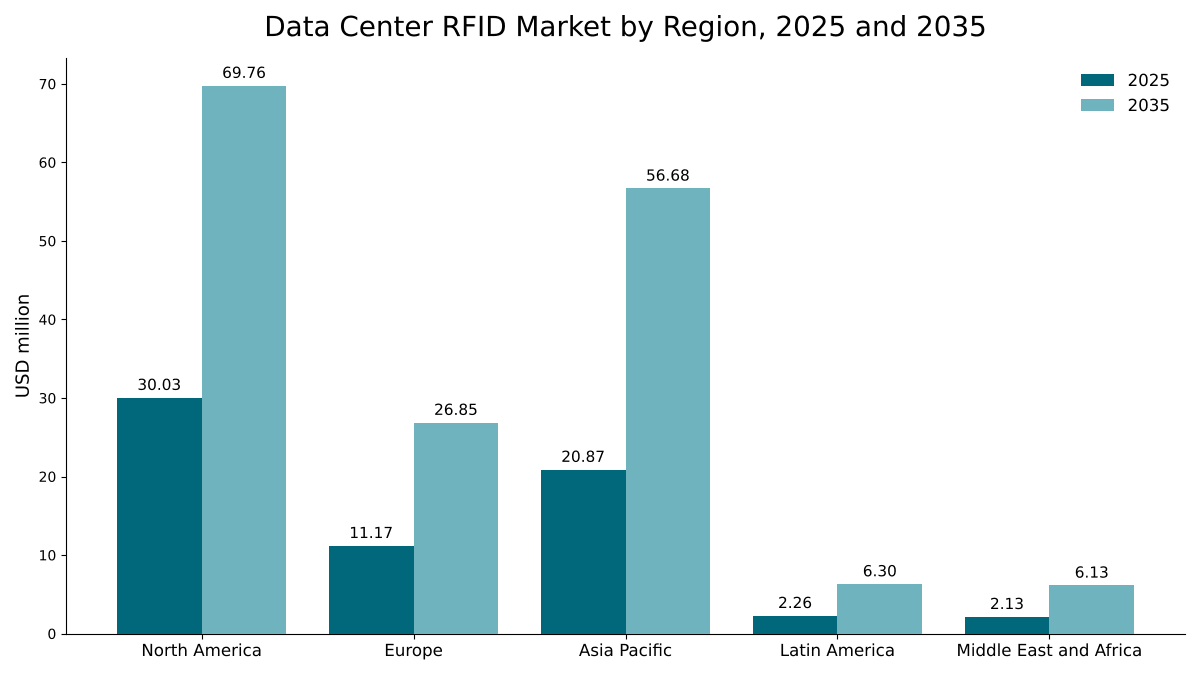
North America leads the Data Center RFID Market with 45.2% of 2025 value, and the Middle East and Africa is the fastest-growing region at 11.15% a year, because DC Market Insights expects new hyperscale campuses there to specify RFID tracking and rack locks at construction rather than as a retrofit.
North America Leads with 45.2% Share
North American data centers spent USD 30.03 million on RFID in 2025, and DC Market Insights forecasts USD 69.76 million by 2035, a CAGR of 8.79%. The United States accounted for 45% of global data center electricity use in 2024 according to the IEA.
Asia Pacific Holds 31.4% Share
Asia Pacific is worth USD 20.87 million in 2025 and USD 56.68 million by 2035, growing 10.51% a year. China took 25% of global data center electricity in 2024 according to the IEA, and Digitalor, a supplier of rack-unit RFID, lists Tencent, Alibaba, China Mobile and Bank of China among its customers.
Europe Holds 16.8% Share
Europe is worth USD 11.17 million in 2025 and USD 26.85 million by 2035, a CAGR of 9.17%. European readers must meet ETSI EN 302 208 power limits, and operators such as Orange have shown inventory accuracy of 99 percent with passive UHF tags.
Latin America Holds 3.4% Share
Latin America is worth USD 2.26 million in 2025 and USD 6.30 million by 2035, a CAGR of 10.80%, with Brazil the largest country market.
Middle East and Africa Holds 3.2% Share
The Middle East and Africa is worth USD 2.13 million in 2025 and USD 6.13 million by 2035, the fastest regional growth at 11.15% a year, from the smallest base.
Country Analysis: Which Countries Spend the Most on Data Center RFID?
The United States is the largest country market for data center RFID at USD 27.58 million in 2025, 41.5% of global value, followed by China at USD 14.69 million (22.1%) and Germany at USD 2.72 million (4.1%). The 12 largest countries account for 88.6% of 2025 spending.
| Rank | Country | Region | 2025 (USD million) | Share 2025 | 2035 (USD million) | CAGR 2025-2035 |
|---|---|---|---|---|---|---|
| 1 | United States | North America | 27.58 | 41.5% | 63.47 | 8.69% |
| 2 | China | Asia Pacific | 14.69 | 22.1% | 39.11 | 10.29% |
| 3 | Germany | Europe | 2.72 | 4.1% | 6.46 | 9.04% |
| 4 | United Kingdom | Europe | 2.59 | 3.9% | 6.21 | 9.14% |
| 5 | Japan | Asia Pacific | 2.39 | 3.6% | 5.63 | 8.95% |
| 6 | Canada | North America | 2.19 | 3.3% | 5.72 | 10.08% |
| 7 | France | Europe | 1.46 | 2.2% | 3.48 | 9.07% |
| 8 | Netherlands | Europe | 1.26 | 1.9% | 2.98 | 8.99% |
| 9 | Brazil | Latin America | 1.13 | 1.7% | 3.15 | 10.80% |
| 10 | India | Asia Pacific | 1.06 | 1.6% | 4.31 | 15.06% |
| 11 | Australia | Asia Pacific | 1.00 | 1.5% | 2.82 | 10.92% |
| 12 | Singapore | Asia Pacific | 0.80 | 1.2% | 2.15 | 10.39% |
India is the fastest-growing country market at 15.06% a year, ahead of Australia at 10.92%, from a small base, as DC Market Insights expects new colocation and cloud capacity to specify tracking at construction. The country figures are a DC Market Insights allocation of the regional totals, weighted by each country’s estimated share of installed servers and racks.
Forecast Scenarios: How Could the 2035 Forecast Change?
The Data Center RFID Market reaches USD 165.72 million by 2035 in the base case, with a range of USD 132.00 million to USD 220.49 million across the low and high scenarios.
| Scenario | Assumption from 2026 | 2035 (USD million) | CAGR 2025-2035 |
|---|---|---|---|
| Low | Tagged share of assets rises 0.08 points a year to 5.8%; RFID lock share rises to 3.6% of racks | 132.00 | 7.10% |
| Base | Tagged share rises 0.22 points a year to 7.2%; RFID lock share reaches 4.6% of racks | 165.72 | 9.57% |
| High | Tagged share rises 0.45 points a year to 9.5%; RFID lock share reaches 6.2% of racks | 220.49 | 12.74% |
Adoption is the swing factor. The low case is a market where hyperscale fleets keep relying on serial-number discovery and RFID stays a colocation and enterprise tool. The high case assumes battery-free sensor tags and DCIM subscriptions make tagging a default line in new-build specifications.
Competitive Insights: Who Leads the Data Center RFID Market?
- RF Code
- Schneider Electric
- Hyperview
- Digitalor
- Asset Vue
- HID Global
- Xerafy
- Brady
- Turck Vilant
- Powercast
- EPC Solutions Taiwan
- Vertiv
- Impinj
- Zebra Technologies
RF Code reports one of the largest published installed bases in data center asset tracking, with more than three million tagged assets across the company. In value, DC Market Insights estimates that RF Code, Digitalor and HID Global together hold about 40% of the USD 40.48 million asset-tracking core, based on their installed bases and published prices. Impinj, whose platform datacenters use for asset tracking according to its annual report filed with the US Securities and Exchange Commission, reported revenue of USD 361.1 million for 2025 across all industries, so data centers are a small vertical for chip and reader makers. Schneider Electric and Hyperview bring RFID into DCIM software, Asset Vue, Brady and Turck Vilant sell tagging and tracking projects, Xerafy and HID Global supply on-metal tags, and HID Global and Vertiv supply rack access control with RFID credential readers.
Recent Developments
- In April 2024, RF Code and Schneider Electric partnered to integrate RF Code’s active RFID hardware with the EcoStruxure IT DCIM platform for data center asset lifecycle management (Source: RF Code press release).
- In December 2024, EPC Solutions Taiwan introduced a passive UHF RFID system for data centers with rack-mounted cable antennas, Axzon temperature and humidity tags and a Zebra FX-7500 exit portal, with commercial release planned for July 2025 (Source: RFID Journal news report).
- In December 2024, Brady EMEA published a case study in which a large ICT infrastructure provider adopted rewriteable on-metal RFID NFC labels to identify servers (Source: Think WIoT case study).
- In May 2025, Powercast customized its battery-free RFID sensor condition monitoring system for data centers for Asset Vue, powered by standard RAIN RFID readers (Source: Powercast press release).
- In May 2025, Powercast’s battery-free RFID sensor system won Best New Product 2025 at RFID Journal LIVE! (Source: Powercast company announcement).
We follow these launches, partnerships and deployments as they happen in our data center industry updates.
Methodology: How We Built the Data Center RFID Market Model
No supplier reports data center RFID revenue, so DC Market Insights built the Data Center RFID Market as a bottom-up model with bound checks. The asset-tracking core multiplies a global server base (US servers from LBNL, 21 million in 2020 and almost 37 million in 2028, divided by an assumed 40% US share), 1.3 trackable IT assets per server and an adoption rate of 5.0% in 2025. The adoption rate is a DC Market Insights assumption, anchored on RF Code’s more than three million tagged assets, and it moves from 4.65% in 2020 to 7.2% in 2035. Tags are bought at 30% of the tagged base a year at a blended USD 6.00 per tag; readers at USD 20,000 per 5,000-asset site over 5 years; software at USD 50 per rack per year at 12 tagged assets per rack; and services at 60% of hardware. Rack locks multiply 7.46 million racks (415 TWh of 2024 data center electricity from the IEA, a power usage effectiveness of 1.54 and 7.5 kW average modal rack density from Uptime Institute, at 55% utilization) by a 3.0% lock share, a 15% annual replacement and new-build rate, and USD 774.04 for a front and rear lock pair at USD 387.02 each. With the low and high ends of every input range, the 2025 value spans USD 17.60 million to USD 331.70 million; the report publishes the base case. Two bounds check the result. First, the base case equals about 0.015% of the USD 444.1 billion of 2025 worldwide server revenue in public server-tracker data. Second, about 1.46 million new data center tags a year are about 0.003% of the 42.7 billion RAIN tag chips shipped worldwide in 2025, and the whole market is about 18% of Impinj’s USD 361.1 million revenue for 2025, which covers all of its industries. Every split sums to the market total. The analyst named on this page built the model, and the reviewer checked the arithmetic, the sources and the dates before publication.
Table of contents
- 01Introduction
- 1.1Market Definition and Scope
- 1.2Research Objectives
- 1.3Currency, Units and Years Considered
- 02Research Methodology
- 2.1Tagged-Asset Model and Rack Lock Model
- 2.2Data Sources and Fact Verification
- 2.3Bound Checks and Assumptions
- 03Executive Summary
- 3.1Market Snapshot, 2025 and 2035
- 3.2Key Findings
- 04Market Dynamics
- 4.1Market Drivers
- 4.2Market Trends
- 4.3Market Challenges
- 4.4Market Opportunities
- 05Pricing Analysis
- 5.1Tag, Reader and Lock List Prices
- 5.2Blended Tag Price and Spend per Server
- 06Standards and Regulation
- 6.1ISO/IEC 18000-63 and GS1 UHF Gen2
- 6.2ETSI EN 302 208
- 6.3FCC Part 15.247
- 6.4Rack Lock Credential Frequencies
- 07Supply Chain Analysis
- 7.1Chip and Inlay Suppliers
- 7.2Tag, Reader and Lock Makers
- 7.3Software Platforms and Integrators
- 08Market Size and Forecast
- 8.1Market Size, 2020-2035
- 8.2Tagged Assets and Installed Servers, 2020-2035
- 09Market by Component
- 9.1Tags
- 9.2Readers and Antennas
- 9.3RFID Rack Locks
- 9.4Software
- 9.5Services
- 10Market by Technology
- 10.1Passive UHF (RAIN)
- 10.2Active RFID
- 10.3HF/NFC and LF
- 11Market by Application
- 11.1Asset Tracking and Inventory
- 11.2Environmental Sensing
- 11.3Rack Access Control
- 12Market by Data Center Type
- 12.1Hyperscale
- 12.2Colocation
- 12.3Enterprise
- 13DC Exclusive: Component × Buyer Matrix
- 13.1Matrix, 2025
- 13.2Model Inputs
- 14Market by Region
- 14.1North America
- 14.2Europe
- 14.3Asia Pacific
- 14.4Latin America
- 14.5Middle East and Africa
- 15North America Market
- 15.1United States
- 15.2Canada
- 16Europe Market
- 16.1Germany
- 16.2United Kingdom
- 16.3France
- 16.4Netherlands
- 17Asia Pacific Market
- 17.1China
- 17.2Japan
- 17.3India
- 17.4Australia
- 17.5Singapore
- 18Latin America Market
- 18.1Brazil
- 19Middle East and Africa Market
- 19.1Middle East and Africa Overview
- 20Regional Cross-Sections
- 20.1Regional Shares and Growth Rates, 2025 and 2035
- 21Forecast Scenarios
- 21.1Low, Base and High Scenarios, 2035
- 22Competitive Landscape
- 22.1Market Concentration
- 22.2Recent Developments
- 23Company Profiles
- 23.1RF Code
- 23.2Schneider Electric
- 23.3Hyperview
- 23.4Digitalor
- 23.5Asset Vue
- 23.6HID Global
- 23.7Xerafy
- 23.8Brady
- 23.9Turck Vilant
- 23.10Powercast
- 23.11EPC Solutions Taiwan
- 23.12Vertiv
- 23.13Impinj
- 23.14Zebra Technologies
- 24Analyst Recommendations
- 24.1For Data Center Operators
- 24.2For RFID Suppliers
- 24.3For Investors
- Fig. 1Data Center RFID Market Size, 2020–2035
- Fig. 2Data Center RFID Market by Region, 2025 and 2035
- Fig. 3Tagged Data Center Assets, 2020–2035
- Fig. 4Data Center RFID Market by Component, 2025 and 2035
- Fig. 5Data Center RFID Market by Technology, 2025 and 2035
- Fig. 6Forecast Scenarios, 2035
- Table 1Report Attributes
- Table 2Tag, Reader and Lock List Prices
- Table 3Market by Component, 2025 and 2035
- Table 4Market by Technology, 2025 and 2035
- Table 5Market by Application, 2025 and 2035
- Table 6Market by Data Center Type, 2025 and 2035
- Table 7Component × Buyer Matrix, 2025
- Table 8Market by Region, 2025 and 2035
- Table 9Top 12 Countries, 2025 and 2035
- Table 10Forecast Scenarios, 2035
- Table 11Model Inputs and Sources
About this report
Written by Amit Jain and reviewed by Deepti Agrawal, Senior Editor, Research. Figures are built top-down and bottom-up and reconciled before publication, with 2025 as the base year.
Read our methodologyHow we built this
- Historical period2020-2024
- Base year2025
- Forecast period2026-2035
- Sizing approachTop-down + bottom-up
Need more than the report?
Advisory on this market
Due diligence, site selection and market entry work, by the analysts who wrote this report.
See consulting servicesFrequently asked questions
USD 66.46 million in 2025, rising to USD 165.72 million by 2035. DC Market Insights estimates the market at USD 45.44 million in 2020.
9.57% a year from 2025 to 2035, up from 7.90% a year between 2020 and 2025, as the tagged share of data center IT assets rises from 5.0% to 7.2%.
RFID rack locks, with USD 25.98 million or 39.1% of 2025 value. Software is the fastest-growing component at 11.09% a year, reaching USD 57.97 million by 2035.
About 4.86 million IT assets in 2025, or 5.0% of trackable assets, rising to 12.59 million by 2035 (DC Market Insights estimate). RF Code alone reports more than three million tagged assets.
USD 0.52 to USD 3.70 at list price for passive on-metal tags. DC Market Insights uses a blended USD 6.00 per tag in 2025 once active and sensor tags are included.
North America, with USD 30.03 million or 45.2% of 2025 value. The Middle East and Africa grows fastest at 11.15% a year.
Environmental sensing, at 12.16% a year from USD 6.88 million in 2025 to USD 21.68 million in 2035, as battery-free RFID sensor tags monitor rack temperature and humidity.
RF Code reports more than three million tagged assets, and RF Code, Digitalor and HID Global together hold about 40% of the asset-tracking core (DC Market Insights estimate). Schneider Electric, Hyperview, Asset Vue, Brady, Xerafy, Vertiv, Impinj and Zebra Technologies also compete.
Licences, delivery and payment
Which licence should I choose?
Single User is a view-only PDF for one person. Multi User adds a printable PDF and the Excel data for unlimited users at one location. Enterprise covers your whole company and includes 100 free analyst hours.
How and when will I receive the report?
By email, within 24–48 business hours of payment, in the formats of your licence.
How can I pay?
Securely through PayPal: with a PayPal account, a debit or credit card, or PayPal Pay Later where available. Prices are in US dollars.
Can I see a sample first?
Yes. Request a free sample and we will email it to you.
Can the report be tailored to my needs?
Yes. We can add countries, segments or data cuts. Talk to an analyst about the scope you need.
Can I get an invoice or pay against a purchase order?
Write to sales@dcmarketinsights.com and our team will help.