Executive summary:
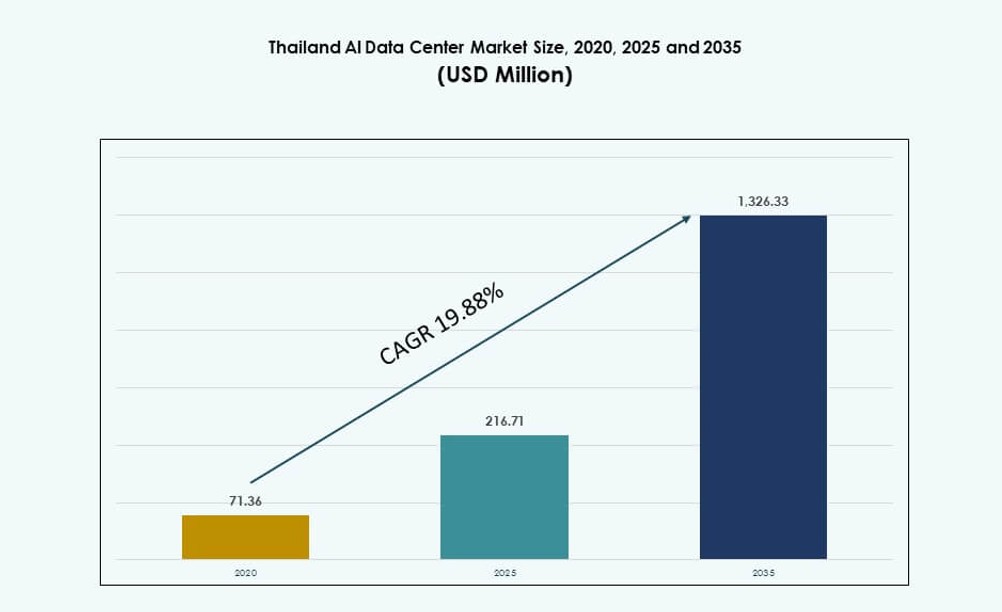
The Thailand AI Data Center Market size was valued at USD 71.36 million in 2020 to USD 216.71 million in 2025 and is anticipated to reach USD 1,326.33 million by 2035, at a CAGR of 19.77% during the forecast period.
| REPORT ATTRIBUTE |
DETAILS |
| Historical Period |
2020-2023 |
| Base Year |
2024 |
| Forecast Period |
2025-2035 |
| Thailand AI Data Center Market Size 2025 |
USD 216.71 Million |
| Thailand AI Data Center Market, CAGR |
19.77% |
| Thailand AI Data Center Market Size 2035 |
USD 1,326.33 Million |
Thailand’s AI data center market is driven by digital transformation across manufacturing, telecom, and BFSI sectors. Government-backed programs, AI partnerships, and hyperscale investments are expanding national compute capacity. Cloud migration, edge deployment, and generative AI tools fuel high-density infrastructure demand. Businesses increasingly seek localized AI services for compliance and latency-sensitive workloads. Partnerships with global cloud providers support long-term scalability. Investors view this market as a strategic ASEAN AI hub with accelerating enterprise and regulatory readiness. Technology adoption remains central to new data center design and deployment strategies.
Bangkok remains the core region, supported by digital infrastructure, dense enterprise zones, and submarine cable access. The Eastern Economic Corridor is emerging as a key location due to industrial AI demand and land availability. Provinces like Chonburi and Rayong attract edge and hyperscale development projects. Regional focus continues to shift toward urban-rural distribution, supporting low-latency AI workloads. Government incentives and zoning flexibility in secondary regions support future infrastructure expansion.
Market Dynamics:
Market Drivers
Government-Backed Digital Economy Plans and Public Sector AI Integration Boost Demand for Scalable Infrastructure
Thailand’s digital economy policy framework actively supports national AI growth, increasing data center demand. Government initiatives under Thailand 4.0 have led to digital transformation in healthcare, education, and smart cities. Agencies are deploying AI models that need robust compute and low-latency access. This drives investment in GPU-enabled infrastructure and AI-ready colocation services. The Thailand AI Data Center Market benefits from this policy-driven momentum. Long-term frameworks are creating predictable infrastructure demand. AI workloads tied to national programs prioritize local compute. Public cloud and hybrid models gain traction for policy-compliant AI delivery. These efforts help shape a consistent baseline for future capacity growth.
Enterprise Cloud Migration and Data Localization Push Edge AI Processing and Multi-Tenant Compute Models
Local enterprises are transitioning from legacy IT to hybrid and AI-enabled cloud environments. Data localization rules require some AI models to run within Thailand, driving local capacity needs. Businesses demand high-density compute with integrated AI model training support. Major banks, telecoms, and manufacturers lead adoption of in-country GPU infrastructure. The Thailand AI Data Center Market reflects this rising need for secure, compliant, and scalable AI hosting. Local service providers are adapting by deploying containerized GPU clusters. Edge deployments are increasing across retail and logistics for real-time insights. Growth in managed AI infrastructure services expands options for SMEs. Domestic AI stack hosting is becoming a competitive requirement.
- For instance, Siam Commercial Bank has adopted AWS cloud services to accelerate its digital transformation, improving time-to-market for new applications and modernizing its IT infrastructure. The bank’s collaboration with AWS supports its strategy to enhance operational agility and customer experience.
Private Sector Innovation in GPU Infrastructure and HPC-Enabled Services Expands High-Density Buildouts
Telecoms and digital infrastructure providers are launching AI-ready offerings including rack-level GPU compute and liquid cooling. High-performance computing is extending into enterprise data centers. AI software stacks are pre-integrated into colocation platforms for faster deployment. The Thailand AI Data Center Market sees a surge in innovation-focused capacity planning. Private firms leverage NVIDIA-certified infrastructure for AI model training. Telecom operators deploy 5G-linked GPU clusters to support edge AI use cases. This shift accelerates AI service availability across verticals. Businesses prioritize latency, performance, and security, making local AI data centers an enabler of differentiation. Liquid cooling and modular GPU racks support thermal and density needs.
- For instance, in May 2025, True IDC launched Thailand’s first AI hyperscale data center under Charoen Pokphand Group. The facility is designed to support large‑scale AI training and inference workloads with high‑density, GPU‑ready infrastructure, strengthening Thailand’s position as a regional AI and digital hub.
Strategic Location in Southeast Asia Enhances Thailand’s Role in Regional AI Hosting and Cross-Border Compute
Thailand offers strategic connectivity between mainland Southeast Asia and key markets like Singapore and Vietnam. The country’s geographic position supports regional AI deployment for multinationals. Submarine cables, regional IXPs, and low-latency links help anchor high-availability AI services. The Thailand AI Data Center Market gains from regional spillover as AI adoption grows in nearby nations. International firms expand into Thailand to localize AI training and inference. Thailand’s neutral policy stance helps attract hyperscale partnerships. Its location reduces response times for distributed inference applications. Growing demand for cross-border AI hosting services reinforces the country’s role in regional compute distribution.
Market Trends
Growth of AI-As-A-Service (AIaaS) Offerings from Colocation Providers to Support SME Model Deployment
AIaaS models are emerging across colocation platforms to serve enterprises lacking in-house capabilities. Providers offer GPU nodes with pre-configured AI tools and model orchestration layers. SMEs use these platforms to experiment, fine-tune, and deploy AI without heavy capital spend. In the Thailand AI Data Center Market, this model enables broader AI accessibility. Multi-tenant GPU environments reduce entry barriers for smaller firms. AIaaS lowers operational complexity for non-tech businesses. Providers are building user-friendly APIs and interfaces. It drives higher utilization of AI-capable racks. Increasing AIaaS use among traditional sectors like logistics and retail is expanding platform diversity.
Emergence of Energy-Efficient Designs and Thermal Innovation to Handle AI Compute Density
New thermal solutions are gaining traction as high-density GPU servers strain traditional HVAC systems. Thailand’s tropical climate makes liquid cooling increasingly necessary. Data centers are adopting immersion cooling and rear-door heat exchangers. The Thailand AI Data Center Market incorporates thermal innovations into AI facility blueprints. Energy-efficient power distribution and advanced airflow systems improve PUE. These upgrades reduce long-term OPEX and environmental risks. AI-focused builds prioritize sustainability to align with corporate ESG goals. Power-efficient GPUs and carbon-reducing operations become selection criteria. This thermal shift influences how future AI workloads are provisioned in the country.
Deployment of Edge AI Clusters Across Smart Infrastructure and Industrial IoT Projects
Smart factories, smart logistics, and infrastructure projects are integrating AI into edge nodes. Compact, high-efficiency micro data centers with AI acceleration support real-time data processing. These deployments lower latency and bandwidth load for industrial AI. In the Thailand AI Data Center Market, smart infrastructure fuels new edge AI workloads. The Eastern Economic Corridor and industrial zones are key deployment areas. Edge AI enhances defect detection, predictive maintenance, and logistics flow optimization. It supports real-time operations where cloud latency is unviable. Demand is growing for ruggedized, modular AI nodes tailored to specific industrial environments.
Increased Demand for AI Model Fine-Tuning and Inference Hosting for Language and Vision Applications
Thailand’s language diversity drives need for localized natural language processing models. Developers are fine-tuning multilingual LLMs for Thai and regional dialects. Vision models are also being trained for manufacturing and healthcare. These models require local inference infrastructure to reduce latency. The Thailand AI Data Center Market sees rising interest in GPU-optimized platforms for model hosting. Developers need scalable environments for testing and refining AI pipelines. AI infrastructure must support varied workloads, including transformers and CNNs. Language model latency affects user experience in fintech and customer service tools. Inference compute growth fuels a broader ecosystem of local model providers.
Market Challenges
Power Supply Constraints, Cooling Infrastructure Gaps, and Regulatory Delays Limit AI Workload Readiness
Thailand’s existing power and cooling setups often lag behind the needs of AI infrastructure. Many data centers rely on aging grid supply without guaranteed redundancy for high-density clusters. Cooling inefficiencies make large-scale GPU deployments difficult to sustain year-round. The Thailand AI Data Center Market faces hurdles in scaling AI-ready environments fast enough. Delays in utility permits and energy supply allocation slow build timelines. Outdated facility codes hinder adoption of liquid cooling and higher power densities. Heat dissipation is difficult in tropical zones without advanced thermal systems. Some AI projects stall due to hardware import restrictions and tax ambiguity. Long-term planning is challenged by zoning restrictions near urban cores.
Talent Shortage in AI Operations, Facility Design, and Specialized Maintenance Slows Industry Maturity
Thailand’s AI infrastructure growth is outpacing the availability of specialized workforce. Engineers skilled in liquid-cooled systems, GPU cluster management, and AI orchestration remain limited. The Thailand AI Data Center Market must address a growing gap in AI data center operations talent. Facility technicians often lack exposure to high-density systems. Import reliance for software-defined power and cooling tools reduces local skill development. AI-focused roles face competition from higher-paying global tech hubs. Universities are expanding training programs, but industry demand exceeds graduate output. Retention of technical talent remains difficult due to limited vertical mobility. This talent bottleneck constrains long-term scalability.
Market Opportunities
AI Model Training Growth in Key Industries Unlocks Infrastructure Monetization Across Vertical Segments
AI model training needs in banking, retail, and automotive are driving demand for local compute. Thailand’s business sectors are rapidly digitizing, generating high volumes of training data. The Thailand AI Data Center Market has room to capture this shift through modular, scalable GPU services. Colocation firms can target industry-specific AI needs. Vertical AI platforms offer long-term monetization paths. Training AI models locally supports data compliance and latency goals.
Foreign Investment in GPU Cloud Platforms and Hyperscale Projects Expands Thailand’s Global Role
International cloud and GPU service providers are investing in Thailand to meet regional demand. Infrastructure partnerships accelerate hyperscale builds and cloud edge extensions. The Thailand AI Data Center Market benefits from these capital inflows and joint ventures. Expansion into secondary provinces helps decongest urban sites. Foreign firms gain market access, while Thailand gains next-gen capacity. This synergy drives long-term infrastructure resilience.
Market Segmentation
By Type
The Thailand AI Data Center Market is dominated by the colocation & enterprise segment, accounting for over 60% share in 2025. Colocation providers are deploying AI-ready racks to support diverse customer needs, especially in financial and telecom sectors. Hyperscale operators are gaining traction with investments from international cloud giants. Edge/micro data centers are emerging in logistics and manufacturing corridors, offering low-latency GPU infrastructure close to endpoints. Growing hybrid IT setups continue to favor colocation strategies.
By Component
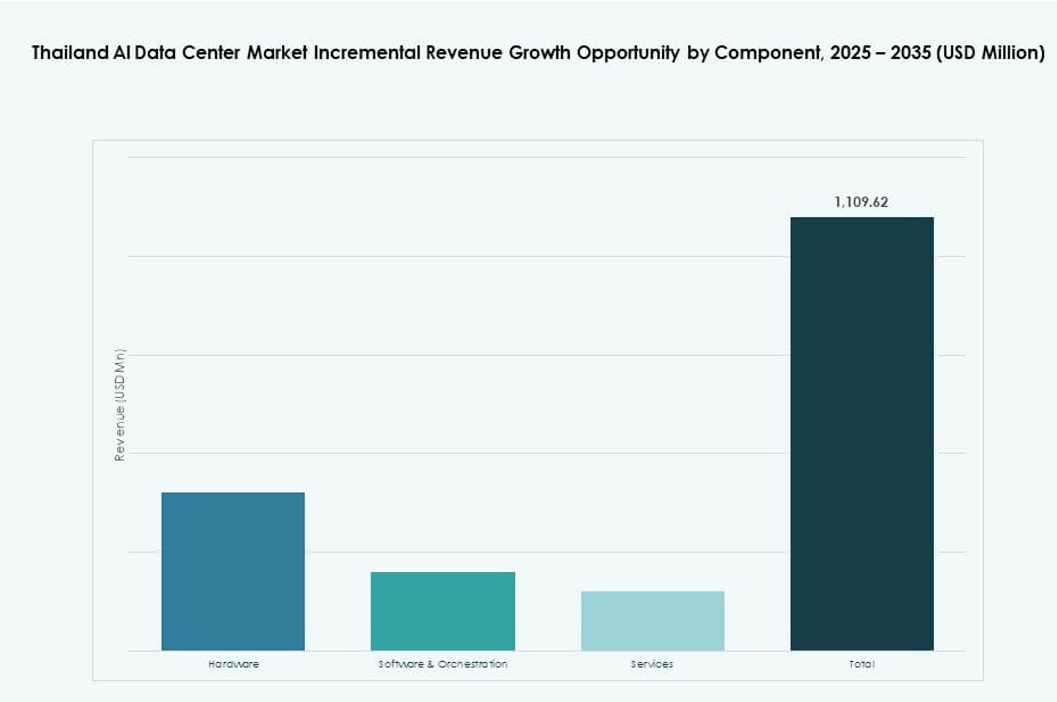
Hardware holds the largest share in the Thailand AI Data Center Market due to rising deployment of GPU servers, switches, and liquid cooling units. Investments are driven by the need for AI model training and inference infrastructure. Software and orchestration platforms, including Kubernetes and container management tools, are growing due to AI workload automation. Services segment is expanding fast, with demand for managed AI infrastructure and consulting increasing among non-tech businesses across Thailand.
By Deployment
Cloud deployment leads the Thailand AI Data Center Market with strong demand from digital-first startups and AI service platforms. It supports scalability and flexible AI model deployment. Hybrid deployment is growing among traditional enterprises balancing cloud agility with regulatory compliance. On-premise remains relevant in BFSI and public sectors with strict data control requirements. Hybrid models are emerging as the default strategy to balance performance, cost, and governance for AI workloads.
By Application
Machine Learning (ML) dominates application usage in the Thailand AI Data Center Market, powering use cases across retail, telecom, and healthcare. Generative AI (GenAI) is gaining traction, especially in marketing automation and content creation. Computer Vision (CV) sees adoption in industrial zones for quality control and surveillance. Natural Language Processing (NLP) supports chatbots, voice assistants, and localized interfaces. Other applications like predictive analytics and fraud detection drive demand across sectors.
By Vertical
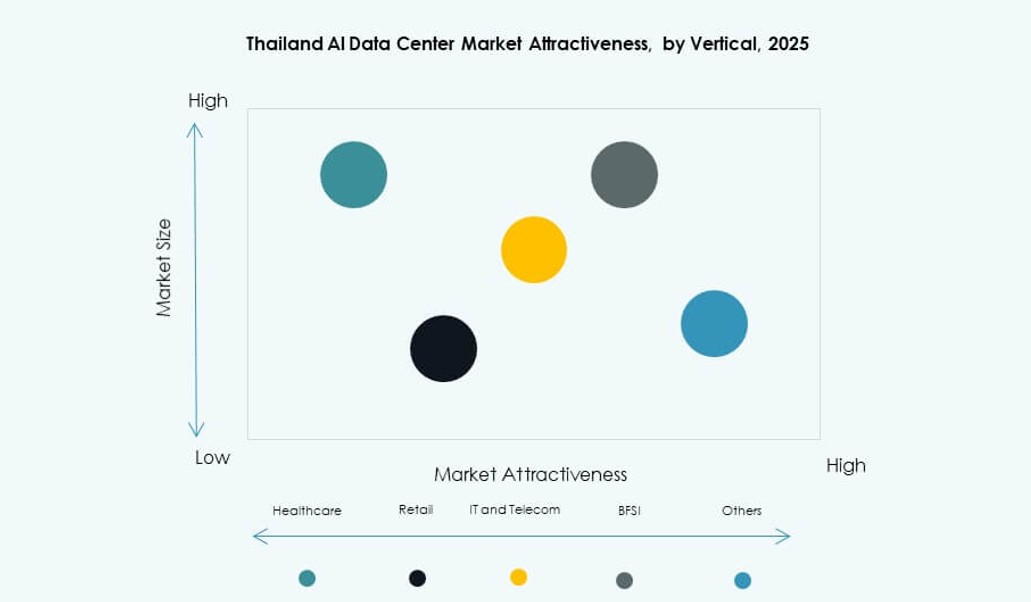
IT and Telecom is the leading vertical in the Thailand AI Data Center Market, leveraging AI for network automation, predictive analytics, and customer insights. BFSI is rapidly expanding AI usage in fraud detection and personalized finance tools. Healthcare is an emerging vertical, applying AI in diagnostics and imaging. Retail adopts AI for customer profiling and inventory optimization. Manufacturing uses AI in automation and defect detection. Media & entertainment, and automotive sectors contribute to demand for AI inference infrastructure.
Regional Insights
Bangkok Metropolitan Region Holds Over 55% Share Due to Urban Demand and Infrastructure Density
Bangkok dominates the Thailand AI Data Center Market due to its role as the digital and business hub. It hosts most of the country’s major colocation sites and enterprise IT infrastructure. High population density, financial services concentration, and smart city projects drive demand for AI infrastructure. Submarine cable connectivity and IXPs enhance Bangkok’s suitability for AI model training and inference workloads. It continues to attract hyperscale and edge deployments alike. Energy availability and skilled workforce remain stronger than secondary provinces.
- For instance, in January 2025, Amazon Web Services launched the AWS Asia Pacific (Thailand) Region with three Availability Zones in Bangkok. The new region strengthens local cloud infrastructure and supports low‑latency deployment of cloud, AI, and machine learning workloads for enterprises operating in Thailand.
Eastern Economic Corridor (EEC) Accounts for 25% Share, Driven by Industrial AI and Edge AI Growth
The EEC, including provinces like Chonburi and Rayong, supports edge AI expansion tied to manufacturing and logistics. Industrial AI demand from smart factories and port automation drives data center deployment. The region benefits from government incentives and zoning flexibility. AI data centers here serve as edge hubs for real-time inference. Proximity to industrial zones allows GPU infrastructure to meet low-latency needs. The Thailand AI Data Center Market leverages this region for vertical-specific AI hosting.
- For instance, Digital Edge and B.Grimm announced a 100 MW AI-ready data center project in the EEC in September 2025, designed to support regional AI clusters with projected operational readiness by Q4 2026.
Northern and Northeastern Thailand Make Up 20% Combined Share with Emerging AI-Focused Builds
These regions are gaining attention for distributed AI workloads, academic AI research, and local inference needs. Chiang Mai and Khon Kaen see early-stage investments in modular data centers. Healthcare and agricultural AI use cases are driving interest in region-specific compute nodes. Growth remains slower than the core regions but offers cost and land advantages. The Thailand AI Data Center Market finds opportunities in decentralizing AI services beyond Bangkok. Regional government support for tech clusters aids long-term growth.
Competitive Insights:
- True IDC
- INET
- SUPERNAP
- Equinix
- Digital Realty Trust
- CoreWeave
- Microsoft (Azure)
- Amazon Web Services (AWS)
- Google Cloud / Alphabet
- NVIDIA
The Thailand AI Data Center Market features a blend of local colocation providers, global hyperscalers, and infrastructure specialists. True IDC, INET, and SUPERNAP lead in domestic capacity and compliance-ready hosting. Global players like Equinix and Digital Realty expand premium colocation and interconnect services. Cloud majors such as AWS, Microsoft, and Google scale AI workloads through regional zones and hybrid deployments. NVIDIA supports the ecosystem through advanced GPU infrastructure across enterprise and hyperscale environments. It remains competitive with strong demand for AI-ready capacity across verticals like telecom, BFSI, and manufacturing. Vendor partnerships, energy-efficient designs, and edge-ready builds drive differentiation in a market shaped by digital policy, industrial AI, and regional data localization.
Recent Developments:
- In October 2025, Microsoft partnered with Charoen Pokphand Group and True IDC to develop a Thailand cloud region, where True IDC serves as a core data center partner for the initiative. This strategic collaboration aims to strengthen cloud and AI infrastructure, support low‑latency services, and build capacity for enterprise digital transformation.
- In May 2025, True IDC, under Charoen Pokphand Group, launched Thailand’s first AI hyperscale data center, ushering in a new era of large‑scale AI compute infrastructure. The facility is designed to handle extensive AI workloads and reinforce Thailand’s role as a regional digital hub.
- In February 2025, Alibaba Cloud established its second data center in Thailand, expanding local AI and cloud infrastructure and enhancing services for generative AI and industry‑specific solutions. This launch improves operational performance for businesses in technology, media, fintech, and retail sectors. It strengthens Alibaba Cloud’s footprint in Southeast Asia and supports Thailand’s digital innovation agenda.
- In January 2025, Amazon Web Services (AWS) officially launched the AWS Asia Pacific (Thailand) Region, offering three availability zones to support cloud and AI workloads within the country. This launch boosts performance, reduces latency, and aligns with data residency policies for local enterprises.